When you hear the term collect freight in shipping, it's actually pretty simple: the receiver of the goods is the one who pays the transportation bill. Think of it like a "cash on delivery" service, but for the freight charges themselves. The consignee (the one receiving the shipment) settles up directly with the carrier, not the shipper.
So, What Exactly Is Collect Freight?

At its heart, "collect freight" is all about defining who holds the purse strings. Instead of the sender prepaying for everything, the financial responsibility flips to the person at the destination. This isn't just a handshake deal; it's a formal arrangement that gets documented right on the Bill of Lading (BOL), which is the legal contract for the shipment.
So why would anyone do this? It's all about leverage. A collect arrangement is most common when the receiver has more negotiating power with carriers than the sender does.
Imagine a huge retailer that gets products from hundreds of small suppliers. That retailer has likely negotiated some serious volume discounts with their favorite freight company. By marking their inbound shipments as "collect," they can use their own fantastic shipping rates, taking direct control of the cost and saving a ton of money.
It’s All About Who’s in Control
The real game-changer with collect freight is control. Since the receiver is footing the bill, they get to call the shots. This gives them a massive advantage over the entire process.
They can directly influence:
- Carrier Selection: The receiver can pick the carriers they trust for reliability, speed, or special handling that fits their warehouse's needs. No more getting stuck with a shipper's slow or careless choice.
- Cost Management: By using their own hard-won shipping rates, they dodge any potential markups that a shipper might have baked into a "prepaid" invoice.
- Scheduling and Tracking: The receiver manages the relationship with the carrier, which means more direct communication and better visibility into where their stuff is and when it will arrive.
In short, collect freight puts the buyer in the driver's seat. It turns shipping from a mysterious cost passed down by a vendor into a manageable expense that the buyer can actively control and optimize.
This is the polar opposite of prepaid freight, where the shipper handles all the logistics and just adds the cost to the buyer's invoice. While prepaid is simple, collect is strategic.
Freight Billing Options at a Glance
To make it even clearer, let's break down the main ways freight gets paid for. This little chart should help you see exactly who pays for what, and when.
| Billing Term | Who Pays the Carrier | When Payment is Made | Primary Benefit |
|---|---|---|---|
| Collect | Receiver (Consignee) | Upon delivery or on credit terms | Control & Cost Savings for the receiver |
| Prepaid | Shipper | Before or at the time of shipment | Simplicity & Convenience for the receiver |
| Third-Party | An uninvolved third party | Per agreed-upon credit terms | Centralized Billing for brokers or large corps |
Choosing the right option really boils down to one question: Who has the better carrier relationship and who wants to be in charge of the logistics? Understanding this fundamental difference is the first step to making a smarter, more cost-effective decision for your supply chain.
Collect Freight vs. Prepaid Freight: What E-commerce Sellers Need to Know
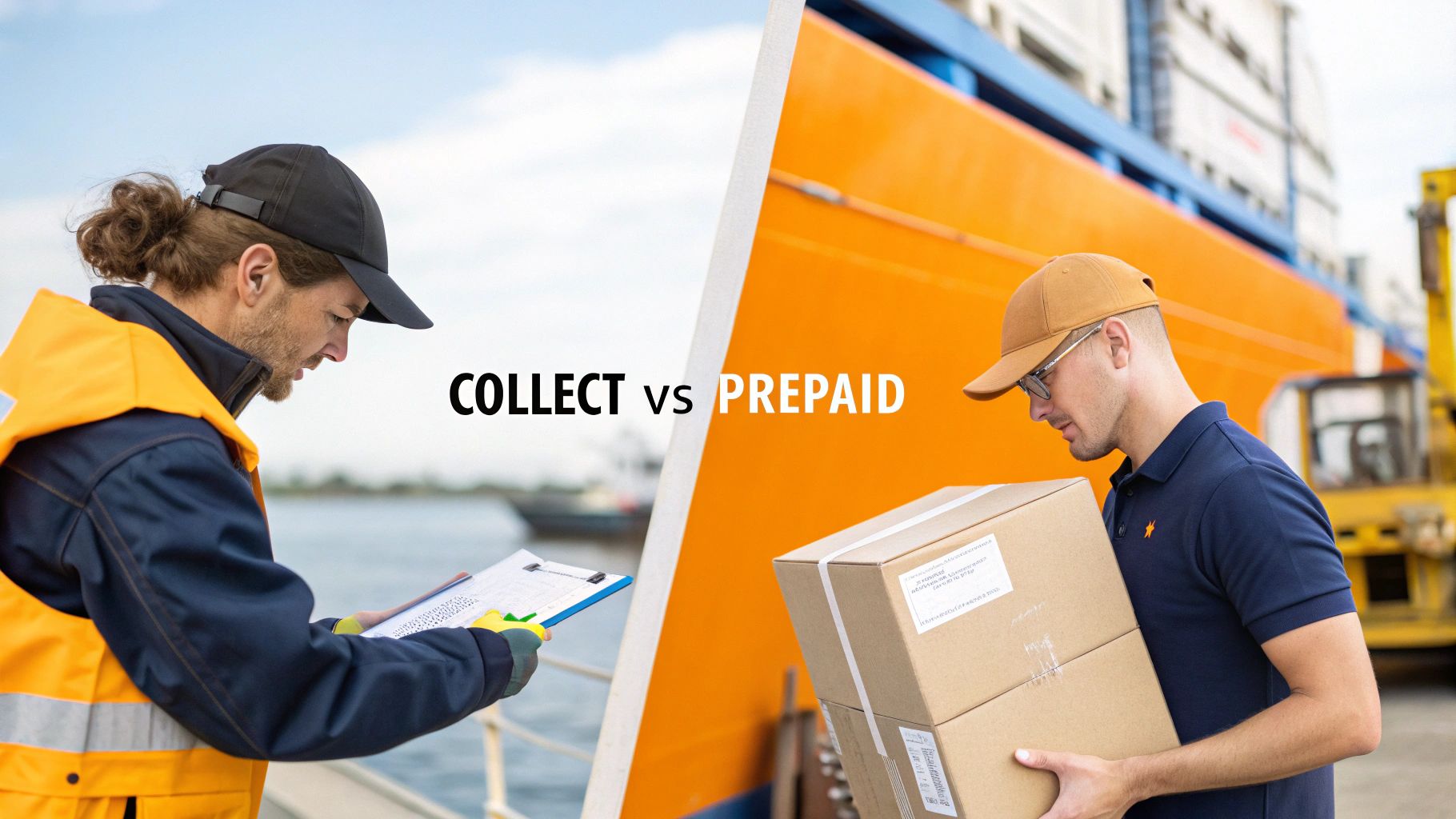
As an e-commerce seller, deciding between collect freight and prepaid freight is a bigger deal than you might think. It’s not just about who foots the bill—it’s a choice that directly impacts your costs, your workload, and even your relationship with suppliers.
Think of it like this: do you want to cook your own meal or order takeout?
With freight collect, you're the chef. You get to pick the ingredients (your preferred carrier), control the entire process (the routing and timing), and pay for everything directly (the freight charges). You have total control over the final result and, most importantly, the cost.
On the flip side, prepaid freight is like ordering from a restaurant. Your supplier (the restaurant) handles all the logistics and prep work, then sends you a single bill that includes everything. It’s definitely easier, but you lose control over the process and often pay a premium for that convenience.
Control Over Costs and Carriers
The single biggest reason sellers choose collect freight is direct cost control. When you manage your own inbound shipments, you can use your own negotiated rates with carriers. If you ship a decent volume, those rates are almost always better than what a smaller supplier can get their hands on.
This also means you get to pick carriers based on what actually matters to your business—like reliability, speed, or special handling. With prepaid, shippers often just pick the cheapest option available, which might not meet your standards for quality or timing. You can learn more about how picking the right shipping method, like LTL vs. SPD for FBA, impacts your bottom line in our detailed guide.
Key Takeaway: With collect freight, you actively manage shipping as a controllable expense. With prepaid, shipping costs get buried in your product cost, often hiding markups and leaving you no room to optimize.
Liability and Administrative Workload
Liability is a crucial piece of the puzzle. With freight collect, you (the consignee) typically take ownership of the goods as soon as they’re on the truck. This means you need a solid system for filing claims if anything gets damaged in transit.
Prepaid freight can seem simpler here because the shipper holds onto ownership and responsibility until the product lands at your door. While that sounds nice, this hands-off approach can cause major headaches and delays when you’re not the one talking directly to the carrier to solve problems.
From a workload perspective, collect freight is more hands-on. Your team will be responsible for:
- Booking pickups with your carriers.
- Tracking shipments and managing delivery windows.
- Auditing and paying freight invoices.
- Filing claims for any lost or damaged goods.
Prepaid freight pushes these tasks onto the shipper, boiling your administrative work down to just paying a single invoice from your supplier.
A Side-By-Side Comparison
To make the choice crystal clear, let's break down how these two methods stack up in the areas that matter most to e-commerce sellers.
| Feature | Freight Collect | Freight Prepaid |
|---|---|---|
| Payment Responsibility | You (the receiver) pay the carrier directly. | The shipper pays the carrier and invoices you. |
| Cost Control | High. You use your own negotiated rates. | Low. Costs are bundled and often marked up. |
| Carrier Choice | You choose the carrier that fits your needs. | The shipper chooses the carrier, usually the cheapest. |
| Administrative Work | Higher. You manage scheduling, tracking, & payment. | Lower. The shipper handles all logistics. |
| Best For | High-volume sellers with established carrier rates. | Sellers who prioritize convenience and simplicity. |
Who Is Liable in a Collect Freight Shipment?
Here’s where logistics can get tricky—and expensive. When you agree to a collect freight shipment, you absolutely have to be clear on who's on the hook for what, especially when something goes wrong.
In a collect freight deal, the legal responsibility for the freight charges flips to you (the consignee) the second the carrier picks up the goods. From that moment on, the carrier’s invoice is your problem to solve.
This is a critical point that trips a lot of people up. Even if your products show up damaged or the order isn’t all there, you are still legally obligated to pay the carrier for the ride. The transportation bill is completely separate from the condition of the goods inside the boxes.
Payment Liability vs. Damage Claims
It’s crucial to separate two very different issues: who pays for the shipping and who pays for damaged goods. They are handled through entirely different processes.
- Liability for Freight Charges: With collect terms, this is all you. As the consignee, you agreed to pay the carrier for their service, and they delivered.
- Liability for Damaged Goods: This is a whole other ballgame. It’s determined by your sales terms, usually called Free on Board (FOB) terms, not the freight payment terms.
Let’s break that down. Under FOB Origin terms, you (the buyer) technically own the goods the moment they leave the shipper's dock. If they get damaged in transit, it’s up to you to file a claim with the carrier to get your money back. The shipper is out of the picture.
On the flip side, with FOB Destination terms, the shipper owns the goods all the way to your door. If something gets damaged, they are the ones who have to file the claim. But—and this is a big but—you are still required to pay the collect freight bill to the carrier. Your fight over the broken product is with the shipper, not the trucking company.
The bottom line is this: your obligation to pay the carrier has nothing to do with the condition of your cargo. Refusing to pay a collect freight invoice because of product damage can get you sent to collections, wreck your credit, and burn bridges with that carrier for good.
How to Protect Your Business
The best way to protect your business is to be incredibly diligent at the receiving dock. Your most important weapon here is the Bill of Lading (BOL). Think of it as the legal contract between the shipper, the carrier, and you. For anyone using a 3PL warehouse, making sure the receiving team is trained on this is absolutely vital.
Before you or anyone on your team signs that BOL and accepts the delivery, you have to do these three things:
- Verify the Details: Count the boxes. Does the piece count on the pallet match what’s on the BOL?
- Inspect for Damage: Give everything a once-over. Look for crushed corners, gashes, tears, water stains—any visible sign of trouble.
- Note Any Discrepancies: If you see any damage or a shortage, you must write it down on the BOL before you sign. This little note is called a "notation," and it’s your only real proof when you go to file a claim.
Signing a "clean" BOL without any notes is like legally stating, "Everything arrived in perfect condition." Trying to file a damage claim after that is nearly impossible. This one simple step is your single best defense in any liability dispute.
When Does Collect Freight Actually Make Sense?
Understanding the textbook definition of collect freight is one thing. Knowing when to actually use it to give your business a real-world advantage is another entirely. This isn't just about who pays the bill; it's a strategic move you can pull to gain control, slash costs, and make your supply chain run a whole lot smoother.
Let's walk through three common scenarios where freight collect becomes a secret weapon for e-commerce brands.
The Savvy Importer Who Wants Better Rates
Imagine you're bringing in a big container of product from an overseas factory. Sure, your supplier can arrange shipping with their local carrier, but you’ve put in the work to build a relationship with a major ocean freight forwarder and have killer volume-based rates locked in. This is the perfect time to use collect freight.
You simply tell your supplier to ship it "freight collect" and have your carrier pick it up. You pay your forwarder directly, tapping into your negotiated rates instead of whatever markup the supplier would have tacked onto their invoice.
This is a game-changer in a volatile market. When ocean freight rates are all over the place, having your own carrier relationship means you can jump on lower spot rates when they pop up. Just look at the recent market—global ocean freight rates dropped by 21% in a single year, handing huge savings to importers who controlled their own shipping. You can dig into more of these quarterly freight and logistics trends on UPS.com.
The Growing Brand Juggling Inbound Logistics
Picture an e-commerce brand sourcing products from ten different suppliers across the country. All that inventory needs to end up at a single 3PL warehouse, like Snappycrate. If each of those ten suppliers sends a separate prepaid shipment, it's absolute chaos. You'd have ten different carriers, ten unpredictable delivery times, and a mountain of invoices to sort through.
No thank you.
Instead, the brand can tell all ten suppliers to ship freight collect. This move immediately lets them:
- Take Control: Use one trusted LTL carrier to handle all the pickups.
- Simplify Billing: Get one, easy-to-read invoice from their carrier instead of ten inflated bills from suppliers.
- Boost Efficiency: Schedule all inbound deliveries with their 3PL to make receiving and putaway a breeze.
What was a logistical nightmare is now a well-oiled machine. You cut down on admin work and freight spend at the same time.
Strategic Insight: Using collect freight to manage multiple inbound streams gives you total visibility and control over your supply chain. You can turn a bunch of random deliveries into a predictable, steady flow of inventory.
The Smart Retailer Dodging Compliance Headaches
Finally, think about a retailer selling on a platform like Amazon FBA. As any FBA seller knows, their inbound rules are incredibly strict—from how a pallet is built to scheduling the right carrier appointment. If a supplier ships prepaid, they might use a random carrier who has no idea about these requirements. The result? Rejected shipments, frustrating delays, and expensive chargeback fees.
By shipping freight collect, the retailer takes charge. They can require the use of an Amazon-approved partner carrier, guaranteeing every shipment is prepped and delivered exactly to FBA's standards.
The control you get with collect freight becomes your best tool for staying compliant and avoiding risk. In these cases, the little bit of extra admin work is a tiny price to pay for making sure your inventory gets checked in smoothly and on time.
How to Manage Your Inbound Collect Shipments
Successfully handling inbound collect shipments isn’t about luck—it’s about having a solid operational playbook. Without one, you’re just inviting surprise fees, receiving delays, and a mountain of invoice headaches.
By creating a clear internal process, you can turn collect freight from a potential liability into a strategic advantage. It’s all about making sure every delivery is smooth and cost-effective.
This process ensures your team, whether it’s in-house or a 3PL partner like Snappycrate, is always prepared. The flowchart below breaks down the typical flow, showing how goods move from a supplier to your warehouse, all under your control.
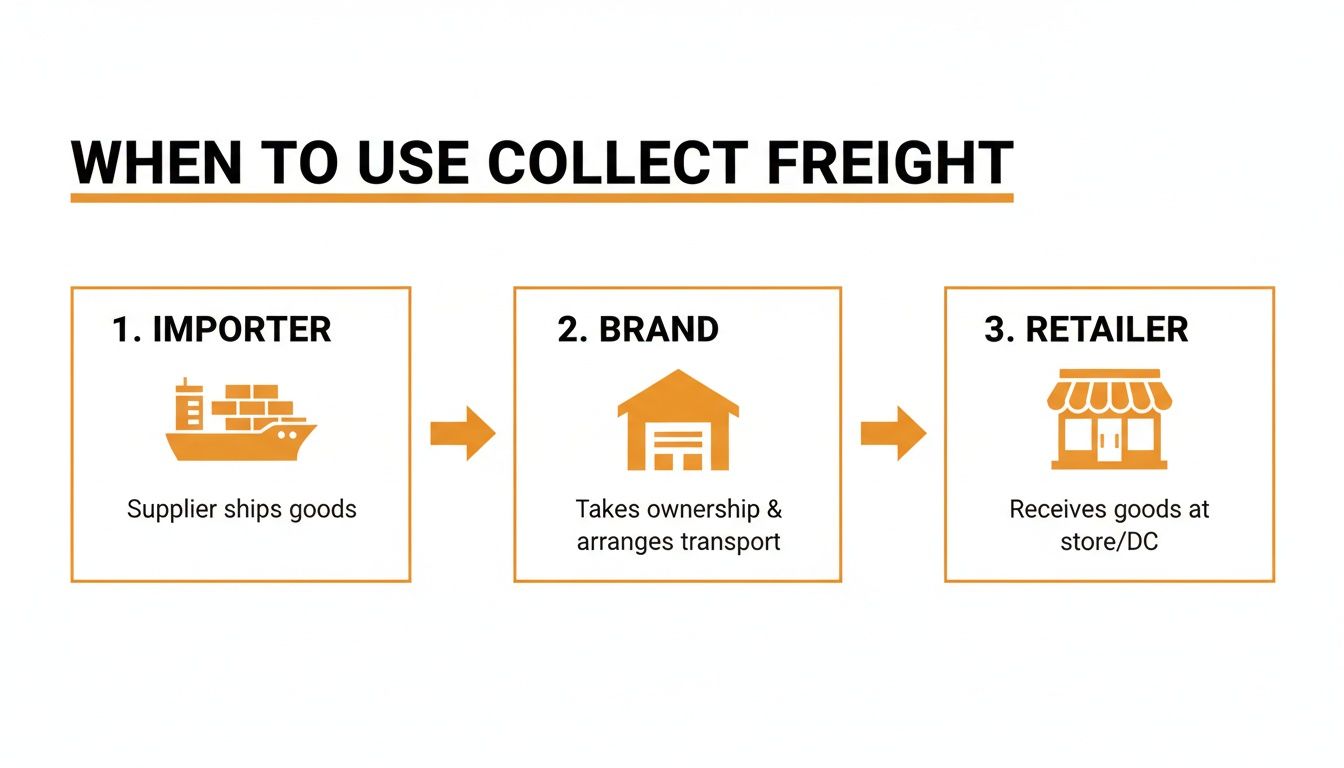
As you can see, a clear understanding of collect freight lets a brand centralize control over inbound logistics, no matter how many suppliers are involved.
Step 1: Proactive Communication and Scheduling
Your first move is always to establish clear communication. The moment a collect shipment is confirmed, get on the phone or send an email to your warehouse or 3PL.
Give them the essential details: the carrier's name, the PRO number (the master tracking number), and the expected delivery window. This simple heads-up allows them to plan dock space and labor, preventing a traffic jam at the receiving door.
For shipments heading straight to Amazon, this step is absolutely non-negotiable. Check out our guide on Amazon FBA inbound shipment requirements to make sure you're compliant.
Step 2: Documentation Mastery
Think of paperwork as your best defense against billing disputes. Before that truck even thinks about backing into your dock, make sure you have the correct documentation and that it’s filled out perfectly.
Your must-have document checklist includes:
- Bill of Lading (BOL): This is the holy grail. It absolutely must be marked "COLLECT" clearly and legibly. This simple word is what officially assigns you responsibility for payment.
- Packing List: This verifies the contents and quantities in the shipment. No guesswork allowed.
- Purchase Order (PO): This is your internal record of the order, and it had better match what's on the packing list and BOL.
Crucial Tip: Train your receiving team to become документальный ninjas. They should know to reject any BOL that isn’t correctly marked. Accepting a shipment with the wrong terms creates a messy paper trail that’s a nightmare to untangle later.
Step 3: Receiving and Inspection Protocols
When the truck arrives, what your team does in the first five minutes is critical. They need to perform a thorough inspection before signing a single piece of paper. This protocol shouldn't be a suggestion; it should be standard practice.
- Verify Piece Count: Count the pallets or cartons. Does that number match what’s on the BOL? If not, something is wrong.
- Inspect for Damage: Look for the tell-tale signs of a rough ride—crushed boxes, torn shrink wrap, or water stains. Be nosy.
- Make Notations: If there are any discrepancies or damages, note them directly on the carrier’s copy of the BOL before signing. This little note is your golden ticket for filing a successful freight claim. No note, no proof.
Step 4: Invoice Reconciliation and Auditing
The final piece of the puzzle is to meticulously audit the carrier’s invoice against your own records. Don't just assume it's correct.
Compare the invoiced amount to the rate you were quoted and hunt for any unexpected accessorial fees. In today's market, with tariff volatility and shaky freight demand, sharp invoice auditing is how you protect your bottom line. Every dollar counts, and it's essential to control every possible expense.
Common Questions About Collect Freight
Even when you think you have a handle on the collect freight definition, the real world has a knack for throwing curveballs. Certain situations pop up that can create a lot of confusion and put your business at risk. Let's walk through the most common questions we see, so you can sidestep those expensive mistakes.
What Happens If I Refuse to Pay for a Collect Shipment?
Let's be blunt: refusing to pay a collect freight invoice is a really bad idea. The carrier provided a service, and they have every legal right to get paid by you, the consignee.
First, they'll almost certainly hold your cargo hostage. They won't release it until the bill is settled. This grinds your supply chain to a halt, and you'll start racking up storage fees that can get expensive, fast.
If you still don't pay, things get worse. The carrier can put a legal lien on your goods. Ultimately, they can actually sell your inventory to cover what you owe them. You're out the money, out the product, and your reputation with logistics partners is shot. It's always better to dispute an invoice error through the proper channels instead of flat-out refusing to pay.
Can the Shipper Be Billed If the Consignee Does Not Pay?
Yes, and it happens more than you'd think. This is where a little detail on the Bill of Lading (BOL) called "Section 7" becomes incredibly important for shippers.
If a shipper signs Section 7, they’re off the hook for the bill if the consignee defaults. But if they don't sign it, they automatically accept secondary liability. This means if you, the receiver, fail to pay, the carrier can legally go after the shipper for the money.
Think of it as the carrier’s insurance policy. It guarantees they get paid for their work, one way or another. This is a huge reason why shippers need to be careful about who they agree to ship collect for.
Is FOB Destination the Same as Freight Collect?
Nope. This is probably one of the most common mix-ups in shipping, and it can lead to major headaches over who is responsible for what.
- Freight Collect is just a payment term. All it does is define who pays the carrier. In this case, it’s the receiver (consignee).
- FOB Destination is a shipping term (or sales term). It defines who owns the goods while they're on the truck and who's responsible for filing a claim if something gets damaged.
Under FOB Destination terms, the seller owns the product until it's safely delivered. While a shipment can be both FOB Destination and Freight Collect at the same time, the terms mean two completely different things. One is about the money, the other is about ownership and risk.
Navigating the complexities of inbound logistics, from managing collect shipments to ensuring Amazon FBA compliance, is what Snappycrate does best. We act as a reliable extension of your team, handling the details so you can focus on growth. Learn more about our seamless fulfillment and prep services at https://www.snappycrate.com.