To really get a handle on your e-commerce logistics, you have to nail one key distinction: supply chain and warehouse management are two totally different things, but they're completely tied together. Think of the supply chain as the entire road trip your product takes, from creation to customer. Warehouse management is the critical pit stop along the way, where speed and accuracy can either make or break the whole journey.
Demystifying Supply Chain and Warehouse Management
Let’s stick with that road trip analogy. Imagine your product is driving from a factory on the East Coast to a customer on the West Coast.
The supply chain is the entire map. It’s the grand plan that covers everything from sourcing materials, the manufacturing process, the long-haul freight journey across the country, and the final "last mile" delivery to the customer’s doorstep. It’s the big-picture strategy focused on getting a product from Point A to Point Z as efficiently and cheaply as possible.
Warehouse management, on the other hand, is what happens inside the four walls of the fulfillment center—that high-octane pit stop. This is where the hands-on, tactical work happens: receiving truckloads of inventory, storing it smartly so it can be found later, picking and packing orders with near-perfect accuracy, and getting them on the right truck for the next leg of their trip.
If the supply chain is the "what" and the "where," warehouse management is the "how" it all gets done on the ground.
The Strategic vs. The Tactical
A common mistake is to use these terms interchangeably, but that’s like confusing the role of a head coach with the quarterback. One sets the strategy, the other executes the plays. Knowing the difference is key to figuring out where your operational problems are really coming from.
Supply Chain Management (Strategic): This is all about high-level planning. It involves everything from vetting suppliers and managing manufacturing schedules to negotiating freight contracts and forecasting customer demand. It answers questions like, "Which factory in Vietnam gives us the best balance of quality and cost?" or "What's the most reliable shipping lane to use during the holiday rush?"
Warehouse Management (Tactical): This is about execution inside a specific building. It’s the day-to-day grind of physically handling goods. It answers questions like, "Where's the best spot in the warehouse to store this new SKU for the fastest picking?" or "How can we pack this fragile item to prevent damage while keeping shipping costs down?"
The strength of your entire supply chain is determined by its weakest link, and more often than not, that link is the warehouse. A bottleneck inside the fulfillment center creates a massive traffic jam that brings the entire supply chain to a screeching halt.
To quickly see how these two concepts differ, here’s a simple breakdown.
Supply Chain Management vs. Warehouse Management At A Glance
This table offers a high-level look at their core functions, scope, and goals, clarifying exactly where one ends and the other begins.
| Aspect | Supply Chain Management | Warehouse Management |
|---|---|---|
| Scope | End-to-end journey from sourcing to final delivery. | Activities within the four walls of a fulfillment center. |
| Focus | Strategic planning, procurement, logistics network. | Tactical execution, inventory control, order fulfillment. |
| Objective | Optimize the overall flow of goods, information, and finances. | Maximize efficiency, accuracy, and speed of in-house operations. |
| Analogy | The entire road trip itinerary and route planning. | The high-performance pit stop crew and their garage. |
Ultimately, a flawlessly run warehouse is the engine that powers a healthy supply chain. You can have an amazing product and brilliant marketing, but if your warehouse can't get the right item to the right customer on time, the whole strategy collapses. Great supply chain and warehouse management aren't just back-office functions; they're a direct reflection of the promise you make to your customers.
The Six Critical Warehouse Workflows for E-commerce
Every product that makes its way into your warehouse goes on a journey. For an e-commerce seller, nailing each step of that journey is the difference between smooth scaling and total chaos. It’s like a relay race—each handoff has to be perfect if you want to win.
This visual breaks down the product's path from your supplier to your customer's front door, with the warehouse sitting right in the middle, running the show.
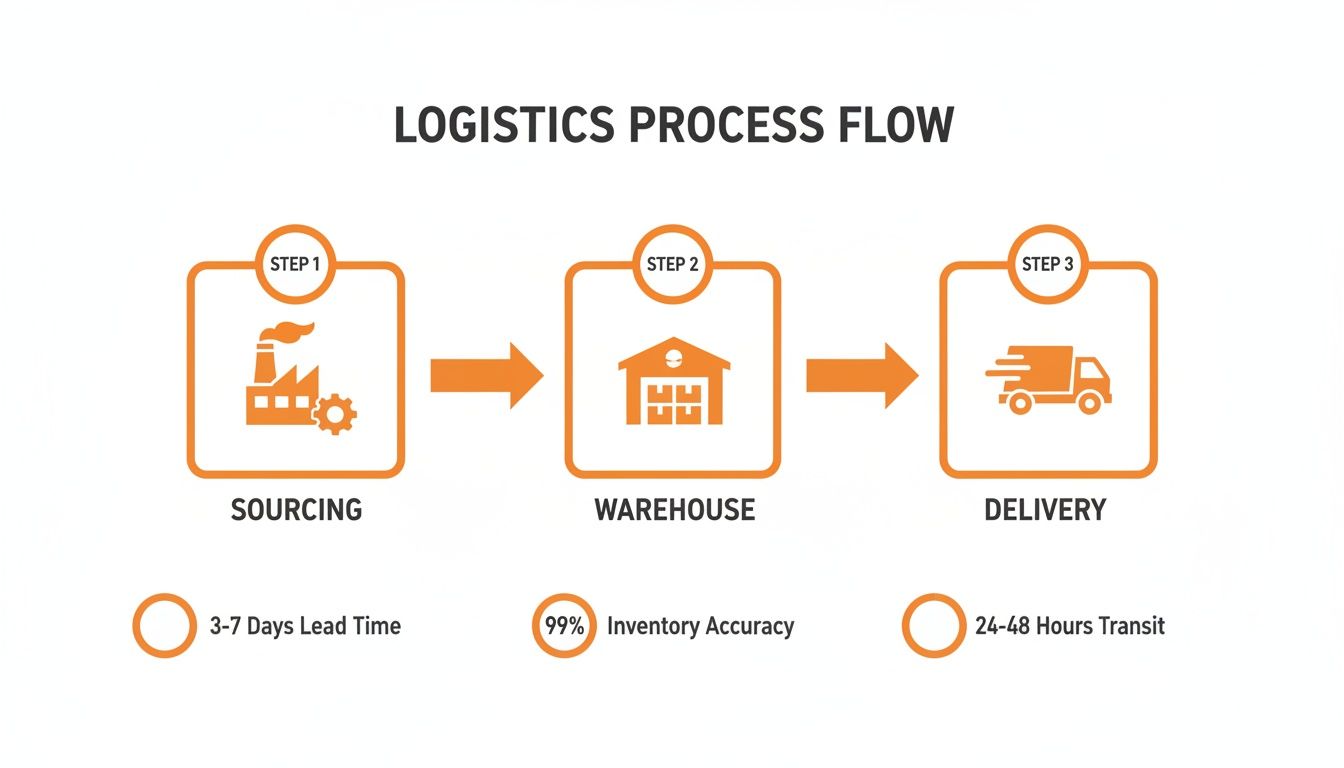
This flowchart really shows how the warehouse connects your bulk inventory to individual customer orders, making it the most important player in your supply chain. Let’s walk through the six core workflows that happen inside those four walls.
1. Receiving and Inbound Logistics
This is where it all starts—the moment your inventory shows up. And it's so much more than just unloading boxes from a truck. The receiving team has to carefully inspect every shipment for damage, count the items to make sure they match the purchase order, and log everything into the Warehouse Management System (WMS).
Get this part wrong, and the problems snowball. One miscounted box or an unchecked pallet creates "phantom inventory," tricking you into selling products you don't actually have. This is your first and best defense against supplier mistakes.
2. Strategic Storage and Slotting
Once your products are checked in, they aren't just tossed onto any random shelf. That's where strategic slotting comes in. It’s the science of assigning each SKU a specific home in the warehouse based on how fast it sells, its size, and its weight. The goal is simple: make it faster for the pickers to grab what they need.
- Fast-moving items are kept in prime real estate, close to the packing stations where they're easy to access.
- Slow-moving products get stored on higher shelves or further back in the warehouse.
- Heavy or bulky items stay on the ground level for safety and easy handling.
Organizing inventory this way has a huge impact on fulfillment speed and labor costs. A well-slotted warehouse means your team can process more orders every hour, keeping your operation lean and mean.
3. Real-Time Inventory Control
Good inventory control is the heartbeat of both your supply chain and warehouse management. It’s not just about knowing what you have, but knowing where it is at all times. A modern WMS gives you that real-time visibility, automatically updating your stock levels as products are received, moved, and shipped out.
Without accurate, real-time data, you're flying blind. You risk stocking out of your bestsellers while your cash is tied up in products that aren't moving. Both are expensive mistakes for any growing brand.
This constant monitoring stops you from overselling and helps you figure out when to reorder, taking all the guesswork out of managing your stock.
4. Specialized Amazon FBA Prep
If you sell on Amazon FBA, you know you have to play by their rules. Every single product sent to an Amazon fulfillment center needs to follow exact guidelines for labeling, poly bagging, and packaging. One small mistake can lead to rejected shipments, frustrating chargebacks, and weeks of delays.
This is why specialized FBA prep is so critical. A good 3PL partner handles all these little details to ensure 100% compliance, from applying FNSKU labels to creating custom bundles. Think of it as an insurance policy that guarantees your inventory gets checked in fast so you can start making sales.
5. Accurate Order Fulfillment and Kitting
This is the moment of truth—when a customer's order turns into a real-life package. This workflow has a few key steps:
- Picking: The WMS guides a warehouse associate to the exact shelf location for each item in an order.
- Packing: Items are packed securely with the right materials to keep them safe on their journey.
- Kitting: For brands that sell bundles or subscription boxes, this is when individual items are assembled into a single, ready-to-ship kit.
Accuracy here is everything. One wrong item picked can lead to an unhappy customer, a costly return, and a damaging negative review. Efficient e-commerce order fulfillment services build your brand's reputation one perfect package at a time.
6. Optimized Outbound Shipping
The final handoff is getting that packed order onto the right truck. This is more than just printing a shipping label. A smart outbound process involves weighing packages, double-checking addresses, and choosing the most cost-effective shipping carrier based on where the package is going and how fast it needs to get there.
The global warehouse management logistics market—the engine behind all this—was valued at USD 5.21 billion and is expected to explode to USD 17.30 billion by 2032. That explosive growth shows just how much complexity modern warehouses have to manage to keep up.
Key Performance Indicators to Measure Success
You can't improve what you don't measure. In both supply chain and warehouse management, moving beyond gut feelings and into hard data is the only way to spot bottlenecks, drive efficiency, and scale your brand profitably. Key Performance Indicators (KPIs) are the vital signs of your fulfillment operation.
They transform complex warehouse activities into simple, actionable numbers, telling you exactly where you're winning and where you're falling behind. For e-commerce sellers, mastering these metrics is like learning the language of operational excellence.
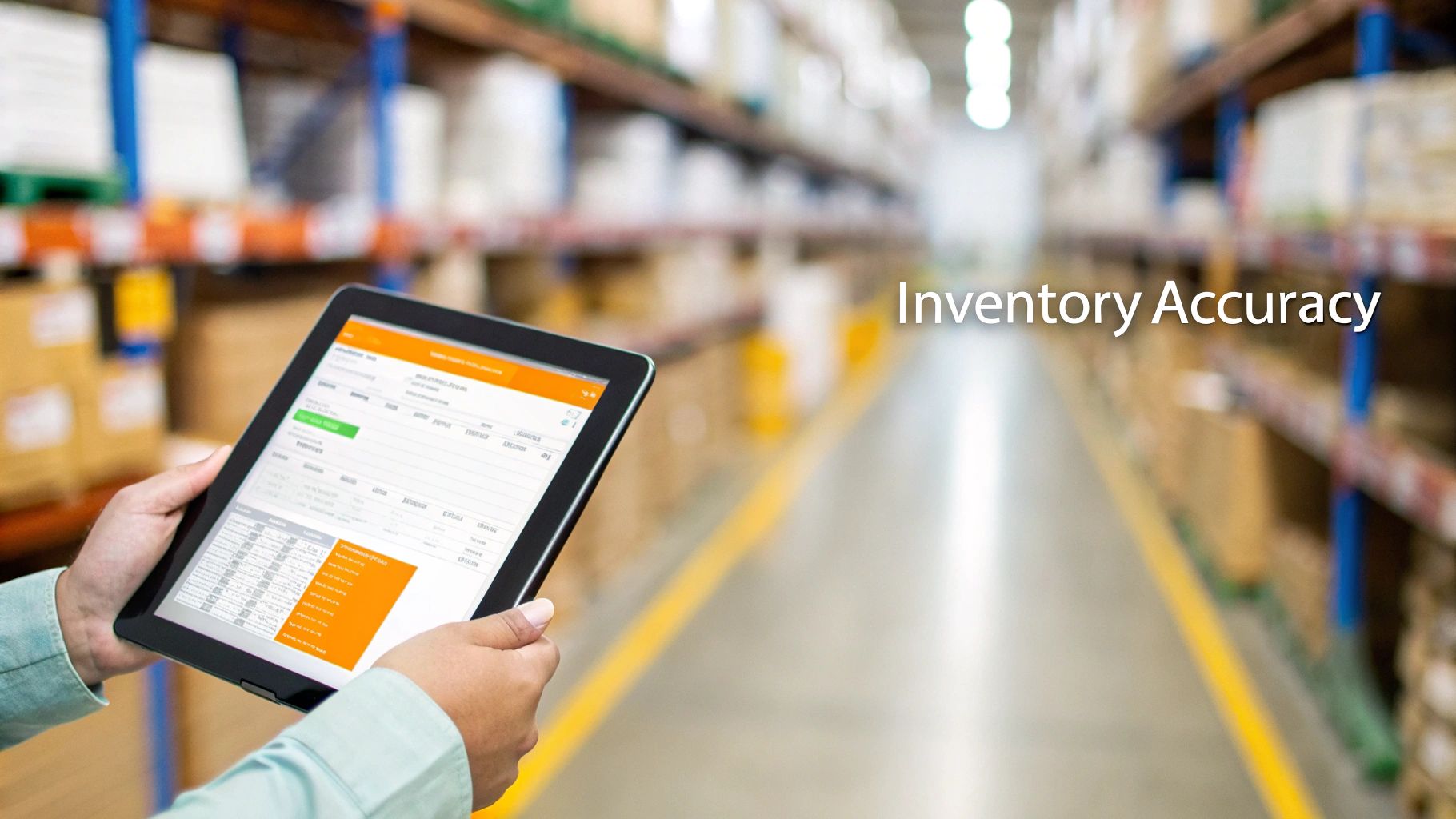
Let’s break down the essential KPIs that top operations leaders live by.
Inventory Accuracy
This KPI measures the difference between the inventory your system thinks you have and the physical inventory you actually have on the shelves. It’s the absolute foundation of a healthy e-commerce business.
Low inventory accuracy is a recipe for disaster. It leads to selling products you don't have (overselling), which results in canceled orders, unhappy customers, and a damaged brand reputation. A world-class warehouse aims for 99.5% inventory accuracy or higher, reflecting just how dialed-in their receiving and inventory control workflows are.
Calculation: (Physical Inventory Count / Inventory Count in WMS) x 100
A high score here means you can trust your data to make smart purchasing decisions, preventing both stockouts and costly overstock situations.
Order Picking Accuracy
This is arguably the most customer-facing KPI in the entire warehouse. It measures the percentage of orders picked and packed without a single error—no wrong items, no incorrect quantities.
Every mistake here directly hits your bottom line. A mis-picked order means you pay for the return shipping, the labor to process the return, and the shipping for the correct item. More importantly, it erodes customer trust. Top-tier 3PLs consistently achieve an order picking accuracy of 99.8% or greater.
On-Time Shipping Rate
This metric tracks the percentage of orders that leave the warehouse on or before the promised ship date. In an era of two-day shipping expectations, this KPI is completely non-negotiable for customer satisfaction.
A low on-time shipping rate is a huge red flag pointing to a bottleneck in your fulfillment process. It could be slow picking, inefficient packing, or delays in carrier pickups. Consistently hitting a high rate builds a reputation for reliability and keeps customers coming back.
- Why It Matters: Late shipments are a primary cause of negative reviews and customer service headaches.
- The Goal: Aim for an on-time shipping rate of 99% or higher to meet and exceed customer expectations.
This KPI directly connects your warehouse performance to the customer's end experience, making it a critical measure of your brand's promise.
Cost Per Order
Finally, this metric rolls up all your fulfillment expenses—labor, packaging, shipping, and overhead—and divides them by the total number of orders shipped. It tells you exactly how much it costs to get a single package out the door.
Tracking your Cost Per Order is essential for managing profitability, especially for products with tighter margins. An efficient warehouse is always looking for ways to push this number down, whether through better shipping rates, optimized packing materials, or more streamlined workflows. Understanding this cost is fundamental to making smart decisions about pricing, promotions, and your overall business strategy.
The Technology Powering Modern Warehouses
Behind every fast-growing e-commerce brand, there’s a powerful tech stack holding everything together. At the heart of it all is the Warehouse Management System (WMS)—the brain of your entire fulfillment operation.
Think of it as the air traffic controller for your inventory. A modern WMS connects directly to your sales channels like Shopify, Amazon, or Walmart. The moment an order comes in, the WMS grabs the data, checks your stock, and tells the warehouse team exactly what to do. It’s the tool that turns thousands of chaotic orders into a smooth, manageable workflow.
This is what allows brands to handle explosive growth with the same precision and ease as when they were just starting out. In today's market, a solid tech foundation isn't a luxury—it's essential for survival.
The Rise of Cloud-Based WMS Platforms
Not too long ago, warehouse management software was a clunky, expensive beast that lived on a single server in the back office. It required a massive upfront investment and a dedicated IT crew just to keep it running. Thankfully, that model is a thing of the past.
Today, everything has moved to the cloud. A cloud-based WMS runs on the internet, meaning you get real-time data from anywhere, on any device. This gives e-commerce sellers incredible visibility and control, letting them manage operations across multiple warehouses from one dashboard. No hardware to buy, no servers to maintain, and updates happen automatically.
This shift is more than just a trend; it's a fundamental change in fulfillment. Cloud-based WMS platforms are dominating the industry, capturing over half the market share and are projected for a 19.12% CAGR. This growth is fueled by sellers needing a single source of truth for their inventory and operations, which can boost accuracy by 30-40% while slashing overhead costs. You can get a deeper look at this industry shift by reviewing market analysis on Mordor Intelligence.
For sellers juggling Shopify sales and Amazon FBA prep, the scalability of the cloud is an absolute game-changer.
How a WMS Orchestrates Warehouse Workflows
So, how does this technology actually work on the warehouse floor? A WMS uses data and automation to make every single step faster and more accurate.
- Automated Order Processing: As soon as a customer clicks "buy," the WMS pulls that order from your store, verifies the shipping address, and assigns it to the floor for picking. No manual data entry needed.
- Optimized Picking Paths: The system calculates the most efficient route for a picker to walk through the warehouse to grab all the items for an order. This simple trick drastically cuts down travel time and lets your team process more orders per hour.
- Pinpoint Inventory Tracking: Using barcodes or RFID tags, the WMS knows where every single item is, right down to the specific bin on a shelf. This real-time visibility is everything. If you want to dive deeper, check out our guide on automated inventory tracking.
A WMS transforms inventory management from a reactive guessing game into a proactive, data-driven strategy. It eliminates "phantom inventory" and ensures the stock levels on your website perfectly match what's physically on the shelf.
This level of control has a direct impact on your bottom line. It minimizes picking errors, lowers the labor cost per order, and helps you avoid running out of your bestsellers. By integrating technology at the core of your supply chain and warehouse management, you build an operation that doesn’t just keep up with growth—it fuels it.
How Automation Is Reshaping E-commerce Fulfillment
Let’s be honest: the modern warehouse has hit a wall. Between persistent labor shortages and customers who expect their orders yesterday, just hiring more people isn't cutting it anymore. The real solution is working smarter, not harder. This is where automation comes in, turning old-school, labor-intensive fulfillment centers into hyper-efficient operations powered by data.
We're not just talking about a few extra conveyor belts. Think advanced robotic pickers, towering Automated Storage and Retrieval Systems (AS/RS), and sharp AI-driven forecasting all working in sync. These technologies directly boost the KPIs that actually matter to your business, like order accuracy and processing speed.
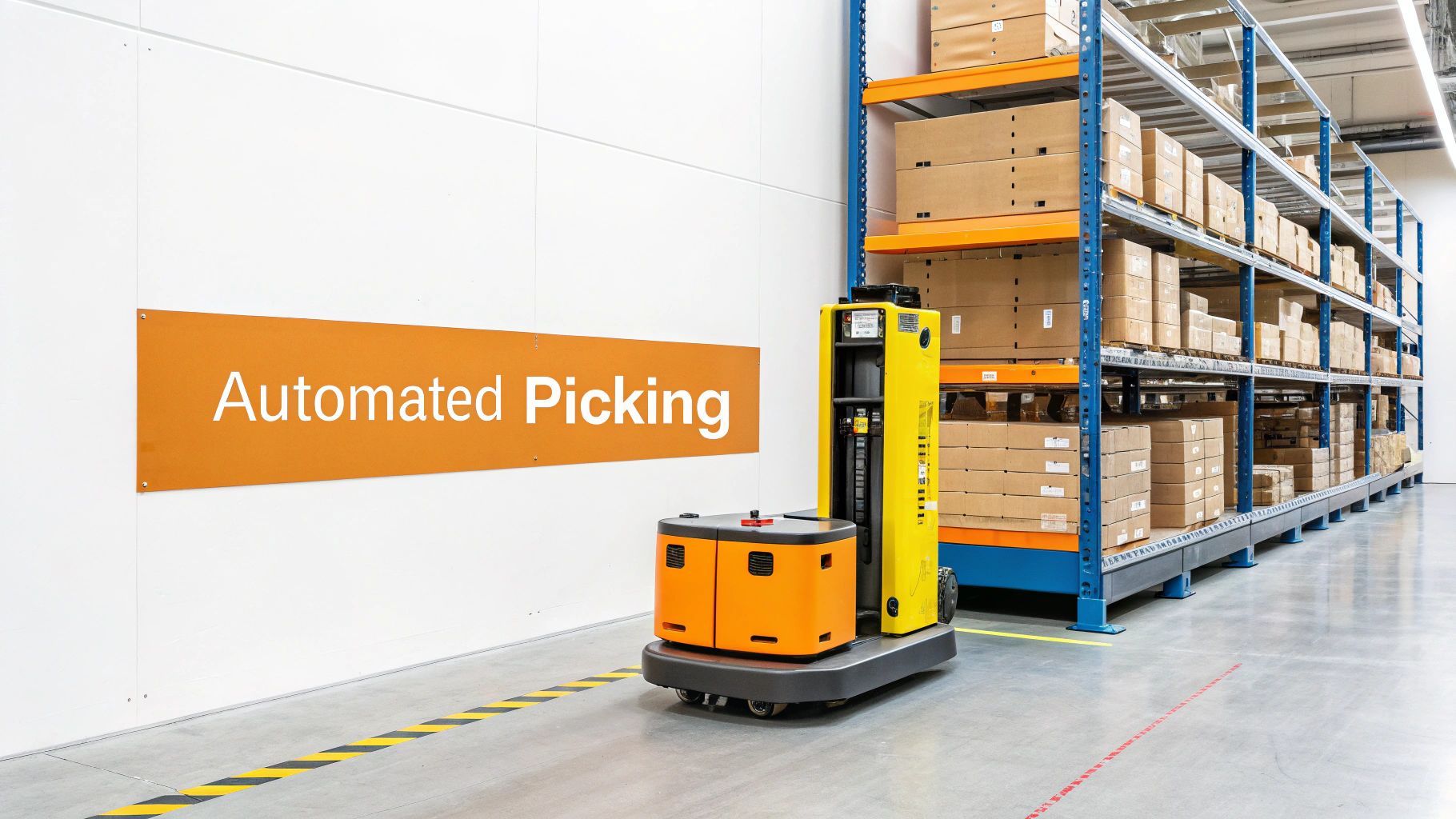
For an e-commerce seller, the payoff is huge. A 3PL partner that leans into automation can handle massive Black Friday sales spikes without breaking a sweat. This means you get consistent, high-quality service that lets your brand scale fearlessly.
The Driving Forces Behind Warehouse Automation
The big push toward automation isn’t just about chasing shiny new tech. It’s a direct response to real-world pressures that are squeezing every link in the supply chain.
- Labor Shortages: More than 50% of warehouses are struggling with major labor constraints, a problem that’s only gotten worse since 2020. Automation helps fill those critical gaps, letting fulfillment centers keep up with demand even when they’re short-staffed.
- Customer Expectations: The demand for next-day or even same-day delivery is relentless. Automated systems can pick, pack, and sort orders at a pace humans simply can't match, keeping your on-time shipping rates high and customers happy.
- Accuracy and Quality Control: Let's face it, human error happens. But when a robot does the same repetitive task thousands of times, it does it with near-perfect accuracy. This drastically cuts down on costly picking mistakes and the returns that follow.
This isn’t a small trend—it's reshaping the entire industry. The global warehouse automation market is on track to hit USD 63 billion by 2030, and experts predict 26% of warehouses will be fully automated by 2027. For 3PLs serving competitive channels like Amazon FBA, adapting is no longer optional. You can dig deeper into these changes by exploring some of the latest essential warehousing trends.
Key Automation Technologies in Action
So, what does this actually look like on the warehouse floor? It’s a mix of smart hardware and software working together to make every workflow—from receiving to shipping—run smoother.
Key Takeaway: Automation isn’t about replacing people. It’s about augmenting them. It gives the repetitive, back-breaking tasks to machines, freeing up your team for more valuable roles like quality control, problem-solving, and customer service.
Here are a few of the core technologies making the biggest impact on supply chain and warehouse management right now:
- Automated Guided Vehicles (AGVs): Picture self-driving carts or forklifts that zip around the warehouse on their own. They follow set paths to move pallets and bins from the receiving dock to storage or from shelves to packing stations, saving employees miles of walking each day.
- Collaborative Robots (Cobots): Unlike the big, caged-off robots of the past, cobots are designed to work safely right next to people. A picker might stay in their zone while a cobot brings them empty totes and whisks away completed orders, basically multiplying their productivity without the physical strain.
- Automated Storage and Retrieval Systems (AS/RS): Imagine a massive, smart vending machine for your inventory. AS/RS tech uses cranes and shuttles to automatically store and retrieve entire bins or pallets from high-density racks. This not only maximizes vertical space but also delivers goods directly to workers, slashing the time it takes to put away new stock and pick orders.
Knowing When to Outsource to a 3PL Partner
Handling your own supply chain and warehouse management feels like a rite of passage for many e-commerce brands. It’s a badge of honor. But there’s a tipping point where the very tasks that built your business start to choke its growth. Is your garage so full of inventory you can’t park your car? Are you spending more time fighting with a tape gun and printing labels than you are marketing your products?
These aren't just growing pains—they're flashing red lights. Deciding to outsource to a Third-Party Logistics (3PL) partner isn’t giving up. It’s a smart, strategic move to get your time back and set your brand up for scalable, stress-free growth. Knowing when to make that leap is everything.
The Tipping Points for Outsourcing
For most sellers, the switch from fulfilling orders themselves to using a 3PL happens when the daily friction becomes impossible to ignore. It’s rarely a single event. It’s more like a collection of nagging problems that prove your current setup can't keep up with where you’re headed.
If you find yourself nodding along to these points, you’ve probably reached that moment.
Here are the classic signs it’s time for a change:
- Unmanageable Order Volume: You’re consistently shipping 50-100+ orders per month, and the daily grind of picking and packing is eating up your entire day.
- Storage Space Crisis: Your inventory has officially taken over your house, garage, or that small storage unit you rented. Keeping track of it all is becoming a nightmare.
- Complex Fulfillment Needs: You're juggling sales from Shopify, Amazon FBA, and maybe a wholesale channel. Managing inventory and FBA prep rules for each has become a full-time job.
- Lost Focus on Growth: You’re so buried in operational tasks that you have no time left for marketing, product development, or finding new customers.
The real cost of self-fulfillment isn't what you pay for boxes and postage. It's the opportunity cost—the sales you lose and the growth you can't chase because you're stuck in the "warehouse" instead of building your brand.
The Game-Changing Benefits of a 3PL Partnership
Moving your fulfillment to a 3PL is about more than just offloading tasks. It’s about plugging your business directly into a professional-grade logistics machine. A partnership like this instantly gives you access to resources that would take years and a massive amount of cash to build on your own.
A great 3PL partner gives you a serious competitive advantage. You get an expert team that lives and breathes logistics, modern technology that automates every step, and access to much better shipping rates. You can learn more about how this all works by exploring what a 3PL warehouse truly offers. This shift lets you offer a customer experience that can go head-to-head with much bigger companies.
Ultimately, outsourcing your supply chain and warehouse management is about leverage. It lets you turn a chaotic, fixed cost center into a simple, variable expense that scales up or down with your sales. When you stop worrying about packing boxes, you can finally put all your energy into what matters most: getting more orders to fill them.
Frequently Asked Questions
When you're scaling an e-commerce brand, you're bound to run into questions about logistics. Here are some straightforward answers to the questions we hear most often from sellers just like you.
What Is the Main Difference Between a 3PL and a Warehouse?
A warehouse is just a building—four walls and a roof for storing products. A 3PL (Third-Party Logistics) is the expert team and the operational brain inside that building that handles everything for you.
Think of it like this: a warehouse is an empty stage. A 3PL is the entire production crew that sets the lights, manages the props (your inventory), and makes sure every performance (your customer's order) goes off without a hitch. They handle receiving, inventory management, picking, packing, and shipping, turning that empty space into a high-performance fulfillment machine.
How Does a WMS Actually Help My E-commerce Business?
A Warehouse Management System (WMS) is the software that runs the entire fulfillment show. It connects your online store, like Shopify or Amazon, directly to the warehouse floor.
When a customer places an order, the WMS instantly tells our team exactly where to find the items, prints the shipping label, and updates your inventory levels across all your sales channels. This stops overselling in its tracks. It means fewer mistakes, lightning-fast shipping, and the power to handle a massive surge in orders without breaking a sweat.
A WMS gives you a single source of truth for your inventory. It eliminates the guesswork and reactive decision-making, allowing you to manage your stock with data-driven precision.
Why Is Amazon FBA Prep So Important?
Amazon plays by its own rules, and they are incredibly strict. Every single product sent to their fulfillment centers must be labeled, bagged, and packaged exactly to their standards. One tiny mistake can get your entire shipment rejected.
This isn't just an inconvenience—it means rejected inventory, costly penalty fees, and weeks of lost sales while your products are stuck in limbo. FBA prep services are your insurance policy. A skilled 3PL makes sure every item meets Amazon's precise requirements, from FNSKU labeling to bundling, so your inventory gets checked in fast and starts selling immediately.
Ready to stop worrying about logistics and start focusing on growth? The expert team at Snappycrate provides seamless order fulfillment and Amazon FBA prep services designed to help your e-commerce brand scale effortlessly. Learn how we can become an extension of your business by visiting us at https://www.snappycrate.com.