Think of your e-commerce business as an orchestra. You have suppliers, sales channels, warehouses, and shipping partners all playing their parts. Supply chain integration is the conductor, making sure every instrument works in perfect harmony to create a flawless customer experience. Without it, you just get noise—operational chaos.
What Is Supply Chain Integration And Why It Matters
At its core, supply chain integration is about breaking down the walls between different parts of your business. It connects systems that used to be separate—like your Shopify store and your 3PL partner’s warehouse—so they can talk to each other and act as one single, smart unit. This creates a network where data flows freely and actions are synced up automatically.
Imagine a customer places an order on your site. In an integrated system, that order instantly pops up in your fulfillment partner’s system. Inventory levels update across all your sales channels in real-time, and a shipping label gets printed without anyone lifting a finger. This isn't just a tech upgrade; it's the engine that lets your brand scale.
The Strategic Value for E-Commerce Sellers
For direct-to-consumer (DTC) brands and Amazon sellers, this kind of integration turns operational headaches into a serious competitive advantage. The benefits are all about speed, accuracy, and real-time visibility.
A fully connected system helps you dodge the common pitfalls that kill growth, including:
- Stockouts and Overselling: Real-time inventory syncing means you can’t sell products you don’t actually have.
- Shipping Errors: Automated data transfer eliminates manual entry mistakes, making sure the right product gets to the right person.
- Delayed Fulfillment: Orders are processed the moment they come in, drastically cutting down the time from click to delivery.
For a growing e-commerce brand, manual processes are the enemy of scale. Supply chain integration automates the routine tasks, freeing up your team to focus on marketing, product development, and customer service instead of putting out logistical fires.
Outsourcing as a Path to Integration
Let's be real—building this level of connectivity from scratch is a massive undertaking. That's why so many brands turn to strategic outsourcing. A huge 52% of total supply chain costs are already spent on outsourcing partnerships, with companies offloading things like storage, fulfillment, and FBA prep to specialized 3PLs.
Partnering with a 3PL like Snappycrate isn't just about handing off tasks. You’re plugging your operations directly into an established ecosystem built for efficiency. You can learn more about how expert supply chain and warehouse management is the foundation for this kind of growth. This lets you focus on your core business while your fulfillment partner handles the complex logistics, ensuring your operations can keep up with your ambitions.
The Three Essential Flows of an Integrated Supply Chain
Real supply chain integration isn’t just about plugging in some software. It’s about getting three critical flows to move in perfect sync. Think of them as the lifeblood of your entire e-commerce operation: information, products, and money.
When these flows are out of whack, you get costly errors, angry customers, and a whole lot of headaches. But when they move in harmony, your business runs like a well-oiled machine. This is exactly what a modern 3PL partnership is designed to do—turn potential chaos into a smooth, predictable process.
The Information Flow
This is the digital nervous system of your business. The information flow is all the data zipping back and forth between you, your customers, your suppliers, and us, your fulfillment partner. It’s the real-time conversation that makes everything else work.
This isn’t just abstract data; it's mission-critical intelligence:
- Customer Orders: That order from your Shopify store needs to hit our warehouse management system instantly.
- Inventory Levels: Stock counts must sync back to your sales channels in real-time to stop you from selling products you don't have.
- Shipping Confirmations: Tracking numbers have to flow from the carrier to your store and straight to your customer’s inbox.
- Inbound Notifications: Your suppliers send us an advanced shipping notice (ASN) so we know exactly what’s arriving and when.
Without a clean, automated information flow, you're essentially flying blind. Manual data entry is a recipe for disaster—human error, delayed orders, and wrong inventory counts that chip away at customer trust and your profits.
The Product Flow
While information moves at the speed of light, your products have to move physically. The product flow is the literal journey your inventory takes, from your supplier’s loading dock to your customer’s doorstep. A truly integrated supply chain makes this physical movement fast, accurate, and totally transparent.
Every single step is a link in the chain that can’t afford to break:
- Receiving: We take in your inventory, verifying counts and checking for any damage right away.
- Storage: Your products are put away in designated, organized spots in the warehouse so we can find them in a flash.
- Picking and Packing: An order comes in, and our team picks the right items and packs them securely for transit.
- Shipping: The package is handed off to the right carrier to get it to its final destination.
- Returns Management: If a customer sends something back, the product flows in reverse—back to our warehouse for inspection and restocking.
An integrated product flow means your 3PL knows exactly what to do with your inventory at every stage. This orchestrated movement minimizes handling time, reduces the risk of loss or damage, and gets orders out the door faster.
The Financial Flow
Last but not least, money has to move, too. The financial flow tracks every dollar, from customer payments to supplier invoices and fulfillment fees. Getting this piece right is non-negotiable for staying profitable and maintaining healthy cash flow.
We’re talking about purchase orders, invoices, credit terms, and payments. When this flow is integrated with your accounting software, you get a crystal-clear view of your costs and revenue.
For instance, the moment we ship an order, the fulfillment and shipping costs are logged automatically. This gives you a precise, up-to-the-minute understanding of your cost of goods sold (COGS) and profit margins on every single sale. A disconnected financial flow, on the other hand, creates accounting nightmares and makes it impossible to know if you're actually making money.
The Technology Powering Your Integrated Operations
To make seamless e-commerce fulfillment a reality, you need more than just good intentions. You need a powerful tech stack where different systems communicate flawlessly.
Think of it like a specialized team. Each member has a distinct role, but they all share information instantly to achieve one goal: getting orders to your customers fast and accurately.
This digital conversation is the backbone of supply chain integration. It’s how an order on your Shopify store can trigger a physical action in a warehouse hundreds of miles away in just a few seconds. Let's break down the key players in this tech ecosystem and see how they work together.
The Core Systems Your Business Runs On
At the heart of any integrated operation are a few core software platforms. Each one acts as the single source of truth for a specific part of your business, and their ability to connect is what makes automation possible.
Enterprise Resource Planning (ERP): This is the central brain of your entire business. Your ERP system holds the master data for everything from product information (SKUs, costs, descriptions) and financials to customer records and supplier details. It’s the ultimate source of truth.
Warehouse Management System (WMS): If the ERP is the brain, the WMS is the command center of the warehouse. It directs every physical movement inside the four walls of a fulfillment center—from receiving and putaway to picking, packing, and shipping. A good WMS optimizes efficiency, telling workers the best path to pick items and ensuring inventory is stored correctly. For an in-depth look at how this impacts your stock levels, check out our guide to real-time inventory management.
Order Management System (OMS): The OMS acts as the traffic controller for all your customer orders. It pulls in orders from every sales channel you have (Shopify, Amazon, Walmart) and routes them to the right fulfillment location based on rules you set, like inventory availability or customer location.
These systems can’t operate in silos. They need a way to talk to each other, which brings us to the messengers that carry data back and forth.
How Systems Communicate: API vs. EDI
For these platforms to work as a single unit, they need a common language and a way to transmit messages. This is typically handled by two main technologies: APIs and EDI. While they achieve similar goals, their methods are quite different.
An API (Application Programming Interface) is a modern, flexible messenger. Think of it like a waiter in a restaurant. You (your OMS) tell the waiter what you want (a new order), and the waiter communicates that request to the kitchen (the WMS). The waiter then brings back the completed dish (a tracking number). APIs are built for fast, real-time, two-way conversations.
On the other hand, an EDI (Electronic Data Interchange) is a more traditional, structured language. It’s like sending a standardized, formatted business document—like a purchase order or an invoice—between two systems. It’s highly reliable and secure but is often more rigid and less suited for the instant feedback that e-commerce demands.
This table breaks down the core differences.
Comparing Integration Technologies: API vs. EDI
| Feature | API (Application Programming Interface) | EDI (Electronic Data Interchange) |
|---|---|---|
| Speed | Real-time or near real-time communication | Typically batch-processed; slower |
| Flexibility | Highly flexible; can handle custom data formats | Rigid and standardized formats |
| Cost | Generally lower implementation cost | Can be expensive to set up and maintain |
| Data Format | Uses modern, web-friendly formats like JSON | Uses legacy, structured text formats (e.g., ANSI X12) |
| Best For | E-commerce, mobile apps, real-time updates | B2B transactions, large enterprise systems, retail |
| Analogy | A direct, two-way phone conversation | Sending a formal, structured letter via mail |
While both have their place, the real-time nature of APIs makes them the clear winner for modern e-commerce operations.
The key takeaway: While EDI is still used in many legacy supply chains, APIs have become the gold standard for e-commerce integration. Their flexibility allows for the kind of real-time data exchange that prevents overselling and keeps customers updated instantly.
Putting It All Together: A Real-World Example
Let’s see how this creates a powerful, automated feedback loop. Imagine a customer buys a blue t-shirt from your Shopify store.
- Order Placed: The order is captured by your OMS, which immediately confirms payment and checks inventory rules.
- API Call: The OMS makes an API call, instantly sending the order details (SKU, quantity, shipping address) to your 3PL partner's WMS.
- Warehouse Action: The WMS receives the order, creates a picklist, and directs a warehouse associate to retrieve the blue t-shirt.
- Inventory Update: As the item is picked, the WMS updates its own inventory count and sends another API message back to your ERP and OMS, decrementing the stock level for that SKU.
- Sync Across Channels: Your OMS then pushes this updated inventory count to all your sales channels, ensuring your Shopify and Amazon listings reflect the new, accurate stock level.
This entire cycle happens automatically, without anyone lifting a finger. It prevents overselling and ensures that every system—from finance to fulfillment—is working with the exact same data. This is the true power of supply chain integration in action.
A Practical Roadmap for 3PL Integration
Kicking off a supply chain integration with a new 3PL partner can feel like a massive undertaking. But with a clear roadmap, what seems like a complex project breaks down into a series of simple, manageable steps. A solid plan takes the guesswork out of the equation, keeps disruptions to a minimum, and sets your partnership up for success right from the start.
Think of this as a strategic journey, not just a technical task. Each phase builds on the one before it, making sure your business and your fulfillment partner are perfectly in sync before a single order goes out the door.
Let's walk through the entire process, from initial planning to the final go-live, to ensure everything runs smoothly.
Phase 1: Initial Discovery and Planning
The bedrock of any successful integration is a deep, honest look at your current operations. Before you write a single line of code, you need to audit your existing processes from top to bottom. Where are the bottlenecks holding you back? What manual tasks are eating up your team's time?
This is all about asking the right questions:
- Process Mapping: Get it all down on paper. Document your entire fulfillment workflow, from the moment a customer clicks "buy" to the second a package lands on their doorstep.
- Pain Point Identification: Be specific. Are you dealing with constant inventory discrepancies? Are shipping times lagging? Are manual data entry errors causing chaos?
- Goal Setting: Define what a "win" looks like for you. Are you aiming for a 99.9% order accuracy rate? Do you need a 24-hour dock-to-stock time? Are you planning for a 50% increase in order volume next quarter?
Once you have that clear picture, you can start looking for the right 3PL partner. Don't just hunt for warehouse space—find a partner with proven tech chops and experience integrating with platforms you already use, like Shopify or Amazon. Understanding what a 3PL warehouse really brings to the table technologically is a crucial first move.
Phase 2: Scoping and Technical Definition
With a partner chosen, it’s time to get technical and define the scope of the project. You're essentially creating a detailed blueprint for how data will flow between your systems and the 3PL’s Warehouse Management System (WMS).
This isn't just about plugging one system into another. It's about defining the exact data points that need to be shared to put your operations on autopilot.
Key data flows to map out include:
- Order Information: What fields are non-negotiable for every order? Think SKU, quantity, customer address, and requested shipping method.
- Inventory Updates: How often will inventory levels sync back to your sales channels? Real-time is the gold standard here.
- Shipment Confirmations: What info (tracking number, carrier) needs to come back to your system to trigger those all-important customer shipping notifications?
- Returns Data: How will return merchandise authorizations (RMAs) be created, communicated, and processed?
This diagram shows exactly how an order can flow seamlessly from your e-commerce store, through the WMS, and sync back up with your business systems.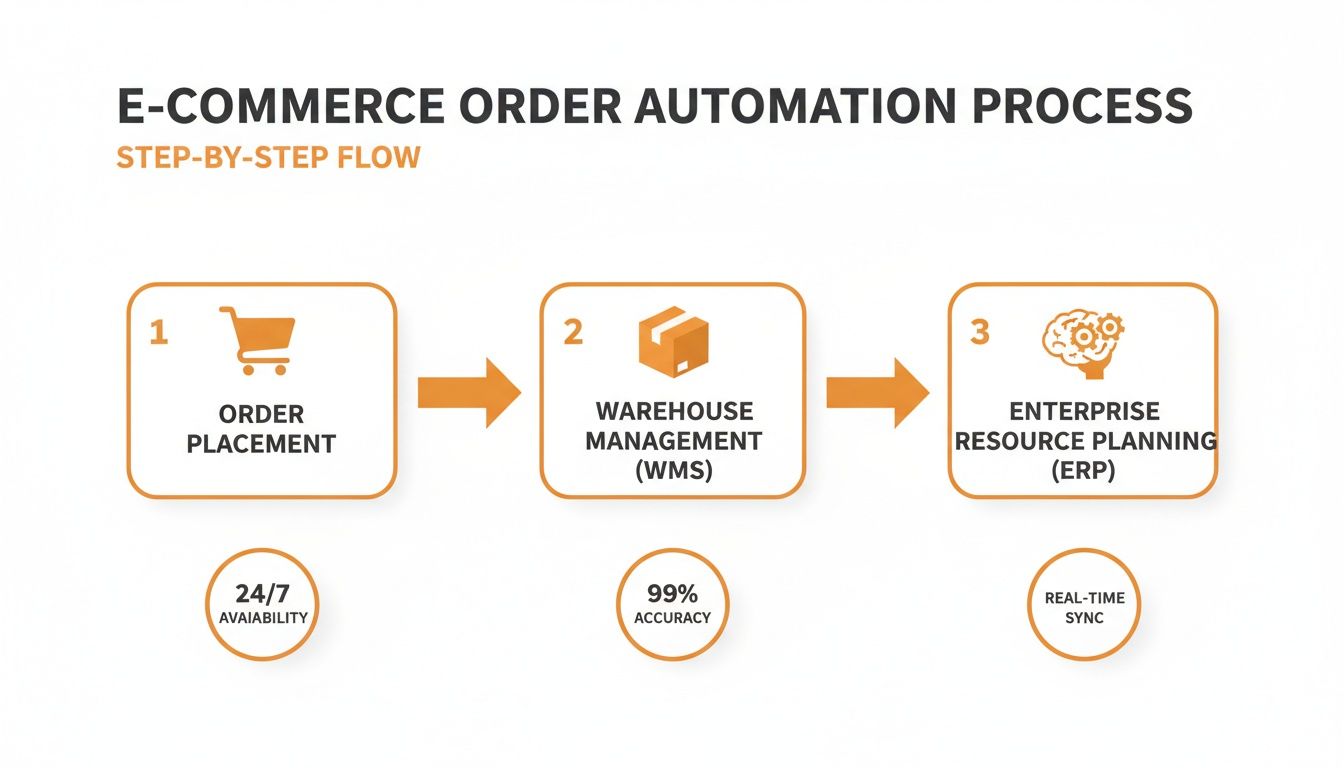
This automated workflow is the whole point of integration—it gets rid of manual touchpoints and makes fulfillment faster at every step.
A well-defined scope is your best defense against "scope creep"—the unexpected additions that can delay projects and inflate costs. Be meticulous here to ensure everyone is on the same page about what needs to be built.
Phase 3: Development and Rigorous Testing
Once the blueprint is locked in, the technical teams can start building the connections, usually with APIs. This is where the digital plumbing gets laid, linking your ERP, OMS, and e-commerce platforms to the 3PL's WMS.
But building the connection is only half the battle. The testing phase is arguably the most critical part of the entire integration. This is where you put the system under pressure to find and squash bugs before they ever affect a real customer.
Your testing needs to cover a wide range of real-world scenarios:
- Standard Orders: Does a simple, one-item order fly through the system correctly?
- Complex Orders: What about orders with multiple items, bundles, or special packing instructions?
- Edge Cases: Test what happens with order cancellations, mid-stream address changes, and out-of-stock items.
Thorough testing ensures that when you finally flip the switch, the system works just like it's supposed to. Rushing this step is a classic mistake that leads to post-launch headaches, lost sales, and unhappy customers.
Phase 4: Go-Live and Ongoing Optimization
After every test is passed and both teams give the green light, it’s time for the go-live. This is usually done in a phased rollout. You might start by routing a small percentage of your orders through the new system, watching them like a hawk before ramping up to 100%.
But the work doesn’t stop at launch. A great partnership is all about continuous monitoring and improvement. Regularly review key performance indicators (KPIs) with your 3PL to find new ways to get better. The end goal is a tough, scalable fulfillment operation that grows right alongside your business.
How to Measure Your Integration Success
Connecting your systems is a huge step, but a successful supply chain integration isn't just about whether the tech works. The real question is: is it actually making your business better?
To answer that, you need to ditch the gut feelings and dig into the hard data. Key performance indicators (KPIs) are your scorecard, showing you the real-world health of your operations.
Tracking the right metrics gives you an objective view of what’s working and what isn't. It allows you to have productive, data-driven conversations with your fulfillment partner, pinpoint weak spots, and prove the ROI your integrated supply chain is delivering to your bottom line and your customers.
Key Metrics for E-Commerce Fulfillment
While you could track dozens of different metrics, a few core KPIs tell most of the story. Nailing these three will give you a powerful, at-a-glance snapshot of your fulfillment efficiency.
1. Order Accuracy Rate
This is the ultimate measure of getting it right. It calculates the percentage of total orders shipped without a single error—no wrong items, incorrect quantities, or damages. A high rate here is a direct reflection of a well-oiled picking and packing process.
- Formula:
(Total Orders Shipped Perfectly / Total Orders Shipped) x 100 - Why It Matters: Inaccurate orders torch your profits. They lead to expensive returns, negative reviews, and wasted labor fixing mistakes. Get this right, and everything else gets easier.
- Industry Benchmark: Top-tier operations consistently hit an order accuracy rate of 99.8% or higher.
2. On-Time Shipping Rate
In e-commerce, speed is king. This metric tracks the percentage of orders that leave the warehouse on or before the promised date. It’s a make-or-break indicator of your fulfillment partner’s ability to meet customer expectations.
- Formula:
(Orders Shipped On or Before Deadline / Total Orders Shipped) x 100 - Why It Matters: A low rate often signals bottlenecks in the warehouse, like messy pick paths or staffing issues. Consistently missing shipping deadlines is one of the fastest ways to kill your brand’s reputation.
- Industry Benchmark: The gold standard is an on-time shipping rate of 99% or better.
3. Inventory Accuracy Rate
This KPI measures the gap between the inventory numbers in your software and the actual physical stock on the warehouse shelves. A good integration keeps these numbers in sync, but you still need regular cycle counts to keep them honest.
- Formula:
1 - (Absolute Difference Between Recorded and Actual Inventory / Recorded Inventory) x 100 - Why It Matters: This is the foundation for preventing stockouts and overselling. When your numbers are off, you can’t trust your system, leading to lost sales and frustrated customers.
- Industry Benchmark: A healthy, well-run warehouse should maintain an inventory accuracy rate of 99.5% or higher.
To make it even easier, here's a quick reference table with the most essential fulfillment KPIs.
Essential E-Commerce Fulfillment KPIs
| KPI | What It Measures | Industry Benchmark |
|---|---|---|
| Order Accuracy Rate | The percentage of orders shipped without any errors (wrong item, quantity, or damage). | 99.8%+ |
| On-Time Shipping Rate | The percentage of orders shipped on or before the promised fulfillment date. | 99%+ |
| Inventory Accuracy Rate | How closely your system's inventory count matches the physical inventory in the warehouse. | 99.5%+ |
| Dock-to-Stock Time | The time it takes for incoming inventory to be received, processed, and put away. | Under 24 hours |
| Order Cycle Time | The total time from when a customer places an order to when it's delivered. | Varies by service |
| Cost Per Order | The total warehouse cost (labor, packing, etc.) divided by the number of orders shipped. | Varies by 3PL/product |
Monitoring these metrics regularly isn't just about checking boxes; it's about creating a constant feedback loop.
This data gives you the insights needed to collaborate with your 3PL, fine-tune processes, and ensure your integration continues to drive growth and efficiency.
When you consistently measure performance, you turn your supply chain from a cost center into a strategic asset—ensuring every dollar you invest in integration pays off in customer loyalty and a stronger bottom line.
Common Integration Mistakes and How to Avoid Them
A successful supply chain integration is as much about dodging pitfalls as it is about following a perfect plan. Even with the best tech on your side, simple oversights can lead to costly delays, frustrated teams, and a project that completely misses the mark.
Knowing where these common traps lie is the first step to avoiding them. By learning from the challenges others have faced, you can sidestep these errors and make sure your integration project gets off to a strong start.
Overlooking Data Hygiene and SKU Management
One of the most frequent—and damaging—mistakes we see is assuming your product data is clean and consistent. This leads to a nightmare scenario we call "The SKU Mismatch," a seemingly small problem with massive consequences.
Imagine your Shopify store lists a product as "BLUE-TSHIRT-L" but your 3PL’s system knows it as "TSBL-L." When an order for the first SKU hits the warehouse, the system has no idea what it is. The order stalls, fulfillment stops, and a simple data inconsistency grinds your entire operation to a halt until someone can fix it manually.
A successful integration runs on clean, standardized data. Before you connect a single thing, do a thorough audit of your product catalog. Make sure every SKU, barcode, and product description is identical across all your systems—your ERP, your e-commerce platform, and your 3PL’s WMS.
Underestimating the Need for Process Change
Another huge pitfall is treating integration as a purely technical project. A lot of businesses believe they can just plug in new software without changing how their teams actually work. This is a recipe for failure.
Technology is just a tool; it can’t fix broken or clunky workflows. If your team is used to manually adjusting inventory numbers or emailing spreadsheets back and forth, just giving them a new dashboard won't solve the underlying problem. The new tech requires new processes to work.
To avoid this, you have to:
- Map Existing Workflows: Get a clear picture of how things are done today, warts and all.
- Design Future-State Processes: Work with your 3PL to design new workflows that actually take advantage of the automation.
- Invest in Training: You can’t just hand over the keys. Train your team thoroughly on the new processes so everyone knows their role in the integrated system.
Choosing Incompatible Technology Partners
Not all tech is created equal. A critical mistake is partnering with a 3PL whose systems can't easily connect with your existing tech stack. Choosing a partner with a rigid, outdated WMS or one that lacks flexible APIs will turn your integration project into a money pit of custom-coded workarounds.
Before you sign any contracts, ask pointed questions about their technical capabilities. Do they have pre-built integrations for platforms like Shopify or Amazon? Can they give your developers clear API documentation? A partner with a modern, adaptable tech stack will make the entire process smoother and faster. Skipping this step almost always leads to headaches and budget overruns.
Your Top Integration Questions, Answered
Diving into a full supply chain integration can feel like a big step, and it naturally brings up a lot of practical questions. E-commerce brands want to know what they're getting into before they commit. Getting clear, straightforward answers helps take the mystery out of the process and shows the real-world value of having a fully connected operation.
Let's tackle some of the most common questions we hear from growing businesses just like yours.
How Long Does a 3PL Integration Take?
This is always the first question, and the honest answer is: it depends on how complex your setup is. A standard, out-of-the-box integration with a major platform like Shopify can often be up and running in just a few weeks.
However, if you're working with custom-built systems or connecting multiple sales channels, the timeline might stretch to one to three months. The final schedule really depends on a few key things: how clean your product data is, how quickly technical teams on both sides can work together, and how thoroughly we test everything before going live.
Is Integration Only for Big Companies?
Not at all. In fact, you could argue that supply chain integration is even more critical for businesses on the rise. Small to mid-sized brands are the ones who feel operational growing pains the most, especially when a sudden surge in orders threatens to swamp their manual processes.
Integration gives a growing brand the scalable foundation to say "yes" to new opportunities. Think expanding to a new marketplace or running a huge sale—all without worrying that your fulfillment will break under the pressure.
Can I Connect Multiple Sales Channels to One 3PL?
Yes, and this is where the magic really happens. A modern 3PL acts as your central command center for fulfillment, plugging into all the places you sell, such as:
- Your main e-commerce site on Shopify or BigCommerce.
- Marketplaces like Amazon, Walmart, and eBay.
- Wholesale or B2B order portals.
This creates a single source of truth for all your inventory. When an item sells on Amazon, the stock level is automatically updated on your Shopify store. This simple sync completely eliminates the risk of overselling and makes managing your inventory across the entire business a whole lot simpler.
Ready to build a scalable fulfillment operation that actually grows with you? Snappycrate provides the expert integration and reliable service you need. Get in touch with our team today.