Skip to Content

Blog Archives

E-commerce Reporting and Analytics: Boost Efficiency

Peak week exposes every weak reporting habit in a warehouse. Orders spike, the packing tables fill up, customer service starts asking where delayed orders are, and someone is still reconciling three spreadsheets to figure out whether a fast-moving SKU is available. At that point, the problem isn't only volume. It's visibility.

In e-commerce fulfillment, reporting and analytics only matter if they help somebody on the floor make a better decision. Can the picker find the product without walking the aisle twice? Did packing fall behind because labor was thin, because replenishment missed a bin, or because a marketplace promotion changed the order mix? Is a carrier miss creating late deliveries, or did the delay begin inside the warehouse before the label printed?

The strongest operations teams tie every metric back to a physical action. Inventory data should influence replenishment. Order status should trigger exception handling. Shipping analysis should change carrier selection, cut rework, or tighten cut-off planning. When the data stays abstract, teams admire dashboards and still miss SLAs.

Moving Beyond Spreadsheets in Your Warehouse

A familiar scene plays out in a lot of fulfillment operations. The daily order file comes from Shopify. Amazon performance data lives in Seller Central. Inventory adjustments sit in the WMS. Carrier charges show up later in another system. By midafternoon, the ops manager is piecing together what happened by exporting CSVs and asking supervisors for updates.

That approach works for a while. Then volume grows, SKU counts expand, and the spreadsheet becomes a lagging explanation instead of a control system. By the time someone spots a stock discrepancy, the picker has already hit an empty bin. By the time a shipping issue is visible, the last pickup is gone.

What changes the game is disciplined reporting that stays close to the workflow. A live inventory view should tell the replenishment lead which locations need attention first. A pack-out report should show where orders are aging on the floor. A shipment exception report should separate label-created, packed, manifested, and departed orders so the team knows where to intervene.

For teams trying to get out of manual reporting cycles, a practical starting point is implementing effective report automation. Its actual value isn't prettier files. It's getting standard reports delivered consistently enough that supervisors stop rebuilding the same answer every morning.

A stronger operation also needs inventory visibility that updates with warehouse activity, not just end-of-day exports. Tools built for real-time inventory management software are useful because they connect data to immediate warehouse decisions like receiving, putaway, replenishment, and order release.

Practical rule: If a report can't tell a warehouse lead what to fix in the next hour, it's probably too late or too broad.

Spreadsheets still have a role. They're fine for ad hoc analysis, one-off audits, and validating edge cases. They fail when they become the primary operating layer for pick, pack, and ship decisions.

Reporting vs Analytics What Ops Teams Must Know

In fulfillment, people often lump reporting and analytics together. That's a mistake because they solve different operational problems.

Reporting tells the team what happened or what is happening in a defined window. Analytics goes deeper and helps explain why something happened and what is likely to happen next. That distinction became mainstream with the spread of interactive BI platforms in the 2010s, which shifted teams from static spreadsheet reporting toward visual KPI monitoring and broader data-driven management practices, as described in Domo's explanation of analytics vs reporting.

An infographic comparing reporting as a dashboard snapshot versus analytics as deep insights and predictive modeling.

What reporting looks like on the warehouse floor

Think of reporting as the dashboard in a truck. It shows speed, fuel, temperature, and warning lights. In a warehouse, that means current backlog, open orders, orders released but not picked, late shipments, available inventory, and exception queues.

A good operational report is direct. It tells a shift lead:

  • What is stuck so they can clear blocked orders
  • What is late so they can resequence work before cutoff
  • What is short so inventory control can verify the location
  • What is at risk so customer service gets ahead of complaints

Reporting is about control. It supports immediate action and repeatable daily management.

What analytics adds

Analytics is the diagnostic layer. It connects patterns across time, channels, people, carriers, products, and workflows.

A report might show late shipments increased last week. Analytics asks different questions:

  • Did the issue cluster by carrier or service level?
  • Were the delays tied to a specific pick zone?
  • Did order profile change because more bundles or multi-line orders came in?
  • Are stock discrepancies forcing substitutions or holds?
  • Is the problem likely to repeat under similar demand conditions?

Those questions matter because they lead to structural fixes instead of daily firefighting.

Reporting tells you the line is behind. Analytics tells you whether the real cause is slotting, replenishment timing, order mix, labor planning, or carrier pickup discipline.

Where teams get it wrong

The most common mistake is expecting one dashboard to do both jobs. It usually ends up doing neither well.

Ops teams should treat them differently:

Function Best use in fulfillment Typical user
Reporting Daily execution, order status, SLA management, exception handling Supervisors, leads, customer service
Analytics Root cause review, trend analysis, demand planning, network and carrier decisions Operations managers, analysts, leadership

If a warehouse manager is trying to release waves and they need to wait on a heavy trend query, the system design is wrong. If leadership is trying to understand recurring stockouts using only today's dashboard, that's also wrong.

Critical KPIs for E-commerce Fulfillment

Most warehouses don't suffer from too few metrics. They suffer from too many low-value ones. The best reporting stack stays focused on a small set of high-signal metrics such as on-time shipment rate, order defect rate, and inventory accuracy, combined with uncluttered dashboards that help operators act on exceptions instead of reconciling spreadsheets manually, as outlined in Dot Analytics' guidance on data analytics reporting.

The key is choosing KPIs that map directly to warehouse work. If a metric doesn't influence receiving, putaway, picking, packing, shipping, or exception handling, it usually belongs in a different scorecard.

Inventory KPIs

Inventory issues don't stay in the inventory team. They spill into picking delays, canceled orders, split shipments, and customer complaints.

Inventory accuracy measures whether the system matches what is physically in the bin. This is the foundation. If this number is unstable, almost every downstream report becomes suspect.

Inventory turns helps identify whether stock is moving or sitting. In fulfillment terms, this affects slotting, replenishment frequency, and how much prime pick space gets wasted on slow movers.

Stockout frequency is worth watching qualitatively even if teams define it differently across systems. If customer demand exists but inventory isn't available to allocate, the warehouse pays for that in expediting, split handling, and support tickets.

Order processing KPIs

This category measures whether work moves cleanly from release to ship.

Order accuracy tells you whether the right items, quantities, and packaging reached the customer. Every miss creates double cost. The warehouse pays once to make the error and again to fix it.

Pick-to-ship time tracks how long it takes an order to move through the building. This isn't only a speed metric. It's often the fastest way to spot congestion between departments.

Order defect rate is a strong composite signal because it captures execution failures the customer experiences, not just internal completion counts.

For teams that want a broader service lens beyond warehouse execution, Halo AI's guide to measuring customer service efficiency and ROI helps connect fulfillment outcomes with support load, which is useful when late or inaccurate orders start driving ticket volume.

Shipping KPIs

Shipping data should not stop at label creation. The warehouse needs to know whether the package left on time, arrived as promised, and cost what the operation expected.

On-time shipment rate reflects whether orders left the facility by the promised cutoff.

Carrier performance by service level helps separate internal misses from transportation misses.

Cost per shipment becomes useful when paired with order profile. Heavier, multi-item, or branded packaging orders may cost more for good reasons. The point is to understand where cost is structural versus where process waste is hiding.

A deeper logistics view can come from tools and systems focused on analytics in logistics, where order, inventory, and shipment data are looked at together instead of in separate channel reports.

Essential E-commerce Fulfillment KPIs

KPI Category Metric What It Measures Goal
Inventory Inventory Accuracy Whether system stock matches physical stock Reduce mis-picks, shorts, and manual recounts
Inventory Inventory Turns How quickly inventory moves through storage Improve slotting and avoid dead stock consuming space
Order Processing Order Accuracy Whether customers receive the correct order Reduce rework, returns, and support contacts
Order Processing Pick-to-Ship Time Time from order release to shipment Speed up flow through pick, pack, and manifest
Order Processing Order Defect Rate Customer-facing fulfillment failures Catch quality issues before they scale
Shipping On-Time Shipment Rate Whether orders leave by promised timing Protect marketplace performance and customer trust
Shipping Carrier Performance Reliability by carrier and service type Route parcels through more dependable options
Shipping Cost per Shipment Fulfillment transportation cost at order level Control margin erosion and packaging waste

Keep KPI ownership clear. Inventory control should own inventory accuracy. Floor leadership should own flow metrics. Shipping should own departure discipline. Shared metrics with no owner usually drift.

How to Collect and Integrate Your Fulfillment Data

Most fulfillment data is fragmented by design. Orders originate in commerce platforms. warehouse activity lives in the WMS. Tracking and invoice detail sits with carriers. Returns data may live somewhere else entirely. Teams often think they need more reports when the fundamental problem is that the underlying records never meet in one place.

The fix is a single source of truth built from connected systems. That doesn't mean one giant operational screen for everyone. It means order, inventory, warehouse, and carrier data should be standardized enough that the same order can be followed from import to pick, to pack, to label, to departure, to delivery outcome.

A four-step infographic illustrating the process of collecting, automating, transforming, and storing fulfillment data in a central database.

Start with the physical workflow

Before connecting APIs, map the warehouse events that matter:

  • Receiving events such as inbound receipt, inspection, and putaway
  • Inventory events such as transfers, adjustments, replenishments, and cycle counts
  • Order events such as import, allocation, release, pick confirmation, pack confirmation, and ship confirmation
  • Carrier events such as manifest, scan acceptance, transit exceptions, and delivery confirmation

If the event model is sloppy, the dashboard will be sloppy too. Clean reporting begins with clear operational definitions.

Separate live operations from deeper analysis

The highest-value design pattern is to keep operational reporting separate from analytical reporting. Interject explains that operational dashboards should support near-real-time decisions like order status and SLA breach alerts, while analytics layers should combine historical data from multiple sources to forecast demand and identify longer-term bottlenecks in analytics and reporting system design.

For a warehouse, that means:

  • Operational layer for today's open orders, current shortages, pack backlog, and late-to-cutoff risk
  • Analytical layer for trends in inventory reliability, labor bottlenecks, carrier outcomes, and recurring exception patterns

Teams that blend those layers usually end up with slow dashboards and confused users.

Build the pipeline around traceability

A practical integration stack should make it easy to answer basic traceability questions. Which order line was short? Which bin was picked? Which pack station handled it? Which carrier service was assigned? Which scan happened last?

That level of connection is where integrations matter. A platform designed for warehouse management system integration helps tie order systems, warehouse execution, and shipment data together so the business can trace both performance and failures through the same workflow.

If your team can't follow one delayed order from storefront to carrier handoff in a few clicks, your data isn't integrated enough.

Actionable Use Cases from Real Fulfillment Data

The value of reporting and analytics shows up when the warehouse changes behavior. A clean dashboard is fine. A better replenishment schedule, fewer Amazon prep issues, and tighter carrier selection are better.

A warehouse worker analyzing business performance data on a tablet in a logistics distribution center.

Recent analytics thinking has pushed beyond static dashboards toward decision intelligence, where the system connects signals, business rules, and scenarios to guide the next best action. That only works when teams trust the data and maintain clear governance, as discussed in Luzmo's piece on business analytics angles to follow.

Preventing stockouts before picks fail

A stockout rarely starts at the shelf. It usually starts earlier with poor visibility into sales velocity, inbound timing, or internal inventory accuracy.

One common pattern looks like this. A product begins selling faster through one channel, but replenishment planning still follows older assumptions. The WMS says there is stock. The primary pick face runs dry. Reserve inventory exists, but nobody moves it soon enough. Pickers hit empty bins, the queue slows down, and customer service starts handling oversell complaints.

Useful signals include:

  • Fast-moving SKU movement by day
  • Available versus allocated inventory
  • Replenishment lag between reserve and forward pick
  • Channel-specific order spikes
  • Cycle count variance on affected SKUs

The action isn't just "order more inventory." Sometimes the correct move is changing slotting, setting earlier replenishment triggers, or protecting inventory for higher-priority channels.

Fixing Amazon FBA prep and compliance issues

FBA prep errors are expensive because they create rework before goods even become sellable. A shipment can arrive at the warehouse needing labels, bundling, poly bagging, case pack verification, or inspection. If reporting only shows completed prep volume, managers miss where the defects begin.

The stronger approach is to tie prep exceptions to inbound source, SKU profile, and prep step. If one supplier consistently sends units with missing labels, the warehouse can isolate that supplier's receipts for inspection instead of letting the issue hit the full line. If one product family regularly fails bundling checks, prep instructions need to be rewritten or moved upstream.

The best prep reports don't celebrate throughput. They expose which inbound patterns create preventable touchpoints.

This is also where warehouse layout data matters. If relabeling, inspection, and bundling are causing extra walking or repeated handoffs, process analysis should influence the physical setup. Material Handling USA offers a useful perspective on optimizing warehouse design with data, which is directly relevant when prep work starts crowding core pick-pack space.

Finding pick and pack bottlenecks

A floor can look busy and still be poorly balanced. One shift may blame picking when the underlying delay sits at replenishment. Another may blame packing when wave release timing is flooding stations unevenly.

Bottleneck analysis gets clearer when teams compare operational timestamps:

Workflow point Question to ask
Order release Did work hit the floor in manageable batches?
Pick confirmation Are specific zones lagging or producing more exceptions?
Pack confirmation Are stations waiting on dunnage, labels, or QC review?
Manifest and handoff Are completed cartons sitting before carrier departure?

The next useful media example walks through how teams think about warehouse reporting in practice.

Once those timestamps line up, decision-making gets sharper. If pick time expands only for multi-line orders, slotting or batching may be the issue. If orders are packed quickly but miss departure, the bottleneck may be staging discipline or carrier handoff timing.

Comparing carriers by real operational outcome

Carrier analysis often starts and ends with rate cards. That's incomplete. The warehouse should compare carriers using both cost and execution outcomes.

The most useful review pairs shipment records with final outcomes:

  • Which services miss promised delivery windows more often
  • Which carriers create more exception handling work
  • Which zones or package profiles perform poorly by carrier
  • Which shipping options look cheap until claims, delays, or support contacts are considered

This is where analytics earns its keep. Reporting can show yesterday's ship file. Analytics can reveal that one service works well for lightweight East Coast parcels but creates issue volume for oversize shipments to a different region. That changes routing rules, not just yesterday's review.

A Practical Adoption Roadmap for Your Operations Team

Most operations teams don't need a full BI program on day one. They need enough structure to stop guessing, enough consistency to trust the numbers, and enough discipline to turn findings into process changes.

A four-phase adoption roadmap for data-driven operations ranging from foundation and integration to analysis and optimization.

Phase 1 Foundation

Start with a short KPI set and define each metric operationally. Make sure everyone agrees on what counts as shipped, late, short, damaged, adjusted, or backordered.

At this stage, a simple daily reporting rhythm matters more than tool sophistication.

  • Choose a handful of metrics that map directly to inventory, order flow, and shipping
  • Set owners so each metric has someone responsible for investigating misses
  • Validate manually against source systems until the team trusts the output

Phase 2 Integration

Next, connect the systems that create the most operational friction when left separate. Usually that means order sources, WMS data, and carrier status.

This phase isn't about building every dashboard imaginable. It's about eliminating the blind spots created by disconnected records.

Start integration where handoffs fail most often. That's usually between order import, inventory availability, and carrier confirmation.

Phase 3 Analysis

Once the data is stable, teams can investigate causes instead of only logging outcomes. Review recurring late shipments, repeated stock adjustments, prep exceptions, and slow-moving order states.

A good operating habit here is a weekly root-cause review. Pick one recurring issue and trace it all the way through the building.

Phase 4 Optimization

Applying historical data to make better forward decisions initiates operational improvements. Labor planning gets tighter. Replenishment timing improves. Slotting changes become evidence-based. Carrier rules get smarter.

One option in this phase is working with a fulfillment partner or platform that already captures and organizes warehouse execution data alongside inventory and shipment activity. Snappycrate, for example, provides storage, fulfillment, and FBA prep services with systems built around inventory management and warehouse workflow visibility.

The roadmap works because each phase produces something tangible. Better daily visibility. Fewer manual reconciliations. Faster root-cause diagnosis. Better forward planning.

Your Data Is Your Greatest Competitive Asset

In e-commerce fulfillment, data isn't a side effect of operations. It's the operating system for the building. Every scan, adjustment, pick confirmation, pack confirmation, and carrier event tells you something about cost, speed, and risk.

The teams that win don't collect the most data. They use the right data to improve the next physical action. They replenish before a pick face empties. They catch prep defects before an FBA shipment gets rejected. They route parcels with a clearer view of service reliability. They spot bottlenecks before cutoff gets missed.

When reporting and analytics are tied tightly to warehouse work, the operation becomes easier to control. That means fewer surprises, faster orders out the door, cleaner handoffs, and better customer outcomes. It also means leadership can scale with less guesswork.

The warehouse floor will always be busy. It doesn't have to be blind.


If your team needs a fulfillment partner that understands how warehouse execution, inventory visibility, and FBA prep data connect in real operations, Snappycrate is worth a look. Their services cover storage, pick-pack-ship fulfillment, inventory management, and Amazon prep workflows, which can help sellers build cleaner reporting around the work that moves orders out the door.


0 Continue Reading →

Analytics in Logistics: Master analytics in logistics with Data-Driven Insights

If you've ever tried navigating a busy city at rush hour without a map, you know the feeling—wrong turns, wasted gas, and a whole lot of frustration. Running an e-commerce supply chain without data is pretty much the same: a series of expensive guesses based on incomplete information.

This is where logistics analytics comes in. It’s the process of using data to make smarter, faster, and more profitable decisions across your entire operation. It turns guesswork into informed strategy, helping you optimize inventory, speed up deliveries, and slash costs.

What Is Logistics Analytics and Why Does It Matter?

A delivery driver in an orange vest and cap signs a document on a digital tablet next to a white van.

Think of logistics analytics as the GPS for your supply chain. It’s the systematic use of data to improve performance, from the moment a customer clicks "buy" to the second their package lands on their doorstep.

For a growing e-commerce seller, it’s the key to answering the tough questions that directly hit your bottom line:

  • Inventory: Where is my best-selling product right now, and am I about to stock out?
  • Shipping: Are my packages actually arriving on time? How can I stop overpaying for shipping?
  • Fulfillment: What’s the biggest bottleneck in my warehouse that's slowing down orders?

To really get a handle on logistics analytics, it helps to see it as a tiered system. Each level builds on the last, answering a progressively more powerful question—kind of like how a weather forecast evolves from a simple observation to actionable advice.

Before we dive into the levels, here’s a quick overview of what each area of logistics analytics can tell you.

Table: Key Focus Areas of Logistics Analytics

Analytics Area What It Measures Key Question It Answers for Your Business
Inventory Analytics Stock levels, turnover rates, storage costs, stockout frequency "Do I have the right amount of the right products in the right place?"
Transportation Analytics On-time delivery rates, cost per shipment, transit times, carrier performance "How can I ship faster and cheaper without sacrificing quality?"
Fulfillment Analytics Order cycle time, pick-and-pack accuracy, labor productivity, cost per order "Which part of my fulfillment process is slowing me down or costing too much?"
Demand Analytics Sales velocity, seasonal trends, customer buying patterns, promotional impact "What are my customers going to buy next, and how much of it will they need?"

Each of these areas provides a different lens through which to view your business, giving you a complete picture of your operational health.

The Three Levels of Logistics Analytics

  1. Descriptive Analytics (What happened?): This is the starting point—looking back at historical data to figure out what went right or wrong. A report showing that 75% of your shipments were delivered on time last month is pure descriptive analytics. It’s the weather report telling you it rained yesterday. Simple, but necessary.

  2. Predictive Analytics (What will happen?): This is where things get interesting. Using that historical data, you can start building statistical models to forecast what's coming next. For example, a predictive model might forecast a 20% jump in demand for a specific SKU next quarter based on seasonal trends and recent sales. This is the forecast telling you there’s an 80% chance of rain tomorrow.

  3. Prescriptive Analytics (What should we do?): This is the most powerful level. It doesn't just predict the future; it recommends specific actions to take. A prescriptive system could automatically suggest re-routing a shipment to avoid a predicted snowstorm or tell you exactly how much extra inventory to order to meet that forecasted demand. This is your weather app not only telling you it will rain but advising you to grab an umbrella before you leave.

By moving from simply looking at the past to predicting the future and prescribing actions, logistics analytics lets you get ahead of problems. You become proactive, not reactive. You can learn more about building these skills in our guide to supply chain and warehouse management.

This shift to data-driven decision-making isn’t just a nice-to-have. It’s fundamentally changing how modern supply chains are run. The global digital logistics market is expected to hit an incredible USD 338.47 billion by 2035. That explosive growth is all thanks to businesses using analytics to cut costs and get a leg up on the competition. For any scaling e-commerce brand, using data is no longer optional—it's essential.

The Building Blocks of a Powerful Logistics Data Strategy

A solid logistics analytics strategy isn't built on guesswork; it’s built on good, clean data. Think of it like building a house. You can’t put up walls or a roof until you have a rock-solid foundation. In logistics, your foundation is made of key metrics and the data sources where they live.

The whole point is to go from a blurry, outdated snapshot of your operations to a crystal-clear, real-time picture. That clarity starts with tracking the right numbers.

Key Metrics Every E-commerce Brand Should Track

For an e-commerce brand, not all metrics are created equal. Trying to chase dozens of data points will just leave you confused and chasing your tail. Instead, focus on a handful of vital signs that tell you exactly how healthy your fulfillment operations are.

  • Order Accuracy Rate: What percentage of your orders are shipped without a single mistake? That means the right product, in the right quantity, sent to the right person. A high accuracy rate means fewer expensive returns and much happier customers.

  • On-Time Delivery Rate: How often do your packages actually arrive by the promised delivery date? This is a direct measure of customer satisfaction and a huge factor in whether they'll buy from you again.

  • Inventory Turnover: This metric shows how many times you sell and replace your entire inventory over a set period. A healthy turnover rate is a sign of strong sales and smart inventory management, preventing your cash from getting tied up in products that just sit on a shelf. You can find more details on this topic in our article about real-time inventory management.

  • Cost Per Shipment: This calculates the total expense to get an average order out the door, including packaging, labor, and what you pay the carrier. Keeping an eye on this helps you find ways to cut shipping costs and fatten up your profit margins.

These metrics are your command center. They give you an immediate gut check on what’s working and what needs fixing. The next step is knowing where to find the raw data to power them.

Uncovering Your Primary Data Sources

Here's the good news: you’re probably already sitting on a goldmine of data. The information is just scattered across the different software platforms you use to run your business. The real challenge isn't creating data from scratch—it's pulling it all together into one place.

A modern 3PL partner acts as a data refinery. They take the raw, scattered information from your systems and transform it into polished, actionable intelligence that you can use to make smarter business decisions.

Here are the most common places to find your logistics data:

  1. Warehouse Management System (WMS): Your WMS is the heart of your fulfillment data. It’s packed with details on inventory levels, how long it takes to process an order, picking and packing accuracy, and how productive your team is.

  2. Transportation Management System (TMS): This platform is all about movement. It holds all the data on carrier performance, transit times, on-time delivery rates, and freight costs. Digging into your TMS data helps you pick better routes and more reliable carriers.

  3. E-commerce Platform (Shopify, Amazon Seller Central, etc.): Your sales channels provide the demand-side of the puzzle. This includes order volume, how fast certain SKUs are selling, customer locations, and return data—all of which are non-negotiable for accurate forecasting.

While the data exists, getting it all to play nicely together can be a huge headache. A recent industry survey found that 33.5% of logistics operations struggle to find solutions with strong analytical capabilities. This just goes to show that plenty of businesses know they should be using analytics, but they lack the right tools or partners to actually do it. You can learn more about these logistics market findings on stellarmr.com.

By understanding which metrics truly matter and where to find the data behind them, you lay the essential groundwork for a powerful analytics strategy that will actually drive growth and efficiency.

Putting Logistics Analytics into Practice

Theory is one thing, but results are what really matter. This is where we get our hands dirty and look at how analytics in logistics solves the real-world headaches e-commerce sellers face every day. Think of each use case as a problem solved—turning an operational nightmare into a serious competitive advantage.

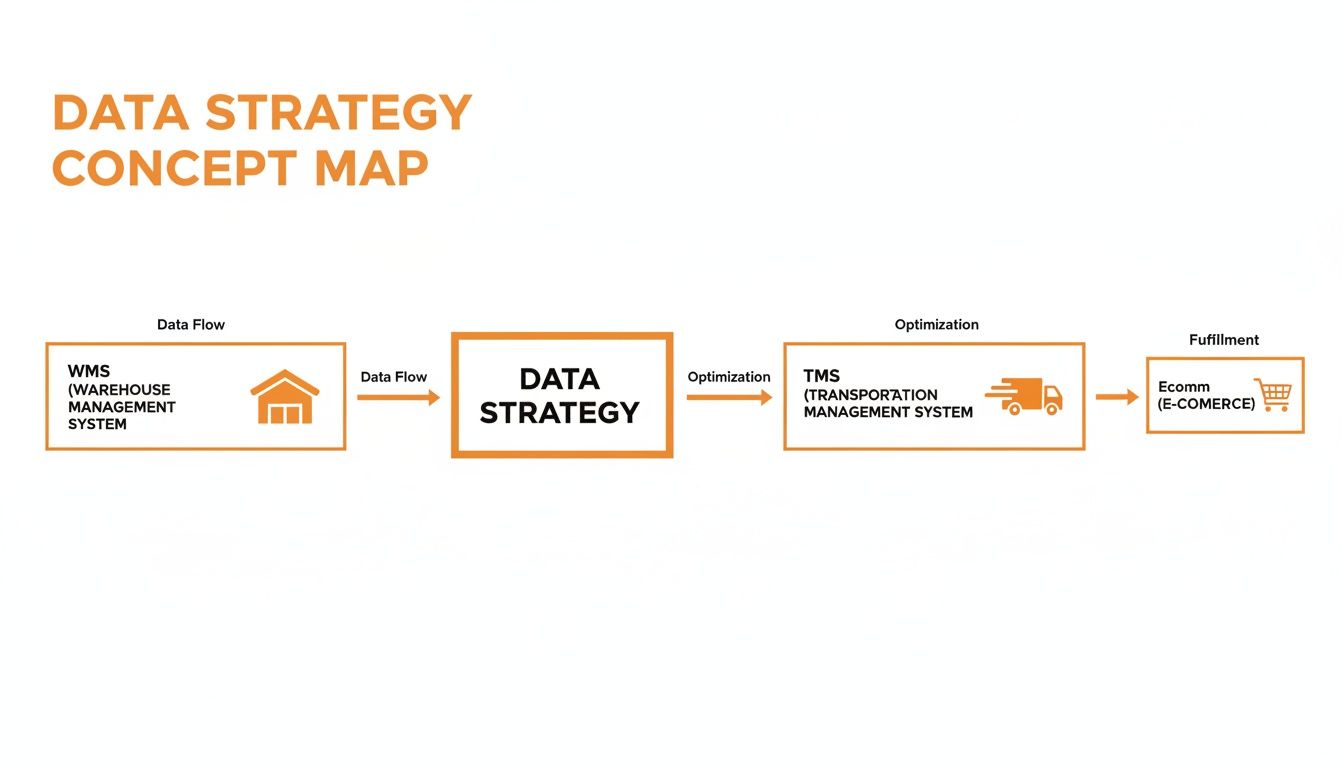
To get the full picture, you need to see how the data flows. A solid data strategy connects the dots from your warehouse management system (WMS), through your transportation management system (TMS), and right into your e-commerce platform. It's a continuous feedback loop.

Data strategy concept map illustrating the flow from warehouse management to e-commerce for logistics optimization.

This map shows how the nitty-gritty operational data from your warehouse and shipping directly informs your sales channels, helping you make smarter, faster decisions.

Inventory and Demand Forecasting

Managing inventory is one of the trickiest balancing acts in e-commerce. Too much stock, and your cash is tied up in products that aren't moving. Too little, and you’re hit with stockouts and angry customers. Logistics analytics takes the guesswork out of the equation.

By digging into historical sales data, seasonal patterns, and market trends, predictive models can forecast what your customers will want with surprising accuracy. This means you can stock just enough of the right stuff at exactly the right time.

For instance, your analytics dashboard might show that sales for a specific SKU have shot up by 30% over the last two weeks. Instead of waiting for it to sell out, the system can flag it and recommend a reorder, ensuring you never miss a sale. This is a game-changer for modern inventory management. You can learn more about getting this set up in our guide on automated inventory tracking.

The goal here is to stop thinking of inventory as a static cost and start treating it like a dynamic, revenue-generating asset. Analytics makes sure every dollar you spend on stock is working as hard as possible.

And this isn't just a nice idea. In a recent study, nearly 78% of supply chain leaders said they’ve gained huge operational advantages from AI-driven logistics. In fact, 22% of businesses are already using AI for things like predictive demand forecasting.

Route and Carrier Performance Optimization

Shipping costs can absolutely demolish your profit margins, and slow delivery times are a great way to lose a customer for good. Analytics helps you tackle this head-on by putting every part of your shipping process under the microscope, from the routes you use to the carriers you choose.

Let's say you ship thousands of packages a month with a few different carriers. An analytics platform can automatically stack them up against each other based on what really matters.

  • On-Time Delivery Rate: Who actually delivers when they say they will?
  • Cost Per Mile: Which carrier gives you the best bang for your buck in different shipping zones?
  • Damage Rate: Are your packages arriving in one piece, or are they getting beat up?

By crunching this data, the system can instantly tell you the best carrier for every single shipment. Maybe it’s Carrier A for coast-to-coast deliveries but Carrier B for anything regional. Those small, data-backed decisions save you money and keep your customers happy on every single order.

Warehouse and Fulfillment Efficiency

How fast and accurately your warehouse operates has a direct line to customer satisfaction. Analytics gives you a deep dive into your fulfillment process, shining a light on hidden bottlenecks you never knew you had.

You can track key metrics like pick-and-pack time, order cycle time, and order accuracy rate on a simple dashboard. It might reveal that orders with more than three items are taking 50% longer to process.

Once you know that, you can do something about it. Maybe you need to reorganize your warehouse layout, tweak your picking strategy for multi-item orders, or give your team some extra training. These small, informed changes add up to much faster and more accurate fulfillment across the board.

Optimizing Amazon FBA Prep

If you're an Amazon seller, you know FBA prep is serious business. One little mistake can lead to rejected shipments, expensive penalty fees, and lost sales while your inventory is stuck in limbo.

This is where analytics becomes essential. A 3PL partner like Snappycrate uses data to track and improve every single step of the FBA prep process, making sure it's done right the first time.

Data-Driven FBA Prep Checklist:

  1. Labeling Accuracy: We track the error rate on FNSKU labels to guarantee every item scans perfectly when it arrives at Amazon. No exceptions.
  2. Packaging Compliance: The data tells us if items are being correctly poly-bagged, bubble-wrapped, or bundled based on Amazon’s strict rules for that category.
  3. Shipment Plan Adherence: We use data to double-check that the items and quantities in every box match the shipment plan exactly, so you don't get hit with frustrating receiving delays.

By keeping a close eye on these metrics, we can spot recurring problems and fix them fast. This data-driven approach turns FBA prep from a major source of stress into a reliable part of your supply chain, getting your products to customers without a single hitch.

Your Step-by-Step Implementation Roadmap

Diving into logistics analytics can feel like trying to drink from a firehose. Between all the data, tools, and buzzwords, it’s easy to get overwhelmed before you even start. But here’s the thing: building a data-driven operation doesn’t require a PhD or a massive budget. It just takes a smart, step-by-step plan.

This roadmap cuts through the noise. It’s a practical, five-step process designed for any business ready to stop guessing and start measuring. We’ll go from identifying a single, core problem to building a culture that instinctively asks, "What does the data say?"

Step 1: Define Your Core Objective

Before you touch a single spreadsheet, ask yourself one simple question: What is the single biggest, most expensive problem I need to solve right now? Trying to boil the ocean is a surefire way to fail. Instead, channel all your energy into one high-impact area.

Maybe you're bleeding cash on shipping costs. Perhaps stockouts are killing your sales and eroding customer trust. Or it could be that your team is bogged down with complaints about slow or inaccurate orders. Whatever it is, pick one.

Defining a clear objective is like setting a destination in your GPS. Without it, you’re just driving aimlessly. Your goal could be as simple as, "Reduce our average cost per shipment by 10% in the next quarter."

This singular focus makes everything that comes next infinitely easier. You'll know exactly which data to hunt for and which metrics matter, keeping you from getting lost in a sea of irrelevant numbers.

Step 2: Identify and Consolidate Your Data

Right now, your operational data is probably scattered across a bunch of systems that don't talk to each other. You’ve got inventory data in your Warehouse Management System (WMS), shipping details in your Transportation Management System (TMS), and sales numbers in your Shopify or Amazon account.

The goal here is to find where this valuable information is hiding and pull it all together. This doesn't mean you need a complex, expensive data warehouse on day one. It can start with simple exports into a central spreadsheet or by leaning on the built-in integrations of a modern 3PL partner.

  • For Inventory: Pull stock levels and order accuracy from your WMS.
  • For Shipping: Grab on-time delivery rates and transit times from your TMS or carrier portals.
  • For Sales: Collect order volume and sales velocity straight from your e-commerce platform.

A fulfillment partner like Snappycrate can act as your data hub, connecting these different sources to give you a single, unified view of your operations without you needing to manage all the technical plumbing.

Step 3: Select the Right Tools for the Job

Once you know your objective and where your data lives, it's time to pick your tools. The key is to start simple. Choose technology that fits your immediate needs and technical comfort level. You can always upgrade to more advanced solutions as you grow.

Here’s how most businesses progress:

  1. Spreadsheets (Google Sheets, Excel): This is the perfect starting point. They're free, flexible, and fantastic for basic tracking and building simple charts.
  2. Business Intelligence (BI) Tools (Tableau, Power BI): These are the next step up. They let you create interactive, automated dashboards that pull from multiple data sources.
  3. 3PL Dashboards: An analytics-focused 3PL gives you a purpose-built platform that visualizes key logistics metrics in real-time, requiring zero setup on your end.

Step 4: Build Your First Insights Dashboard

Your first dashboard should be ruthlessly simple. Its only job is to display the handful of key metrics that directly track the core objective you defined in step one. If your goal is to slash shipping costs, your dashboard has no business showing inventory turnover.

Focus on clean, easy-to-digest visuals. A line chart showing your cost-per-shipment over the last six months is far more powerful than a giant table of raw numbers. This visual approach helps you spot trends, flag problems, and track progress at a glance.

Step 5: Cultivate a Data-Driven Mindset

Tools and dashboards are only half the equation. The final, and most critical, step is to build a company culture that actually uses data to make decisions. This has to start from the top.

Encourage your team to shift away from making calls based on gut feelings or "the way we've always done it." Give them the power to ask questions and dig into the data to find real answers.

When a problem pops up, the first question should always be, "What does the data tell us?" This simple change transforms your entire operation from reactive to proactive, letting you use insights to solve problems before they ever reach your customers or your bottom line.

Measuring the True ROI of Your Analytics

A desk with a laptop showing a financial bar chart, calculator, coins, papers, and 'MEASURE ROI' text.

Putting money into data can feel a bit abstract, but the returns are anything but. How do you actually prove that all this focus on analytics in logistics is paying off? The secret is connecting those data-driven insights directly to tangible, bottom-line results.

Your return on investment (ROI) isn't just one magic number. It's a powerful combination of gains across cost, revenue, and pure operational efficiency. By breaking it down, you can turn logistics analytics from a line-item expense into a proven profit center.

Significant Cost Reduction

The most immediate way analytics hits your finances is by systematically chopping down operational costs. Every dollar saved on shipping, storage, or returns goes straight to your bottom line. This is where data moves off a dashboard and into your bank account.

Think about it: without data, you might be consistently overpaying for shipping by choosing a carrier that’s fast but unnecessarily expensive for certain zones. Analytics puts a spotlight on these hidden costs instantly.

By analyzing carrier performance, transit times, and historical costs, you can uncover massive savings. Data helps optimize routes for lower fuel consumption and better fleet use, directly impacting your profitability on every single order.

This goes beyond just shipping, too. When you use accurate demand forecasts to guide your inventory, you stop overstocking and cut the high costs tied to warehousing slow-moving products.

Sustainable Revenue Growth

While saving money gives you an instant boost, the real long-term prize from logistics analytics is its impact on revenue. Getting orders to customers on time, every time, isn't just an operational goal—it's one of the most powerful drivers of customer loyalty and repeat business.

When a customer gets their order exactly when they expect it, their trust in your brand skyrockets. That positive experience is often the tipping point for their next purchase.

Here’s how analytics makes that happen:

  • Improved On-Time Delivery: Data shows you which carriers are the most dependable, ensuring you meet or beat your delivery estimates.
  • Reduced Stockouts: Predictive forecasting keeps your best-sellers in stock, so you don't lose sales to frustrated customers who go to a competitor.
  • Fewer Order Errors: Tracking fulfillment accuracy helps you minimize mistakes, leading to happier customers and fewer costly returns.

Over time, this level of reliability builds a rock-solid reputation that attracts and keeps high-value customers, creating a sustainable engine for growth.

Enhanced Operational Efficiency

Finally, analytics delivers a powerful ROI by giving your team back its most valuable resource: time. When your team isn't drowning in manual report-pulling or firefighting preventable problems, they can focus on strategic activities that actually grow the business.

Automated dashboards replace hours of spreadsheet work, and real-time alerts flag potential issues before they cause a major disruption. For instance, an alert might show that pick times are slowing in a specific warehouse zone, allowing a manager to step in and fix it immediately. This shifts your team from being reactive to proactive.

Calculating the Impact of Logistics Analytics

Let's look at a practical breakdown of how specific improvements translate into measurable business gains. This isn't theoretical; it's how smart data decisions create real financial and operational wins.

Analytics Improvement Key Metric Improved Direct Business ROI
Carrier Performance Analysis Shipping Cost per Order 5-10% reduction in overall shipping expenses by selecting the most cost-effective carrier for each route.
Demand Forecasting Models Inventory Turnover Rate 15% decrease in holding costs by preventing overstocking and minimizing slow-moving inventory.
Route Optimization Software On-Time Delivery Rate 10% increase in customer lifetime value (CLV) due to higher satisfaction and more repeat purchases.
FBA Prep Performance Tracking Inbound Defect Rate Reduced Amazon non-compliance fees and faster inventory receiving times, leading to more sales days.
Warehouse Labor Analytics Orders Picked per Hour 20% boost in labor productivity, allowing you to fulfill more orders without increasing headcount.

As you can see, each data-driven action has a direct, positive reaction on your bottom line. It’s about making smarter, faster decisions that compound over time to build a more resilient and profitable business.

Your Analytics Questions Answered

Diving into logistics analytics can feel a little overwhelming at first. It’s a new way of looking at your business, so it’s totally normal to have questions. Let's tackle some of the most common ones we hear from e-commerce sellers just starting out.

Is My Business Too Small for This?

Absolutely not. In fact, analytics is one of the most powerful tools a smaller business has to compete with the big guys. It's how you punch above your weight.

Think about it: analytics helps you operate more efficiently, make smarter inventory buys, and keep shipping costs from eating into your profits. When every dollar counts, this isn't just a nice-to-have; it's a critical tool for survival and growth. It completely levels the playing field.

Do I Need to Be a Data Scientist?

Nope. You don't need a degree in data science or a pocket protector. The goal isn't to build complex algorithms from scratch—it's to get clear answers to your business questions.

A good 3PL partner will give you simple, easy-to-use dashboards that turn all that complicated operational data into insights you can actually use. Your job is to be curious and ask the right questions about your business; our job is to make sure the data gives you the answers.

The most important skill isn't coding—it's curiosity. If you can pinpoint a problem you want to solve, you have everything you need to use analytics. Your fulfillment partner should handle all the technical heavy lifting.

How Quickly Will I See Results?

You’ll see results come in stages. Some wins are almost immediate—like figuring out the cheapest shipping carrier for a specific route. You could see those savings hit your bottom line within the first month.

Other benefits, like fine-tuning your inventory levels based on sales forecasts, are more of a slow burn. These are the big, strategic improvements that might take a quarter or two to fully show up in your profits, but they’re what builds long-term financial health and a rock-solid operation.

What Is the First Step I Should Take?

Don't try to boil the ocean. The best way to start is to pick your single biggest headache. Is it sky-high shipping costs? Running out of your best-selling product? A frustrating number of inaccurate orders?

Once you’ve identified that one thing, have a real conversation with your fulfillment partner. A simple chat about your biggest challenge is the most effective first step you can take. It’s the starting point for building a data-driven solution that delivers real, measurable value.


Ready to turn your operational data into your greatest asset? Snappycrate provides the fulfillment expertise and analytics insights you need to scale smarter. Discover how we can help optimize your logistics at https://www.snappycrate.com.

0 Continue Reading →