Skip to Content

Blog Archives

Amazon FBA Prep Service Fees: 2026 Guide & Cost Breakdown

A seller once sent us a quote from a prep provider and said, “Their per-unit rate looks cheap.” It did, until we looked at the receiving line items, pallet handling, storage exposure, and the labor buried outside the prep fee.

Why FBA Prep Fees Suddenly Matter More in 2026

Amazon sellers used to treat prep as a tactical decision. If you were small, you might do it in-house. If you were scaling, you might outsource. That changed when Amazon discontinued its internal FBA Prep and Item Labeling services for shipments entering US Fulfillment by Amazon centers starting January 1, 2026 per Amazon Seller Central. Before that cutoff, Amazon's own FBA Label Service was priced at $0.55 per unit through that same policy reference.

That single operational change made third-party prep less of a convenience and more of a planning requirement. If your inventory reaches a prep center non-compliant, the cost decision isn't whether to pay for prep. It's who you'll pay, how their fee structure works, and whether their inbound process inflates your landed cost.

For newer brands, the biggest mistake is comparing only one line on a quote. A prep partner might advertise a simple per-unit number, but your real spend starts earlier than labeling. It starts when cartons arrive, when pallets need to be broken down, when mixed SKUs need to be sorted, and when inventory sits waiting for instructions.

If you're still tightening your process, this primer on mastering Amazon FBA prep workflows is useful because it frames prep as an operations system, not just a packaging task. For a basic grounding in the service itself, what FBA prep is is worth reviewing before you compare providers.

What changed for sellers operationally

The old model let some sellers lean on Amazon's internal service pricing. The new model pushes cost discovery upstream. Sellers now need to ask harder questions before inventory ever ships from the supplier:

  • Who receives the freight: Parcel intake is one workflow. palletized freight and container freight are another.
  • Who owns compliance work: Labeling, bagging, bundling, inspection, and carton prep all need clear accountability.
  • Who absorbs exceptions: Damaged units, mixed cartons, missing labels, and count mismatches all create labor.

Practical rule: If the quote only explains the prep fee and says little about receiving, storage, and problem inventory, you don't yet know your true cost.

Why this matters to high-growth brands

Growth magnifies small operational gaps. A seller doing light monthly volume can survive a few vague invoices. A brand shipping freight regularly can't. Once your inbound gets more complex, every unclear charge hits margin, forecasting, and reorder planning.

That's why Amazon FBA prep service fees matter more now. The fee itself is only one part of the decision. The process behind the fee is what determines whether your business stays predictable.

Deconstructing the Prep Service Fee Schedule

I see the same mistake in quote reviews every week. Sellers compare a $0.55 labeling rate to a $0.75 labeling rate and assume they've found the cheaper provider, even though one warehouse is also charging receiving labor, pallet breakdown, carton sort time, and extra touches on problem inventory. The prep line looks low. The landed cost ends up higher.

Prep fees make sense once you separate base handling from exception handling. A clean fee schedule should show which tasks are standard unit prep, which are material charges, and which are inbound or receiving labor that only appears when freight arrives in a less-than-clean condition.

What each line item usually means

FNSKU labeling is usually the entry-level charge. The labor is simple if cartons are uniform, products match the ASN, and labels can be applied in a steady workflow. It gets slower fast when cartons are mixed, units are mispacked, or products need identification before a barcode can even be applied.

Poly bagging is partly a labor charge and partly a materials charge. Flat, uniform items move quickly. Odd shapes, multiple loose components, suffocation warning requirements, or oversized bags push the cost up because the packout station spends more time per unit and uses more material.

Protective wrapping covers work such as bubble wrap, tape, corner protection, shrink wrap, or extra containment for leak-prone items. The cost driver is not just the wrap itself. It is the extra handling time and the slower throughput on the line.

Kitting and bundling is where fee schedules get muddy. One provider may define kitting as putting two items in one bag. Another may include component verification, insert placement, bundle labeling, and final inspection. If those definitions are not written clearly, the invoice will drift away from the quote.

Quality inspection can mean a fast visual pass, or it can mean count verification, packaging review, lot checks, and defect segregation. Those are different jobs with different labor profiles. High-growth brands should pin this down before the first shipment lands.

For sellers validating compliance assumptions internally, this guide to Amazon FBA labeling requirements is useful because it helps you check whether a prep center is charging for work Amazon requires, or for avoidable rework caused upstream.

Typical fee categories you should expect to see

Service Typical Billing Method Primary Use Case
FNSKU labeling Per unit Barcode application for scan compliance
Poly bagging Per unit, sometimes plus materials Loose items, apparel, sets, contamination protection
General prep services Per unit Standard prep workflows for ready-to-handle SKUs
Kitting and bundling Per bundle or per completed set Multi-item offers, gift sets, component assembly
Multipack creation Per bundle Creating sellable multi-unit packs
Inspection Per unit or hourly Visual QC, count checks, defect screening

How to read a fee schedule without getting surprised later

The useful question is not “What is your prep fee?” The useful question is “What work is included before you start adding exception charges?”

A strong quote makes the boundaries obvious:

  • Base prep scope: Which SKUs qualify for the standard per-unit rate?
  • Materials policy: Are labels, bags, tape, bubble wrap, and inserts included, or billed separately?
  • Receiving separation: Is freight intake priced apart from prep, especially for pallets, floor-loaded containers, or mixed cartons?
  • Exception triggers: What happens if cartons arrive unlabeled, short, over, damaged, or mixed by SKU?
  • Inspection depth: Is QC a visual glance, or a documented process with count and condition checks?

The hidden risk is usually upstream of the prep table. If your products arrive floor-loaded, poorly labeled, or mixed across cartons, the prep center has to create order before it can create FBA-ready inventory. That labor often sits outside the headline prep rate.

A low per-unit quote can still be expensive. The right fee schedule shows the full path from inbound receipt to FBA-ready carton so you can estimate total landed handling cost, not just the cheapest-looking line on page one.

Key Factors That Drive Your Per-Unit Costs

I've seen two importers send the same unit count in the same week and get quotes that were nowhere near each other. The difference was not the headline prep rate. The difference was how much labor the prep center had to burn before a unit was ready for FBA.

A diagram outlining the six key factors that influence FBA prep costs for Amazon business sellers.

Volume lowers cost only when the work stays consistent

Higher volume usually gets a better per-unit rate because the operation can schedule labor, batch labels, and run the same motions across larger quantities. That only works if the inbound is predictable. A seller shipping 3,000 units across a few clean SKUs is cheaper to handle than a seller shipping 800 units with tight carton discipline, but it can also be cheaper than 3,000 units arriving mixed, mislabeled, and split across random case packs.

That is the part new sellers miss. Volume buys efficiency. It does not erase disorder.

A prep center prices for labor stability. If your receipts come in on a regular cadence, your carton labeling is consistent, and your SKU instructions do not change every shipment, your quote usually improves over time because the account becomes easier to run.

SKU complexity drives touches, and touches drive cost

Per-unit prep fees rise when each unit needs extra decisions or extra handling. The package size matters, but labor content matters more.

Common cost drivers include:

  • Mixed-SKU cartons: staff have to sort, identify, and separate inventory before standard prep can start
  • Fragile items: added protection, slower handling, and a higher rework risk
  • Bundles and multipacks: more assembly steps, more count checks, and more chances for errors
  • Compliance labeling: FNSKU labels, suffocation warnings, sold-as-set labels, expiration labels, and other required markings
  • Manual inspection requirements: visual QC is quick, but detailed count verification or defect screening can turn into a separate labor line

One clean, barcode-ready SKU can move fast. One small cosmetic set with inserts, bagging, and count verification can tie up a station for several times longer.

Supplier discipline shows up on your invoice

The cheapest prep accounts usually start with disciplined suppliers. If factories pack one SKU per carton, follow carton mark rules, and apply the right labels upstream, the prep center spends less time fixing preventable problems.

If suppliers mix variants in a carton, change pack-outs without warning, or ship product with missing labels, your per-unit cost rises even if the public rate card does not. The labor still has to be paid for somewhere. It often shows up as receiving exceptions, relabeling, resorting, or manual research.

I tell fast-growing brands to document prep SOPs the same way they document manufacturing specs. A vague instruction sheet creates expensive pauses on the floor.

Field note: The unit that costs the most is often the one that forces a supervisor decision because no one can tell whether it should be relabeled, rebagged, quarantined, or packed as-is.

Carton structure and freight presentation matter more than sellers expect

Per-unit cost is also shaped by how inventory arrives at the dock. Clean master cartons with a single SKU and accurate counts are fast to receive and stage. Floor-loaded cartons, mixed pallets, or inconsistent case quantities create extra labor before prep starts. Even if a provider advertises a low prep rate, the effective landed handling cost rises when inbound freight needs sorting and correction.

This is one reason regional fit matters. If you need to compare warehousing solutions in South Africa, look beyond the prep line item and ask how each operator handles inbound presentation, dock workflow, and exception labor.

Timing affects cost, even when the prep fee looks unchanged

Rush jobs rarely stay cheap. Late routing decisions, last-minute Amazon appointments, and urgent turnaround requests usually create added labor pressure somewhere in the process. Some providers bill this as an explicit rush fee. Others recover it through storage days, schedule premiums, or higher exception charges.

The smart way to lower per-unit cost is to make the account easier to operate from inbound receipt through final carton-out. Sellers who control supplier packing, keep SKU instructions current, and ship on a reliable schedule usually get the best long-term economics.

The Hidden Costs of Inbound Logistics and Storage

Most sellers don't get burned by the obvious prep fee. They get burned before prep starts.

A process flow chart illustrating the eight stages of inbound logistics and hidden storage fees for Amazon prep.

A provider can quote a competitive per-unit prep rate and still become expensive once receiving begins. That happens because many public pricing guides leave out the actual labor tied to inbound freight. As one industry review notes, pricing guides often omit tiered inbound logistics costs such as pallet breakdowns and container receiving, bundling them instead into opaque receiving fees that make total landed cost hard to forecast as discussed here.

Where hidden costs usually appear

Think of pallet breakdown like a corkage fee at a restaurant. You didn't pay for the bottle alone. You paid for the work required to handle it in that setting. In prep operations, a pallet isn't just a stack of cartons. Someone has to unload it, stage it, break it down, count it, inspect it, and route the cartons correctly.

The same issue shows up with container freight. A container arrival changes labor planning, dock time, floor space, and receiving workflow. If your quote doesn't explain how freight is handled before unit-level prep, you're comparing incomplete numbers.

Watch for charges tied to:

  • Receiving and intake: Counting cartons, opening freight, checking SKU mix
  • Pallet handling: Depalletizing inbound or building outbound pallet configurations
  • Short-term storage: Inventory waiting for prep approval, Amazon shipment creation, or routing
  • Exception management: Damaged goods, quantity mismatches, or packaging corrections

Storage is often a symptom fee

Storage becomes expensive when the seller's process is loose. Inventory arrives too early. Shipment plans aren't ready. Product instructions change after receipt. Each of those decisions turns the prep center into a holding facility, whether you intended that or not.

Importers should be especially careful here. Ocean freight and palletized inbound create more touchpoints before prep begins, so receiving terms matter just as much as prep terms. If you're evaluating networks outside the US or thinking about regional warehousing strategy, this overview of warehousing solutions in South Africa is a useful comparison point for how operators present storage and handling models in different markets.

If your provider can't explain inbound handling in plain language, expect the invoice to explain it later in expensive language.

The better way to forecast landed cost

Build your cost model in sequence, not just by unit prep fee:

  1. Supplier to prep center freight
  2. Receiving and unloading
  3. Initial inspection
  4. Temporary storage
  5. Pallet or freight-specific handling
  6. Per-unit prep
  7. Shipment to Amazon

That sequence is what determines your real operational spend. The prep fee sits in the middle, not at the beginning.

How to Calculate Your Total Fulfillment Cost In-House vs Outsourced

Most sellers compare in-house and outsourced prep the wrong way. They compare vendor pricing to their visible material spend and ignore labor drag, floor space, supervision, and the cost of doing exception handling badly.

A better framework is total cost of ownership. If you want a broader business lens for that thinking, Zaro on total cost of ownership is a useful non-logistics read because it forces you to count the costs that don't show up on the first invoice.

To make this concrete, use a fictional product and map every cost category before choosing a process.

A comparison chart showing the per-unit cost difference between in-house fulfillment and outsourcing Amazon FBA prep services.

A simple side-by-side method

Take one SKU and answer four questions.

First, what work is required?
Does the product need labeling only, or also bagging, set assembly, and inspection?

Second, what labor does that create in-house?
Who receives cartons, verifies counts, prints labels, handles damaged units, and builds shipments?

Third, what overhead supports that work?
You need space, equipment, supplies, management time, and a process for replacing mistakes.

Fourth, what does the outsourced workflow add before and after prep?
Receiving, short-term storage, freight handling, outbound coordination, and exception management all matter.

The embedded example below is useful if you want to think through how sellers approach the outsource decision operationally.

Where in-house usually looks cheaper than it is

In-house prep often feels inexpensive because the owner mentally treats labor as “already paid for.” That's a mistake. If your team spends time relabeling, bagging, sorting mixed cartons, and fixing supplier errors, that labor has a cost even if it sits on payroll instead of a prep invoice.

The same goes for space. A back room, garage, office corner, or warehouse bay may not appear on a prep spreadsheet, but it still carries opportunity cost. Once growth starts, that hidden overhead becomes operational debt.

Where outsourced prep wins and where it doesn't

Outsourced prep is usually stronger when your business has one or more of these traits:

  • Frequent inbound shipments: Repeated receiving work rewards established warehouse processes.
  • Higher SKU count: Complexity is easier to manage with formal intake and station workflows.
  • Regular compliance work: Labeling, bagging, bundling, and inspections fit well into dedicated operations.
  • Need for predictable throughput: You want prep to happen without pulling your own staff off sales or purchasing.

It may be less attractive if your volume is irregular, your products are extremely simple, and your team already has spare labor and space. Even then, you still need to model exception handling accurately.

For sellers who want a structured way to estimate the comparison, a fulfillment cost calculator can help organize the line items you should be counting on both sides.

Decision test: If outsourcing removes variability from your receiving, prep, and ship-to-Amazon process, that stability often matters as much as the nominal per-unit rate.

Negotiating Your Prep Contract and Building a Partnership

The cheapest quote rarely stays cheap for long. The better deal is the one that defines work clearly, scales with your volume, and prevents disputes when something goes wrong.

A prep contract should answer operational questions before the first shipment lands. If it doesn't, you're not negotiating price. You're postponing confusion.

Terms worth pinning down early

Start with service scope. You want line-item clarity on standard prep, non-standard prep, receiving, storage, and exception handling. If pallet breakdown or mixed-carton sorting is part of your inbound reality, it should be discussed directly.

Then look at performance terms:

  • Turnaround expectations: What starts the clock, and what pauses it?
  • Error handling: How are mislabels, count discrepancies, and damaged units documented?
  • Liability boundaries: What happens if inventory is lost or mishandled?
  • Rate reviews: When can pricing be revisited if your volume or SKU mix changes?

Negotiate for fit, not just rate

If you expect growth, ask how volume tiers are reviewed. If your inbound is bursty, ask how they handle peaks. If your products are simple now but will move into bundles later, get that pricing framework discussed before you need it.

This is also the right place to ask whether one provider can handle multiple functions under one roof. A company like Snappycrate, for example, handles storage, pallet breakdowns, labeling, bundling, and Amazon prep as part of a broader 3PL workflow. That matters if you'd rather avoid splitting inbound freight, prep, and fulfillment across separate vendors.

What a healthy partnership looks like

A good prep relationship feels boring in the best way. Instructions are followed. Exceptions are surfaced quickly. Quotes match invoices. Inventory doesn't disappear into email chains.

That kind of partnership usually comes from disciplined communication, not polished sales language. Ask how they escalate problems. Ask who owns your account day to day. Ask how they report completed work. Those answers tell you more than the headline prep rate.

Prep Center Red Flags and Your Vetting Checklist

You can usually identify a risky prep center before your first shipment if you know what to look for. Most failures aren't dramatic. They start with vague quotes, slow replies, and hand-wavy answers about process.

An infographic titled Vetting Your FBA Prep Partner showing a list of red flags and essential checklists.

Red flags that should slow you down

Some warning signs are obvious. Others only look small until your inventory is sitting in someone else's warehouse.

  • Vague quotes: If the provider can't itemize what is included, they're asking you to accept invoice risk.
  • Weak communication: Slow responses before you're a customer usually become worse after onboarding.
  • No process visibility: If they can't explain intake, prep status, and shipment tracking clearly, expect operational blind spots.
  • Hard lock-ins: Long commitments and rigid minimums can trap you before the relationship is proven.
  • Thin compliance answers: If they talk generally about Amazon requirements but can't discuss actual prep scenarios, that's a concern.

The checklist I'd use before sending freight

Ask these questions directly and listen for specifics.

  1. Can you provide an itemized quote based on my actual SKU mix?
    You want each service separated enough to understand what triggers extra charges.

  2. How do you handle palletized freight, mixed cartons, or container arrivals?
    This reveals whether inbound complexity is routine for them or a source of surprise fees.

  3. What is your communication protocol for exceptions?
    Damaged units, missing quantities, and unclear prep instructions need a documented path.

  4. How do you track inventory through receiving, prep, and outbound?
    You don't need fancy software for its own sake. You need reliable visibility.

  5. What happens if there's an error on your side?
    Good operators answer this without getting defensive.

  6. Can you support my next phase, not just my current one?
    Today's labeling-only account can become tomorrow's kitting account.

Choose the provider who makes operational reality easier to understand, not the one who makes the quote look artificially simple.

Final filter before you decide

A solid prep center should be able to do three things in one conversation: explain the work, explain the exceptions, and explain the invoice. If any one of those stays fuzzy, keep looking.

Amazon FBA prep service fees aren't hard to manage once the process is transparent. They become expensive when the process is hidden.


If you want a second set of eyes on your current quote or need help mapping total landed cost across receiving, storage, prep, and outbound, Snappycrate is one option to consider. The team handles Amazon FBA prep, pallet breakdowns, labeling, bundling, and broader 3PL workflows, which is useful when you want one operating model instead of disconnected vendors.

0 Continue Reading →

A Seller’s Guide to Amazon FBA Prep Services

Think of an Amazon FBA prep service as the “backstage crew” for your e-commerce brand. They’re the specialists who handle all the essential labeling, bagging, and bundling that Amazon requires before your products can even hit their fulfillment network. They’re the partners who make sure your inventory meets Amazon’s notoriously strict rules, saving you from expensive rejections and painful delays.

Why FBA Prep Services Are a Seller’s Secret Weapon

Let’s imagine your Amazon business is a hit Broadway show. You’re the director, focused on the big picture—sourcing amazing products (the script), crafting killer marketing campaigns (promoting the show), and keeping the finances in order. But what about everything happening behind the curtain? Who’s making sure every prop is in the right place, correctly labeled, and ready for its big moment?

That backstage work? That’s exactly what an Amazon FBA prep service does. They are the invisible engine powering the tedious but absolutely critical tasks that Amazon demands before your inventory is allowed through the door of its fulfillment centers.

The Hidden Costs of DIY Prep

For a lot of sellers, especially when they’re just starting out, doing FBA prep yourself seems like a no-brainer. You buy a label printer, a giant roll of poly bags, and turn your garage into a mini-warehouse. It works for a while. But as your business scales, that DIY approach quickly turns into a massive bottleneck.

Every hour you spend printing FNSKU labels, bubble-wrapping fragile items, or building product bundles is an hour you aren’t spending on what actually moves the needle. You know, the high-value tasks that grow your business:

  • Sourcing new products to expand your catalog and find your next winner.
  • Optimizing your listings to boost conversion rates and climb the rankings.
  • Running marketing campaigns to drive traffic and sales.
  • Digging into the data to make smarter inventory buys.

Before you know it, you’re drowning in packing tape and cardboard boxes, working in your business instead of on it. Your growth grinds to a halt.

The High Stakes of Compliance Errors

It’s not just about the time you lose, either. It’s the very real risk of making mistakes. Amazon’s fulfillment network is a finely tuned machine built on perfect standardization. One tiny error—a label that’s slightly crooked, a poly bag that’s the wrong thickness, or a missing suffocation warning—can set off a chain reaction of problems.

A simple mistake in your prep can lead to rejected shipments, surprise fees, lost sales, and a hit to your account health. It can turn a potential bestseller into a logistical nightmare overnight.

Amazon has zero hesitation in penalizing sellers for non-compliant shipments. These penalties range from “unplanned service fees” (where Amazon fixes your mistakes and sends you a hefty bill) to having your entire shipment rejected and sent back on your dime. All the while, your products are out of stock, your sales rank is tanking, and your customers are getting frustrated.

A professional prep service is your insurance policy against all of this. They ensure every single unit meets Amazon’s ever-changing rules with precision. They turn prep from a major liability into a reliable, scalable part of your operation.

Understanding the Core FBA Prep Services

Diving into the world of Amazon FBA prep services is like getting a backstage pass to your own e-commerce operation. It’s the nitty-gritty, essential work that transforms a product from your supplier into a Prime-eligible item ready for Amazon’s massive fulfillment network. Each service is a crucial, deliberate step designed to meet Amazon’s notoriously strict standards.

Think of it like getting a race car ready for the track. You wouldn’t just fill it with gas and go. You’d check the tires, tune the engine, and make sure every single component is perfect. That’s exactly what FBA prep does for your products—it ensures they’re not just ready, but fully optimized for the journey to your customers.

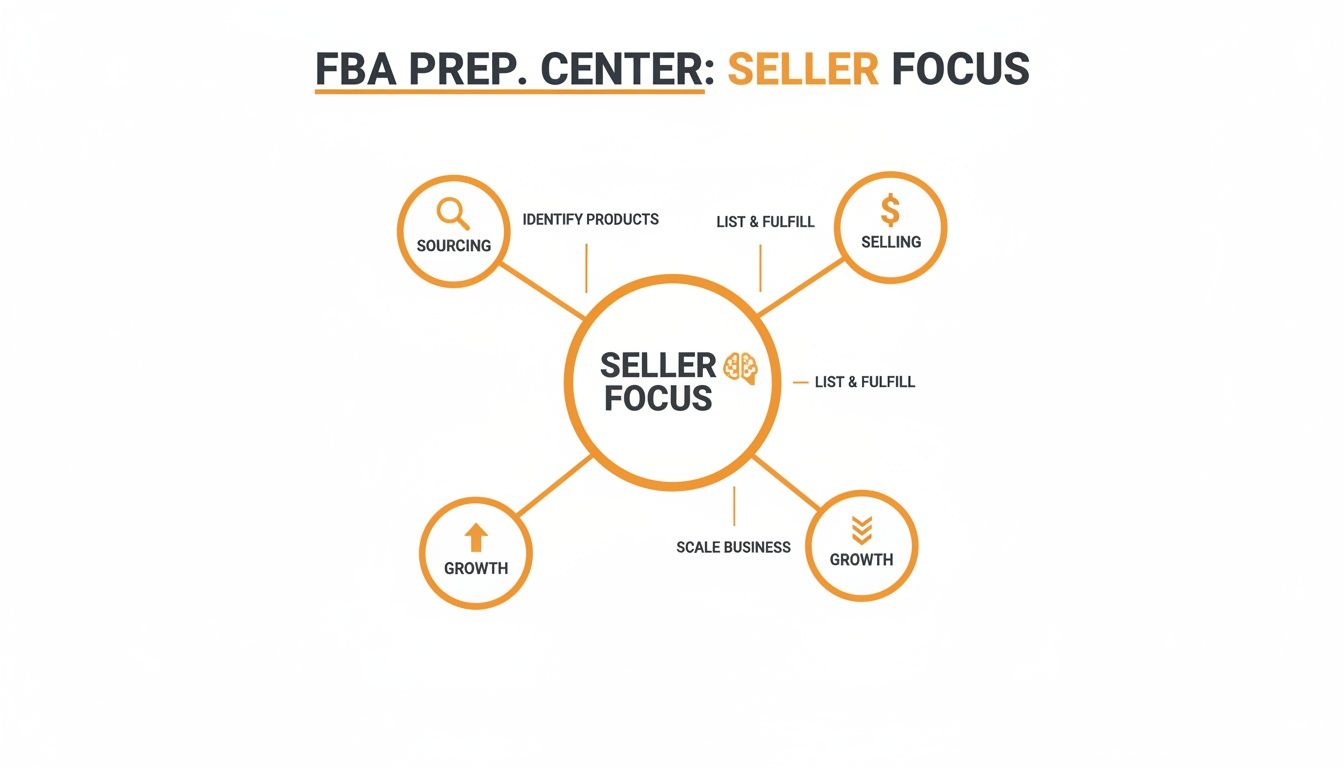
Handing this off means you can stop worrying about the operational weeds and start focusing on what really grows your business: sourcing, selling, and scaling.

Diagram illustrating Amazon FBA prep center seller focus, including sourcing, selling, and growth strategies.

As you can see, a prep center becomes the operational engine of your business, freeing you up to concentrate on the three pillars of e-commerce growth.

To give you a clearer picture, here’s a quick rundown of the most common prep services and why they are so critical for any serious Amazon seller.


Service What It Achieves Problem It Solves
FNSKU Labeling Assigns a unique Amazon ID to each product unit. Prevents lost inventory, commingling, and incorrect payouts.
Poly-Bagging Protects items from dust, moisture, and warehouse grime. Stops products from arriving dirty or damaged.
Bubble Wrapping Cushions fragile items against drops and impacts. Avoids costly breakage and negative customer reviews.
Bundling & Kitting Creates a new, high-value product from multiple items. Increases average order value and creates unique listings.
Expiration Date Labeling Clearly marks “best by” dates for Amazon’s system. Ensures compliance for grocery, supplements, and beauty items.


These services aren’t just busywork; they are your first line of defense against costly mistakes that can derail your FBA business. Let’s break down the most important ones.

FNSKU Labeling and Barcode Management

The absolute cornerstone of all FBA prep is FNSKU labeling. An FNSKU (Fulfillment Network Stock Keeping Unit) is your product’s unique fingerprint inside Amazon’s ecosystem. It’s a special barcode that ties a specific unit directly to your seller account, making sure you get credit when it sells. Simple as that.

Without a correct FNSKU, your product is basically an orphan. It might get mixed up with another seller’s lower-quality inventory (a commingling nightmare) or, even worse, get lost in a fulfillment center black hole. A prep service meticulously applies these labels to every single item, guaranteeing they scan perfectly and track accurately.

Pro Tip: Don’t think of FNSKU labeling as just another rule. It’s your official claim of ownership on every unit you send to Amazon. Getting this step right is the single most important thing you can do to protect your inventory and get paid.

For a deeper dive, check out our guide on how to prepare and label your products for FBA like a pro.

Protective Packaging: Poly-Bagging and Bubble Wrapping

Beyond labeling, protecting your products is everything. Amazon’s warehouses are fast-paced, industrial environments. Your items will get tossed around. This is where the right protective packaging makes all the difference.

  • Poly-Bagging: This is mandatory for tons of products, from t-shirts to plush toys. A poly bag keeps items safe from dust, dirt, and moisture. Amazon has specific rules, too—the bag must have a certain thickness and a clear suffocation warning label if the opening is over 5 inches.
  • Bubble Wrapping: For anything fragile—glass jars, ceramics, delicate electronics—bubble wrap is non-negotiable. A good prep center knows exactly how much padding an item needs to survive Amazon’s dreaded drop tests and prevent expensive breakage.
  • Cap Sealing: If you sell liquids like supplements or cosmetics, you need to make sure the caps are securely taped or sealed. A single leak can damage a whole pallet of other sellers’ inventory, leading to hefty penalties for your account.

Bundling and Kitting for Higher Value

One of the smartest and most profitable services a prep center offers is bundling or kitting. This is where you combine several different products into a single, ready-to-sell unit. Think of creating a “Grill Master’s Kit” by packaging BBQ sauce, a set of tongs, and a meat thermometer together.

This strategy is a game-changer. It can dramatically increase your average order value and create a unique product listing that competitors can’t just copy. A prep center handles all the assembly, creates a new master package, and applies a single FNSKU label to the final bundle.

This service turns a few individual SKUs into a much higher-value product, all without you ever lifting a finger. It’s one of the best ways to stand out and boost your margins on the platform.

Mastering Amazon’s Strict FBA Compliance Rules

Amazon’s fulfillment network is a logistics marvel, a massive machine that moves millions of products every single day. To keep that machine humming, Amazon has a set of non-negotiable rules for every item that enters its fulfillment centers. Think of these FBA prep requirements less like guidelines and more like the hard-and-fast laws of their universe.

Every rule, no matter how small it seems, is there for a good reason. That suffocation warning on a poly bag isn’t just bureaucratic red tape; it’s a vital safety measure. The specific way they require you to tape liquid containers prevents a single leaky shampoo bottle from ruining an entire pallet of inventory—both yours and other sellers’. It’s all about maximizing warehouse efficiency, keeping employees safe, and making sure the customer gets a perfect product every time.

Breaking these rules comes with consequences that are both swift and expensive. It’s never a matter of if you’ll get caught, but when.

The High Cost of Non-Compliance

Ignoring or misinterpreting Amazon’s FBA rules is one of the quickest ways to watch your profits evaporate. The penalties aren’t just a slap on the wrist; they’re designed to be painful enough to ensure sellers get it right, protecting the integrity of the entire system.

When a shipment that isn’t compliant arrives at an Amazon facility, a few things can happen, and none of them are good for your business:

  • Inventory Holds: Your products are pulled aside and stuck in a logistical purgatory while Amazon sorts out the problem. While this is happening, your listing shows “out of stock,” your sales rank tanks, and your competitors are more than happy to pick up your lost sales.
  • Unplanned Prep Fees: Amazon’s team will fix your mistakes for you, but they’ll send you a hefty bill for their trouble. These “unplanned service fees” are significantly higher than what any third-party prep center would charge, cutting directly into your bottom line.
  • Shipment Rejection: For more serious issues, Amazon will just refuse the entire shipment. It gets sent back to you at your expense, and then you have to pay to fix everything and pay to ship it all back in again. You just doubled your inbound shipping costs.

“One compliance mistake can cost you a month of lost sales. The penalties are swift, and the impact on your inventory availability and account health can be devastating.”

Ultimately, repeated problems can lead to the worst-case scenario: a suspension of your FBA privileges or even your seller account. In Amazon’s eyes, if you can’t follow the rules, you’re a risk to their operation.

Why a Prep Partner Is Your Compliance Insurance

This is exactly where professional amazon fba prep services are a game-changer. They do more than just pack boxes; they are your insurance policy against compliance headaches. A good prep partner lives and breathes Amazon’s constantly changing rulebook. Their entire business is built on mastering these details so you don’t have to.

They’re experts in the little things that trip up most sellers:

  • Label Placement: Making sure FNSKU labels are perfectly placed, fully covering old barcodes, and scannable every time.
  • Material Specs: Knowing the exact thickness required for poly bags or the right kind of dunnage for fragile items.
  • Expiration Dates: Applying date labels in the precise format and font size Amazon demands for grocery or beauty products.

A dedicated prep partner follows every update in Seller Central, so they see changes coming and make sure your inventory is always compliant. For sellers trying to keep up, especially with major updates like Amazon’s new packaging and prep guidelines for 2025, a prep partner isn’t a luxury. It’s a critical part of building a scalable and resilient e-commerce business, shielding you from the financial drain of compliance issues so you can focus on growing your brand.

The Strategic Payoff of Outsourcing FBA Prep

Man analyzing e-commerce data on a laptop, with a stack of Amazon boxes, indicating online business.

It’s easy to look at Amazon FBA prep services as just another cost on your P&L sheet, but that completely misses the point. You’re not just paying someone to stick labels on boxes. You’re making a strategic choice to shift your role from a warehouse packer to a brand builder—and that’s a powerful lever for growth.

Think about the classic seller story: spending 15-20 hours every single week drowning in bubble wrap, inventory counts, and FNSKU labels. That’s nearly half a workweek spent on tedious tasks that don’t actually make you money. Handing this work off doesn’t just buy you time; it buys you opportunity. You get those hours back to focus on what matters—product research, marketing, and staying ahead of your competition.

It’s the difference between working in your business and working on it. You turn an operational bottleneck into a launchpad for your next big move.

Slashing Overhead and Gaining Financial Flexibility

One of the first things you’ll notice is the complete disappearance of physical infrastructure costs. Setting up your own prep operation is a huge capital investment. You need warehouse space, shelving, packing stations, label printers, and a never-ending supply of materials.

More importantly, you need people. Hiring, training, and managing staff comes with payroll, insurance, and administrative headaches. By partnering with a prep center, you sidestep all of it.

You get immediate access to a fully equipped, professionally staffed warehouse without spending a dime on rent, equipment, or employee benefits. This flips a massive fixed cost into a predictable, variable expense that scales directly with your sales.

This model is just plain smarter. During slow months, your prep costs are minimal. When sales explode during Q4, you don’t have to scramble to hire temps; your partner simply handles the surge.

Achieving Instant and Effortless Scalability

Seasonal peaks and surprise sales spikes are a nightmare when you’re handling your own prep. One good marketing campaign can turn your garage into an impassable maze of boxes, creating a massive shipping logjam that kills your momentum.

An FBA prep service gives you scalability on demand. Their entire operation is built to handle fluctuating volumes from hundreds of clients. Your Q4 rush is just another Tuesday for them.

This operational elasticity gives you a few key advantages:

  • Conquer Peak Seasons: Attack major sales holidays like Black Friday with total confidence, knowing your logistics can handle a 10x increase in order volume without a hiccup.
  • Launch Products Faster: Send huge initial inventory orders straight from your supplier to your prep partner, getting new products live on Amazon faster to capture those crucial early sales.
  • Pursue Bigger Deals: Say “yes” to wholesale opportunities or large B2B orders that would have otherwise buried your in-house capacity.

Leveraging Specialized Expertise to Prevent Costly Errors

Finally, a dedicated prep partner brings deep expertise to the table. These guys live and breathe Amazon’s complex and constantly changing compliance rules. As FBA grows, so does its complexity. In 2025, an estimated 82% of Amazon’s 2.5 million active sellers used FBA, creating a massive, competitive ecosystem where getting the details right is everything. With 58% of FBA sellers hitting profitability in their first year, having your logistics dialed in is a clear advantage, especially as Amazon’s fees continue to climb. You can find more FBA seller statistics on redstagfulfillment.com.

This expertise is your shield against expensive mistakes. A single compliance error can lead to rejected shipments, surprise fees, and weeks of lost sales while your inventory sits in limbo. A professional prep team makes sure every label is perfect, every poly bag has the right warning, and every bundle is secure—safeguarding your revenue and your account health.

How to Choose the Right FBA Prep Partner

Picking an FBA prep partner is a lot like hiring a new team member. The right one becomes an invisible, invaluable part of your operations, making sure your inventory flows into Amazon without a hitch. But the wrong one? They can create costly delays, compliance headaches, and logistical nightmares you’ll be stuck fixing.

Your goal isn’t just to find a vendor who slaps labels on boxes. You need a real partner who gets your business, communicates clearly, and can keep up as you grow. It all starts with asking the right questions and knowing what to look for in their answers.

Evaluating Key Service Metrics

Before you even jump on a call, you should have a mental checklist of your non-negotiables. A professional amazon fba prep services provider will be upfront and transparent about these core metrics.

Here’s what you absolutely need to nail down:

  • Guaranteed Turnaround Times: How fast can they get your inventory received, prepped, and ready for an Amazon truck? A solid partner should promise a 24-72 hour turnaround. Anything more than that, and you risk going out of stock.
  • Transparent Pricing Structure: Vague pricing is a major red flag. Ask for a detailed price list that breaks down the cost for every single service—labeling, poly-bagging, bundling, even the materials they use. Keep an eye out for sneaky fees for things like receiving, storage, or account management.
  • Strategic Location: Where are their warehouses? A prep center located near major coastal ports or Amazon’s key fulfillment centers can drastically cut down your inbound shipping costs and speed up transit times.
  • Software and Integration: What system do they use to manage your inventory? You want a partner with a modern software platform that gives you a real-time window into your stock and, ideally, integrates directly with your Seller Central account.

Asking the Right Questions

Once a potential partner ticks all the basic boxes, it’s time to dig deeper. The answers to these questions will show you how they really operate, especially when things don’t go according to plan.

A great prep partner doesn’t just promise perfection; they have clear, proven processes for handling imperfection. Their ability to manage exceptions—like damaged goods from a supplier or an unexpected inbound delay—is what separates the professionals from the amateurs.

Show up to that first meeting ready with a few pointed, scenario-based questions:

  1. Communication on Inbound Issues: “What’s your exact process if a shipment from my supplier shows up with crushed boxes or the wrong number of units?” A good answer involves immediate photo proof, email alerts, and a clear protocol for what happens next.
  2. Handling Damaged Goods: “If you find damaged products during your inspection, what are my options? Can you dispose of them, ship them back to my supplier, or just set them aside for me?” You’re looking for flexibility here.
  3. Managing Amazon Compliance Errors: “Let’s say Amazon flags a shipment you prepped for a compliance issue. How do you investigate and fix it? Do you take any responsibility?” This question cuts right to their level of accountability.
  4. Scaling for Peak Season: “How do you handle the Q4 rush? What guarantee do I have that my turnaround times won’t double during the holidays?” They need a solid plan for hiring seasonal staff and scaling their operations.

By focusing on these practical details, you can confidently choose a partner who will truly support your growth. To learn more about how a 3PL can streamline this process, explore our complete guide to using a 3PL for Amazon FBA prep.

Partnering with Snappycrate to Scale Your Brand

A worker in a high-vis vest and cap inspecting boxes on a conveyor belt in a logistics facility.

Choosing the right amazon fba prep services provider isn’t just about finding a warehouse. It’s about finding a team that gets what’s really on the line—your inventory, your cash flow, and the reputation you’ve worked so hard to build.

At Snappycrate, we get it because we’re e-commerce sellers, too. We’ve lived the late nights and frustrating logistics puzzles that come with scaling a brand. We built our services from the ground up to solve the real problems that keep sellers like you from growing.

This isn’t just a list of services; it’s our commitment to being a true operational partner. We look past the individual boxes and labels to see how flawless prep and fulfillment can fuel your bigger vision.

Differentiators That Drive Real Growth

We’ve built our entire operation around solving the biggest headaches for growing brands. These aren’t just add-ons; they’re core capabilities designed to give you a serious competitive edge.

  • Full Container Processing: Sourcing directly from overseas is a huge milestone. We’re fully equipped to receive and process your 20-foot or 40-foot containers, breaking them down and prepping everything for FBA. You can skip the hassle and expense of finding a separate cross-docking facility.

  • Multi-Channel Fulfillment: Your brand doesn’t live only on Amazon, and neither do we. We offer seamless fulfillment for your Shopify and Walmart stores, managing all your inventory from one unified hub. Simple.

  • Custom Brand Experiences: We help your brand pop with custom packaging, kitting, and branded inserts. It’s all about creating that memorable unboxing experience that turns a one-time buyer into a loyal fan.

This holistic approach means we can support your brand’s journey from its first pallet to its first full container, and across every sales channel you add along the way.

A Partnership Proven by Results

The real measure of a great partnership is in the results. Just ask our clients.

One of our partners was getting hammered by inbound compliance errors, leading to costly delays and chargebacks from Amazon. After they made the switch to Snappycrate, they hit 100% error-free FBA shipments. Those fees vanished, and their inventory check-in times got a whole lot faster.

Another client was staring down a chaotic Q4, terrified their old provider couldn’t handle the holiday rush. We stepped in and helped them triple their order volume during the peak season without a single hiccup. They captured every possible sale.

Your prep partner shouldn’t just be a defensive measure to prevent problems. They should be an offensive asset that actively enables growth. The right partnership transforms your supply chain from a potential headache into a powerful tool for scaling your brand.

With major industry shifts coming, having a reliable partner is more critical than ever. Amazon just announced they are ending their own FBA prep services on January 1, 2026. This move is about to send over 400,000 sellers scrambling for new solutions. By getting a proven, growth-focused partner like Snappycrate in your corner now, you’re not just getting ahead of the curve—you’re securing a massive strategic advantage. You can read more about this industry shift at zimark.io.

Got Questions? We’ve Got Answers

Stepping into the world of FBA prep services can bring up a few questions. We get it. Here are the straight-up answers to the most common things sellers ask before they hand over this crucial piece of their business.

How Much Do FBA Prep Services Actually Cost?

Most prep centers work on a “per-touch” pricing model, which usually lands somewhere between $0.50 and $2.00 per item. A simple job, like slapping an FNSKU label on a product, is going to be on the low end of that range.

The price starts to climb when you need more complex work. Think about things like:

  • Creating product bundles or multi-packs
  • Bubble wrapping fragile items
  • Adding special inserts or marketing materials

Before you commit, always ask for a complete pricing sheet that breaks down every possible fee, like receiving, short-term storage, or the cost of materials. A good partner will give you a clear, all-in quote based on what you actually need.

Here’s a solid rule of thumb: every single time a worker has to physically handle or “touch” your product to do something, it adds to the cost. That’s why a simple label is always cheaper than building a multi-item bundle.

What’s a Realistic Turnaround Time?

You should expect a turnaround time of 24 to 72 hours. That clock officially starts ticking the moment your inventory hits the prep center’s loading dock and stops when it’s fully prepped and waiting for an Amazon-partnered carrier to pick it up.

Of course, this can shift depending on how complex your prep job is and the sheer size of your shipment. It’s super important to confirm the service level agreement (SLA) with your provider upfront. A partner you can count on will be transparent about their current processing times so there are no surprises.

Can I Use a Prep Center if I Source Products Internationally?

Absolutely. In fact, this is one of the biggest strategic moves you can make as a seller. Many brands ship products directly from their manufacturer in China or elsewhere straight to a US-based prep center like ours. We then become your team on the ground, handling everything from quality checks to making sure every last box is FBA-compliant.

This single move can save you a massive amount of time and money. You get to skip the incredibly expensive and slow step of shipping everything to your own office, only to turn around and send it right back out to Amazon’s warehouses. It’s a game-changer for streamlining a global supply chain.


Ready to stop wrestling with prep work and start focusing on growing your brand? The team at Snappycrate has the experience and the setup to scale right alongside you. See how our FBA prep services can make your operations run smoother.

0 Continue Reading →