Skip to Content

Blog Archives

Automated Inventory Tracking: Cut Stockouts and Boost Online Profits

If you're still relying on spreadsheets to track your inventory, you know the feeling. A big sale kicks off, the orders start rolling in, and you're just hoping the numbers in front of you are accurate. That uncertainty is the quiet tax you pay for manual inventory management—a system that seems to work just fine until, all at once, it doesn't.

The Hidden Costs of Manual Inventory Management

Picture this: you launch a hot new product. Orders are flying in from your Shopify store, Amazon, and Walmart at the same time. Your team is scrambling to keep the master inventory sheet updated, but there's a lag. It's only a few minutes, but it's enough.

Before you know it, you've sold 100 units that you don't actually have in stock. Now you're facing a tidal wave of angry customer emails, canceled orders, and bad reviews that stain your brand's reputation. This isn't just a worst-case scenario; it's the inevitable result of a disconnected, lagging system.

From a Blurry Photo to a Live Video Feed

Trying to run a business with manual inventory tracking is like navigating with a blurry photo of your warehouse that was taken last Tuesday. It gives you a static, outdated snapshot. You might have seen 500 units of your top-seller on Monday, but by Thursday, that number is pure fiction.

Automated inventory tracking, on the other hand, is like having a continuous, high-definition video feed of your entire operation. It's a live, accurate view of every single item you own, at every moment, across all your warehouses and sales channels.

An automated system gets rid of the guesswork that leads to those expensive, brand-damaging mistakes. Instead of just reacting to problems after they’ve already happened, you gain the foresight to prevent them completely. Your inventory stops being a constant liability and starts becoming a strategic asset.

This shift is everything when it comes to scaling your business. When you can trust your inventory data, you can run promotions with confidence, expand to new marketplaces without fear, and make much smarter purchasing decisions. You stop tying up cash in overstocked products that just collect dust and stop losing sales because your best-sellers went out of stock unexpectedly. For a deeper dive into foundational principles, you can learn more about inventory management best practices in our detailed guide.

The True Price of Inaccuracy

The fallout from manual errors goes way beyond a single oversell. It creates a domino effect that can destabilize your entire business.

  • Wasted Labor: Every hour your team spends doing manual cycle counts or trying to reconcile conflicting spreadsheets is an hour they aren't spending on marketing, product development, or actually helping your customers.
  • Poor Capital Allocation: Without real-time data, you're flying blind. You’re far more likely to sink money into slow-moving products while completely missing out on restocking your proven winners.
  • Damaged Customer Loyalty: Nothing kills customer trust faster than a canceled order. In fact, 88% of consumers say they are less likely to buy from a brand again after a bad fulfillment experience.
  • Operational Bottlenecks: Bad counts lead to disorganized warehouses, inefficient picking routes, and slow fulfillment times. It puts a hard ceiling on how many orders you can physically get out the door each day.

Ultimately, manual tracking creates friction at every single turn. Moving to automated inventory tracking isn't just about getting new software; it's about building a resilient, scalable foundation that your e-commerce business can actually grow on.

How Automated Inventory Tracking Systems Work

If you’ve ever tried to manage inventory with a spreadsheet, you know the feeling of chasing numbers that are already out of date. Automated inventory tracking swaps that manual guesswork for a coordinated system where every component works together, turning physical products into reliable digital data.

Think of it as a complete operational upgrade. It closes the gap between what's on your shelves and what's in your system, eliminating the human error that leads to costly mistakes.

The whole process starts by giving each of your products a unique identity.

Barcodes and QR Codes: The Digital Fingerprints

The bedrock of any automated system is giving every single item a unique "digital fingerprint." That's exactly what barcodes and QR codes do. Just like a real fingerprint, each code is one-of-a-kind and stores specific, machine-readable information—like a product’s SKU, batch number, or expiration date.

This simple tag transforms a generic box into a trackable asset. When a new shipment arrives, each item gets its fingerprint and is officially logged into your digital ecosystem. From that moment on, every move it makes can be recorded with perfect accuracy.

Scanners: The Eyes of the Operation

If barcodes are the fingerprints, then handheld scanners and mobile devices are the sharp "eyes" of your warehouse. When an employee scans an item during receiving, picking, or packing, the device instantly reads the barcode and sends the data back to your central system. It’s the digital version of a tally mark, but it happens in a split second with zero chance of a typo.

These scanners capture data at every critical point in your workflow, from the receiving dock all the way to the outbound shipping station. This constant flow of information builds a complete history of every item’s journey through your facility.

Without these digital eyes, businesses are forced to rely on manual counts, which is a direct path to the problems shown below.
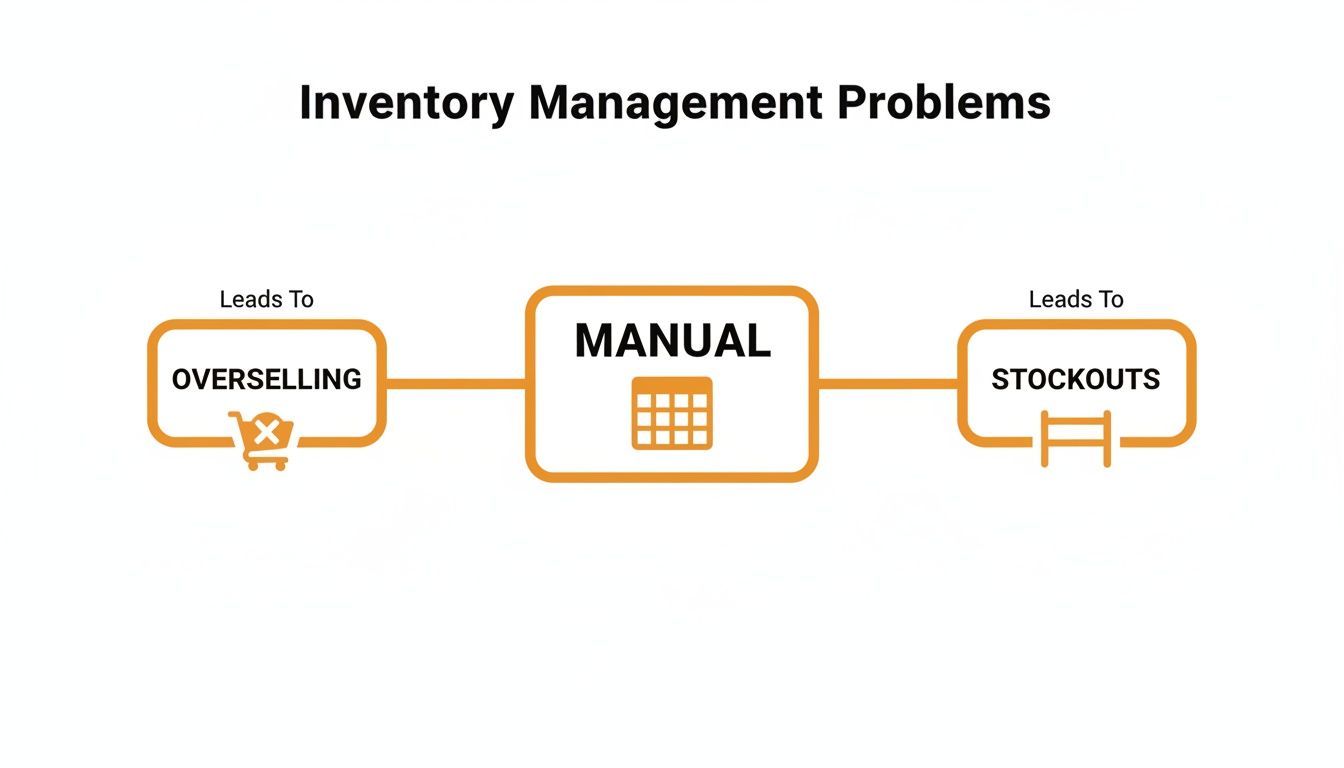
Infographic showing how manual inventory management leads to common problems like overselling and stockouts.

As you can see, a lack of automated data capture is what causes expensive issues like overselling products you don't have and running out of stock unexpectedly.

RFID: The E-ZPass for Your Warehouse

Barcodes are great, but they need a direct line of sight to be scanned. Radio-Frequency Identification (RFID) technology takes things a huge step forward. Think of it like an E-ZPass system for your inventory—you don't need to stop and aim.

An RFID tag contains a tiny chip and antenna that can be read from a distance. This means a warehouse worker can walk down an aisle with a reader and capture data from hundreds of tagged items at once, instead of scanning one box at a time. It’s a game-changer for doing fast, bulk inventory counts.

Warehouse Management System: The Central Brain

All that data from scanners and RFID readers has to go somewhere. This is where a Warehouse Management System (WMS) comes in—it’s the "central brain" of your entire operation. This software platform is where every piece of inventory data is received, processed, and organized in real time.

Your WMS becomes the single source of truth for your business. It knows:

  • How many units of every SKU you have.
  • The exact location of each item in the warehouse.
  • Which products are getting close to their expiration dates.
  • When you need to reorder to prevent a stockout.

This central hub is what powers your e-commerce engine. By integrating with sales channels like Shopify or Amazon, the WMS automatically subtracts inventory as orders come in, preventing you from selling items you don't have. You can finally trust your numbers. To dig deeper, check out our guide on real-time inventory management.

The Business Benefits of Automating Your Inventory

Knowing how scanners and software talk to each other is one thing. But the real magic of automated inventory tracking is what it does for your bottom line. Switching from manual methods isn't just a tech upgrade; it's a strategic move that directly boosts profitability, builds customer loyalty, and gives you the power to scale.

The cost of a simple manual error is often invisible until it’s a full-blown disaster. Inventory management mistakes quietly bleed cash from e-commerce businesses everywhere. In fact, inventory distortion—which includes both running out of stock and having way too much—costs retailers a mind-boggling $1.77 trillion globally. Businesses that adopt automated solutions see a massive difference, often cutting stock discrepancies by up to 30%. That means fewer stockouts and fewer angry customers trying to buy products you don't actually have. You can see more on these findings in this automated inventory management report from Quicksync.pro.
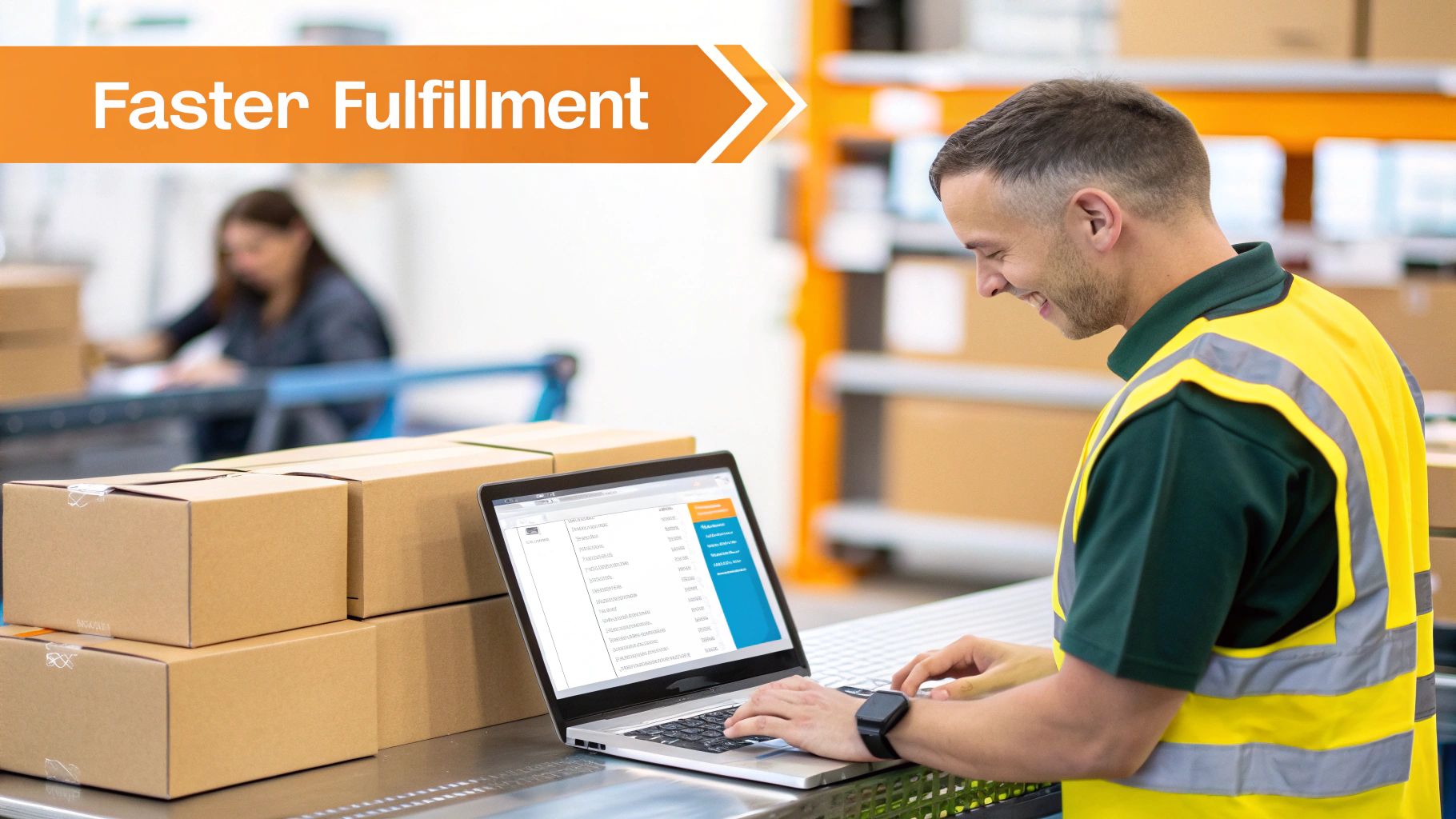
Warehouse worker uses a laptop for faster fulfillment of orders, surrounded by boxes.

Before we dig deeper, let’s quickly compare the old way versus the new way.

Manual vs Automated Inventory Tracking at a Glance

The table below paints a clear picture of just how different these two approaches are, highlighting the massive operational and financial gains that come from automation.

Feature Manual Tracking Automated Tracking
Data Entry Pen, paper, spreadsheets. Prone to typos and delays. Barcode/RFID scanners. Instant and error-free.
Accuracy Often below 95%. Small mistakes compound over time. Pushes 99% or higher. Consistent and reliable.
Labor Cost High. Hours spent counting and reconciling inventory. Low. Frees up staff for high-value tasks.
Visibility Days or weeks old. A snapshot of the past. Real-time. See stock levels the second they change.
Fulfillment Speed Slow. Staff must manually locate items. Fast. Optimized picking paths and instant verification.
Decision Making Based on old data and gut feelings. Risky. Data-driven. Smart purchasing based on live trends.

As you can see, the difference isn't just about speed; it's about control, insight, and ultimately, profitability. Now, let’s break down exactly where you'll see these benefits.

Eliminate Costly Human Error

Every time a number is typed into a spreadsheet, there's a chance for a mistake. A simple typo can send the wrong item to a customer, kicking off a chain reaction of costly returns, wasted shipping fees, and a seriously unhappy buyer. A miscount during receiving can create "phantom stock," leading you to sell products that aren't actually on the shelf.

Automation kills these risks at the source. When a barcode is scanned, the right data is captured instantly and perfectly, every single time. This kind of precision stops the small, silent errors that chip away at your profit margins day after day.

Unlock Significant Labor Savings

Think about all the hours your team spends on manual inventory chores. Walking the warehouse with a clipboard, fighting with spreadsheet formulas, and trying to figure out why your Shopify numbers don't match your Amazon numbers. These are low-value, repetitive tasks that burn through payroll without adding a dime to your growth.

By automating this grunt work, you free up your team’s most valuable asset: their time. Instead of counting boxes, they can focus on work that actually moves the needle—like improving customer service, finding better suppliers, or launching a new marketing campaign. This turns your labor cost from a necessary evil into a strategic investment.

The goal isn't just to do the same tasks faster; it's to reallocate your human capital toward activities that a machine could never perform—like building relationships and creating value for your customers.

Drastically Improve Order Fulfillment

In e-commerce, speed and accuracy are the name of the game. Customers expect their orders to be right and to show up fast. Automated inventory tracking is the engine that powers a reliable fulfillment machine.

When an order hits, the system knows exactly where to find each item in the warehouse, instantly generating the most efficient picking route for your team. This slashes the time it takes to grab products and get an order ready. Better yet, verification scans at the packing station make sure the right items go into every box, pushing your order accuracy rates toward 99% and beyond.

This operational excellence translates directly into a better customer experience. Fast shipping and perfect orders build the kind of trust that creates repeat customers—the bedrock of any lasting brand.

Make Smarter Purchasing Decisions

One of the biggest wins from real-time data is the power to see trends as they're happening. An automated system gives you a crystal-clear, up-to-the-minute picture of how fast every single one of your SKUs is selling.

This newfound visibility allows you to:

  • Prevent Stockouts: Set smart reorder points that automatically tell you when it's time to restock a hot seller, so you never miss a sale.
  • Avoid Overstocking: Easily spot slow-moving products and stop tying up your cash in stuff that just sits there.
  • Optimize Cash Flow: Make confident, data-backed decisions on where to put your purchasing dollars for the biggest return.

At the end of the day, automated inventory tracking turns your inventory from a source of stress into a powerful strategic asset. It gives you the control, accuracy, and insight you need to run a leaner, more profitable, and scalable e-commerce business.

Integrating Your Systems for Seamless Operations

An automated inventory system is a huge leap forward, but its real power is unlocked when you connect it to the rest of your e-commerce world. If your inventory data is stuck in a silo, it can't talk to the platforms where you actually sell. This is where integrations come in—they're the critical link for creating a truly hands-off operation.

These connections are made possible by Application Programming Interfaces (APIs). Think of an API as a dedicated messenger that runs back and forth between your warehouse management system (WMS) and your online store. Its only job is to make sure both sides have the exact same information, all the time.

When your systems are hooked up like this, your business stops feeling like a collection of separate parts and starts acting like a single, well-oiled machine.

Connecting Your E-Commerce Platform

For any brand selling directly to consumers, the first and most important integration is with your e-commerce platform. Whether you’re on Shopify, BigCommerce, or something else, a direct API link is non-negotiable if you want real-time accuracy.

Here’s a simple breakdown of how it works:

  1. A customer buys one of your best-sellers on your Shopify store.
  2. The API instantly shoots that sales data from Shopify over to your WMS.
  3. Your WMS immediately deducts that unit from your master inventory count.
  4. The API then updates the stock level right back on your Shopify product page.

This entire loop happens in a matter of seconds, without anyone lifting a finger. It’s this instant sync that makes overselling a thing of the past. Your website will never show an item as "in stock" when it just sold out, which protects your brand's reputation and saves you the headache of canceling orders.

Mastering Marketplace Integrations

Selling across multiple channels makes perfect synchronization even more critical. An automated inventory tracking system that plugs into marketplaces like Amazon and Walmart is a must-have for any multi-channel brand. Without it, you’re stuck manually updating inventory levels on each platform—a recipe for disaster, especially during a flash sale.

A seamless integration ensures that a sale on Amazon instantly updates your available stock on Walmart and your own website. This centralized control is the only way to scale a multi-channel strategy without constant chaos and costly errors.

This level of connectivity is also crucial for protecting your seller performance metrics. Marketplaces like Amazon are ruthless about penalizing sellers who cancel orders due to stockouts, which can tank your rankings or even get your account suspended. Automation is your best defense.

As your brand grows, it's also worth understanding what a 3PL warehouse is and how partners like us manage these complex integrations on your behalf.

Creating a Single Source of Truth

At the end of the day, the goal of integration is to create a single, undisputed source of truth for your inventory. When your e-commerce store, marketplaces, and WMS are all pulling from the same live data, every part of your business is finally on the same page.

This unified view allows you to:

  • Run Confident Promotions: Launch a flash sale knowing your inventory numbers are rock-solid across every channel.
  • Get Accurate Reporting: Pull a clean, consolidated report on sales velocity and inventory value without wrestling with a dozen spreadsheets.
  • Operate Efficiently: Your warehouse team gets orders instantly, and your marketing team knows exactly what’s available to promote.

Integration isn't just a technical add-on; it's the backbone of a modern, scalable e-commerce business. It turns your automated inventory system from a simple counting tool into the central nervous system of your entire operation.

Your Roadmap to Implementing Automation

Making the jump to automated inventory tracking can feel like a huge project, but breaking it down into a clear roadmap makes it completely manageable. This isn't just about buying fancy new scanners; it's about building a rock-solid operational backbone for your entire business. And the journey starts not with technology, but with a hard look at what you already have.

Three professionals collaborate on a digital implementation plan using a tablet, stylus, and whiteboard in an office.

Conduct an Initial Inventory Audit

Before you can even think about automating, you need a perfectly clean slate. That means doing a full, wall-to-wall physical inventory count—it's the first, non-negotiable step. Think of it as hitting the reset button. You have to iron out every single discrepancy between what your spreadsheet says you have and what's actually sitting on your shelves.

Starting with bad data is like building a house on a shaky foundation. If your initial counts are off, your shiny new system will be wrong from day one, defeating the whole purpose. This baseline audit ensures your automated inventory tracking system kicks off with a trustworthy, 100% accurate snapshot of your stock.

Select the Right Software and Hardware

With your inventory counts squared away, it’s time to choose the tools that actually fit your business. There’s no magical one-size-fits-all solution here. The right gear depends entirely on how complex your operation is.

As you look at your options, consider these key factors:

  • SKU Count: A brand with 50 SKUs has totally different needs than one juggling 5,000. Make sure the software can handle your catalog's size without breaking a sweat.
  • Order Volume: Think about your average day versus your Black Friday peak. Your system needs to handle the pressure without crashing.
  • Sales Channels: Are you just on Shopify, or are you also selling on Amazon, Walmart, and through wholesale? Your system has to talk to all of them seamlessly.
  • Hardware Needs: Are simple barcode scanners good enough, or do you need the raw speed of RFID to handle bulk receiving and rapid cycle counts?

Choosing the right tools is all about balancing where you are today with where you want to be tomorrow.

Manage Data Migration and System Configuration

Once you've picked your system, you have to carefully transfer your product data into it. This step, called data migration, is way more than a simple copy-paste job. You'll need to map all your current data fields—like SKUs, product names, and costs—to the new system's format, making sure nothing gets lost or scrambled in the process.

Getting the configuration right is just as crucial. This is where you set up your warehouse map (aisles, shelves, and bins), define reorder points for your best-sellers, and build the rules that will run your new automated workflows. A classic mistake is rushing this stage, which almost always leads to disorganized stock and headaches down the road.

A successful implementation isn't about the tech itself, but how well it's molded to your unique operation. Taking the time to dial in every detail at the start will save you countless hours of troubleshooting later.

Train Your Team and Standardize Procedures

Technology is only half the battle; your team is the other half. They need to be trained not just on how to point a scanner, but on the why behind the new processes. You need clear, standardized procedures for everything—receiving, picking, packing, and returns—to ensure everyone is on the same page.

This is all about change management. Show your team how the new system makes their jobs easier by getting rid of tedious manual counts and cutting down on frustrating errors. When your crew understands the benefits and feels confident with the new tools, you’ll get buy-in much faster.

Decide Between In-House vs. Outsourcing

Finally, you’ll come to a major fork in the road: do you build and manage all this yourself, or do you partner with an expert? For many growing e-commerce brands, working with an automation-ready 3PL like Snappycrate is simply the smarter, faster path.

Building an in-house system demands a huge upfront investment in software, hardware, and the IT staff to run it all. A 3PL partner, on the other hand, already has the entire infrastructure and expertise ready to go. This lets you get all the benefits of automated inventory tracking without the massive cost and operational drain, so you can focus on what you do best—growing your brand.

The market backs this up. The global warehouse automation market is expected to balloon to $59.52 billion by 2030, with these systems delivering up to 300% faster fulfillment and 99% accuracy. You can dig into more of these powerful warehouse automation statistics from SellersCommerce.

Frequently Asked Questions About Inventory Automation

Making the jump to automated inventory tracking is a big move, and it's totally normal to have a few questions. This isn't just about plugging in new software; it's about changing the very engine of your business. We've rounded up the most common questions we hear from e-commerce sellers to give you the straight answers you need to move forward.

Is Automated Inventory Tracking Too Expensive for a Small Business?

This is the big one, and we get it. The upfront cost for hardware and software can look steep, but you have to see it as an investment, not an expense. The real question isn't "what does it cost?" but rather, "what's it costing me not to automate?"

Think about the hidden fees you're already paying:

  • The cost of reshipping products to fix wrong orders.
  • The lost sales from going out of stock on a hot item.
  • The countless payroll hours your team spends on manual counts and fixing spreadsheets.
  • The hit your brand takes when you have to cancel an order because you oversold.

When you add it all up, the cost of human error usually blows past the price of an automation system. Modern tools are more accessible than ever, with scalable, subscription-based software that grows with you. An even smarter route? Partnering with a 3PL that already has all this tech in place. You get enterprise-level tools without the enterprise price tag.

How Long Does It Take to Implement an Automated System?

The timeline can really vary, but for a small or medium-sized business, you're typically looking at anywhere from a few weeks to a couple of months. The exact time depends on how complex your operation is, how many SKUs you carry, and how many sales channels you need to connect.

The whole process usually breaks down into a few key stages:

  1. Planning: Researching and picking the right WMS and scanners for your needs.
  2. The Big Count: Doing one last, full physical inventory count to get a perfectly clean slate. Honestly, this is often the hardest part.
  3. Data & Setup: Moving all your product info into the new system and tweaking the workflows to match how you operate.
  4. Training & Go-Live: Getting your team comfortable with the new tools and officially flipping the switch.

Rushing this is the biggest mistake you can make. A slow, methodical setup will save you a world of hurt later on and make the transition way smoother for your team.

Will Automation Replace My Warehouse Staff?

This is a common fear, but the reality is that automation doesn’t replace people—it makes them better at their jobs. Automated inventory tracking is built to get rid of the boring, repetitive, and mistake-prone tasks that slow your team down.

Think of it this way: automation frees your team from low-value work so they can focus on things that require a human brain—like quality control, finding ways to improve processes, and solving tricky problems. It elevates their roles.

Your pickers and packers get faster and more accurate. Your warehouse manager gets real data to make smart decisions. The whole operation just runs better. These tools are powerful assistants, not replacements for your team.

Can I Still Use My Existing Barcodes?

Most of the time, yes. The good news is that nearly all modern inventory systems are designed to read the standard UPC or EAN barcodes that are already on your products from the manufacturer. This makes everything a whole lot easier since you won’t have to relabel your entire inventory.

Now, if you sell products without barcodes or create your own bundles and kits, you’ll need to generate your own. Luckily, most Warehouse Management Systems (WMS) have a built-in feature to create and print unique barcode labels for your SKUs. The trick is just to get a solid process in place for labeling every single item as it comes in the door.

What Happens If the System Goes Down?

Reliability is a huge deal when you're choosing a system. Any reputable, cloud-based software provider will have crazy-high uptime rates, usually 99.9% or better. They pull this off with redundant servers and solid backup plans, so a total system failure is extremely rare.

Still, you should always have a backup plan. Here’s what that usually looks like:

  • Offline Mode: Some modern scanners can keep working even if they lose their connection, and they'll sync up all the data once they're back online.
  • Manual Fallback: Have a clear, temporary manual process your team can switch to in a worst-case scenario to keep orders flowing.
  • Good Support: Make sure your software provider has a great support team that responds quickly to fix any glitches.

While the risk is low, being prepared for a hiccup is what makes your business resilient. That's the whole point of automated inventory tracking, after all.


Ready to stop worrying about inventory and start focusing on growth? Snappycrate provides the automated inventory management and fulfillment infrastructure you need to scale your e-commerce brand without the headaches. Let us handle the logistics so you can get back to business. Learn how Snappycrate can streamline your operations today.
0 Continue Reading →

The Ultimate Guide to Real Time Inventory Management

Think of trying to navigate a busy city with a paper map printed yesterday. You'd hit unexpected road closures, get stuck in traffic jams that popped up overnight, and completely miss your appointments. For a long time, that's how e-commerce inventory worked.

Real time inventory management is your business's live GPS. It's the practice of tracking your stock levels and every single movement—sales, returns, transfers—as it happens, giving you a constantly accurate view of every item you own.

What Is Real Time Inventory Management

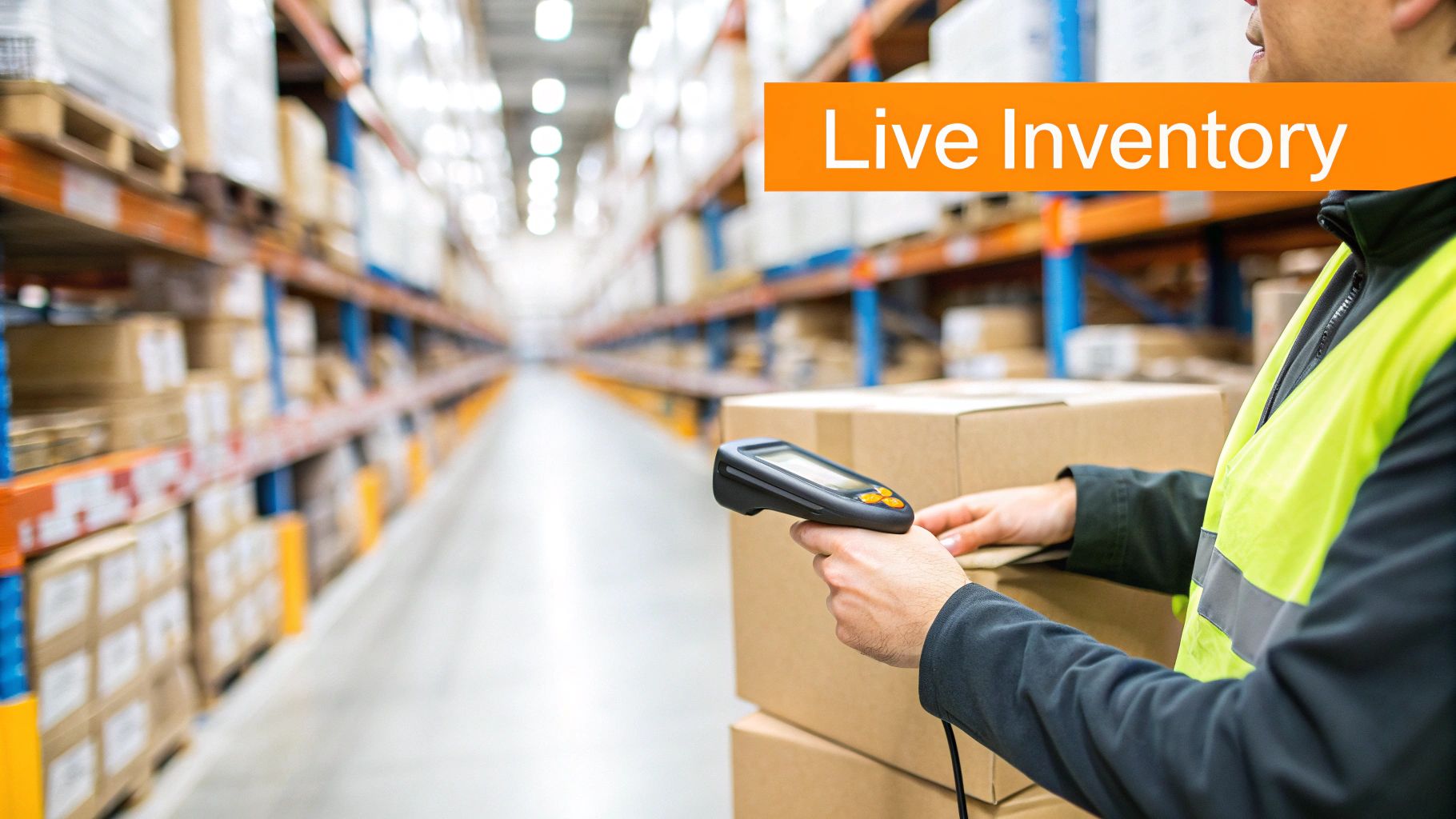
A warehouse worker scans a box with a handheld device, indicating live inventory.

Unlike old-school methods that update your stock counts periodically, a real time system ensures your data is always current. Every sale, return, or new shipment triggers an immediate update across all your connected systems.

This live, moment-by-moment picture of your entire inventory prevents the kind of costly mistakes that sink growing brands, like overselling a hot product during a flash sale or running out of stock when you thought you had plenty.

The Problem with Old-School Methods

In today's multi-channel world, legacy methods like batch updates are a recipe for disaster. Batch updates collect inventory changes over a set period—maybe a few hours, or even an entire day—and then sync everything at once.

This delay creates a dangerous information gap. If you’re running a sale, you could easily sell hundreds of units before your system even realizes you're sold out. The consequences are painful:

  • Overselling: You sell products you don’t actually have, forcing you to cancel orders and deal with angry customers.
  • Stockouts: You miss out on sales because your website incorrectly shows an item as unavailable.
  • Bad Decisions: You end up ordering new stock based on data that's already hours or days old.

The digital shelf is unforgiving. When a customer sees an item as “in stock” only to get a cancellation email later, they probably aren't coming back. Real-time visibility closes the gap between what a customer expects and what your warehouse can actually deliver.

To put it in perspective, let's compare the two approaches side-by-side.

Traditional vs Real Time Inventory Management

The difference isn't just about speed; it's about fundamentally changing how you operate your business. The table below breaks down the core differences.

Feature Traditional Inventory Management (Batch Updates) Real Time Inventory Management (Live Syncing)
Data Freshness Data can be hours or even a full day old. Data is updated instantly, within seconds of an event.
Accuracy Prone to errors due to manual entry and delays. High accuracy with automated, event-triggered updates.
Overselling Risk High. A major risk during sales or high-traffic periods. Low. Stock levels are synced across all channels immediately.
Stockout Risk High. Lagging data makes it hard to know when to reorder. Low. Live data provides accurate reorder points and low-stock alerts.
Decision Making Based on outdated information, leading to reactive choices. Based on live data, enabling proactive, strategic decisions.
Customer Experience Poor. Leads to canceled orders and customer frustration. Excellent. Ensures a reliable and trustworthy shopping experience.

The takeaway is clear: while traditional methods were once manageable, the speed and complexity of modern e-commerce demand a live, synchronized system.

A Single Source of Truth

At its core, real time inventory management creates a single, reliable source of truth for your entire operation.

When you sell a product on Shopify, your available quantity on Amazon and Walmart updates instantly. When your 3PL partner receives a new shipment, that inventory becomes available for sale across all your channels in seconds, not hours.

This synchronization is no longer a "nice-to-have"—it's a must-have for growth. For 3PLs managing inventory for brands selling across multiple marketplaces, this real-time sync is an absolute necessity to prevent chaos. You can explore more about how these evolving industry standards are critical for modern supply chains.

This live data empowers you to make smarter, faster decisions, turning what was once a logistical headache into a real competitive advantage. It's the foundation for building a scalable, efficient, and customer-focused e-commerce business.

The Engine Behind a Real-Time Inventory System

A real-time inventory system can feel like magic, but it’s really just a smart, coordinated network of technologies working together. Think of it less like a single piece of software and more like your business’s central nervous system—a team of specialists constantly talking to each other to keep every piece of data perfectly in sync.

At its core, the system needs eyes and ears on your warehouse floor. These are the tools that see physical events happen and instantly translate them into digital data. This is where it all starts.

Capturing Every Movement

Every single action in the warehouse—from a new shipment arriving from your supplier to one tiny item being picked for an order—is an "event" that has to be recorded. If you miss these events, the entire system’s accuracy starts to crumble.

The most common tools for this job are pretty straightforward:

  • Barcode Scanners: These are the trusty workhorses of any modern warehouse. Your team uses handheld scanners to zap items as they’re received, moved to a new shelf, picked for an order, or packed into a box. Each scan is an instant, error-free data entry point. No more manual spreadsheets.
  • RFID (Radio-Frequency Identification): This is the next level up from barcodes. RFID tags don't need a direct line of sight to be read, which means you can process things much faster. Imagine scanning an entire pallet of goods just by wheeling it past a reader, instead of having to scan every single box on it.

These devices make sure that what’s physically happening on the warehouse floor is immediately reflected in your digital records. This instant data capture is the first critical link in the chain.

Connecting Your Digital Storefronts

Once an event is captured, that new information has to be shared with every other system your business relies on. This is where APIs (Application Programming Interfaces) come into play.

Think of APIs as universal translators or digital messengers. They build a seamless bridge that lets different software platforms talk to each other, even if they were built by different companies. Your Warehouse Management System (WMS), for instance, uses an API to push a stock update to your Shopify store. In turn, Shopify uses an API to send a new order right back to the WMS for fulfillment. You can learn more about how a powerful WMS is the cornerstone of effective warehouse management for e-commerce.

An API is the digital handshake between your warehouse and the outside world. It ensures that a sale on Amazon doesn’t happen in a vacuum—it’s an event that your entire operation is aware of instantly.

This constant, two-way conversation is what gives you a single source of truth. Without it, your systems would just be isolated islands of information, quickly becoming outdated and totally unreliable.

Using Event-Driven Triggers

The final piece of the puzzle is what makes the system truly "real-time": event-driven triggers. This just means that updates aren't based on a clunky schedule, like refreshing data every hour. Instead, updates are triggered automatically and immediately by specific events.

Here’s what that looks like in the real world:

  1. A Customer Buys a Product: The second a customer clicks "buy" on your website, an event is triggered. An API instantly tells your WMS to decrease the available stock for that SKU by one.
  2. A Return is Processed: When a returned item is inspected and scanned back into sellable inventory, that event triggers an update, adding that unit back to your available stock across all your sales channels.
  3. New Stock Arrives: Your warehouse team scans a new shipment from your supplier. This event instantly increases your inventory levels, making those new products available for sale right away.

This isn’t about doing periodic check-ins. It’s a living, breathing network that reacts to actions as they happen, guaranteeing your inventory data is always accurate and ready for you to act on.

Unlock Growth with Real Time Inventory Control

Knowing the mechanics of a real-time system is one thing, but seeing how it actually transforms your business is another. This is where abstract ideas like APIs and data triggers turn into real revenue, happier customers, and a warehouse that just works. For e-commerce brands, real time inventory control isn't just a nice-to-have upgrade—it's a serious growth engine.

The most immediate and powerful benefit? You can finally say goodbye to overselling and stockouts for good.

Imagine your product suddenly goes viral on TikTok. A traditional, slow-moving inventory system would completely buckle under the pressure. You'd end up selling hundreds of units you don't actually have, creating a customer service disaster that could take weeks to clean up.

With a live system, every single sale—no matter which channel it comes from—instantly adjusts your available stock count. The moment the 100th unit is sold, an "out of stock" message appears on all your platforms at the same time. This simple action preserves customer trust and prevents a flood of angry emails and canceled orders.

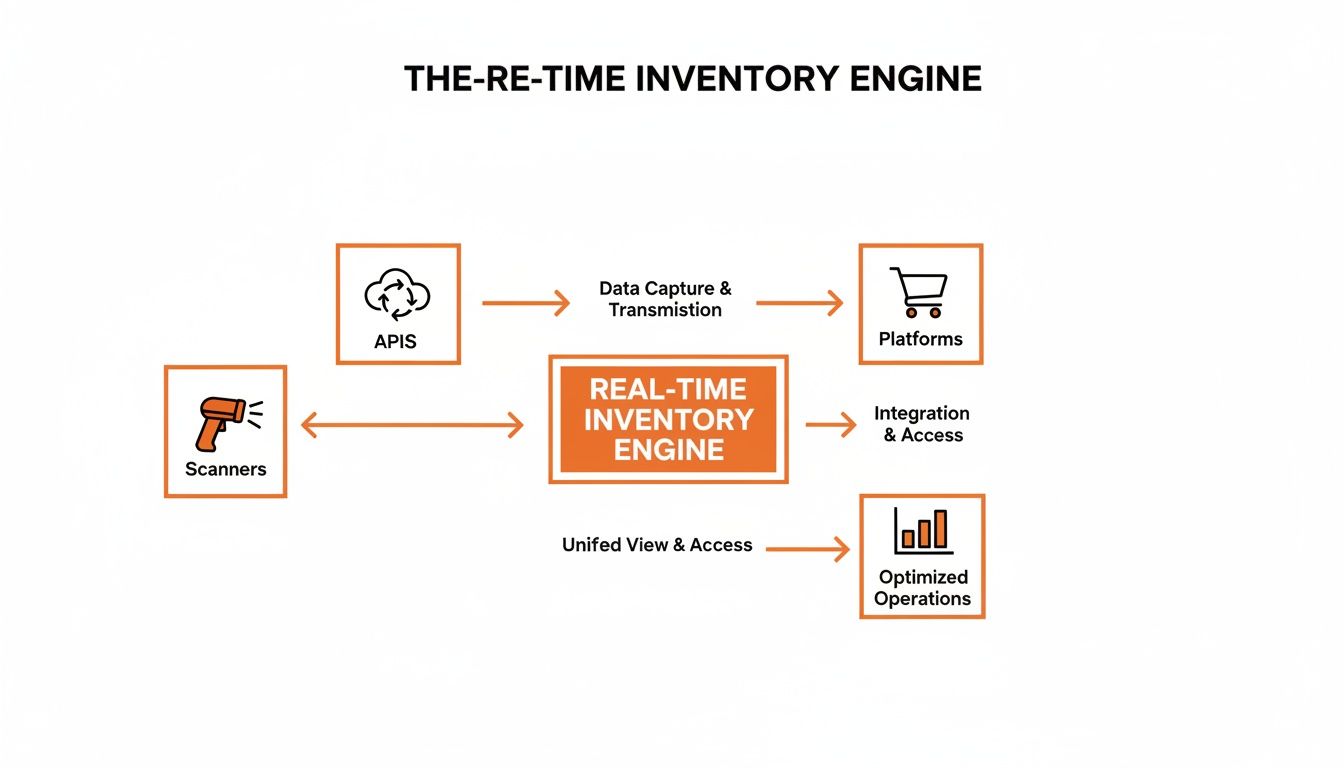
This flow shows how data travels from a physical scan in the warehouse all the way to a digital update on your storefront.

Flowchart illustrating a real-time inventory engine connecting scanners, APIs, platforms, and optimized operations.

It’s a clear picture of how your hardware, software, and sales channels have to talk to each other seamlessly to make those instant updates happen.

Drive Fulfillment Speed and Accuracy

Beyond preventing stock issues, accurate inventory data is the foundation of fast, error-free fulfillment. When your warehouse management system (WMS) knows the exact location and quantity of every single item, your whole fulfillment process becomes incredibly efficient.

  • Faster Picking: Your warehouse team gets sent to the precise bin location, which means no more wasted time searching for products.
  • Fewer Errors: Barcode scanning at the packing station confirms that the right items are going into each box, slashing mis-picks and expensive returns.
  • Improved Order Throughput: With smoother workflows, your team can process more orders every hour, helping you hit tight shipping deadlines and keep customers happy.

When people consistently get the right items on time, they start to trust your brand. That trust has a direct impact on how often they come back and how much they spend over time.

Smarter Decisions and Lower Costs

Live inventory data gives you the clarity you need to make smarter, more profitable decisions. Instead of waiting for weekly reports, you’re operating with a view of your business that's updated to the minute.

Real-time inventory management moves you from being reactive to proactive. You’re no longer fixing past mistakes; you’re making intelligent decisions based on what’s happening right now.

This shift makes a huge difference to your bottom line. With a clear picture of sales velocity and current stock levels, you can stop overstocking products that aren't selling. This directly cuts your carrying costs—the money tied up in storage, insurance, and unsold goods. For more on this, you can dig into these inventory management best practices.

This level of control also helps you manage more than just stock. Real-time project tracking, when tied to inventory and team data, has become essential. Businesses now rely on live dashboards to make faster decisions because old-school tools often create blind spots between tasks and inventory.

Elevate the Customer Experience

At the end of the day, every operational improvement should come back to the customer. Real time inventory control helps build a better customer experience from the very first click.

When a shopper lands on your product page, the availability info they see is actually accurate. That small detail is a massive trust signal. It tells them your operation is buttoned-up and professional, giving them the confidence to go ahead and make the purchase.

This reliability builds a strong brand reputation, lowers cart abandonment, and helps turn one-time buyers into loyal fans. It transforms inventory from a simple logistical task into a core part of your brand’s promise to your customers.

How a Modern 3PL Enables Your Real-Time Strategy

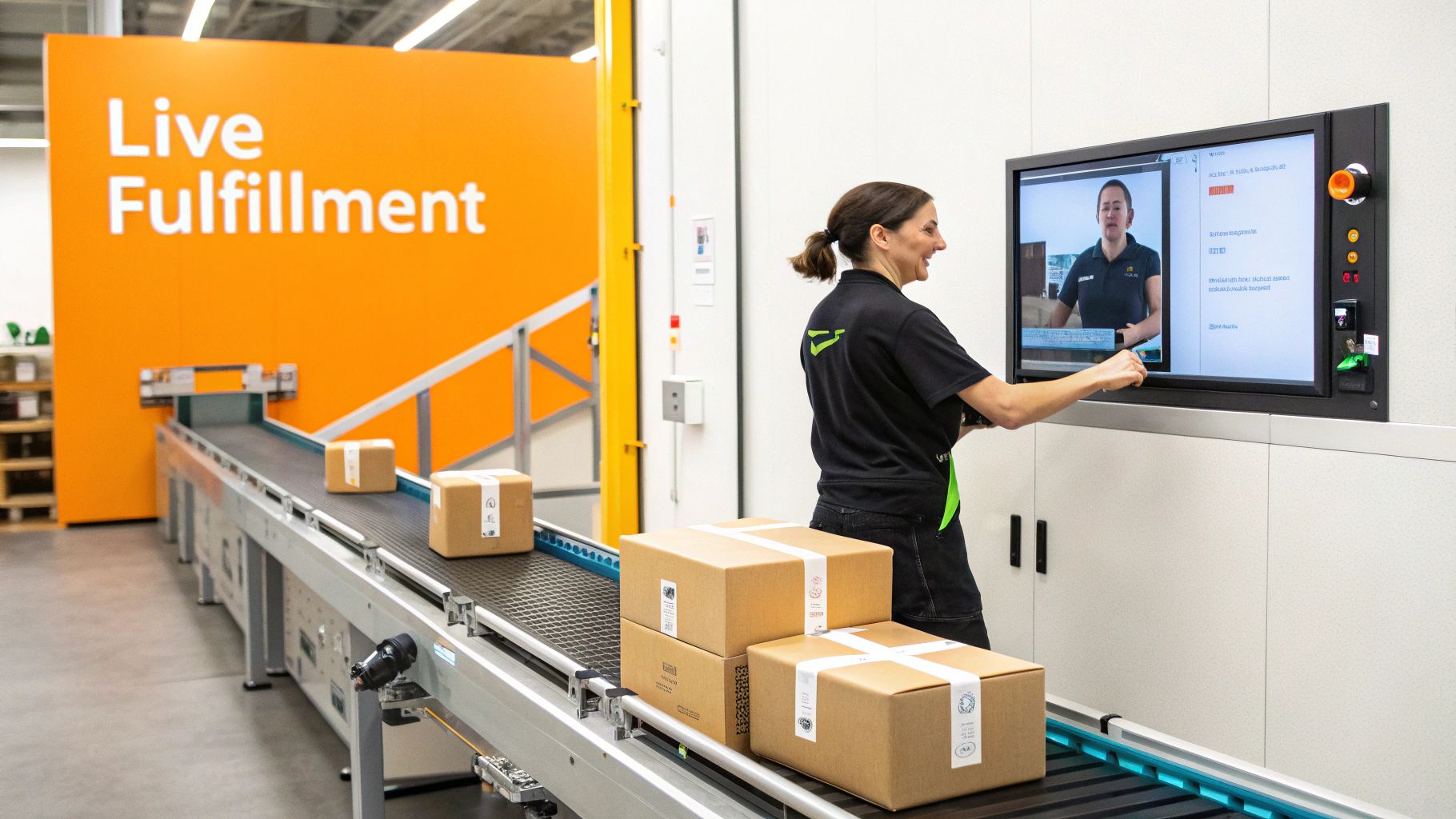
A woman operates a packing station with a conveyor belt and monitor showing video instructions in a modern fulfillment center.

Let's be honest: building a true real-time inventory management system from scratch is a massive undertaking. It demands a huge investment in warehouse space, technology, and a team of experts to run it. For most growing e-commerce brands, that's just not realistic.

This is exactly where partnering with a modern third-party logistics (3PL) provider changes the entire game. A tech-forward 3PL like Snappycrate already has the infrastructure, software, and know-how built and running. You get all the power of a sophisticated, real-time system without the crippling upfront costs and operational headaches.

Tapping into a Ready-Made Infrastructure

When you work with an advanced 3PL, you're not just renting shelf space. You’re plugging your business directly into a fully operational, real-time ecosystem. From day one, your products are managed inside a warehouse built for speed, accuracy, and scalability.

Our Warehouse Management System (WMS) is the brain of the entire operation. It's engineered to integrate seamlessly with major sales channels like Shopify, Amazon, and Walmart, creating that essential single source of truth for your inventory. You don't have to build or buy any complex software—you just connect your stores to our existing, powerful platform. If you want a deeper dive into how these facilities operate, you can learn more about what a 3PL warehouse does in our guide.

This tight integration means every single product movement—from the moment your inventory hits our dock to the second an order ships—is tracked and synced across your entire business. Instantly.

Following a Product Through Our System

To see how this works in practice, let’s follow one of your products on its journey through our fulfillment center. This path is a series of precise, scan-based events that keep your data perfectly accurate at all times.

  1. Receiving and Inbounding: Your shipment arrives. Our team inspects it and scans the barcode on every single unit. This first scan is the critical trigger—it instantly adds the new items to your available inventory, making them live for sale across all your channels.
  2. Putaway: Each item is then scanned again as it’s placed into a specific bin or shelf location. Our WMS now knows not only that you have 100 units of a product, but precisely where each one is sitting.
  3. Picking and Packing: A customer places an order. Our system immediately generates a pick list, directing a team member to the exact location. They scan the item as they pick it, and then again at the packing station to confirm it’s the right product for the right order.
  4. Shipping: The final scan happens when we print and apply the shipping label. This event triggers the final inventory deduction and automatically pushes tracking information back to your sales channel and out to your customer.

Every scan is a conversation. It's the warehouse telling your online store, "One unit has been picked for an order," or "A new shipment of 50 units is now available for sale." This constant communication is the engine of your real-time strategy.

Handling Complexity with Flawless Accuracy

A modern 3PL does far more than just pick, pack, and ship. We're built to handle complex inventory scenarios while maintaining that same level of real-time accuracy.

  • Kitting and Bundling: Selling a product bundle, like a skincare set? Our system tracks the individual components. When a bundle sells, the WMS automatically deducts one of each component from your stock, keeping your counts for individual items perfectly in sync.
  • FBA Prep: For Amazon sellers, we manage the entire FBA prep process. Every label, poly bag, and case pack is handled according to Amazon's strict, ever-changing rules. Your inventory is tracked precisely as it's prepared and updated the moment it leaves our warehouse for an Amazon fulfillment center.

By handing off these operations, you gain complete visibility and control without getting bogged down in the complex details yourself. Your 3PL becomes a true extension of your team, providing the foundation you need to scale your business with confidence.

Your Checklist for Implementing Live Inventory Tracking

Making the switch to a real-time inventory management system is a big move, but it doesn't have to be a headache. Think of this checklist as your game plan. We'll break the whole process down into manageable steps, guiding you from a simple audit all the way to a successful launch.

The first step is always getting a lay of the land. A thorough review of what you’re already doing prevents nasty surprises down the road and makes sure your new system solves real problems, not just the ones you think you have.

Phase 1: Audit and Define Your Needs

Before you can build something better, you need a blueprint of your current operation and where you want to go. This first phase is all about asking the right questions to figure out what you actually need.

  1. Audit Your Current Tech Stack: Get a clear list of every single piece of software that touches your inventory. We're talking about your e-commerce platform (like Shopify or BigCommerce), your accounting software, and yes, even those messy spreadsheets. Find the weak spots and the things that just don’t talk to each other.
  2. Define Your Sales Channels: Where do you sell? Write it all down—your own website, marketplaces like Amazon and Walmart, and anywhere else. Every single one needs to be perfectly synced.
  3. Map Your Physical Inventory Flow: Follow a product on its journey through your business right now. Trace it from the moment a shipment arrives from your supplier to the second it’s handed off to a carrier. This is how you’ll spot the real-world bottlenecks.

Once you have a crystal-clear picture of where you are today, it's time to find the right tools and people to build your future.

A successful implementation isn't about finding the "best" software. It's about finding the right combination of tech and partners that fits your unique workflow and business goals.

Phase 2: Select Your Partners and Plan the Transition

With your needs clearly mapped out, you can start looking at potential partners and technologies. This is where you pick the core pieces of your new real-time inventory system.

  • Choose the Right 3PL Partner: For most e-commerce brands, this is the most important decision you'll make. Look for a 3PL with proven, ready-to-go integrations for the channels you sell on. Don't be afraid to ask for case studies or proof that their WMS can handle your specific needs, whether it's kitting, bundling, or FBA prep.
  • Plan Your Data Migration: You need a solid plan for moving your product data (SKUs, barcodes, and current stock counts) into the new system. Work with your partner on this. A clean data import from the get-go is critical for accuracy.
  • Establish Operational Procedures: Get your Standard Operating Procedures (SOPs) down on paper. How will you handle receiving new inventory? What's the process for returns? How do you flag and fix a discrepancy? Make sure both your internal team and your 3PL are on the same page.

With your partners locked in and a clear plan in place, the final phase is all about execution, testing, and making sure it all works.

Phase 3: Go Live and Measure Success

Flipping the switch on your new system is just the beginning. The real magic happens when you start using the data to make smarter decisions and fine-tune your operations.

  1. Conduct Thorough Testing: Before you go fully live, run some test orders through the entire system. Make sure a sale on Shopify correctly deducts inventory from Amazon, and that all the data is flowing back and forth exactly as it should.
  2. Set Your Key Performance Indicators (KPIs): You can't improve what you don't measure. Decide what success looks like and track it. A few essential metrics are your inventory accuracy rate, stockout frequency, order fulfillment cycle time, and overall carrying costs.
  3. Train Your Team: Make sure everyone on your team knows how to use the new system, pull reports, and actually understand the data. When they have real-time visibility, they can make better decisions every single day.

Common Pitfalls to Avoid in Real Time Inventory Management

Putting a powerful real time inventory management system in place is a massive leap forward, but it's no silver bullet. Even the most sophisticated software will fail if you stumble into a few common, and totally preventable, traps. Knowing what to watch out for is key to building a system that’s not just powerful, but actually reliable.

The single biggest mistake? Thinking the technology does all the work for you. It doesn't. Your software is only as good as the people and processes behind it. If you don't train your team properly, you're just undermining your own investment.

Overlooking System Integrations

One of the quickest ways to fail is by creating a "franken-system" of cobbled-together software that barely speaks the same language. If your Warehouse Management System (WMS) isn’t flawlessly synced with your Shopify store or Amazon account, you’re just creating data silos. Before you know it, one system shows 100 units in stock while the other shows 95.

This leads right back to the problems you were trying to solve in the first place: overselling, surprise stockouts, and a total loss of faith in your own numbers. Real-time management absolutely depends on a seamless, two-way street of information where every platform sees the exact same count, all the time.

Relying on a system with weak integrations is like having a translator who only knows half the language. Critical information gets lost, leading to confusion and costly errors that damage your customer relationships and bottom line.

Ignoring the Physical Realities

Another classic error is trusting your software blindly without ever checking it against the real world. That clean digital dashboard is only as accurate as the physical, hands-on processes that feed it information.

Two areas where this breaks down constantly are returns and physical counts:

  • Unprocessed Returns: A customer's return sitting in a receiving bin is basically "ghost inventory." It’s physically back in your warehouse, but it’s not digitally available for anyone to buy. If you don't have a fast, consistent process for scanning returns back into stock, you're creating huge discrepancies.
  • Skipping Physical Counts: No system is 100% perfect. People make mistakes—a mis-scan happens, an item gets damaged, or worse, things go missing. Relying only on software without doing regular cycle counts is a recipe for disaster. These physical checks are your reality check, making sure your digital records match what’s actually on the shelf.

Neglecting Process Discipline

Finally, even the best tech falls apart without good old-fashioned operational discipline. Your team has to follow the right procedure for every single inventory movement. A single unscanned pallet or a misplaced box can throw your entire system out of whack.

This comes down to creating and enforcing clear Standard Operating Procedures (SOPs) for every task, from receiving a new shipment to processing a return. Every single person on your team needs to understand their role in keeping the data clean. Without that discipline, your fancy real-time system will quickly become just another source of unreliable, outdated numbers.

Got Questions? We’ve Got Answers.

Moving to a real-time system is a big step, and it’s natural to have questions about how it all works in the real world. Let's tackle a few of the most common ones we hear from brands to connect the final dots.

How Does This Work for Product Bundles?

This is a classic. What happens when you sell a gift set with three different items? A smart inventory system doesn't just see the "gift set" SKU. It sees the individual components.

When a customer buys one bundle, the system automatically deducts one of each component from your total inventory. This keeps your stock levels for the individual items perfectly accurate, so you never accidentally sell a standalone product that was supposed to be part of a kit.

What’s the Difference Between an Inventory Tracker and True Sync?

This one trips a lot of people up. Think of a simple inventory tracker like a personal to-do list on a sticky note. It tells you what you have in one place, but it doesn't share that info with anyone else. It's static.

A true synchronization system, powered by a Warehouse Management System (WMS), is more like a shared, cloud-based project board. It’s the single source of truth that every sales channel—Shopify, Amazon, Walmart—is constantly checking. A sale on Shopify instantly updates the available quantity on Amazon and Walmart. No delays, no manual updates.

A simple tracker tells you what you have. A true synchronization system tells your entire business—and all your customers—what's available to sell right now, preventing overselling and ensuring a seamless customer experience across every platform.

Can a Small Business Actually Afford This?

Finally, the big one: the cost. Many small business owners assume this kind of tech requires a massive upfront check for software, hardware, and an IT team. And if you were building it all from scratch, you'd be right—it’s incredibly expensive.

But here’s the game-changer: partnering with a modern 3PL makes this power accessible to everyone.

A 3PL like Snappycrate has already made the huge investment in the warehouse, the WMS, the scanners, and the expert team. When you partner with us, you’re plugging your business directly into our existing real-time infrastructure. You get all the benefits—flawless accuracy, lightning speed, and unlimited scalability—for a predictable operational cost. It completely levels the playing field, giving growing brands the exact same tools that power the biggest retailers in the world.


Ready to unlock real-time inventory management without the massive upfront investment? Snappycrate provides the infrastructure, technology, and expertise to manage your inventory with flawless accuracy across all your sales channels. Let us handle the logistics so you can focus on growth. Learn more about our fulfillment services.

0 Continue Reading →

A Guide to Kitting and Assembly Services for Ecommerce

When you hear "kitting and assembly," you might picture a factory floor, but for e-commerce sellers, it’s a powerhouse strategy that happens right in the fulfillment center. At its core, it's about taking individual items and grouping them together to be sold as a single unit. This simple act turns a pile of separate products into one ready-to-ship bundle, like a curated skincare gift set or a monthly subscription box.

The real magic is how this simplifies your backend operations and speeds up the entire fulfillment process.

Unpacking Kitting and Assembly Services

An open kitting box filled with product bottles, papers, and accessories on a table.

Think of kitting like a meal-prep service for your products. Instead of a customer (or your warehouse team) having to pick out a tomato, an onion, and a packet of spices individually, your fulfillment partner acts as the chef. They gather everything needed for the "recipe" ahead of time and package it into one convenient box.

This has a massive impact on your inventory. It takes multiple individual SKUs (Stock Keeping Units) and transforms them into one new, easy-to-manage master SKU. For anyone selling on platforms like Amazon, Shopify, or Walmart, this is a total game-changer. Instead of your pickers hunting down five different items for a holiday gift set, they just grab one pre-made box. This cuts down on labor, virtually eliminates picking errors, and gets orders flying out the door.

It's no surprise the demand for these services is exploding. The global market for kitting and assembly has skyrocketed from USD 8.4 billion and is projected to hit USD 17.0 billion by 2034. This boom is driven by brands just like yours, looking to create special promotions, subscription boxes, and value-added multi-packs. You can learn more about these kitting market growth projections and see what's fueling the trend.

Kitting vs. Assembly: What’s the Real Difference?

The terms "kitting" and "assembly" are often thrown around together, but they’re two distinct processes. Nailing down the difference is critical when you’re talking to a fulfillment partner, as it defines the entire scope of your project.

Simply put: kitting is about grouping, while assembly is about building.

Let’s break it down further. The table below gives a quick side-by-side look at how these two services differ in practice.

Kitting vs Assembly At a Glance

Aspect Kitting Services Assembly Services
Core Function Grouping separate, finished items into a single package. Combining multiple parts to create a new, single product.
Product State Individual items remain unchanged. Individual parts are altered or combined; light manufacturing.
Example A "Welcome Kit" with a water bottle, towel, and keychain. Screwing together parts of a chair before boxing it.
Complexity Lower; primarily a pick-and-pack process. Higher; requires instructions, tools, and quality checks.
Labor Skill Basic warehouse skills. Requires training and sometimes specialized tools.

As you can see, kitting is more about curation, while assembly is about creation. One gathers existing items, and the other builds a new one from scratch.

Here's an easy way to remember it: Kitting creates a collection of items. Assembly creates a single, new item from multiple parts.

In many fulfillment projects, these two services actually go hand-in-hand. A 3PL might first perform assembly—like putting together an electronic device—and then kit it with accessories like a charger and manual before creating the final retail-ready package.

The key takeaway is that both services streamline your operations by doing the heavy lifting before a customer ever clicks "buy."

Strategic Benefits of Outsourcing Kitting to a 3PL

Partnering with a third-party logistics (3PL) provider for your kitting and assembly services does way more than just free up your time—it’s a strategic move that directly boosts your bottom line, protects your brand, and lets you grow. Trying to manage kitting in-house might feel like you have more control, but it often brings a ton of hidden costs and operational headaches that can actually hold you back.

When you outsource, you turn a complex, often messy process into a smooth, efficient engine for your business. It lets you swap fixed costs, like warehouse rent and employee salaries, for variable costs that scale up or down with your sales. That kind of financial flexibility is a game-changer, especially for brands with seasonal peaks or those growing like crazy.

Driving Down Operational Costs

One of the first things you'll notice is a serious drop in your expenses. When you handle kitting yourself, you’re not just paying for labor. You're also on the hook for dedicated workspace, packing supplies, costly mistakes, and the lost opportunity of what your team could be doing instead. A 3PL just absorbs all of that.

A specialized fulfillment partner operates at a massive scale, which means they get better prices on things like boxes and packing materials—savings they can pass right on to you. It's a proven fact that direct-to-consumer (DTC) brands can see cost savings of 20-25% on labor and materials alone by outsourcing kitting. For sellers on tough marketplaces like Amazon and Shopify, that financial edge can be the difference between thriving and just getting by.

Enhancing Order Accuracy and Customer Experience

Fulfillment mistakes are expensive. Sending a customer a kit with the wrong item doesn't just mean a costly return; it chips away at the trust you've built with them. A single bad review can scare off countless future customers. Professional 3PLs, on the other hand, build their entire business on getting it right.

They use multi-step verification, like barcode scanning and weight checks, at every single point on the assembly line. This systematic approach pretty much eliminates human error.

By outsourcing, you’re not just handing off a task—you’re investing in a system built for near-perfect accuracy. This precision means the awesome unboxing experience you designed is the one your customer actually gets, every single time.

This focus on quality is also critical for staying compliant with marketplaces. For Amazon FBA sellers, a bad kitting job can get your inbound shipments rejected, a problem that hits an estimated 15-20% of shipments from sellers who aren't prepared. A good 3PL knows Amazon's strict rules inside and out—from FNSKU labeling to poly bagging—so your inventory gets checked in smoothly without any penalties. If you want to get a better handle on what a fulfillment partner does, our guide on what a 3PL warehouse does is a great place to start.

Unlocking Scalability and Business Focus

Picture this: you launch a new subscription box or a huge holiday sale. Can your current setup handle a sudden jump from 100 orders a day to 1,000? For most brands, that kind of spike would cause total chaos, shipping delays, and a lot of unhappy customers.

This is where a 3PL partner becomes your secret weapon for growth. They already have the warehouse space, technology, and trained staff to handle massive swings in order volume without breaking a sweat.

Here’s how a 3PL helps you scale:

  • Elastic Workforce: They can throw more staff at your project during peak season and scale back when things quiet down.
  • Optimized Space: You get access to a massive warehouse without signing a long-term lease, and you only pay for the space you actually use.
  • Expert Processes: They’ve already perfected workflows for high-volume kitting and assembly services, so there’s no learning curve.

By handing off all these logistical headaches, you and your team can finally stop packing boxes and get back to what you're best at: creating amazing products, marketing your brand, and talking to your customers. That shift in focus is the real strategic advantage.

A Look Inside the Kitting and Assembly Workflow

Ever wonder what actually happens when you hand off a kitting project to a 3PL? It’s not just a matter of tossing items into a box. It's a finely tuned process built for speed and, most importantly, accuracy.

Getting a peek behind the curtain helps you understand where the real value is created. Let's walk through the entire journey, from creating your kit’s “recipe” to getting it stocked and ready to ship at a moment's notice.

Step 1: Defining the Project Scope

Everything starts with a detailed consultation. Think of this as you and your 3PL partner acting as architects, drawing up the exact blueprint for your finished kit. You’ll define the bill of materials—a precise list of every single component SKU that goes into the final product.

This isn’t just a simple checklist; it's a complete set of instructions. You’ll specify everything from how items should be placed inside the box to where to put that marketing insert or special sticker. The goal is to create a crystal-clear, repeatable process that guarantees every single kit looks and feels identical.

Step 2: Receiving and Inspecting Components

Once the plan is locked in, your 3PL is ready to receive all the individual parts at their warehouse. As items arrive, each one is carefully inspected to make sure it matches the specs and hasn't been damaged in transit. This initial quality check is absolutely critical.

A single scuffed item can ruin the unboxing experience, and catching these issues upfront saves you from major headaches and costs later on. Every component is counted and its SKU is logged into the Warehouse Management System (WMS), giving you total inventory visibility from day one.

Step 3: Workstation Setup and Assembly

With all the components checked in and ready, the 3PL sets up a dedicated assembly line. Picture a professional kitchen, where every ingredient and tool is perfectly placed to make the workflow as efficient as possible. These stations are designed to minimize wasted movement and shave precious seconds off each kit's build time.

Then, the assembly begins. Trained staff follow the blueprint from step one to the letter. Every action is standardized, from folding the box just right to applying the final sealing tape. For Amazon sellers, this is also the moment when crucial FNSKU labels are applied—a step that demands total precision to avoid frustrating FBA check-in problems. You can learn more about these strict guidelines in our guide to Amazon FBA labeling requirements.

Step 4: Quality Control and SKU Creation

Throughout the assembly process, there are multiple quality control checkpoints. Supervisors will spot-check kits, while tools like barcode scanners and digital scales can instantly verify that each kit contains the correct items and weighs exactly what it should. This layered approach is how high accuracy rates are maintained.

After a kit is fully assembled and passes its final inspection, it's assigned a brand new, single master SKU. This new SKU is created in the WMS, officially turning a pile of separate parts into one unified, sellable product.

This master SKU is the key to simplifying your inventory. Instead of tracking five different components for a gift set, your ecommerce platform now only needs to track one—the finished kit.

Step 5: Storage and Fulfillment Readiness

The last step is to move the completed kits to their designated storage spot in the warehouse. They're no longer treated as individual parts but as finished goods, ready for immediate picking. So, when a customer orders that kit from your Shopify or Walmart store, there's no frantic scramble to find and pick multiple items.

Your fulfillment team just picks one box with the master SKU, packs it for shipping, and sends it on its way. This is how you drastically cut down on order processing time.

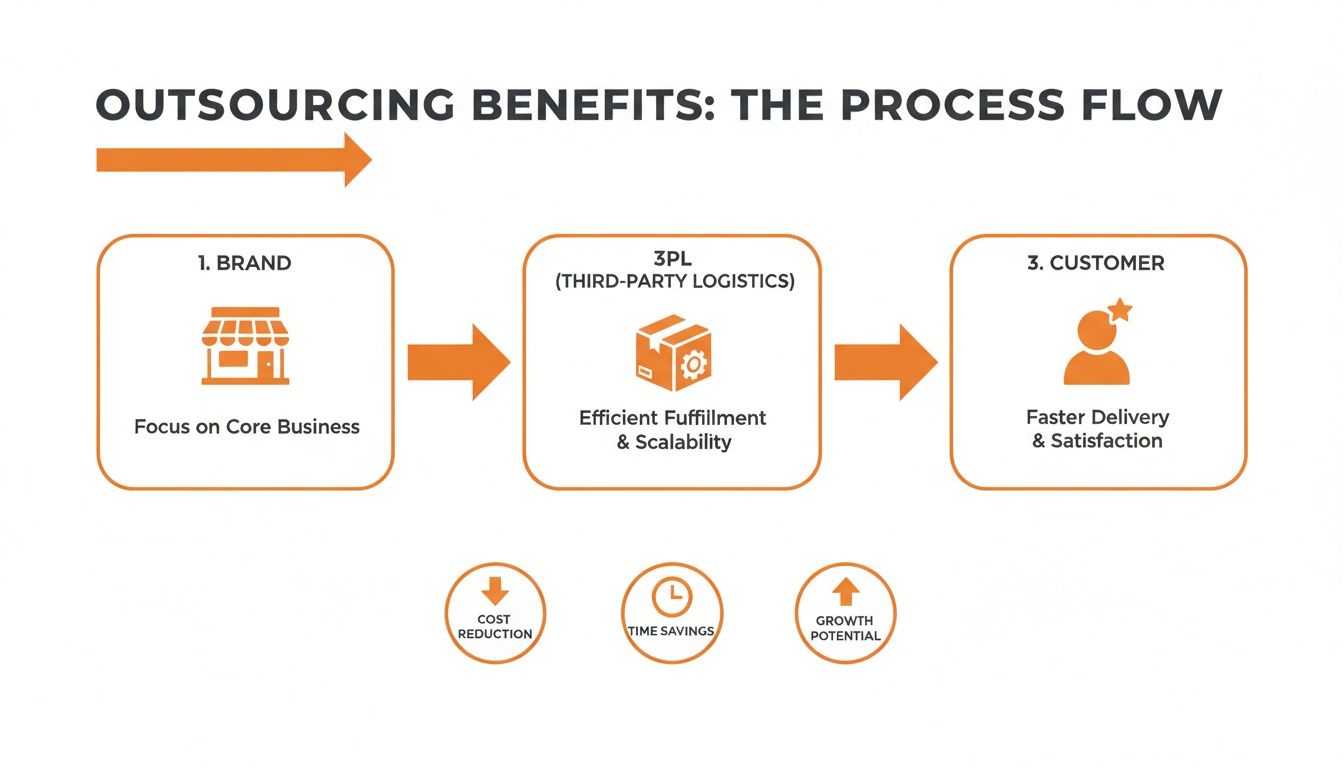
This visual shows how outsourcing connects your brand, your fulfillment partner, and your end customer into a seamless operation.

Infographic showing the outsourcing benefits process flow from brand to customer with key advantages.

This workflow turns what could be a chaotic internal project into a predictable, scalable, and highly accurate operation run by pros.

How Technology is Actually Changing Modern Kitting

If you think kitting and assembly is still just about people carefully packing boxes by hand, you’re missing the bigger picture. The entire process has been overhauled by technology, turning it into a high-precision, data-driven operation.

For e-commerce sellers and ops leaders, this shift is a game-changer. It’s the difference between hoping your orders are right and knowing they are. Modern 3PLs now deliver a level of speed, accuracy, and transparency that was simply impossible a decade ago. It means you get more than just bundled products—you get a fulfillment partner you can actually rely on.

The Warehouse Management System: Your Kitting Command Center

At the core of any tech-forward fulfillment center is its Warehouse Management System (WMS). Think of it as the brain of the entire kitting operation. It’s not just counting inventory; it's orchestrating every single step with digital precision.

This system is your single source of truth. It knows exactly how many screws, widgets, and instruction manuals you have in stock. It knows how many finished kits are ready to ship. And it knows which components are currently being assembled into new kits. That level of detail is non-negotiable for running a smooth operation.

A solid WMS lets a 3PL:

  • Keep Inventory Separate: It digitally tags your raw component SKUs and your finished, ready-to-sell master SKUs. No more accidental shipments of loose parts.
  • Give You Real-Time Updates: You can log into a portal anytime and see exactly what’s happening with your inventory. This is huge for making smart forecasting and purchasing decisions.
  • Set Automatic Reorder Points: The system can ping you when a specific component is running low, so a single missing part doesn’t bring your entire production to a halt.

This digital oversight takes the guesswork out of inventory management, ensuring the parts for your kitting and assembly services are always on hand when you need them.

Barcode Scanning: The Simple Fix for Human Error

Let’s be honest—human error is the biggest killer of kitting accuracy. A warehouse picker grabs the blue shirt instead of the black one, and suddenly you’re dealing with an unhappy customer and a costly return. This is where barcode scanning becomes your best friend. It’s a simple, foolproof check at every single step.

When your components first arrive at the warehouse, they’re scanned into the WMS. During assembly, each item is scanned again to confirm it matches the kit’s “recipe.” This forces a digital handshake, catching mistakes before they ever get inside a box.

By integrating barcode scanning, a 3PL can all but eliminate picking errors. It’s a simple but incredibly powerful layer of quality control that guarantees what you designed is what your customer actually gets.

Automation and Robotics: Kitting at Scale

The next big leap is automation. Robots and other automated systems are now handling the repetitive tasks, allowing 3PLs to scale up to massive volumes without compromising on quality. And this isn't just for massive corporations anymore—it’s becoming a must-have for successful e-commerce brands dealing with high order volumes.

Automation is already making a huge impact. The global market for kitting automation is valued at USD 2.10 billion and is projected to hit USD 7.15 billion by 2033. In North America, advanced robotics are cutting picking errors by 50% and boosting how many orders can get out the door. For high-volume sellers, this translates to a 15-30% drop in operational costs while hitting 99%+ accuracy. You can dive deeper into how automation is reshaping the kitting industry on snsinsider.com.

When you combine a powerful WMS, mandatory scanning, and smart automation, a modern 3PL truly becomes an extension of your business—one that’s built to be reliable, transparent, and ready to handle your growth.

Finding the Right Kitting and Assembly Partner

Picking a 3PL partner is one of the biggest calls you’ll make for your e-commerce brand. This isn’t just about renting warehouse space or finding someone to slap a label on a box. It’s about trusting another company with your inventory and, ultimately, your customer's happiness.

A great partner feels like an extension of your own team, proactively solving problems and helping you scale. The wrong one? They become a source of constant headaches, creating costly bottlenecks and damaging the reputation you’ve worked so hard to build.

Evaluating Core Competencies and Experience

Let's be clear: not all 3PLs are created equal, especially when it comes to the detailed work of kitting and assembly services. A warehouse that's great at basic pick-and-pack for simple t-shirt orders might completely fall apart when faced with a complex subscription box with ten different components.

Your first job is to find out if they have real, hands-on experience with businesses like yours. Do they live and breathe the strict compliance rules for Amazon FBA, or is their sweet spot direct-to-consumer fulfillment for Shopify brands? Deep experience with your primary sales channels is non-negotiable. A 3PL that already knows FBA prep inside and out will save you from the painful—and expensive—reality of rejected inbound shipments.

Don't just take their word for it. Ask for case studies or, even better, a few client references who sell similar products and have a comparable order volume. This is how you get undeniable proof of their skills.

Key Questions for Potential Partners

The best way to cut through the slick sales pitch is to come prepared with sharp, specific questions. Vague, hand-wavy answers are a major red flag. You want a partner who can confidently walk you through their exact processes, step-by-step.

Here are a few essential questions to get the conversation started:

  • Technology and Inventory: "Show me how your WMS tracks component parts versus finished kits. Can I see a live demo of your client portal and how I can view my stock levels for both?"
  • Quality Control: "Walk me through your QC process for a typical kitting project. What happens when your team finds a damaged component? What’s the communication process back to me?"
  • Scalability: "Tell me about a time you handled a sudden, massive spike in kitting volume for a client during a promotion. How did your team manage it, and what was the outcome?"
  • Billing and Transparency: "Can you provide a sample invoice for a kitting project? I want to see every potential line item and fee so there are no surprises."

How they answer these questions tells you everything you need to know about their operational maturity and their commitment to transparency. A great partner will welcome this level of detail.

A 3PL’s ability to clearly articulate their quality control and inventory management procedures is a direct indicator of their operational maturity. If they can't explain it simply, they likely can't execute it reliably.

A Quick Checklist for Vetting Partners

To keep your evaluation process organized, it helps to use a checklist. This ensures you're comparing each potential 3PL using the same objective criteria, making the final decision much clearer.

Use this checklist to systematically compare potential kitting and assembly partners on the factors that matter most for your business.

3PL Partner Evaluation Checklist

Evaluation Criteria Key Questions to Ask Ideal Answer/Capability
Relevant Experience "Can you share case studies or references from clients in my industry (e.g., subscription boxes, cosmetics, supplements)?" Demonstrates a portfolio of successful clients with similar needs and compliance requirements (e.g., FBA, Walmart).
Technology & WMS "How does your system manage component vs. finished kit inventory? Can I see real-time levels? Does it integrate with my platforms?" The WMS provides real-time, segregated visibility. Offers seamless integrations with Shopify, Amazon, etc.
Quality Control "What is your documented process for QA checks during assembly? How are errors tracked and corrected?" Has a multi-step, documented QC process with clear protocols for handling damaged items and reporting errors.
Scalability "How do you handle sudden volume spikes? Do you have dedicated kitting lines or cross-trained staff?" Has a proven plan for flexing labor and resources to meet demand without sacrificing quality or speed.
Pricing Transparency "Can I see a full fee schedule, including receiving, storage, assembly, and outbound shipping? Are there hidden fees?" Provides a clear, all-inclusive quote with no vague "miscellaneous" charges. Explains all potential costs upfront.
Communication "Who will be my dedicated point of contact? What are your standard response times for support inquiries?" Offers a dedicated account manager and a clear Service Level Agreement (SLA) for communication.

Treat this process like you're hiring a key employee, because you are. A thorough vetting process now prevents massive operational fires later.

Finalizing Your Decision

Once you’ve narrowed it down to a few top contenders, the final choice comes down to a balance of cost, capability, and culture. While it’s tempting to go with the lowest price, the cheapest 3PL is almost never the best value. A partner who invests in solid technology and bulletproof quality control might have a slightly higher per-kit fee, but they’ll save you thousands in the long run by preventing costly errors.

For brands with big growth plans, it's also smart to look at a provider's full range of e-commerce order fulfillment services to understand their long-term potential. Can they handle your freight, returns, and FBA replenishment down the road?

Ultimately, you need to feel confident that the 3PL truly gets your brand and has a clear plan to help you hit your goals. This decision isn't just a line item on your P&L; it's a long-term investment in your brand’s operational backbone.

Common Kitting Use Cases for Ecommerce Brands

Various product kitting boxes displayed on a white shelf, with one open box revealing a camera.

The real power of kitting and assembly services clicks when you see how smart ecommerce brands put them to work. This isn’t just some back-end operational task; it's a core strategy for driving sales, making customers happier, and taming logistical headaches.

From subscription boxes to Black Friday promotions, kitting gives brands a framework to create unique product offers that would be an absolute nightmare to manage in-house. Let’s walk through a few common scenarios where this strategy really delivers.

The Subscription Box Model

Subscription box companies are built on one thing: delivering a fresh, curated experience month after month. The problem? The contents are always changing, which means you're constantly juggling dozens of different items for every single shipment cycle.

A 3PL partner cuts right through that chaos. Each month is a new kitting project. They receive all the different products, follow that month's specific "recipe" to assemble the boxes, and get them ready for a massive, coordinated shipment. It turns a messy, unpredictable process into a smooth, repeatable workflow.

Boosting Sales with Bundles and Multi-Packs

If you're selling on a competitive marketplace like Amazon, bumping up your average order value (AOV) is the name of the game. Kitting is the perfect play here. Instead of just selling one bottle of shampoo, you can create a bundled "Hair Care Kit" with shampoo, conditioner, and a styling cream.

This one move accomplishes several goals at once:

  • Higher AOV: Customers spend more in one go.
  • Increased Sell-Through: It’s a great way to move slower-selling items by pairing them with your bestsellers.
  • Simplified Listings: One product page is much easier for a customer to navigate and buy than three separate ones.

Your fulfillment partner can crank out these multi-packs, apply the right FNSKU labels for FBA, and make sure every bundle meets Amazon’s strict packaging rules. This saves you from the pain of costly rejections at the fulfillment center.

By bundling products, you transform individual items into a high-value solution. The customer gets a convenient package, and you get a healthier bottom line with a stronger competitive position on the marketplace.

Creating Memorable Holiday and Gift Sets

Seasonal sales events are a huge opportunity for ecommerce brands. A beautifully packaged gift set can become a massive revenue driver, but trying to assemble thousands of them in-house during your busiest season is a recipe for disaster. This is a classic use case for outsourced kitting and assembly services.

Picture a beauty brand launching a special holiday gift box. They ship their custom-branded boxes, tissue paper, and products to their 3PL. The fulfillment team then carefully assembles each gift set exactly to the brand’s specs, creating that premium unboxing experience that customers love and rave about in reviews. By outsourcing, the brand can focus on marketing the big promotion instead of getting buried in packing tape and crinkle paper.

Kitting Services: Your Questions Answered

Even after getting the big picture, you probably still have questions about how kitting and assembly services actually work day-to-day. We get it. Here are the most common questions we hear from ecommerce brands just like yours.

What's the Real Cost of Kitting Services?

Kitting is almost always priced on a simple, per-kit basis. The fee depends on a few things: how many items go into each kit, how tricky the assembly is, and the total number of kits you need.

Sure, it’s a line item on your invoice, but it's often a fraction of the cost of doing it yourself. Once you add up your team's labor, the warehouse space you're using, all the packing materials, and the steep cost of a single fulfillment mistake, outsourcing starts to look like a bargain.

How Will Kitting Mess With My Inventory Management?

It actually does the opposite—it makes it way simpler. Your 3PL partner handles tracking all the individual component SKUs as they arrive and get assembled. Once a kit is built, it gets a brand new "master" SKU in their system.

What does this mean for you? Your ecommerce store, whether it’s on Shopify or Amazon, only has to track one final, sellable product. This single SKU dramatically cuts down on picking errors, makes sales forecasting easier, and gives you a much clearer, real-time view of your ready-to-ship stock.

Can a 3PL Use My Custom Branded Packaging?

Absolutely. This is one of the best parts of working with a pro 3PL—they bring your unboxing experience to life. You just send them your custom boxes, branded tissue paper, logo stickers, or any little marketing cards you want to include.

The kitting team will follow your directions to a T, making sure every single package looks exactly how you envisioned it. It's a small touch that goes a long way in building brand loyalty and getting those five-star reviews.

What Are the Minimum Order Quantities for Kitting?

This really varies from one 3PL to another. Some of the giant logistics companies are built for enterprise-level clients and have pretty high minimum order quantities (MOQs).

But plenty of others, like us, are set up to help growing ecommerce brands. A good partner will be flexible enough to handle a small test run for a new product launch and then easily scale up with you as your orders start pouring in.


Ready to stop worrying about logistics and start scaling your brand? Snappycrate offers expert kitting and assembly services designed for growth-minded sellers. Let us handle the details so you can focus on your business. Learn more and get a quote from SnappyCrate.

0 Continue Reading →