When you hear "3PL for Amazon sellers," think of it as your logistics command center—a strategic partner that manages your inventory, FBA prep, and fulfillment completely outside of Amazon’s four walls. It’s the key to breaking free from FBA's strict rules, sidestepping those painful storage fees, and building a supply chain that’s actually flexible and resilient.
Why Smart Amazon Sellers Partner with a 3PL
Let's be real: as your Amazon business grows, staring down the beast that is FBA can feel completely overwhelming. FBA has its perks, no doubt, but the rigid rules, ever-increasing fees, and frustrating inventory limits create serious bottlenecks that can stop your growth cold. This is exactly where bringing in a third-party logistics (3PL) provider becomes a total game-changer for ambitious brands.
Don’t just think of a 3PL as an offsite warehouse. Think of it as your brand's dedicated logistics headquarters. They're the air traffic controller for your inventory, expertly managing everything from inbound containers to the nitty-gritty of FBA prep. This leaves you free to do what you do best: fly the plane and scale your business.
Moving Beyond FBA Limitations
The Amazon marketplace is a battlefield. While a massive 82% of sellers use FBA to get that coveted Prime badge, leaning so heavily on one platform comes with huge risks. Amazon's constant policy changes, punishing long-term storage fees, and strict inventory caps can trip up even the most experienced sellers. Partnering with a 3PL lets you take back control and build your operations on a much stronger foundation. To dig deeper, check out our guide on the role of a 3PL warehouse.
This hybrid approach really gives you the best of both worlds. Here’s what that looks like in practice:
- Slash Your Costs: Sellers who outsource to a specialized 3PL often report cutting their total fulfillment costs by up to 30%. This comes from better storage rates and smarter, optimized shipping.
- Get True Flexibility: A 3PL acts as a central hub for all your inventory. From there, you can seamlessly send stock to FBA, your own Shopify store, or other marketplaces without being trapped in Amazon's ecosystem.
- Scale on Your Own Terms: Forget being handcuffed by Amazon’s receiving limits during Q4. A 3PL has the space and staff to handle massive sales surges, ensuring you never leave money on the table during your busiest seasons.
A 3PL partnership turns your supply chain from a reactive, costly headache into a proactive, strategic asset. It’s all about creating options and resilience so your business can pivot and adapt to whatever the market throws at it.
Navigating Global Expansion
Thinking about selling internationally? That adds a whole new layer of complexity. Sellers often run into tricky regulations, like the Canadian government's Non-Resident Importer program, which can be a nightmare to navigate alone. A 3PL with cross-border experience is invaluable here. They manage these challenges for you, simplifying your global growth and making sure you stay compliant every step of the way.
What a 3PL Actually Does for Amazon Sellers
So, what is a third-party logistics provider (3PL)? In simple terms, a 3PL is the operational muscle behind your Amazon brand. They handle all the critical, hands-on tasks that get your inventory from your supplier's factory floor to Amazon’s fulfillment centers, ready to sell. Their entire job is to receive, inspect, prepare, and forward your products so that every single item meets Amazon's notoriously strict FBA requirements.
Think of a 3PL as a highly skilled pit crew for your e-commerce race team. While you’re focused on driving sales, marketing, and growing the business, they’re behind the scenes handling the tough stuff—receiving your inventory, prepping it perfectly, and getting it back on the track (into FBA) without any penalties. This partnership is what keeps your business moving at full speed.
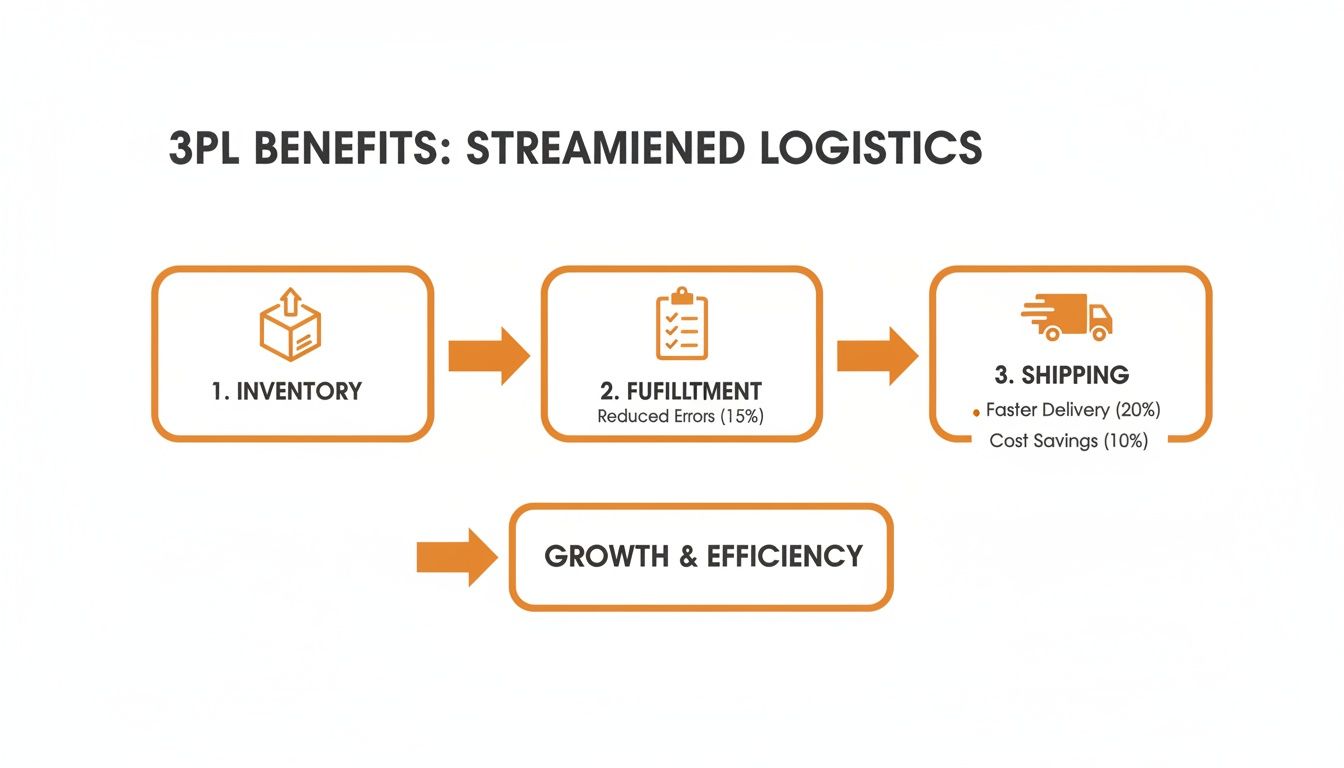
Here’s a look at the typical journey your inventory takes when you bring a 3PL into the mix.

This process isn't just about outsourcing work; it's about inserting a crucial quality control and compliance checkpoint before your products ever get near an Amazon warehouse. That single step drastically reduces your risk of costly inbound shipment problems.
Meticulous FBA Prep and Compliance
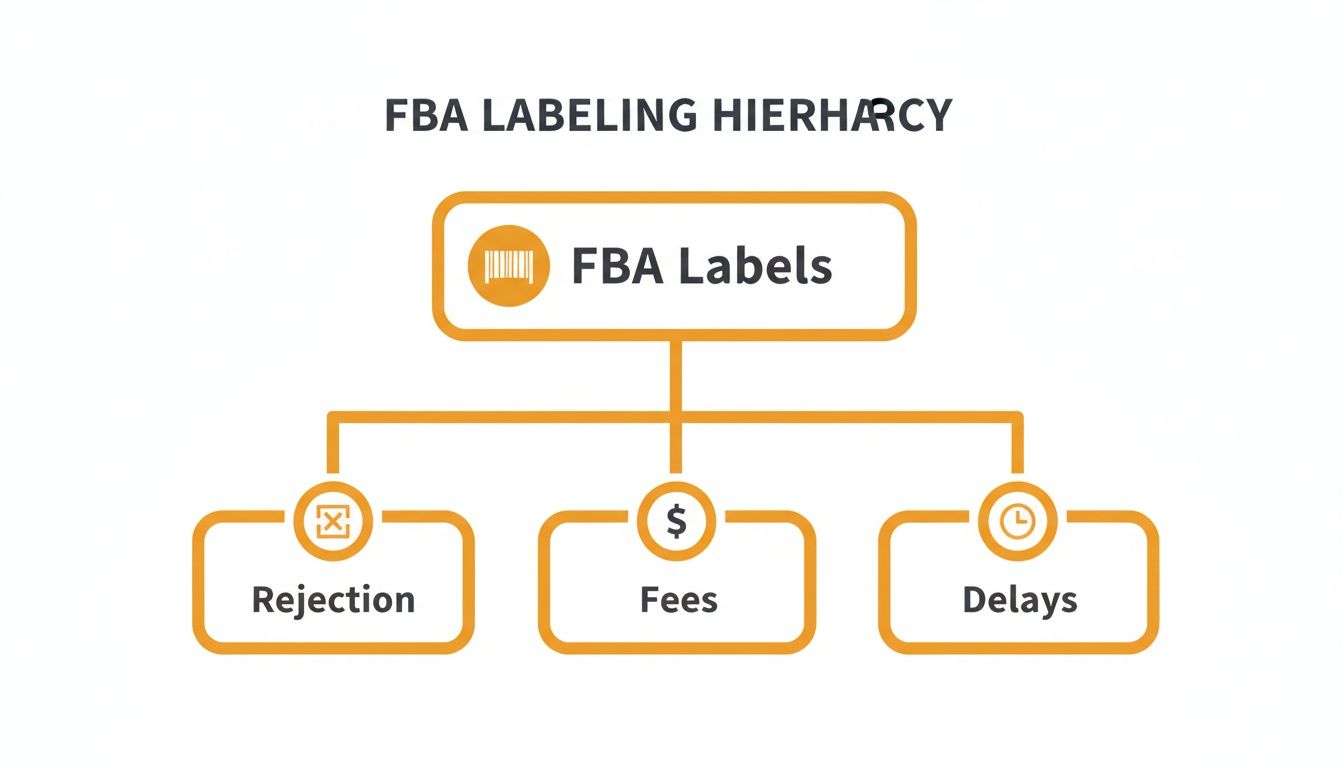
If there’s one job a 3PL for Amazon sellers must get right, it’s FBA preparation. Amazon’s receiving process is fast, automated, and completely unforgiving. A single misplaced label or a non-compliant poly bag can get your shipment rejected, delayed for weeks, or hit with unplanned fees that silently drain your profits.
A great 3PL lives and breathes these rules. Their bread and butter is making sure your inventory sails through receiving without a single hiccup.
Core prep services always include:
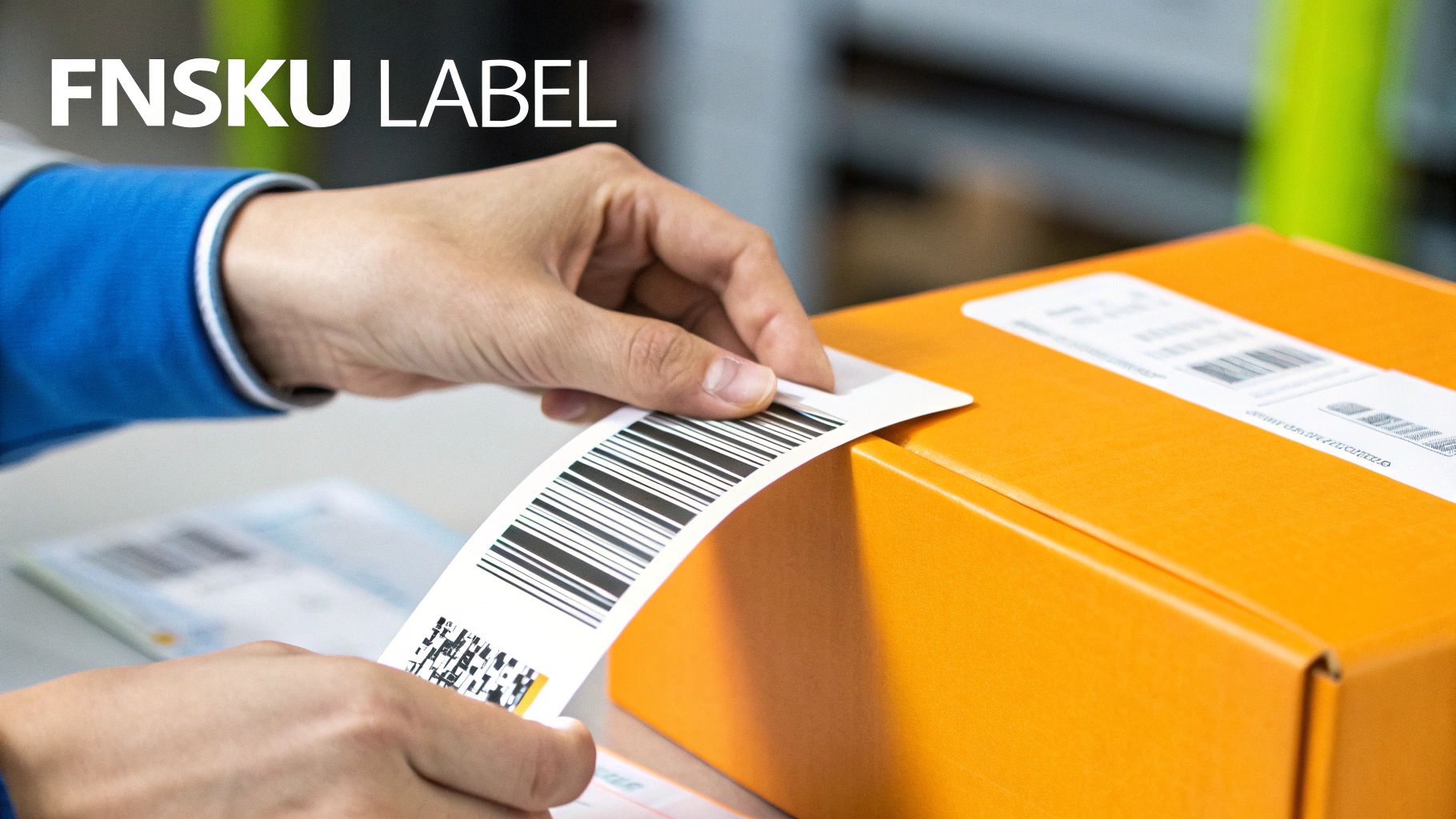
- FNSKU Labeling: This is the Amazon-specific barcode that identifies your product as yours in their massive network. A 3PL knows exactly how to apply these labels, making sure they completely cover any old UPCs.
- Poly Bagging: Required for apparel, plush toys, or anything with loose parts. They’ll use the right bags with the correct suffocation warnings.
- Bundling and Kitting: This is a huge value-add. They can take multiple individual items and assemble them into a single, sellable unit for multi-packs or promotional bundles.
- Dunnage and Expiration Labels: They’ll add protective materials for fragile items or apply the required "best by" date labels for any consumables.
Getting these prep steps right is absolutely non-negotiable for FBA success. You can dive deeper into the specifics in our guide on https://snappycrate.com/%f0%9f%8f%b7%ef%b8%8f-how-to-prepare-and-label-your-products-for-fba-like-a-pro/.
FBA Direct vs 3PL Prep Workflow Comparison
To see the difference in action, let's compare the two workflows side-by-side. The "direct" method has far more risk baked into it, while the 3PL route builds in a safety net.
| Logistical Step | Shipping Direct to FBA | Using a 3PL for FBA Prep |
|---|---|---|
| Supplier Ships | Goes straight to Amazon FC. No one inspects it. | Goes to the 3PL's warehouse for inspection first. |
| Quality Control | High Risk. You only find out about damaged goods or wrong counts after Amazon receives them (or customers complain). | Low Risk. The 3PL inspects everything, verifies counts, and flags supplier errors immediately. |
| FBA Prep | You're relying on your supplier to label and prep perfectly. A huge gamble. | The 3PL handles all labeling, bagging, and bundling to meet Amazon's strict standards. |
| Inbound to FBA | Your shipment might be rejected or delayed due to prep errors, costing you sales and fees. | Your shipment arrives perfectly prepped, ensuring a smooth and fast check-in process at the fulfillment center. |
Using a 3PL clearly gives you a "firewall" that protects you from supplier mistakes and ensures your inventory is ready for Amazon's system.
Comprehensive Inventory Management and Receiving
A 3PL is so much more than just a prep service; it’s your central command for all things inventory. Shipping directly from your supplier to Amazon is a high-stakes gamble with zero room for error. Instead, you send everything to your 3PL first.
Their team takes care of the entire inbound process for you:
- Receiving Shipments: They're equipped to handle anything you throw at them, from a few small parcel boxes to a full 40-foot ocean container or LTL freight pallets.
- Inspection and Quality Control: This is the most underrated benefit. As soon as your goods arrive, their team inspects for shipping damage, verifies counts against your purchase order, and flags any supplier mistakes before they turn into a massive headache.
- Warehousing: They provide secure, organized storage that’s way cheaper than Amazon’s long-term storage fees. This lets you keep buffer stock on hand without getting penalized.
By acting as a quality control firewall, a 3PL protects your brand reputation and prevents defective or incorrect inventory from ever reaching your customers or Amazon's warehouses.
The Hub for Your Multi-Channel Empire
As your brand grows, you're not just going to sell on Amazon. This is where a 3PL evolves from a simple service provider into a true strategic partner, turning your logistics from a one-trick pony into a flexible, multi-channel machine.
Think about it: third-party sellers now account for 62% of items sold on Amazon. And while 82% of sellers use FBA, its rigid rules are pushing smart brands toward more agile solutions. A good 3PL for Amazon sellers, like Snappycrate, not only nails FBA prep but also acts as the perfect central command for your Shopify, Walmart, or wholesale orders.
By holding all your inventory in one central location, your 3PL can pick, pack, and ship orders for any sales channel. This gives you a single, unified view of your stock and the power to send it wherever demand is highest. It’s this kind of agility that fuels real e-commerce growth. Plus, a deep dive into how 3PLs operate can uncover some great Amazon FBA tips to sharpen your overall fulfillment strategy.
The Strategic Benefits of Using a 3PL Partner

Thinking about a 3PL partner? It’s more than just hiring a warehouse to pack boxes. For a serious Amazon seller, it’s a strategic play that unlocks three massive advantages: real cost savings, operational flexibility, and the ability to truly scale your business.
Let's be honest, going all-in on FBA is like building your house on rented land. It works, until it doesn't. A 3PL for Amazon sellers gives you a solid foundation, creating a more resilient and profitable e-commerce machine.
Significant Cost Savings and Margin Protection
One of the first things you'll notice is the impact on your wallet. A 3PL acts as a financial shield, protecting your margins from Amazon's notoriously high storage fees. FBA is a fulfillment network, not a long-term warehouse, and Amazon makes that painfully clear with its pricing.
Those punishing long-term storage fees can absolutely wreck the profitability of slower-moving or seasonal SKUs. A 3PL, on the other hand, offers warehousing at a fraction of the cost. It's the perfect place to hold buffer stock until you need to drip-feed it back into FBA.
But the savings don't stop at storage. A specialized 3PL gives you access to their negotiated shipping rates for both inbound freight and small parcel shipments, which are almost always better than what a lone seller can get. Those cents and dollars saved on every shipment add up fast, boosting your bottom line on every single unit.
The 3PL space for Amazon sellers is exploding in 2025, and for good reason. Sellers are desperately seeking ways to counter FBA's rising costs, and 3PLs are stepping up with optimized workflows that avoid hefty fees. You can find more insights on this trend from the experts at LogiMax WMS.
Enhanced Flexibility and Inventory Control
This is where a 3PL partnership really starts to feel like a superpower. When all your inventory is locked inside an Amazon fulfillment center, you’re playing 100% by their rules. A 3PL hands the control of your most valuable asset—your inventory—back to you.
Suddenly, a bunch of new strategic options open up:
- Smart Returns Management: Instead of paying Amazon to dispose of returns or ship them back one by one, send them to your 3PL. They can inspect, refurbish, and repackage perfectly good items, getting them back into circulation and saving you money.
- Multi-Channel Readiness: With your stock in a central hub, you can easily fulfill orders from your own Shopify site, other marketplaces like Walmart, or even wholesale accounts. You’re no longer just an "Amazon business."
- Quality Assurance on Your Terms: Need to add a custom marketing insert or perform a final quality check? A 3PL can do that before your products get sent to FBA, something that’s impossible once they’re in Amazon’s ecosystem.
By decoupling your main inventory from FBA, you create an operational "sandbox." This gives you the freedom to test new sales channels, manage returns intelligently, and maintain a buffer of stock that is immune to Amazon's sudden policy changes or inventory restrictions.
True Scalability for Peak Seasons
Scalability isn't just a buzzword; it's your ability to handle massive growth without your operations imploding. And for Amazon sellers, the ultimate test is always Prime Day or the Q4 holiday rush. Relying solely on FBA during these periods is a gamble, especially with Amazon’s strict restock limits.
Picture this: You’ve just landed 10,000 units of your best-selling product for a huge Prime Day deal. But Amazon hits you with a restock limit of just 2,000 units. Without a 3PL, you're dead in the water. Thousands of potential sales, gone.
Now, imagine that same scenario with a 3PL partner. They receive and hold all 10,000 units for you. You then send smaller, just-in-time replenishment shipments into FBA throughout the sales event. You never stock out, and you never violate Amazon’s limits.
That’s true scalability. It's the ability to absorb huge inbound shipments and strategically feed FBA, a level of operational agility you simply can't achieve with FBA alone.
How to Choose the Right 3PL for Your Amazon Business

Picking a third-party logistics provider is easily one of the biggest decisions you'll make for your e-commerce business. This isn't just about renting some shelf space. You’re finding a partner whose performance directly impacts your customer reviews, your brand's reputation, and ultimately, your bottom line.
The right 3PL for an Amazon seller can be a growth engine. The wrong one? A constant source of costly headaches and inventory nightmares.
So, how do you cut through the sales pitches and focus on what really matters? We'll walk you through a practical framework to properly vet potential partners and make a smart choice that actually fits your business.
H3: Evaluate Their Amazon Compliance Expertise
This is ground zero. It's the absolute first thing you need to check. A 3PL that doesn't live and breathe Amazon's rules isn't an asset; they're a massive liability waiting to happen.
Amazon’s FBA inbound process is famous for being incredibly strict. Tiny mistakes in labeling, packaging, or how a pallet is built can get your entire shipment rejected, hit you with unplanned fees, and lock up your inventory for weeks.
You need a partner who has a proven history of getting it right—every single time. Their team should speak fluent FNSKU, know suffocation warning requirements by heart, and understand exactly what Amazon expects for dunnage and case packs. Don't be shy about digging deep here.
A great 3PL acts as your FBA compliance shield. Their expertise is what ensures your inventory flows smoothly into Amazon's network, preventing costly errors that can cripple your cash flow and sales velocity.
Instead of just asking, "Do you do FBA prep?" get specific. Try something like, "Walk me through your process for a shipment that requires both FNSKU labeling and bundling." Their answer will tell you everything you need to know about their real-world experience.
Scrutinize Their Technology and Integrations
In today's e-commerce world, a 3PL without a modern tech stack is like a warehouse without a roof. It just doesn't work. The software they run, usually called a Warehouse Management System (WMS), is the brain of their entire operation. It's also your window into what's happening with your inventory.
A solid 3PL will give you access to a client portal with real-time data on:
- Inventory Levels: See exactly what you have in stock, what's available to sell, and what's being prepped.
- Order Status: Track your inbound and outbound shipments from the moment they arrive to the moment they're shipped out.
- Reporting: Pull data on how fast your inventory is turning, their order accuracy rates, and other vital metrics.
Always, always ask for a live demo of their portal. If it looks like it was built in 1999 or is a nightmare to navigate, that’s a huge red flag. Their system also needs to connect smoothly with your tools, whether it's your Amazon Seller Central account or your Shopify store. This integration automates everything and gets you out of manual, error-prone spreadsheet hell.
Understand Their Pricing Model
Finally, you have to get total clarity on their pricing. Hidden fees and surprise charges are the number one complaint in the logistics world, and they can absolutely destroy your profit margins. A transparent partner will give you a detailed fee schedule that you can actually understand.
Most 3PLs use a mix of charges, but make sure you know exactly how these core services are billed:
- Receiving: How do they bill for incoming shipments? Is it per pallet, per carton, or an hourly rate?
- Storage: What’s the monthly cost per pallet or cubic foot? Do they charge different rates for different types of storage?
- FBA Prep: What are the per-item costs for services like applying an FNSKU label, poly bagging, or creating a bundle?
- Order Fulfillment: If they also ship your direct-to-consumer orders, how are pick-and-pack fees calculated?
- Shipping: How are outbound freight and parcel costs passed on to you? Do they mark them up?
Ask for a sample invoice from a current client (with sensitive info blacked out, of course). This is the best way to see exactly how they bill and avoid any nasty surprises down the road. For more tips on finding a great fit, check out our guide on the best 3PL for small business. Making the right choice here is the foundation for a scalable, profitable, and stress-free partnership.
Before you sign any contracts, it's crucial to ask the right questions. This isn't just about comparing prices; it's about understanding how a 3PL operates and whether their culture and capabilities align with your needs.
We've put together a checklist of critical questions to guide your conversations. Use this table to interview potential partners and compare their answers side-by-side.
Critical Questions to Ask a Potential 3PL Partner
| Category | Question to Ask | Why It's Important |
|---|---|---|
| Amazon Expertise | Can you walk me through your standard process for receiving, prepping, and shipping a complex FBA shipment? | This reveals their hands-on experience and operational depth beyond a simple "yes, we do FBA prep." |
| Technology | Can I get a live demo of your client portal (WMS)? How does it integrate with Amazon Seller Central and my other tools? | You need to see if their system is user-friendly, provides real-time data, and won't create technical headaches. |
| Pricing | Can you provide a complete fee schedule and a sample invoice? What are the most common "extra" fees clients see? | This pushes for transparency and helps you uncover potential hidden costs that can kill your margins. |
| Operations | What are your standard turnaround times for receiving inbound inventory and prepping an FBA shipment? | This tells you how quickly they can get your products checked in and ready to sell, impacting your cash flow. |
| Communication | Who will be my main point of contact, and what is your process for handling issues or discrepancies? | You need a dedicated contact and a clear escalation path. Bad communication is a hallmark of a poor partner. |
| Scalability | What is your process for handling seasonal spikes in volume? How do you help clients grow? | A good partner should be able to support your growth, not hold you back during your busiest seasons. |
| Accountability | What are your policies for inventory damage, loss, or receiving errors? How are we compensated? | This clarifies who is responsible when things go wrong and ensures you are protected financially. |
Asking these direct questions will help you cut through the noise and find a logistics partner who is truly equipped to support your Amazon business as it grows. A great 3PL is more than a vendor—they're an extension of your team.
Common Mistakes to Avoid with Your 3PL
Signing on with a third-party logistics provider is a huge milestone for any Amazon seller. But that signed contract? That’s just the starting line.
The real challenge is making the partnership work. I’ve seen countless sellers stumble into common pitfalls that turn a strategic asset into a frustrating, costly nightmare. Let's walk through the most frequent mistakes so you can sidestep them and build a partnership that actually fuels your growth.
Falling for the Lowest Price Trap
It’s human nature to gravitate toward the lowest price on the proposal. But in the world of logistics, the cheapest option on paper is almost never the best value. Rock-bottom pricing is usually a red flag.
To offer that low rate, corners have to be cut somewhere—staffing, technology, or quality control. This translates into slow receiving times, sloppy FBA prep that gets your shipments rejected, and inventory counts that are constantly off. A single FBA compliance error can trigger unplanned fees and delays that completely wipe out whatever you thought you were saving.
The Fix: Look past the per-item fee and evaluate the total value. Ask potential partners about their average receiving times, their error rates on FBA prep, and what happens when they make a mistake. A slightly higher price with a 3PL that guarantees accuracy and speed is a much smarter investment in the long run.
Ignoring Unclear Communication and SLAs
Vague promises and a lack of clear Service Level Agreements (SLAs) are a recipe for disaster. When things inevitably go wrong—a delayed shipment, a damaged product—you need a documented game plan for how it gets resolved.
Without defined SLAs, you have zero leverage if your provider takes a week to check in an urgent restock or keeps making the same labeling errors. Poor communication turns small hiccups into massive headaches, leaving you completely in the dark about your own inventory.
A strong 3PL partnership is built on transparent, proactive communication. If a potential partner is vague about their processes or turnaround times before you've even signed on, it's a major red flag for the future.
The Fix: Insist on a detailed SLA document before you sign a thing. This agreement needs to spell out the key performance indicators (KPIs) and their targets, like:
- Receiving Turnaround: How many business days will it take to process your inventory after it hits their dock?
- FBA Prep and Outbound Time: What’s the standard window for getting an FBA shipment prepped and out the door?
- Communication Response Time: How quickly will your account manager get back to you?
Getting Blindsided by Hidden Fees
Nothing sours a partnership faster than a monthly invoice loaded with charges you never saw coming. The logistics industry can be notorious for complex fee structures, and some providers count on you not reading the fine print.
You might get hit with surprise charges for things like account management, breaking down a pallet, or even the labels they print for your products. These "nickel and dime" fees can easily inflate your bill by 20-30% or more, completely torpedoing your product profitability.
The Fix: Be direct and demand total transparency on pricing. Ask for a complete fee schedule that lists every single potential charge. Better yet, ask for a sample invoice from a current client (with sensitive info blacked out). This is the absolute best way to see exactly how they bill and make sure there are no nasty surprises waiting for you.
Your Top Questions About 3PLs for Amazon, Answered
Jumping into the world of third-party logistics can feel a bit overwhelming. As you start exploring your options, you're probably wondering how a 3PL partnership actually works day-to-day and what it really means for your profitability.
Let's cut through the noise. Here are some clear, straightforward answers to the questions we hear most often from Amazon sellers just like you. Our goal is to clear up any confusion and show you how the right 3PL for Amazon sellers can become your secret weapon.
Can I Use a 3PL and Amazon FBA at the Same Time?
Absolutely. In fact, you should. This hybrid strategy is exactly how the most successful sellers scale their brands without losing control of their inventory.
Think of your 3PL as your own private command center. It’s the hub where all your bulk inventory from suppliers lands first. Here, it gets inspected, prepped, and stored safely. From this central spot, you can drip-feed smaller, just-in-time replenishment shipments into Amazon’s FBA network as needed.
This approach gives you some serious advantages:
- Dodge High Storage Fees: You can sidestep FBA's brutal long-term storage fees by keeping most of your stock in your 3PL's much more affordable warehouse.
- Keep a Safety Stock: You'll have a flexible reserve of inventory totally outside of Amazon's ecosystem, protecting you from surprise restock limits or inbound delays at FBA.
- Sell on More Channels: It suddenly becomes super easy to send inventory to other sales channels, like your own Shopify store or Walmart Marketplace, without being tied down by Amazon.
Is a 3PL More Expensive Than Using FBA Directly?
It’s a common misconception that adding another partner automatically means adding more cost. But when you look at the big picture, a smart 3PL partnership almost always leads to major savings that boost your bottom line.
Sure, you’re paying for a service, but the financial wins add up fast. For starters, 3PL storage rates are consistently lower than FBA's—especially for slower-moving products. That alone can save you thousands of dollars a year.
A good 3PL can also consolidate your inventory and find cheaper freight options to lower your inbound shipping costs. And most importantly, by ensuring 100% FBA compliance on every single shipment, they help you avoid those painful penalties, unexpected service fees, and flat-out rejections from Amazon.
When you add up the money saved on storage, inbound shipping, and penalty avoidance, the total cost of using a 3PL is often significantly lower than going all-in on FBA for everything.
What Is the Difference Between a 3PL and a Prep Center?
This is a huge point of confusion, but the distinction is critical. The easiest way to think about it is a specialist versus a full-service logistics department.
A prep center does one thing: it preps your products specifically for Amazon FBA. Their services are laser-focused on tasks like FNSKU labeling, poly bagging, and bundling to meet Amazon’s strict inbound rules. They solve a single, specific problem for you.
A true 3PL for Amazon sellers, on the other hand, is a whole different ballgame. They do all the essential FBA prep work, but that’s just the starting line.
A real 3PL also provides:
- Long-term warehousing and storage.
- Inventory management that syncs across multiple sales channels.
- Direct-to-consumer (DTC) order fulfillment for your website.
- Complex freight management, like receiving ocean containers and breaking down LTL pallets.
In short, a prep center is a useful tool for one task. A 3PL is a strategic partner that can manage your entire supply chain.
How Does My Inventory Get from My Supplier to the 3PL?
This part is way simpler than most sellers think, and any decent 3PL will walk you right through it. It all starts with one simple change.
Instead of giving your supplier an Amazon warehouse address, you just give them your 3PL's address. Then, you log into your 3PL’s online portal and give them a heads-up about the incoming shipment—the PO number, what’s in it, and when it should arrive.
That's it. Your 3PL takes over from there. When your inventory shows up at their dock, whether it’s a few boxes or a full 40-foot container, their receiving team gets to work. They will:
- Unload the Shipment: They’ll safely get your products off the truck or out of the container.
- Inspect and Count: They’ll do a quality check for shipping damage and verify the counts against your PO, catching any supplier mistakes before they become your problem.
- Log It In: Every item is scanned into their warehouse management system (WMS), so you can see your entire inventory in your online portal almost immediately.
Once that’s done, your inventory is safe, sound, and ready for your next command—whether that’s prepping a shipment for FBA or sending an order to a customer who bought from your Shopify store.
Ready to build a more resilient and profitable Amazon business? The team at Snappycrate has hands-on e-commerce experience and is ready to act as a reliable extension of your brand. Let us handle the FBA prep, inventory management, and fulfillment so you can focus on growth. Learn more about how Snappycrate can streamline your operations.