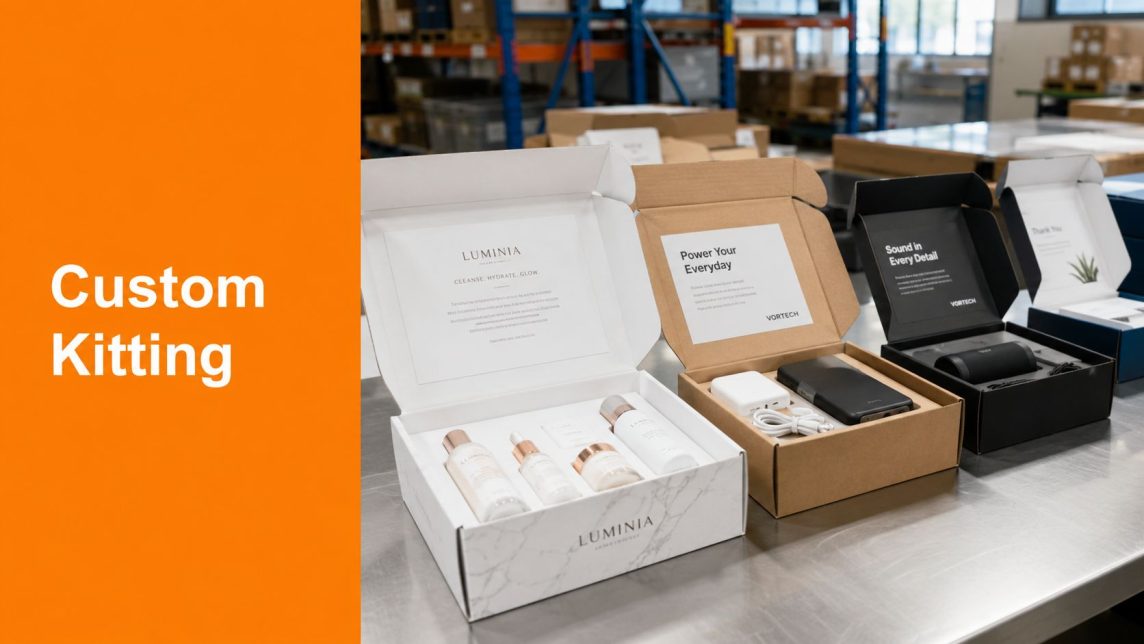
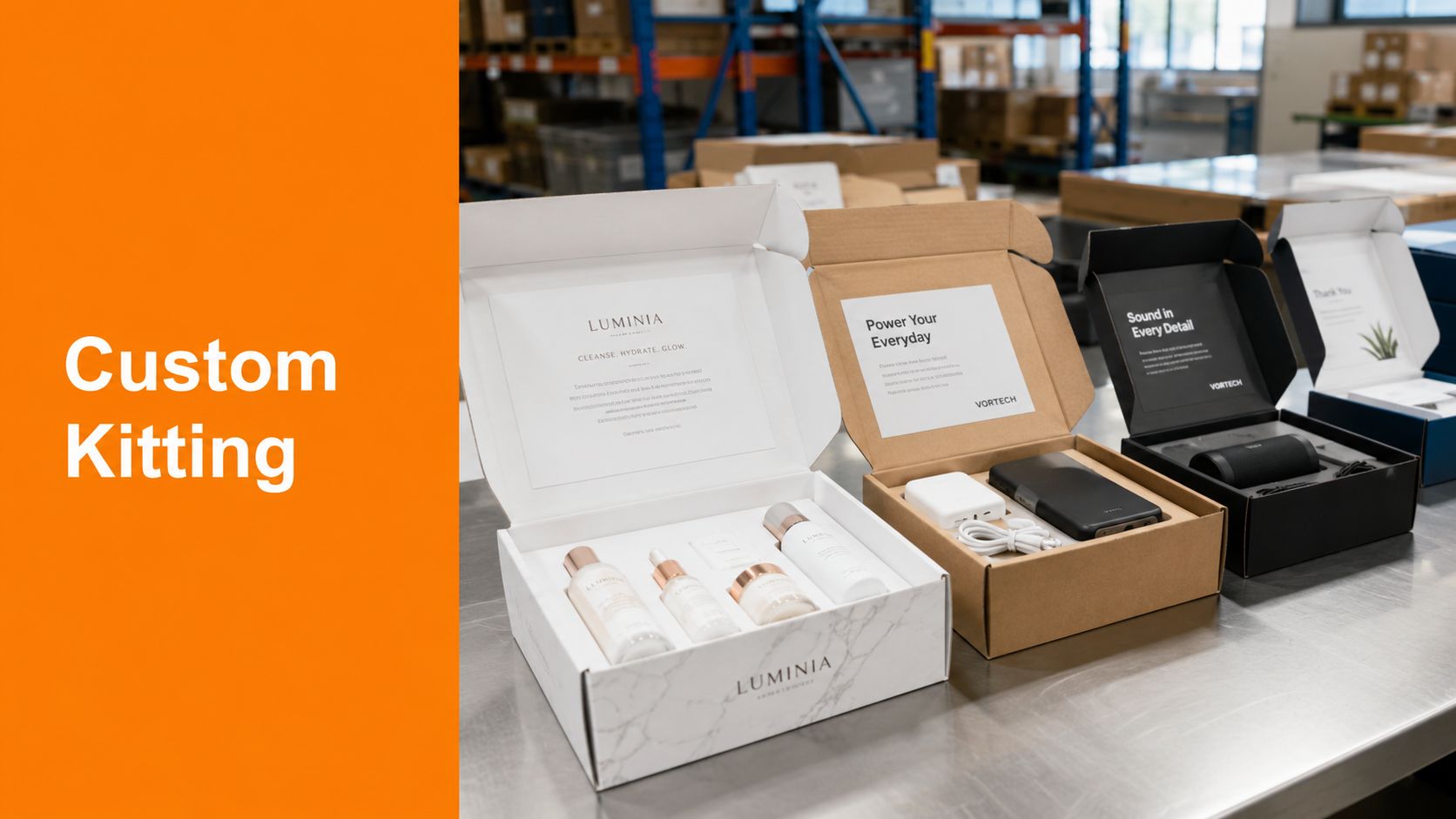
If you're selling bundles, gift sets, launch kits, influencer mailers, or Amazon-ready multi-item packs, you've probably felt the pain already. Orders look simple on the storefront, but inside the warehouse they turn into extra picks, more hand assembly, more labels, and more chances to ship the wrong combination.
That's usually when brands realize custom kitting isn't just a packaging choice. It's an operations decision. It affects labor, order speed, inventory visibility, channel compliance, and the way the customer experiences your brand when the box lands on their doorstep.
For growing e-commerce brands, the biggest mistake is treating kitting as a creative project first and a fulfillment workflow second. The strongest kitting programs do both. They present the product well, and they move through the warehouse cleanly.
What Is Custom Kitting for Brands?
A brand usually starts thinking about kitting when single-SKU fulfillment stops matching the way customers buy. Maybe you sell a skincare routine as three separate products, but shoppers want the full set. Maybe your holiday promotion combines a candle, match jar, and insert card. Maybe Amazon needs a bundled unit that arrives labeled and sealed as one sellable product.
Custom kitting for brands is the process of taking multiple individual items and turning them into one predefined fulfillment unit. That unit gets built to a specific configuration and is typically managed as its own SKU. Instead of a picker grabbing three or four separate products every time an order comes in, the warehouse can pull one ready kit.
A simple way to think about it is this. Individual SKUs are ingredients. The kit is the finished meal.

That shift matters operationally. As ShipBob's explanation of inventory kitting notes, kitting converts multiple related SKUs into one pre-defined fulfillment unit with a unique SKU, which reduces pick-path complexity and packing variability at the warehouse. In practice, that changes the labor model from multi-line order assembly to a single-line kit pull for recurring bundles.
What problem it solves
The main problem is repeated manual assembly under order pressure. If every order requires someone to build the same bundle from scratch, small inefficiencies multiply fast.
Common friction points look like this:
- Too many touches: Staff pick each component separately, then stage, verify, and repack them.
- More room for errors: One missing insert, one wrong color variant, or one extra item can turn into a return or marketplace issue.
- Inconsistent presentation: Branded sets don't always arrive with the same fold, insert placement, seal, or outer packaging.
- Slower release times: Orders can't move until the final combination is assembled.
For brands that are newer to the concept, this overview of kitting in logistics is useful because it frames kitting as a warehouse control method, not just a merchandising tactic.
Practical rule: If the same product combination is selling again and again, assembling it one order at a time usually isn't the cleanest way to run fulfillment.
What counts as a custom kit
Not every kit looks like a gift box. In practice, custom kitting can include:
- Retail bundles: A shampoo, conditioner, and treatment mask sold as one set
- Marketplace prep packs: Two or more units packaged together for Amazon FBA
- Subscription configurations: Monthly assortments built to one bill of materials
- Promo kits: Product plus sample, insert, coupon, or branded material
- Channel-specific packs: One version for Shopify, another for wholesale, another for Amazon
The important point is consistency. A true kit isn't just “items in the same carton.” It's a repeatable configuration with a defined build standard.
Unlocking Growth with Strategic Kitting
Brands often approach kitting as a fulfillment fix. That's only part of the picture. The better use case is broader: kitting can support revenue strategy, labor efficiency, and brand presentation at the same time.

A bundle changes what the customer buys. A prebuilt kit changes how the warehouse fulfills it. When those two parts line up, the program works.
Growth through assortment design
The easiest commercial win is packaging products in a way that makes the offer clearer. A customer may hesitate to buy three separate accessories, but the same three items presented as a starter kit, travel set, or gift-ready bundle can feel like a complete purchase.
Kitting benefits merchandising teams:
- It supports bundle selling: A camera body paired with a bag and cleaning cloth is easier to understand as a set than as three separate add-ons.
- It gives slow movers a job: Components that don't sell well on their own can still move when they belong in a stronger bundle.
- It helps protect presentation: Premium packaging and inserts can turn a set into a more intentional product, not just a grouped order.
If you're building marketplace offers around bundles, this guide for Amazon sellers on AOV is worth reading because it focuses on how kits and bundles can support basket value in Amazon environments.
Efficiency that compounds in the warehouse
The warehouse payoff is less visible to customers, but it's usually where margin gets protected. NetSuite notes that kitting can increase revenue and reduce costs by cutting picking and packing time, reducing errors, and raising average order value through bundled sales. In the same discussion, it cites Folio3 reporting that kitted parts can be retrieved in 1.86 seconds versus 3.29 seconds from racks, a 43% reduction in average parts-fetching time in that manufacturing example, as covered in NetSuite's inventory kitting benchmark.
That kind of improvement matters most when a brand has recurring order patterns. One-off custom assortments don't benefit the same way. But if the same set ships every day, reducing touches adds up fast.
A kit earns its keep when it removes repeat labor, not when it creates a prettier version of the same manual work.
Better customer experience without extra chaos
A good kit also protects the last impression. The customer doesn't see your pick path or bin layout. They see whether the order feels intentional.
That can mean:
- a gift set arriving in the right branded box
- inserts placed consistently
- no loose items rolling around in void fill
- retailer-specific packs that look shelf-ready
- a subscription experience that feels curated instead of rushed
The strongest kitting programs don't force a trade-off between operations and brand. They treat customer experience as something designed upstream, then repeated cleanly at scale.
The Kitting Workflow and Marketplace Compliance
A lot of brands underestimate where kitting goes wrong. It usually isn't the idea of the kit. It's the handoff between inventory, assembly, labeling, and channel rules.
If a set is built beautifully but arrives at Amazon with inconsistent barcoding, unclear unit designation, or missing prep, the inbound can still fail. That's why operational workflow and compliance have to be designed together.

How the physical workflow usually runs
On the floor, a clean kitting process tends to follow a predictable path.
Components are received and inspected. The warehouse checks quantities, packaging condition, labeling status, and whether every component matches the approved bill of materials.
Inventory is stored by component. Before assembly starts, each item needs a controlled location and count. That prevents short builds and guesswork.
A kitting station is set. This includes the assembly instructions, packaging materials, inserts, barcodes, and sample unit for reference.
The kit is assembled. Staff pull components in the required sequence, place them into the final packaging, and apply any branded materials.
Quality control happens before storage or shipment. The team verifies count, orientation, packaging integrity, and labeling.
The completed kit is assigned or confirmed as a finished unit. At that point, the warehouse can store it as a ready-to-ship item or route it directly to outbound.
One thing that helps is documenting build instructions like a production recipe. “Include three units” isn't enough. Teams need exact SKUs, packaging order, barcode placement, seal method, and channel notes.
Where marketplace compliance changes the workflow
For Amazon and similar marketplaces, the kit has to be classified correctly before anyone starts sealing cartons. Norscot points out that the primary issue for sellers is whether a kit is treated as a single sellable unit, a multi-pack, or a virtual bundle, because that changes prep steps and inbound rejection risk, as explained in Norscot's corporate kitting guidance.
That affects practical decisions such as:
- Barcode strategy: Which barcode identifies the final sellable unit
- Outer packaging: Whether the items must stay physically joined as one unit
- Label language: Whether the package needs “Sold as a Set” or similar set-identification handling
- Prep method: Poly bagging, suffocation warnings, sealing, and visibility of the final label
- Case consistency: Whether inbound cartons contain uniform kit configurations
Marketplace enforcement has tightened, so aesthetics can't come before documentation and scan accuracy.
Here's a useful visual walkthrough of the assembly side before you add marketplace-specific SOPs:
The details that prevent inbound problems
Most inbound problems come from simple mismatches between what the brand intends and what the marketplace receives.
A few examples:
- The bundle isn't physically secured. Components separate during handling, so the receiver doesn't treat it as one unit.
- The wrong barcode is exposed. Amazon scans an internal component instead of the finished kit.
- Case packs vary. One carton has one version of the kit, the next has another.
- The build sheet is loose. Assembly teams improvise because the instructions don't show the final approved unit.
If you sell on Amazon FBA, don't approve a kit based only on appearance. Approve the barcode map, prep method, and final sellable-unit definition first.
A practical standard for brands
Before launching a new kit, brands should confirm four things in writing:
| Workflow area | What needs to be defined |
|---|---|
| Unit definition | Is this a single sellable set, multi-pack, or another marketplace-approved configuration? |
| Build instructions | Which exact SKUs, quantities, inserts, and packaging steps are required? |
| Label placement | Which barcode must be scannable on the outside of the final packaged unit? |
| QA signoff | What must be checked before the kit can enter storage or ship inbound? |
That level of discipline sounds basic, but it's what keeps a branded kit from turning into a receiving exception.
Implementing Your Custom Kitting Strategy
The question that matters isn't whether kitting sounds efficient. It's whether a specific kit reduces total handling and supports predictable demand. That's where many brands overreach.
A bundle that sells well every week is a very different candidate than a seasonal promotion with shifting components. Hanzo Logistics makes the point well: the key question is not what kitting is, but when it reduces total cost versus adding hidden complexity, and over-kitting is a real risk if demand is volatile or the bill of materials changes often, as noted in Hanzo Logistics' customized kitting strategy discussion.
Which products are worth kitting
Strong candidates usually share a few traits:
- Stable configuration: The same items go together repeatedly, with limited variation.
- Predictable demand: The kit sells often enough to justify pre-assembly.
- Repeat channel use: Amazon, Shopify, Walmart, retail, or subscription orders call for the same format again and again.
- Clear presentation value: The set looks better and arrives better when assembled in advance.
Poor candidates usually involve frequent swaps, uncertain promotions, or too many variant combinations. If the customer can choose any scent, size, or accessory mix, prebuilding inventory can create rework fast.
Pre-kitted versus assembled on demand
This is usually the fork in the road.
Pre-kitting works best when the bundle is stable and volume is repeatable. You take the labor hit upfront, gain faster outbound handling, and create a ready unit for inventory control.
On-demand assembly makes more sense when the order mix is less predictable. It protects flexibility, even though each order takes more labor.
A simple decision lens:
- Choose pre-kitting when speed, consistency, and repeatability matter more than flexibility.
- Choose on-demand assembly when customization matters more than throughput.
- Use a hybrid model when a core version sells constantly but add-on options vary.
Floor reality: The more often your team has to break open finished kits to swap components, the less likely that kit should have been prebuilt in the first place.
A launch checklist that catches expensive mistakes
Before a brand starts a kitting program, it helps to pressure-test the plan against real operations.
Ask these questions:
- Will this exact configuration still be valid a month from now?
- Can purchasing keep every component in stock without starving the kit line?
- Does the warehouse know whether the kit should be stored, cross-docked, or assembled to order?
- Will this create stranded components or dead stock if demand shifts?
- Does every marketplace version need the same packaging and label flow?
Brands usually get the best results by starting with a small number of high-confidence kits. Prove the process on the obvious winners first. Then expand once inventory planning, QA, and compliance routines are steady.
Choosing the Right 3PL Kitting Partner
Most brands don't fail at kitting because the concept is wrong. They fail because the operating partner treats it like a light-value add service without enough process behind it. A real kitting partner needs assembly discipline, inventory control, quality checks, and channel-specific prep knowledge.
If you're comparing providers, broad market overviews can help frame the context. This guide to logistics companies from Peak Transport is useful as a starting point when you're looking at the different types of providers in the market. After that, the screening needs to get much more specific.
What to verify before you hand over inventory
A solid 3PL should be able to answer detailed operational questions without hand-waving.
Look for evidence in these areas:
- Component tracking: Can they track both raw components and finished kits accurately?
- Assembly control: Do they use build instructions, sample units, and QA checkpoints?
- Compliance fluency: Can they handle Amazon FBA prep requirements alongside direct-to-consumer fulfillment?
- Scalability: Can the process hold up when your order count or SKU count rises?
- Communication: Will they flag shortages, packaging defects, or mismatched inbound before it turns into a fulfillment problem?
This overview of what a 3PL warehouse does is a good internal reference if your team is still aligning on what services should sit inside the partner's scope.
3PL Kitting Partner Evaluation Checklist
| Evaluation Area | Key Questions to Ask |
|---|---|
| Product fit | Have you handled products like ours before, including fragile items, apparel, cosmetics, inserts, or retailer-specific packs? |
| Build process | How do you document kit assembly instructions, revisions, and approved samples? |
| QA standards | What gets checked before a finished kit is stored or shipped? How are errors logged and corrected? |
| Amazon readiness | How do you handle labeling, poly bagging, bundling, case-pack consistency, and final inspection for FBA? |
| Inventory visibility | Can we see counts for components and completed kits separately? |
| Change management | What happens when we update packaging, swap an insert, or retire one component? |
| Throughput planning | How do you schedule large kit runs versus daily order fulfillment? |
| Exception handling | How do you communicate shortages, damaged inbound, or nonconforming components? |
| Pricing structure | Are charges based on setup, per-unit assembly, storage, rework, or all of the above? |
| Reporting | What operational data will we receive on kit inventory, assembly status, and order flow? |
What good partners do differently
The best conversations usually happen when a provider pushes back a little. If a 3PL asks whether your bundle should really be prebuilt, whether Amazon will treat it as one unit, or whether your insert versioning is under control, that's a good sign.
A provider that says yes to every kit request can create expensive downstream issues.
One option in this category is Snappycrate, which handles storage, order fulfillment, Amazon FBA prep, and custom kitting for e-commerce sellers. The useful part for brands is having kitting, labeling, bundling, inspection, and channel prep managed in one workflow rather than split across separate vendors.
Red flags worth taking seriously
If a prospective partner can't clearly explain their process, assume the process isn't mature.
Watch for these warning signs:
- No distinction between components and finished goods in inventory
- No written QA or assembly SOPs
- Weak answers around Amazon prep requirements
- Pricing that sounds simple because key rework charges aren't discussed
- No clear owner for exceptions and communication
Kitting adds value when the warehouse treats it like controlled light manufacturing. It creates headaches when the provider treats it like gift wrapping.
Understanding Kitting Pricing and Technology
Kitting costs are rarely complicated in theory. They get complicated when brands only price the assembly step and ignore everything around it.
A realistic budget usually includes setup, labor, packaging materials, storage, and rework risk. If the kit changes often, or if components arrive inconsistently, the hidden costs show up quickly in extra handling and rebuilds.
What you're usually paying for
Most 3PL kitting pricing falls into a few categories:
- Project setup: Building the SKU, documenting instructions, creating the bill of materials, and preparing the workflow
- Per-kit assembly: The labor to combine components into the finished unit
- Packaging materials: Branded boxes, inserts, sleeves, labels, poly bags, seals, or void fill
- Storage: Space used by raw components and by completed kits
- Rework or change fees: Costs that appear when packaging, inserts, or component lists change after setup
The trap is focusing only on the per-kit rate. A cheap assembly fee doesn't help if your provider can't control versioning, barcode accuracy, or inventory visibility.
Why the WMS matters
Technology decides whether a kitting program stays clean after launch. The warehouse management system needs to track inventory in two layers: component stock and finished kit stock.
That matters because a kit can and should have its own SKU. As Buske's article on kitting and assembly services explains, assigning a kit its own SKU supports cleaner demand tracking and replenishment planning. It also notes that pre-assembled kits can reduce dimensional weight and parcel cost while improving the unboxing experience.
If the system can't separate component availability from finished-unit availability, you run into familiar problems:
- selling kits that can't be built
- storing finished kits without clear counts
- consuming components without accurate replenishment signals
- struggling to report what's available for Shopify versus Amazon
For teams trying to model the storage side of the equation, this warehouse storage cost calculator can help frame how inventory footprint affects total cost.
The integrations that matter
At minimum, the tech stack should support clean order flow from storefront or marketplace into the warehouse, then back out with inventory updates. That doesn't need to sound fancy. It just needs to work consistently.
For kitting, the essentials are simple:
| Tech need | Why it matters |
|---|---|
| Component-level inventory | Prevents stockouts and false assembly capacity |
| Finished kit SKU tracking | Keeps bundles sellable and reportable as their own unit |
| Order channel integration | Syncs Shopify, Amazon, Walmart, or other channels accurately |
| Revision control | Helps the warehouse build the current approved version, not an outdated one |
Without that foundation, kitting becomes a spreadsheet project. That's when mistakes start showing up in fulfillment.
Frequently Asked Questions About Custom Kitting
What's the difference between kitting, bundling, and assembly
They overlap, but they aren't always identical.
Kitting usually refers to creating a predefined unit from multiple components for fulfillment. Bundling is more of a selling concept, where multiple items are offered together commercially. Assembly can be broader and may involve putting together products or packaging that requires more than simple grouping.
In practice, e-commerce brands often use the terms loosely. What matters operationally is whether the warehouse is building one repeatable finished unit with a defined process.
Can I use my own branded boxes, inserts, and packaging materials
Yes, as long as the packaging works for storage, handling, and shipping. A nice-looking box that crushes easily or exposes the wrong barcode can create more problems than it solves.
The best approach is to test the full packaged unit, not just the design proof. That includes labeling, seal method, fit, durability, and how the finished kit moves through inbound, storage, and outbound handling.
Should every bundle be pre-kitted
No. Some bundles should be assembled on demand.
If the product mix changes often, if demand is uncertain, or if customers choose too many variants, prebuilding can create dead stock and rework. Repeating kits with stable demand are usually the stronger fit for pre-assembly.
How long does a kitting project take
It depends on component readiness, packaging availability, approval speed, and whether the workflow is already documented. A simple recurring kit moves much faster than a new launch with custom packaging, multiple inserts, and channel-specific compliance requirements.
The biggest delays usually come from unclear build instructions or missing components, not from the physical act of assembly.
What should I send a 3PL before launching a kit
Send the full bill of materials, packaging specs, label requirements, a visual pack-out reference, and channel rules for each version of the kit. If Amazon is involved, include the exact prep and barcode expectations for the final sellable unit.
That upfront detail prevents the warehouse from making judgment calls your brand should have made earlier.
If you're evaluating custom kitting for bundles, FBA prep, retailer packs, or branded subscription builds, Snappycrate offers e-commerce warehousing, kitting, bundling, labeling, and channel-compliant fulfillment support for Amazon, Shopify, and Walmart sellers.