Skip to Content

Blog Archives

Top 7 Ports in Turkey: A 2026 Shipper’s Guide

You're booking freight out of Turkey, the factory says cargo will be ready next week, and your forwarder asks the question that decides half the job: which port? A lot of sellers answer with the closest one, or the one their supplier used last time. That's how avoidable costs show up later as missed delivery windows, extra drayage, customs friction, and pallets landing at the wrong side of the Marmara region.

Turkey is big enough, and its logistics map is uneven enough, that “best port” is the wrong question. The right one is simpler. Which gateway fits your cargo, your inland origin, your carrier options, and your final delivery point? That matters even more in a market where about 85% to 90% of Turkey's foreign trade moves by sea, and Turkish ports handled 553.3 million tons of cargo in 2025, according to this Turkish ports trade analysis.

For e-commerce sellers, that scale is good news. Ports in Turkey move real volume across containers, bulk cargo, Ro-Ro, and general cargo, with inland road and rail feeding industrial zones. The bad news is that operational quality isn't uniform. Governance, operator standards, customs workflows, and truck access vary a lot by location.

This guide skips the tourist-directory approach. You'll get the seven ports and terminals that matter most for practical shipping decisions, plus the trade-offs that affect landed cost and delivery speed.

1. Mersin International Port (MIP)

If your suppliers are in southern Turkey, or your cargo needs strong East Mediterranean reach, Mersin is usually the first serious option to check. It isn't just another coastal port. It's one of the country's core container gateways and one of the older major container ports identified by UNECE alongside Haydarpaşa, Ambarlı, and İzmir in its Turkey container port overview.

That matters for a seller moving steady SKU volume, because established gateway status usually means better service depth, better carrier familiarity, and fewer surprises when you're trying to line up factory pickup with vessel cutoff.

Where Mersin works best

Mersin is a good fit for high-volume FMCG, textiles, packaged consumer goods, and shelf-stable DTC inventory moving through Mediterranean lanes. If your inbound is palletized cleanly and your supplier can hit documentation deadlines, Mersin is often easier to plan around than a smaller regional port with thinner schedules.

It also suits cargo that may need onward movement toward the Middle East or inland Turkish manufacturing zones. Rail and highway connectivity are a real advantage here, especially when your origin factory isn't sitting next to Istanbul.

Practical rule: Use Mersin when the cargo origin and destination naturally support it. Don't force it just because ocean freight looks good on the first quote.

What works and what doesn't

What works is scale, investment, and service breadth. A large terminal network tends to give forwarders more routing flexibility when one carrier rolls cargo or adjusts calls. That can save a launch window if your Amazon FBA booking or retail replenishment date is tight.

What doesn't work is using Mersin for cargo that ultimately needs fast final delivery into western Turkey without checking inland cost first. A cheaper ocean leg can get erased by slower repositioning and extra trucking.

Also watch your contract terms. Sellers routinely lose control over the handoff because they haven't aligned responsibilities under the right Incoterms 2020 chart. If the supplier controls too much of the move, you may not know there's a delay until the container is already missing cutoff.

You can review terminal details directly on the Mersin International Port website.

2. Marport (Ambarlı Port Complex)

If your inventory is heading into Istanbul's consumer market, Marport is one of the most practical choices in ports in Turkey. The biggest reason is simple. It puts your container close to the country's largest concentration of buyers, warehouses, and fulfillment activity on the European side of Istanbul.

That cuts unnecessary inland movement. For e-commerce sellers, that's often more valuable than shaving a small amount off the ocean leg.

Why importers keep choosing Marport

Marport benefits from being inside the Ambarlı complex, which remains central to Turkey's container geography. Older infrastructure analysis put Ambarlı among the country's four major container ports, and that still matches how many importers think operationally. You choose it because it is close to demand, close to trucking, and familiar to carriers and customs brokers.

The terminal's digital tooling also helps. When a seller is managing multiple inbound POs, gate status, document visibility, and container tracking matter. A terminal that supports cleaner digital workflows usually creates fewer “where is the box?” days.

Here's the practical use case:

  • Best for Istanbul delivery: If your 3PL, Amazon prep provider, or retail DC sits on the European side, Marport usually reduces trucking complexity.
  • Best for repeat import programs: Sellers with weekly or monthly replenishment cycles benefit more from mature terminal routines than one-off importers do.
  • Less ideal for loose planning: If your supplier books late, misses VGM timing, or treats cutoff dates casually, rigid appointment systems can become painful.

Marport is strong when your paperwork is disciplined. It's frustrating when your booking habits are not.

The main trade-off

The strength is proximity. The trade-off is congestion risk across the wider Marmara and Istanbul area. When roads back up, everyone pays for it. Truck turn times get worse, pickup windows tighten, and a container that looks “arrived” on paper may still not be moving smoothly to your warehouse.

That's why I'd choose Marport for consumer-bound imports, but not automatically for every Istanbul-area shipment. If the final destination is east of the city, another terminal may save time overall.

If you're comparing containerized cargo against other types of freights, mode discipline is particularly important. Don't choose a port in isolation from the inland move.

Terminal information is available on the Marport website.

3. Kumport (Ambarlı Port Complex)

Kumport is the terminal I'd put on the shortlist when you want Ambarlı access without defaulting to the first name everyone mentions. It serves the same broad Istanbul demand story, but some shippers prefer it because of its scale, equipment base, and structured operating environment.

This is a good example of why ports in Turkey shouldn't be evaluated at country level. Even inside one port complex, the terminal experience can be meaningfully different.

When Kumport is the better call

Kumport makes sense for importers who need a high-capacity container terminal and can live with process discipline. It's well suited to sellers with recurring full-container programs, regular broker coordination, and warehouse teams that want predictable document flow.

If your business is still improvising every shipment, Kumport can feel strict. If your business is operationally mature, strict is usually a benefit.

A few practical advantages stand out:

  • Good fit for structured import flows: Repeated SKUs, booked-in receiving, and known warehouse delivery windows fit well here.
  • Useful for larger seasonal pushes: Peak periods are easier to survive when the terminal has real scale and established systems.
  • Helpful for finance teams: Online billing and documentation access reduce the back-and-forth that slows release.

What to watch before routing here

The catch is that Kumport shares the wider Marmara exposure. Congestion, bridge traffic, and trucking disruptions don't disappear because the terminal itself is modern. Sellers often underestimate how much the final warehouse location matters. A container for Başakşehir is a different job from a container for Gebze, even if both are “Istanbul area” on the spreadsheet.

Another issue is onboarding friction for new importers. Compliance-heavy terminals reward teams that submit clean data early. They punish last-minute changes.

Many first-time importers often make the wrong call. They ask which terminal is largest or most modern. A better question is which terminal matches the consistency of your own operations.

You can review services and customer tools on the Kumport website.

4. DP World Yarımca

DP World Yarımca

If your cargo is feeding factories, contract packers, or 3PLs in the Kocaeli, Gebze, and İzmit corridor, DP World Yarımca is one of the smartest options on the board. I'd put it ahead of a European-side Istanbul terminal for many industrial shipments because it avoids forcing the move through the city when the cargo doesn't need to go there.

That's a common mistake with ports in Turkey. Sellers hear “Istanbul” and assume that means efficiency. Sometimes it means extra bridge traffic, extra cost, and extra handling risk.

Best use case for e-commerce and B2B importers

DP World Yarımca works well when your inbound goods need fast release into the industrial belt east of Istanbul. That includes consumer products being staged at a regional 3PL, packaging materials feeding production, and replenishment inventory that will be redistributed later.

The appeal here is less about headline rankings and more about operating style. DP World terminals tend to offer standardized customer tools, clear documentation paths, and a workflow that larger importers already know how to use.

Operational note: Yarımca is often the better answer when the box belongs near production, not near downtown demand.

The trade-off most sellers miss

The issue is geographic, not terminal quality. If your final receiving warehouse is on the European side of Istanbul, the cross-bridge trucking leg can eat up the advantage. That's especially true when the handoff is time-sensitive and the delivery appointment is narrow.

Turkey's port system is also fragmented in governance and ownership across state, municipal, private, and specialized operators, as outlined in this overview of Turkish port diversity. That's why comparing by terminal operator and corridor fit is more useful than asking for a single national ranking.

If your goods will later move through a duty-advantaged or bonded setup, it also helps to understand how a free trade zone example changes the inland workflow after port release.

You can check service details on the DP World Yarımca website.

5. YILPORT Gebze

YILPORT Gebze is a practical port for mixed programs. If you're not moving only standard import containers, and you may have some general cargo or bulk-linked requirements around the same supplier network, this terminal becomes more interesting.

That flexibility matters for sellers who buy from manufacturers instead of pure trading companies. Real factory freight is often messier than a clean FCL spreadsheet suggests.

Why Gebze works for industrial-origin cargo

Gebze sits in one of Turkey's most important industrial zones, so the port naturally fits manufacturers and importers serving that belt. It's especially useful when your cargo needs to move into nearby warehouses, depots, or assembly sites before going to retail or e-commerce channels.

YILPORT's broader network and logistics services also help if your inbound flow needs more than a simple terminal release. Some sellers need depot support, some need cross-dock handling, and some need coordination across different cargo types.

A few situations where Gebze is strong:

  • Factory-adjacent routing: Shorter inland movement from origin factories can reduce handling risk.
  • Mixed cargo profiles: Useful when containerized imports sit alongside general or bulk cargo programs.
  • 3PL staging in the east Marmara belt: Better fit than pushing everything to the European side by habit.

Where it can go wrong

The weak point isn't the terminal itself. It's the road environment around the Gulf of İzmit during heavy traffic periods. Drayage planning needs to be realistic. If your warehouse books narrow receiving slots and your trucking provider overpromises, you'll feel the delay fast.

This also isn't the best “default Istanbul” choice for every seller. If your inventory is built for direct retail distribution inside central European-side Istanbul, another terminal may shorten the final mile.

In 2023, Kocaeli handled almost 81.3 million metric tons of cargo, placing it just behind Aliağa's roughly 81.4 million metric tons in Turkey's freight rankings, according to Statista's leading Turkish ports data. That concentration tells you something useful. Cargo in Turkey clusters around a few very powerful industrial gateways. Gebze benefits from that pattern.

For terminal details, see the YILPORT Gebze page.

YILPORT Gebze

6. YILPORT Gemlik (Gemport)

Gemlik is the right answer more often than general e-commerce content suggests. If your suppliers are in Bursa or tied to the automotive, white-goods, textile, or industrial manufacturing base there, routing through Gemlik can be cleaner than dragging cargo toward Istanbul first.

That's the kind of decision that saves money. Less inland chaos, fewer handoffs, fewer chances for a late truck to wreck your vessel plan.

Why Gemlik earns a place on the shortlist

Gemlik is valuable because it supports more than standard container work. It's well positioned for automotive-linked flows, project cargo, general cargo, and manufacturers that need a port close to Bursa's production clusters.

For sellers sourcing home goods, appliances, components, or textile-heavy inventory from that region, proximity beats prestige. You don't need the biggest terminal in the country. You need the one that gets the box from factory to vessel with less friction.

Choose Gemlik when Bursa is the real gravity point of the shipment. Don't pay Istanbul costs for cargo that doesn't belong there.

The practical downside

For retail cargo going straight into Istanbul fulfillment, Gemlik isn't always ideal. Drayage to Istanbul can be longer and less direct than using Ambarlı. If your 3PL is on the European side and your customer demand is concentrated there, that extra inland leg matters.

The other thing to remember is that smaller or more specialized choices can be strategically better than nationally famous gateways. Recent neutral coverage notes that Turkey handled roughly 13.5 million TEUs in 2024 and that five Turkish ports ranked among the world's top 100 in Lloyd's List 2025, while also showing that many secondary ports serve specialized cargo and regional roles rather than pure high-volume container throughput, as summarized in this Turkey Mediterranean ports overview.

That's exactly how to think about Gemlik. Not as a headline winner, but as a lane-specific tool.

You can review services on the YILPORT Gemlik page.

7. Asyaport Tekirdağ

Asyaport is the port I'd look at when I want a Marmara gateway without leaning too hard on central Istanbul. It sits west of the city in Tekirdağ, which gives it a different advantage profile. For cargo headed into Thrace, toward European Turkey, or toward land routes into Europe, that location can be very useful.

It also suits shippers who want alternatives. Depending on the season and service pattern, keeping one non-Istanbul-core option in your routing playbook is just smart risk management.

Where Asyaport fits best

Asyaport works for importers serving Tekirdağ, Çorlu, Edirne-facing corridors, and distribution flows that don't need to thread directly through central Istanbul. If your warehouse network extends into western Marmara or your outbound plans lean toward Europe, it deserves a serious look.

It can also help when your forwarder needs a fallback to avoid the worst congestion pockets elsewhere in the region. That doesn't make it universally better. It makes it situationally efficient.

Useful fits include:

  • Thrace-bound distribution: Better trucking geometry for western Marmara and EU-facing lanes.
  • Alternative Marmara planning: Good backup option when you don't want all volume tied to one congestion zone.
  • Transshipment-minded routings: Helpful when service design matters more than city proximity.

The trade-off

Service frequency can be the issue. Depending on the lane and season, you may not get the same direct-call convenience you'd expect from an Ambarlı option. Some routings may depend more on feeder structures, and that can reduce flexibility if your shipment is urgent.

Still, not every seller needs the busiest port. Many need the right inland geometry and a cleaner drayage profile. Asyaport is often strongest in exactly that scenario.

For terminal information, visit the Asyaport website.

Comparison of 7 Major Ports in Turkey

Port 🔄 Implementation complexity ⚡ Resource requirements 📊 Expected outcomes 💡 Ideal use cases ⭐ Key advantages
Mersin International Port (MIP) Moderate, large‑scale operations; possible feeder leg for some routings High, mega‑ship berths, deep draft, rail & highway links High throughput & strong transshipment connectivity High‑volume FMCG, textiles, shelf‑stable DTC via Mediterranean Mega‑ship capacity, robust rail/highway links, wide service network
Marport (Ambarlı) Low‑Moderate, 24/7 ops with appointment rules Moderate, modern equipment and digital visibility tools Fast urban import turnaround when appointments met Istanbul e‑commerce and consumer imports Proximity to Istanbul, mature processes, strong visibility
Kumport (Ambarlı) Moderate, large terminal processes; strict compliance for new shippers High, long quay, deep water, large yard and equipment fleet Stable high capacity; resilient in peak season High‑volume Ambarlı gateway traffic Scale, modern handling tech, strong Marmara reputation
DP World Yarımca Low, standardized DP World systems and predictable ops Moderate, big‑ship cranes, IT systems, direct motorway access Reliable distribution into Kocaeli/İzmit industrial corridor Imports for factories and 3PLs in Kocaeli–Gebze–Istanbul Global operator standards, responsive support, congestion alternative
YILPORT Gebze Moderate, multi‑cargo handling and 24/7 operations Moderate, extensive equipment, integrated depots & warehouses Flexible industrial throughput; good for mixed SKU programs Manufacturers and 3PLs in Gebze/Marmara industrial region Integrated logistics network, strong hinterland access
YILPORT Gemlik (Gemport) Moderate, Ro‑Ro and project cargo handling adds complexity High, large bonded CFS, vehicle storage, heavy lift capability Strong automotive and project‑cargo handling performance Automotive, white‑goods, Bursa supply chains Dedicated Ro‑Ro, large bonded facilities, express gate options
Asyaport Tekirdağ Low‑Moderate, purpose‑built hub with hub/feeder focus Moderate, modern STS, yard kit and rail linkage toward Europe Efficient hub/transshipment with typically lower congestion Alternative Marmara gateway; EU‑bound and transshipment flows Deep‑sea hub with rail access, often less congested

Making Your Turkish Port Decision and Next Steps

The biggest mistake I see with ports in Turkey is picking by name recognition instead of by cargo path. Sellers hear Mersin, Ambarlı, or a major Istanbul terminal and assume the biggest gateway must be the best one. It isn't. The right choice depends on three things first. Where the goods are produced, where they need to go after discharge, and how disciplined your shipping documents and trucking plan are.

Start with cargo origin. If your suppliers are concentrated around Bursa, Gemlik should be in the conversation early. If they sit in the Kocaeli and Gebze industrial corridor, Yarımca or Gebze often makes more sense than pushing everything through European-side Istanbul. If the shipment belongs in southern Turkey or East Mediterranean routing, Mersin can be a strong fit.

Then look at final delivery, not just port arrival. A container discharged at the “best” terminal can still become the worst option if the warehouse is on the wrong side of the city, the receiving appointment is narrow, or customs handoff is poorly timed. For e-commerce sellers, that last leg is where margin gets chipped away. Extra storage, missed unloading slots, split deliveries, and rushed relabeling costs are all preventable with the right gateway decision.

The next step is execution. Port choice only creates the opportunity. Your team still has to coordinate drayage, customs clearance, release timing, container receiving, pallet breakdowns, and prep for the next channel. That's where a lot of sellers lose the savings they thought they created at booking stage.

A good workflow is simple. Choose the port based on lane logic, align Incoterms before cargo leaves the factory, confirm who controls customs documents, pre-book warehouse receiving, and make sure your 3PL can handle the freight exactly as it arrives. If the container shows up with floor-loaded cartons, mixed SKUs, or non-compliant labeling, your downstream partner needs to be ready for that reality, not the ideal version in the packing list.

At Snappycrate, we manage inbound freight from ports worldwide, including major hubs in Turkey. We help receive container or LTL shipments, coordinate customs handoffs, and move inventory into prep and fulfillment without creating a second bottleneck after the port. That's what turns a smart port choice into a working supply chain.


If you're importing from Turkey and need a 3PL that can receive freight, break down pallets, prep inventory for Amazon FBA, and move products into fulfillment without unnecessary delays, Snappycrate can help. Their team works with e-commerce sellers that need practical inbound support, clear communication, and a clean handoff from port arrival to sellable inventory.

0 Continue Reading →

How to Reduce Shipping Costs: Practical Tips to Save Big

If you're serious about reducing your shipping costs, you can't just pick the cheapest carrier and call it a day. The most effective approach combines several key strategies: dialing in your packaging to crush dimensional weight, negotiating smarter rates with carriers, and strategically partnering with a third-party logistics (3PL) provider.

This isn't about one magic bullet; it's about building a multi-faceted system that saves you money at every single stage of the fulfillment process.

Uncovering Your True Shipping Expenses

Before you can slash your shipping spend, you need a crystal-clear picture of where every dollar is actually going. Let’s be honest, shipping expenses are never as simple as the price you see on a carrier’s website. They’re a complex web of base rates, ever-changing fuel surcharges, accessorial fees, and hidden costs buried in packaging and labor.

A thorough audit isn't just a good idea—it's the essential first step.

Many e-commerce merchants are shocked to find their biggest expense isn't the carrier rate itself, but completely avoidable fees. These often come from using oversized boxes that trigger expensive dimensional weight (DIM) charges, or simply from not having the shipping volume to qualify for better-than-retail rates.

The goal isn't just to find cheaper shipping; it's to build a more efficient and resilient fulfillment operation. True cost savings come from optimizing the entire process, not just one part of it.

To get a real handle on your costs and predict future expenses, using a reliable tool like a shipping calculator is invaluable. It helps you stop guessing and start making decisions based on actual data.

Charting Your Path to Savings

To help you get started, we've broken down the most impactful strategies into a simple roadmap. This table highlights the core areas where you can find significant, meaningful savings.

Think of it as your guide to transforming shipping from a frustrating cost center into a competitive advantage. Each strategy tackles a different part of the fulfillment puzzle, from the moment a product is packed to its final delivery.

Key Areas for Shipping Cost Reduction

Strategy Primary Benefit Best For
Packaging Optimization Reduces dimensional weight fees and prevents product damage. Businesses with lightweight but bulky items or standardized product sizes.
Carrier Negotiation Secures lower rates and better terms than standard pricing. Companies with consistent shipping volume, even if it's moderate.
Using a 3PL Accesses deeply discounted rates and streamlines operations. Scaling brands that need to reduce fulfillment labor and shipping costs.
Zone & Routing Strategy Lowers last-mile delivery costs by shipping from closer locations. Sellers with a geographically diverse customer base.

By focusing on these four areas, you can systematically chip away at your fulfillment expenses and build a more profitable business.

Winning the Battle Against Dimensional Weight

Ever shipped a lightweight item in a standard box, only to get hit with a surprisingly high bill? You're not alone. The culprit is almost always dimensional weight, or DIM weight as it's known in the industry.

Carriers like UPS and FedEx don't just bill you for how heavy a package is. They also charge for the space it takes up on their truck. This means a three-pound puffy jacket crammed into a big box can actually cost more to ship than a ten-pound dumbbell that fits into a small one. The carrier calculates both the actual weight and the DIM weight, and you pay for whichever is greater. Ignoring this single metric is one of the fastest ways to bleed money on shipping without even realizing it.

The good news? You can fight back. It all starts with a simple, hands-on task I call a box audit.

Conducting a Practical Box Audit

The goal here is to physically see where you're wasting space and, by extension, money.

Grab your top 5-10 best-selling products and the boxes you normally ship them in. Pack each one just like you would for a customer, including all the packing peanuts, bubble wrap, and marketing inserts.

Now, get out a tape measure and take a hard look. Are there more than a couple of inches of empty space on any side? Is the box half-full of air pillows? Every single inch of that unnecessary space is costing you money on every shipment that goes out the door.

My rule of thumb is simple: if you can shake the box and hear the contents rattle around, your packaging is probably too big. That sound is the echo of wasted shipping spend.

This simple, hands-on review gives you a crystal-clear picture of which products are prime candidates for smaller packaging. It’s the foundation for making smarter, more cost-effective packing decisions.

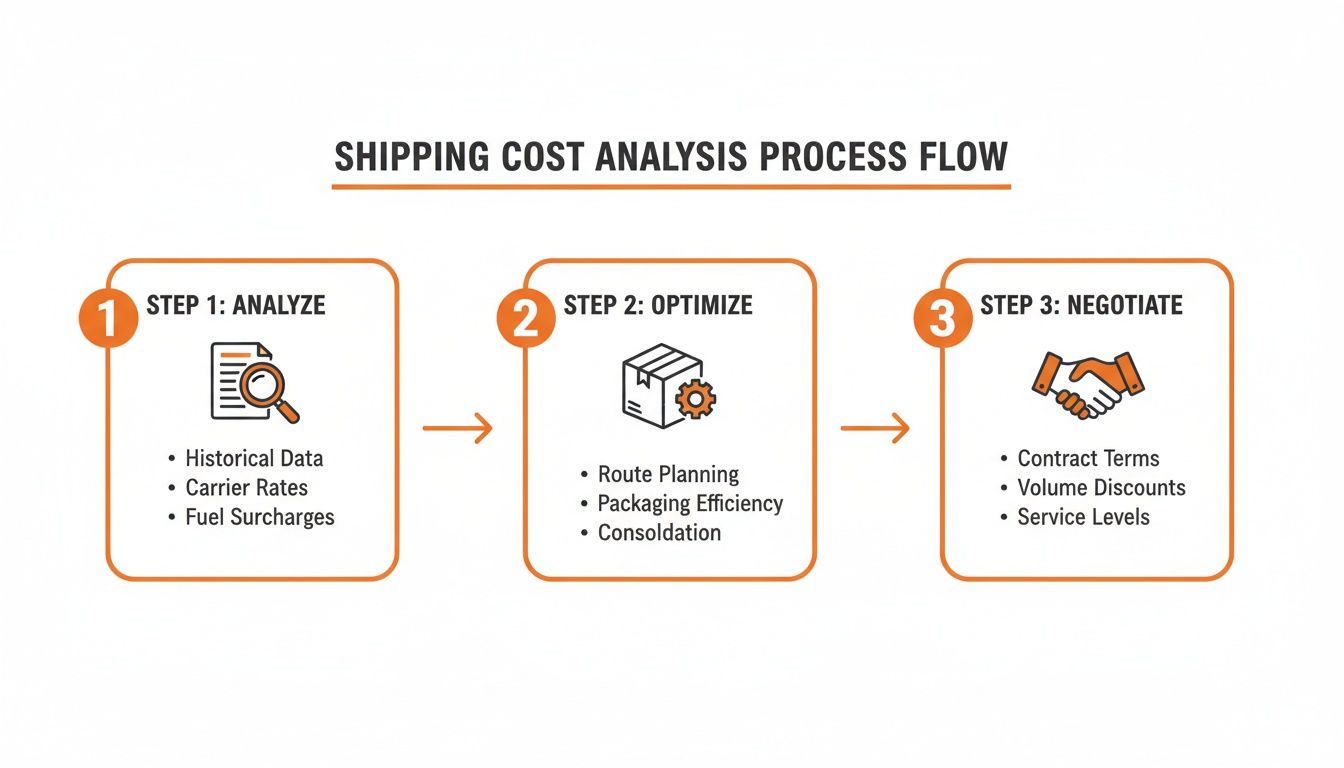
This infographic breaks down the core process for tackling these kinds of shipping expenses.

A clear three-step shipping cost analysis process flow covering analysis, optimization, and negotiation.

As you can see, cutting costs is a cycle. You analyze, you optimize, and then you use that data to negotiate better terms. It all starts with that first analysis.

Finding the Right-Sized Packaging

Once you've identified the products swimming in oversized boxes, it's time to find better alternatives. Your audit will probably reveal some obvious patterns. Maybe you have three different SKUs that could all fit perfectly into a box that's two inches shorter than your current "one-size-fits-all" solution.

Here are a few actionable steps you can take right away:

  • Stock Multiple Box Sizes: Stop relying on one or two generic box sizes. Build an inventory of 5-7 boxes that more closely match the dimensions of your products. The small upfront investment pays for itself almost immediately.
  • Use Lighter Void Fill: If you still need filler, swap bulky air pillows for lighter, more compact options like crinkle paper or recycled kraft paper. They often protect just as well without adding unnecessary bulk.
  • Consider Custom Packaging: For your absolute best-sellers with consistent dimensions, custom-made boxes are a game-changer. Yes, it requires a larger initial order, but the per-shipment savings can be massive. You'll often recoup the investment in just a few months.

Let's run the numbers to see how this plays out in the real world.

The Financial Impact of a Smaller Box

Imagine you sell ceramic mugs. To keep them safe, you ship each one in a standard 10" x 8" x 6" box. With the mug and padding, the package has an actual weight of 2 pounds.

Using the standard DIM weight formula (L x W x H / 139), the calculation is:

(10 x 8 x 6) / 139 = 3.45 lbs

The carrier ignores the 2 lb actual weight and bills you for the dimensional weight of 3.45 lbs.

But after your box audit, you find a snug and secure 8" x 6" x 5" box. The actual weight is still 2 lbs, but let’s recalculate the DIM weight:

(8 x 6 x 5) / 139 = 1.72 lbs

Now, the carrier bills you for the actual weight of 2 lbs, since it’s greater than the new DIM weight. By simply switching to a smaller box, you’ve cut your billable weight from 3.45 lbs down to 2 lbs.

That’s a 42% reduction on every single mug you ship. If you're sending out 500 mugs a month, that small change just saved you thousands of dollars over the year.

Negotiating Carrier Rates Like a Pro

Accepting the default shipping rates you see on a carrier's website is one of the biggest and most expensive mistakes an e-commerce business can make. Think of those prices as a starting point, not the final word. The real key to unlocking serious savings is knowing that everything is negotiable—but you have to come to the table prepared.

A man reviewing documents and finances at a desk with a laptop and a sign saying 'Negotiate Rates'.

So many business owners assume they don't have enough shipping volume to get a discount. That’s a myth. Even a consistent volume of 50-100 packages per week gives you the leverage you need to secure much better rates than the general public pays.

Carriers are in the business of predictable volume. Your consistent business, no matter the size, is a valuable asset. It's time to use it.

Leveraging Your Shipping Volume

Before you even think about picking up the phone, you need to know your numbers inside and out. Don't just tell a carrier rep you "ship a lot." Hit them with concrete data.

Get this information ready:

  • Average Monthly Volume: How many packages do you actually ship each month?
  • Package Characteristics: What are the average weights and dimensions of your shipments?
  • Destination Data: Where are your packages going? Knowing your most common shipping zones is critical.
  • Service Mix: What’s the breakdown? How much is ground, express, or international?

This data does more than just show you're a serious business; it gives the carrier's rep everything they need to build a custom pricing profile that truly reflects your shipping patterns. That's where the real savings are hiding.

The most powerful tool in any negotiation is data. Walk in with a detailed summary of your shipping activity for the last 6-12 months, and you instantly change the conversation from a generic inquiry to a strategic partnership discussion.

Once your data is compiled, start reaching out to account managers at major carriers like UPS, FedEx, and DHL. Skip the general customer service line. Your goal is to connect with a dedicated representative whose job is to win—and keep—your business.

Exploring Regional Carriers and Hybrid Services

While the national giants get all the attention, regional carriers can be a secret weapon for cutting shipping costs, especially if a lot of your customers are clustered in a specific geographic area.

Companies like OnTrac on the West Coast or Spee-Dee Delivery in the Midwest often blow national carriers out of the water on price for next-day ground service within their territory. They are specialists, and that focus lets them offer both speed and savings.

Another powerful option is using hybrid services. These clever solutions combine the long-haul strength of a major carrier with the final-mile delivery network of the USPS.

  • UPS SurePost: UPS handles the pickup and transportation, then hands the package off to the local Post Office for the final delivery to the customer's door.
  • FedEx SmartPost: This works on the exact same model, using the FedEx network for the main journey and USPS for that last residential mile.

These hybrid services are often 20-30% cheaper than standard ground options. They are a fantastic choice for non-urgent shipments where saving money is the top priority. You get reliable delivery without the premium price tag.

Before we dive into a multi-carrier strategy, it helps to know which services are best for different situations. Here’s a quick breakdown to help you match the right service to your needs.

Comparing Major Carrier Services for E-Commerce

Carrier Service Ideal Use Case Typical Speed Cost Factor
USPS Ground Advantage Lightweight, non-urgent items under 70 lbs. Great for standard e-commerce. 2–5 business days Low
USPS Priority Mail Time-sensitive items under 70 lbs. Includes some insurance and tracking. 1–3 business days Medium
UPS Ground Reliable delivery for packages of all sizes, with excellent tracking. 1–5 business days Medium
FedEx Ground Similar to UPS Ground, known for business deliveries and speed in certain zones. 1–5 business days Medium
UPS SurePost/FedEx SmartPost Cost-effective for non-urgent residential deliveries. 3–8 business days Low
UPS 2nd Day Air/FedEx 2Day When you need guaranteed two-day delivery. 2 business days High

This table is a starting point. Your negotiated rates will ultimately determine the best value, but understanding the core purpose of each service is the first step toward making smarter shipping decisions.

The Power of a Multi-Carrier Strategy

Putting all your eggs in one basket is a recipe for disaster. Relying on a single carrier leaves you exposed to their annual General Rate Increases (GRIs), surprise surcharges, and service disruptions from things like strikes or bad weather.

A multi-carrier strategy is your best defense.

By working with two or more providers, you create a system of checks and balances. It keeps everyone honest and their pricing competitive. If one carrier's rates for a particular route get too high, you can instantly pivot and shift that volume to a more affordable partner. To really dial this in, you should understand the different ways you can work with them. For a deeper look, check out our guide on partnered carrier vs non-partnered carriers to see how those relationships impact your bottom line.

This approach isn't just about saving money today. It's about building a resilient and flexible fulfillment machine for the future, giving you the power to always choose the best service at the best price for every single package you ship.

How a 3PL Unlocks Deeper Shipping Savings

As your brand grows, there comes a point where packing boxes in-house goes from a scrappy advantage to a serious operational drag. This is the moment a third-party logistics (3PL) partner stops being a "nice to have" and becomes a strategic move to slash expenses and get your time back. It’s not just about renting warehouse space; it’s about plugging your business into a high-powered fulfillment machine built for efficiency.

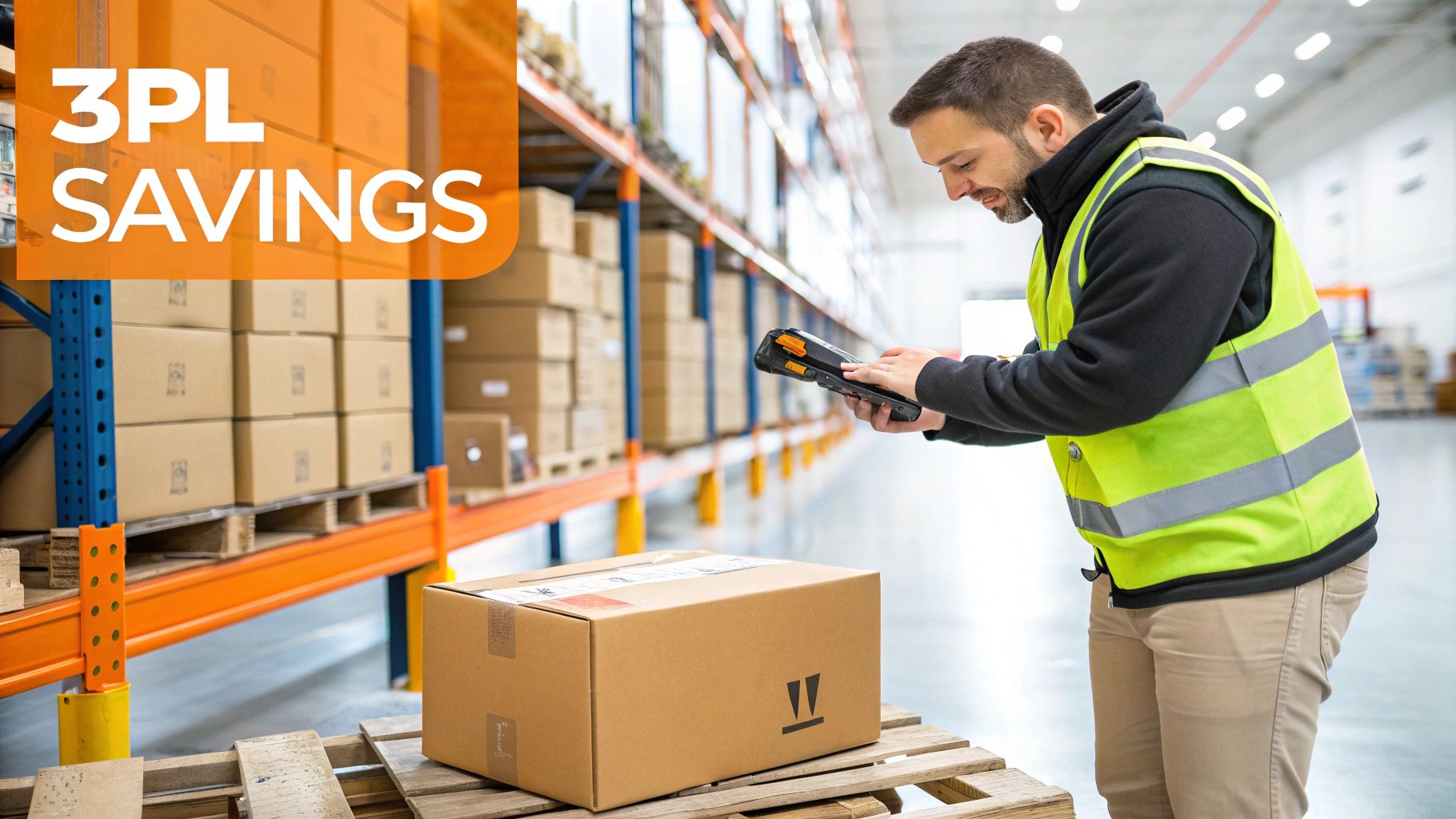
A warehouse worker in a high-visibility vest scans a package on a pallet, with text '3PL SAVINGS'.

The biggest and fastest win you'll see with a 3PL is access to deeply discounted carrier rates. A good 3PL ships millions of packages a year, giving them massive negotiating power with carriers like UPS, FedEx, and USPS. They pass those volume-based savings directly to you—rates that are simply out of reach for a business shipping a few hundred or even a few thousand orders a month.

This move alone instantly lowers your cost per shipment, adding pure profit back to every single order.

Gaining Operational Efficiency and Expertise

Beyond just cheaper shipping labels, a 3PL completely overhauls your fulfillment operation. Think about all the hidden costs of doing it yourself: warehouse rent, utilities, employee wages and benefits, packing supplies, and the hours you spend managing it all. A 3PL rolls these unpredictable fixed and variable costs into a single, predictable cost per order.

This operational shift frees up both cash and your team's energy to focus on what you actually do best—marketing, product development, and growing your brand. You’re no longer in the warehouse business; you're back to being an e-commerce leader.

The real value of a 3PL isn't just in the cost savings, but in the operational excellence you inherit. You gain a team of logistics experts dedicated to getting your orders out quickly and accurately, eliminating costly picking errors and improving the customer experience.

If you sell across multiple channels, this is even more critical. A 3PL with solid software can sync with your Shopify store, Amazon account, and other marketplaces, creating a single source of truth for your inventory and orders. This prevents overselling and keeps fulfillment smooth, no matter where the sale happened. To get the full picture, you can learn more about what a 3PL warehouse is and how it works in our detailed guide.

Strategic Warehouse Placement to Cut Zones and Time

One of the smartest ways to crush shipping costs is to shrink the distance your packages travel. The further a package goes, the more shipping zones it crosses, and the more you pay. A 3PL with a network of strategically located warehouses is the perfect answer to this expensive geography problem.

Instead of shipping every single order from one coast, you can split your inventory across multiple fulfillment centers.

  • West Coast Orders: Ship from a warehouse in California or Nevada.
  • Midwest Orders: Ship from a facility in Illinois or Texas.
  • East Coast Orders: Ship from a center in New Jersey or Georgia.

This model keeps your products close to your customers. The result? Most of your shipments will only travel across one or two zones, dramatically cutting last-mile delivery costs and transit times. This doesn't just save you money—it delights your customers with faster delivery, which is a huge factor in building loyalty.

The financial impact of a distributed inventory model is huge. Businesses partnering with 3PLs often report 30-50% reductions in fulfillment costs by consolidating shipments and avoiding peak-season surcharges. These numbers are backed by industry benchmarks, where optimized pick-pack-ship workflows cut last-mile delivery expenses by 20% on average.

Specialized Services Like FBA Prep

For Amazon sellers, a 3PL offers another game-changing service: FBA preparation. Amazon has incredibly strict—and constantly changing—rules for inbound shipments. One mistake can lead to refused inventory, expensive penalties, and weeks of delays.

A 3PL that specializes in FBA prep takes this entire headache off your plate. They're experts in Amazon's standards and handle all the tedious tasks to ensure your shipment is compliant:

  • Labeling: Applying FNSKU barcodes correctly to every single unit.
  • Poly Bagging: Making sure products are protected and meet Amazon's poly bag rules, including suffocation warnings.
  • Bundling and Kitting: Creating multi-packs or bundled products exactly to your specs.
  • Inspection: Catching any damages or defects before your inventory gets to an Amazon facility.

By outsourcing FBA prep, you dodge the costly mistakes that can tank your Amazon sales. Your inventory arrives at Amazon ready for immediate check-in, getting your products live faster and protecting your sales velocity. This is a perfect example of how a 3PL does more than just ship boxes—it protects your revenue.

Optimizing Your Inbound Freight Strategy

If you want to really get a handle on your shipping costs, you need to stop thinking about it as something that starts when a customer clicks "buy." The real savings begin much, much earlier—with the raw materials and finished goods you bring in from your suppliers.

This is your inbound freight, and it's a massive, often overlooked expense that quietly eats into your profit margins before you’ve even sold a single item. Mastering your inbound logistics is one of the most powerful levers you can pull.

By thinking strategically about where your goods come from and how they get to you, you can build a more resilient and cost-effective operation from the ground up.

Don’t Get Caught in the Front-Loading Trap

In the world of international trade, reacting to headlines is a recipe for disaster. When rumors of new tariffs or trade disputes start flying, the knee-jerk reaction for many importers is to "front-load" their cargo. They scramble to get as much product as possible onto ships before new duties kick in.

It sounds logical, right? Beat the tariff.

But this tactic almost always backfires. It creates a sudden, massive surge in demand for already limited space on vessels, causing ocean freight rates to skyrocket on key trade lanes. You might sidestep a potential tariff, but you get slammed with a guaranteed rate hike that can be just as damaging.

A proactive inbound freight strategy isn't about reacting to every geopolitical ripple. It’s about creating stability in an unstable world by building a diversified sourcing plan that insulates your business from the chaos of any single trade route.

Case in point: As UniCargo reports, in May 2025, transpacific rates from Shanghai to Los Angeles shot up by 117% in just a few weeks. Why? Importers were front-loading cargo to get ahead of announced US-China tariff hikes.

But smart importers who had already pivoted to Southeast Asia, India, or Latin America completely sidestepped these spikes. In fact, global freight rates on other lanes were actually falling during that same period. Asia-to-North Europe dropped 3%, and Asia-to-Mediterranean was down 4%.

Diversify Your Sourcing for Stability and Savings

Putting all your manufacturing eggs in one basket is a huge risk. A trade war, a port strike, or even a natural disaster can paralyze your supply chain overnight. The answer is strategic diversification.

Start looking at sourcing from multiple regions to create a more balanced and resilient inbound flow.

  • Latin America: Countries like Mexico offer incredible nearshoring advantages for the North American market, slashing both ocean transit times and costs.
  • Southeast Asia: Nations like Vietnam and Thailand have become manufacturing powerhouses, giving you high-quality alternatives outside of the usual hubs.
  • India: With a rapidly growing industrial base, India is another fantastic option for diversifying your supplier network and spreading out your risk.

This approach does more than just shield you from surprise rate hikes. It also gives you leverage. When your suppliers know you have other options, you’re in a much stronger position to negotiate better terms and pricing. You should also get familiar with different freight payment terms like "collect freight" to gain even more control over your inbound costs.

Master Your Inbound Documentation

Finally, a smooth inbound process is built on flawless paperwork. Any mistake or missing detail on your shipping documents can lead to costly delays, customs inspections, and painful fines.

Your team absolutely must have a firm grasp on the key documents that govern international freight. To keep things moving and avoid expensive errors, a solid understanding of your shipping paperwork is non-negotiable. For a deep dive, check out this A Complete Guide to Understanding the Bill of Lading.

The Bill of Lading (BOL) is the single most important piece of paper in the shipping world. It's your contract with the carrier, a receipt for your goods, and a document of title. An accurate BOL ensures your cargo is correctly identified, routed, and released to the right party. If you're serious about managing your inbound logistics, getting this document right every single time is critical.

Right, we’ve dug into the weeds on everything from dimensional weight to freight strategy. Now, let's put it all together. This isn't just a recap; it's your go-to checklist for making immediate, real-world changes to your shipping operations.

The goal here is to stop bleeding cash and build a more profitable, resilient business. Every small tweak adds up, and this is where you start laying that stronger foundation.

Immediate Actions for Quick Wins

Let's start with the low-hanging fruit. These are the changes you can make right now, without big investments, that will deliver the fastest results.

  • Conduct a Packaging Audit: Grab your top 10 best-selling products and the boxes you use. Get out a tape measure and see how much empty space is in there. The mission is simple: find where you can switch to smaller boxes, lighter void fill, or even poly mailers to crush those dimensional weight fees.
  • Analyze Your Carrier Invoices: It’s time for a deep dive. Pull your shipping invoices from the last three months. Look past the base rates and hunt for every single accessorial fee—residential surcharges, fuel surcharges, delivery area fees. You can't cut costs you don't know you're paying.
  • Review Your Returns Process: How much are returns really costing you? Dig into the reasons customers are sending things back. If a big chunk is due to damage in transit, that’s a flashing red light. Upgrading your packaging is an investment that pays for itself by cutting down on expensive reverse logistics.

Strategic Moves for Long-Term Savings

Once you've snagged those quick wins, it’s time to think bigger. These are the structural changes that will compound your savings for years to come.

  • Request New Carrier Quotes: Armed with hard data from your invoice analysis, get your carrier reps on the phone. Don't just ask for a generic discount—show them your volume, your typical package specs, and your zone distribution. While you're at it, get quotes from regional carriers. They can often beat the big guys for deliveries in their backyard.
  • Explore 3PL Partnerships: If you're still fulfilling orders from your garage or back office, it's time to get quotes from at least two third-party logistics (3PL) providers. Ask them specifically about their discounted carrier rates and how their warehouse network can lower your average shipping zone. This isn't just about saving money; it’s about buying back your time.

Building a cost-effective shipping operation isn't a "set it and forget it" project. This is a continuous process. You should be revisiting these steps at least quarterly to stay ahead of carrier rate changes and shifts in your own business.

Building a Resilient Supply Chain

Finally, let's zoom all the way out to the very beginning of your supply chain. Getting your inbound freight right is an advanced move that protects you from global hiccups and gives you a serious competitive edge.

  • Analyze Your Inbound Freight Origins: Where is all your inventory coming from? If 100% of it is sourced from a single country, it's time to start researching alternative suppliers in other regions like Southeast Asia or Latin America. Supplier diversification is your best defense against surprise tariffs and port shutdowns.
  • Master Your Documentation: This is non-negotiable. Make sure your team understands critical documents like the Bill of Lading. A simple paperwork mistake on an inbound container can trigger costly delays, customs holds, and a mountain of fees. Flawless documentation is the backbone of an efficient supply chain.

By working through this plan, you can methodically turn shipping from a headache into a streamlined, cost-effective part of your business that actually helps you grow.


At Snappycrate, we specialize in turning these action items into reality for e-commerce brands. From optimized FBA prep to accessing deeply discounted shipping rates, our 3PL services are designed to help you scale efficiently. Let us handle the logistics so you can focus on growing your business. Learn how Snappycrate can reduce your shipping costs today.

0 Continue Reading →