
Think of your e-commerce business like a great neighborhood restaurant. Your Customer Relationship Management (CRM) system is the host at the front door—greeting regulars by name, remembering their favorite table, and knowing they prefer sparkling over still water. Meanwhile, your Order Management System (OMS) is the master chef in the kitchen, turning every ticket into a perfectly executed dish.
When they work separately, you might get decent service. But when they communicate seamlessly, you create an unforgettable experience that keeps customers coming back.
The Power Couple of E-commerce Operations

For any growing e-commerce brand, operational chaos is an all-too-familiar feeling. When your systems don't talk to each other, you end up with frustrating problems: overselling a hot-ticket item, shipping delays because of a manual data entry mistake, or a customer service team that has no idea where an order is. It’s a disjointed mess that creates friction for both your team and your customers.
This is exactly where integrating your CRM and order management systems saves the day. It creates a single, unified source of truth where all your customer data and logistics information can finally live together. This connection turns operational complexity into a smooth, scalable machine.
Let's quickly break down the core functions of each system.
CRM vs Order Management System At a Glance
This table gives you a snapshot of what each system is built to do. Think of it as the "front-of-house" versus the "back-of-house."
| Aspect | Customer Relationship Management (CRM) | Order Management System (OMS) |
|---|---|---|
| Primary Goal | Build and maintain customer relationships. | Fulfill and manage customer orders efficiently. |
| Main Focus | The person—their history, preferences, and interactions. | The transaction—its status, inventory, and journey. |
| Key Data | Contact info, communication history, support tickets, marketing segments. | Order details, inventory levels, shipping status, returns, payment info. |
| Core Question | "Who is this customer and what do they need?" | "Where is this order and when will it arrive?" |
As you can see, one is all about the relationship, and the other is all about the logistics. The magic happens when they share notes.
Bridging Customer Insights with Logistics
At its heart, a CRM is about the who and why of your customer relationships. It tracks every touchpoint, from the first ad they clicked to their most recent support email. In contrast, an OMS is all about the what, where, and when of fulfillment. It manages the entire lifecycle of an order from the moment a customer clicks “buy.”
When these two systems are integrated, they feed information back and forth, creating a powerful loop of intelligence.
An integrated system doesn't just process orders; it enhances the entire customer journey. It uses logistical data to inform customer interactions and customer data to fine-tune operations. This synergy is the key to proactive service and operational excellence.
For operations leaders and online sellers, this unification solves several massive headaches:
- Eliminating Stockouts: Real-time inventory data from the OMS becomes visible in the CRM. This stops your sales team from promising products that are already sold out.
- Improving Customer Service: Your support agents can see a customer's complete purchase history and the live status of their current order on a single screen. No more "Let me check another system." Just fast, accurate answers.
- Enabling Personalization: Purchase data from the OMS flows back into the CRM, arming your marketing team with the insights to create hyper-targeted campaigns based on actual buying behavior.
This guide will walk you through exactly how to merge these two essential platforms, transforming your fulfillment process from a simple cost center into a powerful driver of customer loyalty.
Understanding Your Core E-commerce Systems
To really get a handle on how a CRM and order management system can supercharge your business, we first need to break down what each one actually does. They are two completely different engines, and mixing them up is a classic mistake that gums up the works for a lot of online sellers.
Think of your Customer Relationship Management (CRM) system as your company’s memory. It’s the central hub for every single customer conversation, and its focus is entirely on people.
A good CRM tracks every touchpoint—from the first ad a customer clicked to their most recent support ticket. Its job is to answer the ‘who’ and ‘why’ behind every single sale.
The Role of Your CRM
The CRM is where you get to know your customers. It's not concerned with what’s happening in the warehouse or which shipping carrier you’re using; it’s all about conversations, buying habits, and personal preferences.
Its main gigs include:
- Contact Management: More than just names and emails, it’s a full profile of your customer.
- Interaction History: A complete log of every call, email, and chat. No more asking a customer to repeat themselves.
- Segmentation: Grouping customers for smart marketing, like creating a list of your VIPs or new buyers.
- Sales Pipeline: For B2B or high-touch sales, it tracks leads long before they become a paid order.
Bottom line: The CRM is your master storyteller for every customer relationship.
The Role of Your OMS
Now, let's talk about the Order Management System (OMS). If the CRM is the memory, the OMS is the logistical brain. It is 100% process-focused.
The second a customer hits that "Pay Now" button, the OMS wakes up and takes over. It’s the behind-the-scenes workhorse managing the ‘what, where, and when’ for every order that comes through your store. It’s the unsung hero making sure the right product gets to the right person, on time, every time.
A great OMS provides a single, centralized view of the entire order lifecycle. It connects your sales channels, warehouses, and shipping partners to ensure every order flows through the system without manual intervention or costly errors.
This system is all about the physical journey of your products. Its core functions are worlds away from a CRM’s:
- Order Aggregation: It pulls in orders from all your storefronts—Shopify, Amazon, your own website, you name it.
- Inventory Tracking: It keeps a live, accurate count of your stock across every location. You can learn more about this in our guide to real-time inventory management.
- Fulfillment Routing: It intelligently sends the order to the best warehouse or 3PL for picking and packing.
- Shipment Management: It’s what generates the shipping label and shoots that tracking number over to the customer.
So, while one system builds relationships, the other executes logistics. Getting this distinction right is the first step to building an e-commerce machine where both systems work together in perfect harmony.
How Integrated Systems Transform E-commerce Fulfillment
When your CRM and order management system (OMS) are connected, they create a single source of truth that completely changes how you run your e-commerce operations. This isn't just some technical tweak; it's a strategic move that turns a bunch of disconnected steps into one smooth, intelligent workflow. The real magic happens when customer data meets logistics in real time.
Imagine a loyal customer is at checkout. Because your systems are talking, the CRM recognizes their VIP status and instantly triggers a special "thank you" discount that first-time buyers don't see. In that same split second, the OMS confirms the items in their cart are actually in stock, preventing the dreaded "oops, we oversold that" conversation.
This seamless data exchange makes for a smarter, more responsive customer experience from the very first click.
The visual below shows how customer information flows from the relationship-focused CRM to the logistics-driven OMS, creating a unified view that drives better decisions.
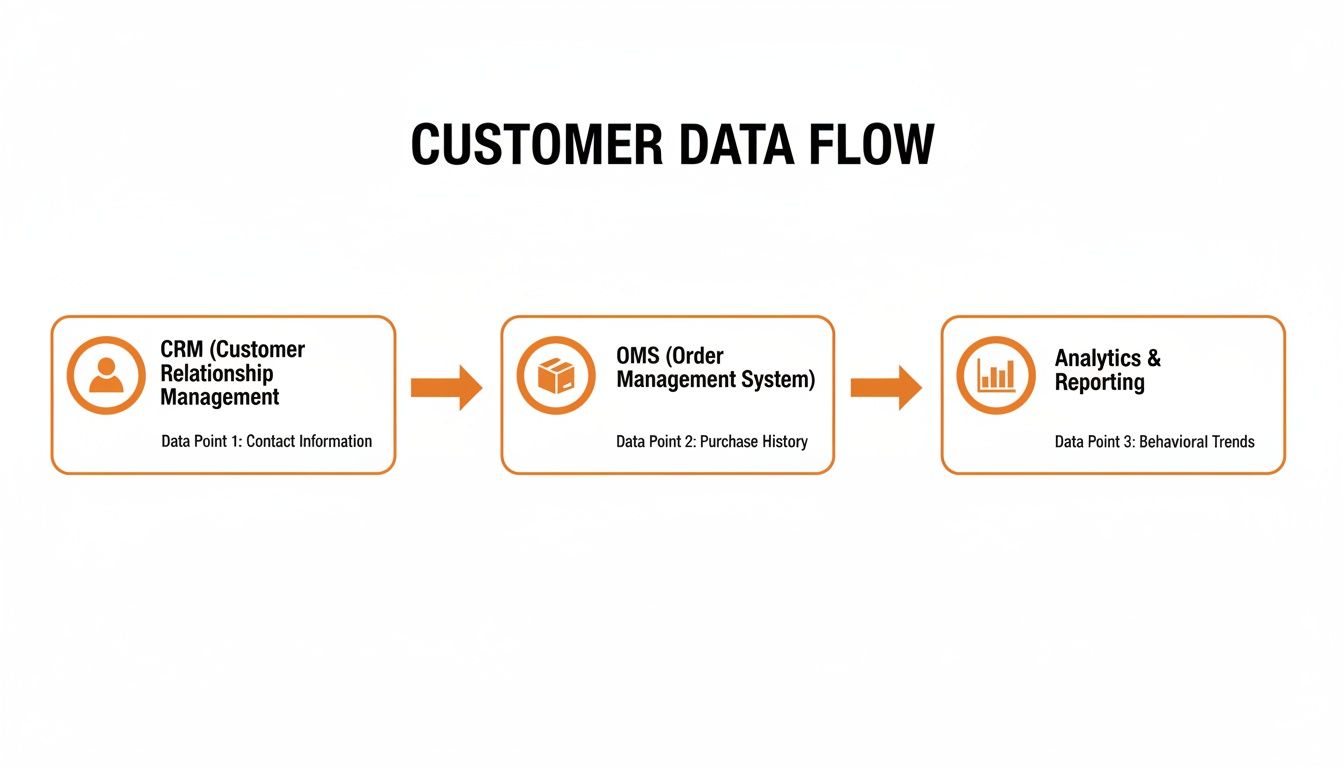
This flow isn’t just about moving data around. It’s about using customer history to power accurate, efficient order processing, turning every transaction into an opportunity to strengthen the relationship.
From Checkout to Doorstep: A Single View
Once an order is placed, the integration kicks into high gear. The order details are instantly zapped from your storefront to the OMS, which then routes it to your 3PL or warehouse. Every single status update—from 'picked' and 'packed' to 'shipped'—is reflected back in both systems at the same time.
This creates a powerful, 360-degree view of the customer. Your support team no longer has to toggle between screens or put frustrated customers on hold.
When a customer calls to ask, "Where is my order?" your team can see their entire purchase history alongside their real-time shipping status, all on one screen. This transforms reactive problem-solving into proactive customer care, completely eliminating the dreaded phrase, "Let me check with the warehouse."
This kind of operational clarity is fast becoming non-negotiable. The global Order Management Systems (OMS) software market is projected to nearly double from $1 billion in 2021 to $1.9 billion by 2026, driven by a 12.3% compound annual growth rate. This explosion is a direct reflection of e-commerce's massive scale, where efficient order handling is make-or-break for businesses like Snappycrate that manage fulfillment for high-volume Amazon FBA and Shopify sellers. You can read more about the future trends of order management systems here.
Unlocking Key Operational Benefits
A tightly integrated CRM and order management platform delivers real, tangible benefits across your entire business—it’s not just about making customer service easier. It builds the foundation you need to scale.
Here’s how it empowers different teams in your operation:
- For the Marketing Team: Purchase data from the OMS flows back into the CRM, making customer profiles smarter. This lets marketers create hyper-targeted campaigns based on what people actually buy, not just what they looked at.
- For the Operations Team: Automation kills manual data entry, which drastically cuts down on human error in order processing. The result? Higher order accuracy, fewer returns from incorrect shipments, and lower operational costs.
- For Leadership: Unified data provides a clear, accurate picture of business performance. Leaders can track key metrics like order fulfillment time, customer lifetime value, and inventory turnover with much greater precision.
Ultimately, this integration ensures that every part of your business is working from the same playbook. It guarantees the promises your marketing team makes are the ones your fulfillment team can keep, creating a consistent and reliable brand experience that builds lasting loyalty.
Choosing Your Integration Strategy
Connecting your CRM and order management systems isn't a simple plug-and-play affair. The right path for your business comes down to your size, your team's technical skills, and where you plan to be in a few years.
Getting this choice right from the start is crucial. It's the difference between building a scalable foundation for growth and creating a tangled mess that you'll have to rip out and replace in two years.
There are really three main ways to get your CRM and order management systems talking. Each has its own pros and cons, and they’re best suited for different stages of a business's journey. Let's break them down.
Direct Point-to-Point Connections
The most straightforward method is a direct, point-to-point integration. Think of it like building a single, dedicated bridge just for your CRM and OMS. This is usually done with APIs (Application Programming Interfaces) that shuttle specific data—like new order details or customer address changes—from one system directly to the other.
This approach can be a quick and cheap win for startups or small businesses with simple workflows. But be warned: it gets fragile fast. As soon as you add another sales channel or a new accounting software, you have to build another separate bridge. Before you know it, you’ve got a complex web of connections that’s a nightmare to manage and troubleshoot.
Want to see how broader connectivity can transform your operations? Check out our guide on unlocking growth with supply chain integration.
Using an Integration Platform (iPaaS)
A much more scalable approach is using an Integration Platform as a Service, or iPaaS. An iPaaS solution is like a central hub or a universal translator for all your software. Instead of connecting every system directly to every other system, you just connect each one to the central hub.
This model gives you incredible flexibility. When you want to add a new app, you just plug it into the hub instead of building a dozen new point-to-point connections. It’s the difference between a clean city grid and a chaotic mess of overlapping back roads.
This is the way to go for growing businesses that know they’ll be adding more tools to their tech stack. It keeps your data flowing cleanly, makes it easier to find and fix problems, and lets your entire system adapt to change without falling apart.
Adopting an All-in-One Platform
The final route is to just skip the integration headache altogether and go with an all-in-one platform that bundles CRM, order management, and other functions from the get-go. These unified systems are built with all the connections already in place.
This path offers the most seamless experience because all your data lives natively in one ecosystem. It’s a powerful choice for businesses that want a single source of truth without the hassle of juggling multiple vendors and integration projects.
This trend is only getting bigger. The cloud-based CRM market is expected to grow at a 13.43% CAGR from 2022 to 2027, largely driven by the demand for integrated solutions that combine sales with core operational functions. You can find more CRM market growth on emailvendorselection.com.
Actionable Tactics for Marketplace and DTC Sellers

All the theory is great, but let's get down to brass tacks. How does combining your CRM and order management actually make you more money? It’s not just about fancy software; it’s about solving the real, everyday headaches that cost you sales, whether you’re selling on Amazon or your own website.
For Amazon FBA sellers, this integration is your command center. It does way more than just track orders. It helps you nail FBA prep compliance, keep an eye on your inbound shipments heading to Amazon, and make sure your inventory numbers actually match what’s on the shelf. This unified view is a lifesaver for preventing stockouts on your fastest-moving products—a mistake that can absolutely crush your sales velocity and tank your product ranking.
For direct-to-consumer (DTC) brands, especially those on a platform like Shopify, the real magic is in hyper-personalized marketing. When your OMS feeds detailed purchase histories back into your CRM, you can slice and dice your customer list with surgical precision. Think targeted campaigns for your loyal repeat buyers or special “we miss you” offers for customers who haven’t shopped in a while. You can find more details in our guide to Shopify order fulfillment services.
Key Metrics to Track for Growth
To see if this is all working, you need to look past the vanity metrics. The right KPIs show you the true health of your operations and how happy your customers really are. This is how you turn all that data from your integrated systems into measurable improvements for your business.
- Order Accuracy Rate: What percentage of your orders go out the door without a single mistake (wrong item, wrong quantity, wrong address)? An integrated system drives this number up by automating data entry, slashing the human errors that lead to expensive returns and frustrated customers.
- On-Time Shipping Rate: Are you shipping orders within the timeframe you promised? Your OMS gives you the raw data, but your CRM can help you spot trends, like if a certain customer group is consistently facing delays.
- Customer Lifetime Value (CLV): This is the ultimate report card for your integration. When you use CRM data to create a smooth, positive order experience, you earn repeat business. That directly boosts the total amount a customer spends with you over their entire relationship with your brand.
Tracking CLV is how you prove the long-term ROI of this investment. It shows that a seamless post-purchase experience—powered by integrated data—isn't just a cost center. It's a powerful engine for building a sustainable, profitable business.
And the market is catching on. The global Order Management Systems market was valued at $2.19 billion in 2021 and is expected to explode to $9.02 billion by 2033, growing at a 12.52% CAGR. This rush is being led by e-commerce sellers who need scalable, compliant fulfillment, especially in North America, which is on track to grab a $1.03 billion share by 2025. You can discover more insights about the OMS market on cognitivemarketresearch.com.
Building Your Blueprint for Seamless Operations
Let's be honest: integrating your CRM and order management system isn't just a nice-to-have anymore. It’s the absolute foundation for any e-commerce brand that wants to scale without breaking. When you connect customer data with your actual warehouse operations, you unlock a new level of efficiency and create a far better experience for your customers.
Think of this connected system as the blueprint for your growth. It frees you up to focus on building your brand and creating amazing products, because you know your operational backbone can handle whatever you throw at it. This is how you turn your fulfillment process from a pure cost center into a powerful engine for customer loyalty and repeat sales.
At the end of the day, a tight integration between your CRM and order management platform makes sure the promises your marketing team makes are the ones your fulfillment team can actually keep. That consistency builds a brand people trust, order after order.
Once your systems are talking to each other, you can finally stop playing defense and putting out fires. You get ahead of the game, managing the entire customer journey—from the first click to the package landing on their doorstep—proactively. This creates a smooth, predictable, and profitable operation built to last. It’s really the core of what it takes to win in e-commerce today.
Common Questions Answered
Even with the best game plan, connecting your CRM and order management systems can raise a few questions. Let's walk through the ones we hear most often so you feel confident making the move to a fully connected operation.
Can I Just Use My CRM to Manage Orders?
While it might be tempting, the short answer is no. Some CRMs let you track sales and see order history, but they aren't built for the heavy lifting of true order management. An Order Management System (OMS) is purpose-built to handle everything that happens after the customer clicks "buy"—from juggling inventory across different sales channels to managing complex fulfillment logic and processing returns.
Trying to use your CRM for this is like managing your company's accounting in a simple spreadsheet. It might work for the first handful of orders, but it breaks down fast as you grow, leading to frustrating bottlenecks and costly mistakes.
What's the Single Biggest Challenge When Integrating?
Nine times out of ten, the biggest headache is data mapping. This is the critical step where you make sure the data fields in both systems are speaking the same language. You have to meticulously connect the dots between customer records, product SKUs, order statuses, and shipping details so they communicate flawlessly.
A rushed or poorly planned data mapping strategy is the #1 reason these integrations fail. You end up with duplicate customer profiles, wrong order information, and a total loss of trust in your data—which defeats the whole point of integrating in the first place.
Before you write a single line of code, take the time to audit your data and draw up a clear mapping plan. Doing this work upfront is what separates a seamless, reliable system from a complete mess.
How Does This Actually Help My Customer Service Team?
It's a game-changer for them. This integration gives your support team a true 360-degree view of every single customer. When someone calls, your agent sees their entire history from the CRM right alongside the real-time status of their current order from the OMS—all on one screen.
No more switching between systems or putting people on hold to "go check with the warehouse." Agents can confidently answer shipping questions, start a return, or give an update with the full story in front of them. This means faster resolutions, happier customers, and a support team that feels empowered to deliver great service every time.
At Snappycrate, we handle the complexities of e-commerce fulfillment so you can focus on growth. From Amazon FBA prep to direct-to-consumer order processing, our 3PL services are built to scale with your brand. Learn how Snappycrate can become a reliable extension of your business.