

When you're dealing with shipping and logistics, you'll see the term FOB everywhere. It stands for Free On Board, and it’s one of the most important terms you'll need to understand as an importer or e-commerce seller.
Put simply, FOB defines the exact moment in the supply chain when the responsibility for your goods—including all the risks and costs—is officially handed off from the seller to you, the buyer.
What FOB Really Means for Your Supply Chain
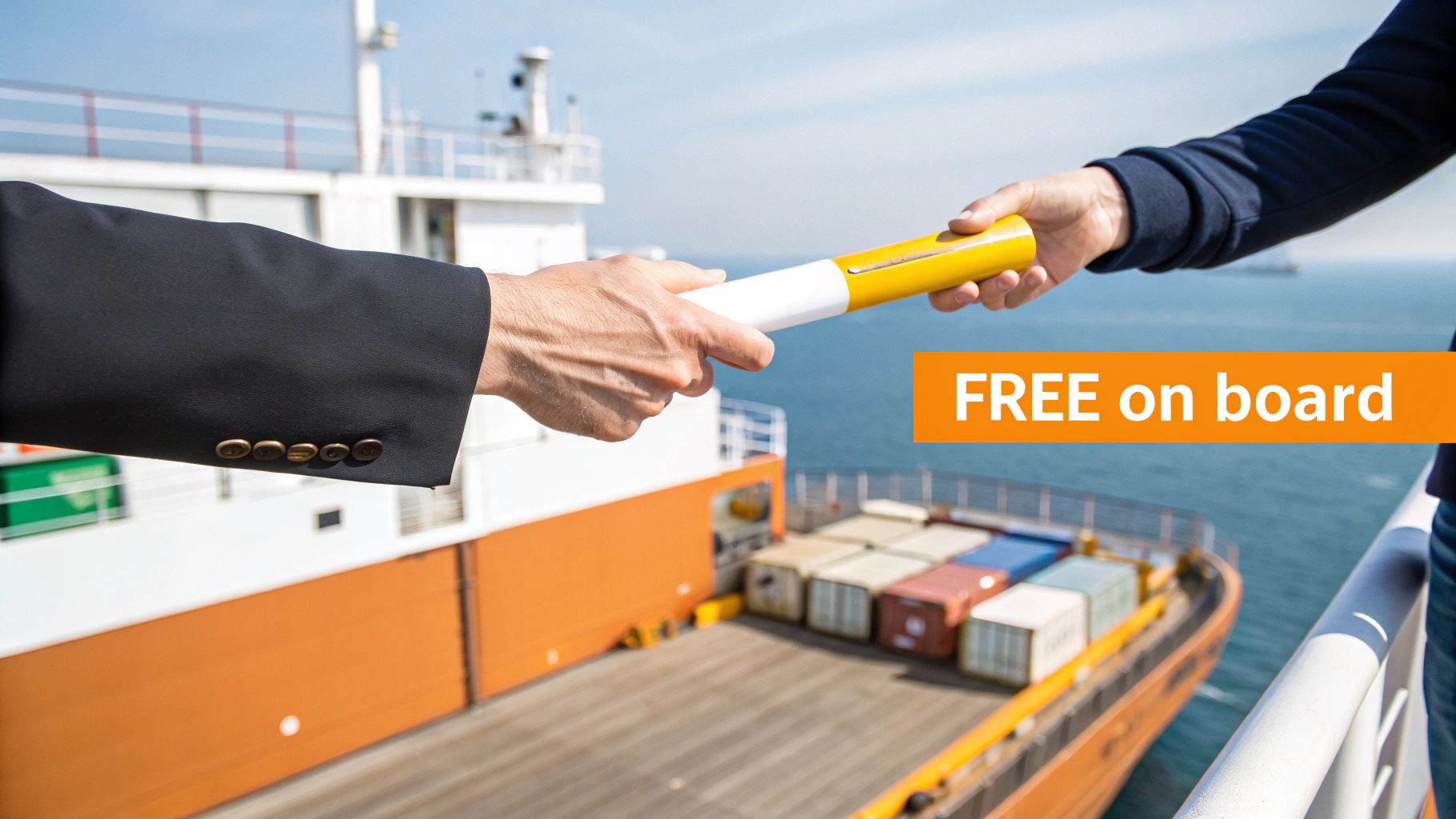
Think of it like a relay race for your inventory. Your supplier (the seller) carries the baton—your products—to a specific, pre-agreed point. Once they hand it off, you (the buyer) take over for the rest of the race to the finish line. That handoff point is what makes understanding FOB so critical for managing your shipping costs, insurance, and liability.
The term actually comes from the old days of sailing ships, when cargo was physically passed "free on board" over the ship's rail. That simple action marked the transfer of responsibility. Today, the concept is formalized by the International Chamber of Commerce (ICC), and FOB still accounts for around 25% of global trade contracts. You can find more on its history over at lot.dhl.com.
For anyone running an e-commerce business, getting this right isn't just about knowing the lingo. It directly impacts your landed cost, insurance coverage, and how much control you have over your own logistics.
FOB Origin vs Destination At a Glance
The easiest way to understand FOB is to compare the two main types. The key difference is simply where that handoff from seller to buyer happens.
This quick table breaks it down.
| Responsibility Point | FOB Origin (Freight Collect) | FOB Destination (Freight Prepaid) |
|---|---|---|
| Risk Transfer | Buyer takes on risk at the port of origin. | Seller keeps the risk until goods arrive at the buyer's destination. |
| Who Pays Freight? | The buyer pays for the main leg of the shipping journey. | The seller pays for shipping all the way to the final destination. |
| Best For | Buyers who want full control over their shipping costs and carriers. | Buyers who prefer simplicity and want to offload logistical work. |
Essentially, the choice between FOB Origin and FOB Destination determines who is on the hook if something goes wrong and who controls the purse strings for the most expensive part of the shipping process.
How FOB Origin Puts You in Control
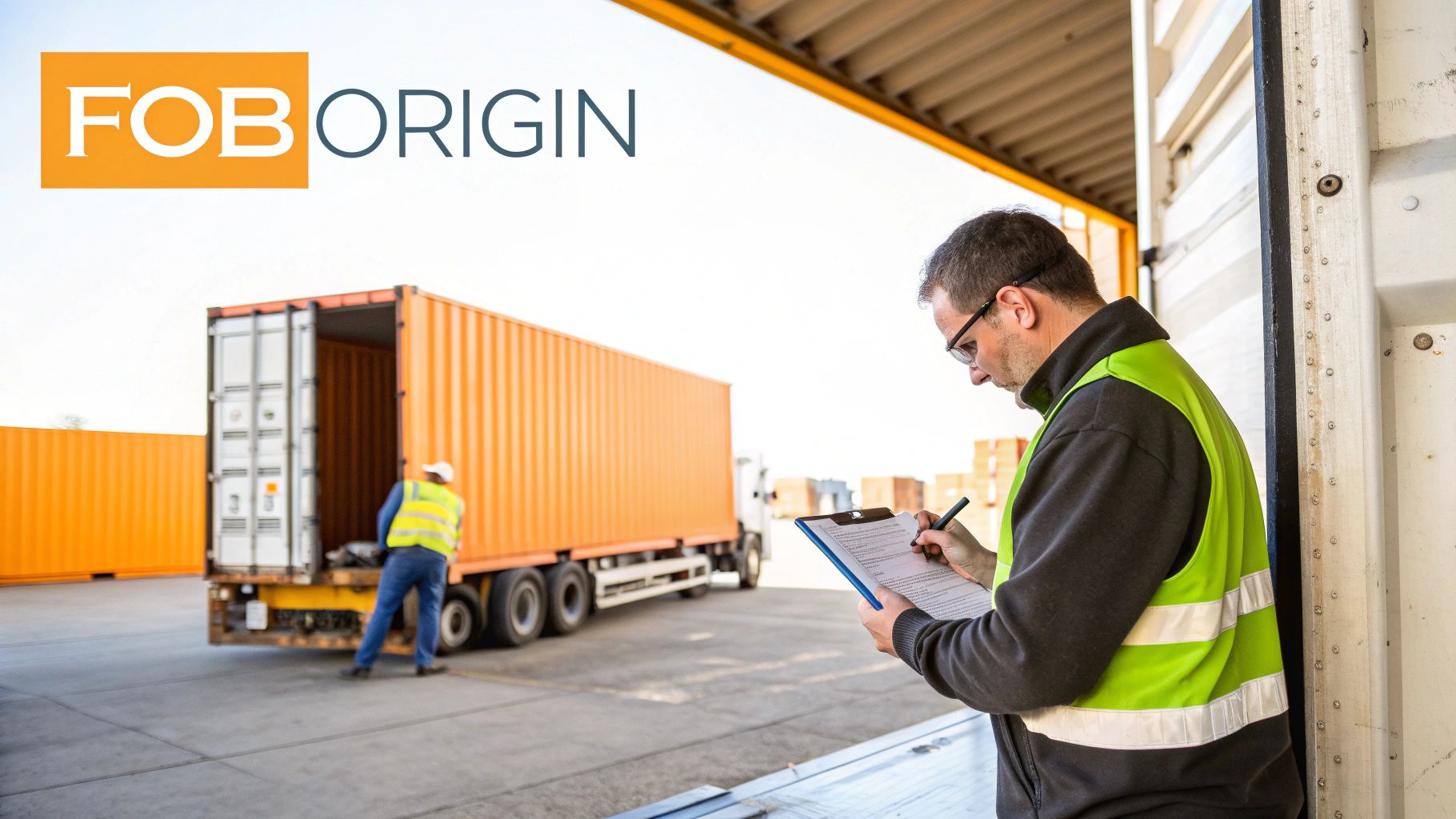
When you opt for FOB Origin, you're essentially grabbing the steering wheel for your international freight. Under this agreement, the handoff happens early and decisively. The moment your goods are loaded onto the ship at the origin port—let’s say in Shanghai—the ownership and risk become yours.
That means you’re in charge of the main leg of the journey. You’re the one paying for the ocean freight, arranging the cargo insurance, and dealing with any hiccups that might pop up during transit. While it sounds like a lot of responsibility, it comes with one massive advantage: control.
Because you're footing the freight bill, you get to choose your own carriers and freight forwarders. This gives you the power to shop around and negotiate rates directly, often uncovering much better deals than your supplier could offer. For experienced importers, this is where the real savings are found.
Seizing the Financial Advantage
The financial upside of choosing FOB Origin is a big deal. In today’s $18 trillion global trade arena, there's a reason this term is so popular. In fact, FOB Origin is used in over 60% of export contracts from major hubs like China, shifting the risk to the buyer as soon as the goods are on the vessel.
For an Amazon FBA seller, this control isn’t just about peace of mind—it’s about the bottom line. It can slash your landed costs by 15-20% compared to other arrangements where the seller bundles shipping. You can find more insights on these trade dynamics at Stonex.com.
Key Takeaway: FOB Origin is the go-to choice for importers who want to actively manage their supply chain, hand-pick their logistics partners, and keep their shipping expenses in check.
The Role of Your 3PL Partner
This is exactly where a savvy third-party logistics (3PL) partner becomes your most valuable player. Just because your FOB Origin container arrives at the port doesn't mean the work is done. A specialized 3PL like Snappycrate takes over from here, managing all the complex steps that follow.
Our team handles:
- Container Receiving: We coordinate the drayage to get your container from the port to our warehouse, no hassle.
- Pallet Breakdowns: We get your container unloaded fast and sort your inventory with precision.
- FBA Prep: We make sure every single item meets Amazon's tough compliance rules, from FNSKU labeling to bundling and bagging.
By taking on these critical inbound tasks, we bridge the gap between your container's arrival and its readiness for sale. You get all the cost-saving benefits of FOB Origin without any of the logistical headaches.
The Simplicity of FOB Destination
If FOB Origin is all about taking the reins, then FOB Destination is the "set it and forget it" option. This agreement completely flips the script. The seller keeps full ownership, risk, and responsibility for your products until they are safely delivered to your specified location—whether that’s your warehouse or a 3PL partner like us.
Think of it as the door-to-door service of Incoterms. The seller handles everything: booking the ocean freight, dealing with customs, and managing the insurance. You're pretty much hands-off until the truck pulls up to your loading dock. For buyers who want to sidestep the headaches of international shipping, this is often the perfect fit.
Weighing Convenience Against Cost
The biggest win with FOB Destination is the massive reduction in your operational workload. You don’t have to hunt for freight forwarders, haggle over shipping rates, or chase down insurance claims if something gets damaged on the way. But, of course, that convenience comes at a price.
Sellers simply bake all those shipping, insurance, and handling fees right into your product cost. This usually means your per-unit price will be higher than it would be with an FOB Origin agreement.
FOB Destination is used in about 35% of U.S.-centric deals. It’s a popular choice for e-commerce importers who would rather not deal with transit issues, since sellers under this term handle most of the insurance claims. You can dig into more of these shipping trends in the research from Inbound Logistics.
How a 3PL Handles FOB Destination Deliveries
Even with a simpler shipping term, a smooth handoff is critical once the goods finally arrive. A good 3PL partner has battle-tested receiving workflows ready to handle FOB Destination deliveries of any size, from a few boxes to a full truckload.
This ensures your products move seamlessly from the carrier's truck into your inventory system. The moment we accept the delivery, our team can immediately get to work:
- Inspecting goods for accuracy and any signs of damage.
- Updating your inventory levels in real-time so you know exactly what you have.
- Getting products prepped for storage or immediate order fulfillment.
This kind of efficiency means that even though you weren’t managing the freight, your products get into your supply chain without missing a beat, ready to ship out to your customers.
Comparing FOB Origin vs FOB Destination
Choosing between FOB Origin and FOB Destination really just boils down to one simple question: who do you want in the driver’s seat for the main leg of the shipping journey? Each term hands over control, cost, and risk to a different party, making the choice a strategic one for your business.
For a new e-commerce brand just getting started, the hands-off nature of FOB Destination is often a lifesaver. Your supplier manages all the logistics until the goods show up at your warehouse, which keeps your supply chain simple and cuts down your risk while everything is in transit. Sure, this convenience usually means a higher per-unit cost, but it removes a ton of operational headaches.
This diagram breaks down exactly why FOB Destination is so appealing for buyers who prioritize simplicity.
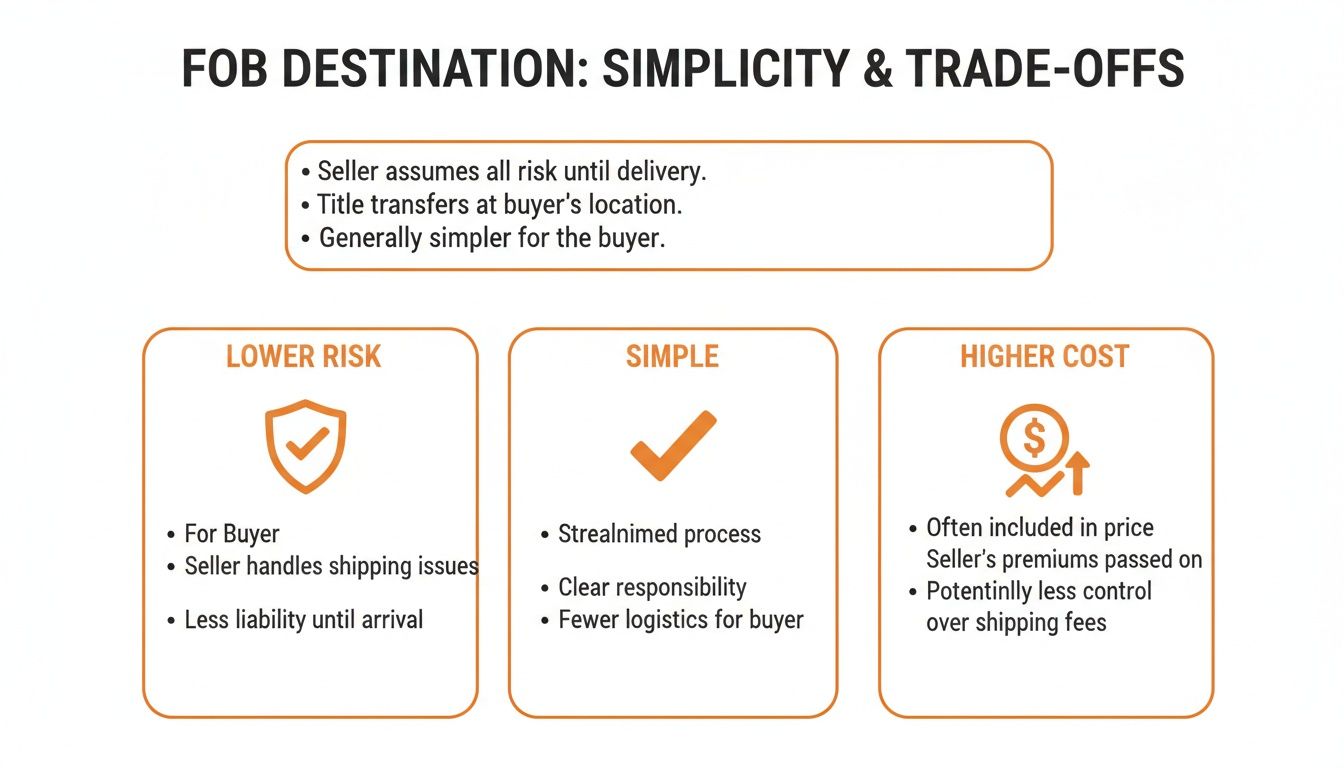
As you can see, the trade-off is pretty clear: you accept a higher product cost in exchange for taking on way less risk and complexity.
Detailed Breakdown FOB Origin vs FOB Destination
On the flip side, an experienced operations manager might lean toward FOB Origin to get full control over the process and squeeze out some cost savings. By managing the freight themselves, they can shop around for better rates and pick their favorite carriers, which directly impacts their final landed cost.
Let's put them side-by-side to see how they really differ.
| Factor | FOB Origin | FOB Destination |
|---|---|---|
| Ownership Transfer | The buyer takes ownership right at the seller's shipping dock. | The buyer takes ownership when the goods arrive at their door. |
| Who Pays Freight? | The buyer pays for the main transport from the origin port. | The seller pays for all transport to the final destination. |
| Risk During Transit | The buyer is on the hook for any risk once goods are loaded. | The seller keeps all the risk until the goods are delivered. |
| Logistics Control | The buyer gets to pick the carrier and manage the freight. | The seller controls all logistics and carrier choices. |
Getting these distinctions right is crucial. For instance, with FOB Origin, the buyer is responsible for what's known as collect freight—a term that just defines who pays the shipping bill. You can learn more about the specifics of collect freight definitions in our guide.
At the end of the day, the right FOB term comes down to your company's logistics know-how, how much risk you're willing to take on, and your overall cost-saving goals.
Choosing the Right FOB Term for Your Business
When it comes to picking the right FOB term, there’s no single "correct" answer. It’s all about matching the agreement to your company's logistics muscle, budget, and how much risk you're willing to take on. For Amazon sellers and e-commerce brands, this decision directly hits your landed costs and how much work lands on your plate.
The choice really boils down to a few honest questions. How much control do you really need over your supply chain? Are you set up to handle customs, import paperwork, and freight forwarding? And the big one: how much sleep will you lose if a container goes missing mid-ocean? Answering these will point you in the right direction.
Aligning FOB Terms with Your Business Stage
Seasoned, high-volume importers almost always lean toward FOB Origin. They’ve been around the block, have solid relationships with freight forwarders, and can use their shipping volume to get much better rates than their supplier ever could. Taking a hands-on approach gives them huge cost savings and total control over which carriers they use and when their products ship. They're ready for the risks because the financial payoff is more than worth it.
On the other hand, newer businesses—or those that just want to focus on marketing and selling products—often find FOB Destination to be a lifesaver. Its biggest selling point is simplicity. You let the seller deal with all the shipping headaches and insurance, and in return, you get a predictable, all-in cost per unit, even if it's a little higher.
Strategic Insight: Your choice of FOB term isn't set in stone. A startup might kick things off with FOB Destination for its simplicity, then switch to FOB Origin once they scale up and get more confident in how to build an efficient supply chain for ecommerce growth.
No matter which path you choose, a strategic 3PL partner is your secret weapon. A good 3PL can just as easily manage the complex process of receiving a full container under FOB Origin as they can handle a standard freight delivery under FOB Destination. They make sure the handoff is smooth, every single time.
Ready to Master Your Inbound Freight? A 3PL Can Help.
Knowing what FOB stands for in shipping is a great first step, but putting it into practice is what really moves the needle for your business. Deciding between FOB Origin and FOB Destination is a critical choice that determines who’s on the hook for risk, cost, and control.
But here’s the thing: the journey is far from over once your inventory hits the port or your warehouse dock.
This is where a solid third-party logistics (3PL) partner changes the game, turning your inbound strategy from a headache into a real competitive edge. Your products still need to be unloaded, checked for accuracy, prepped for sale, and stored correctly. Trying to juggle all that in-house eats up time and money better spent on marketing and growing your brand.
A specialized 3PL takes over the moment your goods arrive, no matter which FOB term you agreed to. We're the essential link that gets your products from the shipping container to a customer-ready state.
From Dock to Customer Without the Headaches
Whether your inventory shows up in a 40-foot container or on a truck, a 3PL provides the hands-on services that keep your supply chain from grinding to a halt. This is especially true for e-commerce sellers trying to keep up with marketplace rules and demanding customer expectations.
Here’s what a 3PL handles for you:
- Container Unloading: We get your containers devanned efficiently so your inventory can start getting processed right away.
- Amazon FBA Prep: We make sure every single item meets Amazon's strict rules for labeling, bagging, and bundling to avoid costly rejections.
- Multi-Channel Fulfillment: We pick, pack, and ship orders accurately across all your sales channels, from Shopify to Walmart.
By handing off these critical tasks, you can stop worrying about day-to-day warehouse operations and get back to thinking about the big picture. You can dive deeper into how this works in our guide on what a 3PL warehouse is.
When you partner with an expert team, you can trust your inbound freight is handled with the precision it needs. It sets you up for scalable success and lets you get back to what you do best—building your business.
Common FOB Questions Answered
Now that we’ve walked through what FOB means for your shipments, let’s tackle a few of the most common questions that pop up for e-commerce sellers and importers.
Does FOB Apply to Air Freight?
Officially? No. The rulebook for Incoterms says FOB is strictly for sea and inland waterway transport. If your goods are flying, the technically correct term is FCA (Free Carrier).
But let's be realistic—in the real world, you'll often hear people use "FOB" for domestic truck shipments. The key takeaway is to always have a crystal-clear agreement that spells out exactly when and where the responsibility shifts from seller to buyer. Don't let industry slang create expensive confusion.
Who Files an Insurance Claim Under FOB Origin?
If you're using FOB Origin, the risk becomes yours the second those goods are safely on the ship. That means if a container gets dropped, damaged by a storm, or goes missing in transit, the buyer is responsible for filing the claim.
This is exactly why having your own robust cargo insurance isn't just a good idea—it's an absolute must. You can't rely on the seller's policy to protect your investment once it leaves their hands.
How Does My FOB Choice Affect Landed Cost?
Your choice between FOB Origin and FOB Destination has a direct and immediate impact on your product's final cost.
With FOB Origin, the price on your supplier's invoice looks lower. But don't be fooled—you then have to manually add all the costs for ocean freight, insurance, and customs duties to figure out your true landed cost.
On the other hand, FOB Destination seems simpler because the seller bundles those transport costs into their higher invoice price. While it requires less legwork, FOB Origin often gives you the control to shop around for better freight rates, which can seriously lower your overall expenses in the long run.
Ready to streamline your inbound logistics, no matter which FOB term you choose? Snappycrate specializes in container receiving, FBA prep, and multi-channel fulfillment to help your business scale smoothly. Learn how we can simplify your supply chain at https://www.snappycrate.com.