Skip to Content

Blog Archives

Define Freight Charges: Your Guide to Shipping Costs & Savings

If you've ever felt sticker shock looking at a shipping invoice, you're not alone. The final bill to move your products is rarely just one simple fee. It’s a mix of costs that can feel complicated and, frankly, a bit overwhelming.

So, let's pull back the curtain on what these charges really are.

What Are Freight Charges and Why They Matter

Think of freight charges as the total, all-in price to get your inventory from Point A to Point B. It’s not just the cost of the truck, plane, or ship—it’s every single service involved in that journey, from the moment your goods leave the factory to the moment they arrive at a warehouse like Snappycrate.

An orange sign displaying 'FREIGHT COSTS' on a wooden pallet inside a large logistics warehouse.

For any e-commerce seller, especially those importing or shipping in bulk, these costs are a massive piece of the profitability puzzle. Getting a handle on what goes into your freight bill is the first step to actually controlling your logistics spend.

The Major Elements of Freight Charges

Most freight invoices aren't a single line item. They're a bundle of different costs, and knowing what they are makes the final number a lot less mysterious.

To help you see exactly where your money goes, here’s a quick breakdown of the core components you’ll find in almost any freight charge.

Your Freight Charge at a Glance

Component What It Covers Real-World Example
Transportation Cost The base rate for moving your shipment via truck, ocean, air, or rail. This is the core "fare" for the journey. The fee to move one 40-foot container from Shanghai to the Port of Los Angeles.
Handling Fees Labor and equipment costs for loading, unloading, sorting, and transferring goods at terminals or warehouses. Charges for using a forklift to unload pallets from a truck at a distribution center.
Documentation & Admin Fees The cost of processing paperwork like the Bill of Lading (BOL), customs forms, and other necessary documents. An administrative fee for filing the ISF (Importer Security Filing) for an ocean shipment.

Understanding these three pillars is crucial because it helps you spot where you can potentially save money and what parts of the cost are more or less fixed.

Why Volatility Is the New Norm

If there's one thing we've all learned recently, it's that shipping costs are anything but stable. Global events can send shockwaves through the system, especially in maritime trade, which moves over 80% of all goods worldwide.

Container freight rates have been on a rollercoaster. Even now, in 2026, ocean rates on key routes like Asia to the U.S. remain stubbornly high—sitting around 140% above pre-pandemic 2019 levels. This isn't just a headache for giant corporations; it directly eats into your product's landed cost and squeezes your margins. You can explore more data on maritime trade pressures from UNCTAD to see the bigger picture.

For e-commerce sellers, this means a seemingly small shift in global freight markets can have a huge ripple effect on your bottom line. Mastering these costs isn't just about saving money—it's about building a resilient and profitable business.

Decoding the Core Components of Your Freight Bill

Ever get a freight bill and feel like you need a translator? You're not alone. The final invoice often feels like it's written in another language, with a laundry list of charges that can be confusing to sort through. Let’s break it down so you know exactly where your money is going.

Think of it like an airline ticket for your products. You have a base fare for the main journey, a fluctuating tax for fuel, and extra fees if you need special services like an assigned seat. Each line item plays a role in your total cost, and understanding them is the first step to controlling them.

The Base Fare: Your Line Haul Rate

The line haul charge is the heart of your freight bill. This is the fundamental cost of moving your goods from the origin city to the destination city—the "base fare" for the trip. It almost always makes up the biggest chunk of what you pay.

Whether your inventory is traveling by truck, train, or ship, this is the core service you’re buying. The rate itself is calculated based on the distance, the shipment's weight, and its freight class.

But the line haul is just the starting point. Several other charges are almost always tacked on top.

The Fluctuating Fuel Surcharge

Next up is the fuel surcharge. This is a separate, variable fee carriers add to protect themselves from the constant ups and downs of fuel prices. While your line haul rate is fixed for the shipment, this charge can change weekly or even daily.

It’s the carrier’s way of managing a cost they can’t control without having to renegotiate their base rates every other day. This fee is usually a percentage of the line haul. For instance, if your line haul is $1,000 and the fuel surcharge is 25%, you'll see an extra $250 on the bill.

Think of the fuel surcharge as a mandatory, fluctuating tax on your shipment's journey. It’s a standard, unavoidable part of nearly every freight bill and directly reflects what’s happening in the energy market.

Extra Services: Accessorial Fees

Finally, you have accessorial fees. These are charges for any service performed beyond a simple dock-to-dock delivery. They are the "à la carte" extras on your shipping menu.

Did your shipment require a truck with a liftgate because the delivery location has no dock? That's an accessorial charge.

Common examples include:

  • Residential Delivery: It costs more time and fuel to navigate a large truck through residential streets versus a commercial loading zone.
  • Liftgate Service: A fee for using a truck equipped with a hydraulic lift, essential for locations without a dock.
  • Inside Delivery: A charge for when the driver has to bring the freight inside the building instead of just leaving it on the curb or dock.
  • Re-weigh and Inspection: If the weight or class you declared is wrong, the carrier will find it, fix it, and send you a bill for their trouble.

Getting a handle on these components is vital. To dig deeper, you can explore resources that detail local charges, like this guide on Australian courier costs. Knowing your terms of sale is just as critical; our guide on what Freight on Board (FOB) means for your bottom line is a great place to start. By learning to decode each line item, you can finally see where to focus your cost-cutting efforts.

How Carriers Actually Calculate Your Freight Costs

It’s one thing to know your bill is a mix of a line haul, fuel, and accessorials. It’s another to understand how carriers put those pieces together to arrive at your final cost. This is where you can start to find real savings.

The math changes depending on how you ship, so let's walk through the methods that matter most to e-commerce sellers.

Less-Than-Truckload (LTL): The Class and Weight Game

When you ship LTL, you're sharing truck space, so the calculation is a bit of a puzzle. Carriers use a few key data points to generate your base rate before they start tacking on any other fees.

Your LTL cost really boils down to three things:

  • Weight: Heavier shipments cost more. Simple enough.
  • Distance: The farther it goes, the more you pay.
  • Freight Class: This is the big one. It’s a number from 50 to 500 that grades your cargo on its density, stowability, and handling difficulty. Lower classes are always cheaper.

Think of it this way: a dense, 1,000-pound pallet of steel parts (Class 50) is a breeze to handle. It will cost way less than a fragile, 1,000-pound pallet of funky-shaped light fixtures (Class 250) going the same distance. This is why getting your freight class right is so critical—a mistake can lead to a surprise re-bill from the carrier.

To see how payment terms also fit into this picture, check out our guide on the definition of collect freight.

This quick visual breaks down how those core pieces add up on your final bill.

Diagram illustrating the three steps of a freight bill decoding process: Line Haul, Fuel Surcharge, and Accessorial Fees.

As you can see, the line haul is just the starting point. The fuel and accessorials are what turn that base rate into the final number you actually pay.

Full Truckload (FTL) and International Freight

Thankfully, Full Truckload (FTL) pricing is a lot more straightforward. Since you’re booking the whole truck, you’re not sharing space or complicating things. Carriers typically charge a simple flat rate for the entire job or a per-mile rate. No freight classes, no complex formulas.

You can get a quick estimate for both FTL and LTL moves with a good shipping calculator.

International ocean and air freight, however, bring their own brand of complexity.

  • Ocean Freight: Costs are usually calculated per container (a 20-foot or 40-foot unit) or by cubic meter if your shipment is smaller and sharing a container (LCL).
  • Air Freight: Charges are based on chargeable weight. This is the greater of the actual weight or the dimensional (DIM) weight of your cargo.

The pricing in these modes can be incredibly volatile. We've seen massive swings in recent years, with data showing that ocean rates are still 140% above 2019 levels thanks to lingering capacity problems and fuel cost spikes.

For example, spot rates for the Asia-US West Coast lane climbed to $2,096/FEU in early 2026. When rates move that fast, getting your calculations right isn't just good practice—it's essential for keeping your business profitable.

Uncovering the Hidden Fees That Inflate Your Bill

A person reviews documents next to a cardboard box, highlighting a 'HIDDEN FEES' banner.

That initial freight quote you received? Think of it as the starting line, not the finish. The real budget-busters are the unexpected accessorials and surcharges—the so-called "hidden fees" that can quietly double your bill after the shipment is already delivered.

But these fees aren’t just random penalties carriers slap on for fun. Every single one tells a story about something that went differently than planned. If you can learn to read those stories, you can start preventing them.

Common Surcharges and Why They Happen

Carriers build their business on efficiency. Their schedules are tight, and their drivers’ time is their most valuable asset. When something disrupts their standard workflow, they bill for it.

Imagine your pallets are heading to a home-based business. The driver pulls up, but there’s no loading dock to get the heavy cargo off the truck. This is where a Liftgate Fee is born. The carrier had to bring in special equipment, which took extra time and effort.

Or maybe the delivery is going to a busy shopping mall, a military base, or even a self-storage facility. You'll likely see a Limited Access Delivery fee pop up. These locations just take longer to navigate or require special clearance, throwing a driver’s tight schedule off course.

An accessorial fee isn't just an extra cost; it's a signal from the carrier that your shipment required a non-standard service. By recognizing these signals, you can proactively adjust your shipping process to prevent the fee from happening next time.

Fees You Can Directly Control

While some charges are tied to the destination, many are a direct result of how you prepare your freight. These are the easiest to control and offer the biggest opportunity for savings.

The most common (and preventable) fees we see are:

  • Re-weigh and Re-classification Fee: This is a classic. It happens when the carrier inspects your shipment and finds the weight or freight class you declared is wrong. Always use a calibrated scale and get your freight class right to avoid this expensive surprise.
  • Residential Surcharge: Delivering to a home address is a completely different ballgame for a massive freight truck compared to a commercial warehouse. If your shipment is going to a residential neighborhood, this fee is almost guaranteed.
  • Detention Fee: Drivers are typically given a set amount of "free time" for loading or unloading—usually 1-2 hours. If your team isn't ready and the driver is left waiting, you're going to get billed for their idle time.

Stop seeing these fees as penalties and start seeing them as teachable moments. Nailing down your shipment details and communicating clearly with your receiver can wipe most of these charges off your bill, helping you better define freight charges on your own terms.

It’s easy to look at a carrier invoice and see freight charges as just another cost of doing business. But they’re so much more than that. Think of freight costs as a direct lever on your e-commerce store's profitability—one that shapes your margins, guides your pricing, and ultimately decides how competitive you can be.

For most online sellers, especially on platforms like Amazon FBA or Shopify, freight is easily one of the biggest and most unpredictable operating expenses. If left unchecked, these costs can quietly eat away at your profits, turning a hot-selling product into a money pit.

The Real-World Impact for E-commerce Sellers

Let's break down how this plays out for different types of sellers.

An Amazon FBA seller is in a constant battle with inbound shipping costs. The price you pay to get inventory from your supplier to an Amazon fulfillment center directly adds to your product’s landed cost. Every extra dollar spent on freight is a dollar straight out of your pocket.

A Shopify merchant has a different tightrope to walk: setting shipping rates for customers. Charge too much, and you’ll watch your cart abandonment rate skyrocket. Charge too little, and you’re the one eating the cost, squeezing your margins thinner with every single order.

For importers, the stakes are even higher. The volatility of ocean freight can crush the profitability of an entire container before it even hits the port. A sudden rate spike can be the difference between a successful import run and one that barely breaks even—or worse, loses money.

Volatility and Your Inventory Strategy

The speed and cost of freight also dictate how you manage your inventory. If you're running a lean just-in-time model, you're counting on fast, predictable shipments. But a single supply chain hiccup can throw that entire strategy into chaos.

Take air freight, for example. It’s the go-to for urgent restocks or high-value items, but that speed comes at a premium that can swing wildly. Toward the end of 2025, the air freight market saw a massive peak. Rates from Hong Kong to North America jumped 6.7% in just one month, hitting $6.60/kg. For a seller desperate for inventory, those charges can spike 100-300% depending on urgency, completely wrecking your margins. You can see for yourself how the air freight market ended 2025 on a high note to get a feel for the trend.

This is where a strategic 3PL partner like Snappycrate becomes your buffer against the chaos. A good 3PL can blend shipping modes—using slower, cheaper ocean freight for planned stock and fast air freight for emergencies—to build a balanced, cost-effective supply chain.

At the end of the day, understanding freight charges means seeing them not just as a cost, but as a strategic tool. When you manage them well, you gain a powerful competitive edge, protect your bottom line, and build a more resilient business. It frees you up to focus on what you do best: growing your brand, not drowning in freight invoices.

Practical Strategies to Reduce Your Freight Costs

Okay, so you understand what goes into freight charges. Now for the important part: how do you actually lower them? Just knowing the definitions won't save you money, but putting a few smart strategies into practice will.

Here’s where we get practical. These are real-world tactics you can use to cut your shipping spend and put that cash right back into your business.

Person measuring packages with a tape measure, an orange 'SAVE ON FREIGHT' box, and a laptop.

The best approach is to tackle the things that have the biggest impact on your bill: the size of your shipments, their density, and the accuracy of your data. Let’s dive in.

Optimize Your Packaging and Consolidation

Your first and easiest win is usually your packaging. Carriers are cracking down on wasted space with dimensional (DIM) weight pricing, which means you pay for empty air inside your boxes.

The fix is simple: use the smallest possible box that still protects your product. Fill any empty space with dunnage, and if you ship a lot of the same item, look into getting custom-sized boxes made. It’s a small change that makes a huge difference.

Next up is consolidation. Combining several small shipments into one larger one—like a full pallet or even a full truckload—is one of the most powerful ways to slash your per-unit shipping cost. Carriers love it because it’s way more efficient for them to move one big shipment than five small ones, and they pass those savings on to you.

Think of it this way: one 400 lb shipment will almost always be cheaper than four separate 100 lb shipments. Consolidating unlocks economies of scale that are impossible to get with piecemeal shipping.

Audit Invoices and Leverage Partners

Even if your packaging is perfect, mistakes on your bill can and will happen. You have to audit every single freight invoice. Seriously.

Look for things like incorrect freight classes, surprise accessorial fees you never agreed to, or typos in the weight and dimensions. A thorough freight audit can uncover thousands of dollars in overcharges over the course of a year.

Finally, know when to call in the experts. You can always try to negotiate rates directly with carriers, but a Third-Party Logistics (3PL) provider like Snappycrate has a massive advantage. We ship in such high volumes that we get access to deeply discounted rates you simply can’t get on your own. For most e-commerce brands, partnering with a 3PL is the single fastest way to see a big drop in freight costs.

If you're looking for even more ways to bring down your logistics spend, check out our complete guide on how to reduce shipping costs.

Common Freight Questions, Answered

Even after you get the hang of freight, a few tricky questions always seem to pop up. We’ve been there. Here are some quick, straightforward answers to the questions we hear most often, so you can handle any shipping curveballs with confidence.

What’s the Difference Between Freight Prepaid and Freight Collect?

This one’s simple: who’s footing the bill?

Freight Prepaid means the shipper (that’s you, the seller) pays for the shipping charges before the carrier even picks up the goods. For most e-commerce brands, this is the default. Your customer pays for shipping at checkout, and you use that to pay the carrier.

Freight Collect is the opposite. The consignee (your customer or the receiving warehouse) is on the hook for the payment when the shipment arrives. You'll rarely use this for customer orders, but it’s a key negotiating point when you're receiving inventory from suppliers.

How Does Freight Class Affect My LTL Shipping Cost?

Freight class is one of the biggest levers on your LTL shipping bill. It’s a standardized number, ranging from 50 to 500, that helps carriers categorize your shipment based on four factors: density, handling, stowability, and liability.

Think of it as a "pain-in-the-neck" score for the carrier.

A lower class like Class 50 (think dense, durable steel parts) is easy to handle and gets you a much lower rate. A higher class like Class 400 (fragile, lightweight ping pong balls) takes up a ton of space for its weight and costs a fortune to ship. Getting this number wrong is a fast track to expensive re-classification fees from the carrier.

Can I Dispute an Incorrect Freight Charge on My Invoice?

Absolutely—and you should make a habit of it. If you see a charge that doesn't look right, like the wrong weight, an accessorial fee you didn’t agree to, or an incorrect freight class, file a claim with the carrier right away. To win your case, you need proof. Gather your documents, like the original Bill of Lading (BOL), weight certificates, and photos, to back up your claim. Regularly auditing your freight invoices is the best way to catch these errors before they drain your profits.


Stop letting freight complexity slow you down. Snappycrate handles all your inbound receiving, FBA prep, and order fulfillment so you can focus on scaling your business. Get a quote from Snappycrate today and see how easy logistics can be.

0 Continue Reading →

How to Reduce Shipping Costs: Practical Tips to Save Big

If you're serious about reducing your shipping costs, you can't just pick the cheapest carrier and call it a day. The most effective approach combines several key strategies: dialing in your packaging to crush dimensional weight, negotiating smarter rates with carriers, and strategically partnering with a third-party logistics (3PL) provider.

This isn't about one magic bullet; it's about building a multi-faceted system that saves you money at every single stage of the fulfillment process.

Uncovering Your True Shipping Expenses

Before you can slash your shipping spend, you need a crystal-clear picture of where every dollar is actually going. Let’s be honest, shipping expenses are never as simple as the price you see on a carrier’s website. They’re a complex web of base rates, ever-changing fuel surcharges, accessorial fees, and hidden costs buried in packaging and labor.

A thorough audit isn't just a good idea—it's the essential first step.

Many e-commerce merchants are shocked to find their biggest expense isn't the carrier rate itself, but completely avoidable fees. These often come from using oversized boxes that trigger expensive dimensional weight (DIM) charges, or simply from not having the shipping volume to qualify for better-than-retail rates.

The goal isn't just to find cheaper shipping; it's to build a more efficient and resilient fulfillment operation. True cost savings come from optimizing the entire process, not just one part of it.

To get a real handle on your costs and predict future expenses, using a reliable tool like a shipping calculator is invaluable. It helps you stop guessing and start making decisions based on actual data.

Charting Your Path to Savings

To help you get started, we've broken down the most impactful strategies into a simple roadmap. This table highlights the core areas where you can find significant, meaningful savings.

Think of it as your guide to transforming shipping from a frustrating cost center into a competitive advantage. Each strategy tackles a different part of the fulfillment puzzle, from the moment a product is packed to its final delivery.

Key Areas for Shipping Cost Reduction

Strategy Primary Benefit Best For
Packaging Optimization Reduces dimensional weight fees and prevents product damage. Businesses with lightweight but bulky items or standardized product sizes.
Carrier Negotiation Secures lower rates and better terms than standard pricing. Companies with consistent shipping volume, even if it's moderate.
Using a 3PL Accesses deeply discounted rates and streamlines operations. Scaling brands that need to reduce fulfillment labor and shipping costs.
Zone & Routing Strategy Lowers last-mile delivery costs by shipping from closer locations. Sellers with a geographically diverse customer base.

By focusing on these four areas, you can systematically chip away at your fulfillment expenses and build a more profitable business.

Winning the Battle Against Dimensional Weight

Ever shipped a lightweight item in a standard box, only to get hit with a surprisingly high bill? You're not alone. The culprit is almost always dimensional weight, or DIM weight as it's known in the industry.

Carriers like UPS and FedEx don't just bill you for how heavy a package is. They also charge for the space it takes up on their truck. This means a three-pound puffy jacket crammed into a big box can actually cost more to ship than a ten-pound dumbbell that fits into a small one. The carrier calculates both the actual weight and the DIM weight, and you pay for whichever is greater. Ignoring this single metric is one of the fastest ways to bleed money on shipping without even realizing it.

The good news? You can fight back. It all starts with a simple, hands-on task I call a box audit.

Conducting a Practical Box Audit

The goal here is to physically see where you're wasting space and, by extension, money.

Grab your top 5-10 best-selling products and the boxes you normally ship them in. Pack each one just like you would for a customer, including all the packing peanuts, bubble wrap, and marketing inserts.

Now, get out a tape measure and take a hard look. Are there more than a couple of inches of empty space on any side? Is the box half-full of air pillows? Every single inch of that unnecessary space is costing you money on every shipment that goes out the door.

My rule of thumb is simple: if you can shake the box and hear the contents rattle around, your packaging is probably too big. That sound is the echo of wasted shipping spend.

This simple, hands-on review gives you a crystal-clear picture of which products are prime candidates for smaller packaging. It’s the foundation for making smarter, more cost-effective packing decisions.

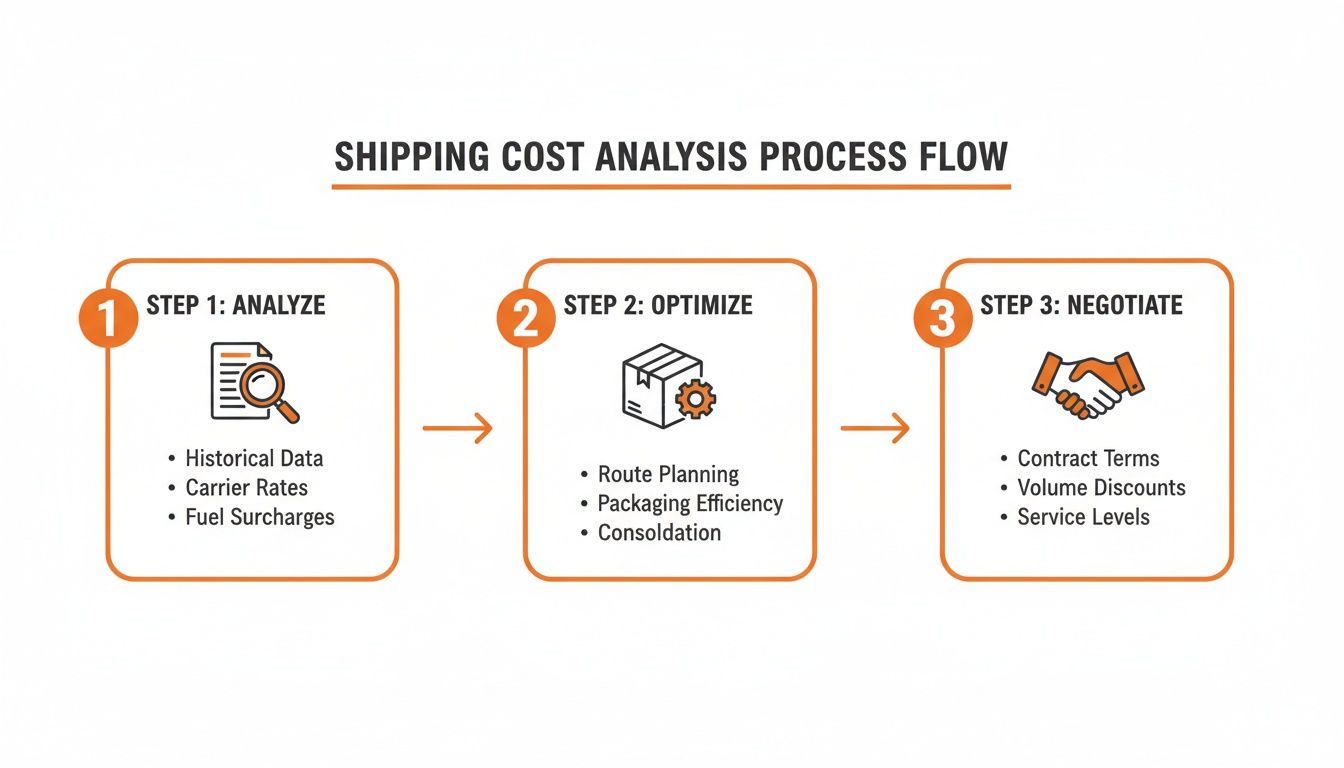
This infographic breaks down the core process for tackling these kinds of shipping expenses.

A clear three-step shipping cost analysis process flow covering analysis, optimization, and negotiation.

As you can see, cutting costs is a cycle. You analyze, you optimize, and then you use that data to negotiate better terms. It all starts with that first analysis.

Finding the Right-Sized Packaging

Once you've identified the products swimming in oversized boxes, it's time to find better alternatives. Your audit will probably reveal some obvious patterns. Maybe you have three different SKUs that could all fit perfectly into a box that's two inches shorter than your current "one-size-fits-all" solution.

Here are a few actionable steps you can take right away:

  • Stock Multiple Box Sizes: Stop relying on one or two generic box sizes. Build an inventory of 5-7 boxes that more closely match the dimensions of your products. The small upfront investment pays for itself almost immediately.
  • Use Lighter Void Fill: If you still need filler, swap bulky air pillows for lighter, more compact options like crinkle paper or recycled kraft paper. They often protect just as well without adding unnecessary bulk.
  • Consider Custom Packaging: For your absolute best-sellers with consistent dimensions, custom-made boxes are a game-changer. Yes, it requires a larger initial order, but the per-shipment savings can be massive. You'll often recoup the investment in just a few months.

Let's run the numbers to see how this plays out in the real world.

The Financial Impact of a Smaller Box

Imagine you sell ceramic mugs. To keep them safe, you ship each one in a standard 10" x 8" x 6" box. With the mug and padding, the package has an actual weight of 2 pounds.

Using the standard DIM weight formula (L x W x H / 139), the calculation is:

(10 x 8 x 6) / 139 = 3.45 lbs

The carrier ignores the 2 lb actual weight and bills you for the dimensional weight of 3.45 lbs.

But after your box audit, you find a snug and secure 8" x 6" x 5" box. The actual weight is still 2 lbs, but let’s recalculate the DIM weight:

(8 x 6 x 5) / 139 = 1.72 lbs

Now, the carrier bills you for the actual weight of 2 lbs, since it’s greater than the new DIM weight. By simply switching to a smaller box, you’ve cut your billable weight from 3.45 lbs down to 2 lbs.

That’s a 42% reduction on every single mug you ship. If you're sending out 500 mugs a month, that small change just saved you thousands of dollars over the year.

Negotiating Carrier Rates Like a Pro

Accepting the default shipping rates you see on a carrier's website is one of the biggest and most expensive mistakes an e-commerce business can make. Think of those prices as a starting point, not the final word. The real key to unlocking serious savings is knowing that everything is negotiable—but you have to come to the table prepared.

A man reviewing documents and finances at a desk with a laptop and a sign saying 'Negotiate Rates'.

So many business owners assume they don't have enough shipping volume to get a discount. That’s a myth. Even a consistent volume of 50-100 packages per week gives you the leverage you need to secure much better rates than the general public pays.

Carriers are in the business of predictable volume. Your consistent business, no matter the size, is a valuable asset. It's time to use it.

Leveraging Your Shipping Volume

Before you even think about picking up the phone, you need to know your numbers inside and out. Don't just tell a carrier rep you "ship a lot." Hit them with concrete data.

Get this information ready:

  • Average Monthly Volume: How many packages do you actually ship each month?
  • Package Characteristics: What are the average weights and dimensions of your shipments?
  • Destination Data: Where are your packages going? Knowing your most common shipping zones is critical.
  • Service Mix: What’s the breakdown? How much is ground, express, or international?

This data does more than just show you're a serious business; it gives the carrier's rep everything they need to build a custom pricing profile that truly reflects your shipping patterns. That's where the real savings are hiding.

The most powerful tool in any negotiation is data. Walk in with a detailed summary of your shipping activity for the last 6-12 months, and you instantly change the conversation from a generic inquiry to a strategic partnership discussion.

Once your data is compiled, start reaching out to account managers at major carriers like UPS, FedEx, and DHL. Skip the general customer service line. Your goal is to connect with a dedicated representative whose job is to win—and keep—your business.

Exploring Regional Carriers and Hybrid Services

While the national giants get all the attention, regional carriers can be a secret weapon for cutting shipping costs, especially if a lot of your customers are clustered in a specific geographic area.

Companies like OnTrac on the West Coast or Spee-Dee Delivery in the Midwest often blow national carriers out of the water on price for next-day ground service within their territory. They are specialists, and that focus lets them offer both speed and savings.

Another powerful option is using hybrid services. These clever solutions combine the long-haul strength of a major carrier with the final-mile delivery network of the USPS.

  • UPS SurePost: UPS handles the pickup and transportation, then hands the package off to the local Post Office for the final delivery to the customer's door.
  • FedEx SmartPost: This works on the exact same model, using the FedEx network for the main journey and USPS for that last residential mile.

These hybrid services are often 20-30% cheaper than standard ground options. They are a fantastic choice for non-urgent shipments where saving money is the top priority. You get reliable delivery without the premium price tag.

Before we dive into a multi-carrier strategy, it helps to know which services are best for different situations. Here’s a quick breakdown to help you match the right service to your needs.

Comparing Major Carrier Services for E-Commerce

Carrier Service Ideal Use Case Typical Speed Cost Factor
USPS Ground Advantage Lightweight, non-urgent items under 70 lbs. Great for standard e-commerce. 2–5 business days Low
USPS Priority Mail Time-sensitive items under 70 lbs. Includes some insurance and tracking. 1–3 business days Medium
UPS Ground Reliable delivery for packages of all sizes, with excellent tracking. 1–5 business days Medium
FedEx Ground Similar to UPS Ground, known for business deliveries and speed in certain zones. 1–5 business days Medium
UPS SurePost/FedEx SmartPost Cost-effective for non-urgent residential deliveries. 3–8 business days Low
UPS 2nd Day Air/FedEx 2Day When you need guaranteed two-day delivery. 2 business days High

This table is a starting point. Your negotiated rates will ultimately determine the best value, but understanding the core purpose of each service is the first step toward making smarter shipping decisions.

The Power of a Multi-Carrier Strategy

Putting all your eggs in one basket is a recipe for disaster. Relying on a single carrier leaves you exposed to their annual General Rate Increases (GRIs), surprise surcharges, and service disruptions from things like strikes or bad weather.

A multi-carrier strategy is your best defense.

By working with two or more providers, you create a system of checks and balances. It keeps everyone honest and their pricing competitive. If one carrier's rates for a particular route get too high, you can instantly pivot and shift that volume to a more affordable partner. To really dial this in, you should understand the different ways you can work with them. For a deeper look, check out our guide on partnered carrier vs non-partnered carriers to see how those relationships impact your bottom line.

This approach isn't just about saving money today. It's about building a resilient and flexible fulfillment machine for the future, giving you the power to always choose the best service at the best price for every single package you ship.

How a 3PL Unlocks Deeper Shipping Savings

As your brand grows, there comes a point where packing boxes in-house goes from a scrappy advantage to a serious operational drag. This is the moment a third-party logistics (3PL) partner stops being a "nice to have" and becomes a strategic move to slash expenses and get your time back. It’s not just about renting warehouse space; it’s about plugging your business into a high-powered fulfillment machine built for efficiency.

A warehouse worker in a high-visibility vest scans a package on a pallet, with text '3PL SAVINGS'.

The biggest and fastest win you'll see with a 3PL is access to deeply discounted carrier rates. A good 3PL ships millions of packages a year, giving them massive negotiating power with carriers like UPS, FedEx, and USPS. They pass those volume-based savings directly to you—rates that are simply out of reach for a business shipping a few hundred or even a few thousand orders a month.

This move alone instantly lowers your cost per shipment, adding pure profit back to every single order.

Gaining Operational Efficiency and Expertise

Beyond just cheaper shipping labels, a 3PL completely overhauls your fulfillment operation. Think about all the hidden costs of doing it yourself: warehouse rent, utilities, employee wages and benefits, packing supplies, and the hours you spend managing it all. A 3PL rolls these unpredictable fixed and variable costs into a single, predictable cost per order.

This operational shift frees up both cash and your team's energy to focus on what you actually do best—marketing, product development, and growing your brand. You’re no longer in the warehouse business; you're back to being an e-commerce leader.

The real value of a 3PL isn't just in the cost savings, but in the operational excellence you inherit. You gain a team of logistics experts dedicated to getting your orders out quickly and accurately, eliminating costly picking errors and improving the customer experience.

If you sell across multiple channels, this is even more critical. A 3PL with solid software can sync with your Shopify store, Amazon account, and other marketplaces, creating a single source of truth for your inventory and orders. This prevents overselling and keeps fulfillment smooth, no matter where the sale happened. To get the full picture, you can learn more about what a 3PL warehouse is and how it works in our detailed guide.

Strategic Warehouse Placement to Cut Zones and Time

One of the smartest ways to crush shipping costs is to shrink the distance your packages travel. The further a package goes, the more shipping zones it crosses, and the more you pay. A 3PL with a network of strategically located warehouses is the perfect answer to this expensive geography problem.

Instead of shipping every single order from one coast, you can split your inventory across multiple fulfillment centers.

  • West Coast Orders: Ship from a warehouse in California or Nevada.
  • Midwest Orders: Ship from a facility in Illinois or Texas.
  • East Coast Orders: Ship from a center in New Jersey or Georgia.

This model keeps your products close to your customers. The result? Most of your shipments will only travel across one or two zones, dramatically cutting last-mile delivery costs and transit times. This doesn't just save you money—it delights your customers with faster delivery, which is a huge factor in building loyalty.

The financial impact of a distributed inventory model is huge. Businesses partnering with 3PLs often report 30-50% reductions in fulfillment costs by consolidating shipments and avoiding peak-season surcharges. These numbers are backed by industry benchmarks, where optimized pick-pack-ship workflows cut last-mile delivery expenses by 20% on average.

Specialized Services Like FBA Prep

For Amazon sellers, a 3PL offers another game-changing service: FBA preparation. Amazon has incredibly strict—and constantly changing—rules for inbound shipments. One mistake can lead to refused inventory, expensive penalties, and weeks of delays.

A 3PL that specializes in FBA prep takes this entire headache off your plate. They're experts in Amazon's standards and handle all the tedious tasks to ensure your shipment is compliant:

  • Labeling: Applying FNSKU barcodes correctly to every single unit.
  • Poly Bagging: Making sure products are protected and meet Amazon's poly bag rules, including suffocation warnings.
  • Bundling and Kitting: Creating multi-packs or bundled products exactly to your specs.
  • Inspection: Catching any damages or defects before your inventory gets to an Amazon facility.

By outsourcing FBA prep, you dodge the costly mistakes that can tank your Amazon sales. Your inventory arrives at Amazon ready for immediate check-in, getting your products live faster and protecting your sales velocity. This is a perfect example of how a 3PL does more than just ship boxes—it protects your revenue.

Optimizing Your Inbound Freight Strategy

If you want to really get a handle on your shipping costs, you need to stop thinking about it as something that starts when a customer clicks "buy." The real savings begin much, much earlier—with the raw materials and finished goods you bring in from your suppliers.

This is your inbound freight, and it's a massive, often overlooked expense that quietly eats into your profit margins before you’ve even sold a single item. Mastering your inbound logistics is one of the most powerful levers you can pull.

By thinking strategically about where your goods come from and how they get to you, you can build a more resilient and cost-effective operation from the ground up.

Don’t Get Caught in the Front-Loading Trap

In the world of international trade, reacting to headlines is a recipe for disaster. When rumors of new tariffs or trade disputes start flying, the knee-jerk reaction for many importers is to "front-load" their cargo. They scramble to get as much product as possible onto ships before new duties kick in.

It sounds logical, right? Beat the tariff.

But this tactic almost always backfires. It creates a sudden, massive surge in demand for already limited space on vessels, causing ocean freight rates to skyrocket on key trade lanes. You might sidestep a potential tariff, but you get slammed with a guaranteed rate hike that can be just as damaging.

A proactive inbound freight strategy isn't about reacting to every geopolitical ripple. It’s about creating stability in an unstable world by building a diversified sourcing plan that insulates your business from the chaos of any single trade route.

Case in point: As UniCargo reports, in May 2025, transpacific rates from Shanghai to Los Angeles shot up by 117% in just a few weeks. Why? Importers were front-loading cargo to get ahead of announced US-China tariff hikes.

But smart importers who had already pivoted to Southeast Asia, India, or Latin America completely sidestepped these spikes. In fact, global freight rates on other lanes were actually falling during that same period. Asia-to-North Europe dropped 3%, and Asia-to-Mediterranean was down 4%.

Diversify Your Sourcing for Stability and Savings

Putting all your manufacturing eggs in one basket is a huge risk. A trade war, a port strike, or even a natural disaster can paralyze your supply chain overnight. The answer is strategic diversification.

Start looking at sourcing from multiple regions to create a more balanced and resilient inbound flow.

  • Latin America: Countries like Mexico offer incredible nearshoring advantages for the North American market, slashing both ocean transit times and costs.
  • Southeast Asia: Nations like Vietnam and Thailand have become manufacturing powerhouses, giving you high-quality alternatives outside of the usual hubs.
  • India: With a rapidly growing industrial base, India is another fantastic option for diversifying your supplier network and spreading out your risk.

This approach does more than just shield you from surprise rate hikes. It also gives you leverage. When your suppliers know you have other options, you’re in a much stronger position to negotiate better terms and pricing. You should also get familiar with different freight payment terms like "collect freight" to gain even more control over your inbound costs.

Master Your Inbound Documentation

Finally, a smooth inbound process is built on flawless paperwork. Any mistake or missing detail on your shipping documents can lead to costly delays, customs inspections, and painful fines.

Your team absolutely must have a firm grasp on the key documents that govern international freight. To keep things moving and avoid expensive errors, a solid understanding of your shipping paperwork is non-negotiable. For a deep dive, check out this A Complete Guide to Understanding the Bill of Lading.

The Bill of Lading (BOL) is the single most important piece of paper in the shipping world. It's your contract with the carrier, a receipt for your goods, and a document of title. An accurate BOL ensures your cargo is correctly identified, routed, and released to the right party. If you're serious about managing your inbound logistics, getting this document right every single time is critical.

Right, we’ve dug into the weeds on everything from dimensional weight to freight strategy. Now, let's put it all together. This isn't just a recap; it's your go-to checklist for making immediate, real-world changes to your shipping operations.

The goal here is to stop bleeding cash and build a more profitable, resilient business. Every small tweak adds up, and this is where you start laying that stronger foundation.

Immediate Actions for Quick Wins

Let's start with the low-hanging fruit. These are the changes you can make right now, without big investments, that will deliver the fastest results.

  • Conduct a Packaging Audit: Grab your top 10 best-selling products and the boxes you use. Get out a tape measure and see how much empty space is in there. The mission is simple: find where you can switch to smaller boxes, lighter void fill, or even poly mailers to crush those dimensional weight fees.
  • Analyze Your Carrier Invoices: It’s time for a deep dive. Pull your shipping invoices from the last three months. Look past the base rates and hunt for every single accessorial fee—residential surcharges, fuel surcharges, delivery area fees. You can't cut costs you don't know you're paying.
  • Review Your Returns Process: How much are returns really costing you? Dig into the reasons customers are sending things back. If a big chunk is due to damage in transit, that’s a flashing red light. Upgrading your packaging is an investment that pays for itself by cutting down on expensive reverse logistics.

Strategic Moves for Long-Term Savings

Once you've snagged those quick wins, it’s time to think bigger. These are the structural changes that will compound your savings for years to come.

  • Request New Carrier Quotes: Armed with hard data from your invoice analysis, get your carrier reps on the phone. Don't just ask for a generic discount—show them your volume, your typical package specs, and your zone distribution. While you're at it, get quotes from regional carriers. They can often beat the big guys for deliveries in their backyard.
  • Explore 3PL Partnerships: If you're still fulfilling orders from your garage or back office, it's time to get quotes from at least two third-party logistics (3PL) providers. Ask them specifically about their discounted carrier rates and how their warehouse network can lower your average shipping zone. This isn't just about saving money; it’s about buying back your time.

Building a cost-effective shipping operation isn't a "set it and forget it" project. This is a continuous process. You should be revisiting these steps at least quarterly to stay ahead of carrier rate changes and shifts in your own business.

Building a Resilient Supply Chain

Finally, let's zoom all the way out to the very beginning of your supply chain. Getting your inbound freight right is an advanced move that protects you from global hiccups and gives you a serious competitive edge.

  • Analyze Your Inbound Freight Origins: Where is all your inventory coming from? If 100% of it is sourced from a single country, it's time to start researching alternative suppliers in other regions like Southeast Asia or Latin America. Supplier diversification is your best defense against surprise tariffs and port shutdowns.
  • Master Your Documentation: This is non-negotiable. Make sure your team understands critical documents like the Bill of Lading. A simple paperwork mistake on an inbound container can trigger costly delays, customs holds, and a mountain of fees. Flawless documentation is the backbone of an efficient supply chain.

By working through this plan, you can methodically turn shipping from a headache into a streamlined, cost-effective part of your business that actually helps you grow.


At Snappycrate, we specialize in turning these action items into reality for e-commerce brands. From optimized FBA prep to accessing deeply discounted shipping rates, our 3PL services are designed to help you scale efficiently. Let us handle the logistics so you can focus on growing your business. Learn how Snappycrate can reduce your shipping costs today.

0 Continue Reading →