Skip to Content

Blog Archives

A Guide to E-commerce Pickup and Delivery

Pickup and delivery is the lifeblood of your e-commerce operation. It’s the physical journey your products take—from the moment they leave your supplier to the second they land on your customer's doorstep. Get this right, and you’re golden. Get it wrong, and you’re looking at stockouts, bad reviews, and a mountain of operational headaches.

This entire process is really a game of two halves.

What Is E-commerce Pickup and Delivery

Think of your supply chain as a relay race. Pickup and delivery are the first and final handoffs, and they set the pace for everything else. A clean pickup from your supplier means inventory arrives on time. A fast, efficient delivery to your customer means a great review and a repeat buyer.

It’s more than just moving boxes. It's about two distinct, equally critical stages:

  • Inbound Logistics: This is the pickup side of things. It's all about getting products from your manufacturer or supplier and transporting them to your warehouse or a 3PL partner like SnappyCrate.
  • Outbound Logistics: This is the delivery phase. It kicks off the moment a customer clicks "buy" and covers everything involved in getting that order picked, packed, and shipped out the door.

The Two Sides of Logistics

For any e-commerce seller serious about scaling, mastering both inbound and outbound logistics is non-negotiable. A mistake on the inbound side—like a delayed freight shipment—can trigger a stockout and kill your sales velocity. An error on the outbound side—like shipping the wrong item—leads directly to customer churn.

The real challenge is building a system that can handle this two-way flow of goods smoothly. To get a handle on it, you need to understand the modern e-commerce processes from click to customer and where the physical handoffs happen.

Let's put this into perspective. The global e-commerce market is set to hit $7.41 trillion in 2026, with a mind-boggling 217 billion parcels delivered that year alone. That's nearly 5,900 packages shipped every single second. This explosion has forced brands to step up, with 52% of companies now aiming for two-to-three-day shipping just to stay competitive.

To help you visualize how these two critical functions work, here’s a quick breakdown.

Inbound vs Outbound Logistics at a Glance

This table offers a snapshot of the different goals and activities involved in receiving inventory versus shipping orders out to customers.

Aspect Inbound Logistics (Receiving) Outbound Logistics (Shipping)
Primary Goal Acquire and store inventory efficiently. Deliver orders to customers quickly and accurately.
Key Activities Sourcing, supplier coordination, transportation, receiving, inspection, and storage. Order processing, picking, packing, labeling, shipping, and customer communication.
Focus Cost control, inventory accuracy, and supplier relationships. Speed, order accuracy, customer satisfaction, and brand experience.
Direction of Flow Goods moving into the business. Goods moving out of the business to the end customer.

Understanding this distinction is the first step toward building a logistics machine that works for you, not against you.

Why It Matters for Your Business

A dialed-in pickup and delivery system directly fuels your bottom line. It dictates your inventory carrying costs, operational speed, and—most importantly—customer happiness. When you get it right, your products are always in stock and arrive exactly when you promised. For a deeper dive into the mechanics, our guide to dispatching and logistics breaks it all down.

In e-commerce, you aren't just selling a product; you're selling a promise. An effective pickup and delivery operation is how you keep that promise, turning a one-time buyer into a loyal customer.

Ultimately, a streamlined logistics process frees you from the day-to-day grind. It lets you step back from chasing down tracking numbers and focus on what you do best: building your brand and creating amazing products.

Choosing the Right Freight Pickup Type

Alright, your inventory is packed and ready to go. Now comes the million-dollar question—or at least the several-hundred-dollar question: how are you going to get it to your fulfillment center?

Getting this decision wrong is like hiring a moving van to deliver a single pizza. It’s overkill, and it’ll drain your budget faster than you can say "logistics."

To get it right, you need to understand the three main ways to move your freight: Parcel, Less-Than-Truckload (LTL), and Full Truckload (FTL). Knowing the difference between them is the key to protecting your margins and keeping your supply chain moving.

This decision tree gives you a high-level look at how an order or inventory need kicks off the entire logistics journey.

A shipping decision flow chart with an order received branching to warehouse or customer.

As you can see, every move in e-commerce logistics starts with that one simple trigger, setting the whole pickup and delivery machine in motion.

Parcel: The Mail Carrier Route

Think of parcel shipping as your everyday mail call. This is the world of carriers like UPS, FedEx, and USPS, and it’s perfect for small, lightweight shipments—we’re typically talking about anything under 150 pounds.

  • When to Use It: You’re sending a few boxes of new product samples to your 3PL for a photoshoot, shipping a small top-up of one SKU, or your supplier is sending a handful of cartons straight from their factory.
  • The Big Advantage: It’s quick, the tracking is excellent, and it’s dead simple to set up. You don't have to worry about palletizing your goods, which saves a ton of prep time.

But be warned: for anything more than a few boxes, parcel costs skyrocket. That's when you graduate to freight.

LTL Shipping: The Freight Carpool

Less-Than-Truckload (LTL) is the workhorse for most growing e-commerce brands. The best way to think about it is as a carpool for your inventory. Your pallets share space on a truck with pallets from other companies, and you only pay for the room your shipment takes up.

LTL is your go-to when a shipment is too big for parcel but not big enough to fill a whole truck on its own. The sweet spot is usually between one and six pallets.

Pro Tip: LTL is ideal for your standard inventory replenishment runs. Need to send four pallets of your top-selling product to your fulfillment center? LTL strikes the perfect balance between cost and speed.

Because your goods will be loaded and unloaded at various terminals along the way, good palletization and clear labeling aren't just recommended—they're critical to preventing damage or lost inventory. If you're sending goods to Amazon, the distinction between LTL and parcel is even more important. Check out our deep dive on LTL vs. SPD for Amazon FBA to learn more.

FTL and Container Shipping: The Private Charter

Full Truckload (FTL) is like chartering a private jet for your goods. You book the entire truck, and it's dedicated solely to your inventory. This is the move for big shipments, usually 10 pallets or more, or for high-value products you want to keep secure and untouched during transit.

Container shipping is a similar beast. It involves moving an entire 20ft or 40ft sea container directly from the port to your fulfillment center. This is standard practice for brands importing large volumes from overseas. With the global online shopper population hitting 2.77 billion people as of 2025, and 36% of brands eyeing international expansion, these bulk shipping methods are becoming essential.

Both FTL and container shipping offer the best cost-per-pallet for large volumes. They’re also faster than LTL because the truck makes a direct run from your pickup spot to the destination with zero stops in between.

How to Schedule Pickups and Manage Documentation

A successful freight pickup isn't something that just happens. It’s a coordinated effort. Think of it like making a reservation at a busy restaurant—you can't just show up with your entire party and expect a table. The same goes for your inventory; this coordination is the backbone of an efficient pickup and delivery operation.

Trying to drop off inventory without an appointment is a surefire way to cause chaos. This is what we call a “blind receiving,” and it’s a huge headache for everyone involved. Most fulfillment centers, including SnappyCrate, will either reject the delivery on the spot or slap you with a hefty non-compliance fee for the disruption.

This forces the driver to either wait around or come back later, racking up expensive detention fees from the carrier and creating serious delays in getting your products checked in and ready to sell.

Booking Your Delivery Appointment

The scheduling process should kick off the second you know your inventory is ready to be picked up from your supplier. Your first move is to secure a delivery appointment with your fulfillment partner. This simple step reserves a specific time slot at the warehouse dock, ensuring staff and equipment are ready and waiting for your shipment.

To book the appointment, your carrier or freight broker will need a few key details from you:

  • Purchase Order (PO) Number: This is the unique ID that links the physical shipment to your order records.
  • Total Pallet and Carton Count: This tells the warehouse team how much space, time, and labor your delivery will need.
  • PRO Number: A tracking number assigned by the LTL carrier that is absolutely essential for identifying the specific shipment when it arrives.

Once the appointment is officially on the books, you have to communicate the exact date and time back to your carrier. This alignment is critical. It prevents the driver from arriving too early or too late, which can also lead to rejection or more fees.

Demystifying Essential Freight Documents

In logistics, paperwork is everything. It’s the official language of the supply chain. Having the correct, accurate documentation is completely non-negotiable for a smooth handover from the carrier to your 3PL. For any freight shipment, two documents are absolutely vital.

The Bill of Lading (BOL)

The Bill of Lading (BOL) is the single most important document in the entire shipping process. It’s a three-in-one powerhouse: a legal contract between the shipper and the carrier, a receipt for the goods being moved, and a document of title. It holds all the critical details of your shipment.

A BOL is your shipment’s passport. It spells out exactly what’s being shipped, where it came from, and where it’s headed. Without a valid BOL, your inventory is basically stateless—it’s going to get stuck at the receiving dock.

The BOL must be 100% accurate and handed to the driver when they pick up the goods. Any differences between what the BOL says and what’s actually on the pallets will cause major problems down the line.

The Packing List

While the BOL is the high-level legal contract, the Packing List is the nitty-gritty breakdown of your shipment's contents. It details exactly what’s inside each carton and on each pallet—including SKU numbers, quantities, item descriptions, and weights.

This document is what the receiving team at the fulfillment center uses to verify that they received exactly what you sent.

Think of it this way: The BOL says, "I'm shipping 4 pallets of inventory." The Packing List says, "Pallet 1 has 20 cartons of SKU-A, and Pallet 2 has 15 cartons of SKU-B plus 5 cartons of SKU-C." An accurate packing list is the key to getting your inventory checked in quickly and correctly.

On top of this, understanding how shipping terms like DDU DDP Incoterms define who is responsible for freight and documentation is crucial for managing your shipments without any surprises.

Preparing Your Pallets for a Flawless Pickup

A plastic-wrapped pallet of bricks on a loading dock, ready for pickup and delivery, with a warehouse.

Think of proper pallet prep as your best insurance policy. Getting this right is what protects you from damaged inventory, lost products, and expensive receiving delays down the line. We’ve seen it time and time again: the way you stack, wrap, and label your pallets will make or break the entire pickup and delivery process.

A few extra minutes here can save you from days of headaches and hundreds of dollars in fees. It’s a small investment with a huge payoff.

Stacking for Stability and Security

Your one and only goal here is to create a single, solid block of inventory that can handle the reality of freight transit—the bumps, the shifts, the sudden stops. A wobbly pallet is just asking for trouble. Remember, freight handlers aren't going to fix your mistakes; they move what you give them, stable or not.

The best method is column stacking, where you align boxes directly on top of each other to maximize their structural strength. For even more stability, you can use an interlocking pattern, turning each layer 90 degrees like a bricklayer building a wall.

Here are the hard-and-fast rules we live by:

  • No Overhang: Never, ever let boxes hang over the pallet's edge. This is the #1 cause of damaged goods and makes the whole stack unstable.
  • Flat Top Surface: The top of your pallet must be completely flat. Carriers need to stack other pallets on top, and an uneven surface is an automatic rejection.
  • Stay Within Limits: Always check height and weight limits with your carrier and 3PL. Most have a max height of 72-80 inches and a max weight of around 2,200 lbs per pallet.

Once your stack is solid, it's time to lock it all down.

A well-built pallet should look like one solid cube. If it seems shaky before it even leaves your warehouse, it has almost zero chance of arriving at its destination in one piece.

The Art of Shrink Wrapping

Shrink wrap is the glue that holds everything together. Its entire purpose is to turn a pile of individual boxes into a single, unified block. This is not the place to be stingy.

Start by tying the wrap to the pallet base. From there, go around the bottom at least 5-7 times to make sure the boxes are anchored to the pallet itself—this is a step people often miss. Then, work your way up, overlapping each layer by about 50%.

Once at the top, wrap it a few times and then work your way back down. This up-and-down technique creates a strong cross-hatched pattern that keeps boxes from shifting. The finished pallet should be tight and secure with no loose ends.

Labeling Your Pallets for Success

We can't say this enough: incorrect or missing labels are one of the most common—and 100% avoidable—reasons for receiving delays. Every single pallet needs to be clearly labeled on all four sides. This way, it doesn't matter how it's positioned on the truck or dock; the receiving team can instantly find the information they need.

Each pallet label is its passport. Without the right information, it's going nowhere fast.

Essential Pallet Label Information:

  • Shipper and Consignee Information: Who sent it and where is it going? (Your 3PL's address).
  • Purchase Order (PO) Number: This is the magic number that connects your physical pallet to the digital order in the system. It's critical.
  • Pallet Count: Use a simple format like "1 of 4," "2 of 4," etc. The receiving team knows instantly if they have the complete shipment.
  • Unique Pallet ID: A specific identifier, like an SSCC, used for tracking.

Getting this wrong creates major backups, especially with fulfillment networks like Amazon. For a deep dive into their specific rules, check out our guide on how to perfect your Amazon FBA labeling requirements. Trust us, proper labeling isn't just a suggestion; it's a requirement for a fast, automated check-in.

To make things even easier, we've put together a quick checklist to run through before your carrier arrives.

Essential Pallet Preparation Checklist

Use this table as your final quality check to ensure every pallet you send is compliant, secure, and ready for a smooth handoff.

Checklist Item Best Practice Why It Matters
Pallet Quality Use a standard 40" x 48" wood pallet in good condition (no broken boards). Damaged pallets can break during transit, causing total loss of the shipment.
Stacking Method Boxes are stacked in columns or an interlocking pattern. No overhang. Prevents crushing, shifting, and damage. Ensures the pallet is stable enough for transport.
Height & Weight Confirm pallet is within the carrier's max height (e.g., 72") and weight (e.g., 2,200 lbs) limits. Over-limit pallets can be rejected by the carrier or incur significant surcharges.
Top Surface The top layer is completely flat and even. Allows other pallets to be stacked on top safely, a standard practice in LTL shipping.
Shrink Wrap Wrapped 5-7 times at the base, 50% overlap up and down the stack. Taut and secure. Unifies the load into a single block, protecting it from shifting and separating from the pallet.
Labeling A compliant label is placed on all 4 sides of the pallet. Guarantees visibility for warehouse staff, no matter how the pallet is oriented.
Label Information Includes PO number, pallet count (1 of X), and shipper/consignee details. This is the minimum info needed for a 3PL or FBA center to receive your inventory without delays.

Following this checklist doesn't just make our lives easier—it ensures your inventory gets checked in faster, keeping your products in stock and ready to sell.

Avoiding Common Carrier Coordination Pitfalls

You can have the most perfectly built pallet and flawless paperwork, but it all means nothing if there’s a communication breakdown with your freight carrier. Honestly, coordinating the actual pickup and delivery is where things most often go wrong. One missed detail, and you’re suddenly dealing with delays, surprise fees, and a supply chain at a dead stop.

Think of it this way: your pallets and your Bill of Lading are the script, but if the driver doesn't get their cues, the show isn't happening. Proactive communication is how you make sure everyone hits their marks on time.

The good news? Most of these headaches are completely avoidable. Once you know what to look for, you can stop putting out fires and start keeping your inventory moving smoothly.

The Missed Pickup Problem

There's nothing more frustrating than a "no-show" driver. You’ve set aside time, your supplier's team is on standby, and the truck just… doesn't arrive. This usually boils down to a simple miscommunication or a driver who ran out of their legal driving hours for the day.

The best defense here is a good offense. Always confirm the pickup appointment directly with the carrier 24 hours in advance. Don't just trust the initial booking confirmation email. A quick call or message to the carrier's dispatch confirms your freight is actually on a driver's schedule for the right day and time.

Also, give the carrier multiple contact numbers for the pickup location. If a driver is running late or can’t find the building, you want them calling someone on-site who can actually help—not a corporate office voicemail.

A missed pickup isn't just a delay; it's a domino effect. It can cause you to miss your 3PL delivery appointment, leading to a cascade of rescheduling efforts and potential fees that bring your supply chain to a halt.

Navigating Paperwork and Driver Preparedness

Another classic snag is the driver who shows up completely unprepared. They might not have a copy of the Bill of Lading (BOL), or they might have no idea they need to go to a specific loading dock. This creates instant confusion while everyone scrambles to sort it out.

To head this off, make sure your carrier or broker sends the BOL to the driver's dispatch electronically. But never, ever assume the driver actually got it. Always have two physical copies of the BOL ready at pickup: one for the driver, and one for your supplier to get signed as proof of pickup.

This simple step acts as the "passport" for your freight. It tells the driver exactly what they're taking and where it's going, eliminating any on-the-spot guesswork and getting your products on the road faster.

Stopping Surprise Accessorial Fees

Few things are more aggravating to an operations manager than seeing an invoice loaded with unexpected charges. In the freight world, these are called accessorial fees—extra charges for any service beyond standard dock-to-dock transport. The most common ones we see are:

  • Liftgate Service: This fee is charged when a location doesn't have a loading dock, and the truck needs its own lift to get pallets on or off the ground.
  • Residential Pickup/Delivery: Carriers charge a premium for going to non-commercial addresses.
  • Limited Access: This applies to tricky locations like schools, construction sites, or storage units that are harder for a big truck to navigate.

These fees can easily add $100 to $200 or more to your bill. The only way to avoid them is with total transparency. When you book the freight, you have to declare if the pickup or delivery spot lacks a dock. If you know you need a liftgate, book it upfront. It’s always far cheaper to plan for it than to get hit with the penalty fee later.

Your E-commerce Pickup and Delivery Checklist

A pickup checklist and pen on a counter with an envelope, in a warehouse setting.

Knowing the theory is one thing, but getting it right in the real world is what actually counts. This section is your go-to playbook for a perfect inbound shipment, every single time.

Think of this as the pre-flight check you should run before your products ever leave your supplier. It’s a simple, four-step process we’ve perfected to prevent the delays, unexpected fees, and headaches that plague so many e-commerce sellers. Following this process is the secret to getting your inventory received smoothly and onto the shelf, ready to sell.

Step 1: Notify Your Account Manager

Your first move, always, is to give a heads-up. Before you even book the freight, send a quick email to your 3PL account manager letting them know a shipment is coming.

This simple, proactive step changes everything. It allows the warehouse team to anticipate your inventory, plan their labor, and reserve dock space. Your shipment goes from being a surprise arrival to an expected guest, setting the stage for a fast and efficient receiving process.

Step 2: Provide Essential Documentation

Once your manager is in the loop, it’s time to send over the paperwork. Your 3PL cannot schedule a delivery appointment without these two key files:

  • The Purchase Order (PO): This document tells us what you are sending.
  • The Packing List: This breaks down exactly how your inventory is packed into cartons and pallets.

These documents are the lifeblood of your inbound shipment. They provide all the data the warehouse needs to create an Advanced Shipping Notice (ASN), which is the digital blueprint for your delivery.

Without an accurate PO and Packing List, your shipment is just a pallet of mystery boxes. Providing these documents upfront is the only way for a fulfillment center to know what to expect and how to receive it correctly.

Step 3: Schedule the Delivery Appointment

Now, it’s the carrier’s turn to act. Your freight carrier or broker must contact the fulfillment center’s scheduling department to book a formal delivery appointment. This is a non-negotiable step that reserves a specific time slot at a receiving dock for your freight.

After the appointment is set, get the date and time in writing. Make sure your supplier and the carrier both have this confirmation so everyone is on the same page. No guessing games.

Step 4: Confirm Your Carrier Has the BOL

One last check before the truck rolls. You absolutely must confirm that the driver has the correct Bill of Lading (BOL) before they leave the pickup location.

This document is your shipment’s passport. If a driver shows up at the 3PL without a valid BOL, they will be turned away. It’s a costly and completely avoidable mistake that can stall your inventory for days. A quick confirmation call or email can save you a massive headache.

Pickup and Delivery FAQs

Even with the best-laid plans, questions are going to pop up. We get it. Here are the quick, no-fluff answers to the most common questions we hear about the pickup and delivery process. Think of this as your go-to cheat sheet for solving problems on the fly.

What Is the Difference Between a Freight Broker and a Carrier?

It’s pretty simple. A carrier is the company that owns the actual trucks and employs the drivers. They’re the ones physically hauling your inventory from Point A to Point B.

A freight broker, on the other hand, is like a logistics matchmaker. They don't own any trucks. Instead, they act as the go-between, connecting you with the right carrier from their massive network. They use their connections and shipping volume to score you a better rate and service than you could likely find on your own.

How Far in Advance Should I Schedule a Freight Pickup?

For LTL and FTL shipments, a solid rule of thumb is to schedule your pickup at least 2-3 business days in advance. This isn’t just about getting a truck to show up.

This lead time is the key to everything running smoothly. It gives the carrier enough time to find a driver and, just as importantly, gives you time to lock in a formal delivery appointment with your 3PL. Trying to rush this almost always ends in a scheduling disaster and extra fees.

That buffer makes sure everyone on both ends of the shipment is ready to go, which is exactly what you want.

What Happens if My Shipment Arrives Without an Appointment?

A shipment that just shows up unannounced is a nightmare for any warehouse. It’s called a "blind receiving," and it creates huge operational headaches. Most fulfillment centers will either flat-out reject the delivery or slap you with a hefty non-compliance fee.

The driver is then stuck with two terrible choices: wait around (while the clock runs on detention fees you’ll have to pay) or leave and try again later. One missed appointment can easily delay your inventory check-in by days, risking stockouts and lost sales. A scheduled appointment isn't just a good idea—it’s non-negotiable.

Who Is Responsible for Filing a Damage Claim?

In most cases, the shipper—which is your brand or your supplier—is responsible for filing a freight claim with the carrier if your inventory gets damaged in transit.

If you want any chance of a successful claim, documentation is your best friend. It is absolutely critical that whoever receives the freight notes any and all visible damage on the Bill of Lading (BOL) before they sign it. Snap photos of the busted pallets or crushed boxes, too. This is the evidence you'll need to prove your case and get your money back.


Ready to stop worrying about logistics and start scaling your business? Snappycrate offers expert fulfillment, Amazon FBA prep, and a seamless pickup and delivery process designed for growth-minded brands. Learn more and get a custom quote at Snappycrate.
0 Continue Reading →

A Guide to Flawless Receiving and Inspection

Receiving and inspection is where your inventory first meets your warehouse. Get this step wrong, and you're setting yourself up for a chain reaction of costly problems—think inaccurate inventory counts, shipping the wrong products, and dealing with unhappy customers. This isn't just a task for the receiving dock; it's your first and best line of defense against supply chain headaches.

Why Flawless Receiving Is Your First Line of Defense

A man in an orange safety vest inspects a clipboard with stacked boxes on pallets in front of a warehouse with “FLAWLESS RECEIVING” signage.

A lot of e-commerce brands and even some 3PLs treat receiving as a simple box-ticking exercise. Just get the stuff off the truck and onto a shelf, right? That’s a huge mistake.

In reality, the receiving dock is where your profitability, inventory accuracy, and customer satisfaction are first put on the line. Every single thing that happens downstream—from putaway and picking to packing and shipping—relies on the data you capture and the quality you verify right at this moment.

The stakes have never been higher. With global e-commerce sales expected to hit $7.4 trillion, the sheer volume of goods flying through warehouses is staggering. This boom means that nearly one in every four dollars spent in retail now happens online, cranking up the pressure on fulfillment operations to be absolutely perfect.

The True Cost of a Small Mistake

Let's walk through a simple, real-world scenario we've seen happen more times than we can count.

A shipment of 500 blue t-shirts (SKU #TS100-BLU) arrives from your supplier. But there was a mix-up at their factory, and 50 of those shirts are actually navy (SKU #TS100-NAV). Without a meticulous receiving process, your team scans the whole lot in as blue. The problems start to snowball immediately:

  • Your Inventory is a Mess: Your warehouse management system (WMS) now shows 500 blue shirts, but you only have 450. It also shows you have zero navy shirts, but you actually have 50 sitting on the shelf.
  • Unhappy Customers: Fifty people order a blue shirt and get a navy one instead. Cue the customer service emails, bad reviews, and costly returns.
  • Stockouts and Lost Sales: Believing you're out of navy shirts, you don't reorder them. You just missed out on 50 potential sales.
  • Wasted Time and Money: Your team is now bogged down handling returns, answering angry customers, and searching for inventory that, according to the system, doesn't even exist.

This single, tiny error at the receiving dock creates a ripple effect of financial loss and brand damage. It’s the perfect example of why a rock-solid receiving and inspection process isn’t a cost center—it's a strategic investment in keeping your operations running smoothly.

This guide treats receiving as a core function for building a resilient e-commerce business. To see how this crucial first step fits into the bigger picture, check out our guide on building an efficient supply chain for ecommerce growth.

Building Your Inbound Receiving Playbook

Let's be honest: a generic checklist taped to a wall isn't going to cut it in a busy warehouse. To really get a handle on your receiving and inspection process, you need a solid, repeatable playbook—a detailed standard operating procedure (SOP) that leaves zero room for guesswork. This isn't about just ticking boxes; it's about building a bulletproof system that everyone on your team can execute flawlessly, every single time.

When putting this guide together, it helps to know the lingo. If you compare a runbook versus playbook, you'll see a playbook is more strategic and built to adapt. That makes it the perfect format for the fast-moving, sometimes chaotic world of an e-commerce warehouse.

So, let’s walk through the core stages of a receiving playbook that actually works, starting long before a truck ever backs into your dock.

Before we dive into the details of each step, it's helpful to see the big picture. A truly effective workflow is more than just a series of disconnected tasks; it's a cohesive process where each stage builds on the last.

Here’s a high-level look at the core stages that should form the backbone of your receiving and inspection playbook.

Core Stages of the Receiving and Inspection Workflow

Stage Key Activity Critical Goal
Pre-Arrival Verify ASN against PO; schedule dock appointment. Catch discrepancies early and ensure dock readiness.
Unloading Visually inspect trailer; unload and stage pallets. Identify and document in-transit damage before accepting.
Initial Verification Count pallets and cartons; verify against BOL. Confirm high-level shipment accuracy immediately.
SKU-Level Inspection Open cartons, scan items, and verify quantities. Ensure every item received matches the PO exactly.
Quality Control Visually inspect a sample of units for defects. Prevent damaged or subpar products from entering stock.
Documentation Record all findings, damages, and discrepancies. Create a clear audit trail for claims and supplier accountability.
System Reconciliation Update WMS/IMS with accurate received quantities. Make inventory available for sale with confidence.

Think of this table as your roadmap. By ensuring each stage is handled with precision, you build a system that protects your inventory, your finances, and your brand's reputation from the moment goods arrive.

The Pre-Arrival Stage

Great receiving starts with great prep. The second you get an Advance Shipping Notice (ASN) from a supplier, the clock starts. This isn’t a passive step where you just wait for the truck—it's your first active checkpoint.

Your team needs to pull up that ASN and immediately compare it to the purchase order (PO) in your Warehouse Management System (WMS). Do the SKUs line up? Are the unit counts what you expected? Catching a mismatch here saves a mountain of headaches later. This is also when you lock in the delivery appointment, making sure you have the dock space and manpower ready to go. No bottlenecks.

A well-managed dock schedule is the foundation of an efficient warehouse. Overlapping deliveries lead to congestion, rushed work, and a much higher likelihood of errors during the crucial receiving and inspection phases.

Unloading and Initial Verification

Once the truck arrives, the real work begins, but it has to be methodical. The very first thing to do is a visual inspection of the trailer and pallets before a single box is moved. Look for the tell-tale signs of damage in transit—crushed corners, gnarly water stains, or torn shrink wrap.

If you see anything suspicious, snap photos and make a note on the Bill of Lading (BOL) right then and there, before you sign it. This is your ammunition for filing freight claims. Miss this step, and you’ve got almost no chance of getting reimbursed.

As pallets come off the truck, stage them in a designated receiving area. This spot should be clean, bright, and completely separate from your main pickable inventory. Then, your team does an immediate verification against the BOL and packing slip.

  • Pallet Count: Does the number of pallets on the dock match what the BOL says?
  • Carton Count: Does the number of boxes on each pallet match the packing slip?
  • Label Check: Are the cartons clearly labeled with the right SKU and PO numbers?

This is your first chance to spot big-picture problems. If the BOL says 100 cartons but you only count 98, you’ve already found a discrepancy that needs to be sorted out before you even think about opening a box.

The Power of a Dedicated Inspection Area

One of the biggest mistakes I see warehouses make is trying to inspect inventory in a cramped, chaotic dock area. Don't do it. Set up a specific, well-equipped station just for detailed receiving and inspection. It doesn’t have to be massive, but it absolutely has to be organized.

Stock this area with the tools your team needs to do the job right:

  • Box cutters and safety knives
  • A calibrated scale for spot-checking weights
  • Barcode scanners that talk to your WMS
  • A computer terminal for quick data entry
  • Good, bright lighting to easily spot defects
  • A camera or phone for documenting any damages

Creating a dedicated space transforms inspection from a rushed chore into a professional, controlled part of your operation. It sends a clear message to your team that this step is a priority, which directly leads to better accuracy and higher quality control across the board.

Mastering Quality and Compliance Inspections

Okay, so you’ve counted the cartons and verified the SKUs. Now the real work begins. This is where your team shifts from just receiving inventory to truly inspecting it. This is the moment your attention to detail protects your customers, your brand, and your bottom line.

Simply matching a carton count to a packing list isn’t enough. You need to dig deeper. A tiered approach works best—not every product needs the same level of scrutiny. Low-cost, durable goods might just get a quick spot-check. But high-value electronics or fragile items? Those demand a much closer look.

This whole inbound process, from pre-arrival tracking to the final inspection, needs to be a smooth, repeatable workflow.

A playbook receiving process flowchart showing steps: Pre-Arrival (Track), Unload (Count), and Inspect (Verify).

As you can see, inspection isn’t a standalone task. It’s the critical quality gate that builds on accurate pre-arrival data and a careful unloading process.

Establishing Your Quality Control Checklist

Think of your inspection checklist as your first line of defense against defects and customer complaints. It has to be specific, easy for anyone on your team to follow, and built around the actual products you sell.

An inspector should be able to run through these points quickly:

  • Physical Condition: Are there any scratches, dents, tears, or other obvious damage to the product itself?
  • Packaging Integrity: Check the retail box. Are the corners crushed? Is the seal broken? Any discoloration?
  • Label and Barcode Accuracy: Scan the barcode. Does it pull up the right item in your system?
  • Product Specifications: Does the color, size, and model number on the item match what’s on the purchase order? No substitutions.
  • Expiration Dates: For anything with a shelf life, check the date. Make sure it meets your minimum requirement, like being at least 90 days out.

Let's say you just received a shipment of high-end skincare. A proper QC check means opening a few units to make sure the jars aren't cracked, the labels are applied straight, and the safety seals are perfectly intact. That one small step is what stops a customer from getting a damaged or tampered-with product.

Navigating Amazon FBA Compliance

For anyone selling on Amazon, FBA compliance is everything. It’s not just a suggestion; it's a set of rules that, if broken, lead to costly chargebacks, receiving delays, or even Amazon refusing your entire shipment. The inspection stage is your final chance to catch these issues before they become a massive headache.

If you need a full breakdown of the rules, our guide on Amazon FBA labeling requirements goes into much greater detail.

Think of FBA prep as a non-negotiable part of your quality inspection. A missing FNSKU label or an incorrect poly bag is just as much a "defect" as a scratch on the product itself.

Your team needs to be trained to spot and fix the common FBA slip-ups during the inspection phase:

  • FNSKU Labeling: Is the FNSKU label correct for the ASIN? Is it neatly applied and completely covering any old barcodes?
  • Poly Bag Requirements: If an item needs a poly bag, is it in one? And does that bag have the required suffocation warning printed on it?
  • Kitting and Bundling: For sets or bundles, are all the components actually there? Are they packaged together correctly so they can be sold as a single unit?

There's a huge difference between inspecting a simple case-packed item and a complex bundle. A case of 24 identical coffee mugs is easy—check one or two for damage and confirm the FNSKU is on every box. But a "Work from Home" kit is another story. You have to verify the mug, a notebook, a pack of pens, and a USB hub are all present, correctly bundled, and have a single FNSKU label for the set. Your inspection process has to be flexible enough to handle that complexity.

What to Do When Shipments Go Wrong: Damages, Discrepancies, and Returns

Several cardboard boxes, one taped, and a tablet on a table in a warehouse, highlighting damaged goods.

Let's be real: no matter how airtight your receiving and inspection process is, things go wrong. A forklift bumps a pallet, a truck springs a leak, or the supplier simply miscounts. That’s just the nature of logistics. You’re not judged by whether these things happen, but by how well you deal with them when they do.

Having a clear, repeatable protocol isn't a nice-to-have; it's the only way to protect your inventory and your client's business. When a problem pops up, your team needs a playbook, not a guessing game. The goal is to move from chaos to control, fast.

Damaged Goods: Document and Isolate Immediately

The second your team lays eyes on a damaged item, the clock is ticking on your ability to file a successful claim. Simply pushing a crushed box to the side won't cut it. You need a formal process built on hard evidence.

First thing’s first: photographic evidence is non-negotiable. Train your crew to snap clear pictures from every angle. Make sure they capture:

  • The outside of the master carton, especially any rips, punctures, or water stains.
  • The inside of the carton, showing how everything was packed (or wasn't).
  • Close-up shots of the actual damage on the product itself.
  • A crystal-clear photo of the shipping label and any tracking numbers.

Once you've got the pictures, get that damaged stock out of the main receiving area. Set up a dedicated, clearly marked "quarantine" or "hold" zone in your warehouse. Physically separating it is the only way to guarantee a damaged product doesn't get accidentally put away and sold.

Finally, update your WMS. Those damaged units need to be moved to a non-sellable or "On Hold" status in your system. This digital quarantine keeps them out of the sales channels and gives everyone an accurate count of what's actually available.

Dealing with Quantity Mismatches

Quantity discrepancies are a classic receiving headache. You either get a shortage (less than you ordered) or an overage (more than you ordered). Both create chaos for your inventory records if you don't jump on them right away.

If you come up short, the first step is always to double-check. Recount the items, review the packing slip again, and check the carton labels. If the shortage is real, you must note it on the Bill of Lading (BOL) before that driver pulls away. That simple note—"Received 98 of 100 cartons"—is your golden ticket for filing a claim.

Overages are a different beast. It might feel like you just got free stuff, but it's really an accounting problem waiting to happen. The extra units should be separated and logged as "Found Inventory," but don’t add them to your sellable stock. Fire off an email to your client or the supplier immediately and wait for their instructions.

Never assume an overage is "free inventory." It's almost always a mistake that will need to be reconciled later, and absorbing it into your stock will only create bigger problems down the line.

The Unique Beast: Customer Returns

Handling customer returns is its own special kind of receiving and inspection. Returns are a massive, unavoidable part of e-commerce—consumers sent back nearly $850 billion in goods last year. This trend means you need a rock-solid returns process to figure out what can be salvaged and resold. For a deeper dive, you can discover insights about the rising return rates and their impact on logistics.

Inspecting a return is like a mini-forensic investigation. Your team isn’t just looking at the product; they’re assessing the packaging to decide its fate:

  • Restock: Is the item in brand-new, unopened, pristine condition?
  • Refurbish: Is the product okay but the box is torn or crushed?
  • Dispose/Liquidate: Is the item clearly used, damaged, or otherwise unsellable?

Constant communication with your client is key here. They need to know the condition of every return to process refunds correctly and keep their inventory valuation accurate.

Using Technology to Measure and Improve Performance

Connecting your physical receiving process to the right technology is where you turn a good operation into a truly great one. A modern Warehouse Management System (WMS) is the brain of your entire inbound operation, finally letting you ditch the clipboards and manual spreadsheets for good. With a simple barcode scan, it automates inventory updates and flags discrepancies the second they happen.

This digital backbone makes every step of the receiving and inspection process faster and far more accurate. When a team member scans a carton, the WMS instantly checks it against the purchase order. Is it the right product? Is the quantity correct? This eliminates all the guesswork and catches supplier errors right on the dock, not weeks later when you're trying to fulfill an order.

The explosive growth of mobile commerce has made this kind of speed non-negotiable. With mobile now driving around 59% of all online retail sales, the flow of orders is constant and relentless. Fulfillment centers have to adapt to this pace, and technology is the only real way to keep up with the demand for rapid, flexible receiving.

Essential Tech for the Modern Receiving Dock

Beyond a solid WMS, a few other tools can seriously supercharge your team’s efficiency. Equipping your staff with mobile scanners is a must—it lets them move freely, scanning items and updating inventory from anywhere in the receiving area without being tethered to a workstation.

Other high-impact tools we see making a big difference include:

  • Dimensioners: These devices automatically measure a package's length, width, and height. This captures precise data that's gold for optimizing storage space and nailing down shipping calculations.
  • Automated Conveyors: For high-volume operations, conveyors are a game-changer. They can move cartons from the truck straight to the inspection station, drastically cutting down on manual labor and saving your team's backs.
  • Software Integrations: Linking your WMS with supplier and carrier systems gives you incredible visibility into what’s coming down the pipeline. This helps you plan labor and clear dock space before the truck even arrives.

And if you're constantly dealing with inconsistently wrapped pallets from suppliers, it might be time to look into automated pallet wrapping machines to standardize your outbound shipments.

Key Performance Indicators That Matter

You can't fix what you can't see. Tracking the right Key Performance Indicators (KPIs) gives you the hard data you need to spot bottlenecks, justify new tech investments, and turn your receiving department into a competitive advantage.

What gets measured gets managed. Focusing on a few core receiving KPIs provides actionable insights that directly impact your warehouse's overall efficiency and profitability.

Start by tracking these crucial metrics:

  • Dock-to-Stock Time: This is the big one. It measures the total time it takes for a shipment to be received, inspected, and put away into its final storage location. The faster this happens, the faster your inventory is available to sell.
  • Receiving Accuracy Rate: This is the percentage of shipments received perfectly—no damages, no quantity screw-ups. You should be aiming for 99% or higher. Anything less points to a problem somewhere in the chain.
  • Cost Per Line Received: This metric helps you understand your operational costs. Just calculate the total cost of your receiving department (labor, equipment, space) and divide it by the number of purchase order lines received.

Keeping a close eye on these numbers will show you exactly where your process is humming along and where it needs a tune-up. To get a better sense of how these metrics drive smart business decisions, check out our guide on the role of analytics in logistics.

Common Receiving and Inspection Questions

Even the most buttoned-up receiving playbook will get thrown a curveball now and then. Things happen. Shipments show up weird. Paperwork goes missing.

Knowing how to handle these common hiccups ahead of time is what separates a smooth-running dock from a chaotic one. Let's walk through a few scenarios we see all the time.

What Is a Blind Receiving Process and When Should I Use It?

Blind receiving is when you have your team count and verify an inbound shipment without giving them the purchase order or ASN first. They have no idea what quantities are supposed to be there.

This forces a completely unbiased, physical count of every single item. It kills the temptation for someone to just glance at the packing slip and assume the supplier’s numbers are correct.

It’s definitely a slower process, so you don’t need it for every shipment. But it's an incredible tool for boosting accuracy. We recommend using it for high-value inventory where a single missing unit is a big financial hit, or when you’re dealing with a supplier who has a history of sending you short-shipments.

Think of blind receiving as a spot-check audit on every inbound. It takes a little more time upfront but can save you from massive inventory headaches and write-offs by catching mistakes the second they hit your door.

How Do I Handle a Shipment with No Packing Slip?

A delivery showing up without a packing slip or an ASN in your system is a huge red flag. The first and only move here is to quarantine it.

Move the entire shipment to a designated holding area and stick a big, clear sign on it. Do not let it get mixed in with your other inventory.

Allowing undocumented stock onto your shelves is how you end up with phantom inventory, fulfillment errors, and a WMS that’s a complete mess. Get on the phone with the supplier or client immediately and track down the paperwork. Only after you have a PO or ASN to receive against should that shipment be touched.

What Are the Most Common Receiving Mistakes to Avoid?

The most expensive errors are almost always the simplest ones. Based on what we've seen over the years, here are the top four rookie mistakes that can sink your inventory accuracy:

  • Signing the POD Blindly: Never, ever sign the carrier’s proof of delivery until you’ve walked around the pallets and checked for obvious external damage. A signature means you’ve accepted it "in good condition."
  • Trusting Carton Counts: It’s easy to assume a carton labeled "24 units" actually has 24 units inside. This is where most quantity discrepancies hide. You have to spot-check the inner contents.
  • Mixing Shipments on the Dock: Letting SKUs from two different POs get staged on the same pallet is a recipe for disaster. It guarantees putaway errors that will haunt you during picking.
  • Taking Bad Photos: If you find damage, blurry photos or a lack of detailed notes won't cut it. To file a successful claim with a carrier or supplier, you need clear, well-documented proof.

At Snappycrate, we’ve built our entire receiving and inspection process around one core idea: preventing these simple mistakes from ever happening. We treat your inventory like our own, ensuring every unit is accounted for and ready to sell. Learn more about how our expert fulfillment services can protect your inventory from the moment it arrives.

0 Continue Reading →

How to Build an Efficient Supply Chain for Ecommerce Growth

When we talk about an efficient supply chain, we're not just talking about getting products from point A to B. We're talking about a finely tuned system that uses the right resources, tech, and hands-on expertise to cut costs and drive profit at every single step—from the moment inventory hits your dock to the final customer delivery.

The goal is to build a predictable, scalable operation that turns logistics from a chaotic, money-draining headache into your biggest competitive advantage. This guide is your blueprint for getting there.

The Blueprint for a Growth-Ready Supply Chain

For most scaling e-commerce brands, logistics feels more like a roadblock than a growth engine. I've seen it countless times. An efficient supply chain isn't just about shipping fast; it's about being dead-on accurate, staying compliant with every platform's rules, and building a system that can handle your next 10,000 orders just as smoothly as your first 100.

Too many businesses are stuck in a reactive loop, constantly putting out fires—unexpected stockouts, frustrating fulfillment errors, or surprise freight delays. This fire-fighting mode burns cash and, worse, erodes the trust you've built with your customers. The real win is moving from managing chaos to orchestrating a seamless flow of goods, information, and capital.

The Core Pillars of Supply Chain Efficiency

To transform your logistics from a costly problem into a true asset, you need to master three interconnected areas:

  • Inbound and Inventory Operations: This is your foundation. It covers everything from how you receive freight from suppliers to how accurately you track and forecast stock levels. If your inbound processes are a mess, you can't trust your inventory data, and that leads to terrible purchasing decisions.
  • Fulfillment and Outbound Logistics: This is the part your customers actually see and feel. It’s the entire pick, pack, and ship process, your 3PL integration, and nailing compliance for marketplaces like Amazon FBA. Get this right, and customer satisfaction soars. Get it wrong, and your brand's reputation takes a direct hit.
  • Data and Performance Measurement: This is the brains of the operation. Tracking key performance indicators (KPIs) lets you measure what’s working, spot bottlenecks before they become disasters, and make decisions based on hard data, not guesswork. You simply can't improve what you don't measure.

An efficient supply chain is a cohesive ecosystem. Each part has to support the others. A weakness in one area, like sloppy inventory counts, will absolutely cause problems downstream—think fulfillment delays and angry customers wondering why their order is out of stock.

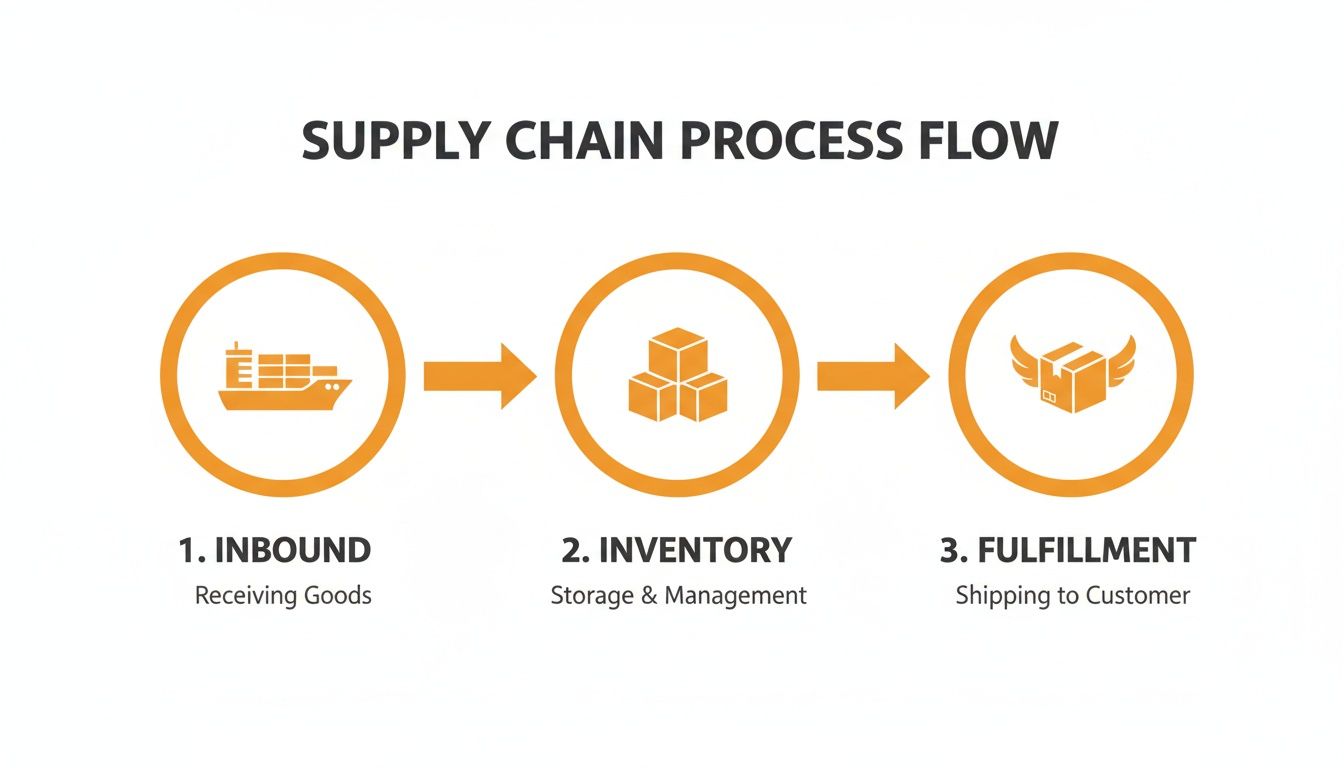
This flow chart gives you a bird's-eye view of how these stages connect, from the moment goods arrive to the moment they leave.

A three-step supply chain process flow chart showing inbound, inventory, and fulfillment stages.

As you can see, efficiency isn't about perfecting one step in isolation. It’s all about the smooth handoff between each operational stage. Let's break down how to build and optimize each one.

Mastering Inbound Logistics and Supplier Relations

Your e-commerce operation is only as strong as its starting point. A truly efficient supply chain doesn't start when a customer clicks "buy"—it begins the moment your goods leave the supplier. Mastering inbound logistics is the bedrock of your entire fulfillment strategy. It's the whole process of receiving, inspecting, and storing your inventory.

Get this part wrong, and you're just injecting chaos into your system. Inaccurate receiving leads to phantom stock, which means you sell things you don't have. Disorganized docks create bottlenecks that can keep thousands of dollars of inventory off your digital shelves. It’s a recipe for angry customers and lost sales.

Taming the Chaos of Inbound Freight

Let's be real: no two shipments are the same. You need a documented, repeatable process for every type of inbound freight you handle, because a one-size-fits-all approach just doesn't work.

Your receiving strategy has to adapt to the shipment type:

  • Full Containers or LTL (Less-Than-Truckload): If you're importing, this is your world. You absolutely need a clear plan for unloading, sorting, and palletizing. Without one, your warehouse floor turns into a mess of boxes, making an accurate count almost impossible.
  • Small Parcel Shipments: For those getting goods from domestic suppliers via carriers like UPS or FedEx, the challenge is sheer volume. You need a dedicated spot and a lightning-fast process to open, inspect, and log dozens—or even hundreds—of boxes without falling behind.

The goal of any inbound process is simple: get every single unit accounted for, inspected, and put away correctly in the shortest amount of time possible. Speed without accuracy is useless, but accuracy without speed creates costly delays.

A Real-World Inbound Scenario

Imagine you sell home goods. A 40-foot container just pulled up with 500 cartons holding 10 different SKUs. You've got fragile ceramic vases, sturdy wooden picture frames, and some pre-packaged gift sets that must stay together.

The chaotic approach? Just unload everything onto the floor and tell the team you'll "figure it out later." This is a guaranteed path to disaster.

An efficient supply chain approach looks completely different. It's all about having a plan before the truck door opens:

  1. Designated Unloading Zone: Pallets are staged in a specific area, keeping walkways clear so people and forklifts can move safely.
  2. Immediate Sortation: As cartons come off the truck, they are immediately sorted by SKU onto separate pallets. No more mixed-SKU pallets that cause headaches down the line.
  3. QC Checkpoint: A team member spot-checks a percentage of cartons from each SKU, comparing them against the packing list and looking for damage. This is where you catch the broken vases or mislabeled frames.
  4. System Check-In: Each correctly received carton is scanned or manually entered into your inventory system. Just like that, the stock is live and available for sale online.
  5. Directed Putaway: Your system tells the team exactly where to store each pallet, ensuring items are put away logically (e.g., fragile items on lower, more accessible racks).

This kind of structured workflow prevents those downstream nightmares, like selling a product you don't actually have in stock or, even worse, shipping a damaged item to a customer.

Building Stronger Supplier Relationships

As you scale, your supplier list grows. Today's supply chains are more complex than ever, with companies adding suppliers to reduce risk. The average number of unique suppliers per company shot up from 80 in 2020 to 116 in 2024—a massive 45% increase. For anyone running operations, that means juggling more relationships, more packing lists, and way more potential points of failure. S&P Global has some great insights on this trend.

Your most powerful tool here is clear communication. Set expectations with your suppliers on how goods should be packed, labeled, and documented before they ever leave their facility.

Giving them a Supplier Routing Guide is a total game-changer. This document should spell out everything: carton labeling standards, how pallets should be built, and mandatory advance shipping notifications (ASNs).

This proactive step makes your receiving team's job infinitely easier and slashes the chance of errors. A good supplier relationship isn't just transactional; it turns them into a true partner who's invested in making your shared supply chain run smoothly. To really get everyone on the same page, you also need to understand the technical side of supply chain integration. A seamless data flow between your suppliers, your inventory system, and your fulfillment center is what truly unlocks operational excellence.

Optimizing Inventory with Smarter Forecasting

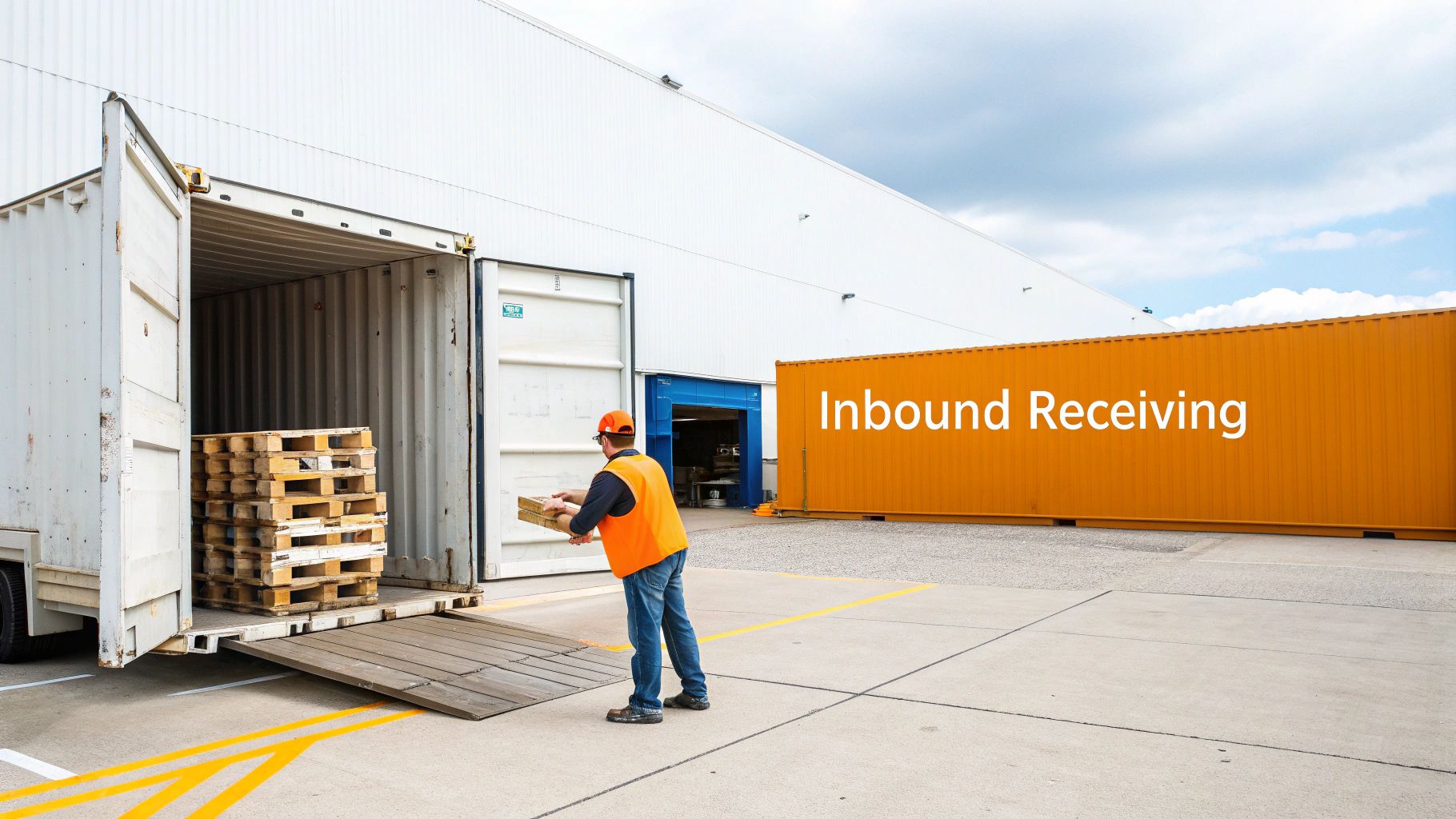
A worker in a safety vest unloads boxes from a shipping container with a ramp at a warehouse. An 'Inbound Receiving' container is nearby.

Once your goods are safely on the shelves, the real work begins. Smart inventory management is the battlefield where growing e-commerce brands either win or lose. Holding too much stock ties up your cash in products that aren't selling, while holding too little means stockouts, lost sales, and frustrated customers.

This isn't just about having product—it's about having the right product, in the right quantity, at the right time. Think of every unit on your shelf as cash. Managing it poorly is like leaving money on the table, and that directly stifles your ability to invest in growth.

Moving Beyond Guesswork in Demand Planning

A lot of sellers start out forecasting demand based on gut feelings or a quick look at last month's sales. That’s fine for a little while, but it’s a recipe for disaster as you scale. Once you’re juggling multiple SKUs across channels like Shopify and Amazon, you absolutely need a data-driven approach to predict what your customers will buy.

A solid forecast is the bedrock of an efficient supply chain. It dictates every purchase order you create and helps you dodge the cash-flow killers: overstocking and understocking. The goal here is to get proactive, not stay stuck in a reactive cycle of putting out fires.

To build a reliable forecast, you need to dig into your historical sales data and account for the variables that actually matter:

  • Seasonality: Are you selling more swimwear in June or more jackets in November? Pinpointing these predictable peaks and valleys is the first step.
  • Promotional Lifts: How much did sales jump during your last Black Friday event? You have to quantify that lift to plan for the next one accurately.
  • Market Trends: What’s happening outside your business? A viral TikTok video or a shout-out from an influencer can create demand surges out of nowhere.

A spreadsheet can tell you what sold last year, but it can’t tell you that your biggest competitor is about to launch a massive sale that will absolutely impact your numbers. The best forecasts blend historical data with real-world context.

Setting Intelligent Reorder Points

A brilliant forecast is useless if you don't act on it. This is where reorder points (ROPs) come in. A reorder point is simply the stock level that triggers a new purchase order for a SKU. It’s your automated alarm bell to replenish inventory before you hit zero.

To calculate your ROP, you need to know your supplier’s lead time (how long it takes for new stock to show up) and your daily sales velocity. You also need a buffer, called safety stock, to shield you from unexpected shipping delays or a sudden spike in sales.

The rise of AI is making this process even smarter. In fact, AI adoption in supply chain operations is expected to explode, jumping from 28% to 82% by 2025. On top of that, 86% of supply chain executives are already planning to invest in AI and analytics to cut costs. These tools can analyze complex patterns to set dynamic reorder points that adjust on the fly.

Here’s a quick look at how old-school forecasting stacks up against modern, AI-powered methods.

Traditional vs. AI-Powered Inventory Forecasting

Feature Traditional Forecasting AI-Powered Forecasting
Data Sources Relies mainly on historical sales data. Analyzes historical sales, market trends, weather, promotions, and more.
Methodology Manual calculations using simple formulas (e.g., moving averages). Uses machine learning algorithms to identify complex patterns and correlations.
Accuracy Prone to error, especially with volatile demand or promotions. Significantly more accurate; adapts to changing conditions automatically.
Labor Time-consuming and requires manual oversight. Automated, freeing up your team to focus on strategy.
Scalability Becomes unmanageable as SKU count and sales channels grow. Easily scales to handle thousands of SKUs and complex supply chains.

As you can see, leaning on modern tools isn't just a "nice-to-have"—it's becoming a competitive necessity for building an efficient supply chain.

Maintaining Rock-Solid Inventory Accuracy

Here’s the hard truth: your forecasts and reorder points are only as good as the data they’re built on. If your system says you have 100 units but your shelf only has 90, your entire strategy is compromised. That’s why maintaining inventory accuracy is completely non-negotiable.

While a full physical count once a year is okay, it’s disruptive and the data is stale almost immediately. A far better approach is cycle counting—counting small, specific sections of your inventory on a continuous, rotating schedule. For instance, you could count your top 20% best-sellers every month and your slower-moving items once a quarter. This method catches discrepancies early and keeps your data clean without having to shut down your whole operation.

To learn more about getting this level of precision, check out our guide on real-time inventory management. It’s a critical piece of the puzzle for any brand serious about scaling.

Putting Your Fulfillment and 3PL Integration on Autopilot

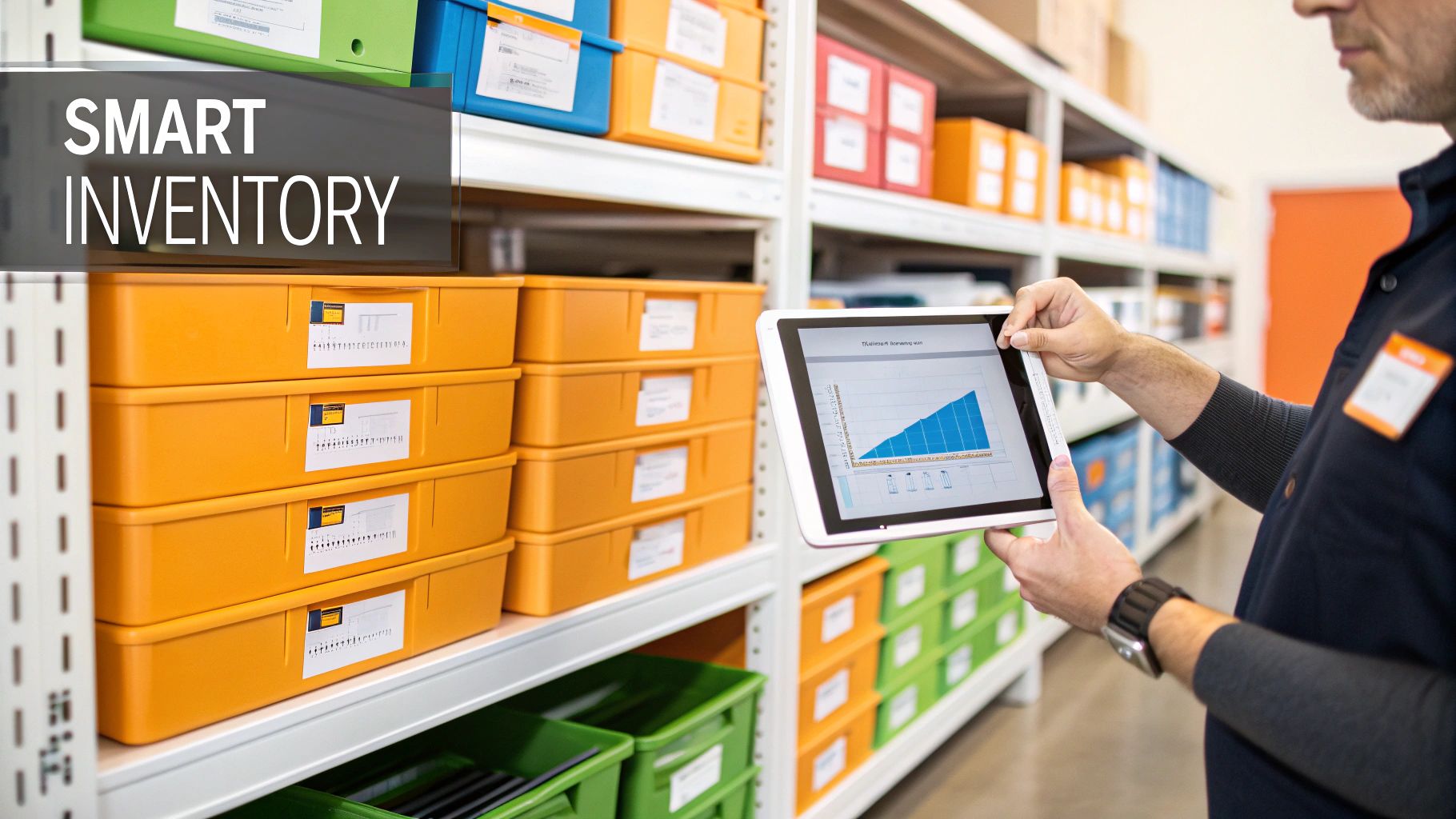
A man uses a tablet to manage smart inventory and logistics in a warehouse filled with colorful bins.

This is where the rubber meets the road. The pick, pack, and ship process is the moment of truth for your customers. A dialed-in fulfillment operation is the heartbeat of an efficient supply chain—it directly impacts how customers feel about your brand and, ultimately, your profitability.

Get this part right, and logistics stops being a cost center and starts becoming a powerful tool for building loyalty. The whole game boils down to speed and precision. Every single order needs to get picked, packed, and shipped out the door with zero mistakes and minimal delay. Any hiccup in this process creates a ripple effect, leading straight to late shipments and unhappy customers.

Building a Fulfillment Workflow That Actually Works

To hit peak efficiency, you have to think beyond just grabbing items off a shelf. Smart picking strategies are what separate the pros from the amateurs, drastically cutting down on the time your team spends walking the warehouse floor. Two of the most effective methods I’ve seen are batching and zoning.

  • Batch Picking: Instead of picking one order at a time, you group a bunch of them together. A picker can grab all the units of a single SKU for ten different orders in one go. It’s a simple change that slashes travel time.
  • Zone Picking: Think of this like an assembly line. You divide the warehouse into distinct zones, and pickers stick to their assigned area. Orders move from zone to zone, with each person adding the items they're responsible for before passing it along.

Warehouse automation has been slow on the uptake, but 2025 is a turning point. Right now, only about 25% of warehouses have any real automation in place, but that number is set to climb fast. For anyone selling on major platforms like Amazon, Shopify, or Walmart, automation means quicker turnaround times, fewer errors, and the ability to handle holiday rushes without hiring an army of temporary staff. For more on this trend, Liferay.com has some great insights.

The Make-or-Break Role of a 3PL Partner

For most e-commerce brands hitting a growth spurt, partnering with a Third-Party Logistics (3PL) provider is the only logical next step. A good 3PL takes storage, picking, packing, and shipping off your plate so you can focus on what you do best—marketing and building great products.

But here’s the thing: a successful 3PL relationship isn't just about handing over your inventory. It’s a true partnership built on clear communication and perfectly aligned processes. Before you even think about signing a contract, you need to hammer out a Standard Operating Procedure (SOP) document. This thing is your operational bible.

Your SOP needs to spell out every single detail, from how orders get sent to the 3PL's system to the specific type of packing tape they should use. If you leave anything open to interpretation, you're asking for trouble.

A great 3PL should feel like an extension of your own team. They need to get your brand, your products, and what your customers expect. If you want to dive deeper into finding the right partner, we have a whole guide on what a 3PL warehouse does.

Demystifying Amazon FBA Prep

If you’re selling on Amazon, sending products into their Fulfillment by Amazon (FBA) network adds a whole new layer of complexity. Amazon’s prep requirements are notoriously strict. One wrong move can lead to costly chargebacks, rejected shipments, or even getting your selling privileges suspended. An efficient supply chain has to nail these rules every single time.

This is where a knowledgeable 3PL becomes your best friend. They can manage the entire FBA prep process, ensuring you stay 100% compliant.

Here’s a quick rundown of the most common FBA prep tasks and why they matter:

Prep Task Why It's Important Consequence of Failure
FNSKU Labeling This is Amazon’s unique barcode that ties a product to you. It has to cover any old manufacturer barcodes. Amazon could lose your inventory or send the wrong items to customers. It’s a mess.
Poly Bagging Required for anything that could be damaged by dust or moisture, plus loose items or products in perforated boxes. Your products get damaged in the warehouse, and Amazon will charge you a per-item fee to fix it.
Bundling/Kitting If you sell multiple items as one unit, they must be packaged together with a clear "Sold as a Set" label. The warehouse team might break up your bundles, leading to incomplete orders and angry customers.

Getting FBA prep right from the start saves you a world of logistical headaches and protects your bottom line. It's not optional for serious Amazon sellers.

Turning Fulfillment into a Brand Experience

Finally, never forget that the package arriving at your customer's door is your last physical touchpoint with them. This is your final chance to make a great impression.

This is where value-added services, often handled by your 3PL, can really shine:

  • Kitting: Pre-assembling multiple items into a ready-to-ship gift set or subscription box.
  • Custom Packaging: Using branded boxes, custom tissue paper, or a thank-you insert to create a memorable unboxing moment.

By weaving these elements into your fulfillment workflow, you transform a simple logistical function into a powerful marketing tool. This is how you build an efficient supply chain that doesn't just support your growth—it actively drives it.

Closing the Loop with Returns and Key Metrics

A smiling warehouse worker in a safety vest places a package on a conveyor belt, with boxes and “EFFICIENT FULFILLMENT” text on the wall.

An efficient supply chain doesn't stop once a package lands on a customer's doorstep. The real pros know the job isn't done. Two critical, often overlooked, pieces of the puzzle are handling returns and actually measuring what matters.

Ignoring these is like running a marathon without checking your pace or learning from a bad race. Reverse logistics—the whole messy process of getting products back—can feel like a huge headache. But with a smart system, it’s a chance to win back customers and salvage value. At the same time, tracking the right data is what separates guessing from growing.

Building a Returns Process That Protects Your Bottom Line

Let's be honest, a clunky returns process is more than just an annoyance for your customers. It's a direct hit to your bottom line, burning up staff time and losing perfectly good inventory. The goal is simple: make it painless for the customer but ruthlessly efficient for your team. This all comes down to a clear, repeatable workflow.

Every time a return shows up at your dock, your team needs to know exactly what to do:

  1. RMA Verification: First things first, find the Return Merchandise Authorization (RMA) number. This is the golden ticket that connects the physical item back to the original order, which is essential for issuing refunds and knowing why it came back.
  2. Product Inspection: This is the moment of truth. Is the item brand new and ready to be resold? Is it slightly damaged? Is it even the right product? A quick but thorough check here decides its fate.
  3. Disposition: Based on that inspection, the item gets routed. Pristine products go right back into sellable inventory. Items with minor cosmetic damage might get funneled to a "scratch and dent" sale. Anything unsalvageable gets disposed of properly.

Think of every return as a clue. Is the same shirt coming back over and over because "the color is wrong"? That's not a warehouse problem; it's a signal to fix your product photos. A solid returns process doesn't just handle boxes—it gives you the intel to fix bigger issues at the source.

Measuring What Moves the Needle

There’s an old saying in logistics that’s gospel: you can't manage what you don't measure. To build a truly efficient supply chain, you have to track the key performance indicators (KPIs) that give you an honest look at how things are really going.

Don't get lost in a sea of data. Focus on the numbers that tie directly to your costs, your speed, and your customer's happiness. These metrics aren't just for fancy reports; they're your operational dashboard. If your Order Accuracy Rate suddenly drops, that's a flashing red light telling you something is wrong on the picking line—and you need to fix it before it becomes a customer service nightmare.

Here are the non-negotiable KPIs every e-commerce brand should have front and center:

  • Order Accuracy Rate: What percentage of your orders go out the door perfectly? No wrong items, no wrong quantities, no damage. You should be aiming for 99.5% or higher.
  • Inventory Turnover: How quickly are you selling through your entire stock? This tells you how well you’re managing the cash you have tied up in inventory.
  • On-Time Shipping Rate: The percentage of orders that shipped on or before the promised date. This is a direct measure of whether you're keeping your promise to the customer.
  • Cost Per Order: Add up all your fulfillment costs—labor, boxes, tape, shipping—and divide it by the number of orders you sent. This is your core efficiency metric.

A simple dashboard can make these numbers come alive. Imagine seeing your Cost Per Order trending down week after week while your On-Time Shipping Rate stays rock solid. That's the tangible proof that you're building a truly efficient supply chain. This data is what empowers you to spot problems, fix bottlenecks, and make smart decisions that fuel real growth.

Creating Your Playbook for Scalable Operations

The real test of your supply chain isn't how it runs on a quiet Tuesday morning. It’s about how it performs under extreme pressure. How do you handle 1,000 orders in a day during a flash sale with the same accuracy as you handle 100? The secret is to stop putting out fires and start building a playbook.

Forget the idea of a dusty binder on a shelf. A modern operations playbook is a living, breathing set of documented procedures that tells your team exactly what to do in high-stakes situations. This isn't about micromanaging—it’s about building muscle memory so your team can execute flawlessly when things get chaotic.

Planning for Predictable Chaos

Some of the biggest operational nightmares are the ones you can actually see coming. Seasonal rushes, product launches, and big promotions are all forms of predictable chaos that can bring an unprepared business to its knees. Your playbook needs dedicated chapters for these events.

Take Black Friday, for example. A solid playbook would break down the entire game plan:

  • Inventory Buffers: How much safety stock do you need for your best-sellers, and what’s the absolute latest it can be checked into the warehouse?
  • Labor Planning: A clear staffing schedule for the warehouse team, with pre-approved overtime and temporary help already lined up.
  • Carrier Communication: Giving your shipping carriers a heads-up on projected volume spikes so they can have trucks ready.

When you plan like this, a potentially frantic period just becomes a controlled, manageable process. You’re not guessing; you’re executing a plan you’ve already rehearsed.

Think of your playbook as an insurance policy against your own growth. It’s what ensures that success doesn't shatter the very systems you built to achieve it. Scaling smoothly means documenting the "how" before you're buried in a crisis.

Building Resilience for the Unexpected

Of course, you can't plan for everything. A key supplier might suddenly shut down production, or a major shipping lane could get hopelessly backed up. A truly efficient supply chain is resilient—it can pivot when things go sideways.

Your playbook for the unexpected needs to be all about rapid response and crystal-clear communication. What’s the plan if a container holding your hottest product gets delayed by two weeks?

The playbook should trigger a series of immediate, pre-defined actions:

  1. Communication Protocol: Who on the team is responsible for instantly looping in the marketing and customer service departments? No delays.
  2. Inventory Allocation: How do you prioritize the stock you have left? Maybe you pause all wholesale orders to save every last unit for your direct-to-consumer customers.
  3. Customer Messaging: Have pre-approved email templates and website banners ready to go, so you can proactively inform customers about potential delays.

By mapping out these responses ahead of time, you kill the panic and empower your team to take decisive action. This is the final piece of the puzzle, the step that ensures your supply chain can actually support your ambitions instead of holding you back.

Frequently Asked Questions About Supply Chain Efficiency

Digging into the nuts and bolts of logistics always brings up good questions, especially when you’re trying to build a truly efficient supply chain. Here are some of the most common things we hear from e-commerce sellers, along with our straight-to-the-point answers.

What Is the First Step to Improve My Supply Chain?

Before you do anything else, map out your current process from the moment a supplier shipment leaves their dock to when it lands on your customer’s doorstep. The first—and most impactful—place to start optimizing is almost always your inbound receiving.

Get this right, and everything else downstream just works better. If you have a rock-solid, standardized process for checking in, inspecting, and logging new inventory, you'll immediately prevent a cascade of problems like inaccurate stock counts and fulfillment errors.

How Do I Choose the Right 3PL for My Business?

Don't just look for a warehouse with space. You need a partner who gets your business. Look for a 3PL that has real experience with your specific product types and, just as importantly, your sales channels. If you’re selling on Shopify or a marketplace like Amazon FBA, a 3PL that's already deep in that world is non-negotiable.

Ask them for case studies from brands that look a lot like yours. Make sure their tech can keep up as you grow. A great partner should feel like an extension of your own team, not just another vendor on your expense report.

What Are the Most Critical KPIs to Track?

You could track dozens of metrics, but for most e-commerce brands, a handful of key performance indicators (KPIs) give you a powerful, at-a-glance snapshot of your operational health. Focusing on these is essential for building and maintaining an efficient supply chain.

  • Order Accuracy Rate: Are you sending the right stuff to the right people? This is ground zero for customer satisfaction.
  • On-Time Shipping Rate: Are orders actually leaving your warehouse when you promised they would? This is a direct measure of your reliability.
  • Inventory Turnover: Is your cash tied up in slow-moving stock, or are you selling through inventory efficiently? This metric is a direct line to your profitability.

Keeping a close eye on these three will help you move from just guessing to making sharp, data-driven decisions that actually move the needle on performance.


Ready to build an efficient supply chain that can keep up with your brand's growth? The team at Snappycrate specializes in fulfillment and FBA prep, turning your logistics from a headache into a real competitive advantage. Learn how we can support your growth at https://www.snappycrate.com.

0 Continue Reading →