Skip to Content

Blog Archives

A Seller’s Guide to Cargo in Transit

Think of your inventory’s journey like a long, risky road trip. The moment your products leave your supplier’s factory, the clock starts ticking and your investment is officially on the line. This entire middle part of the journey is what we call cargo in transit.

It’s the critical—and often nerve-wracking—period when your goods have been paid for but haven’t yet landed safely at your warehouse or 3PL.

What Is Cargo in Transit and Why It Matters for E-commerce

For an e-commerce brand, cargo in transit isn’t just a logistical term; it’s the lifeblood of your operation. It’s the time between when you wire money to your supplier and when those products are finally on a shelf, ready to be sold. This period can last anywhere from a few days for domestic hauls to several weeks for international freight.

Your inventory is passed between trucks, ships, and warehouses like a baton in a relay race, except this race crosses oceans. It might get trucked to a port, loaded onto a massive container ship, sail for weeks, get unloaded, clear customs, and then travel by rail or truck again to its final stop. Every single one of these handoffs is a potential point of failure.

The entire time your products are moving between these points, they are "in transit." Understanding this phase isn't just about tracking a package; it's about protecting your cash flow, preventing painful stockouts, and keeping the promises you make to your customers.

The Real-World Impact on Your Business

So why should this keep you up at night, especially if you’re running a DTC brand or selling on Amazon FBA? Because the modern supply chain is a minefield. Delays, damage, and outright loss during transit can hit your bottom line hard and fast.

Just think about these all-too-common scenarios:

  • Physical Damage: A forklift operator has a bad day, and an entire pallet of your top-selling product is crushed.
  • Theft and Loss: Containers get stolen from congested ports or, in rare cases, fall overboard. It happens.
  • Customs Delays: A single typo on a customs form can leave your entire shipment sitting in limbo for weeks.
  • Port Congestion: Your container might just sit on a ship offshore, waiting for days to get a spot at the dock.

These risks aren’t just theoretical. When disruptions hit global trade, the ripple effects are immediate. In 2025, for example, ongoing disruptions in major sea routes caused global air cargo demand to jump by 3.4% as brands scrambled for alternatives. That same pressure caused sea shipping rates to spike by as much as 40%, showing just how volatile things can get.

From Point A to Point B: The Major Handoffs

The journey from your supplier to your warehouse involves several key stages, and managing these transitions is where logistics pros earn their keep. For most e-commerce businesses, this means moving goods across different modes of transport—a process known as intermodal freight. If you want a deeper dive, check out our guide on intermodal freight and how it works.

To give you a clearer picture, let's break down the main phases where your goods are considered 'in transit' and identify the crucial handoff points.

Key Stages of Cargo in Transit

This table summarizes the primary phases of the journey and where control of your goods typically changes hands.

Stage Description Common Handoff Point
First Mile Movement of goods from the manufacturer or supplier's facility to a port or airport. Goods are loaded onto a truck and the Bill of Lading (B/L) is issued.
Main Leg The primary part of the journey, typically via ocean vessel or cargo plane across countries. Cargo is loaded onto the vessel/aircraft at the Port of Origin.
Customs Clearance Goods arrive at the destination country and must be processed by customs authorities. A customs broker submits documentation to release the cargo.
Final Mile Transportation from the destination port or airport to your warehouse or 3PL. Cargo is picked up by a domestic carrier for final delivery.

Each stage has its own unique risks, from paperwork errors at customs to damage during the final mile delivery. A solid logistics plan accounts for all of them.

Navigating Liability and Demystifying Incoterms

When your cargo hits a snag somewhere between the factory and your warehouse—whether it's damaged, lost, or just plain late—the first question is always the same: who pays for it? The answer, more often than not, is buried in a three-letter acronym you agreed to on your purchase order: the Incoterm.

Incoterms (short for International Commercial Terms) are the global ground rules for shipping. They spell out the exact moment that responsibility for your goods transfers from the supplier to you, the buyer.

Think of them like a prenup for your purchase order. They clearly define who pays for each part of the shipping journey and, crucially, who is on the hook when things go wrong. Choosing the right one isn't just about price—it’s about controlling your risk.

The Great Handoff: When Does Risk Transfer to You?

The transfer of risk is the single most important detail defined by Incoterms. This is the precise point in the journey where financial liability for the goods officially shifts from your supplier's shoulders to yours. If a container full of your products falls off a ship before this point, it's the supplier's problem. If it happens one moment after, it's yours.

This journey has many stages, and the risk transfer can happen at almost any point along the way.

A flowchart illustrating cargo in transit stages from supplier, to container ship, to warehouse.

As you can see, this handover can happen very early (like at the factory door) or very late (like at your warehouse). This is exactly why your choice of Incoterm is so critical to get right.

Let's break down the most common Incoterms we see e-commerce sellers use and what they mean for your liability in the real world.

  • EXW (Ex Works): Maximum risk for you. Your responsibility kicks in the second the goods are ready for pickup at the supplier's factory. You arrange and pay for absolutely everything from their door to yours.
  • FOB (Free On Board): A balanced and popular choice. The supplier is responsible for getting the goods loaded onto the ship at the port of origin. The moment the cargo is safely on board, the risk transfers to you.
  • DDP (Delivered Duty Paid): Minimum risk for you. The supplier handles and pays for everything—shipping, insurance, customs, and duties—all the way until the goods arrive at your final destination, like your 3PL’s warehouse.

By choosing the right Incoterm, you are not just buying products; you are defining the exact terms of engagement for your cargo in transit. This decision dictates who files an insurance claim and who ultimately absorbs a loss.

Common Incoterms and Your Responsibilities

Getting bogged down in the alphabet soup of Incoterms is easy, but it really just boils down to a few key options that most importers stick with. Each one offers a different trade-off between cost, control, and risk.

Example Scenario

Imagine you're importing 500 units of a hot new product from a factory in Vietnam to your fulfillment center in California.

  1. If you choose EXW: You're on the hook for everything. You have to arrange a truck to get the goods from the factory, handle export customs in Vietnam, book and pay for the ocean freight, clear U.S. customs, and arrange the final delivery. If that first truck crashes on the way to the port, that loss is 100% yours.
  2. If you choose FOB: Your supplier handles everything on their end to get your goods to the port and loaded onto the container ship. Your responsibility begins once the cargo crosses the ship's rail. This is a favorite for many sellers because it gives you control over the main (and most expensive) part of the journey—the ocean freight—letting you use your own trusted freight forwarder.
  3. If you choose DDP: The supplier gives you one all-in price. They manage the entire process from start to finish, and you just wait for the delivery. While it’s incredibly convenient, DDP is almost always more expensive and leaves you with zero visibility or control if delays pop up.

For most e-commerce sellers, FOB hits the sweet spot. It provides a fair balance of cost, control, and manageable risk. To get a better handle on all the details, check out our guide on what FOB means in shipping and how it can affect your bottom line.

Your choice of Incoterm isn't a minor detail—it's a strategic decision that empowers you to control your costs and proactively manage the risks that come with moving products around the world.

When you think about risks to your cargo in transit, it’s easy to picture dramatic scenes of pirates or shipwrecks. But the truth is, the real threats are far more common—and just as costly. These are the mundane, unglamorous problems that bring supply chains to a screeching halt and bleed profits dry.

A worker inspects colorful shipping containers in a cargo yard, with a clipboard on a pallet.

Think of your shipment’s journey like a cross-country road trip. The biggest risks aren't usually a single, catastrophic event but a series of small, frustrating setbacks—a flat tire, a wrong turn, a surprise traffic jam. For your inventory, these setbacks happen in warehouses, at ports, and inside the containers themselves.

We can break down these modern threats into two buckets: the physical and the logistical. Both can be devastating to an e-commerce brand.

Physical Damage and Loss

This is the most obvious risk. Your products pass through dozens of hands and machines, creating countless chances for things to get broken, stolen, or just plain lost.

  • Improper Handling: This is the number one culprit. A rushed forklift driver, a poorly stacked pallet, or a failure to brace goods inside a container can crush, shatter, or scuff your products before they ever get near a customer.
  • Theft and Pilferage: While organized crime does target high-value cargo, the more common problem is "pilferage"—small-scale theft where a few items vanish from a carton. These small losses might seem minor, but they add up to a significant hit to your bottom line over time.
  • Environmental Damage: For products like supplements, cosmetics, or food, a broken reefer (refrigerated container) can spoil an entire shipment. Even for dry goods, a leaky container can cause water damage, leading to mold and a total loss of inventory.

It’s also crucial to know the rules for what you’re shipping. If you’re a brand selling electronics, for example, you have to follow very specific lithium battery shipping requirements for preventing fires in transit. Getting this wrong can have disastrous consequences. Your first line of defense is always a thorough cargo inspection, which you can learn more about here: https://snappycrate.com/inspection-of-cargo/

The Invisible Supply Chain Killers

Beyond things you can see, a whole other category of "invisible" risks can be even more damaging. These are the systemic breakdowns that cause bottlenecks, stockouts, and unexpected costs that blindside e-commerce brands.

For an online seller, a container stuck at the port is more than just a delay. It's lost sales, angry customers, and a missed holiday season. These logistical logjams often have a bigger financial impact than a single damaged pallet.

Think about the Shopify brand that had its entire Q4 inventory arrive in January because of a massive port backlog. The holiday shopping frenzy was over. They went from a guaranteed sell-out season to a fire sale just to offload dated products.

This nightmare scenario highlights the real-world impact of:

  • Port Congestion: Too many ships, not enough workers, or equipment shortages can leave your containers sitting on a vessel for weeks, waiting to be unloaded.
  • Customs Delays: One small mistake on a commercial invoice or a random customs hold can trap your goods in administrative purgatory.
  • Carrier Volatility: Shipping lines can go bankrupt or, more often, announce "blank sailings"—canceling a scheduled voyage to manage their capacity. This is a massive source of uncertainty for importers.

Recent data shows just how volatile the system is. In 2025, global ocean container volumes actually dropped by 13%, but that figure hides the real story: a massive reshuffling of trade routes. Imports from China to the U.S. plummeted by 27%, while sourcing from countries like Indonesia and Thailand exploded by over 30%. This shift caused chaos, leading to a surge in blank sailings that left cargo stranded and proved just how fragile shipping schedules are. Building a resilient supply chain is the only way to protect your business from these shocks.

Choosing the Right Insurance to Protect Your Investment

When your inventory is on the move, a lot can go wrong. Relying on your carrier's default liability coverage is one of the biggest—and most common—gambles an e-commerce brand can make. It’s like hoping a basic car warranty will cover you in a five-car pile-up; the protection is minimal and leaves you exposed to huge financial losses.

Let’s be clear: your cargo in transit is cash. It’s a massive outlay you’ve made, and insurance isn't just another line item on a spreadsheet. It’s a vital safety net that can protect you from a catastrophic loss that could stop your business dead in its tracks.

A lot of sellers mistakenly believe their carrier will automatically cover the full value of their goods if something goes wrong. This is a dangerously expensive assumption. Carrier liability is not insurance. It's just a legally required, bare-minimum coverage that often pays out pennies on the dollar.

The Dangerous Default: Carrier Liability

Carrier liability is simply the carrier's legal responsibility for the goods they're hauling. The key word here is limited. The coverage isn't based on what your products are actually worth, but on their weight and freight class.

For example, a standard less-than-truckload (LTL) shipment might only be covered for $0.25 per pound. If you're shipping a pallet of lightweight, high-value electronics, you could lose thousands of dollars and get a check that barely covers lunch.

On top of that, trying to get a payout from a carrier is a tough, uphill battle. You have to prove the carrier was negligent, and they have a long list of built-in excuses they can use to deny your claim.

  • Acts of God: Storms, floods, or other weather events? They’re not liable.
  • Acts of the Shipper: If they can argue you packed the boxes improperly, your claim is dead on arrival.
  • No Proof: If damage isn’t noted on the delivery receipt at the exact moment of delivery, you have almost no chance of winning the claim.

This is exactly why dedicated cargo insurance is non-negotiable for any serious business.

Your Financial Safety Net: Cargo Insurance

Unlike carrier liability, a real cargo insurance policy is designed to make you whole again. It covers the full declared value of your inventory, so if disaster strikes, your investment is safe. The whole game changes from trying to prove who was at fault to simply proving that a loss happened.

"Freight insurance (sometimes called cargo insurance or goods in transit insurance) does not require you to prove that the carrier was at fault for damage or loss, just that damage or loss occurred."

This is a massive difference. It translates to a faster, more reliable claims process that gets you paid so you can reorder your inventory and get back to business.

Getting your investment protected during transit is critical. To better understand what’s involved, looking at these essential insurance tips for a stress-free move can help you pick the right coverage.

To make it crystal clear, here’s a direct comparison that shows the enormous gap between what a carrier offers and what a real insurance policy provides.

Carrier Liability vs All-Risk Cargo Insurance

Feature Carrier Liability All-Risk Cargo Insurance
Coverage Basis Based on weight and class (e.g., $0.50/lb). Full declared value of your goods.
Claim Requirement You must prove the carrier was negligent. You just have to prove a loss occurred.
Common Exclusions Acts of God, improper packaging, concealed damage. Only excludes what’s specifically named in the policy.
Payout Speed Often takes 120 days or more to resolve. Claims are usually paid within 30 days.
Purpose To limit the carrier's financial risk. To protect your financial investment and make you whole.

At the end of the day, deciding on insurance for your cargo in transit is about how much risk you're willing to take. Can your business absorb a total loss on a major shipment? If the answer is no, then a comprehensive cargo insurance policy is one of the smartest investments you’ll ever make.

Best Practices for Receiving Inbound Freight

Your cargo in transit isn't home free just because the truck has arrived. In reality, that final step—the receiving process at your warehouse or 3PL—is where all your careful planning can either pay off or fall apart completely. Get it wrong, and you're looking at lost inventory, shipping delays, and angry customers.

Think of your receiving dock as the finish line of a marathon. A runner doesn't just stop cold; they need a proper cooldown. Your freight is the same. It needs a structured, almost obsessive process to make sure every item is accounted for, inspected, and ready to be sold. This is where a sharp 3PL partner really proves their worth, turning potential chaos into a smooth, efficient operation.

Warehouse employee performs an inbound check, scanning packages on a pallet with a handheld device.

This final handover is more important than ever. With waterborne vessels carrying a massive 41.5% of U.S. international trade value—that's $2.1 trillion—any disruption at the ports has a massive ripple effect. When major ports like LA/Long Beach get backed up, those delays hit warehouses hard. You can dig into the data yourself in the latest government report on port performance. A well-prepared 3PL can absorb that shock.

The Power of Preparation with an ASN

The single best tool for a smooth receiving process is the Advance Shipping Notice (ASN). This is a digital file you or your supplier sends to the warehouse before the cargo shows up. It's the ultimate heads-up, giving the receiving team a clear picture of what’s coming.

A solid ASN includes:

  • Purchase order (PO) number
  • A list of all SKUs and how many of each to expect
  • Carrier details and tracking info
  • Expected arrival date

Armed with this information, your 3PL can get everything ready. They’ll clear dock space, schedule the right number of people, and have equipment on standby. Without an ASN, your shipment arrives "blind," and the team is left scrambling to figure things out on the fly. That's a recipe for mistakes.

The Unforgiving Inspection Process

The moment those truck doors swing open, the real work begins. This isn't just a quick glance—it's a meticulous inspection to confirm that what you ordered is what you actually got, and that it's in good shape. The driver’s Bill of Lading (B/L) is the single source of truth here.

The receiving team performs a three-way match:

  1. The Purchase Order: What you ordered.
  2. The Advance Shipping Notice: What the supplier said they shipped.
  3. The Physical Count: What’s actually on the pallet.

Any difference—shortages, overages, or crushed boxes—must be written down directly on the B/L before signing it. Once that document is signed without any notes, you’ve legally accepted the shipment as-is. Trying to file a successful freight claim after that is nearly impossible.

A meticulous receiving team doesn't just count boxes; they protect your investment. By documenting every detail on the Bill of Lading, they create an indisputable record that is essential for holding carriers accountable and getting reimbursed for any in-transit damage.

FBA Compliance for Amazon Sellers

If you're an Amazon FBA seller, the receiving process gets even more complicated. Amazon’s fulfillment centers have brutally strict inbound rules, and there's absolutely no room for error. One small mistake can get your shipment rejected, leaving you with hefty penalty fees and weeks of delays.

A 3PL that specializes in FBA prep is your first line of defense. As they receive and process your inventory, they're also your quality control team, checking for Amazon's biggest sticking points:

  • FNSKU Labeling: Is every single unit correctly labeled so Amazon's scanners can read it?
  • Poly Bagging: Do items that need it have the right bag with a suffocation warning?
  • Bundling and Kitting: Are multi-packs shrink-wrapped and labeled "Sold as Set"?
  • Pallet and Carton Standards: Does the shipment meet Amazon’s strict rules for weight, size, and labeling?

By catching and fixing these problems at their own warehouse, your 3PL ensures your inventory never even gets to Amazon in a non-compliant state. It’s a crucial preventative step that saves you from chargebacks and keeps your products available for sale, protecting your sales velocity and IPI score.

Frequently Asked Questions About Cargo in Transit

When you’re importing goods, a lot can go wrong between your supplier’s factory and your warehouse. Understanding the ins and outs of cargo in transit is the only way to protect your inventory and your cash flow.

We get these questions all the time from e-commerce sellers. Here are the straight-up answers you need.

What Is the Difference Between Freight Insurance and Carrier Liability?

This is probably the most important and misunderstood part of shipping. Getting this wrong can cost you a fortune.

Think of it this way: carrier liability is the absolute bare-minimum coverage that carriers are legally required to offer. Freight insurance is what you buy to actually protect the full value of your products.

Carrier liability often pays out a ridiculously low amount, like $0.50 per pound, no matter what your goods are worth. If you’re shipping a pallet of expensive electronics and it gets destroyed, you might get a check for a few hundred bucks on a $20,000 loss. On top of that, you have to prove the carrier was negligent, which is a long and frustrating battle.

Freight insurance, on the other hand, covers the full value you declare.

With freight insurance, you don't need to prove the carrier was at fault. You just have to prove the damage happened. This simple difference puts the power back in your hands and gets your money back fast.

Relying on carrier liability alone is a massive gamble. It's a risk no serious e-commerce brand can afford to take with its cargo in transit.

How Do Incoterms Affect My Shipping Costs and Responsibilities?

Incoterms are essentially the "rules of the road" for international trade. The term you agree on with your supplier determines the exact moment you become responsible for the costs and risks of shipping.

Your choice of Incoterm directly impacts your landed cost and how much control you have over your shipment.

Let's look at two common ones:

  • EXW (Ex Works): This puts all the responsibility on you. Your job starts the second the goods leave the factory floor. You arrange and pay for everything: pickup, export customs, ocean freight, insurance, and final delivery. It gives you total control, but also the most work and the most risk.
  • DDP (Delivered Duty Paid): This is the opposite. The supplier handles every single step until the goods are delivered to your final destination, like your 3PL's warehouse. It’s convenient, for sure, but it’s almost always more expensive, and you have zero visibility into where your shipment is or who is handling it.

Choosing the right Incoterm isn't just a detail—it's a major strategic decision that defines who pays for what, who is liable, and who is in charge of your cargo in transit.

My Shipment Is Delayed at the Port—What Should I Do?

Port delays happen. It’s an unfortunate reality of global logistics. The key isn't to avoid them entirely (you can't), but to have a plan for when they pop up. Freaking out won't get your container moving.

Here’s what to do immediately:

  1. Contact Your Freight Forwarder: This is always step one. Your forwarder is your eyes and ears on the ground. They can tell you exactly why there's a delay—whether it’s a random customs exam, port congestion, or a paperwork error.
  2. Give Your 3PL a Heads-Up: As soon as you know there's a delay, let your fulfillment partner know. A good 3PL can adjust receiving schedules and labor to prevent chaos at their docks when your container finally arrives. Proactive communication helps them help you.
  3. Fix the Problem: If the hold-up is because of a mistake on the commercial invoice or other documents, get on it fast. Work with your supplier and forwarder to submit corrected paperwork immediately. The faster you fix it, the faster your cargo gets released.

Having a responsive logistics network is your best defense against these disruptions.

What Documentation Is Essential for Smooth Customs Clearance?

Nothing brings cargo in transit to a screeching halt faster than a customs hold because of bad paperwork. You need to make sure every document is perfect before your shipment even leaves the port of origin.

These are the non-negotiable documents for almost any international shipment:

  • Commercial Invoice: This lists the buyer, seller, product descriptions, quantities, value of the goods, and Incoterms. Every detail must be 100% accurate.
  • Bill of Lading (B/L) or Air Waybill (AWB): This is your contract with the carrier. It functions as both a receipt for your goods and the title to them.
  • Packing List: This document tells customs officials exactly what is in each box and on each pallet, including weights and dimensions. It helps them verify your shipment's contents without tearing everything apart.

Depending on your product, you might also need other papers, like a Certificate of Origin or special import permits. Double-check everything. Small typos on paperwork are one of the leading causes of huge, expensive delays.


Managing inbound freight is a major challenge for growing e-commerce brands. Snappycrate simplifies the entire process by acting as a reliable extension of your team. From container receiving and FBA prep to fast, accurate order fulfillment, we provide the expert logistics support you need to scale without bottlenecks. Learn more about how Snappycrate can streamline your operations.
0 Continue Reading →

Freight on board cost: A 2026 Guide to Incoterms and Shipping

When you get a quote from an overseas supplier, you'll almost always see the term FOB cost. But what does that number actually cover? It’s not just the price of your products.

The freight on board cost is the all-in price to get your goods from the factory floor, through all the origin country hurdles, and safely loaded onto the ship. Getting this number right is the first step to calculating your true landed cost and making sure your profit margins are protected.

What Freight On Board Cost Really Means For Your Business

Two men loading a cardboard box onto a delivery truck, with 'FoB Cost' text.

Think of international shipping like a relay race, and your inventory is the baton. The Freight On Board (FOB) point is the exact moment that baton—along with all the risk and responsibility—is passed from your supplier to you. This isn't just some dry shipping term; it’s one of the most important handoffs in your entire supply chain.

"Freight On Board" means the seller’s job is done once your goods are loaded on board the vessel at a specific port, like "FOB Shanghai." The second those goods cross the ship's rail, you, the buyer, officially own them.

Breaking Down The FOB Price Tag

The freight on board cost isn't a single line item. It’s actually a bundle of different charges your supplier pays for you and then rolls into their final invoice. A standard FOB price includes:

  • Product Cost: The base price you agreed to pay for the goods.
  • Origin Trucking: The cost to haul your inventory from the factory to the port.
  • Port Handling Fees: Charges for loading the container and other terminal logistics, also known as Terminal Handling Charges (THC).
  • Export Customs Clearance: All the fees and paperwork required to legally get the goods out of the country of origin.

This all-in-one price is exactly why FOB is so popular with e-commerce sellers and importers. It simplifies the chaos of origin logistics by making the supplier handle all the local legwork. You’re only responsible for the main ocean freight, insurance, and everything from that point forward. To learn more about who pays for what, check out our guide on the collect freight definition.

Key Takeaway: The FOB cost is the sum of your product price plus all the costs required to get those products loaded onto the shipping vessel. It's the critical point where all liability for the goods transfers from the seller to you, the buyer.

The table below gives you a crystal-clear breakdown of who pays for what.

FOB Cost Responsibility At A Glance

Here’s a simple summary of the cost responsibilities for both the buyer and seller when using FOB Incoterms.

Cost Component Paid by Seller (Before FOB Point) Paid by Buyer (After FOB Point)
Product Manufacturing
Export Packaging
Loading at Factory
Inland Transport to Port
Export Customs & Duties
Origin Port Charges (THC)
Main Ocean/Air Freight
Cargo Insurance
Destination Port Charges
Import Customs & Duties
Final Delivery to Warehouse

As you can see, the handoff is clean. The seller handles everything on their turf, and once the goods are on the ship, the ball is officially in your court.

Understanding FOB Origin Versus FOB Destination

Split image comparing FOB Origin with a worker checking documents and FOB Destination with a truck at a loading dock.

Not all "Freight On Board" terms are the same. That tiny difference between FOB Origin and FOB Destination can have a huge impact on your costs, cash flow, and who’s on the hook if something goes wrong. Think of it as deciding where the handshake happens—at your supplier’s door or your own.

Getting this wrong is one of the most common—and expensive—mistakes we see importers make. It determines the exact moment you legally own your inventory, and with it, all the risk. This can lead to surprise fees and insurance gaps that eat away at your profits before the product even lands.

FOB Origin: You Take Ownership at the Start

With FOB Origin, the deal is done and the inventory becomes yours the second it’s loaded onto the truck or ship at the seller’s end. From that point on, it's your baby.

That means you are 100% responsible for the entire journey. If the container topples into the ocean or a truck gets into an accident, it’s your inventory and your loss.

Here’s what FOB Origin means for you:

  • Early Ownership: The goods are on your books the moment they leave the factory or port.
  • You Assume All Risk: Any damage or loss that happens during transit is your problem to solve.
  • You Pay for Freight: You’re in charge of hiring and paying the main carrier.
  • Inventory on Your Balance Sheet: You have to account for the inventory as soon as it ships.

This is the standard for most international trade because it gives you, the buyer, total control over the most expensive part of the trip: the ocean or air freight.

FOB Destination: Ownership Transfers at the End

On the flip side, FOB Destination means your supplier keeps all the ownership, risk, and responsibility until the goods are delivered to your specified location. That could be your warehouse, a 3PL like SnappyCrate, or an Amazon fulfillment center.

The seller handles everything—they hire the carrier, pay for freight, and cover the insurance. The risk and ownership don't transfer to you until the shipment arrives safe and sound.

With FOB Destination, the supplier's job isn't done until your goods are on your doorstep. You don't own it—or have to worry about it—until it gets there.

This setup is definitely more convenient, but it usually comes with a higher price tag. Sellers often bake extra margin into the shipping charges. You also lose control over the shipping schedule and which carrier is used, which can cause its own set of headaches.

An Amazon Seller's Choice: A Real-World Example

Let's say you're an Amazon seller in the U.S. importing 1,000 wireless speakers from a factory in Shenzhen, China.

  • With FOB Origin (Shenzhen): You take ownership the moment those speakers are loaded onto the ship in the Shenzhen port. You have to book the ocean freight to your U.S. port and arrange your own cargo insurance. If a storm hits and 200 units are damaged by water, that's your financial hit to take.

  • With FOB Destination (Your Warehouse): Your supplier quotes you a single price to get the speakers to your warehouse in Los Angeles. If those same 200 units get damaged on the way, it’s the supplier’s problem. They have to either refund you or send replacements. You only pay when the full, undamaged order arrives.

Knowing the difference gives you the power to negotiate better terms and manage your supply chain effectively. No matter which term you choose, the final step is always a thorough check upon arrival. You can learn more about how we handle this crucial part of the process in our guide to effective receiving and inspection procedures.

How To Calculate Your True Freight On Board Cost

Alright, let's move past the theory and get into the real numbers. This is where you actually gain control over your supply chain costs. If you don’t calculate your total freight on board cost accurately, you’re basically flying blind on your budget, your Cost of Goods Sold (COGS), and your retail pricing.

Getting this number right is the difference between guessing at your profits and actually guaranteeing them.

The calculation itself is pretty straightforward. It's simply the cost of your products plus all the local fees it takes to get them loaded onto the ship at the origin port.

The FOB Cost Formula: Product Cost + Origin Trucking + Port Handling Fees + Export Customs Charges = Total FOB Cost.

This simple formula shows you the true cost to get your goods ready for their international journey. It’s the baseline number that tells you what you’ve spent before the main event—the ocean or air freight—even kicks off.

Breaking Down The Formula Components

Let's pull apart each piece of that equation. Imagine you're importing 1,000 coffee makers from a factory in Ningbo, China, and they need to get to a vessel at the Port of Shanghai.

  • Product Cost: This one’s easy. It’s the price you negotiated with your supplier for the goods. If each coffee maker is $10, your total product cost is a clean $10,000.
  • Origin Trucking: This is the cost to haul your goods from the factory floor in Ningbo to the port in Shanghai. Depending on the distance and truck size, this could run anywhere from $150 to $400.
  • Port Handling Fees: You'll often see this listed as Terminal Handling Charges (THC). These are the fees the port charges to take your container off the truck and load it onto the ship. You can expect this to be in the $100 to $300 range.
  • Export Customs Charges: Your supplier has to file paperwork to clear your goods for export legally. These fees are usually pretty small, often between $50 and $150.

Now, let's put these estimated numbers together to see what your real FOB cost looks like.

A Worked Example

We'll plug in the numbers from our coffee maker shipment to see how this plays out in the real world.

  • Product Cost: $10,000 (1,000 units x $10/unit)
  • Origin Trucking: $300
  • Port Handling Fees (THC): $200
  • Export Customs Charges: $100

Total FOB Cost = $10,000 + $300 + $200 + $100 = $10,600

See that? Your true FOB cost is $10,600, not just the $10,000 you paid for the products. That extra $600 is what the local logistics cost, and it's what your supplier is managing for you. Forgetting to account for this can throw your entire profit calculation off. For a deeper dive into controlling these types of expenses, our guide on how to reduce your overall shipping costs offers practical strategies.

Uncover Hidden Costs With a Proforma Invoice

So, how do you find out what these local charges actually are? The secret is to ask your supplier for a detailed Proforma Invoice (PI) before you finalize your order. Too many importers accept a PI that just lists a single "FOB Price." You need to ask for a breakdown.

A good, transparent supplier won't have an issue separating the product cost from the estimated local fees. This simple request keeps everyone honest and prevents suppliers from padding these charges to make an extra buck. When you’re trying to figure out your true freight on board cost, you have to account for every little fee, especially when you need to ship from China to Amazon FBA. Knowing every single cost gives you the power to negotiate and paints a complete picture of your investment.

Choosing The Right Incoterm For Your E-commerce Business

While knowing your freight on board cost is a great first step, it’s just one piece of the shipping puzzle. As an e-commerce seller, picking the right Incoterm can feel like a high-stakes choice between control and convenience.

Get it wrong, and you could be looking at surprise fees, inflated freight costs, and a total loss of control over your inventory at the worst possible time. To help you choose wisely, we’ll break down the most common options you'll see: EXW, FOB, CIF, and DDP.

EXW (Ex Works): The High-Control, High-Responsibility Option

Think of Ex Works as the ultimate DIY approach to importing. When you agree to EXW, you, the buyer, are responsible for everything from the moment your products leave the factory floor.

You’re on the hook for every single step: getting the goods loaded onto a truck, arranging transportation to the port, clearing export customs in the origin country, and managing the entire ocean or air freight journey. It gives you absolute control over your logistics and costs, but it also saddles you with the most work and the most risk.

For most sellers on Amazon or Shopify, EXW is a very risky place to start. It pretty much requires you to have a trusted partner on the ground in China or wherever you're sourcing from to handle all the local headaches. One simple mistake on an export document can leave your container stuck at the port for weeks.

FOB (Freight On Board): The Balanced Approach

This is where FOB shines. As we’ve covered, it strikes a fantastic balance. Your supplier handles all the messy, unpredictable stuff on their home turf—getting your goods from the factory, through their local customs, and loaded onto the ship.

Your responsibility kicks in the second those goods are safely on board. This frees you from dealing with the local bureaucracy of another country while giving you complete control over the most expensive part of the shipment: the international freight. You get to pick your own freight forwarder, shop around for quotes, and dictate the shipping schedule.

This mix of convenience and control is exactly why FOB is the go-to Incoterm for most growing e-commerce businesses. It eliminates major local risks without forcing you to hand over control of your freight budget.

CIF (Cost, Insurance, and Freight): The Convenient (But Costly) Trap

On the surface, CIF looks like a dream come true. Your supplier quotes you one simple price that includes the cost of your goods, insurance, and all the freight to get it to your destination port. It seems so easy.

But that convenience almost always comes with a hidden cost. Since the seller is arranging and paying for the freight, they have zero incentive to find you a good deal. It’s incredibly common for suppliers to bake a hefty markup into the shipping cost or pick a painfully slow carrier just to boost their own profit margin.

While CIF makes getting a quote simple, you give up all control over your shipping costs and transit times. That "free" or cheap shipping your supplier promised is never actually free—it's just buried in your invoice, often with a nice markup for them.

You also lose all visibility into your real freight costs, which makes it nearly impossible to calculate your true landed cost per unit. You might save a little time upfront, but you'll almost certainly pay for it with higher fees and potential delays.

This decision tree helps visualize how to approach your freight on board cost calculations.

FOB cost decision tree flowchart illustrating the process to calculate cost and request an invoice.

The key takeaway is that having a clear, itemized invoice from your forwarder is critical to understanding your total costs.

DDP (Delivered Duty Paid): The Ultimate Hands-Off Service

DDP is the full white-glove experience. With this term, the seller is responsible for everything—delivering the goods all the way to your final destination (like your warehouse or 3PL), and paying for all transport, insurance, customs clearance, and import duties.

It's the closest you can get to buying something domestically. But this all-inclusive service is almost always the most expensive option. Just like with CIF, the seller is in the driver's seat and will bake a healthy profit margin into the bundled price. You're paying a huge premium for convenience, and it leaves you with no power to control or reduce your single biggest expense after cost of goods.

Incoterm Comparison: FOB vs. EXW vs. CIF

To make it even clearer, here’s a quick breakdown of how these three common Incoterms stack up. This table shows you exactly where risk and cost are transferred from the seller to you.

Incoterm Risk Transfer Point Who Pays Main Freight? Best For…
EXW (Ex Works) At the seller's factory/warehouse Buyer (You) Experienced importers with trusted agents on the ground in the origin country who need maximum control.
FOB (Freight on Board) When goods are loaded onto the vessel at origin port Buyer (You) Most e-commerce sellers. It offers the best balance of cost control, convenience, and manageable risk.
CIF (Cost, Insurance, Freight) When goods are loaded onto the vessel at origin port Seller Buyers who prioritize a single, upfront quote over cost control and are willing to pay a premium for convenience.

Ultimately, choosing the right Incoterm comes down to balancing your budget, your appetite for risk, and how much control you want over your supply chain. For the vast majority of online sellers, FOB hits that sweet spot perfectly.

Managing Your Logistics After The FOB Handoff

A truck transports orange shipping containers on a dock with a cargo ship and cranes in the background, illustrating inbound logistics.

Once your products are loaded "on board" the vessel, the relay race isn't over—the baton has just been passed to you. This FOB handoff is where your real work begins, kicking off the inbound logistics journey that gets your inventory across the ocean and eventually to your warehouse door. It’s also where your true freight costs start piling up.

Getting this next leg of the journey right is what separates profitable importers from the ones who are always struggling. Your mission is to move your products from that origin port to your final destination without breaking the bank. This isn't just about one shipment; it's a core part of successful international supply chain management.

Now that you're in the driver's seat, here are the key steps you're responsible for.

Securing Ocean Freight and Insurance

Your first big task is booking the main voyage. This is almost always the most expensive part of the shipping process, and it's where having control really pays off. You’ll need to find a freight forwarder you trust or work directly with a carrier to book space on a container ship.

This is also when you absolutely must secure cargo insurance. Let me be clear: standard FOB terms do not cover your goods during the main transit. If you skip this and something happens to your container at sea—it gets damaged, falls overboard, whatever—that’s a 100% loss for your business. Don't risk it. Insurance is a non-negotiable cost of doing business.

Taking Advantage of Market Changes

Ocean freight costs aren't set in stone. The market is incredibly volatile, and smart importers watch it like a hawk to take advantage of the dips. We're seeing a perfect example of this play out right now.

In early 2026, ocean freight rates have plummeted from the crazy highs we saw in 2022. For instance, rates for a container on the Trans-Pacific route (Shanghai to Los Angeles) dropped from over $12,000 down to as low as $1,200–$1,800. Data from Xeneta confirmed that average spot rates from the Far East to the U.S. West Coast hovered around $1,889 per 40-foot container in February 2026. You can dig deeper into how to pivot with these changing prices by reviewing recent freight rate forecasts.

This massive 85% reduction in shipping costs creates a huge opportunity. By managing your own freight after the FOB handoff, you can capture these savings directly, slash your landed cost, and seriously boost your profit margins.

Getting Through U.S. Customs and Final Delivery

Once your shipment hits a U.S. port, it has to clear Customs and Border Protection (CBP). This isn't a single step, but a few critical ones:

  • Filing an ISF (Importer Security Filing): This needs to be done at least 24 hours before your cargo is even loaded onto the ship back at the origin port. Don't be late.
  • Submitting a Customs Entry: Your customs broker handles this, filing all the necessary paperwork to declare your goods.
  • Paying Duties and Taxes: You'll pay any import duties based on your product's HTS code.

After your goods are cleared, the final leg begins: drayage and final-mile delivery. Drayage is just the industry term for moving your container from the port to a nearby warehouse. From there, your inventory is trucked to its final destination—whether that’s your own facility, an Amazon FBA center, or a 3PL partner like Snappycrate.

The Strategic Value of a 3PL Partner

Juggling all these post-FOB steps can feel like a full-time job, especially if you’re trying to grow your brand. This is where a good third-party logistics (3PL) partner becomes your secret weapon. A 3PL can grab the baton from you the second your container arrives at the port.

At Snappycrate, we live and breathe this stuff. We specialize in handling the entire inbound process for our clients. Here’s what that looks like:

  1. Container Receiving: We sync up with your freight forwarder to get your containers to our warehouse without a hitch.
  2. Pallet Breakdowns: Our crew unloads, sorts, and inspects your inventory, making sure everything is accounted for and in good condition.
  3. FBA Prep: We handle all the picky Amazon stuff—labeling, poly bagging, and bundling to meet their strict FBA standards.
  4. Warehousing and Fulfillment: Your products are stored safely, ready for us to fulfill orders or transfer to FBA.

Partnering with a 3PL like us turns a logistical nightmare into a smooth, efficient part of your operation. It lets you lock in those freight savings without getting buried in the details, giving you a serious competitive edge.

Common Questions About Freight On Board Cost

Once you start digging into international shipping, the questions pile up fast. As you get a handle on freight on board cost and its effect on your bottom line, you need straight answers to the most common sticking points. We're tackling the questions we hear all the time from importers and e-commerce sellers just like you.

Our goal is simple: to arm you with practical knowledge, cut through the confusion, and help you make smarter shipping decisions. From accounting rules to supplier negotiations, these answers will give you the confidence to manage your supply chain like a pro.

When Should I Record FOB Shipments in My Accounting?

This is a huge one for keeping your books straight, and the answer comes down to one thing: the specific FOB term you agreed to. It all hinges on the exact moment you officially take ownership of your inventory.

If your shipment is FOB Origin, you own those goods the second they're loaded onto the ship. That means you have to record the inventory on your balance sheet right then and there. This will immediately increase your assets and affects your Cost of Goods Sold (COGS) for that accounting period.

On the other hand, with FOB Destination, you don’t own the goods until they safely arrive at your specified location, like our warehouse. You should only record the inventory in your accounting system once it's been delivered. This timing makes a direct impact on your asset reporting and when you recognize those costs.

Key Insight: The timing of your inventory entry isn't a suggestion; it's a hard accounting rule set by the FOB term. Getting this wrong can throw off your financial statements and create compliance headaches down the road.

Are FOB Terms Negotiable With Suppliers?

Yes, 100%. All Incoterms, including FOB, are a negotiable part of your purchase agreement. You can and absolutely should discuss these terms before you finalize any order.

For instance, you can negotiate the specific named port (e.g., FOB Shanghai vs. FOB Yantian) to take advantage of better sailing schedules or lower port fees. It's also smart to demand written confirmation of every single charge baked into that final FOB price so there are no surprises.

Your order volume is your leverage. Having a freight forwarder who can consolidate shipments also gives you more negotiating power. Don't be afraid to push for total clarity and terms that work in your favor.


Trying to manage all the moving parts of inbound logistics—from negotiating FOB terms to handling container receiving and FBA prep—is a massive headache. Snappycrate simplifies the entire process. We act as a reliable extension of your team, making sure your inventory moves seamlessly from the port to our warehouse, prepped and ready for your customers. Learn more about how we can help you scale at https://www.snappycrate.com.

0 Continue Reading →

What does fob stand for in shipping? Guide (what does fob stand for in shipping)

When you're dealing with shipping and logistics, you'll see the term FOB everywhere. It stands for Free On Board, and it’s one of the most important terms you'll need to understand as an importer or e-commerce seller.

Put simply, FOB defines the exact moment in the supply chain when the responsibility for your goods—including all the risks and costs—is officially handed off from the seller to you, the buyer.

What FOB Really Means for Your Supply Chain

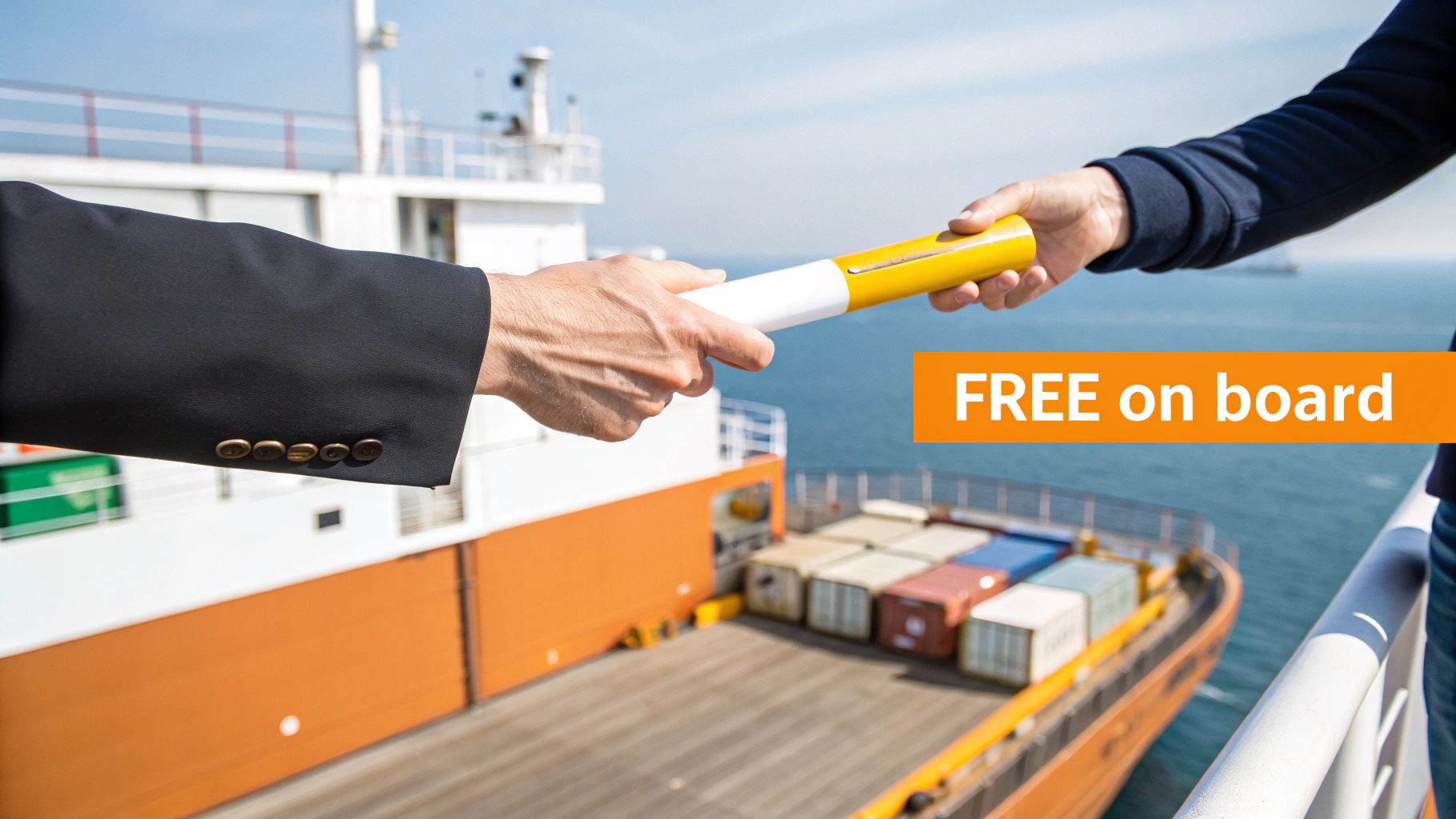
Two people exchange a baton on a cargo ship, illustrating 'FREE on board' shipping terms.

Think of it like a relay race for your inventory. Your supplier (the seller) carries the baton—your products—to a specific, pre-agreed point. Once they hand it off, you (the buyer) take over for the rest of the race to the finish line. That handoff point is what makes understanding FOB so critical for managing your shipping costs, insurance, and liability.

The term actually comes from the old days of sailing ships, when cargo was physically passed "free on board" over the ship's rail. That simple action marked the transfer of responsibility. Today, the concept is formalized by the International Chamber of Commerce (ICC), and FOB still accounts for around 25% of global trade contracts. You can find more on its history over at lot.dhl.com.

For anyone running an e-commerce business, getting this right isn't just about knowing the lingo. It directly impacts your landed cost, insurance coverage, and how much control you have over your own logistics.

FOB Origin vs Destination At a Glance

The easiest way to understand FOB is to compare the two main types. The key difference is simply where that handoff from seller to buyer happens.

This quick table breaks it down.

Responsibility Point FOB Origin (Freight Collect) FOB Destination (Freight Prepaid)
Risk Transfer Buyer takes on risk at the port of origin. Seller keeps the risk until goods arrive at the buyer's destination.
Who Pays Freight? The buyer pays for the main leg of the shipping journey. The seller pays for shipping all the way to the final destination.
Best For Buyers who want full control over their shipping costs and carriers. Buyers who prefer simplicity and want to offload logistical work.

Essentially, the choice between FOB Origin and FOB Destination determines who is on the hook if something goes wrong and who controls the purse strings for the most expensive part of the shipping process.

How FOB Origin Puts You in Control

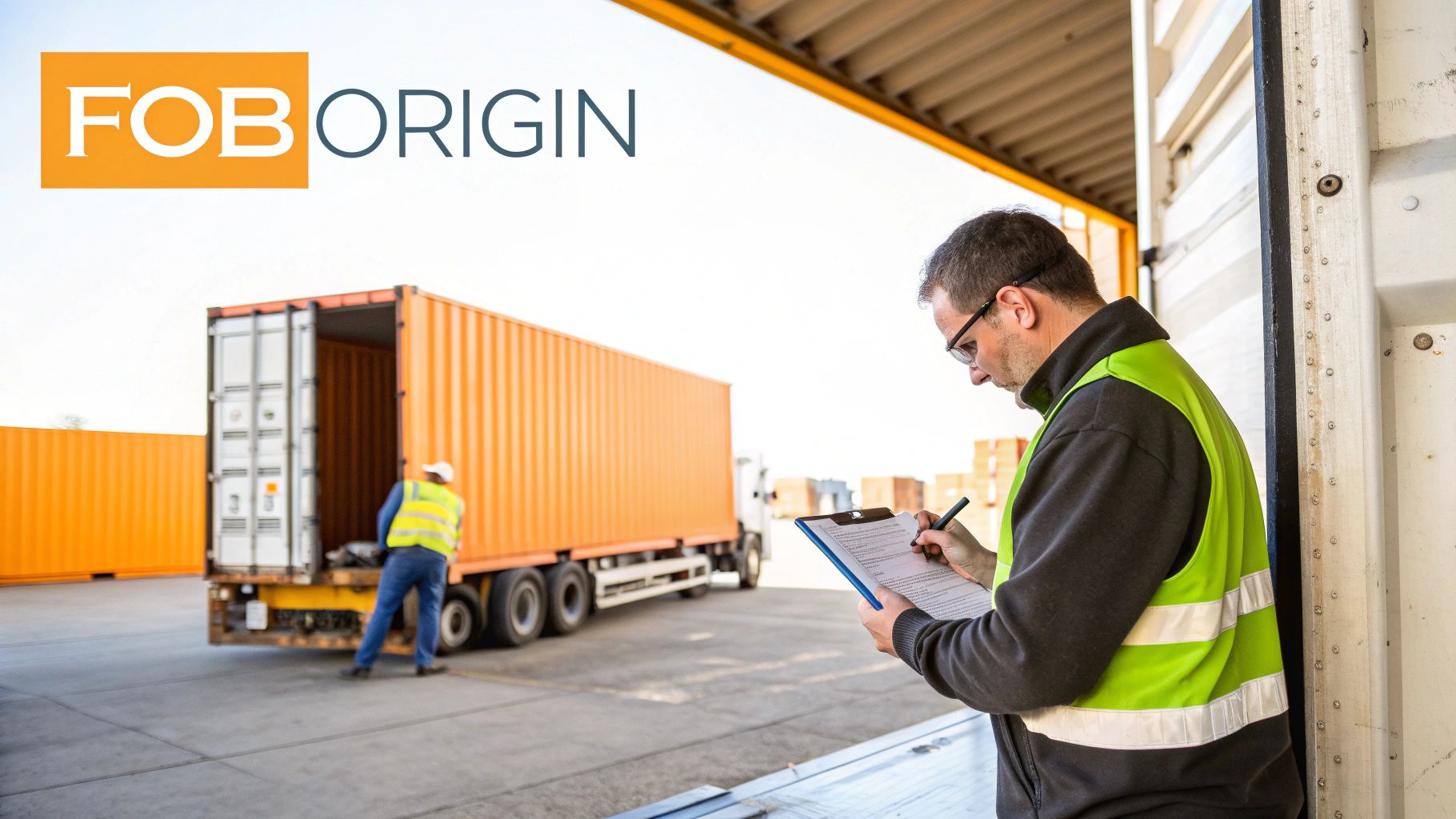
Man in high-visibility vest checks clipboard at a shipping yard with containers and trucks.

When you opt for FOB Origin, you're essentially grabbing the steering wheel for your international freight. Under this agreement, the handoff happens early and decisively. The moment your goods are loaded onto the ship at the origin port—let’s say in Shanghai—the ownership and risk become yours.

That means you’re in charge of the main leg of the journey. You’re the one paying for the ocean freight, arranging the cargo insurance, and dealing with any hiccups that might pop up during transit. While it sounds like a lot of responsibility, it comes with one massive advantage: control.

Because you're footing the freight bill, you get to choose your own carriers and freight forwarders. This gives you the power to shop around and negotiate rates directly, often uncovering much better deals than your supplier could offer. For experienced importers, this is where the real savings are found.

Seizing the Financial Advantage

The financial upside of choosing FOB Origin is a big deal. In today’s $18 trillion global trade arena, there's a reason this term is so popular. In fact, FOB Origin is used in over 60% of export contracts from major hubs like China, shifting the risk to the buyer as soon as the goods are on the vessel.

For an Amazon FBA seller, this control isn’t just about peace of mind—it’s about the bottom line. It can slash your landed costs by 15-20% compared to other arrangements where the seller bundles shipping. You can find more insights on these trade dynamics at Stonex.com.

Key Takeaway: FOB Origin is the go-to choice for importers who want to actively manage their supply chain, hand-pick their logistics partners, and keep their shipping expenses in check.

The Role of Your 3PL Partner

This is exactly where a savvy third-party logistics (3PL) partner becomes your most valuable player. Just because your FOB Origin container arrives at the port doesn't mean the work is done. A specialized 3PL like Snappycrate takes over from here, managing all the complex steps that follow.

Our team handles:

  • Container Receiving: We coordinate the drayage to get your container from the port to our warehouse, no hassle.
  • Pallet Breakdowns: We get your container unloaded fast and sort your inventory with precision.
  • FBA Prep: We make sure every single item meets Amazon's tough compliance rules, from FNSKU labeling to bundling and bagging.

By taking on these critical inbound tasks, we bridge the gap between your container's arrival and its readiness for sale. You get all the cost-saving benefits of FOB Origin without any of the logistical headaches.

The Simplicity of FOB Destination

If FOB Origin is all about taking the reins, then FOB Destination is the "set it and forget it" option. This agreement completely flips the script. The seller keeps full ownership, risk, and responsibility for your products until they are safely delivered to your specified location—whether that’s your warehouse or a 3PL partner like us.

Think of it as the door-to-door service of Incoterms. The seller handles everything: booking the ocean freight, dealing with customs, and managing the insurance. You're pretty much hands-off until the truck pulls up to your loading dock. For buyers who want to sidestep the headaches of international shipping, this is often the perfect fit.

Weighing Convenience Against Cost

The biggest win with FOB Destination is the massive reduction in your operational workload. You don’t have to hunt for freight forwarders, haggle over shipping rates, or chase down insurance claims if something gets damaged on the way. But, of course, that convenience comes at a price.

Sellers simply bake all those shipping, insurance, and handling fees right into your product cost. This usually means your per-unit price will be higher than it would be with an FOB Origin agreement.

FOB Destination is used in about 35% of U.S.-centric deals. It’s a popular choice for e-commerce importers who would rather not deal with transit issues, since sellers under this term handle most of the insurance claims. You can dig into more of these shipping trends in the research from Inbound Logistics.

How a 3PL Handles FOB Destination Deliveries

Even with a simpler shipping term, a smooth handoff is critical once the goods finally arrive. A good 3PL partner has battle-tested receiving workflows ready to handle FOB Destination deliveries of any size, from a few boxes to a full truckload.

This ensures your products move seamlessly from the carrier's truck into your inventory system. The moment we accept the delivery, our team can immediately get to work:

  • Inspecting goods for accuracy and any signs of damage.
  • Updating your inventory levels in real-time so you know exactly what you have.
  • Getting products prepped for storage or immediate order fulfillment.

This kind of efficiency means that even though you weren’t managing the freight, your products get into your supply chain without missing a beat, ready to ship out to your customers.

Comparing FOB Origin vs FOB Destination

Choosing between FOB Origin and FOB Destination really just boils down to one simple question: who do you want in the driver’s seat for the main leg of the shipping journey? Each term hands over control, cost, and risk to a different party, making the choice a strategic one for your business.

For a new e-commerce brand just getting started, the hands-off nature of FOB Destination is often a lifesaver. Your supplier manages all the logistics until the goods show up at your warehouse, which keeps your supply chain simple and cuts down your risk while everything is in transit. Sure, this convenience usually means a higher per-unit cost, but it removes a ton of operational headaches.

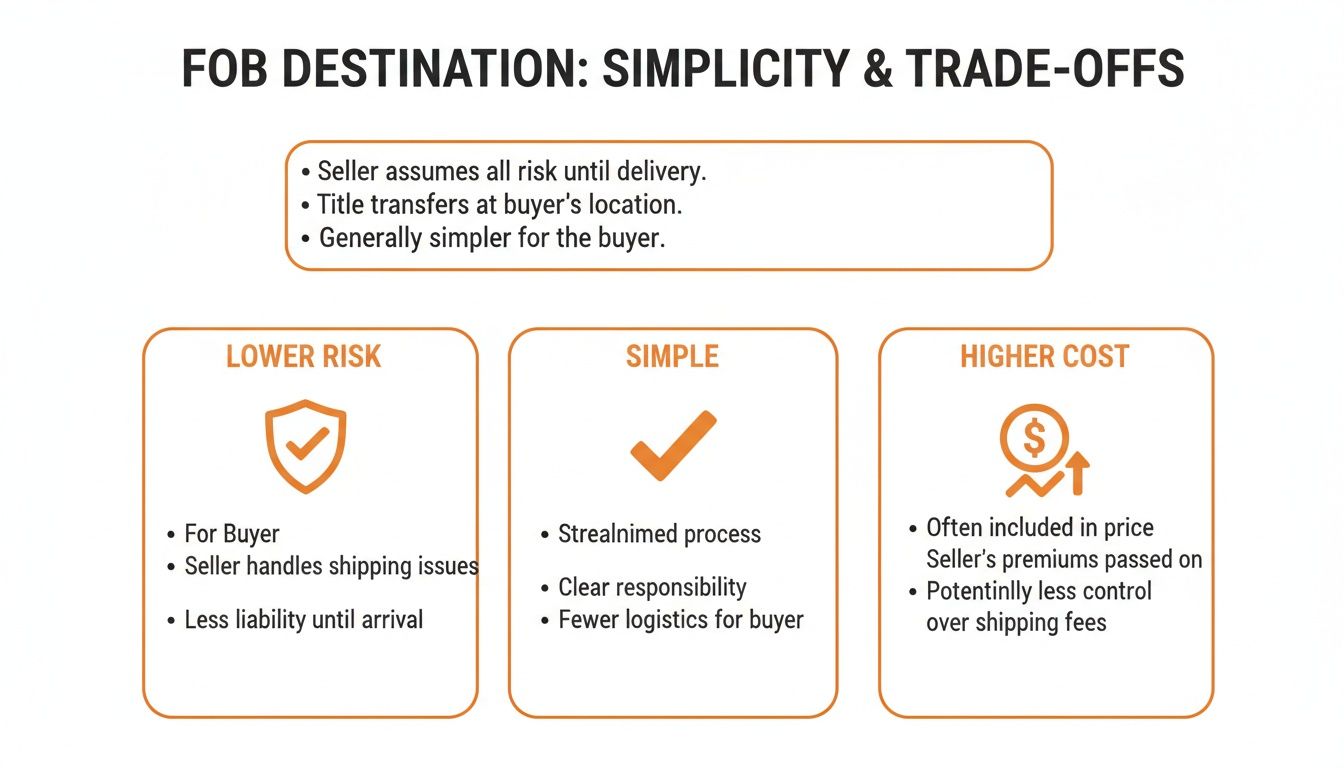
This diagram breaks down exactly why FOB Destination is so appealing for buyers who prioritize simplicity.

Diagram explaining FOB Destination shipping terms, detailing lower risk and simplicity for buyers, with higher costs.

As you can see, the trade-off is pretty clear: you accept a higher product cost in exchange for taking on way less risk and complexity.

Detailed Breakdown FOB Origin vs FOB Destination

On the flip side, an experienced operations manager might lean toward FOB Origin to get full control over the process and squeeze out some cost savings. By managing the freight themselves, they can shop around for better rates and pick their favorite carriers, which directly impacts their final landed cost.

Let's put them side-by-side to see how they really differ.

Factor FOB Origin FOB Destination
Ownership Transfer The buyer takes ownership right at the seller's shipping dock. The buyer takes ownership when the goods arrive at their door.
Who Pays Freight? The buyer pays for the main transport from the origin port. The seller pays for all transport to the final destination.
Risk During Transit The buyer is on the hook for any risk once goods are loaded. The seller keeps all the risk until the goods are delivered.
Logistics Control The buyer gets to pick the carrier and manage the freight. The seller controls all logistics and carrier choices.

Getting these distinctions right is crucial. For instance, with FOB Origin, the buyer is responsible for what's known as collect freight—a term that just defines who pays the shipping bill. You can learn more about the specifics of collect freight definitions in our guide.

At the end of the day, the right FOB term comes down to your company's logistics know-how, how much risk you're willing to take on, and your overall cost-saving goals.

Choosing the Right FOB Term for Your Business

When it comes to picking the right FOB term, there’s no single "correct" answer. It’s all about matching the agreement to your company's logistics muscle, budget, and how much risk you're willing to take on. For Amazon sellers and e-commerce brands, this decision directly hits your landed costs and how much work lands on your plate.

The choice really boils down to a few honest questions. How much control do you really need over your supply chain? Are you set up to handle customs, import paperwork, and freight forwarding? And the big one: how much sleep will you lose if a container goes missing mid-ocean? Answering these will point you in the right direction.

Aligning FOB Terms with Your Business Stage

Seasoned, high-volume importers almost always lean toward FOB Origin. They’ve been around the block, have solid relationships with freight forwarders, and can use their shipping volume to get much better rates than their supplier ever could. Taking a hands-on approach gives them huge cost savings and total control over which carriers they use and when their products ship. They're ready for the risks because the financial payoff is more than worth it.

On the other hand, newer businesses—or those that just want to focus on marketing and selling products—often find FOB Destination to be a lifesaver. Its biggest selling point is simplicity. You let the seller deal with all the shipping headaches and insurance, and in return, you get a predictable, all-in cost per unit, even if it's a little higher.

Strategic Insight: Your choice of FOB term isn't set in stone. A startup might kick things off with FOB Destination for its simplicity, then switch to FOB Origin once they scale up and get more confident in how to build an efficient supply chain for ecommerce growth.

No matter which path you choose, a strategic 3PL partner is your secret weapon. A good 3PL can just as easily manage the complex process of receiving a full container under FOB Origin as they can handle a standard freight delivery under FOB Destination. They make sure the handoff is smooth, every single time.

Ready to Master Your Inbound Freight? A 3PL Can Help.

Two logistics workers in safety vests loading boxes into a shipping container or truck.

Knowing what FOB stands for in shipping is a great first step, but putting it into practice is what really moves the needle for your business. Deciding between FOB Origin and FOB Destination is a critical choice that determines who’s on the hook for risk, cost, and control.

But here’s the thing: the journey is far from over once your inventory hits the port or your warehouse dock.

This is where a solid third-party logistics (3PL) partner changes the game, turning your inbound strategy from a headache into a real competitive edge. Your products still need to be unloaded, checked for accuracy, prepped for sale, and stored correctly. Trying to juggle all that in-house eats up time and money better spent on marketing and growing your brand.

A specialized 3PL takes over the moment your goods arrive, no matter which FOB term you agreed to. We're the essential link that gets your products from the shipping container to a customer-ready state.

From Dock to Customer Without the Headaches

Whether your inventory shows up in a 40-foot container or on a truck, a 3PL provides the hands-on services that keep your supply chain from grinding to a halt. This is especially true for e-commerce sellers trying to keep up with marketplace rules and demanding customer expectations.

Here’s what a 3PL handles for you:

  • Container Unloading: We get your containers devanned efficiently so your inventory can start getting processed right away.
  • Amazon FBA Prep: We make sure every single item meets Amazon's strict rules for labeling, bagging, and bundling to avoid costly rejections.
  • Multi-Channel Fulfillment: We pick, pack, and ship orders accurately across all your sales channels, from Shopify to Walmart.

By handing off these critical tasks, you can stop worrying about day-to-day warehouse operations and get back to thinking about the big picture. You can dive deeper into how this works in our guide on what a 3PL warehouse is.

When you partner with an expert team, you can trust your inbound freight is handled with the precision it needs. It sets you up for scalable success and lets you get back to what you do best—building your business.

Common FOB Questions Answered

Now that we’ve walked through what FOB means for your shipments, let’s tackle a few of the most common questions that pop up for e-commerce sellers and importers.

Does FOB Apply to Air Freight?

Officially? No. The rulebook for Incoterms says FOB is strictly for sea and inland waterway transport. If your goods are flying, the technically correct term is FCA (Free Carrier).

But let's be realistic—in the real world, you'll often hear people use "FOB" for domestic truck shipments. The key takeaway is to always have a crystal-clear agreement that spells out exactly when and where the responsibility shifts from seller to buyer. Don't let industry slang create expensive confusion.

Who Files an Insurance Claim Under FOB Origin?

If you're using FOB Origin, the risk becomes yours the second those goods are safely on the ship. That means if a container gets dropped, damaged by a storm, or goes missing in transit, the buyer is responsible for filing the claim.

This is exactly why having your own robust cargo insurance isn't just a good idea—it's an absolute must. You can't rely on the seller's policy to protect your investment once it leaves their hands.

How Does My FOB Choice Affect Landed Cost?

Your choice between FOB Origin and FOB Destination has a direct and immediate impact on your product's final cost.

With FOB Origin, the price on your supplier's invoice looks lower. But don't be fooled—you then have to manually add all the costs for ocean freight, insurance, and customs duties to figure out your true landed cost.

On the other hand, FOB Destination seems simpler because the seller bundles those transport costs into their higher invoice price. While it requires less legwork, FOB Origin often gives you the control to shop around for better freight rates, which can seriously lower your overall expenses in the long run.


Ready to streamline your inbound logistics, no matter which FOB term you choose? Snappycrate specializes in container receiving, FBA prep, and multi-channel fulfillment to help your business scale smoothly. Learn how we can simplify your supply chain at https://www.snappycrate.com.

0 Continue Reading →