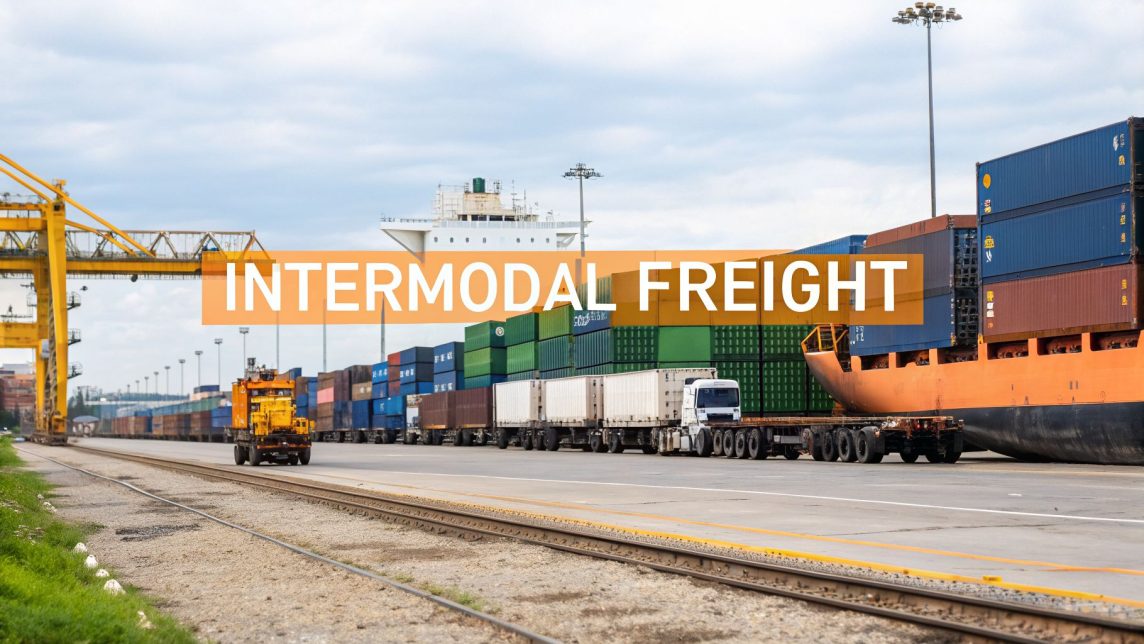

Intermodal freight is all about moving goods in a single shipping container using multiple modes of transportation—like a ship, a train, and then a truck—without ever having to unpack and repack the cargo inside.
Think of it as a long-distance relay race for your products. The cargo is the baton, and it gets passed seamlessly between different runners (transport modes) to reach the finish line efficiently and affordably.
Understanding Intermodal Freight Basics
Let's say you're importing a container of inventory from a factory in Asia to your fulfillment center in the Midwest. Using a single truck for that entire journey would be wildly impractical and incredibly expensive.
This is where intermodal freight shines. It breaks the trip down into specialized, logical legs. The whole system is built around one simple but powerful idea: use the best, most efficient mode of transport for each part of the journey.
The star of the show is the standardized shipping container. Your goods get loaded into it once at the factory, and they aren't touched again until they arrive at your door. This universal "box" is designed to fit perfectly on a cargo ship, a rail car, or a truck chassis, which is what makes those smooth handoffs possible.
The Intermodal Relay Race
To really get a feel for how it works, let's go back to that relay race analogy. Each leg of your cargo's journey is handled by a specialist:
- The Sprinter (Truck): A truck handles the first leg in a process called drayage. It picks up your full container from the factory and makes a quick dash to a nearby port or rail yard.
- The Marathon Runner (Ship or Train): For the long haul, the container is loaded onto a massive cargo ship or a long-distance train. These are the marathon runners, built for covering huge distances with incredible cost and fuel efficiency.
- The Finisher (Truck): Once the container arrives at the destination port or rail terminal on the other side, another truck takes the final handoff, delivering it right to your warehouse or fulfillment center.
This system is the quiet engine powering global trade. Without it, the cost and complexity of moving products across countries and continents would be astronomical. It allows shippers like you to tap into the unique strengths of each transportation mode—the flexibility of trucks for short distances and the raw efficiency of rail and ocean for the long stretches. This is a key component of the broader network of inter state transport that keeps commerce moving.
To give you a clearer picture, here’s a quick breakdown of the core components.
Intermodal Freight At a Glance
| Component | Role in the Process | Primary Benefit |
|---|---|---|
| Container | The standardized box holding the cargo. It's the "baton" in the relay race. | Security & Efficiency: Keeps goods sealed and secure, eliminating repacking. |
| Drayage | Short-haul truck moves from origin-to-port/rail and from port/rail-to-destination. | Flexibility: Bridges the "first and last mile" gaps between facilities. |
| Rail/Ocean | The long-haul "marathon" portion of the journey via train or ship. | Cost-Effectiveness: The cheapest way to move heavy goods over long distances. |
| Chassis | The wheeled frame a container sits on when being pulled by a truck. | Mobility: Makes it possible for a standard truck to haul a shipping container. |
This table shows how each piece of the puzzle fits together to create a seamless, end-to-end journey for your goods.
The magic of intermodal is that the container, not the cargo, is what gets moved between vehicles. This dramatically reduces handling, which in turn lowers the risk of product damage, loss, and theft while speeding up the entire logistics process.
By combining these modes, you get a reliable and budget-friendly solution for moving inventory around the world. To get even more familiar with shipping terminology, you can also check out our guide on the collect freight definition.
Mapping Your Product's Intermodal Journey
Knowing the definition of intermodal freight is one thing, but seeing it in action is where it really clicks. To truly understand its power, let's follow one of your containers on its complete trip—from the factory floor in another country all the way to your fulfillment center's receiving dock.
This isn't just a single voyage; it's a carefully choreographed relay race, with your products being passed between different logistics specialists at each leg. By visualizing every step, you'll be much better equipped to anticipate lead times, spot potential bottlenecks, and plan your inventory with confidence.
This flow chart breaks down the typical journey, showing the key handoffs between trucks, ships, and trains.

As you can see, your cargo stays locked safe inside its container the entire time. Only the mode of transport changes, creating a secure and surprisingly efficient path across the globe.
Stage 1: The First-Mile Drayage
The journey doesn't start at a port or a rail yard—it begins at your supplier's factory. As soon as your goods are manufactured and packed, they're loaded into a standard shipping container. This is where the clock on the "first mile" officially starts ticking.
A specialized trucking company handles the initial drayage, which is just a fancy term for the short truck trip from the factory to the nearest ocean port or rail terminal. This first step is absolutely critical. Any delays here, whether from truck shortages or the factory not being ready, can create a domino effect that messes up the entire timeline.
Stage 2: The Ocean Voyage
With the container dropped off at the port, massive cranes swing into action, lifting it from the truck’s chassis and onto a colossal cargo ship. For international shipments, this is the long-haul portion where your products might spend weeks crossing the ocean.
During this stage, your visibility is often limited to key updates like "vessel departed" and "estimated arrival." Weather, congestion at other ports along the route, and shifting sailing schedules are the main things that can throw off the timing. A single day's delay at sea can disrupt your receiving plans weeks down the line.
It's essential to remember that a vessel's estimated time of arrival (ETA) is just that—an estimate. Port congestion, random customs inspections, and weather can all push that date back. Flexible receiving plans are a must for any importer.
Stage 3: Port Operations and Customs
Once the ship finally docks, the next set of handoffs begins. Your container is unloaded by another giant crane and moved to a staging area in the terminal. This is where it has to clear customs.
For e-commerce sellers, this is a huge checkpoint. Simple mistakes like incorrect paperwork, misclassifying your products, or just bad luck with a random inspection can leave your container sitting in port for days—or even weeks. All the while, you’ll be racking up expensive demurrage fees for taking up space past the free time allowed.
Stage 4: The Cross-Country Rail Segment
After clearing customs, your container is ready for its next long leg. If your fulfillment center is located far from the coast, the container is lifted onto a train for the cross-country rail segment. This is where domestic intermodal really shines.
Rail is far more fuel-efficient and cost-effective for long distances than trucking. Think about it: a single train can haul hundreds of containers at once, which means fewer trucks on the road and a massive reduction in carbon emissions. The biggest risk here is potential delays at crowded rail terminals where containers get transferred.
Stage 5: The Last-Mile Drayage
Finally, the train pulls into an intermodal terminal near your destination city. Here, your container is lifted off the rail car and placed onto another truck chassis for the "last-mile" drayage.
This final truck trip brings the container directly to your 3PL or fulfillment center. Coordination is everything at this stage. Your receiving facility needs to be ready to unload the container quickly, so the driver can get the empty container and chassis back to the terminal without you getting hit with detention fees for holding onto the equipment too long.
The Essential Equipment Driving Intermodal Logistics
The whole magic of moving your products across oceans and continents comes down to a surprisingly simple set of standardized tools. While the logistics feel complex, the physical hardware is the real hero, making sure every handoff between trucks, trains, and ships is as smooth as possible. Getting a handle on this equipment is the key to understanding how intermodal freight actually works.

At the center of it all is the humble shipping container. Don't let its simple appearance fool you. This isn't just any box—it's a mobile vault, a standardized steel unit built to take a beating on its journey around the world. Its uniformity is its greatest strength, letting it be handled by the same equipment no matter where it lands.
The Standardized Shipping Container
The simple idea of using one uniform container is what makes the whole system work. These containers come in a few standard sizes, each built for different types of cargo.
- 20-Foot Container: The smallest common size. It’s perfect for dense, heavy cargo that would hit weight limits in a larger container before you could even fill it up.
- 40-Foot Container: This is the real workhorse of global trade. It offers a great balance of space and weight capacity for just about anything you can think of.
- 45-Foot High Cube (HC) Container: These give you an extra foot of height compared to standard containers, making them ideal for maximizing space with lighter, bulkier products.
This standardization is a game-changer. It means a crane in Shanghai uses the exact same connection points as one in Los Angeles. That same container will then lock perfectly onto a railcar in Chicago or a truck chassis in Dallas. This "plug-and-play" design is the secret sauce behind intermodal's efficiency.
It’s also a major reason why the global intermodal freight market, valued at USD 136.7 billion in 2025, is on track to hit USD 283.4 billion by 2034. As the market keeps growing, knowing the equipment becomes even more vital. You can find more details in this report about the growing intermodal freight market from Fortune Business Insights.
The magic of the container is that it separates your goods from the mode of transport. Your product stays sealed inside, safe from damage and theft, while the box itself gets lifted, loaded, and moved. This slashes handling time and gets your inventory moving faster.
The Chassis: The Container's Wheels
A container by itself is just a box. To get it on the road, it needs a chassis. Think of a chassis as a bare-bones trailer—it's a steel frame with wheels and a locking mechanism that secures the container, turning it into a standard semi-trailer.
Drayage drivers hook their tractors up to these chassis to handle those critical first- and last-mile moves from the port or rail yard. A quick heads-up: the availability of chassis at these terminals can make or break your timeline. A chassis shortage can bring your shipment to a screeching halt.
The Cranes: The Heavy Lifters
The final pieces of the puzzle are the massive cranes that do all the "lifts" at ports and rail terminals. These giants are responsible for moving containers between ships, trains, and trucks with incredible precision.
You'll see a few different types, each with a specific job:
- Ship-to-Shore (STS) Cranes: These are the biggest ones you'll see at seaports, built to load and unload containers from enormous cargo vessels.
- Rubber-Tired Gantry (RTG) Cranes: These are more mobile and buzz around the terminal yard, stacking containers and loading them onto trucks or railcars.
- Rail-Mounted Gantry (RMG) Cranes: These run on fixed tracks and are used to shuttle containers between trains and trucks at intermodal rail yards.
This trio—the container, the chassis, and the crane—forms a powerful system that keeps global trade flowing. By knowing these basics, you’ll be able to have much more productive conversations with your logistics partners. Speaking of partners, you might also want to learn about why you need a 3PL partner to help manage all of this for you.
Intermodal vs. Multimodal vs. Truckload Decoded
Choosing the right way to move your freight can feel overwhelming, especially when terms like intermodal, multimodal, and truckload get thrown around. They all get your products from Point A to Point B, but how they do it—and the impact on your bottom line—is fundamentally different.
Picking the wrong one can lead to higher costs, communication headaches, and unexpected delays that mess up your inventory planning.
Think of it like planning a cross-country trip. You could drive yourself (truckload), book each flight and taxi separately (intermodal), or hire a travel agent to handle the entire door-to-door itinerary for you (multimodal). Each one comes with a different level of control, cost, and convenience.
The Core Difference: Contracts and Communication
The biggest distinction between intermodal and multimodal shipping really boils down to one thing: how the whole journey is managed. This single factor dictates everything from billing and liability to how you track your shipment’s progress.
With intermodal shipping, you’re in the driver's seat. You (or your 3PL partner) will arrange separate contracts with each carrier along the way. That means one contract for the drayage truck at the start, another for the railroad, and a third for the final drayage company at the destination.
This approach gives you more direct control to negotiate rates for each leg, which can lead to significant cost savings. The trade-off? It’s more administrative work, since you'll be juggling multiple bills of lading, tracking numbers, and points of contact.
On the other hand, multimodal shipping simplifies everything by operating under a single contract. You work with just one logistics provider who orchestrates the entire journey from start to finish. They take full responsibility for coordinating all the carriers, giving you one bill, one tracking number, and a single person to call.
Shipping Mode Comparison: Intermodal vs. Multimodal vs. Truckload
Understanding these nuances is key to making a smart logistics decision. Full truckload (often called Over-the-Road or OTR) shipping is the most straightforward option, so it’s a great baseline for comparison. It’s exactly what it sounds like: one truck picks up your cargo and drives it directly to the destination.
To help you visualize the differences, we’ve put together a head-to-head comparison of the three primary freight shipping methods. This should make it easier to see which one fits your business needs.
| Feature | Intermodal | Multimodal | Full Truckload (OTR) |
|---|---|---|---|
| Contracts | Multiple contracts; one for each carrier. | A single contract with one provider. | A single contract with one carrier. |
| Liability | Shifts between carriers on each leg. | Rests with the single multimodal operator. | Rests with the single trucking company. |
| Communication | Multiple points of contact. | One central point of contact. | One point of contact. |
| Cost | Often the most cost-effective for long hauls. | Can be higher due to management fees. | Competitive for short-to-medium distances. |
| Flexibility | Less flexible once in transit on rail. | More flexible, but managed by one provider. | Highly flexible for route/schedule changes. |
Ultimately, the choice comes down to a trade-off between control and convenience. Intermodal offers cost control at the expense of complexity, while multimodal provides simplicity for a potential premium. Truckload delivers speed and flexibility but is often the priciest option for long-distance hauls.
When to Choose Each Method
Your ideal choice really depends on your shipment's distance, urgency, and how much time your team has to manage logistics.
- Choose Full Truckload for: High-value or time-sensitive shipments, shorter distances (under 750 miles), and any situation where you might need to change plans mid-route.
- Choose Intermodal for: Cost-sensitive, non-urgent shipments traveling long distances (over 750 miles). It's the go-to for predictable, high-volume freight where you can plan ahead to lock in savings.
- Choose Multimodal for: Complex international shipments or if you just don’t have the internal team to manage multiple carriers. It's perfect when you need a single point of accountability for the entire door-to-door process.
E-commerce's relentless demand for speed and volume has put intermodal freight on the fast track. The market is projected to soar from $58.85 billion in 2024 to $118.55 billion by 2029, showing just how critical it's become.
This boom is tied directly to surging global trade and volatile fuel costs that make intermodal’s efficiency incredibly attractive. You can read more about these market trends to see how they might shape your logistics strategy.
Weighing the Pros and Cons of Intermodal Shipping
Intermodal shipping isn't a silver bullet for every logistics headache. While it offers some powerful advantages, you have to understand the trade-offs to know if it’s the right fit for your e-commerce supply chain. This balanced perspective will help you decide exactly when to play the intermodal card.
The biggest win is almost always cost savings, especially on those long-haul routes. For shipments traveling over 750 miles, intermodal can be dramatically cheaper than putting a truck on the road for the whole journey. By moving the bulk of the distance by rail—which is incredibly fuel-efficient—you can often slash your freight spend. For businesses running on tight margins, those savings are a game-changer.
On top of the direct cost benefits, intermodal freight is a key piece of the puzzle for achieving overall logistics shipping efficiency in your supply chain.
The Major Advantages of Intermodal
Beyond just saving a buck, intermodal shipping brings other strategic benefits to the table that are especially valuable for growing e-commerce brands.
- Lower Carbon Footprint: Sustainability isn't just a buzzword anymore. Moving goods by rail can cut greenhouse gas emissions by up to 75% compared to long-haul trucking, helping your brand hit its environmental targets.
- Enhanced Cargo Security: Think about it: your products stay sealed in a single container from the start of their journey to the end. This means far less handling, which dramatically cuts down the risk of damage, loss, or theft along the way.
- Scalable Capacity: During peak season or when the trucking market gets tight, the rail network offers a reliable and massive alternative. This access to consistent capacity helps you avoid bottlenecks and keeps your inventory flowing smoothly.
This mix of cost, security, and green benefits is driving huge growth. The whole revolution started when containerization slashed loading times by over 90%, and today the market is projected to rocket from US$51.6 billion in 2023 to US$155.9 billion by 2031. For brands that need predictable, steady operations, this is a powerful tool to have.
Understanding the Limitations and Trade-Offs
But let's be real—intermodal freight comes with its own set of limitations that you have to plan for. The most significant trade-off is longer transit times.
Plan on adding at least one to two extra days to your shipping schedule compared to direct trucking. The time it takes to lift containers on and off trains at terminals adds up on both ends of the trip.
This slower pace makes intermodal a poor choice for urgent or time-sensitive shipments. You also give up quite a bit of flexibility. Once a container is on that train, trying to reroute it or change its destination is a massive, expensive headache.
You also have to contend with potential delays at busy rail terminals or ports. Congestion, equipment shortages (like not enough chassis to go around), or labor issues can cause backlogs that leave your container sitting idle. This can lead to unexpected fees and completely disrupt your inventory flow.
Ultimately, the decision comes down to balancing cost against speed and flexibility. When you have predictable lead times and you're shipping high volumes over long distances, the advantages are tough to ignore. For even more strategies, check out our guide on how to reduce shipping costs for your business.
Your Checklist for a Smooth Intermodal Shipment

Getting intermodal freight right is about more than just picking the right carrier. It’s all about meticulous prep work. One small oversight can snowball into damaged products, customs holds, and unexpected fees that demolish your profit margins. For any e-commerce seller, a hiccup-free receiving process is absolutely critical to keeping your products in stock and available for sale.
This isn’t just a list of suggestions; it’s an actionable checklist to help you nail the prep phase every single time. By getting these steps right before your container is even loaded, you can transform a complex logistics move into a smooth, predictable part of your supply chain.
Before the Container Is Loaded
So many of the most common—and most expensive—mistakes happen before those container doors are sealed shut. Nail this stage, and you've already won half the battle against damaged goods and regulatory nightmares.
Block and Brace Your Cargo: Remember, that container is going on a wild ride. It'll be lifted by massive cranes, rocked around on a container ship, and jostled for hundreds of miles on a train. Your supplier must use proper blocking and bracing—think lumber, dunnage air bags, or heavy-duty straps—to keep your cargo from shifting. Unsecured pallets can easily topple over, leaving you with thousands of dollars in inventory you can't sell.
Verify Weight Distribution: This is a big one. The total weight of your cargo has to be spread evenly across the container floor. An imbalanced load, with all the weight piled at one end, isn't just a minor issue—it's a serious safety violation. It can get your container rejected by the railroad or hit you with hefty fines. Always confirm your supplier is following proper loading patterns.
Confirm the Pallet Count and Dimensions: Don't leave your fulfillment partner guessing. Give your 3PL an exact pallet count along with the dimensions of each pallet. This isn't just busywork; it's how they plan the entire receiving process. It tells them how much warehouse space to allocate and how many team members they'll need to unload your container quickly and efficiently.
A detailed packing list isn’t just a piece of paper; it’s a critical tool for your fulfillment partner. It should specify the number of cartons per pallet and the number of units per carton, allowing for a swift and accurate inventory check-in upon arrival.
Coordinating with Your Logistics Partners
Think of clear communication and perfect documentation as the glue holding your entire shipment together. Even a perfectly packed container can get stuck in limbo without them.
First off, your paperwork has to be flawless. The Bill of Lading (BOL) needs to be 100% accurate—correct addresses, phone numbers, and a precise description of what's inside. Any little discrepancy can flag your shipment for a customs inspection, leading to major delays and surprise fees.
Finally, you need to get in sync with your fulfillment center or 3PL long before the container arrives. Give them the container number, the ship's estimated time of arrival (ETA), and the final delivery appointment as soon as you have them. This simple, proactive communication gives them the heads-up they need to schedule a receiving slot and get their team ready. A 3PL that's in the loop can get your container unloaded fast, helping you dodge expensive detention fees and, most importantly, getting your products on the shelf and ready to sell.
Common Questions About Intermodal Freight
If you’re new to intermodal freight, you probably have some questions. It's a different beast than standard trucking, and as an e-commerce seller, you need straight answers to figure out if it's the right move for your supply chain. Let’s tackle some of the most common things we get asked by sellers just like you.
When Does Intermodal Make Financial Sense?
The golden rule for intermodal is distance. It almost always becomes cheaper than a standard over-the-road (OTR) truck once your shipment needs to travel more than 750 miles.
For short hauls, the extra steps and fees—like drayage to and from the rail yards and terminal handling—wipe out any savings. But for those long, cross-country runs, the efficiency of rail really kicks in, often saving you between 10% and 25% compared to a direct truck.
How Does Intermodal Transit Time Compare?
When you opt for intermodal, you're making a trade: you get those cost savings in exchange for a little more time. As a general rule of thumb, you should plan on adding one to two extra days to your total transit time versus a direct truck.
The train itself moves pretty efficiently, but the extra time comes from the handoffs. The process of lifting your container from a truck chassis onto the train, and then doing it all in reverse at the destination, is what adds to the clock.
Think of it as a strategic trade-off. By accepting a slightly longer journey, you unlock lower shipping costs and a more sustainable way to move your inventory across the country. The key is simply planning for that extra transit time.
What Is the Difference Between Drayage and Trucking?
While drayage definitely involves a truck, it's a very specific, specialized service. Drayage refers only to the short-distance haul of a shipping container, usually between a port, rail terminal, and a local warehouse—all within the same metro area.
"Trucking," on the other hand, is a much broader term. It can mean anything from a full truckload (FTL) shipment going thousands of miles to a smaller less-than-truckload (LTL) delivery. Drayage is all about that first and last mile of an intermodal journey and requires tight coordination with port and rail schedules.
Can I Track My Intermodal Shipment?
Absolutely. You can definitely track an intermodal shipment, but it feels a bit different than tracking a single truck that’s on the road from start to finish. Because your container is handed off between multiple carriers (the drayage company and the railroad), you might have to check different systems to get the full story.
The good news is that most modern logistics providers and 3PLs solve this for you with integrated tracking portals. These platforms pull all the data into one place, giving you end-to-end visibility. You can see when your container is on a truck, sitting at a terminal, moving on the rail, and out for final delivery—all in a single dashboard.
Managing the complexities of inbound container receiving and fulfillment is where Snappycrate excels. We handle the entire process, from coordinating drayage to efficiently unloading and processing your inventory, so you can focus on growing your business. Find out how our expert 3PL services can streamline your supply chain at https://www.snappycrate.com.