Skip to Content

Blog Archives

Mastering Warehousing Operations Management for E-commerce Growth

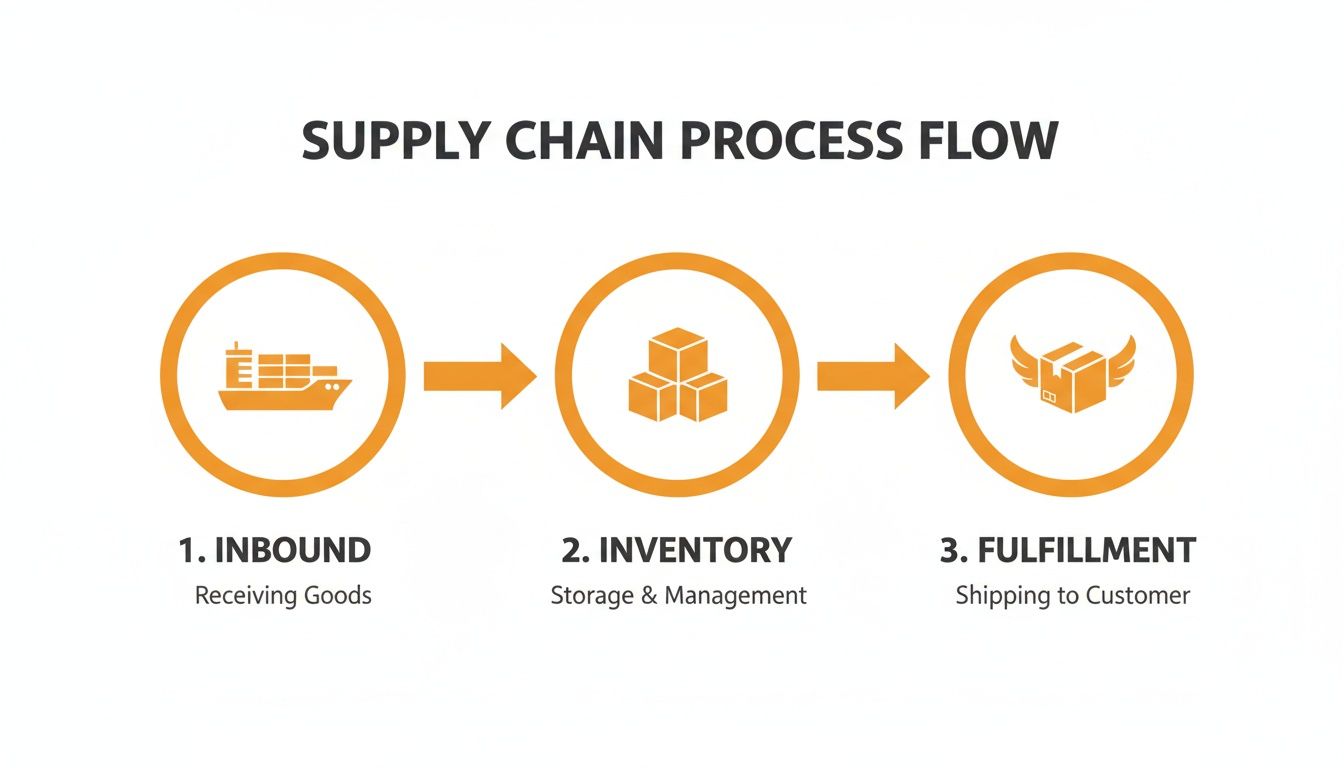
So, what exactly is warehousing operations management? At its core, it’s everything that happens to your inventory from the moment it hits the receiving dock until it's in a box and on its way to a customer.

For any e-commerce brand, getting this right is the secret to keeping costs down and customers happy. It’s the behind-the-scenes work that makes or breaks your business.

The Engine Room of Your E-commerce Business

It’s tempting to see your warehouse as just a big, expensive box for storing products. That’s a huge mistake. Think of it as the engine of your entire e-commerce operation. When that engine is humming, it’s turning your inventory into sales and satisfied customers.

A well-tuned engine relies on several parts firing in perfect sequence. A warehouse is no different. A bottleneck in one area can cause the whole system to sputter.

Your warehouse engine has five core "cylinders" that must work in harmony:

  • Receiving: Unloading and checking in new inventory accurately.
  • Storage (Put-away): Placing products in smart locations for quick and easy retrieval.
  • Picking: Pulling the right items from shelves to fulfill an order.
  • Packing: Boxing up orders securely and cost-effectively.
  • Shipping: Getting packages out the door and into the hands of the right carrier.

From Cost Center to Competitive Edge

Changing your view of the warehouse—from a static cost center to a dynamic operational hub—is a game-changer. Each of those five processes is a chance to get faster, leaner, and more accurate. To truly make your warehouse the "engine room" of your business, you have to constantly look for ways to improve operational efficiency.

For brands trying to scale on Amazon, Shopify, or Walmart, this isn't just a "nice-to-have." It's an absolute necessity for survival.

A well-run warehouse is more than just efficient; it’s a decisive competitive advantage. It allows you to promise faster delivery times, maintain higher inventory accuracy, and absorb demand spikes without failing—all of which build powerful brand loyalty.

Ultimately, mastering these operations gives you direct control over what happens after a customer clicks "buy." Understanding the details of packaging and warehousing can be the single biggest difference-maker for your bottom line.

Decoding the Five Core Warehouse Processes

Think of your warehouse like a professional kitchen during the dinner rush. Every station has a job, and the whole operation depends on how smoothly things move from raw ingredients to a finished plate. One mistake—a dropped ticket or a wrong ingredient—and the entire service grinds to a halt.

Your warehouse is no different. The journey your product takes from the delivery truck to a customer's doorstep is a carefully choreographed dance. Getting a grip on this flow is the first real step to making your fulfillment faster, more accurate, and more profitable.

This five-step flow is the engine of your entire e-commerce business.

E-commerce growth process flow diagram with steps: Product, Warehouse, and Customer.

As you can see, the warehouse is where a product officially becomes an order. It's the critical link between your inventory and your customer. Let's break down the five core processes that make it all happen.

The Five Core Warehouse Processes and Their Key Objectives

To understand how a high-performing warehouse operates, it helps to see how each function builds on the last. The table below outlines the five core processes, what they aim to achieve, and the one thing you need to get right for e-commerce success.

Warehouse Process Primary Objective Critical Success Factor for E-commerce
1. Receiving Accurately check in and document all incoming inventory. Verifying that the physical count and SKU matches the purchase order exactly.
2. Put-away Store inventory in an organized, efficient, and easily accessible location. Placing high-velocity items in prime, easy-to-reach spots (slotting).
3. Picking Retrieve the correct items for customer orders from storage locations. Minimizing travel time for pickers to increase orders picked per hour.
4. Packing Securely package orders to prevent damage and optimize shipping costs. Using the right-sized box and appropriate dunnage to avoid damage and high DIM weight fees.
5. Shipping Label and sort packages for carrier pickup to ensure on-time delivery. 100% label accuracy to prevent mis-shipments and carrier compliance issues.

Each of these stages is a link in the chain. A failure in one directly impacts all the others that follow, proving that operational excellence is a full-team effort.

1. Receiving: The Foundation of Inventory Control

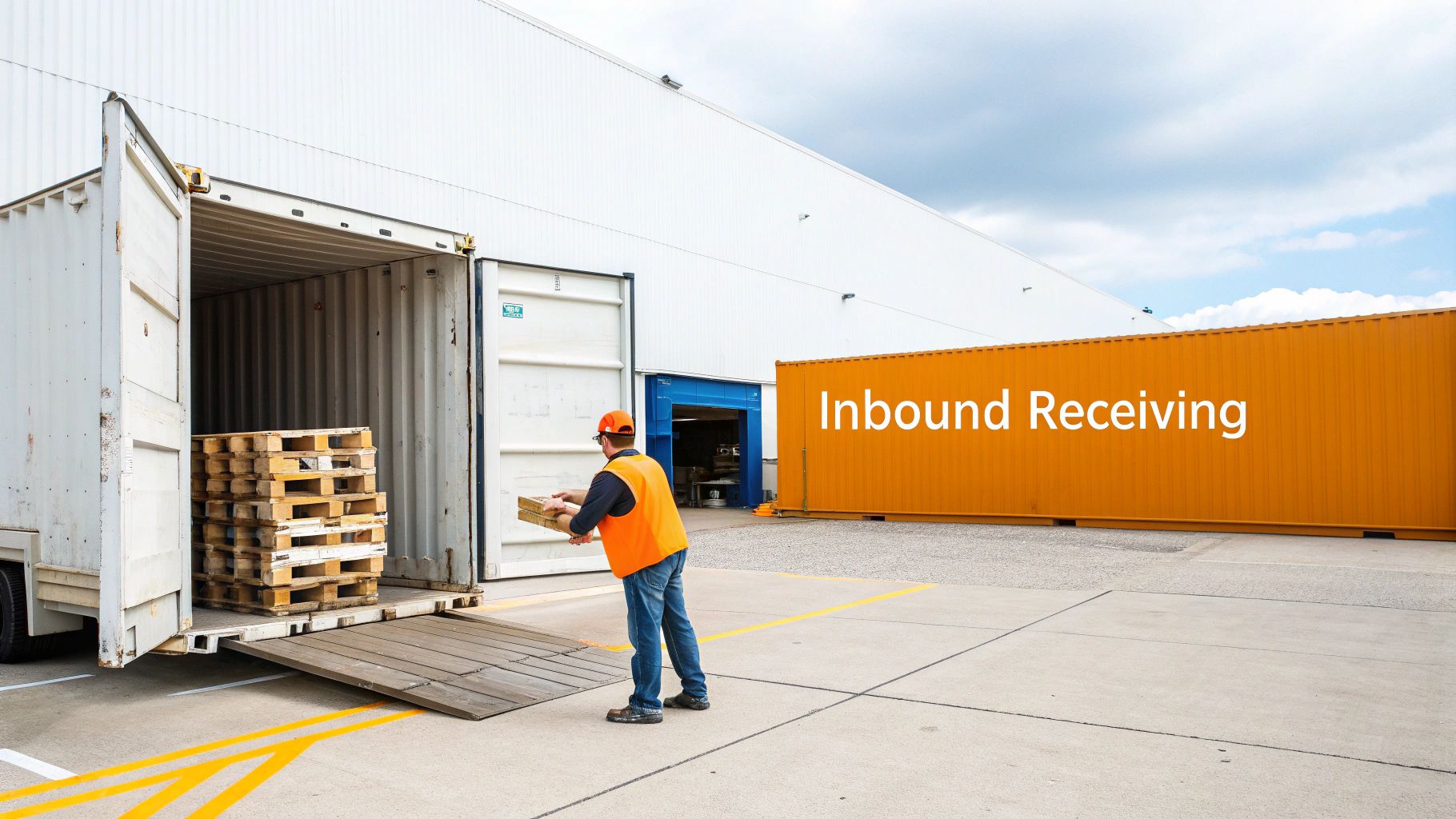
Everything starts at the receiving dock. This is where your inventory officially enters your world. If you accept the wrong products, miscount quantities, or fail to spot damage right away, you’re creating problems that will haunt you for weeks.

Good receiving isn't just about unloading trucks. It’s a disciplined process:

  • Verification: Checking the shipment against the purchase order. Do the SKUs match? Is the quantity correct?
  • Inspection: A quick quality control check to ensure products aren't damaged before they ever hit your shelves.
  • Logging: Scanning items into your Warehouse Management System (WMS), which officially adds them to your sellable stock.

Even a small 1% to 2% receiving error rate can create massive inventory headaches down the line, leading to stockouts on products you thought you had.

2. Put-away: Smart Storage for Efficient Retrieval

Once an item is received, it needs a home. Put-away is the process of moving goods from the receiving dock to a specific storage location. Think of it as organizing your pantry after a grocery run—you put the things you use daily at the front, and the specialty items in the back.

Throwing items onto any random shelf is a recipe for chaos. It guarantees your team will waste time wandering the aisles looking for that one SKU.

Smart put-away isn’t just about finding an empty shelf. It's about strategic placement—a practice known as slotting. High-velocity SKUs should be stored in easily accessible locations close to packing stations, while slower-moving items can be placed further away or on higher shelves.

3. Picking: The Heart of Order Fulfillment

Picking is where the rubber meets the road. It’s often the most labor-intensive part of warehousing, accounting for up to 55% of all operating costs. This is the part of the process where a team member physically grabs the items for a customer's order. Speed and accuracy here are everything.

There are a few common ways to tackle picking:

  • Discrete Picking: One person, one order. It's simple but not always the fastest.
  • Batch Picking: A picker grabs items for a group of orders all at once, which cuts down on travel time across the warehouse.
  • Zone Picking: Pickers stay in one area, and orders are passed from zone to zone like an assembly line.

The best strategy depends on your order volume and warehouse layout. For more advanced techniques, check out our guide on the e-commerce order fulfillment process.

4. Packing: The Final Presentation

Packing is your last chance to make a good physical impression. This is where you ensure the order is secure, presentable, and cost-effective to ship. It involves choosing the right box, adding dunnage (like bubble wrap or air pillows), and including any marketing inserts.

Get this wrong, and you're facing two big problems:

  1. Damaged Products: This means returns, replacements, and a bad customer review.
  2. High Shipping Costs: Using a box that’s too big drives up costs due to dimensional weight (DIM) pricing.

Packing is also a great branding opportunity. A little custom tape or a thank-you note can turn a simple delivery into a memorable unboxing experience.

5. Shipping: The Last Mile to the Customer

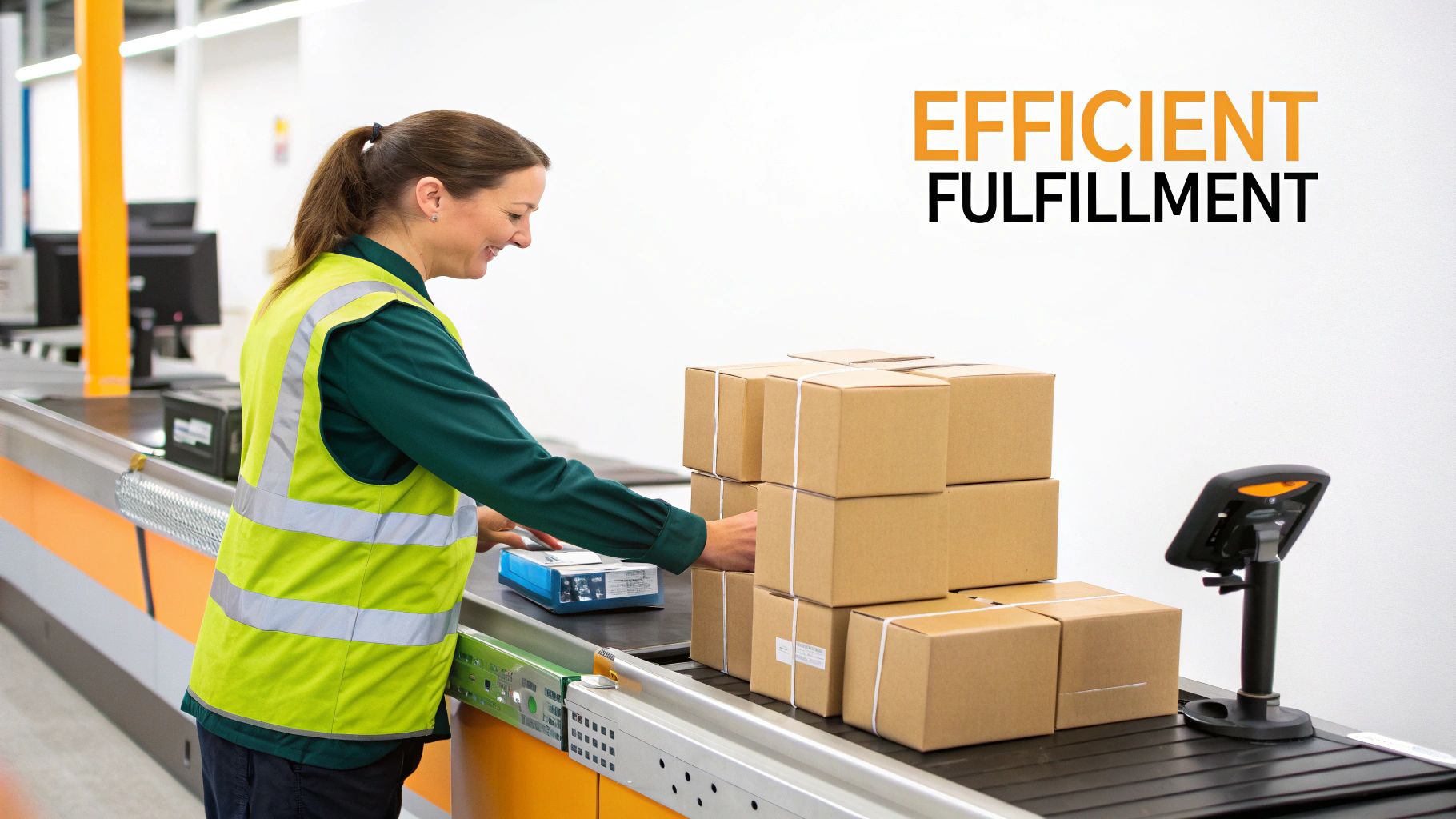
This is it—the final handoff. The shipping station is where a packed order gets weighed, a shipping label is generated and applied, and the package is sorted for carrier pickup with services like USPS, FedEx, or UPS.

Absolute accuracy is critical here. The wrong label sends a package to the wrong place, creating a customer service fire that's hard to put out. An efficient shipping process ensures all packages are sorted correctly and ready for when the carrier truck arrives, so you never miss a cutoff. When all five steps work in harmony, you get the perfect outcome: the right product, delivered on time, in perfect condition.

The KPIs That Truly Measure Warehouse Performance

Once you’ve got a handle on the core processes of your warehouse, the only way to truly master them is to measure them. There's an old saying in operations that holds true every single time: if you can't measure it, you can't improve it. But chasing dozens of metrics just creates noise, not clarity.

The real key is to focus on a handful of Key Performance Indicators (KPIs) that tell a clear, simple story about your operational health. Think of these as the gauges on your fulfillment engine's dashboard—each one pointing to a specific function and telling you if it's running smoothly or starting to stall.

Inventory and Inbound Efficiency KPIs

The health of your entire operation starts the second inventory hits your receiving dock. Any errors or delays here will ripple through your entire workflow, messing up everything from picking efficiency to final customer satisfaction. These KPIs tell you how well you’re managing that crucial first step.

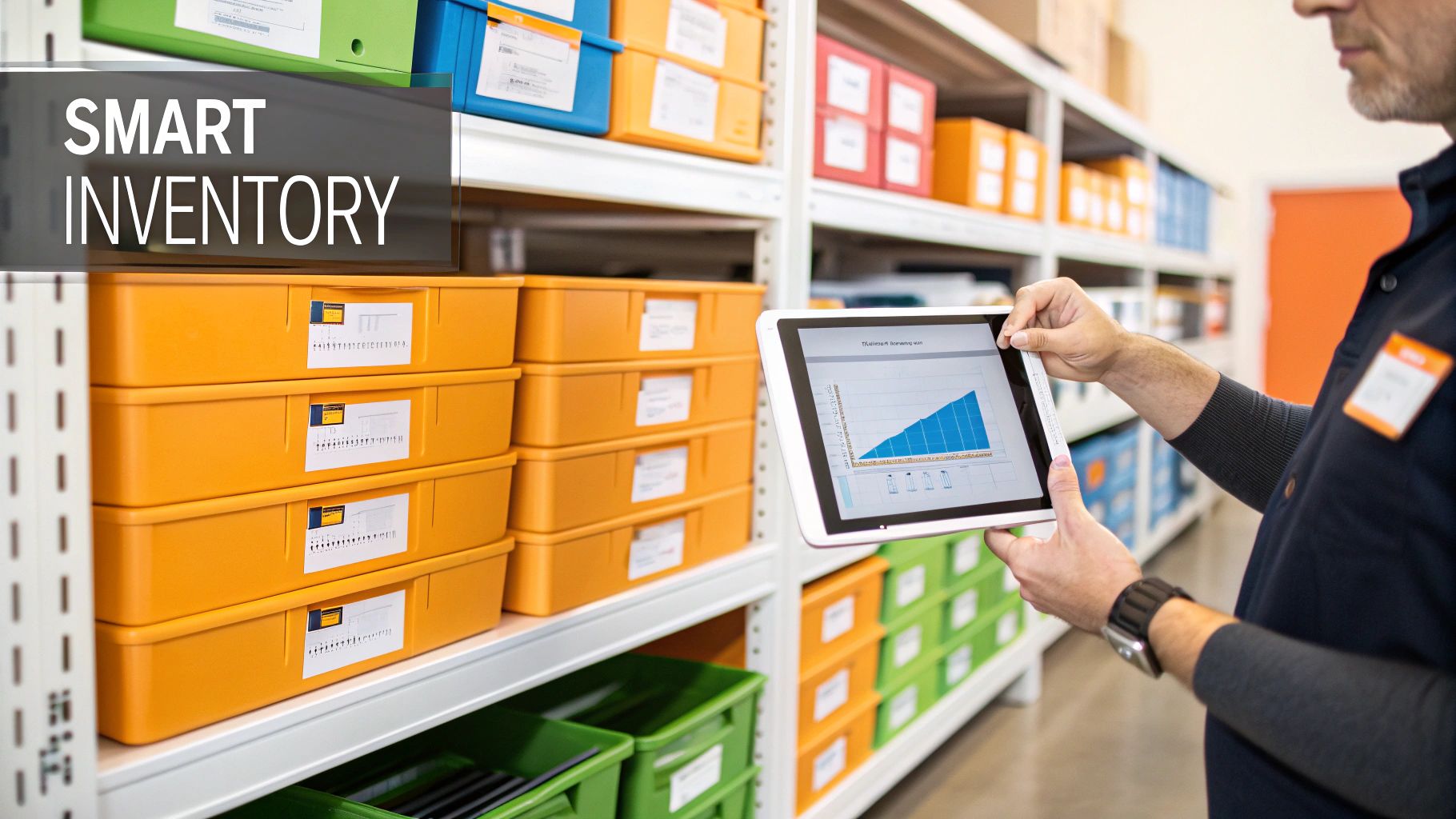
  • Inventory Accuracy: This is your foundational metric. It’s a simple comparison between the inventory your WMS thinks you have and what's actually sitting on your shelves, expressed as a percentage. Anything less than 99% accuracy is a major red flag, pointing to problems in your receiving process, theft, or sloppy cycle counting.

  • Dock-to-Stock Time: This measures how long it takes for a new shipment to be received, checked in, and put away in its final storage spot, ready to be sold. A long dock-to-stock time means your cash is tied up in inventory you can’t even sell yet. Best-in-class warehouses get this done in just a few hours.

Fulfillment Accuracy and Speed KPIs

As soon as a customer clicks "buy," the clock starts ticking. These next KPIs are all about your ability to meet—and beat—customer expectations for speed and accuracy. These are the numbers your customers feel directly, and a slip-up here can damage your brand's reputation almost instantly.

  • Order Picking Accuracy: This might be the single most important fulfillment KPI. It’s calculated as (Total Orders - Orders with Picking Errors) / Total Orders and tells you how precise your picking team is. Even a small dip below 99.5% can trigger a wave of expensive returns and frustrated customers.

If this number starts to drop, it’s time to play detective. Is your warehouse layout confusing? Are pickers using the right equipment? Are the product bins clearly labeled? A drop in picking accuracy is a clear signal to dig into your workflows and training.

  • Order Cycle Time: This measures the total time from the moment an order is placed to the second it’s handed off to the carrier. It gives you a complete picture of your entire outbound process—picking, packing, and shipping combined. A consistently fast order cycle time is a massive competitive advantage, allowing you to offer quicker, more reliable delivery promises. To get a better sense of the data that fuels these metrics, it's worth exploring the wider world of analytics in logistics.

Cost and Productivity KPIs

Finally, you need to know if you're making money. It's not enough to be fast and accurate; your operation has to be profitable. These KPIs connect your warehouse activities directly to your bottom line.

  • Cost Per Order: This is a fundamental financial health check. To find it, divide your total warehouse operating costs (labor, rent, packing supplies, etc.) by the number of orders you shipped in that same period. This one number tells you exactly how much it costs you to get a single package out the door and helps you measure the real impact of any changes you make.

  • Lines Picked Per Hour: This metric tracks how many individual order lines a single team member can pick in one hour. It's a direct measure of your labor productivity. If you want to improve this KPI, you can look at optimizing your warehouse layout for shorter travel paths, trying different picking strategies like batch or zone picking, or introducing technology to guide your team. A rising "lines per hour" rate means you're getting more orders out the door with the same team—a direct boost to your profitability.

How Warehouse Layout and Slotting Drive Efficiency

The physical layout of your warehouse is the blueprint for how fast and cost-effective your fulfillment can be. A bad layout creates constant friction—wasted steps, traffic jams, and slow order processing. But get it right, and your physical space becomes a powerful competitive advantage.

Think of your warehouse as a small city. Your main thoroughfares are the highways, picking aisles are the neighborhood streets, and the packing stations are the busy downtown core. The goal is simple: create a flow that minimizes travel and congestion, getting goods from receiving to shipping as smoothly as possible.

Man in mask reviews plans on an 'Optimized Layout' marked warehouse floor with inventory.

Choosing the Right Warehouse Flow

The path your inventory and team take through the building is your warehouse flow. Most e-commerce operations use one of two patterns, each with its own pros and cons depending on your building's shape.

  • U-Shaped Flow: This is a popular one. Receiving and shipping docks sit side-by-side. Products come in, move in a "U" shape through storage, and end up right back where they started for packing and shipping. It’s a great layout for smaller facilities because it keeps dock operations consolidated and cuts down on forklift travel.

  • I-Shaped Flow: Also called a through-flow, this layout puts receiving on one end of the building and shipping on the other. Inventory moves in a straight line from back to front. This is perfect for larger, high-volume operations because it keeps inbound and outbound traffic completely separate, preventing bottlenecks.

The right choice often comes down to your building’s physical constraints. No matter which you choose, the goal is a clear, one-way path for your products.

Optimizing Your Aisles for Maximum Throughput

Once you’ve set the main flow, it’s time to optimize the "local roads"—your picking aisles. Travel time can eat up over 50% of a picker’s day, so every step you save is money in your pocket and more orders out the door.

Here's what to focus on:

  • Aisle Width: Aisles need to be wide enough for safe movement but not so wide that you’re wasting storage space. The ideal width depends entirely on your equipment—pallet jacks, forklifts, or simple picking carts.
  • One-Way Traffic: Just like in a city, making aisles one-way can drastically reduce congestion and improve safety for your team.
  • Cross Aisles: These are your shortcuts. Adding strategic cross aisles lets pickers move between main aisles without walking all the way to the end and back.

The Power of Smart Slotting with ABC Analysis

A good layout gets your team moving efficiently, but slotting decides how far they have to go. Slotting is simply the process of assigning products to specific locations based on how often they sell. This is where ABC analysis becomes your best friend.

ABC analysis is an inventory trick where you sort products into three groups: 'A' for your fast-moving bestsellers, 'B' for your steady mid-range items, and 'C' for your slow-moving, long-tail products.

Armed with this data, you can completely rethink your picking strategy:

  1. Category A Items: These are your superstars. Put them in the best spots—the "golden zone" closest to the packing stations and at the most ergonomic height (between the waist and shoulders). This is your warehouse's prime real estate.
  2. Category B Items: These get the next-best locations, maybe on middle shelves or a little further down the main aisles.
  3. Category C Items: Your slow movers belong in the back, on high shelves, or in other less-accessible areas that don’t get much traffic.

This simple change ensures your team spends the majority of their time picking from a small, highly convenient area. It’s a straightforward way to slash travel time and send your warehouse productivity through the roof.

Choosing the Right Warehouse Technology and Automation

In any modern warehouse, technology is the engine that drives everything. It's what dictates how quickly and accurately you can get an order out the door, from the moment a customer clicks "buy" to the final scan at the shipping station. Getting your tech stack right is absolutely fundamental to scaling your e-commerce brand.

It helps to think of it this way: technology and automation aren't the same thing, but they are a powerful duo. Your Warehouse Management System (WMS) is the “brain” of the operation, while automation is the “muscle”.

A tablet displaying "Warehouse Tech" on a screen in a modern automated warehouse with a conveyor belt.

The Role of the Warehouse Management System (WMS)

A WMS is the software that acts as the single source of truth for your entire operation. It tells your team what to do, where to go, and tracks every single item in real-time. No more guesswork, no more messy spreadsheets.

Its main jobs include:

  • Inventory Tracking: A live, bird's-eye view of every SKU, its location, and its quantity.
  • Order Management: Pulling in orders from sales channels like Shopify or Amazon and turning them into actionable picking lists for your team.
  • Process Direction: Guiding your crew through every step—receiving, put-away, picking, and packing—with clear, digital instructions.
  • Reporting: Giving you the hard data needed to track KPIs like order accuracy and how long it takes to get an order out the door.

A solid WMS is non-negotiable for any serious e-commerce business. It’s what separates a professional operation from an amateur one. For a 3PL partner like Snappycrate, our WMS is the backbone of our service, allowing us to deliver the reliability and accuracy our clients depend on.

Understanding the Spectrum of Automation

Once you have a WMS "brain" in place, you can start adding "muscle" with automation to make your physical processes faster and more efficient. Automation isn't an all-or-nothing decision; it's a spectrum of tools you can adopt over time to crush different bottlenecks.

1. Foundational Automation:
This is where most warehouses start. These are simple, high-impact tools that immediately cut down on manual work and human error.

  • Barcode Scanners: The absolute must-have. They’re used for receiving, picking, packing, and shipping to ensure accuracy at every single touchpoint.
  • Conveyor Belts: Move products and packed boxes between stations, drastically reducing the amount of walking and manual hauling your team has to do.

2. Advanced Automation:
As your order volume climbs, more sophisticated systems start making sense. These tools work alongside your team to give them superpowers.

  • Pick-to-Light Systems: Lights on the shelves guide pickers to the exact bin location and show them the exact quantity to grab. This is a game-changer for speed and accuracy.
  • Automated Storage and Retrieval Systems (AS/RS): Think of these as robotic librarians for your inventory. They automatically store and retrieve totes or pallets, bringing the goods directly to your team member.

3. Robotic Automation:
This is the top tier, where robots can handle entire tasks with minimal human intervention.

  • Autonomous Mobile Robots (AMRs): These smart little bots navigate the warehouse on their own to transport shelves or bins, either following pickers or bringing inventory directly to a packing station.
  • Robotic Picking Arms: These can actually identify and pick individual items to fulfill an order, working 24/7 without a break.

When Does Automation Make Financial Sense?

The decision to invest in automation all comes down to the Return on Investment (ROI). You have to weigh the high upfront cost against the long-term savings you'll get from reduced labor costs, fewer errors, and the ability to ship more orders per hour. For many growing brands, automation is no longer a "nice-to-have"—it's a competitive must. When looking at what's out there, understanding the landscape of warehouse automation software is key to making a smart choice.

The numbers don't lie. The warehouse automation market was valued at around $30 billion in 2026 and is projected to hit a staggering $59.52 billion by 2030. Brands that make the leap often report 25-30% reductions in labor costs, fulfillment speeds that are up to 300% faster, and accuracy rates that approach a near-perfect 99%. This isn't just a trend; it's a fundamental shift in how fulfillment gets done.

When to Partner with a 3PL to Scale Your Operations

Every e-commerce brand hits a wall eventually. The garage is overflowing, you spend more time with packing tape than with your family, and shipping feels like a black hole for your profits. It’s the classic fork in the road: do you build out your own warehouse, or do you find a partner to do it for you?

This is where a great Third-Party Logistics (3PL) provider comes in. It’s not about giving up control. It’s about gaining an expert team and the scale to grow without limits. When fulfillment starts to feel more like a chore than a core part of your business, it’s time to start looking.

Key Signs You're Ready for a 3PL

The tipping point is different for everyone, but the warning signs are almost always the same. If these "growing pains" sound familiar, your business is telling you it's time to outsource.

  • You've Run Out of Space: Your inventory has officially conquered your home, garage, or that tiny storage unit. The idea of leasing a full-blown warehouse feels like a massive financial and operational headache you’re not ready for.
  • Fulfillment Is Eating Your Time: Are you and your team spending more hours picking orders and wrestling with shipping labels than you are on marketing, developing new products, or talking to customers? That’s a red flag.
  • Shipping Costs Are Out of Control: You're stuck paying retail shipping rates. A 3PL like Snappycrate has access to high-volume discounts from carriers, and those savings go straight to your bottom line.
  • Mistakes Are Creeping In: As your order volume climbs, so do the occasional mix-ups and errors. A professional 3PL uses proven processes and tech to hit 99% accuracy or better, protecting your brand's reputation.

Partnering with a 3PL isn't just about renting shelf space; it's about instantly plugging into a professional logistics operation. You get the optimized warehouse, the trained staff, and the enterprise-level software without the million-dollar-plus investment.

It's no surprise that the global warehousing market is booming. As e-commerce sellers look to scale, they're turning to specialized partners to handle the heavy lifting. The demand for expert logistics is a clear sign of where the industry is headed. You can find more insights on these warehousing industry trends to see just how big this shift is.

What to Look for in a 3PL Growth Partner

Finding the right 3PL is about more than just comparing storage fees. You need a true partner who acts like an extension of your own team—someone who is just as invested in your growth as you are.

Here’s what you should be looking for:

  • Scalable Capacity: Can they handle your business as it grows from 50 orders a month to 5,000? A good partner scales with you seamlessly.
  • Integrated Technology: Their Warehouse Management System (WMS) should connect directly to your sales channels, whether it's Shopify, Walmart Marketplace, or Amazon.
  • Real Expertise: Your 3PL should know the ins and outs of your sales channels, especially the complicated stuff like Amazon FBA prep and compliance rules.
  • Value-Added Services: Can they do more than just pick and pack? Look for flexibility to handle things like kitting, product bundling, or creating custom-branded packages.

Making the jump to a 3PL gives you your time back. It lets you stop worrying about logistics and get back to what you do best: building a brand that customers can’t get enough of.

Frequently Asked Questions

As you get deeper into managing your warehouse operations, a few questions always seem to pop up. We hear them all the time from e-commerce sellers and ops leaders trying to scale. Let's tackle a few of the big ones.

What Is the Difference Between Warehouse Management and Inventory Management?

It’s easy to get these two mixed up, but the difference is pretty simple.

Think of warehouse management as everything happening inside the building. It’s the whole physical game: the layout, your staff, receiving shipments, picking and packing orders, and getting them out the door. The goal is to make the entire facility run like a well-oiled machine.

Inventory management is one crucial piece of that puzzle. It’s all about the product itself—what you have, where it is, and how much you need. This involves forecasting sales, tracking your stock levels, and keeping your counts dead-on accurate so you can meet demand without tying up cash in slow-moving items.

Warehouse management runs the building; inventory management runs the stock. You need both working together for a smooth operation.

How Can I Reduce My Warehouse Operating Costs?

Cutting costs is always top of mind. Forget the small stuff; focus on these three areas for the biggest impact.

  • Optimize Your Layout and Slotting: Put your fastest-selling products (your 'A' items) right next to your packing stations. It sounds simple, but this one change can slash your labor costs by cutting down on how much time your team spends walking the floor.
  • Dial in Your Inventory Accuracy: Start cycle counting regularly. This prevents you from running out of a hot seller or, just as bad, sitting on a mountain of overstock. Accurate data means your cash isn't trapped in products that just aren't moving.
  • Eliminate Shipping Errors: Every wrong order is a costly mistake. Using the right-sized box and double-checking every label before it goes out prevents expensive returns and reshipments. A single error can easily wipe out the entire profit on an order.

When Should I Switch from In-House Fulfillment to a 3PL?

The tipping point is when fulfillment stops being a growth driver and starts becoming a growth blocker.

If you’re spending more time packing boxes than you are on marketing and sales, it’s probably time. If you’re constantly tripping over inventory, running out of space, or watching your shipping error rate creep up, it's definitely time to look for a partner. Outsourcing lets you get back to what you do best: building your brand.


Ready to stop worrying about fulfillment and get back to growing your business? Snappycrate offers scalable, expert warehousing operations management, from receiving and inventory control to FBA prep and fast, accurate order fulfillment. Find out how we can help you scale.
0 Continue Reading →

What Is a Hub and Spoke Model for E-commerce Fulfillment

Think about how airlines operate. Instead of flying a direct route from every small town to another, they funnel all passengers through major airports—the hubs. From there, smaller flights take everyone to their final destinations—the spokes. This is the exact logic behind the hub and spoke logistics model.

This strategy completely changes the game for e-commerce brands. Instead of shipping every single order from one central warehouse, you create a smarter, two-step system that dramatically improves fulfillment speed and cuts shipping costs.

How It Works: The Core Components

It's a simple but powerful concept that breaks down into two key parts:

  • The Hub: This is your command center. It’s a large, primary warehouse where all your inbound inventory arrives in bulk from suppliers—whether by container, truckload, or LTL. The hub’s job is to receive, process, and hold the bulk of your inventory before replenishing the spokes.

  • The Spoke: These are smaller, regional warehouses strategically placed closer to your customers. Each spoke holds a curated selection of your top-selling products, ready for fast, last-mile delivery to customers in that specific geographic area.

This isn't just theory; it's the model that powers giants like UPS. They transformed their network by consolidating volume through hubs to achieve what’s known as economies of density. When you fill trucks on major routes between hubs and spokes, the cost-per-package plummets.

For a quick overview, here's how the model stacks up at a glance.

Hub and Spoke Model At a Glance

Characteristic Description Impact for E-commerce
Central Hub A single, large warehouse receives all inbound inventory from suppliers. Simplifies inbound freight management and reduces receiving costs.
Regional Spokes Smaller fulfillment centers are located in key geographic markets. Positions inventory closer to customers for faster, cheaper shipping.
Inventory Flow Bulk inventory is transferred from the hub to the spokes for replenishment. Enables strategic inventory placement based on regional demand.
Order Fulfillment Customer orders are picked, packed, and shipped from the nearest spoke. Lowers shipping zone costs and provides 2-3 day delivery windows.

Ultimately, this structure gives you the best of both worlds: the efficiency of centralized inbound receiving and the speed of decentralized, regional fulfillment.

By optimizing both the first and last mile of your supply chain, you build a powerful competitive advantage. You can improve your overall e-commerce order fulfillment services and give customers the fast, reliable shipping they expect.

How This Model Accelerates Your Delivery Speed

In e-commerce, speed isn't just a nice-to-have anymore—it’s what customers expect. The hub and spoke model is designed from the ground up to make faster delivery possible by completely rethinking how your products get from your supplier to your customer's door. The whole system is built to slash transit times and shrink the distance for that final, most expensive leg of the journey.

This all starts at the hub. Think of these as large, central warehouses strategically parked near major ports and national freight routes. This prime positioning allows you to quickly and efficiently take in your inventory, whether it's coming off a full container or a truckload from a domestic supplier. By bringing all your inbound freight to one optimized location, you can get it processed and ready for distribution across your network way faster.

From Hub to Customer Doorstep

Once your inventory is sorted at the hub, it's pushed out to the spokes. These smaller, regional warehouses are the real secret to unlocking next-level delivery speed. They are deliberately placed in or near major cities, putting your products just a short drive away from huge chunks of your customer base.

By decentralizing your final-mile delivery, you’re basically moving the finish line closer to your buyers. This strategic placement drastically cuts down the time your products spend on a truck and makes meeting that two-day shipping promise a reality.

This diagram shows you exactly how the inventory flows from your supplier, into the central hub, and out to the regional spokes.

Diagram illustrating a hub and spoke supply chain model with a central warehouse distributing to local spokes.

As you can see, a single, streamlined inbound path to the hub branches out into multiple, highly efficient local delivery routes from the spokes. The entire journey is optimized from start to finish.

The Impact on Transit Time and Cost

This intelligent distribution is a direct answer to the high shipping costs and long delivery times that plague sellers who rely on a single warehouse. Instead of shipping an individual package from California all the way to New York (a pricey Zone 8 shipment), you can ship it from a spoke warehouse in New Jersey (a Zone 1 or 2 shipment). The benefits are immediate and significant.

  • Faster Final-Mile Delivery: Shorter distances from the spoke to the customer mean packages often arrive in just one or two days.
  • Reduced Shipping Costs: Moving from high-zone to low-zone shipments slashes your per-package shipping expense.
  • Improved Customer Satisfaction: Hitting or beating delivery promises builds the kind of brand loyalty that drives repeat business—a must-have for both DTC and Amazon sellers.

Industry benchmarks show that this model can lead to 20-30% faster deliveries in major markets. By optimizing where the hub is located and carefully placing spokes near customer clusters, brands can make their delivery schedules far more reliable and give customers a much better experience. You can get a better sense of these efficiency gains by looking into detailed breakdowns of supply chain logistics performance. The end result is a supply chain that's more resilient and a business that's more competitive.

Comparing Centralized vs Hub and Spoke Fulfillment

Every growing e-commerce brand eventually hits a crossroads with its fulfillment. The strategy that got you here won't necessarily get you to the next level. Your two main paths are sticking with a centralized model (one warehouse) or upgrading to a hub and spoke model.

Making the right choice is about more than just costs—it's about building a supply chain that can keep up with your brand's ambition.

When you're just starting out, a single, centralized warehouse makes perfect sense. You keep all your inventory in one place, manage one team, and simplify your operations. If most of your customers are clustered in one part of the country, this approach is both simple and cost-effective.

But what happens when your brand takes off nationally? That single warehouse starts to feel like an anchor. Shipping a package from California to a customer in New York is painfully slow and expensive, especially as you cross into higher, more costly shipping zones. This is exactly where the hub and spoke network changes the game.

A split image illustrating centralized vs. hub logistics with a warehouse, trucks, and a network map.

A Head-to-Head Comparison

So, how do these two models really stack up for an online seller? Let’s put them side-by-side and look at the factors that actually impact your bottom line and customer experience. Understanding the different retail distribution strategies is key to figuring out which approach fits your business best.

Let’s break down the practical differences in a simple table.

Fulfillment Model Comparison

Factor Centralized Model Hub and Spoke Model
Initial Investment Lower. You're only setting up and managing one facility. Higher. It requires a network of multiple facilities (the hub and its spokes).
Operational Complexity Simple. All your inventory and fulfillment happen under one roof. More Complex. You're managing inventory across multiple locations.
Nationwide Speed Slower. You'll have long transit times to customers far from your warehouse. Faster. Spokes are much closer to customers, unlocking 1-3 day delivery.
Shipping Costs Higher. Cross-country shipments mean expensive high-zone carrier fees. Lower. Shipping from spokes keeps orders in cheap local zones (1-3).
Scalability Limited. Growing often means a complete, disruptive move or overhaul. High. It's easy to add new spoke warehouses to break into new markets.

As you can see, the decision comes down to a classic trade-off: simplicity vs. scalability.

While the centralized model is cheaper to start, the hub and spoke model delivers incredible long-term value through faster shipping and massive savings on fulfillment costs.

For any brand with a national footprint, the savings on shipping alone can quickly pay for the added complexity. A hub and spoke network directly attacks high shipping costs by turning expensive coast-to-coast deliveries into cheap local ones.

Ultimately, the best choice depends on where your brand is today and where you want it to be tomorrow. A centralized setup is a great launchpad, but a hub and spoke model is the engine you need for true national growth.

Unlocking Growth with a Hub and Spoke Strategy

The hub-and-spoke model isn't just a logistics buzzword; it's a powerful framework for scaling your e-commerce brand. By rethinking how you manage inventory and fulfill orders, this strategy creates real efficiencies that boost your bottom line and keep customers coming back. It’s the playbook that helps brands jump from hundreds to thousands of orders a day without their operations collapsing.

A huge part of the advantage comes from the hub itself. You consolidate all your inbound freight at a single, central location. Instead of juggling small, frequent shipments to multiple warehouses, you’re bringing in large, bulk shipments to one spot. This immediately drops your per-unit receiving and processing costs.

Fueling Agile Expansion and Control

The real genius of a hub-and-spoke network is its flexibility. Let's say you want to test the waters in the southeastern U.S. market. If you’re using a single centralized warehouse, you're stuck with high shipping costs and slow delivery times to that entire region. But with hub-and-spoke, you can simply add a new "spoke" warehouse right where you need it.

This setup lets you enter and test new markets with incredible speed, all without a massive, risky overhaul of your entire supply chain. It's a low-risk, high-reward way to build out your national footprint piece by piece.

This scalability is what gives the model its edge. It allows a 3PL to expand its network without huge upfront investments, and DTC brands can spin up new spokes as soon as demand picks up in a new region. It's an adjustable distribution footprint that also gives you much better inventory visibility, since everything is managed from the central hub.

By keeping the majority of your inventory at the hub, you get a bird's-eye view and total control. This massively reduces the risk of painful stockouts at your regional spokes and frees up cash flow since you aren't tying up capital in extra inventory spread across multiple locations.

Turning Strategy into Reality with a 3PL

The good news is you don't have to build this network from scratch. Partnering with a third-party logistics (3PL) provider like Snappycrate is how you make these strategic ideas a practical reality. A 3PL with an established network gives you instant access to:

  • Optimized Inbound Receiving: A central hub fully equipped to handle everything from full containers to LTL freight.
  • Strategic Spoke Locations: A ready-made network of regional warehouses already positioned to reach your key customer hubs.
  • Integrated Technology: A single, unified platform to manage inventory across the entire hub-and-spoke system.

This kind of partnership is the key to effective supply chain and warehouse management. The right 3PL is more than a vendor; they're an extension of your team, handling the logistical headaches so you can focus on what you do best—growing your business. It's how you scale fulfillment smoothly while keeping your operations lean.

So, when is it time to adopt a hub-and-spoke model?

Switching from a single, centralized warehouse to a more complex network is a huge step. Sticking with one warehouse is simple when you’re starting out, but eventually, you’ll start to see the cracks. Recognizing these growing pains is the first step toward building a supply chain that actually supports your national ambitions.

If you’re wondering when to make the leap, it isn’t about hitting a specific order volume. It’s about watching for the operational headaches that signal your current setup is holding you back. The right time is when the cost and complexity of shipping from one spot start to outweigh the benefits of its simplicity.

Key Metrics Signaling a Need for Change

Your own data will tell the story. If you’re not looking at your fulfillment KPIs, you’re flying blind. When these numbers start trending in the wrong direction, it’s a massive red flag that your single warehouse is becoming a liability.

These are the most important metrics to watch:

  • Average Cost-to-Serve: This is the total cost—picking, packing, shipping, everything—to get an order to a customer. If this cost is blowing up for customers in farther shipping zones, your single location is almost certainly the problem.
  • Delivery Time by Zone: Are customers in Zones 5-8 constantly waiting 5+ days for their packages? Slow delivery times are a conversion killer and a clear sign you need to get inventory closer to your buyers.
  • Shipping Costs as a Percentage of Revenue: When shipping fees start eating into your profit margins on a national scale, it’s time to find a way to lower your average shipping zone. A hub-and-spoke network does exactly that.

A huge pain point we see is multi-channel inventory management. If you're constantly fighting to balance stock between your Shopify store and Amazon FBA, a central hub can act as your main inventory pool. This simplifies replenishment and helps prevent costly stockouts on either sales channel.

Ask Yourself These Critical Questions

Beyond the hard numbers, think about your strategic goals. Your logistics network should be helping you grow, not holding you back.

If you answer "yes" to any of these, it's time to seriously look at a hub-and-spoke strategy:

  1. Is national expansion a core part of your growth plan? You can't effectively serve a national customer base from one corner of the country. It’s just too slow and expensive.
  2. Are high shipping costs stopping you from offering competitive free shipping? A hub-and-spoke model directly attacks this problem by slashing your average shipping costs.
  3. Do you frequently have fulfillment delays for customers outside your primary region? This is a direct symptom of being too far away from your buyers.

Making this move is a proactive step toward building a scalable, customer-focused brand. It's about putting an operational backbone in place that can handle your future growth without breaking a sweat.

Finding the Right 3PL Partner for Your Network

A great strategy is worthless without great execution. Moving to a hub-and-spoke model is a huge operational shift, and your most critical decision will be choosing the right third-party logistics (3PL) partner. Think of them as more than just a vendor; they're the hands-on extension of your brand, responsible for making your logistics plan a reality.

You need a partner who can do far more than just store boxes. Look for a 3PL with serious experience managing complex inbound freight, from full containers down to less-than-truckload (LTL) shipments. They have to function as a true hub, breaking down bulk inventory before it’s sent out to the spokes.

Two logistics professionals, a man and a woman, review data on a tablet in a warehouse.

What to Look for in a Partner

When you’re vetting 3PLs, zero in on the non-negotiable skills that make a hub-and-spoke network tick. A partner’s ability to handle your inventory flow without a hitch is everything, whether you're shipping across the country or growing overseas. When you’re expanding, picking from the top 3PL logistics companies in Singapore can make or break your ability to scale efficiently.

Here’s what your checklist should include:

  • Rock-Solid FBA Prep: If you sell on Amazon, your 3PL must be an expert in FBA compliance. That means everything from labeling and poly bagging to building case packs. This keeps your inventory flowing into Amazon’s network without racking up costly penalties or delays.
  • Connected Technology: A modern 3PL gives you a single software platform to see all your inventory across every location. This visibility is absolutely essential for managing stock levels at both the hub and the spokes.
  • Multi-channel Know-How: The right partner connects easily with all your sales channels—Shopify, Walmart, you name it. This guarantees consistent and accurate fulfillment, no matter where a customer places an order.

The best 3PL relationships are built on more than just warehouse space. They’re founded on clear communication and trust. You need a partner who gets your brand’s goals and has a proven track record of helping businesses like yours scale up.

At the end of the day, your 3PL should make your supply chain simpler, not more complicated. For a closer look at what these partners actually do day-to-day, check out our guide on what a 3PL warehouse does. Finding a partner who masters these details is how you finally get rid of logistical headaches and build a fulfillment network that can handle anything.

Your Hub-and-Spoke Questions, Answered

Thinking about a new logistics strategy always brings up questions. It's a big move. Let's walk through some of the most common ones we hear from e-commerce sellers trying to figure out if this model is right for them.

How Does a Hub-and-Spoke Model Affect My Inventory Costs?

It might sound strange, but spreading your inventory across multiple warehouses can actually lower your overall carrying costs. It all comes down to how you stock them.

Instead of trying to keep every single SKU in every location, you hold the bulk of your inventory at one central hub. This means you need way less "just-in-case" safety stock sitting around the country. Your spokes are then stocked with smaller, smarter shipments from the hub, based on what’s actually selling in that region.

This tightens up your whole operation. Your inventory turn rate improves, and you dramatically cut the risk of getting stuck with slow-moving products in the wrong part of the country—freeing up your cash for growth.

Can a Small Business Actually Use This Model?

Absolutely. In fact, small and growing brands are often the ones who benefit the most, but with one crucial twist: you don't build the network yourself. You partner with a 3PL that already has an established hub-and-spoke system.

By plugging into an existing 3PL network, you gain immediate access to a sophisticated, national distribution system. This lets you compete with larger brands on delivery speed and cost, all without the massive capital investment required to build and manage your own warehouses.

This approach gives you scalability on demand. You get all the benefits of the model from day one, paying only for the space and services you actually use.

What’s the Difference Between Hub-and-Spoke and Distributed Inventory?

This is a common point of confusion, but the distinction is pretty simple. Think of it this way: hub-and-spoke is a specific type of distributed inventory.

  • Distributed Inventory: This is the general idea of storing products in more than one warehouse to be closer to your customers. That's it.

  • Hub-and-Spoke Model: This puts a strategic structure on that network. You have a main "hub" that takes in all your inventory from your manufacturer, and it acts as the feeder for smaller, regional "spoke" warehouses.

Other distributed models might treat all warehouses as equals, which can create a logistical nightmare when it comes to managing replenishment. The hub-and-spoke model's clear hierarchy makes everything simpler, from inventory planning to inbound freight, making it a much smarter choice for most e-commerce brands.


Ready to see how a hub-and-spoke network can transform your fulfillment? Snappycrate provides the expert FBA prep, inventory management, and fast order fulfillment you need to scale. Get in touch with our team today!

0 Continue Reading →

Your Guide to the Ecommerce Order Fulfillment Process

The ecommerce order fulfillment process is everything that happens behind the scenes, turning a customer’s click into a package on their doorstep.

Think of it like a restaurant kitchen. A ticket comes in (the order), the line cooks gather the ingredients (pick the products), the head chef plates the meal (packs the box), and a server delivers it to the table (the shipping carrier). This entire sequence is your brand’s promise in action.

What Is The Ecommerce Order Fulfillment Process?

A rock-solid ecommerce order fulfillment process is the unsung hero of customer loyalty and scalable growth. It's the physical engine that connects your digital store to your customer's front door. Whether you're a fast-growing Shopify brand or navigating the complexities of Amazon FBA, getting this right is non-negotiable.

The Scale Of Ecommerce Fulfillment

And the stakes are only getting higher. The global e-commerce fulfillment market recently hit a massive $123.7 billion, growing at a steady clip of 12.9% year-over-year. With projections showing it will soar to $272 billion by 2030, a sharp pick, pack, and ship operation is absolutely critical for staying in the game.

To understand how your brand fits into this massive ecosystem, you first need to break down the core stages of the fulfillment lifecycle.

Here’s a look at the six essential steps every order goes through, from the moment inventory hits your warehouse to when it lands with your customer.

The 6 Core Stages of Order Fulfillment

Stage What Happens Key Goal
1. Receiving New inventory arrives, is inspected for accuracy and damage, and is officially logged into your system. Accurately account for all incoming stock so it’s ready to be sold.
2. Storage Products are put away in designated warehouse locations (bins, shelves, or pallets). Organize inventory for fast and easy access during the picking stage.
3. Picking Warehouse staff locate and retrieve the specific items needed to fulfill an open customer order. Gather all items for an order with 100% accuracy.
4. Packing Items are placed in appropriate packaging with protective dunnage and a shipping label is applied. Secure the products for transit and ensure the package is ready for the carrier.
5. Shipping The packed order is handed off to a shipping carrier (like USPS, FedEx, or UPS) for delivery. Get the order out the door and on its way to the customer on time.
6. Returns The customer sends an item back, which must be inspected, processed for a refund, and restocked or disposed of. Manage the reverse flow of goods efficiently to recover value and maintain customer satisfaction.

Each of these stages has its own set of challenges, but mastering them as a whole is what creates a seamless customer experience.

From Click To Customer

At its heart, the process is a simple, three-part flow: a customer places an order, your team packs it, and a carrier ships it.

Diagram illustrating the three steps of e-commerce fulfillment: order, pack, and ship.

While the concept looks straightforward, the execution is what makes or breaks your business. Every step needs to be handled with care to keep customers happy and protect your bottom line from costly mistakes like mis-ships or damaged goods.

The best operations run on a documented Standard Operating Procedure that ensures every team member handles every order with the same level of quality and consistency.

A great fulfillment operation doesn't just send products; it delivers on a brand's promise. Getting this sequence right is the difference between a one-time buyer and a lifelong customer. It’s your most powerful tool for building trust after the sale is complete.

Step 1: Receiving and Managing Your Inventory

Your entire fulfillment operation hinges on what happens the second a shipment from your supplier lands on your receiving dock. This first step, often called inbound logistics or receiving, is the absolute foundation for everything else.

Think of it this way: if your receiving process is sloppy, you'll end up with phantom inventory, inaccurate stock counts, and the dreaded oversell. Get this wrong, and you're setting yourself up for chaos. But a rock-solid, disciplined process ensures every single item is accounted for and ready to be picked the moment an order drops. This isn't just unpacking boxes—it’s where operational excellence begins.

The Inbound Receiving Workflow

A structured receiving process is your first line of defense against inventory errors. While the exact steps might vary a bit depending on your setup, every shipment—from a single box to a full container—needs to go through a few core actions.

A solid workflow always includes these key steps:

  1. Unload and Verify: The shipment is unloaded, and the contents are immediately checked against the purchase order (PO) or advance shipping notice (ASN). This is a simple but critical check to confirm you got what you actually ordered.
  2. Inspect for Quality: Every item needs a quick inspection for damage. A damaged product that slips through receiving and gets shipped to a customer is a guaranteed return and a bad review waiting to happen.
  3. Label and Identify: This is where each sellable unit gets its unique identifier—the Stock Keeping Unit (SKU). A SKU is like a product's fingerprint, an alphanumeric code that lets your system track it from the moment it arrives to the moment it ships out.
  4. Enter Into the System: Finally, the accurate count of good, sellable inventory is entered into your Warehouse Management System (WMS). This is the action that officially makes the stock "live" and available for sale on your storefront.

Best Practices for Accurate Receiving

A mistake made at receiving creates a ripple effect of problems that are a nightmare to fix later. To keep your inventory accurate and your operations smooth, you have to nail this part of the process.

For a much deeper look at this critical first step, our complete guide on a proper receiving and inspection process is packed with detailed checklists and pro tips.

Here are a few non-negotiable best practices:

  • Have a Designated Receiving Area: Don't just unload boxes in the middle of the floor. Set up a clear, dedicated space just for inbound shipments to prevent new stock from mixing with ready-to-ship inventory before it's been processed.
  • Use Barcode Scanners: Manual data entry is slow and full of typos. Using scanners to log items into your WMS is a game-changer for speed and accuracy, virtually eliminating human error.
  • Document Everything: Snap photos of any damaged boxes or products as they arrive. Note every discrepancy between the packing slip and what's actually in the box. This proof is your best friend when you need to file a claim with a supplier or freight carrier.

An error in receiving is like starting a marathon on the wrong foot. It doesn’t matter how fast you run later; you’ll always be correcting for that initial mistake. Inventory accuracy begins the moment a product enters your building, not when an order is placed.

Step 2 Smart Storage and Warehouse Organization

Warehouse workers managing inventory: one scans a package, another operates a pallet jack.

Once your inventory is checked in, where you put it matters. A lot. This isn't just about finding an empty shelf—it's about strategically placing your products to make the next step, picking, as fast and error-free as possible.

Think of it like setting up your kitchen. You wouldn't bury the coffee grounds you use every morning behind a stack of old Tupperware. You keep them right at the front for easy access. Your warehouse needs to follow the same logic. Good storage isn't a chore; it’s a competitive advantage.

Choosing Your Storage Strategy

How you organize your shelves directly impacts your pickers' speed and your overall efficiency. A disorganized warehouse means pickers spend more time walking and searching than actually picking, which kills your fulfillment times. Most modern warehouses use one of two main strategies.

  • Dedicated Slotting: Each SKU gets its own permanent home. It’s simple and predictable, like having a specific hook for every tool on a pegboard. The downside? If that product sells out, its prime location sits empty, wasting valuable space.
  • Chaotic Storage (Dynamic Slotting): This sounds messy, but it’s brutally efficient. A product goes into whatever open slot is available, and your Warehouse Management System (WMS) tracks its exact location. This maximizes every square inch of your warehouse. An item might be in Bin A-01 today and Slot C-34 tomorrow.

For most growing brands, a hybrid approach hits the sweet spot. You can dedicate slots for your top-selling rockstars while using a chaotic system for the rest of your inventory. This gives you a balance of predictability and flexibility.

Optimizing Your Warehouse Layout

Beyond slotting, the physical layout of your warehouse is critical. The main goal is to cut down the distance your team has to travel to grab the items for an order. Wasted steps are wasted time, and wasted time is wasted money.

Every extra minute a picker spends searching for a product is a minute an order is delayed. Smart warehouse organization isn't about tidiness for its own sake; it's about engineering speed and accuracy into your physical space. A well-organized facility is the silent engine of a fast fulfillment operation.

To make this happen, you need a logical flow. Put your fastest-moving products, your "A-movers," in the most accessible spots—close to the packing stations and at a comfortable height. Slower-moving "C" and "D" items can be stored further away or on higher shelves where they won't get in the way. For a deeper look at organizing your space, check out our guide on warehouse management for ecommerce for actionable layout plans.

Essential Organization Tactics

Finally, a few simple but powerful tactics will keep your operation humming and prevent costly mistakes.

  • Label Everything Clearly: Every single bin, shelf, and pallet location needs a clear, scannable barcode label. No exceptions. This allows your WMS to guide pickers to the exact spot without any guesswork.
  • Maintain Clean Aisles: Keep walkways clear of boxes, pallets, and clutter. A clean environment isn't just safer; it lets your team and equipment move faster.
  • Implement a "Golden Zone": This is the sweet spot between a picker's shoulders and knees. Storing your most popular 80% of SKUs in this zone drastically cuts down on physical strain and picking time because it eliminates the need to bend down or climb ladders for your best-sellers.

Step 3: The Art of Picking and Packing Orders

Once your inventory is received and organized, you’ve reached the most hands-on part of the fulfillment process. This is where a customer's click on your website becomes a real, physical package ready to head out the door. This two-part dance is called picking and packing, and it's where speed and accuracy truly make or break your operation.

The moment an order comes in, your team gets to work. The first job is to generate a pick list—basically, a shopping list for your warehouse staff. This list, whether it’s on a digital scanner or a simple piece of paper, tells the picker exactly what to grab and where to find it. A well-organized pick list is your roadmap to getting orders out quickly and without errors.

Choosing the Right Picking Strategy

Not all picking methods are the same. The best strategy for your business will depend on your order volume, how many different SKUs you sell, and the layout of your warehouse. Picking is usually the most labor-intensive part of fulfillment, so getting this workflow right can lead to huge savings and much faster shipping times.

Here are the most common strategies you'll see:

  • Single Order Picking: This is the simplest method. A picker takes one order, walks the warehouse to find all the items, and brings them to a packing station. It's straightforward and great for accuracy but gets very slow if you have more than a few orders a day.
  • Batch Picking: To get more efficient, a picker grabs items for several orders at the same time. For example, if three separate orders all need a blue t-shirt, the picker goes to the blue t-shirt bin just once and grabs three. This dramatically cuts down on travel time.
  • Zone Picking: In this setup, the warehouse is split into different zones, and pickers are assigned to work only within their specific area. An order moves from zone to zone like it's on an assembly line, with each picker adding the items from their section. This is best for very large operations with high order volumes.

For most growing brands, batch picking offers the best balance of speed and simplicity. It lets you process more orders with fewer trips through the warehouse, directly boosting your fulfillment capacity without needing a complex system overhaul.

Think of your pickers as personal shoppers who are racing against a clock. Every step they take costs you money. A smart picking strategy is all about minimizing those steps, making sure they spend their time grabbing products, not just wandering through aisles. This is where most fulfillment costs are either won or lost.

The Critical Packing Stage

After all the items for an order have been picked and checked for accuracy, they land at the packing station. This isn't just about throwing things in a box—it's your final chance to make a great impression on your customer and get a handle on your shipping costs.

The packing process comes down to a few key decisions:

  1. Selecting the Right Box: If your box is too big, you're literally paying to ship air. Carriers use a formula called dimensional weight (DIM weight) to set their prices, which means a big, light box can often cost more to ship than a small, heavy one. Choosing the smallest box that still protects your product is essential for managing costs.
  2. Using Branded Materials: Packing is a huge branding opportunity. Using things like custom tape, branded tissue paper, or even a simple thank-you note can create a memorable unboxing experience. This small touch turns a boring delivery into a powerful marketing moment that reinforces who you are as a brand.
  3. Ensuring Accuracy: Before that box gets sealed, one last check is crucial. The packer needs to verify the contents against the packing slip. This document lists everything in the shipment and acts as the customer's receipt. Sealing the box with an accurate packing slip inside prevents a lot of customer service headaches down the road.

By focusing on both efficiency and the customer experience, the packing stage gets the order ready for a successful final delivery. For more ideas on how to make your packages pop, check out our in-depth guide to ecommerce packaging solutions.

Step 4 Shipping and Last Mile Delivery

A person in a blue shirt packs a cardboard box on a desk, preparing an order for shipping.

You’ve picked and packed the order, and the box is sealed. Now for the moment of truth: shipping and last-mile delivery. This is the final, most visible leg of the journey, where the package actually leaves your warehouse and lands on your customer's doorstep.

Every step before this was behind the curtain. But shipping happens in full view of the customer, and their entire experience hinges on how well you handle it. A speedy, transparent delivery builds massive trust. A delay or a lost package can undo all your hard work in an instant.

Choosing the Right Shipping Carrier

Picking a carrier isn’t just about grabbing the cheapest rate. It's a strategic move balancing cost, speed, and reliability. The big three carriers—USPS, UPS, and FedEx—all have their sweet spots.

  • USPS (United States Postal Service) is your go-to for small, lightweight packages. If you're shipping products under two pounds, it's tough to beat the value of USPS First-Class and Priority Mail.
  • UPS (United Parcel Service) really shines with its reliable ground network for heavier domestic packages. Their tracking is top-notch, and guaranteed delivery times give you and your customer peace of mind.
  • FedEx (Federal Express) is legendary for its speed, especially for express and overnight services. If you promise premium, expedited shipping, FedEx is a must-have partner.

Smart sellers don't marry one carrier. A multi-carrier strategy lets you cherry-pick the best service for every single order, optimizing cost and speed on a package-by-package basis.

Decoding Shipping Costs

To make those smart choices, you have to understand how carriers actually price your shipments. Two concepts that trip up a lot of sellers are shipping zones and dimensional weight.

Think of shipping zones like concentric circles drawn around your warehouse. The farther away the destination, the higher the zone number—and the higher the cost. Shipping a package across town might be Zone 1, but shipping that same box across the country to New York will be Zone 8.

Dimensional (DIM) weight, which we touched on in the packing stage, is how carriers charge for a package’s size, not just what it weighs on a scale. They calculate a "billable weight" based on its length, width, and height. This is exactly why using the right-sized box is so crucial; you don't want to pay to ship air.

Shipping is the only part of your fulfillment process the customer actively watches. Providing automated, accurate tracking isn't a feature; it's a necessity. It turns customer anxiety into anticipation and drastically reduces the "Where Is My Order?" tickets that clog your support team.

The Shipping Station and Final Hand-Off

This all comes together at the shipping station. This is where the packed box gets weighed, a shipping label is printed and slapped on, and the tracking number is automatically fired off to the customer.

At the end of the day, all the outgoing orders are gathered, a manifest is created for the carrier, and the driver picks them up. That final hand-off officially starts the clock on the customer’s delivery experience.

Step 5: Managing Returns and Reverse Logistics

A brown cardboard box sits on a scale inside a shipping facility, with a delivery van waiting outside.

The job isn't done just because the package lands on the customer's porch. In fact, what happens after delivery is just as critical to your brand's reputation and bottom line. We're talking about reverse logistics—the entire process of handling customer returns.

Most brands see returns as a pure cost center, a frustrating but unavoidable part of doing business. But here's the secret: a smooth, easy returns process is one of the most powerful loyalty-building tools you have. When a customer knows they can send something back without a headache, they're far more likely to click "buy" again.

The Reverse Logistics Workflow

A well-managed return is a structured process, not a chaotic free-for-all. It's about more than just getting your product back; it's about recovering as much value as possible while keeping your customer happy. Every returned item should move through a clear sequence of steps.

This workflow almost always includes these five stages:

  1. Initiating the Return: It all starts when a customer decides they want to send an item back. The best systems let customers do this themselves through an online portal, where they can get a Return Merchandise Authorization (RMA) number and a shipping label instantly.
  2. Receiving the Return: The package arrives back at your warehouse. It needs to be scanned in and kept separate from your brand-new inbound inventory to avoid mix-ups.
  3. Inspecting the Product: This is a crucial step. Your team needs to inspect the item to determine its condition. Is it still in the plastic? Was it tried on once? Is it damaged beyond repair?
  4. Processing the Refund or Exchange: Based on the inspection and your return policy, you either issue a refund, give them store credit, or ship out a replacement product.
  5. Dispositioning the Item: Finally, you decide the product's fate. It might be restocked and sold as new, listed on a secondary marketplace, sent for refurbishment, or written off and disposed of.

Your return policy is a marketing tool. An easy, customer-friendly return process can turn a potentially negative experience into a positive one, building trust and encouraging repeat business. A difficult process, on the other hand, can cost you a customer for life.

Turning Returns into an Opportunity

Look, nobody wants returns. But a smart approach can minimize the financial sting and even strengthen your brand. The key is to see the process not just as a cost, but as another chance to interact with your customer and show them you care.

Efficiently handling seller-fulfilled returns is a huge part of this. A dialed-in operation gets products back into your sellable inventory faster, which means fewer lost sales.

Best Practices for Smart Returns Management

To make your reverse logistics as painless as possible, focus on a few key areas that deliver the biggest impact on both your bottom line and your customer's happiness.

  • Have a Clear, Published Policy: Your return policy needs to be dead simple to find and understand. Any confusion here just creates headaches for your customers and your support team.
  • Automate Where Possible: Use a returns management portal that lets customers start returns and print labels on their own. This saves your team countless hours and gives customers the self-service options they've come to expect.
  • Establish Clear Inspection Criteria: Don't leave it to guesswork. Create a simple checklist for your team to use when inspecting returned items. This ensures everyone is on the same page when deciding if a product can be resold as new, sold at a discount, or needs to be written off.

In-House Fulfillment Versus Outsourcing to a 3PL

As your brand grows, you eventually hit a wall. You're faced with a big decision: keep packing boxes yourself, or hand the whole operation over to a specialist? This is the classic dilemma of in-house fulfillment versus outsourcing to a Third-Party Logistics (3PL) provider.

Think of it like buying a house versus renting. Handling fulfillment in-house is like buying. You own everything and have total control over the process, from how your warehouse is organized to the branded tape on your boxes. But it also means a huge upfront investment in space, staff, and software.

Outsourcing to a 3PL is more like renting. You get instant access to a professional warehouse, an expert team, and the ability to scale up or down without tying up a ton of cash. This frees you up to focus on what actually grows your business: creating great products and marketing them.

Understanding the Trade-Offs

Picking the right path means taking an honest look at your budget, your growth plans, and how much time you really have. In-house gives you complete control, but it also means you carry the entire weight of operations. You're on the hook for every lease, every employee, and every software subscription.

A 3PL partner lifts that weight off your shoulders. They take care of the storage, picking, packing, and shipping, and they often get better shipping rates than you could on your own because of their massive volume. The trade-off? You give up some direct control and trust a key part of your customer experience to a partner.

When Does Outsourcing Make Sense?

The tipping point is different for every business, but it almost always comes down to growing pains. If you’re spending more time tangled in packing tape than you are building your brand, it might be time to look for help.

Here’s a quick checklist to see if you’re there:

  • Order Volume: Are you consistently shipping 50-100+ orders per month? This is often where the time you spend packing stops being worth it.
  • Space Constraints: Is your garage, spare room, or office completely overflowing with inventory? A 3PL gives you professional warehouse space without a scary commercial lease.
  • Growth Goals: Planning to expand to new channels like Amazon or even ship internationally? A 3PL already has the systems and know-how to make that happen smoothly.
  • Time Commitment: Is fulfillment eating up your nights and weekends? Outsourcing buys back your time—your most valuable asset.

Choosing to outsource isn't giving up; it's a strategic move to scale. It’s about admitting your time is better spent on marketing and product development than on managing a warehouse.

A Head-to-Head Comparison

To help you see it clearly, let's put in-house fulfillment and 3PLs side-by-side. This table breaks down the biggest differences.

In-House vs. 3PL Fulfillment Comparison

Factor In-House Fulfillment 3PL Partner (Outsourcing)
Control Total control over branding, process, and staff. Less direct control; you rely on the partner's processes.
Upfront Costs Very high (warehouse lease, equipment, software, staff). Low to none. You pay for services as you use them.
Scalability Difficult to scale. Requires more space and hiring. Easy to scale up or down to meet seasonal demand.
Expertise You must build all operational knowledge from scratch. Immediate access to industry expertise and best practices.
Shipping Rates You negotiate rates based on your volume alone. Access to the 3PL’s bulk-discounted shipping rates.

Ultimately, the decision to bring on a 3PL partner is about strategy. It lets you plug into a professional, efficient operation so you can get back to focusing on the parts of your business that only you can do.


Managing every step of the ecommerce order fulfillment process can be overwhelming. If you're ready to get out of the warehouse and get back to growing your brand, Snappycrate can help. We provide scalable fulfillment, Amazon FBA prep, and expert support to help you scale without the logistical headaches. Learn how we can become an extension of your team by visiting https://www.snappycrate.com.

0 Continue Reading →

Amazon Warehousing Distribution: amazon warehousing distribution insights 2026

When you sell on Amazon, you’re not just listing a product on a website. You're plugging into a massive, global machine built to move billions of items from factory floors to customer doorsteps. For sellers, getting a handle on this system is non-negotiable if you want to survive, let alone grow.

Understanding the Amazon Logistics Superhighway

A modern logistics warehouse interior with a white delivery van, open industrial door, storage shelves, and 'Logistics Superhighway' text.

The best way to think about the Amazon warehousing distribution system is as a global logistics superhighway. It’s an incredibly complex network built for one simple reason: to get products into customers' hands faster than anyone else. As an e-commerce business, you face a clear choice—merge onto the fast lane with Fulfillment by Amazon (FBA) or build your own route with a smart partner.

At the heart of it all are the fulfillment centers. These aren't just big sheds for storing your stuff; they're hyper-automated hubs where products are received, stored, and prepped for their final journey. To really get what makes them tick, it helps to understand what an Amazon fulfillment center is all about.

The Key Components of the Network

This superhighway is made up of a few critical parts that work together flawlessly. Each one has a specific job in getting your inventory from its origin point all the way to the customer’s front door.

Here’s how it breaks down:

  • Fulfillment Centers (FCs): These are the main warehouses where your inventory lives. Amazon places them strategically to cut down on delivery times, using a powerful mix of people and robotics to run the show.
  • Sortation Centers: Once an order is picked and packed at an FC, it’s not done. It heads to a sortation center, where packages are sorted by zip code and loaded onto trucks for the next stage.
  • Delivery Stations: This is the last stop. Packages arrive here from sortation centers and get loaded onto Amazon’s delivery vans for that crucial last-mile trip to the customer.

The Unbelievable Scale of Operations

The sheer volume flowing through this network is hard to wrap your head around. In 2024 alone, Amazon Logistics delivered 9 billion U.S. packages in one day or less. That's a 28.6% jump from the year before and breaks down to a dizzying 11,954 orders processed every single minute.

As you can imagine, this kind of scale is exactly why so many sellers rely on expert prep partners. You have to meet Amazon's strict standards to keep your products moving at this blistering pace.

This isn't just a shipping service; it’s a massive competitive edge. By tapping into Amazon's network—either directly with FBA or with a specialized 3PL—sellers gain access to an infrastructure that would be impossible to build themselves.

Once you understand how this machine works, you can make much smarter decisions for your business. Whether you go all-in on FBA or use a third-party logistics (3PL) partner like Snappycrate to handle your prep and multi-channel orders, knowing your way around the superhighway is the first step to building a resilient e-commerce brand.

The Evolution of Amazon's Global Logistics Network

To really get a handle on the beast that is Amazon’s modern logistics network, you have to go back to the beginning. What we see today as a global giant actually started out surprisingly small. The journey from a couple of warehouses to a network powered by robots tells you everything you need to know about Amazon's obsessions: insane scale, relentless speed, and radical efficiency.

Believe it or not, the story begins in 1997. Back then, Amazon had just two fulfillment centers—one in Seattle and another in New Castle, Delaware. In those early days, employees were manually picking, packing, and shipping book orders. It was a world away from the automated symphony we see today, but it was the start of a logistics revolution.

This slow-and-steady expansion reveals a core part of Amazon’s playbook. Each new type of warehouse wasn't just another building; it was a specific solution to a problem, whether that was speeding up sorting or getting packages closer to customers for that final delivery mile. The goal was always the same: make the time between a customer's click and a doorbell ring as short as humanly (and robotically) possible.

From Manual Picking to Robotic Fleets

The real turning point came in 2012 with the acquisition of Kiva Systems, which Amazon quickly rebranded as Amazon Robotics. This wasn't just an upgrade—it was a complete flip of the script on how a warehouse should operate. Instead of people walking for miles down endless aisles to find products, robotic drive units would bring entire shelves directly to them.

This "goods-to-person" model was a game-changer. It massively boosted picking speeds and allowed Amazon to cram more inventory into the same physical space. This single move set the stage for the incredible scale-up that was about to happen.

The numbers are just staggering. In 1997, Amazon had two manual fulfillment centers. Fast forward to today, and the network includes over 600 facilities in the USA alone and more than 1,200 worldwide. This sprawling infrastructure is now run with the help of over 750,000 robots. These robots are involved in processing roughly 75% of all U.S. orders, a testament to their impact on throughput. You can dig into more insights on Amazon's warehouse numbers and the story of this expansion.

The Pandemic Acceleration and Regionalization

The global pandemic was the ultimate stress test for Amazon’s network. The explosion in online shopping forced them to expand their infrastructure at a pace nobody had ever seen before. In a very short time, Amazon added hundreds of new facilities, from massive fulfillment centers to smaller delivery stations.

This period also fast-tracked another major strategy shift: regionalization. Instead of trying to ship an order from any random warehouse across the country, Amazon started placing inventory in smaller, regional hubs much closer to customers.

This strategic pivot is what makes lightning-fast delivery promises like same-day and next-day shipping possible. It works by shrinking that final, crucial transit distance, effectively turning a single national network into a web of interconnected local ones.

For you as a seller, this evolution is a double-edged sword. The speed and reach of FBA are powerful tools, no doubt. But the system's ever-growing complexity and rigid rules mean you need more expertise than ever to navigate the amazon warehousing distribution maze. Understanding this history isn’t just interesting—it shows why a careful, detail-oriented approach to your fulfillment is absolutely essential for success on the platform.

Choosing Your Path: FBA vs. 3PL Fulfillment

Sooner or later, every ecommerce brand hits a critical decision point. Do you go all-in with Fulfillment by Amazon (FBA), or do you partner with a flexible Third-Party Logistics (3PL) provider? This isn't just about who puts your products in a box; it's a strategic move that dictates your costs, customer experience, and how much control you have over your own brand.

Choosing FBA is like handing Amazon the keys to your warehouse. You ship your inventory to their fulfillment centers, and they take it from there—storage, picking, packing, shipping, and even customer service. The main prize, of course, is that coveted Prime badge. It’s a massive symbol of trust and speed that millions of shoppers specifically filter for.

For many sellers, especially those starting out, this hands-off approach is a lifesaver. It lets you focus on sourcing products and marketing instead of wrestling with logistics. But that convenience comes at a price: you're playing entirely in Amazon's sandbox, by their rules, with their branding on every box.

The Case for Fulfillment by Amazon (FBA)

Let's be clear: the power of FBA is its seamless integration with the Amazon marketplace. When a customer sees the Prime logo, it's an instant promise of fast, free, and reliable shipping. That is a huge driver for conversions. Amazon’s own data suggests products available for same-day delivery can see a 20% lift in sales compared to standard two-day options.

Beyond the badge, FBA just makes life simpler. You create a shipment, send your products in, and Amazon handles the rest. It’s a single-stream system perfect for brands built entirely around the Amazon ecosystem. You completely avoid the headache of managing warehouse staff, negotiating shipping rates, or processing returns.

The Freedom of Third-Party Logistics (3PL)

Partnering with a 3PL like Snappycrate unlocks a totally different level of control and flexibility, especially as you start selling on more than just Amazon. A 3PL is your outsourced fulfillment team, but they work for your brand across all your sales channels.

That’s the biggest game-changer: multi-channel fulfillment. While Amazon is trying to compete with its Multi-Channel Fulfillment (MCF) service, a dedicated 3PL was built for this from day one.

A good 3PL partner offers some serious advantages:

  • Brand Control: Want to ship every order in a custom-branded box with a handwritten thank-you note? A 3PL can do that. With FBA, your product arrives in a smiling Amazon box, building their brand, not yours.
  • Smarter Cost Management: FBA fees can get complicated and expensive, especially the long-term storage fees that punish slow-moving inventory. A 3PL often provides more straightforward pricing that can be far more cost-effective, especially for brands with seasonal or varied sales cycles.
  • Centralized Inventory: This is huge. A 3PL lets you keep one single pool of inventory to fulfill orders from your own website, Amazon, Walmart, and wholesale accounts. You don't have to tie up cash by splitting stock between different channels, which dramatically reduces the risk of stockouts. In fact, using a unified inventory pool can improve turnover by an average of 12%.

To make it even clearer, here’s a quick breakdown of how the two models stack up against each other. Think about your business goals—where you are now and where you want to be in a year—to see which column aligns better with your vision.

FBA vs. 3PL Fulfillment: A Quick Comparison

Feature Fulfillment by Amazon (FBA) Third-Party Logistics (3PL)
Primary Focus Optimized for the Amazon marketplace. Built for multi-channel sales (your website, other marketplaces, wholesale).
Branding Ships in Amazon-branded packaging. Limited to no customization. Full control over custom boxes, inserts, and unboxing experience.
Fees Complex fee structure including storage, fulfillment, and penalty fees. Typically more transparent pricing (e.g., per-pick, per-bin, per-shipment).
Inventory Inventory is siloed within Amazon's network for FBA orders only. Centralized inventory pool serves all sales channels, reducing stockouts.
Support Relies on Seller Support, which can be slow and inconsistent. Direct access to a dedicated account manager or support team.
Compliance Strict and constantly changing prep and inbound requirements. Experts handle all prep and compliance for you, including FBA prep.
Flexibility Rigid system; you must conform to Amazon's processes. Highly flexible and can create custom workflows for your specific needs.

Ultimately, there's no single "right" answer, only the right fit for your brand at its current stage.

A 3PL takes your fulfillment from a necessary cost center and turns it into a strategic asset. It gives you the operational firepower to build a memorable brand, expand wherever your customers are, and get a better handle on your costs—all while still leveraging the amazon warehousing distribution network for your FBA sales.

So, what's the verdict? If you're 100% focused on Amazon and value simplicity above all else, FBA is an incredible tool. But if you’re building a lasting, multi-channel brand and want real control over your customer experience and bottom line, a 3PL partner gives you a far more scalable path to get there.

Mastering FBA Prep and Inbound Compliance

Getting your products into an Amazon fulfillment center isn’t as simple as just packing a box. It’s a minefield where one small mistake can get your shipment rejected, rack up surprise fees, or cause delays that stop your sales cold. For any seller using Amazon warehousing distribution, mastering FBA prep is one of the biggest—and most important—hurdles to clear.

Think of Amazon's network like a high-speed, fully automated train system. Your products are the passengers. To get on board, they need the right ticket (FNSKU label), the right luggage (proper packaging), and they have to be at the correct platform at the right time. Get any of that wrong, and your inventory gets left behind.

These rules aren't just for show. They’re the very language Amazon’s robots and warehouse systems use to receive, sort, and store millions of items a day. Getting it right isn't optional; it's essential.

The Non-Negotiable FBA Prep Checklist

Every single product you send to Amazon has to be "e-commerce ready," and their definition is strict. Overlook a step, and you’ll face penalties. It could be something as small as a missing poly bag or as big as an entire pallet getting turned away at the loading dock.

The chart below shows the choice sellers have: handle the complicated prep work yourself, or offload it to a 3PL partner who specializes in it.

A diagram comparing FBA vs 3PL fulfillment choices for sellers, detailing steps, pros, and cons.

As you can see, a 3PL acts as your expert filter, making sure every unit is perfect before it ever gets near an Amazon warehouse.

Here are a few of the most critical prep steps:

  • FNSKU Labeling: Every unit needs its unique Amazon barcode (the FNSKU). It absolutely must cover up the original manufacturer barcode to prevent scanning errors at check-in.
  • Poly Bagging: Items that are loose, dusty, or could be damaged by moisture need a clear poly bag. If the opening is 5 inches or wider, it must have a suffocation warning.
  • Bundles and Multipacks: Selling items as a set? They must be packaged together with a label that clearly says "Sold as a Set," "Ready to Ship," or "This is a Set. Do Not Separate." This keeps warehouse staff from accidentally splitting them up.
  • Carton & Pallet Rules: Boxes have strict limits, typically staying under 50 lbs and 25 inches on any one side. Pallets have their own set of rules for height, weight, and wrapping to ensure they are safe and stable.

If you mess any of this up, Amazon will fix it for you with their Unplanned Prep Services—and charge you a steep per-item fee for the trouble.

Prep Services as a Compliance Insurance Policy

Amazon’s FBA rules change all the time. What was perfectly fine last month might get your shipment flagged today. It’s a huge headache for sellers, which is why smart brands don't see FBA prep services as a cost. They see it as an insurance policy.

A good prep partner, like Snappycrate, makes it their full-time job to know every single rule, new or old. They become your compliance experts, guaranteeing your inventory is 100% ready for FBA. For a full rundown of the latest rules, check out our guide on the 2025 FBA inbound shipment requirements.

This insulates your business from the risk of inbound errors. It protects your account health from compliance dings and, most importantly, gets your products checked in and ready for sale without a hitch. You avoid stockouts and keep the revenue flowing.

Imagine you ship 1,000 units that needed a suffocation warning, but you forgot. Amazon might charge you $0.50 per unit to fix it, adding $500 to your costs and delaying your inventory for days or even weeks. A prep service would have caught that instantly, saving you the money, the time, and the stress.

Ultimately, you have two choices: become an FBA compliance expert yourself, or partner with someone who already is.

How Amazon Technology Shapes Your Business Strategy

Automated guided vehicles carrying orange and blue storage bins move through a modern warehouse.

It’s not just the sheer size of Amazon's warehouses that gives them an edge. The real power behind the Amazon warehousing distribution machine is its massive investment in robotics and artificial intelligence. This tech sets the bar for speed, cost, and efficiency—a bar most individual sellers can't clear on their own.

For sellers, this is a bit of a double-edged sword. FBA gives you access to that incredible logistics power. But at the same time, you’re competing in an ecosystem where Amazon’s efficiency dictates the rules. If you can't keep up, you get left behind.

The most obvious example is Amazon's famous "robot army." We're talking about a real-world fleet of over a million robotic units zipping around their warehouses. They handle the grunt work—ferrying shelves to human pickers, sorting packages, and moving inventory—which dramatically cuts down on labor costs and speeds up every single step of the process.

The Power of AI and Regionalization

It goes way beyond just physical robots, though. Amazon's entire strategy is powered by artificial intelligence. AI is the brain behind the operation, constantly forecasting demand, deciding where to place inventory, and figuring out the fastest delivery routes. It’s how Amazon knows to stock up on a certain product in a specific city before customers even think about buying it.

This predictive power is what allowed Amazon to build its regionalized network. Instead of a few giant, centralized warehouses, they now run a web of smaller, local hubs. This completely changes the game for your business in a few key ways:

  • Faster Delivery: With products stored just miles from your customers, Amazon can easily pull off same-day and next-day delivery. That speed is a huge reason why customers click "Buy."
  • A More Resilient Network: If a storm or disruption hits one part of the country, the other regional hubs can pick up the slack. This makes the entire supply chain far less likely to break down.
  • Lower Shipping Costs: Shorter delivery routes mean lower transportation costs for Amazon. Those savings are passed along in their pricing and fulfillment fees, keeping them hyper-competitive.

This whole strategy is backed by an insane amount of capital investment. Amazon is pouring money into automation and regional hubs to get even faster. In fact, one report projects that by early 2026, 76% of orders will be fulfilled from within their local region, which will slash Amazon’s own "cost-to-serve."

Matching Tech with a Smart 3PL Partner

Okay, so you can’t exactly go out and build your own billion-dollar robot army. But you can get access to similar operational smarts by partnering with a tech-focused 3PL like Snappycrate. A good 3PL uses its own sophisticated warehouse management systems (WMS) and data to optimize everything from storage to picking routes for all of its clients. That’s where you can find powerful https://snappycrate.com/analytics-in-logistics/ to get an edge.

A tech-forward 3PL gives you access to a level of operational sophistication that bridges the gap between your brand and the resources of a giant like Amazon. They use technology to provide the flexibility, control, and multi-channel capabilities that FBA alone cannot offer.

To get a feel for how deeply tech is changing logistics, it’s worth looking into how different businesses are using these tools. A practical guide on AI for business operations can give you a ton of context. When you choose a 3PL that invests in technology, you’re not just outsourcing fulfillment—you’re adopting a strategy to compete on a much more level playing field.

Selecting Your Ideal Distribution Partner

Picking a third-party logistics (3PL) partner is one of the biggest moves a growing brand can make. This isn’t just about finding the lowest price to pack a box. You’re choosing a partner who should act as an extension of your own team—someone who will make you more efficient and help you compete.

It’s easy to get caught up in per-order pricing when you’re comparing quotes. But a cheap partner who constantly makes shipping mistakes or messes up FBA compliance will cost you way more in the long run. Think lost sales, angry customers, and painful penalty fees from Amazon.

Evaluating Core Competencies and Expertise

Your first step should be to filter for partners who have proven experience where it counts for your business. A 3PL that’s great at shipping huge B2B freight orders might not have the detail-oriented approach needed for direct-to-consumer e-commerce. You need a specialist.

Look for a partner with deep experience in your specific sales channels. If you sell on Shopify and Amazon, your 3PL has to be fluent in both. They need to connect seamlessly with your stores to automatically pull in orders and send back tracking info. Ask them for case studies or to speak with other brands who have a similar business model.

Your partner's expertise in FBA prep is completely non-negotiable. A good 3PL is your last line of defense, making sure every single unit heading into the Amazon warehousing distribution network is perfect. This protects you from rejections, fees, and major delays.

Assessing Scalability and Value-Added Services

Your business changes, and your fulfillment partner needs to be able to keep up. One of the most important questions you can ask is how they handle big swings in order volume. A solid partner has the space, the people, and the systems to manage your slow months just as smoothly as your Black Friday rush, where orders can spike by 500% or more.

And don't just think about the basics of picking, packing, and shipping. Consider the value-added services that can make your brand stand out.

  • Kitting and Bundling: Can they build custom product bundles for you on the fly? This lets you test new offers without having to pre-package thousands of units yourself.
  • Custom Packaging: Do they support your branded boxes, special inserts, or gift messages? This is key for creating a great unboxing experience that FBA just can't offer.
  • Returns Management (Reverse Logistics): What’s their process for handling returns? A great 3PL will inspect returned products, figure out if they can be resold, and help you get as much value back as possible.

Choosing the right partner is about building a stronger, more resilient brand. By understanding what a 3PL warehouse is and what to look for, you can find a team that truly gets your vision. Look past the price sheet to find a partner obsessed with accuracy, ready to scale, and committed to being part of your growth.

Frequently Asked Questions About Amazon Warehousing

Diving into the world of Amazon warehousing and distribution can feel overwhelming. We see sellers run into the same costly issues time and time again. To help you sidestep these problems, we’ve put together straight answers to the most common questions we hear.

Think of this as your cheat sheet for making smarter, more profitable decisions for your brand.

What Is the Biggest Mistake Sellers Make with FBA Shipments?

By far, the most common and expensive mistake is improper preparation and labeling. It sounds simple, but this covers everything from using the wrong FNSKU labels to forgetting a poly bag or building a non-compliant pallet.

These small errors snowball into massive headaches. They lead to entire shipments being rejected at the dock, surprise prep fees from Amazon, and long delays before your inventory is even available for sale. This can trigger a stockout right when you need it most, tanking your sales rank and costing you revenue.

The only surefire way to prevent these issues is to partner with a specialized FBA prep service. Their entire business revolves around knowing Amazon's ever-changing rules, ensuring every single shipment is 100% compliant before it ever leaves their warehouse.

When Should I Switch from FBA to a 3PL?

You should start seriously looking at a third-party logistics (3PL) partner once your business starts to grow beyond Amazon alone. The biggest trigger is when you expand to new sales channels, like your own Shopify store or other marketplaces like Walmart.

Other clear signs it’s time to make the move include:

  • High Storage Fees: If Amazon's long-term storage fees are crushing your margins on slower-moving products, a 3PL will almost always offer more affordable and flexible storage options.
  • Branding Control: Want to create a memorable unboxing experience with custom boxes, branded inserts, or thank-you notes? A 3PL gives you that freedom, while FBA offers a one-size-fits-all approach.
  • Complex Needs: If your business requires services like custom kitting, bundling, or even light assembly, a good 3PL is built from the ground up to handle these custom workflows.

Essentially, you move to a 3PL when you’re ready to centralize your inventory for all channels and take back control of your brand experience and operational costs.

How Does a 3PL Handle FBA Prep and Distribution?

A specialized 3PL acts as the expert link between your factory and Amazon’s fulfillment centers. The process is really straightforward: you ship your bulk inventory directly to the 3PL's warehouse, not to Amazon.

Once your products arrive, their team gets to work. They inspect each unit for damage, apply the correct FNSKU labels, handle any required poly bagging or bundling, and build perfectly compliant cartons and pallets based on Amazon’s strict rulebook. Finally, they create the shipment in your Seller Central account and send the ready-to-go inventory on to Amazon. This guarantees a smooth, problem-free check-in every time.

Can a 3PL Help Me Lower My Shipping Costs?

Yes, in nearly all cases, a 3PL can absolutely lower your overall shipping costs. Because they ship enormous volumes for all their clients combined, they get access to deep discounts from carriers like UPS and FedEx that a single business could never get on its own.

These savings are passed directly on to you for your direct-to-consumer orders. On top of that, by strategically placing your inventory in their network of warehouses, they can shrink shipping zones and transit times for your non-Amazon orders, cutting costs even further while getting products to your customers faster.


Ready to stop stressing about FBA compliance and finally scale your fulfillment? Snappycrate becomes a true extension of your team, handling everything from expert FBA prep to fast, accurate multi-channel order fulfillment. Learn how we can streamline your operations at https://www.snappycrate.com.

0 Continue Reading →

The Just In Time Inventory System Explained

A just in time inventory system is an operational strategy where you receive goods from suppliers only when you actually need them—either for production or to fulfill a customer order. The goal is to slash inventory holding costs and waste by getting rid of huge stockpiles of products just sitting on shelves.

Understanding the Core of Just In Time Inventory

Two chefs reviewing a wooden crate of fresh produce in a kitchen, symbolizing inventory management.

Think of a high-end restaurant chef. Instead of cramming a giant pantry full of ingredients that might go bad, they get daily deliveries of fresh produce, meat, and fish—precisely what's needed for that night's menu. This keeps every dish at peak freshness, cuts down on spoilage, and saves a ton on storage. That, in a nutshell, is a just in time (JIT) inventory system.

This strategy works on a 'pull' system. It’s a customer order that triggers the entire supply chain into motion, pulling materials from your suppliers all the way to the final delivery. When someone clicks "buy" on your e-commerce store, it sends a signal to your supplier to ship the necessary stock to your fulfillment center.

It's the complete opposite of the traditional 'push' method, better known as "Just in Case" (JIC). With JIC, businesses load up on inventory based on sales forecasts, creating a safety buffer. While that buffer can protect against unexpected sales spikes, it also locks up a massive amount of cash in unsold goods and drives up costs for storage, insurance, and the risk of products becoming obsolete.

To make it clearer, let's compare these two philosophies side-by-side.

Just In Time vs. Just In Case Inventory Models

This table breaks down the fundamental differences between holding minimal stock (JIT) and maintaining a safety buffer (JIC).

Feature Just In Time (JIT) Just In Case (JIC)
Core Philosophy Produce or order goods only as needed. Maintain extra inventory to guard against uncertainty.
Inventory Levels Kept to a bare minimum. High levels of safety stock.
Trigger Actual customer demand (a 'pull' system). Sales forecasts and projections (a 'push' system).
Cash Flow Improved, as cash isn't tied up in stock. Weaker, as capital is invested in unsold goods.
Risk Profile High risk of stockouts if demand spikes or supply fails. Low risk of stockouts, high risk of overstocking.
Ideal For Businesses with predictable demand and reliable suppliers. Industries with volatile demand or long lead times.

Understanding which model fits your business is crucial for building a resilient supply chain.

The whole point of a just in time inventory system is to boost efficiency and cut waste by getting goods only when you need them. This directly shrinks your holding costs and frees up your cash flow.

JIT as a Demand-Driven Model

Because JIT is a 'pull' system, it’s incredibly responsive. Your production and inventory levels are directly tied to real market demand, not guesswork. For e-commerce sellers trying to keep up with fast-moving trends, this agility is a game-changer.

Imagine one of your products suddenly goes viral on TikTok. With a well-oiled JIT system and great supplier relationships, you can quickly ramp up to meet that surge in demand without having been overstocked on your other, less popular items.

Of course, making this work requires a few non-negotiables:

  • Rock-solid suppliers who can deliver quality products on a tight schedule.
  • Accurate demand forecasting to signal your procurement needs at the right time.
  • Efficient fulfillment processes to receive goods and get them out the door fast.

Grasping these fundamentals is the first step for any e-commerce brand considering this lean approach. For a deeper dive, check out our guide on inventory management best practices. By adopting a just in time inventory system, you stop managing piles of stock and start managing a smooth, continuous flow of goods—giving customers exactly what they want, right when they want it.

From Toyota's Factory to Your Online Store

A 'Pull Production' sign, cardboard box, and scanner on a conveyor belt in a bustling factory.

The just in time inventory system wasn't born in a high-tech e-commerce warehouse. Its roots trace back to the factory floors of post-WWII Japan, a country grappling with scarce resources and a desperate need for efficiency. The entire philosophy was pioneered by Toyota as the backbone of its now-legendary Toyota Production System (TPS).

At the time, Toyota's leaders knew they couldn't compete with the massive, forecast-driven production models used in the West. They simply didn't have the capital to stockpile parts or build cars that might just sit on a lot, unsold. That necessity became the mother of a brilliant idea: what if they only produced what was actually ordered by a customer?

This was the birth of the “pull” system. Instead of pushing products through the line based on what they thought people might buy, Toyota let real demand pull materials through the assembly line at the exact moment they were needed. It was a total flip of traditional manufacturing logic, designed to crush waste in every form—from holding excess inventory to workers waiting around for parts.

The Evolution from Factory Floor to Global Principle

For a long time, JIT was mostly seen as an automotive thing. But its powerful principles of efficiency and waste reduction were too good to ignore. By the 1990s, the just in time inventory system was no longer just a Toyota secret; it had become a global business philosophy.

Major corporations from completely different industries started borrowing its core ideas to untangle their own complex operations.

  • Boeing began applying JIT principles across its entire enterprise, working hand-in-hand with its massive supplier network to trim redundant processes and inventory costs.
  • Motorola used JIT to seriously boost its production quality and speed, making it a key part of its quality management programs.
  • Harley-Davidson famously used JIT to slash its inventory by a whopping 75%, which dramatically freed up cash and made its production lines far more flexible.

The core lesson from Toyota's journey is that a just in time inventory system is more than an inventory tactic—it's a philosophy centered on continuous improvement and the relentless elimination of waste.

This global spread got a massive boost from another key player: technology. As computerized systems like Enterprise Resource Planning (ERP) software and barcode tracking became common in the 2000s, businesses suddenly had incredible visibility into their supply chains. The pinpoint coordination needed for JIT was no longer just for manufacturing giants. You can get a deeper look at this shift by reading about the modern era of just-in-time manufacturing on GlobalTradeMag.com.

Why This History Matters for E-Commerce

So, why does a story about old car factories matter to an online seller today? Because the fundamental problems Toyota solved are the exact same ones e-commerce businesses face every single day: tight capital, the need to be agile, and the high cost of waste.

That "pull" system that changed everything for Toyota? It’s the same principle that lets an online store pivot instantly to a viral TikTok trend or a sudden spike in demand. The evolution of JIT, powered by technology, is what makes it possible for a growing brand to team up with a 3PL and get the same efficiencies once reserved for billion-dollar corporations.

The history of JIT isn't just a business school lesson. It's a practical blueprint for building a lean, agile, and customer-focused operation in today's digital marketplace.

Unlocking the Financial Benefits of Lean Inventory

Adopting a just in time inventory system does more than just tidy up your warehouse—it directly and profoundly impacts your bottom line. Moving beyond operational theory, the financial advantages of this lean approach are tangible, measurable, and often substantial. The main win comes from slashing inventory holding costs, which are the sneaky expenses tied to every single unit you have in storage.

These costs are more than just the price of a shelf. They include warehouse rent, utilities, insurance to cover your stock, labor for managing and moving products, and the financial risk of items becoming obsolete, damaged, or expired. Holding inventory is like paying rent for items that aren't earning you money. JIT aims to nearly eliminate that expense.

For an e-commerce brand, this translates into a powerful shift in how you use your cash. Instead of having money trapped in boxes of unsold stock, that capital is freed up. It becomes working capital you can inject directly into growth-driving activities like marketing campaigns, product development, or expanding into new sales channels.

Quantifying the Savings

The savings from a just in time inventory system aren't just marginal; they can be transformative. Real-world data shows how even moderate reductions in stock levels lead to significant financial gains. For instance, Harley-Davidson famously used JIT principles to reduce its inventory by a staggering 75%, a move that unlocked immense capital and supercharged its manufacturing flexibility.

A critical financial metric to watch when you go lean with JIT is the inventory turnover ratio. This KPI measures how many times you sell and replace your entire stock over a specific period. A higher ratio is a great sign, indicating you're selling goods quickly without overstocking—a hallmark of an efficient JIT model.

By minimizing the amount of capital tied up in stock, JIT improves a business’s cash conversion cycle. This means you convert inventory into cash much faster, creating a healthier, more agile financial state.

Research backs this up with hard numbers. One study showed that companies adopting JIT principles slashed their inventory holding costs by an average of $300,000 per year. The same study found these companies cut their overall operating costs by approximately $500,000 annually compared to businesses using traditional inventory models. You can find more on these savings by exploring the JIT inventory findings on NetSuite.com.

From Manufacturing Giants to Your Online Store

The proof of JIT's financial power can be seen across all kinds of industries, from manufacturing titans to global apparel brands. It’s not just for the big guys.

  • Nike: In 2012, Nike implemented a just in time inventory system across its production facilities in Southeast Asia. The results were incredible: lead times were cut by 40%, productivity jumped by 20%, and the company could introduce new shoe models 30% faster. This speed didn't just save money; it gave Nike a major competitive edge.

  • Tesla: In the fast-paced automotive world, Tesla uses JIT to maintain minimal inventory at its Gigafactories. By having parts delivered directly to the assembly line exactly when needed, Tesla avoids the enormous costs of warehousing bulky components like battery packs and chassis, keeping its operations exceptionally lean and responsive.

These examples illustrate a universal truth. Whether you're building electric cars or selling handmade goods on Shopify, the core principle is the same: holding less inventory means having more cash. For a mid-sized manufacturer with $10 million in inventory, a 30% stock reduction through JIT can yield annual savings between $450,000 and $900,000 in carrying costs alone.

Navigating the Inherent Risks of a JIT System

While the financial upsides of a just in time inventory system are powerful, its lean nature is a double-edged sword. Think of it like a high-wire act. When everything is perfectly balanced, it's incredibly efficient. But one gust of wind can lead to a serious fall.

By design, JIT eliminates the safety nets that traditional inventory models provide. This creates specific vulnerabilities that every e-commerce business must understand and actively manage.

The biggest risk? A heightened vulnerability to supply chain shocks. Since you hold minimal to no buffer stock, any disruption can bring your operations to a screeching halt. A delayed container from an overseas supplier, a sudden quality control issue, or even unexpected transportation problems can have an immediate and cascading effect.

Without that safety stock, these delays don't just create an internal headache—they directly impact your customers. The result is often stockouts, backorders, and broken delivery promises, which can quickly erode customer trust and send them straight to your competitors.

The Domino Effect of a Single Disruption

In a JIT framework, your business is only as strong as the weakest link in your supply chain. It’s a delicate chain of dependencies where a problem in one area quickly triggers failures down the line.

Just think about these all-too-common scenarios:

  • Supplier Issues: Your key supplier has a factory shutdown or can’t meet your quality standards. With no backup inventory, you have nothing to sell.
  • Logistics Failures: A shipment gets stuck in customs, delayed by bad weather, or lost in transit. Your fulfillment center sits idle, and customer orders go unfulfilled.
  • Unexpected Demand Spikes: Your product suddenly goes viral. While great for business, a rigid JIT system can't always react fast enough, leading to massive missed sales opportunities.

This extreme dependency on perfect execution was put on full display during the global pandemic. The COVID-19 crisis fundamentally challenged the entire just in time inventory system philosophy, exposing just how fragile it can be.

Data from Japan's manufacturing sector showed a sharp increase in work-in-process inventories as companies scrambled to cope. By 2022, reports revealed that global shipping delays had jumped by 23%, severely impacting industries that lived by JIT. You can learn more about how the pandemic shifted inventory strategies from just-in-time to just-in-case on CEPR.org.

Building Resilience with a Hybrid Approach

The lessons from recent supply chain turmoil have taught us a valuable lesson: pure JIT can be too risky in an unpredictable world. This has led to the rise of a more balanced, hybrid strategy that blends the efficiency of JIT with the security of a "just-in-case" (JIC) model.

A hybrid inventory strategy isn't about abandoning lean principles. It's about intelligently applying them, creating a system that is both efficient and resilient by selectively holding safety stock for your most critical items.

This balanced approach means identifying your most vital products—the ones that drive the most revenue or are hardest to replace—and maintaining a small buffer for them. For your less critical or more easily sourced items, you can continue to use a strict JIT model.

This lets you protect your business from the most damaging stockouts while still benefiting from the cost savings of lean inventory management where it makes the most sense.

Is Your E-Commerce Business Ready for JIT?

Thinking about moving to a just-in-time inventory system? It’s a powerful strategy, but it’s more like training for a marathon than flipping a switch. You need a rock-solid operational foundation and a very honest look at what your business can handle.

Jumping in too soon is a recipe for disaster—think stockouts, angry customers, and a warehouse in complete chaos. A successful move to JIT hinges on a few non-negotiable factors. This isn't just about wanting to carry less inventory; it's about being built to handle the pressures of a system with almost no safety net.

The Readiness Checklist for Your Business

So, are you ready? Run through this checklist and be brutally honest. A weak link in any of these areas can bring the whole system crashing down.

  1. Rock-Solid Supplier Relationships: In a JIT world, your suppliers aren't just vendors—they're your partners. Can you count on them to hit tight delivery windows every single time? Do they have a proven track record for quality and clear communication? A just-in-time inventory system is dead on arrival without suppliers who can handle frequent, smaller orders flawlessly.

  2. Accurate Demand Forecasting: While JIT is all about reacting to real-time sales, you still need to give your suppliers a heads-up. How accurate are your sales forecasts right now? If you're consistently off by more than a few percentage points, you'll either be out of stock or accidentally hoarding the exact safety stock you’re trying to get rid of.

  3. Advanced Technology Integration: A JIT model runs on live data, not guesswork. Is your inventory software up to the task? You need real-time visibility into stock levels, sales velocity, and supplier lead times. Spreadsheets just won't cut it. Your tech needs to tie your sales channels, warehouse, and suppliers together seamlessly. For a deeper dive, check out our guide on why real-time inventory management is so critical.

This decision tree gives you a great visual for figuring out if a pure JIT model—or maybe a hybrid approach—is the right fit for your brand's stability.

Flowchart illustrating JIT risks decision framework based on supply chain stability for inventory management.

The takeaway here is simple: JIT loves stability. If your supply chain is a bit shaky, mixing in some "just-in-case" inventory for your bestsellers is a much smarter play.

Evaluating Your Operational Agility

Beyond that checklist, you need to look at your internal processes. Your entire operation has to be nimble enough to keep up with the pace of JIT. That means your receiving and fulfillment have to be lightning-fast.

A core requirement for JIT success is the ability to process incoming shipments and turn them into shippable orders almost immediately. If your receiving dock is a bottleneck, the entire system breaks down.

Ask yourself these questions:

  • Receiving Speed: How fast can your team or 3PL get a shipment off the truck, checked in, and ready to sell? Hours, or days?
  • Fulfillment Efficiency: Can you handle a sudden spike in orders without falling behind?
  • Flexibility: What happens when a supplier is late or a product suddenly goes viral? How quickly can you pivot?

If you spot some gaps, don't panic. It doesn’t mean a just-in-time inventory system is off the table. It just means you now have a clear roadmap of what to fix first. Strengthen those supplier agreements, upgrade your tech, or find a 3PL partner who can handle the speed. Nail down these fundamentals, and you'll be ready to make the leap to a much leaner, more efficient inventory model.

How a 3PL Partner Enables a JIT Strategy

A warehouse worker scans cardboard boxes on a pallet moving along a conveyor belt in a large facility.

For many growing e-commerce brands, pulling off a flawless just in time inventory system in-house is a massive undertaking. The razor-thin margins for error and the need for perfect, split-second coordination can feel completely out of reach without a huge investment in infrastructure and an expert team.

This is where a strategic third-party logistics (3PL) partner becomes a true game-changer. They act as the operational engine that makes a JIT strategy not just possible, but profitable. Instead of building a hyper-efficient warehouse from scratch, you can plug your business into one that’s already running at peak performance. This partnership lets you reap the rewards of lean inventory without the crippling overhead and operational headaches.

Rapid Receiving and Instant Availability

The entire just in time inventory system lives and dies by one thing: speed. The moment your goods arrive at the warehouse, the clock is ticking. A 3PL that excels at rapid receiving isn't just a "nice to have"—it's a critical asset. Their entire process is built to get products off the truck, inspected, scanned into the system, and made available for sale in a matter of hours, not days.

Think about it. If inbound containers or pallets just sit on a loading dock waiting to be processed, the "just in time" promise is broken before it even begins. An expert 3PL eliminates this bottleneck, ensuring your inventory flows from supplier to shippable status almost instantly. This is a huge part of what makes a 3PL warehouse more than just storage; it’s an active, high-velocity fulfillment hub.

Partnering with the right 3PL provides the operational backbone you need to actually benefit from JIT. It transforms a high-risk, complex strategy into a manageable and powerful competitive advantage by handling all the nitty-gritty execution details for you.

Specialized Services That Support Lean Operations

Beyond just speed, the right fulfillment partner offers specialized services that directly support a lean inventory model. These on-demand capabilities give brands the confidence to operate with minimal stock because they know their 3PL can handle any curveball thrown their way.

  • Pallet Breakdowns and Container Handling: A good 3PL can receive full containers or massive pallets from your suppliers and immediately break them down into individual, sellable units. This completely avoids the need for you to store bulky, hard-to-manage freight.
  • Fast and Accurate Order Fulfillment: As soon as an order is placed and the corresponding inventory is received, the 3PL’s optimized pick-and-pack workflow ensures it's out the door quickly and accurately.
  • FBA Prep and Compliance: For Amazon sellers, this is huge. A 3PL that handles FBA prep (labeling, poly bagging, bundling) ensures your JIT shipments meet Amazon's strict standards without delay, preventing costly rejections at the fulfillment center door.
  • Kitting and Assembly: Need to create product bundles on the fly? A 3PL can perform these value-added services as orders come in. This eliminates the need to pre-assemble kits and tie up precious capital in component inventory.

Many businesses are already using 3PL partners to make JIT a reality. For instance, looking at the services offered by a global provider like UPS SCS Singapore shows how sophisticated logistics networks support these complex supply chains on a massive scale. By outsourcing these functions, your business can finally focus on marketing and growth while your 3PL executes the complex logistical dance of a just in time inventory system.

Common Questions About JIT Inventory

Switching to a just in time inventory system can feel like a huge leap, especially if you’re used to the old-school, stock-heavy model. It’s a total shift in how you operate, so it's completely normal to have a few questions about how it all works in the real world of e-commerce.

Let’s clear up some of the confusion. My goal here is to answer the most common questions I hear from brands and help you figure out if this lean, efficient strategy is a good fit for your business.

What Is the Biggest Mistake When Implementing JIT?

The single biggest—and most expensive—mistake is underestimating how crucial your supplier relationships are. A just in time inventory system is only as strong as its weakest link, and that link is almost always a supplier. I’ve seen countless businesses crash and burn because they chose a supplier based on the lowest price, only to find out they couldn’t handle the frequent, smaller, time-sensitive orders that JIT requires.

When that happens, the entire 'pull' system collapses, leading to stockouts and completely defeating the purpose of the model. Success with JIT demands a true partnership built on trust, clear communication, and proven reliability—not just a cheap, transactional one.

"The main issue with JIT methodology is fairly straightforward. The success of this approach relies on precise ordering and stocking between the business and the supplier. If this coordination is off, there is no inventory buffer and production can be delayed."

A solid JIT setup doesn't start with your first order. It starts way before that, with the hard work of vetting and building rock-solid alliances with your suppliers.

Can a Small E-Commerce Business Realistically Use JIT?

Absolutely. It’s not just for the big guys, especially if you have a capable 3PL in your corner. While a small brand might not have the bargaining power of a giant corporation, you can still get the core benefits of a just in time inventory system by being smart about your sourcing and outsourcing logistics. The real win here is agility and a much healthier cash conversion cycle.

For example, a small brand can absolutely:

  • Work with domestic suppliers to dramatically shorten lead times, which allows for faster, more frequent stock replenishment.
  • Use a 3PL partner that can receive your goods and fulfill orders almost immediately, minimizing the time your products sit on a shelf collecting dust (and tying up your cash).
  • Implement a hybrid model. You can apply JIT principles to your faster-moving SKUs while keeping a small safety stock for your absolute bestsellers.

This approach lets smaller players stay nimble and financially lean without needing massive scale.

How Does a JIT System Affect Customer Satisfaction?

When it’s done right, a JIT system can actually give customer satisfaction a major boost. By cutting out operational waste and lowering your holding costs, you can reinvest those savings into better-quality products or even offer faster shipping options. That efficiency translates directly into a better experience for your customer.

But let’s be real—the risk is there. One hiccup in your supply chain can lead straight to stockouts and frustrating backorders, which will kill customer trust in a heartbeat. The key isn't to build a fragile system; it's to build a resilient one with solid backup plans and partners you can count on. That way, you get all the efficiency gains without ever putting the customer experience on the line.


A Snappycrate fulfillment partnership gives you the operational backbone to run a resilient JIT strategy. We handle everything from rapid receiving and FBA prep to fast, accurate order fulfillment. Learn how our services can help you build a leaner, more agile e-commerce business.

0 Continue Reading →

A Complete Guide to CRM and Order Management Integration

Think of your e-commerce business like a great neighborhood restaurant. Your Customer Relationship Management (CRM) system is the host at the front door—greeting regulars by name, remembering their favorite table, and knowing they prefer sparkling over still water. Meanwhile, your Order Management System (OMS) is the master chef in the kitchen, turning every ticket into a perfectly executed dish.

When they work separately, you might get decent service. But when they communicate seamlessly, you create an unforgettable experience that keeps customers coming back.

The Power Couple of E-commerce Operations

Smiling man shows tablet menu to customer at food stand with 'CRM + OMS' sign.

For any growing e-commerce brand, operational chaos is an all-too-familiar feeling. When your systems don't talk to each other, you end up with frustrating problems: overselling a hot-ticket item, shipping delays because of a manual data entry mistake, or a customer service team that has no idea where an order is. It’s a disjointed mess that creates friction for both your team and your customers.

This is exactly where integrating your CRM and order management systems saves the day. It creates a single, unified source of truth where all your customer data and logistics information can finally live together. This connection turns operational complexity into a smooth, scalable machine.

Let's quickly break down the core functions of each system.

CRM vs Order Management System At a Glance

This table gives you a snapshot of what each system is built to do. Think of it as the "front-of-house" versus the "back-of-house."

Aspect Customer Relationship Management (CRM) Order Management System (OMS)
Primary Goal Build and maintain customer relationships. Fulfill and manage customer orders efficiently.
Main Focus The person—their history, preferences, and interactions. The transaction—its status, inventory, and journey.
Key Data Contact info, communication history, support tickets, marketing segments. Order details, inventory levels, shipping status, returns, payment info.
Core Question "Who is this customer and what do they need?" "Where is this order and when will it arrive?"

As you can see, one is all about the relationship, and the other is all about the logistics. The magic happens when they share notes.

Bridging Customer Insights with Logistics

At its heart, a CRM is about the who and why of your customer relationships. It tracks every touchpoint, from the first ad they clicked to their most recent support email. In contrast, an OMS is all about the what, where, and when of fulfillment. It manages the entire lifecycle of an order from the moment a customer clicks “buy.”

When these two systems are integrated, they feed information back and forth, creating a powerful loop of intelligence.

An integrated system doesn't just process orders; it enhances the entire customer journey. It uses logistical data to inform customer interactions and customer data to fine-tune operations. This synergy is the key to proactive service and operational excellence.

For operations leaders and online sellers, this unification solves several massive headaches:

  • Eliminating Stockouts: Real-time inventory data from the OMS becomes visible in the CRM. This stops your sales team from promising products that are already sold out.
  • Improving Customer Service: Your support agents can see a customer's complete purchase history and the live status of their current order on a single screen. No more "Let me check another system." Just fast, accurate answers.
  • Enabling Personalization: Purchase data from the OMS flows back into the CRM, arming your marketing team with the insights to create hyper-targeted campaigns based on actual buying behavior.

This guide will walk you through exactly how to merge these two essential platforms, transforming your fulfillment process from a simple cost center into a powerful driver of customer loyalty.

Understanding Your Core E-commerce Systems

To really get a handle on how a CRM and order management system can supercharge your business, we first need to break down what each one actually does. They are two completely different engines, and mixing them up is a classic mistake that gums up the works for a lot of online sellers.

Think of your Customer Relationship Management (CRM) system as your company’s memory. It’s the central hub for every single customer conversation, and its focus is entirely on people.

A good CRM tracks every touchpoint—from the first ad a customer clicked to their most recent support ticket. Its job is to answer the ‘who’ and ‘why’ behind every single sale.

The Role of Your CRM

The CRM is where you get to know your customers. It's not concerned with what’s happening in the warehouse or which shipping carrier you’re using; it’s all about conversations, buying habits, and personal preferences.

Its main gigs include:

  • Contact Management: More than just names and emails, it’s a full profile of your customer.
  • Interaction History: A complete log of every call, email, and chat. No more asking a customer to repeat themselves.
  • Segmentation: Grouping customers for smart marketing, like creating a list of your VIPs or new buyers.
  • Sales Pipeline: For B2B or high-touch sales, it tracks leads long before they become a paid order.

Bottom line: The CRM is your master storyteller for every customer relationship.

The Role of Your OMS

Now, let's talk about the Order Management System (OMS). If the CRM is the memory, the OMS is the logistical brain. It is 100% process-focused.

The second a customer hits that "Pay Now" button, the OMS wakes up and takes over. It’s the behind-the-scenes workhorse managing the ‘what, where, and when’ for every order that comes through your store. It’s the unsung hero making sure the right product gets to the right person, on time, every time.

A great OMS provides a single, centralized view of the entire order lifecycle. It connects your sales channels, warehouses, and shipping partners to ensure every order flows through the system without manual intervention or costly errors.

This system is all about the physical journey of your products. Its core functions are worlds away from a CRM’s:

  1. Order Aggregation: It pulls in orders from all your storefronts—Shopify, Amazon, your own website, you name it.
  2. Inventory Tracking: It keeps a live, accurate count of your stock across every location. You can learn more about this in our guide to real-time inventory management.
  3. Fulfillment Routing: It intelligently sends the order to the best warehouse or 3PL for picking and packing.
  4. Shipment Management: It’s what generates the shipping label and shoots that tracking number over to the customer.

So, while one system builds relationships, the other executes logistics. Getting this distinction right is the first step to building an e-commerce machine where both systems work together in perfect harmony.

How Integrated Systems Transform E-commerce Fulfillment

When your CRM and order management system (OMS) are connected, they create a single source of truth that completely changes how you run your e-commerce operations. This isn't just some technical tweak; it's a strategic move that turns a bunch of disconnected steps into one smooth, intelligent workflow. The real magic happens when customer data meets logistics in real time.

Imagine a loyal customer is at checkout. Because your systems are talking, the CRM recognizes their VIP status and instantly triggers a special "thank you" discount that first-time buyers don't see. In that same split second, the OMS confirms the items in their cart are actually in stock, preventing the dreaded "oops, we oversold that" conversation.

This seamless data exchange makes for a smarter, more responsive customer experience from the very first click.

The visual below shows how customer information flows from the relationship-focused CRM to the logistics-driven OMS, creating a unified view that drives better decisions.

A flowchart illustrating the customer data flow from CRM to OMS and then to analytics.

This flow isn’t just about moving data around. It’s about using customer history to power accurate, efficient order processing, turning every transaction into an opportunity to strengthen the relationship.

From Checkout to Doorstep: A Single View

Once an order is placed, the integration kicks into high gear. The order details are instantly zapped from your storefront to the OMS, which then routes it to your 3PL or warehouse. Every single status update—from 'picked' and 'packed' to 'shipped'—is reflected back in both systems at the same time.

This creates a powerful, 360-degree view of the customer. Your support team no longer has to toggle between screens or put frustrated customers on hold.

When a customer calls to ask, "Where is my order?" your team can see their entire purchase history alongside their real-time shipping status, all on one screen. This transforms reactive problem-solving into proactive customer care, completely eliminating the dreaded phrase, "Let me check with the warehouse."

This kind of operational clarity is fast becoming non-negotiable. The global Order Management Systems (OMS) software market is projected to nearly double from $1 billion in 2021 to $1.9 billion by 2026, driven by a 12.3% compound annual growth rate. This explosion is a direct reflection of e-commerce's massive scale, where efficient order handling is make-or-break for businesses like Snappycrate that manage fulfillment for high-volume Amazon FBA and Shopify sellers. You can read more about the future trends of order management systems here.

Unlocking Key Operational Benefits

A tightly integrated CRM and order management platform delivers real, tangible benefits across your entire business—it’s not just about making customer service easier. It builds the foundation you need to scale.

Here’s how it empowers different teams in your operation:

  • For the Marketing Team: Purchase data from the OMS flows back into the CRM, making customer profiles smarter. This lets marketers create hyper-targeted campaigns based on what people actually buy, not just what they looked at.
  • For the Operations Team: Automation kills manual data entry, which drastically cuts down on human error in order processing. The result? Higher order accuracy, fewer returns from incorrect shipments, and lower operational costs.
  • For Leadership: Unified data provides a clear, accurate picture of business performance. Leaders can track key metrics like order fulfillment time, customer lifetime value, and inventory turnover with much greater precision.

Ultimately, this integration ensures that every part of your business is working from the same playbook. It guarantees the promises your marketing team makes are the ones your fulfillment team can keep, creating a consistent and reliable brand experience that builds lasting loyalty.

Choosing Your Integration Strategy

Connecting your CRM and order management systems isn't a simple plug-and-play affair. The right path for your business comes down to your size, your team's technical skills, and where you plan to be in a few years.

Getting this choice right from the start is crucial. It's the difference between building a scalable foundation for growth and creating a tangled mess that you'll have to rip out and replace in two years.

There are really three main ways to get your CRM and order management systems talking. Each has its own pros and cons, and they’re best suited for different stages of a business's journey. Let's break them down.

Direct Point-to-Point Connections

The most straightforward method is a direct, point-to-point integration. Think of it like building a single, dedicated bridge just for your CRM and OMS. This is usually done with APIs (Application Programming Interfaces) that shuttle specific data—like new order details or customer address changes—from one system directly to the other.

This approach can be a quick and cheap win for startups or small businesses with simple workflows. But be warned: it gets fragile fast. As soon as you add another sales channel or a new accounting software, you have to build another separate bridge. Before you know it, you’ve got a complex web of connections that’s a nightmare to manage and troubleshoot.

Want to see how broader connectivity can transform your operations? Check out our guide on unlocking growth with supply chain integration.

Using an Integration Platform (iPaaS)

A much more scalable approach is using an Integration Platform as a Service, or iPaaS. An iPaaS solution is like a central hub or a universal translator for all your software. Instead of connecting every system directly to every other system, you just connect each one to the central hub.

This model gives you incredible flexibility. When you want to add a new app, you just plug it into the hub instead of building a dozen new point-to-point connections. It’s the difference between a clean city grid and a chaotic mess of overlapping back roads.

This is the way to go for growing businesses that know they’ll be adding more tools to their tech stack. It keeps your data flowing cleanly, makes it easier to find and fix problems, and lets your entire system adapt to change without falling apart.

Adopting an All-in-One Platform

The final route is to just skip the integration headache altogether and go with an all-in-one platform that bundles CRM, order management, and other functions from the get-go. These unified systems are built with all the connections already in place.

This path offers the most seamless experience because all your data lives natively in one ecosystem. It’s a powerful choice for businesses that want a single source of truth without the hassle of juggling multiple vendors and integration projects.

This trend is only getting bigger. The cloud-based CRM market is expected to grow at a 13.43% CAGR from 2022 to 2027, largely driven by the demand for integrated solutions that combine sales with core operational functions. You can find more CRM market growth on emailvendorselection.com.

Actionable Tactics for Marketplace and DTC Sellers

A seller's workstation with shipping boxes, a tablet showing product listings, and a notebook with a pen.

All the theory is great, but let's get down to brass tacks. How does combining your CRM and order management actually make you more money? It’s not just about fancy software; it’s about solving the real, everyday headaches that cost you sales, whether you’re selling on Amazon or your own website.

For Amazon FBA sellers, this integration is your command center. It does way more than just track orders. It helps you nail FBA prep compliance, keep an eye on your inbound shipments heading to Amazon, and make sure your inventory numbers actually match what’s on the shelf. This unified view is a lifesaver for preventing stockouts on your fastest-moving products—a mistake that can absolutely crush your sales velocity and tank your product ranking.

For direct-to-consumer (DTC) brands, especially those on a platform like Shopify, the real magic is in hyper-personalized marketing. When your OMS feeds detailed purchase histories back into your CRM, you can slice and dice your customer list with surgical precision. Think targeted campaigns for your loyal repeat buyers or special “we miss you” offers for customers who haven’t shopped in a while. You can find more details in our guide to Shopify order fulfillment services.

Key Metrics to Track for Growth

To see if this is all working, you need to look past the vanity metrics. The right KPIs show you the true health of your operations and how happy your customers really are. This is how you turn all that data from your integrated systems into measurable improvements for your business.

  • Order Accuracy Rate: What percentage of your orders go out the door without a single mistake (wrong item, wrong quantity, wrong address)? An integrated system drives this number up by automating data entry, slashing the human errors that lead to expensive returns and frustrated customers.
  • On-Time Shipping Rate: Are you shipping orders within the timeframe you promised? Your OMS gives you the raw data, but your CRM can help you spot trends, like if a certain customer group is consistently facing delays.
  • Customer Lifetime Value (CLV): This is the ultimate report card for your integration. When you use CRM data to create a smooth, positive order experience, you earn repeat business. That directly boosts the total amount a customer spends with you over their entire relationship with your brand.

Tracking CLV is how you prove the long-term ROI of this investment. It shows that a seamless post-purchase experience—powered by integrated data—isn't just a cost center. It's a powerful engine for building a sustainable, profitable business.

And the market is catching on. The global Order Management Systems market was valued at $2.19 billion in 2021 and is expected to explode to $9.02 billion by 2033, growing at a 12.52% CAGR. This rush is being led by e-commerce sellers who need scalable, compliant fulfillment, especially in North America, which is on track to grab a $1.03 billion share by 2025. You can discover more insights about the OMS market on cognitivemarketresearch.com.

Building Your Blueprint for Seamless Operations

Let's be honest: integrating your CRM and order management system isn't just a nice-to-have anymore. It’s the absolute foundation for any e-commerce brand that wants to scale without breaking. When you connect customer data with your actual warehouse operations, you unlock a new level of efficiency and create a far better experience for your customers.

Think of this connected system as the blueprint for your growth. It frees you up to focus on building your brand and creating amazing products, because you know your operational backbone can handle whatever you throw at it. This is how you turn your fulfillment process from a pure cost center into a powerful engine for customer loyalty and repeat sales.

At the end of the day, a tight integration between your CRM and order management platform makes sure the promises your marketing team makes are the ones your fulfillment team can actually keep. That consistency builds a brand people trust, order after order.

Once your systems are talking to each other, you can finally stop playing defense and putting out fires. You get ahead of the game, managing the entire customer journey—from the first click to the package landing on their doorstep—proactively. This creates a smooth, predictable, and profitable operation built to last. It’s really the core of what it takes to win in e-commerce today.

Common Questions Answered

Even with the best game plan, connecting your CRM and order management systems can raise a few questions. Let's walk through the ones we hear most often so you feel confident making the move to a fully connected operation.

Can I Just Use My CRM to Manage Orders?

While it might be tempting, the short answer is no. Some CRMs let you track sales and see order history, but they aren't built for the heavy lifting of true order management. An Order Management System (OMS) is purpose-built to handle everything that happens after the customer clicks "buy"—from juggling inventory across different sales channels to managing complex fulfillment logic and processing returns.

Trying to use your CRM for this is like managing your company's accounting in a simple spreadsheet. It might work for the first handful of orders, but it breaks down fast as you grow, leading to frustrating bottlenecks and costly mistakes.

What's the Single Biggest Challenge When Integrating?

Nine times out of ten, the biggest headache is data mapping. This is the critical step where you make sure the data fields in both systems are speaking the same language. You have to meticulously connect the dots between customer records, product SKUs, order statuses, and shipping details so they communicate flawlessly.

A rushed or poorly planned data mapping strategy is the #1 reason these integrations fail. You end up with duplicate customer profiles, wrong order information, and a total loss of trust in your data—which defeats the whole point of integrating in the first place.

Before you write a single line of code, take the time to audit your data and draw up a clear mapping plan. Doing this work upfront is what separates a seamless, reliable system from a complete mess.

How Does This Actually Help My Customer Service Team?

It's a game-changer for them. This integration gives your support team a true 360-degree view of every single customer. When someone calls, your agent sees their entire history from the CRM right alongside the real-time status of their current order from the OMS—all on one screen.

No more switching between systems or putting people on hold to "go check with the warehouse." Agents can confidently answer shipping questions, start a return, or give an update with the full story in front of them. This means faster resolutions, happier customers, and a support team that feels empowered to deliver great service every time.


At Snappycrate, we handle the complexities of e-commerce fulfillment so you can focus on growth. From Amazon FBA prep to direct-to-consumer order processing, our 3PL services are built to scale with your brand. Learn how Snappycrate can become a reliable extension of your business.

0 Continue Reading →

How to Build an Efficient Supply Chain for Ecommerce Growth

When we talk about an efficient supply chain, we're not just talking about getting products from point A to B. We're talking about a finely tuned system that uses the right resources, tech, and hands-on expertise to cut costs and drive profit at every single step—from the moment inventory hits your dock to the final customer delivery.

The goal is to build a predictable, scalable operation that turns logistics from a chaotic, money-draining headache into your biggest competitive advantage. This guide is your blueprint for getting there.

The Blueprint for a Growth-Ready Supply Chain

For most scaling e-commerce brands, logistics feels more like a roadblock than a growth engine. I've seen it countless times. An efficient supply chain isn't just about shipping fast; it's about being dead-on accurate, staying compliant with every platform's rules, and building a system that can handle your next 10,000 orders just as smoothly as your first 100.

Too many businesses are stuck in a reactive loop, constantly putting out fires—unexpected stockouts, frustrating fulfillment errors, or surprise freight delays. This fire-fighting mode burns cash and, worse, erodes the trust you've built with your customers. The real win is moving from managing chaos to orchestrating a seamless flow of goods, information, and capital.

The Core Pillars of Supply Chain Efficiency

To transform your logistics from a costly problem into a true asset, you need to master three interconnected areas:

  • Inbound and Inventory Operations: This is your foundation. It covers everything from how you receive freight from suppliers to how accurately you track and forecast stock levels. If your inbound processes are a mess, you can't trust your inventory data, and that leads to terrible purchasing decisions.
  • Fulfillment and Outbound Logistics: This is the part your customers actually see and feel. It’s the entire pick, pack, and ship process, your 3PL integration, and nailing compliance for marketplaces like Amazon FBA. Get this right, and customer satisfaction soars. Get it wrong, and your brand's reputation takes a direct hit.
  • Data and Performance Measurement: This is the brains of the operation. Tracking key performance indicators (KPIs) lets you measure what’s working, spot bottlenecks before they become disasters, and make decisions based on hard data, not guesswork. You simply can't improve what you don't measure.

An efficient supply chain is a cohesive ecosystem. Each part has to support the others. A weakness in one area, like sloppy inventory counts, will absolutely cause problems downstream—think fulfillment delays and angry customers wondering why their order is out of stock.

This flow chart gives you a bird's-eye view of how these stages connect, from the moment goods arrive to the moment they leave.

A three-step supply chain process flow chart showing inbound, inventory, and fulfillment stages.

As you can see, efficiency isn't about perfecting one step in isolation. It’s all about the smooth handoff between each operational stage. Let's break down how to build and optimize each one.

Mastering Inbound Logistics and Supplier Relations

Your e-commerce operation is only as strong as its starting point. A truly efficient supply chain doesn't start when a customer clicks "buy"—it begins the moment your goods leave the supplier. Mastering inbound logistics is the bedrock of your entire fulfillment strategy. It's the whole process of receiving, inspecting, and storing your inventory.

Get this part wrong, and you're just injecting chaos into your system. Inaccurate receiving leads to phantom stock, which means you sell things you don't have. Disorganized docks create bottlenecks that can keep thousands of dollars of inventory off your digital shelves. It’s a recipe for angry customers and lost sales.

Taming the Chaos of Inbound Freight

Let's be real: no two shipments are the same. You need a documented, repeatable process for every type of inbound freight you handle, because a one-size-fits-all approach just doesn't work.

Your receiving strategy has to adapt to the shipment type:

  • Full Containers or LTL (Less-Than-Truckload): If you're importing, this is your world. You absolutely need a clear plan for unloading, sorting, and palletizing. Without one, your warehouse floor turns into a mess of boxes, making an accurate count almost impossible.
  • Small Parcel Shipments: For those getting goods from domestic suppliers via carriers like UPS or FedEx, the challenge is sheer volume. You need a dedicated spot and a lightning-fast process to open, inspect, and log dozens—or even hundreds—of boxes without falling behind.

The goal of any inbound process is simple: get every single unit accounted for, inspected, and put away correctly in the shortest amount of time possible. Speed without accuracy is useless, but accuracy without speed creates costly delays.

A Real-World Inbound Scenario

Imagine you sell home goods. A 40-foot container just pulled up with 500 cartons holding 10 different SKUs. You've got fragile ceramic vases, sturdy wooden picture frames, and some pre-packaged gift sets that must stay together.

The chaotic approach? Just unload everything onto the floor and tell the team you'll "figure it out later." This is a guaranteed path to disaster.

An efficient supply chain approach looks completely different. It's all about having a plan before the truck door opens:

  1. Designated Unloading Zone: Pallets are staged in a specific area, keeping walkways clear so people and forklifts can move safely.
  2. Immediate Sortation: As cartons come off the truck, they are immediately sorted by SKU onto separate pallets. No more mixed-SKU pallets that cause headaches down the line.
  3. QC Checkpoint: A team member spot-checks a percentage of cartons from each SKU, comparing them against the packing list and looking for damage. This is where you catch the broken vases or mislabeled frames.
  4. System Check-In: Each correctly received carton is scanned or manually entered into your inventory system. Just like that, the stock is live and available for sale online.
  5. Directed Putaway: Your system tells the team exactly where to store each pallet, ensuring items are put away logically (e.g., fragile items on lower, more accessible racks).

This kind of structured workflow prevents those downstream nightmares, like selling a product you don't actually have in stock or, even worse, shipping a damaged item to a customer.

Building Stronger Supplier Relationships

As you scale, your supplier list grows. Today's supply chains are more complex than ever, with companies adding suppliers to reduce risk. The average number of unique suppliers per company shot up from 80 in 2020 to 116 in 2024—a massive 45% increase. For anyone running operations, that means juggling more relationships, more packing lists, and way more potential points of failure. S&P Global has some great insights on this trend.

Your most powerful tool here is clear communication. Set expectations with your suppliers on how goods should be packed, labeled, and documented before they ever leave their facility.

Giving them a Supplier Routing Guide is a total game-changer. This document should spell out everything: carton labeling standards, how pallets should be built, and mandatory advance shipping notifications (ASNs).

This proactive step makes your receiving team's job infinitely easier and slashes the chance of errors. A good supplier relationship isn't just transactional; it turns them into a true partner who's invested in making your shared supply chain run smoothly. To really get everyone on the same page, you also need to understand the technical side of supply chain integration. A seamless data flow between your suppliers, your inventory system, and your fulfillment center is what truly unlocks operational excellence.

Optimizing Inventory with Smarter Forecasting

A worker in a safety vest unloads boxes from a shipping container with a ramp at a warehouse. An 'Inbound Receiving' container is nearby.

Once your goods are safely on the shelves, the real work begins. Smart inventory management is the battlefield where growing e-commerce brands either win or lose. Holding too much stock ties up your cash in products that aren't selling, while holding too little means stockouts, lost sales, and frustrated customers.

This isn't just about having product—it's about having the right product, in the right quantity, at the right time. Think of every unit on your shelf as cash. Managing it poorly is like leaving money on the table, and that directly stifles your ability to invest in growth.

Moving Beyond Guesswork in Demand Planning

A lot of sellers start out forecasting demand based on gut feelings or a quick look at last month's sales. That’s fine for a little while, but it’s a recipe for disaster as you scale. Once you’re juggling multiple SKUs across channels like Shopify and Amazon, you absolutely need a data-driven approach to predict what your customers will buy.
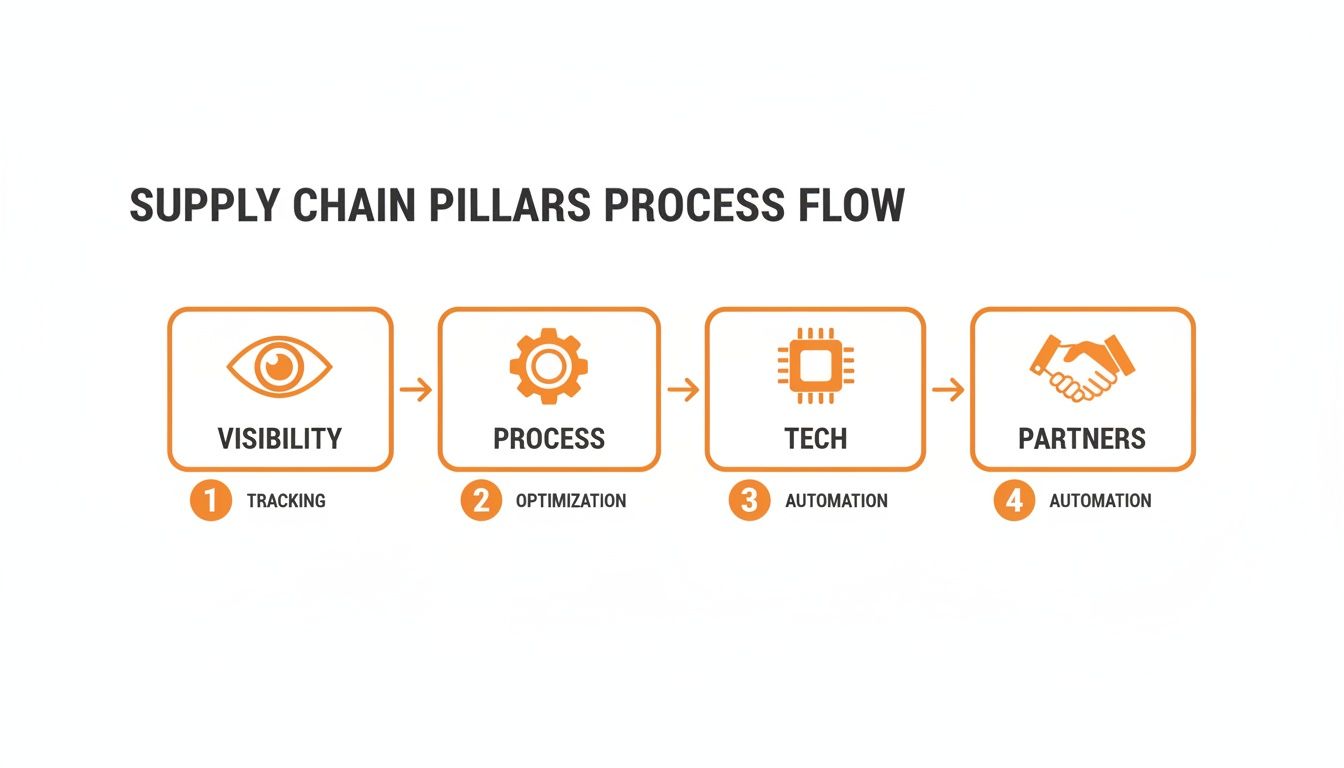
A solid forecast is the bedrock of an efficient supply chain. It dictates every purchase order you create and helps you dodge the cash-flow killers: overstocking and understocking. The goal here is to get proactive, not stay stuck in a reactive cycle of putting out fires.

To build a reliable forecast, you need to dig into your historical sales data and account for the variables that actually matter:

  • Seasonality: Are you selling more swimwear in June or more jackets in November? Pinpointing these predictable peaks and valleys is the first step.
  • Promotional Lifts: How much did sales jump during your last Black Friday event? You have to quantify that lift to plan for the next one accurately.
  • Market Trends: What’s happening outside your business? A viral TikTok video or a shout-out from an influencer can create demand surges out of nowhere.

A spreadsheet can tell you what sold last year, but it can’t tell you that your biggest competitor is about to launch a massive sale that will absolutely impact your numbers. The best forecasts blend historical data with real-world context.

Setting Intelligent Reorder Points

A brilliant forecast is useless if you don't act on it. This is where reorder points (ROPs) come in. A reorder point is simply the stock level that triggers a new purchase order for a SKU. It’s your automated alarm bell to replenish inventory before you hit zero.

To calculate your ROP, you need to know your supplier’s lead time (how long it takes for new stock to show up) and your daily sales velocity. You also need a buffer, called safety stock, to shield you from unexpected shipping delays or a sudden spike in sales.

The rise of AI is making this process even smarter. In fact, AI adoption in supply chain operations is expected to explode, jumping from 28% to 82% by 2025. On top of that, 86% of supply chain executives are already planning to invest in AI and analytics to cut costs. These tools can analyze complex patterns to set dynamic reorder points that adjust on the fly.

Here’s a quick look at how old-school forecasting stacks up against modern, AI-powered methods.

Traditional vs. AI-Powered Inventory Forecasting

Feature Traditional Forecasting AI-Powered Forecasting
Data Sources Relies mainly on historical sales data. Analyzes historical sales, market trends, weather, promotions, and more.
Methodology Manual calculations using simple formulas (e.g., moving averages). Uses machine learning algorithms to identify complex patterns and correlations.
Accuracy Prone to error, especially with volatile demand or promotions. Significantly more accurate; adapts to changing conditions automatically.
Labor Time-consuming and requires manual oversight. Automated, freeing up your team to focus on strategy.
Scalability Becomes unmanageable as SKU count and sales channels grow. Easily scales to handle thousands of SKUs and complex supply chains.

As you can see, leaning on modern tools isn't just a "nice-to-have"—it's becoming a competitive necessity for building an efficient supply chain.

Maintaining Rock-Solid Inventory Accuracy

Here’s the hard truth: your forecasts and reorder points are only as good as the data they’re built on. If your system says you have 100 units but your shelf only has 90, your entire strategy is compromised. That’s why maintaining inventory accuracy is completely non-negotiable.

While a full physical count once a year is okay, it’s disruptive and the data is stale almost immediately. A far better approach is cycle counting—counting small, specific sections of your inventory on a continuous, rotating schedule. For instance, you could count your top 20% best-sellers every month and your slower-moving items once a quarter. This method catches discrepancies early and keeps your data clean without having to shut down your whole operation.

To learn more about getting this level of precision, check out our guide on real-time inventory management. It’s a critical piece of the puzzle for any brand serious about scaling.

Putting Your Fulfillment and 3PL Integration on Autopilot

A man uses a tablet to manage smart inventory and logistics in a warehouse filled with colorful bins.

This is where the rubber meets the road. The pick, pack, and ship process is the moment of truth for your customers. A dialed-in fulfillment operation is the heartbeat of an efficient supply chain—it directly impacts how customers feel about your brand and, ultimately, your profitability.

Get this part right, and logistics stops being a cost center and starts becoming a powerful tool for building loyalty. The whole game boils down to speed and precision. Every single order needs to get picked, packed, and shipped out the door with zero mistakes and minimal delay. Any hiccup in this process creates a ripple effect, leading straight to late shipments and unhappy customers.

Building a Fulfillment Workflow That Actually Works

To hit peak efficiency, you have to think beyond just grabbing items off a shelf. Smart picking strategies are what separate the pros from the amateurs, drastically cutting down on the time your team spends walking the warehouse floor. Two of the most effective methods I’ve seen are batching and zoning.

  • Batch Picking: Instead of picking one order at a time, you group a bunch of them together. A picker can grab all the units of a single SKU for ten different orders in one go. It’s a simple change that slashes travel time.
  • Zone Picking: Think of this like an assembly line. You divide the warehouse into distinct zones, and pickers stick to their assigned area. Orders move from zone to zone, with each person adding the items they're responsible for before passing it along.

Warehouse automation has been slow on the uptake, but 2025 is a turning point. Right now, only about 25% of warehouses have any real automation in place, but that number is set to climb fast. For anyone selling on major platforms like Amazon, Shopify, or Walmart, automation means quicker turnaround times, fewer errors, and the ability to handle holiday rushes without hiring an army of temporary staff. For more on this trend, Liferay.com has some great insights.

The Make-or-Break Role of a 3PL Partner

For most e-commerce brands hitting a growth spurt, partnering with a Third-Party Logistics (3PL) provider is the only logical next step. A good 3PL takes storage, picking, packing, and shipping off your plate so you can focus on what you do best—marketing and building great products.

But here’s the thing: a successful 3PL relationship isn't just about handing over your inventory. It’s a true partnership built on clear communication and perfectly aligned processes. Before you even think about signing a contract, you need to hammer out a Standard Operating Procedure (SOP) document. This thing is your operational bible.

Your SOP needs to spell out every single detail, from how orders get sent to the 3PL's system to the specific type of packing tape they should use. If you leave anything open to interpretation, you're asking for trouble.

A great 3PL should feel like an extension of your own team. They need to get your brand, your products, and what your customers expect. If you want to dive deeper into finding the right partner, we have a whole guide on what a 3PL warehouse does.

Demystifying Amazon FBA Prep

If you’re selling on Amazon, sending products into their Fulfillment by Amazon (FBA) network adds a whole new layer of complexity. Amazon’s prep requirements are notoriously strict. One wrong move can lead to costly chargebacks, rejected shipments, or even getting your selling privileges suspended. An efficient supply chain has to nail these rules every single time.

This is where a knowledgeable 3PL becomes your best friend. They can manage the entire FBA prep process, ensuring you stay 100% compliant.

Here’s a quick rundown of the most common FBA prep tasks and why they matter:

Prep Task Why It's Important Consequence of Failure
FNSKU Labeling This is Amazon’s unique barcode that ties a product to you. It has to cover any old manufacturer barcodes. Amazon could lose your inventory or send the wrong items to customers. It’s a mess.
Poly Bagging Required for anything that could be damaged by dust or moisture, plus loose items or products in perforated boxes. Your products get damaged in the warehouse, and Amazon will charge you a per-item fee to fix it.
Bundling/Kitting If you sell multiple items as one unit, they must be packaged together with a clear "Sold as a Set" label. The warehouse team might break up your bundles, leading to incomplete orders and angry customers.

Getting FBA prep right from the start saves you a world of logistical headaches and protects your bottom line. It's not optional for serious Amazon sellers.

Turning Fulfillment into a Brand Experience

Finally, never forget that the package arriving at your customer's door is your last physical touchpoint with them. This is your final chance to make a great impression.

This is where value-added services, often handled by your 3PL, can really shine:

  • Kitting: Pre-assembling multiple items into a ready-to-ship gift set or subscription box.
  • Custom Packaging: Using branded boxes, custom tissue paper, or a thank-you insert to create a memorable unboxing moment.

By weaving these elements into your fulfillment workflow, you transform a simple logistical function into a powerful marketing tool. This is how you build an efficient supply chain that doesn't just support your growth—it actively drives it.

Closing the Loop with Returns and Key Metrics

A smiling warehouse worker in a safety vest places a package on a conveyor belt, with boxes and “EFFICIENT FULFILLMENT” text on the wall.

An efficient supply chain doesn't stop once a package lands on a customer's doorstep. The real pros know the job isn't done. Two critical, often overlooked, pieces of the puzzle are handling returns and actually measuring what matters.

Ignoring these is like running a marathon without checking your pace or learning from a bad race. Reverse logistics—the whole messy process of getting products back—can feel like a huge headache. But with a smart system, it’s a chance to win back customers and salvage value. At the same time, tracking the right data is what separates guessing from growing.

Building a Returns Process That Protects Your Bottom Line

Let's be honest, a clunky returns process is more than just an annoyance for your customers. It's a direct hit to your bottom line, burning up staff time and losing perfectly good inventory. The goal is simple: make it painless for the customer but ruthlessly efficient for your team. This all comes down to a clear, repeatable workflow.

Every time a return shows up at your dock, your team needs to know exactly what to do:

  1. RMA Verification: First things first, find the Return Merchandise Authorization (RMA) number. This is the golden ticket that connects the physical item back to the original order, which is essential for issuing refunds and knowing why it came back.
  2. Product Inspection: This is the moment of truth. Is the item brand new and ready to be resold? Is it slightly damaged? Is it even the right product? A quick but thorough check here decides its fate.
  3. Disposition: Based on that inspection, the item gets routed. Pristine products go right back into sellable inventory. Items with minor cosmetic damage might get funneled to a "scratch and dent" sale. Anything unsalvageable gets disposed of properly.

Think of every return as a clue. Is the same shirt coming back over and over because "the color is wrong"? That's not a warehouse problem; it's a signal to fix your product photos. A solid returns process doesn't just handle boxes—it gives you the intel to fix bigger issues at the source.

Measuring What Moves the Needle

There’s an old saying in logistics that’s gospel: you can't manage what you don't measure. To build a truly efficient supply chain, you have to track the key performance indicators (KPIs) that give you an honest look at how things are really going.

Don't get lost in a sea of data. Focus on the numbers that tie directly to your costs, your speed, and your customer's happiness. These metrics aren't just for fancy reports; they're your operational dashboard. If your Order Accuracy Rate suddenly drops, that's a flashing red light telling you something is wrong on the picking line—and you need to fix it before it becomes a customer service nightmare.

Here are the non-negotiable KPIs every e-commerce brand should have front and center:

  • Order Accuracy Rate: What percentage of your orders go out the door perfectly? No wrong items, no wrong quantities, no damage. You should be aiming for 99.5% or higher.
  • Inventory Turnover: How quickly are you selling through your entire stock? This tells you how well you’re managing the cash you have tied up in inventory.
  • On-Time Shipping Rate: The percentage of orders that shipped on or before the promised date. This is a direct measure of whether you're keeping your promise to the customer.
  • Cost Per Order: Add up all your fulfillment costs—labor, boxes, tape, shipping—and divide it by the number of orders you sent. This is your core efficiency metric.

A simple dashboard can make these numbers come alive. Imagine seeing your Cost Per Order trending down week after week while your On-Time Shipping Rate stays rock solid. That's the tangible proof that you're building a truly efficient supply chain. This data is what empowers you to spot problems, fix bottlenecks, and make smart decisions that fuel real growth.

Creating Your Playbook for Scalable Operations

The real test of your supply chain isn't how it runs on a quiet Tuesday morning. It’s about how it performs under extreme pressure. How do you handle 1,000 orders in a day during a flash sale with the same accuracy as you handle 100? The secret is to stop putting out fires and start building a playbook.

Forget the idea of a dusty binder on a shelf. A modern operations playbook is a living, breathing set of documented procedures that tells your team exactly what to do in high-stakes situations. This isn't about micromanaging—it’s about building muscle memory so your team can execute flawlessly when things get chaotic.

Planning for Predictable Chaos

Some of the biggest operational nightmares are the ones you can actually see coming. Seasonal rushes, product launches, and big promotions are all forms of predictable chaos that can bring an unprepared business to its knees. Your playbook needs dedicated chapters for these events.

Take Black Friday, for example. A solid playbook would break down the entire game plan:

  • Inventory Buffers: How much safety stock do you need for your best-sellers, and what’s the absolute latest it can be checked into the warehouse?
  • Labor Planning: A clear staffing schedule for the warehouse team, with pre-approved overtime and temporary help already lined up.
  • Carrier Communication: Giving your shipping carriers a heads-up on projected volume spikes so they can have trucks ready.

When you plan like this, a potentially frantic period just becomes a controlled, manageable process. You’re not guessing; you’re executing a plan you’ve already rehearsed.

Think of your playbook as an insurance policy against your own growth. It’s what ensures that success doesn't shatter the very systems you built to achieve it. Scaling smoothly means documenting the "how" before you're buried in a crisis.

Building Resilience for the Unexpected

Of course, you can't plan for everything. A key supplier might suddenly shut down production, or a major shipping lane could get hopelessly backed up. A truly efficient supply chain is resilient—it can pivot when things go sideways.

Your playbook for the unexpected needs to be all about rapid response and crystal-clear communication. What’s the plan if a container holding your hottest product gets delayed by two weeks?

The playbook should trigger a series of immediate, pre-defined actions:

  1. Communication Protocol: Who on the team is responsible for instantly looping in the marketing and customer service departments? No delays.
  2. Inventory Allocation: How do you prioritize the stock you have left? Maybe you pause all wholesale orders to save every last unit for your direct-to-consumer customers.
  3. Customer Messaging: Have pre-approved email templates and website banners ready to go, so you can proactively inform customers about potential delays.

By mapping out these responses ahead of time, you kill the panic and empower your team to take decisive action. This is the final piece of the puzzle, the step that ensures your supply chain can actually support your ambitions instead of holding you back.

Frequently Asked Questions About Supply Chain Efficiency

Digging into the nuts and bolts of logistics always brings up good questions, especially when you’re trying to build a truly efficient supply chain. Here are some of the most common things we hear from e-commerce sellers, along with our straight-to-the-point answers.

What Is the First Step to Improve My Supply Chain?

Before you do anything else, map out your current process from the moment a supplier shipment leaves their dock to when it lands on your customer’s doorstep. The first—and most impactful—place to start optimizing is almost always your inbound receiving.

Get this right, and everything else downstream just works better. If you have a rock-solid, standardized process for checking in, inspecting, and logging new inventory, you'll immediately prevent a cascade of problems like inaccurate stock counts and fulfillment errors.

How Do I Choose the Right 3PL for My Business?

Don't just look for a warehouse with space. You need a partner who gets your business. Look for a 3PL that has real experience with your specific product types and, just as importantly, your sales channels. If you’re selling on Shopify or a marketplace like Amazon FBA, a 3PL that's already deep in that world is non-negotiable.

Ask them for case studies from brands that look a lot like yours. Make sure their tech can keep up as you grow. A great partner should feel like an extension of your own team, not just another vendor on your expense report.

What Are the Most Critical KPIs to Track?

You could track dozens of metrics, but for most e-commerce brands, a handful of key performance indicators (KPIs) give you a powerful, at-a-glance snapshot of your operational health. Focusing on these is essential for building and maintaining an efficient supply chain.

  • Order Accuracy Rate: Are you sending the right stuff to the right people? This is ground zero for customer satisfaction.
  • On-Time Shipping Rate: Are orders actually leaving your warehouse when you promised they would? This is a direct measure of your reliability.
  • Inventory Turnover: Is your cash tied up in slow-moving stock, or are you selling through inventory efficiently? This metric is a direct line to your profitability.

Keeping a close eye on these three will help you move from just guessing to making sharp, data-driven decisions that actually move the needle on performance.


Ready to build an efficient supply chain that can keep up with your brand's growth? The team at Snappycrate specializes in fulfillment and FBA prep, turning your logistics from a headache into a real competitive advantage. Learn how we can support your growth at https://www.snappycrate.com.

0 Continue Reading →

Ways to improve supply chain efficiency: Tactics for faster operations

Improving your e-commerce operations really boils down to a handful of core strategies: getting visibility across all your channels, automating the right processes, nailing inventory management, and building rock-solid supplier relationships. These aren’t just line items on a P&L; they’re the pillars that shift your supply chain from a reactive cost center to a proactive, strategic weapon that actually drives growth.

Why Supply Chain Efficiency Is Your Greatest Competitive Edge

It’s time to stop thinking of your supply chain as just a series of costs to be managed—it's your most powerful competitive tool. For way too many e-commerce brands, frustrating stockouts, expensive fulfillment mistakes, and sky-high shipping costs just feel like the price of doing business. This guide is your playbook to change that narrative.

We're going to dive into the real-world strategies that take chaotic operations and turn them into a hyper-efficient growth engine. The goal here is to move beyond just shipping boxes and start building a tough, responsive system that keeps customers happy and protects your bottom line. An efficient supply chain isn't about cutting every possible corner; it's about making smart, data-driven moves that save you money while making your service better.

The Four Pillars of an Efficient Supply Chain

To really get a handle on your logistics, you need to focus on four connected areas. What’s great is that improving one almost always creates a positive ripple effect on the others, creating a powerful flywheel of efficiency.

  • Visibility: You can't fix what you can't see. The first, most critical step is getting a clear, real-time view of your inventory, orders, and shipments across every single warehouse and sales channel.
  • Process: This is all about refining the physical and digital workflows in your warehouse—everything from the moment a shipment arrives at your dock to the way you pick, pack, and get it out the door.
  • Technology: Putting the right software in place, like a Warehouse Management System (WMS), automates those repetitive tasks, cuts down on human error, and gives you the hard data you need to make sharp decisions.
  • Partnerships: Your suppliers, freight carriers, and any 3PLs are extensions of your team. Strong, collaborative relationships are absolutely essential for navigating disruptions and finding ways to win together. You can learn more about how a strong supply chain and warehouse management go hand-in-hand in our detailed article.

This diagram shows how these four pillars—Visibility, Process, Technology, and Partnerships—build on each other to create a more efficient operation.

Process flow diagram detailing four supply chain pillars: Visibility, Process, Tech, and Partners.

As you can see, operational excellence isn’t a one-and-done fix. It's a sequence of building blocks, with each one supporting the next. By tackling each pillar systematically, you can build a robust and scalable operation that’s ready for whatever comes its way.

Diagnosing Your Warehouse and Process Bottlenecks

You can't fix what you can't see. Before you start overhauling your supply chain, you have to get an honest, boots-on-the-ground picture of what’s actually happening in your warehouse. This is the diagnostic phase—moving beyond gut feelings to find the real friction points that are quietly draining your time and money.

The best way to start? Walk the path of an order. Literally. Follow its entire journey from the moment it’s received to the second it leaves your dock. How many steps does a picker take to grab a single item? How many different people touch a single order before it’s sealed in a box? These simple observations often reveal shocking inefficiencies that never show up on a spreadsheet.

Where to Look for Hidden Inefficiencies

Pinpointing the exact source of a delay means zooming in on specific stages of your fulfillment process. Every step is an opportunity for improvement, but some areas are notorious for hiding the biggest bottlenecks. You're not just looking for obvious train wrecks; you're hunting for the small, repetitive actions that compound into massive wasted effort over thousands of orders.

A classic culprit is your warehouse layout. Is it actually designed around how you sell, or is it just organized by SKU number or whenever the inventory showed up? I see this all the time: a brand’s fastest-selling products are tucked away in the back of the warehouse, forcing the team to walk past slow-moving junk on every single pick.

I worked with a Shopify seller selling custom phone cases who was stuck with a two-day processing time. A quick audit revealed their top 20 SKUs made up 80% of their sales but were scattered randomly across the shelves. We moved those items into a dedicated "fast-mover" zone right next to the packing station, and just like that, they cut their average order processing time in half.

Key Metrics to Guide Your Audit

To take the guesswork out of your diagnosis, you need to track the right data. Numbers don’t have opinions—they point you directly to your biggest operational headaches. Focusing on a few key performance indicators (KPIs) gives you a clear baseline to measure your improvements against.

Get started with these critical metrics:

  • Order Cycle Time: This is the total time from when a customer clicks "buy" to when the package lands on their doorstep. A long cycle time can signal anything from picking delays to slow carrier handoffs.
  • Pick Accuracy: What percentage of your orders are picked perfectly the first time? Anything below 99% is a red flag. It points to issues with slotting, labeling, or your picking process, and it always leads to costly returns and angry customers.
  • Receiving Dock-to-Stock Time: How long does it take for new inventory to get checked in, put away, and become available for picking? If this process takes days instead of hours, you're risking stockouts even when the product is sitting in your building.

Analyzing these numbers gives you a data-backed roadmap for what to fix first. This methodical approach is a cornerstone of effective warehouse management for e-commerce, ensuring your efforts are focused where they’ll make the biggest difference.

Finally, pull your findings together into a simple self-audit. It doesn't need to be fancy; a basic checklist is all you need to organize your thoughts and prioritize what to tackle.

Key Areas for Your Supply Chain Self-Audit

Use this table as a starting point to turn your observations into a concrete action plan. Ask yourself these questions for each key area of your operation to identify where the biggest opportunities for improvement lie.

Operational Area Key Question to Ask Metric to Measure
Warehouse Layout Are my fastest-selling items easily accessible? Average pick time per order
Picking Workflow How many steps does my team take to fulfill an order? Steps per pick; orders per hour
Packing Station Are all necessary supplies within arm's reach? Units packed per hour
Inbound Receiving How quickly is new inventory available for sale? Dock-to-stock time (in hours)

This simple framework transforms that vague feeling that "things could be faster" into a clear list of problems to solve. By methodically diagnosing these bottlenecks, you’re laying the essential groundwork to build a truly efficient supply chain.

Turning Inventory Into Your Smartest Asset

Inventory is the lifeblood of any e-commerce brand, but let's be honest—it’s also a massive headache. Carry too much, and your cash is tied up in boxes gathering dust. Carry too little, and you're dealing with stockouts, lost sales, and frustrated customers.

The secret to improving your supply chain isn't just counting what you have. It's about turning your inventory into a dynamic, intelligent asset that actively works for you. This means getting strategic about how you manage, prioritize, and forecast every single product.

A fantastic place to start is with ABC analysis. It’s a simple but incredibly powerful method for categorizing your inventory based on its real value to your business, ensuring your most important products always get the VIP treatment they deserve.

Man in a warehouse scanning a box, performing a warehouse audit for supply chain efficiency.

Prioritizing Your Products With ABC Analysis

Ever heard of the 80/20 rule? ABC analysis is basically that principle applied directly to your warehouse shelves. You break down your entire product catalog into three tiers:

  • A-Items: These are your superstars. They represent the top 10-20% of your SKUs but generate a whopping 80% of your revenue. These products demand the tightest inventory control, the most frequent cycle counts, and the best real estate in your warehouse.
  • B-Items: This is your solid middle group. They typically make up 30% of your SKUs and contribute about 15% of your revenue. They need moderate attention but don't require the constant babysitting your A-Items do.
  • C-Items: These are the slow-movers, the long-tail products. They might make up 50% of your total SKUs but only bring in around 5% of revenue. You can manage this inventory with a much looser grip, maybe using a periodic review system instead of constant monitoring.

Once you categorize your products this way, you can stop treating every SKU the same. It lets you focus your limited time and money where it will make the biggest impact.

Setting Smart Reorder Points and Buffer Stock

Now that you know which products are your breadwinners, the next job is to prevent stockouts without over-ordering. This is where setting automatic reorder points is a game-changer. A reorder point is simply the lowest stock level a product should hit before you place a new order with your supplier.

To calculate it properly, you'll need your lead time demand (that's your average daily sales multiplied by the supplier's lead time in days). Then, you add a layer of buffer stock, also called safety stock.

Buffer stock is your insurance policy against the chaos of e-commerce. It’s the extra inventory you keep on hand to guard against a sudden spike in demand or an unexpected delay from your supplier. A common mistake is applying a generic buffer—like two weeks of stock—to everything. Your A-Items need a much healthier buffer than your slow-moving C-Items.

For example, say you sell 10 units of a popular A-Item per day, and your supplier takes 14 days to deliver. Your lead time demand is 140 units. If you add a 7-day buffer (70 units), your reorder point should be set at 210 units. This simple calculation ensures you have enough stock to keep selling while the new shipment is on its way, plus a cushion for when things go sideways.

The Amazon Seller Challenge: IPI Score and FBA

For Amazon sellers, this whole inventory game gets an extra layer of difficulty: the Inventory Performance Index (IPI) score. This metric, from 0 to 1,000, is how Amazon grades your FBA inventory management. A low score can slam you with storage limits and higher fees, directly hitting your bottom line.

To keep your IPI score healthy, you have to juggle a few key factors:

  • Excess Inventory: Don't clog up FBA with slow-moving products.
  • Sell-Through Rate: Keep your products turning over by aligning stock levels with sales velocity.
  • Stranded Inventory: Fix any listing problems immediately so your products are actually buyable.
  • In-Stock Inventory: Make sure your most popular and profitable items are always available.

Many smart sellers use a hybrid strategy. They keep a small, fast-moving supply at FBA to protect their IPI score, while holding the rest of their inventory with a 3PL partner. This lets them replenish FBA in a flash without getting hit with long-term storage fees on slower products. To really nail this down, you can learn more about these inventory management best practices.

When you make your inventory work for you, not against you, you’re building the foundation for a truly efficient supply chain.

Using Automation and Tech to Scale Your Operations

A tablet displaying smart inventory software on a shelf amidst clear storage bins in a warehouse.

If you're still running your warehouse on spreadsheets and gut feelings, you're going to hit a wall. Sooner or later, manual processes become the bottleneck that chokes your growth. This is the point where technology isn't just a nice-to-have; it's the only way to scale without everything falling apart.

Embracing automation isn't about filling your warehouse with robots (though that can be part of it). It’s about being smart with software to kill repetitive tasks, slash human error, and get the data you need to make quick, informed decisions. Your tech stack is the central nervous system of your entire supply chain.

Implementing a Warehouse Management System

One of the biggest levers you can pull for efficiency is adopting a Warehouse Management System (WMS). A WMS is basically the mission control for your warehouse, giving you a live look at everything from the moment a product hits your dock to the second it’s on a truck to a customer.

It digitizes your entire workflow, and the improvements are almost immediate.

  • Real-Time Inventory Visibility: A WMS tracks every single item, so you know exactly where it is. No more hunting for "lost" products, and your website's stock levels are always spot on.
  • Optimized Picking Paths: The system tells your team the most efficient route to pick an order, which dramatically cuts down on wasted steps and boosts how many orders one person can pick in an hour.
  • Fewer Picking Errors: With barcode scanners and system checks, a WMS can get your picking accuracy close to 100%. That means fewer returns, happier customers, and less money wasted on fixing mistakes.

A WMS turns organized chaos into a finely tuned, data-driven operation. It's the foundation that lets you scale from hundreds of orders a month to thousands without your team breaking a sweat.

A lot of smaller brands think a WMS is just for giants like Amazon. That's not true anymore. There are plenty of cloud-based WMS platforms built specifically for growing e-commerce businesses, and they're more affordable than you think.

The Rise of AI in Supply Chain Management

Beyond a WMS, Artificial Intelligence (AI) is quickly becoming the go-to tool for getting ahead of problems. AI isn't just about automating simple tasks; it’s about predictive analytics that help you make decisions before you're in crisis mode.

AI can sound intimidating, but its real-world uses are incredibly practical. For instance, an AI-powered system can chew through your sales history, current market trends, and even social media chatter to give you a demand forecast that's way more accurate than any human could create.

Imagine getting an alert that a key product is at risk of stocking out in three weeks because an influencer just mentioned it. That's the power of AI. It gives you a heads-up so you can place a PO and avoid a stockout entirely. It can also flag a delayed inbound shipment and suggest reallocating inventory from another channel to cover your immediate needs.

The results speak for themselves. Companies using these tools are seeing huge efficiency gains. In markets like the US and Europe, brands report up to 20-30% faster order fulfillment when AI flags issues and suggests solutions. For a deep dive into what's coming, check out these supply chain AI trends on dataiku.com.

Choosing the Right Tech for Your Business

With so many options out there, it’s easy to get overwhelmed. The secret is to start by tackling your biggest headache first.

If your problem is… Look for technology that offers…
Frequent stockouts or overstocking Advanced inventory forecasting and automated reorder points.
High rate of picking/shipping errors A WMS with barcode scanning and order verification features.
Slow order fulfillment times Software with smart picking strategies and batch processing.
Lack of operational visibility A centralized dashboard with real-time analytics and reporting.

You don't need to buy a massive, do-it-all system on day one. Start small, focus on the tools that solve your most expensive problems, and build from there. By adding technology strategically, you build a resilient operation that's ready for whatever growth comes your way.

Building Stronger Supplier and Inbound Logistics

Worker in a warehouse using a tablet to monitor and automate operations on conveyor belts.

A slick supply chain doesn't just happen after a customer clicks "buy." It starts way, way back with the partners who actually make your products. If your inbound game is a mess—unpredictable, slow, and disorganized—you'll spend all your time putting out fires instead of growing your brand.

This is all about building a foundation of resilience and predictability. You need to trust that your suppliers can deliver on time, every time. And you need a rock-solid process for getting that inventory off the truck and onto your shelves without creating a massive traffic jam at the receiving dock.

Diversify Suppliers and Rethink Your Geography

Relying on a single factory for your best-selling product is just asking for trouble. One hiccup on their end—a production delay, a shipping nightmare, a port shutdown—and your entire business grinds to a halt. It's a massive single point of failure.

That's why smart brands always have a backup plan. Having a primary and a secondary supplier for your A-Items is non-negotiable. It gives you a safety net, strengthens your negotiating power, and helps keep quality high.

But it’s not just about having more names on a list. It’s also about where they are.

The move toward nearshoring—sourcing from countries closer to home—is exploding for a reason. With global supply chains still feeling shaky, brands are strategically shifting production to more stable regions. We're seeing businesses cut their lead times and risk exposure by 15-25% just by making this change. It's not about ditching your global partners, but about creating a more balanced, bulletproof network. You can dig deeper into these evolving supply chain trends on rfgen.com.

Establish Crystal-Clear Inbound Guidelines

Want to speed up receiving? Make it painfully easy for your suppliers to send you inventory exactly how you want it. Stop assuming they know your process. Create a formal Supplier Inbound Guide and bake it into every purchase order you send.

This document needs to be brutally specific, with pictures and diagrams—leave zero room for error.

  • Carton Labeling: Show the exact size, format, and placement for all carton labels. Mandate barcodes, SKUs, quantities, PO numbers, and country of origin.
  • Pallet Configuration: Lay out the rules for how cartons are stacked. Define the max height and weight. Specify if pallets can contain mixed SKUs or must be single-SKU only.
  • Documentation: Make an electronic Advanced Shipping Notice (ASN) mandatory. It should be sent the second the freight leaves their facility, giving your team a critical heads-up to plan labor and space.

A well-defined inbound guide is a massive efficiency lever. When your team can scan a pallet and know exactly what's on it without opening a single box, your dock-to-stock time can shrink from days to just a few hours.

Master Your Receiving and Quality Control Process

Finally, your own inbound process needs to run like clockwork. When a container shows up, your team should have a clear, repeatable workflow ready to go.

This starts with scheduling delivery appointments. The last thing you want is three trucks showing up at once, completely overwhelming your dock crew and creating chaos.

As pallets come off the truck, step one is verification. Does the physical shipment match the ASN and the PO? Any issues get flagged on the spot. From there, your QC team can jump in to perform spot checks based on your quality standards. This ensures you catch any defects before a product ever hits a pickable shelf location.

Nailing your supplier relationships and inbound logistics creates a powerful ripple effect. Predictable lead times make your forecasting more accurate. Clear labeling makes putaway faster. And tight quality control stops bad products from ever reaching your customers.

When to Partner With a 3PL for Strategic Growth

At some point, every successful e-commerce founder has the same realization: they're spending more time wrestling with packing tape and shipping labels than they are actually growing their business.

Handling fulfillment in-house feels like the ultimate form of control when you're starting out. But as you scale, that control quickly becomes a bottleneck. Your time is your most valuable asset, and if it's being spent in the warehouse instead of on marketing, product development, or building your brand, you're holding yourself back.

This is the inflection point where partnering with a Third-Party Logistics (3PL) provider stops being a "nice to have" and becomes one of the smartest strategic moves you can make. It’s not about admitting defeat; it’s about recognizing that your genius lies in creating and selling great products, not in the highly specialized, capital-intensive world of logistics.

Telltale Signs You've Outgrown In-House Fulfillment

So, how do you know when it's time? The signs are usually pretty clear. If you find yourself nodding along to any of these scenarios, it’s time to start looking for a logistics partner. These aren't just minor growing pains—they're signals that your current operations are capping your growth.

  • You’re the Chief Packing Officer: If you, the founder, are still packing boxes, you're the most expensive person on your own pick-and-pack line. Your focus should be on strategy, not on fulfilling individual orders.
  • You Can't Keep Up With Orders: Are you constantly underwater during peak season? Or maybe even just a busy Tuesday? A good 3PL is built for this. They scale their labor and resources up or down in real-time, so you never become a victim of your own success.
  • Your "Warehouse" Is Your Garage: When inventory starts taking over your office, your garage, and every spare closet, you’re not just creating a mess—you're running an inefficient operation. A 3PL gives you instant access to professional warehouse space without the headache of a long-term commercial lease.
  • Your Shipping Rates Are Too High: 3PLs ship millions of packages a year. They have access to deeply discounted rates from carriers like UPS, FedEx, and USPS that a small or mid-sized business could never get on its own.

Partnering with a 3PL shifts fulfillment from a fixed cost to a variable one. You pay for what you use, which means your logistics expenses scale perfectly with your revenue.

The Power of Centralization and Scale

One of the biggest wins you get with a 3PL is centralization. Instead of juggling a dozen different tasks and systems, a 3PL becomes your single operational hub. This approach is designed to unify all the repetitive work under one roof, using scale to drive down costs and improve efficiency. In fact, industry reports show this model can cut operational costs by 10-20% while making your business far more agile. You can find more insights on this in Supply Chain Dive's recent analysis.

You get the benefits of enterprise-level technology and infrastructure without having to build or pay for it yourself.

A great 3PL isn't just a vendor; they are a true extension of your team. They bring the operational expertise, the tech stack, and the physical space that allows you to compete with much larger brands.

Specialized Services a 3PL Handles Seamlessly

Beyond just picking, packing, and shipping, a modern 3PL offers a whole menu of value-added services that are a massive headache to manage in-house. These services are often what unlock new sales channels and create a better customer experience.

Think about common e-commerce needs:

  • Amazon FBA Prep: Selling on Amazon means playing by their rules, and those rules are complex. A good 3PL can handle everything—from applying FNSKU labels and poly bagging to creating case packs—to ensure your inbound shipments are 100% compliant. This saves you from costly penalties and receiving delays.
  • Custom Kitting and Bundling: Want to sell a "starter kit" or bundle three of your products for a holiday promotion? A 3PL can build these kits on demand, turning your individual SKUs into new, high-value offerings without you having to pre-assemble a single one.
  • Freight Management: Getting your inventory from your supplier to the warehouse is a job in itself. Whether it’s a full container from overseas or a smaller LTL shipment, a 3PL with freight capabilities can coordinate the entire process—receiving, unloading, pallet breakdowns, and quality checks—so your inventory gets from the dock to a stockable shelf fast.

When you hand off these complex operational tasks, you free up an incredible amount of mental and physical energy. You can finally stop worrying about the tactical details and pour that energy back into what really moves the needle: building an amazing brand.


Ready to stop packing boxes and start scaling your brand? Snappycrate is the trusted 3PL partner for growth-minded e-commerce sellers. We handle everything from secure storage and inventory management to fast, accurate order fulfillment and compliant Amazon FBA prep, so you can focus on what you do best. Get a quote and see how we can streamline your operations.

0 Continue Reading →

Automated Inventory Tracking: Cut Stockouts and Boost Online Profits

If you're still relying on spreadsheets to track your inventory, you know the feeling. A big sale kicks off, the orders start rolling in, and you're just hoping the numbers in front of you are accurate. That uncertainty is the quiet tax you pay for manual inventory management—a system that seems to work just fine until, all at once, it doesn't.

The Hidden Costs of Manual Inventory Management

Picture this: you launch a hot new product. Orders are flying in from your Shopify store, Amazon, and Walmart at the same time. Your team is scrambling to keep the master inventory sheet updated, but there's a lag. It's only a few minutes, but it's enough.

Before you know it, you've sold 100 units that you don't actually have in stock. Now you're facing a tidal wave of angry customer emails, canceled orders, and bad reviews that stain your brand's reputation. This isn't just a worst-case scenario; it's the inevitable result of a disconnected, lagging system.

From a Blurry Photo to a Live Video Feed

Trying to run a business with manual inventory tracking is like navigating with a blurry photo of your warehouse that was taken last Tuesday. It gives you a static, outdated snapshot. You might have seen 500 units of your top-seller on Monday, but by Thursday, that number is pure fiction.

Automated inventory tracking, on the other hand, is like having a continuous, high-definition video feed of your entire operation. It's a live, accurate view of every single item you own, at every moment, across all your warehouses and sales channels.

An automated system gets rid of the guesswork that leads to those expensive, brand-damaging mistakes. Instead of just reacting to problems after they’ve already happened, you gain the foresight to prevent them completely. Your inventory stops being a constant liability and starts becoming a strategic asset.

This shift is everything when it comes to scaling your business. When you can trust your inventory data, you can run promotions with confidence, expand to new marketplaces without fear, and make much smarter purchasing decisions. You stop tying up cash in overstocked products that just collect dust and stop losing sales because your best-sellers went out of stock unexpectedly. For a deeper dive into foundational principles, you can learn more about inventory management best practices in our detailed guide.

The True Price of Inaccuracy

The fallout from manual errors goes way beyond a single oversell. It creates a domino effect that can destabilize your entire business.

  • Wasted Labor: Every hour your team spends doing manual cycle counts or trying to reconcile conflicting spreadsheets is an hour they aren't spending on marketing, product development, or actually helping your customers.
  • Poor Capital Allocation: Without real-time data, you're flying blind. You’re far more likely to sink money into slow-moving products while completely missing out on restocking your proven winners.
  • Damaged Customer Loyalty: Nothing kills customer trust faster than a canceled order. In fact, 88% of consumers say they are less likely to buy from a brand again after a bad fulfillment experience.
  • Operational Bottlenecks: Bad counts lead to disorganized warehouses, inefficient picking routes, and slow fulfillment times. It puts a hard ceiling on how many orders you can physically get out the door each day.

Ultimately, manual tracking creates friction at every single turn. Moving to automated inventory tracking isn't just about getting new software; it's about building a resilient, scalable foundation that your e-commerce business can actually grow on.

How Automated Inventory Tracking Systems Work

If you’ve ever tried to manage inventory with a spreadsheet, you know the feeling of chasing numbers that are already out of date. Automated inventory tracking swaps that manual guesswork for a coordinated system where every component works together, turning physical products into reliable digital data.

Think of it as a complete operational upgrade. It closes the gap between what's on your shelves and what's in your system, eliminating the human error that leads to costly mistakes.

The whole process starts by giving each of your products a unique identity.

Barcodes and QR Codes: The Digital Fingerprints

The bedrock of any automated system is giving every single item a unique "digital fingerprint." That's exactly what barcodes and QR codes do. Just like a real fingerprint, each code is one-of-a-kind and stores specific, machine-readable information—like a product’s SKU, batch number, or expiration date.

This simple tag transforms a generic box into a trackable asset. When a new shipment arrives, each item gets its fingerprint and is officially logged into your digital ecosystem. From that moment on, every move it makes can be recorded with perfect accuracy.

Scanners: The Eyes of the Operation

If barcodes are the fingerprints, then handheld scanners and mobile devices are the sharp "eyes" of your warehouse. When an employee scans an item during receiving, picking, or packing, the device instantly reads the barcode and sends the data back to your central system. It’s the digital version of a tally mark, but it happens in a split second with zero chance of a typo.

These scanners capture data at every critical point in your workflow, from the receiving dock all the way to the outbound shipping station. This constant flow of information builds a complete history of every item’s journey through your facility.

Without these digital eyes, businesses are forced to rely on manual counts, which is a direct path to the problems shown below.

Infographic showing how manual inventory management leads to common problems like overselling and stockouts.

As you can see, a lack of automated data capture is what causes expensive issues like overselling products you don't have and running out of stock unexpectedly.

RFID: The E-ZPass for Your Warehouse

Barcodes are great, but they need a direct line of sight to be scanned. Radio-Frequency Identification (RFID) technology takes things a huge step forward. Think of it like an E-ZPass system for your inventory—you don't need to stop and aim.

An RFID tag contains a tiny chip and antenna that can be read from a distance. This means a warehouse worker can walk down an aisle with a reader and capture data from hundreds of tagged items at once, instead of scanning one box at a time. It’s a game-changer for doing fast, bulk inventory counts.

Warehouse Management System: The Central Brain

All that data from scanners and RFID readers has to go somewhere. This is where a Warehouse Management System (WMS) comes in—it’s the "central brain" of your entire operation. This software platform is where every piece of inventory data is received, processed, and organized in real time.

Your WMS becomes the single source of truth for your business. It knows:

  • How many units of every SKU you have.
  • The exact location of each item in the warehouse.
  • Which products are getting close to their expiration dates.
  • When you need to reorder to prevent a stockout.

This central hub is what powers your e-commerce engine. By integrating with sales channels like Shopify or Amazon, the WMS automatically subtracts inventory as orders come in, preventing you from selling items you don't have. You can finally trust your numbers. To dig deeper, check out our guide on real-time inventory management.

The Business Benefits of Automating Your Inventory

Knowing how scanners and software talk to each other is one thing. But the real magic of automated inventory tracking is what it does for your bottom line. Switching from manual methods isn't just a tech upgrade; it's a strategic move that directly boosts profitability, builds customer loyalty, and gives you the power to scale.
The cost of a simple manual error is often invisible until it’s a full-blown disaster. Inventory management mistakes quietly bleed cash from e-commerce businesses everywhere. In fact, inventory distortion—which includes both running out of stock and having way too much—costs retailers a mind-boggling $1.77 trillion globally. Businesses that adopt automated solutions see a massive difference, often cutting stock discrepancies by up to 30%. That means fewer stockouts and fewer angry customers trying to buy products you don't actually have. You can see more on these findings in this automated inventory management report from Quicksync.pro.

Warehouse worker uses a laptop for faster fulfillment of orders, surrounded by boxes.

Before we dig deeper, let’s quickly compare the old way versus the new way.

Manual vs Automated Inventory Tracking at a Glance

The table below paints a clear picture of just how different these two approaches are, highlighting the massive operational and financial gains that come from automation.

Feature Manual Tracking Automated Tracking
Data Entry Pen, paper, spreadsheets. Prone to typos and delays. Barcode/RFID scanners. Instant and error-free.
Accuracy Often below 95%. Small mistakes compound over time. Pushes 99% or higher. Consistent and reliable.
Labor Cost High. Hours spent counting and reconciling inventory. Low. Frees up staff for high-value tasks.
Visibility Days or weeks old. A snapshot of the past. Real-time. See stock levels the second they change.
Fulfillment Speed Slow. Staff must manually locate items. Fast. Optimized picking paths and instant verification.
Decision Making Based on old data and gut feelings. Risky. Data-driven. Smart purchasing based on live trends.

As you can see, the difference isn't just about speed; it's about control, insight, and ultimately, profitability. Now, let’s break down exactly where you'll see these benefits.

Eliminate Costly Human Error

Every time a number is typed into a spreadsheet, there's a chance for a mistake. A simple typo can send the wrong item to a customer, kicking off a chain reaction of costly returns, wasted shipping fees, and a seriously unhappy buyer. A miscount during receiving can create "phantom stock," leading you to sell products that aren't actually on the shelf.

Automation kills these risks at the source. When a barcode is scanned, the right data is captured instantly and perfectly, every single time. This kind of precision stops the small, silent errors that chip away at your profit margins day after day.

Unlock Significant Labor Savings

Think about all the hours your team spends on manual inventory chores. Walking the warehouse with a clipboard, fighting with spreadsheet formulas, and trying to figure out why your Shopify numbers don't match your Amazon numbers. These are low-value, repetitive tasks that burn through payroll without adding a dime to your growth.

By automating this grunt work, you free up your team’s most valuable asset: their time. Instead of counting boxes, they can focus on work that actually moves the needle—like improving customer service, finding better suppliers, or launching a new marketing campaign. This turns your labor cost from a necessary evil into a strategic investment.

The goal isn't just to do the same tasks faster; it's to reallocate your human capital toward activities that a machine could never perform—like building relationships and creating value for your customers.

Drastically Improve Order Fulfillment

In e-commerce, speed and accuracy are the name of the game. Customers expect their orders to be right and to show up fast. Automated inventory tracking is the engine that powers a reliable fulfillment machine.

When an order hits, the system knows exactly where to find each item in the warehouse, instantly generating the most efficient picking route for your team. This slashes the time it takes to grab products and get an order ready. Better yet, verification scans at the packing station make sure the right items go into every box, pushing your order accuracy rates toward 99% and beyond.

This operational excellence translates directly into a better customer experience. Fast shipping and perfect orders build the kind of trust that creates repeat customers—the bedrock of any lasting brand.

Make Smarter Purchasing Decisions

One of the biggest wins from real-time data is the power to see trends as they're happening. An automated system gives you a crystal-clear, up-to-the-minute picture of how fast every single one of your SKUs is selling.

This newfound visibility allows you to:

  • Prevent Stockouts: Set smart reorder points that automatically tell you when it's time to restock a hot seller, so you never miss a sale.

  • Avoid Overstocking: Easily spot slow-moving products and stop tying up your cash in stuff that just sits there.
  • Optimize Cash Flow: Make confident, data-backed decisions on where to put your purchasing dollars for the biggest return.

At the end of the day, automated inventory tracking turns your inventory from a source of stress into a powerful strategic asset. It gives you the control, accuracy, and insight you need to run a leaner, more profitable, and scalable e-commerce business.

Integrating Your Systems for Seamless Operations

An automated inventory system is a huge leap forward, but its real power is unlocked when you connect it to the rest of your e-commerce world. If your inventory data is stuck in a silo, it can't talk to the platforms where you actually sell. This is where integrations come in—they're the critical link for creating a truly hands-off operation.

These connections are made possible by Application Programming Interfaces (APIs). Think of an API as a dedicated messenger that runs back and forth between your warehouse management system (WMS) and your online store. Its only job is to make sure both sides have the exact same information, all the time.

When your systems are hooked up like this, your business stops feeling like a collection of separate parts and starts acting like a single, well-oiled machine.

Connecting Your E-Commerce Platform

For any brand selling directly to consumers, the first and most important integration is with your e-commerce platform. Whether you’re on Shopify, BigCommerce, or something else, a direct API link is non-negotiable if you want real-time accuracy.

Here’s a simple breakdown of how it works:

  1. A customer buys one of your best-sellers on your Shopify store.
  2. The API instantly shoots that sales data from Shopify over to your WMS.
  3. Your WMS immediately deducts that unit from your master inventory count.
  4. The API then updates the stock level right back on your Shopify product page.

This entire loop happens in a matter of seconds, without anyone lifting a finger. It’s this instant sync that makes overselling a thing of the past. Your website will never show an item as "in stock" when it just sold out, which protects your brand's reputation and saves you the headache of canceling orders.

Mastering Marketplace Integrations

Selling across multiple channels makes perfect synchronization even more critical. An automated inventory tracking system that plugs into marketplaces like Amazon and Walmart is a must-have for any multi-channel brand. Without it, you’re stuck manually updating inventory levels on each platform—a recipe for disaster, especially during a flash sale.
A seamless integration ensures that a sale on Amazon instantly updates your available stock on Walmart and your own website. This centralized control is the only way to scale a multi-channel strategy without constant chaos and costly errors.
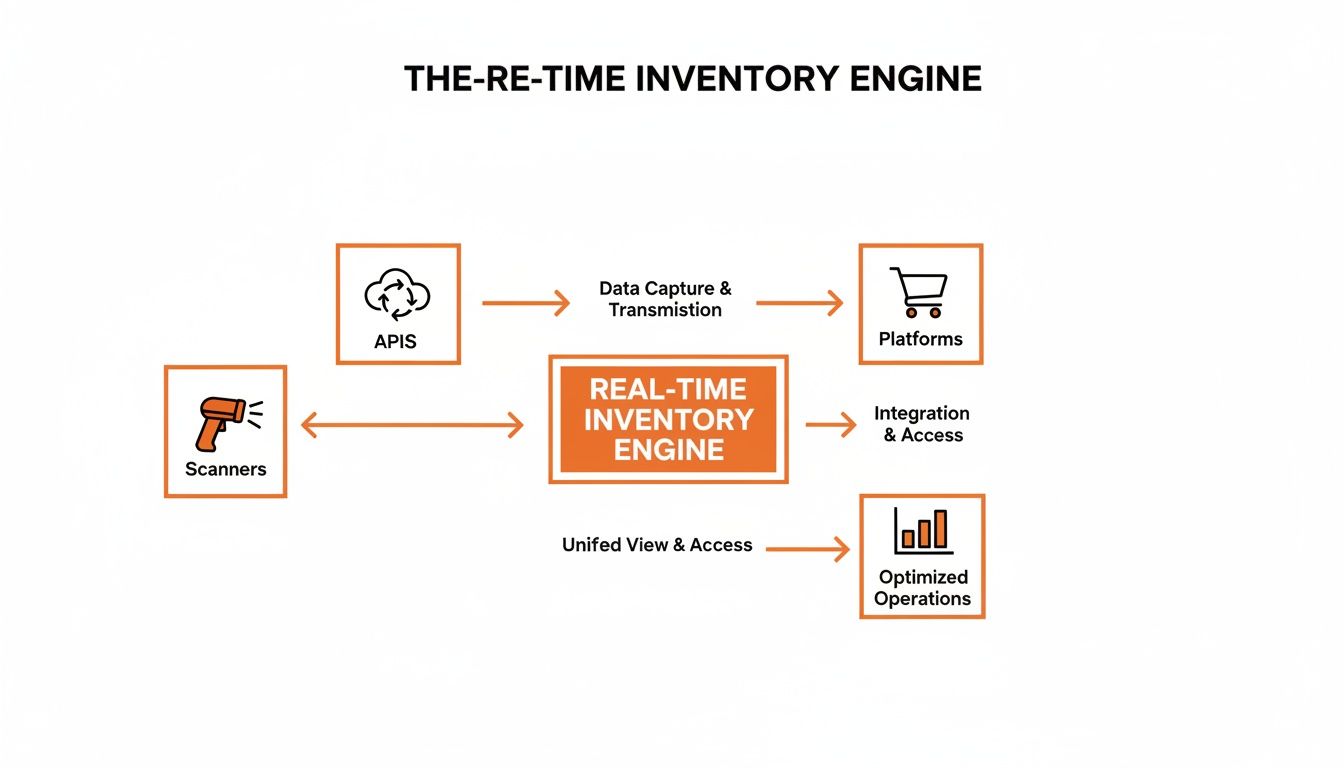
This level of connectivity is also crucial for protecting your seller performance metrics. Marketplaces like Amazon are ruthless about penalizing sellers who cancel orders due to stockouts, which can tank your rankings or even get your account suspended. Automation is your best defense.

As your brand grows, it's also worth understanding what a 3PL warehouse is and how partners like us manage these complex integrations on your behalf.

Creating a Single Source of Truth

At the end of the day, the goal of integration is to create a single, undisputed source of truth for your inventory. When your e-commerce store, marketplaces, and WMS are all pulling from the same live data, every part of your business is finally on the same page.

This unified view allows you to:

  • Run Confident Promotions: Launch a flash sale knowing your inventory numbers are rock-solid across every channel.
  • Get Accurate Reporting: Pull a clean, consolidated report on sales velocity and inventory value without wrestling with a dozen spreadsheets.
  • Operate Efficiently: Your warehouse team gets orders instantly, and your marketing team knows exactly what’s available to promote.

Integration isn't just a technical add-on; it's the backbone of a modern, scalable e-commerce business. It turns your automated inventory system from a simple counting tool into the central nervous system of your entire operation.

Your Roadmap to Implementing Automation

Making the jump to automated inventory tracking can feel like a huge project, but breaking it down into a clear roadmap makes it completely manageable. This isn't just about buying fancy new scanners; it's about building a rock-solid operational backbone for your entire business. And the journey starts not with technology, but with a hard look at what you already have.

Three professionals collaborate on a digital implementation plan using a tablet, stylus, and whiteboard in an office.

Conduct an Initial Inventory Audit

Before you can even think about automating, you need a perfectly clean slate. That means doing a full, wall-to-wall physical inventory count—it's the first, non-negotiable step. Think of it as hitting the reset button. You have to iron out every single discrepancy between what your spreadsheet says you have and what's actually sitting on your shelves.

Starting with bad data is like building a house on a shaky foundation. If your initial counts are off, your shiny new system will be wrong from day one, defeating the whole purpose. This baseline audit ensures your automated inventory tracking system kicks off with a trustworthy, 100% accurate snapshot of your stock.

Select the Right Software and Hardware

With your inventory counts squared away, it’s time to choose the tools that actually fit your business. There’s no magical one-size-fits-all solution here. The right gear depends entirely on how complex your operation is.

As you look at your options, consider these key factors:

  • SKU Count: A brand with 50 SKUs has totally different needs than one juggling 5,000. Make sure the software can handle your catalog's size without breaking a sweat.
  • Order Volume: Think about your average day versus your Black Friday peak. Your system needs to handle the pressure without crashing.
  • Sales Channels: Are you just on Shopify, or are you also selling on Amazon, Walmart, and through wholesale? Your system has to talk to all of them seamlessly.
  • Hardware Needs: Are simple barcode scanners good enough, or do you need the raw speed of RFID to handle bulk receiving and rapid cycle counts?

Choosing the right tools is all about balancing where you are today with where you want to be tomorrow.

Manage Data Migration and System Configuration

Once you've picked your system, you have to carefully transfer your product data into it. This step, called data migration, is way more than a simple copy-paste job. You'll need to map all your current data fields—like SKUs, product names, and costs—to the new system's format, making sure nothing gets lost or scrambled in the process.

Getting the configuration right is just as crucial. This is where you set up your warehouse map (aisles, shelves, and bins), define reorder points for your best-sellers, and build the rules that will run your new automated workflows. A classic mistake is rushing this stage, which almost always leads to disorganized stock and headaches down the road.

A successful implementation isn't about the tech itself, but how well it's molded to your unique operation. Taking the time to dial in every detail at the start will save you countless hours of troubleshooting later.

Train Your Team and Standardize Procedures

Technology is only half the battle; your team is the other half. They need to be trained not just on how to point a scanner, but on the why behind the new processes. You need clear, standardized procedures for everything—receiving, picking, packing, and returns—to ensure everyone is on the same page.

This is all about change management. Show your team how the new system makes their jobs easier by getting rid of tedious manual counts and cutting down on frustrating errors. When your crew understands the benefits and feels confident with the new tools, you’ll get buy-in much faster.

Decide Between In-House vs. Outsourcing

Finally, you’ll come to a major fork in the road: do you build and manage all this yourself, or do you partner with an expert? For many growing e-commerce brands, working with an automation-ready 3PL like Snappycrate is simply the smarter, faster path.

Building an in-house system demands a huge upfront investment in software, hardware, and the IT staff to run it all. A 3PL partner, on the other hand, already has the entire infrastructure and expertise ready to go. This lets you get all the benefits of automated inventory tracking without the massive cost and operational drain, so you can focus on what you do best—growing your brand.

The market backs this up. The global warehouse automation market is expected to balloon to $59.52 billion by 2030, with these systems delivering up to 300% faster fulfillment and 99% accuracy. You can dig into more of these powerful warehouse automation statistics from SellersCommerce.

Frequently Asked Questions About Inventory Automation

Making the jump to automated inventory tracking is a big move, and it's totally normal to have a few questions. This isn't just about plugging in new software; it's about changing the very engine of your business. We've rounded up the most common questions we hear from e-commerce sellers to give you the straight answers you need to move forward.

Is Automated Inventory Tracking Too Expensive for a Small Business?

This is the big one, and we get it. The upfront cost for hardware and software can look steep, but you have to see it as an investment, not an expense. The real question isn't "what does it cost?" but rather, "what's it costing me not to automate?"

Think about the hidden fees you're already paying:

  • The cost of reshipping products to fix wrong orders.
  • The lost sales from going out of stock on a hot item.
  • The countless payroll hours your team spends on manual counts and fixing spreadsheets.
  • The hit your brand takes when you have to cancel an order because you oversold.

When you add it all up, the cost of human error usually blows past the price of an automation system. Modern tools are more accessible than ever, with scalable, subscription-based software that grows with you. An even smarter route? Partnering with a 3PL that already has all this tech in place. You get enterprise-level tools without the enterprise price tag.

How Long Does It Take to Implement an Automated System?

The timeline can really vary, but for a small or medium-sized business, you're typically looking at anywhere from a few weeks to a couple of months. The exact time depends on how complex your operation is, how many SKUs you carry, and how many sales channels you need to connect.

The whole process usually breaks down into a few key stages:

  1. Planning: Researching and picking the right WMS and scanners for your needs.
  2. The Big Count: Doing one last, full physical inventory count to get a perfectly clean slate. Honestly, this is often the hardest part.
  3. Data & Setup: Moving all your product info into the new system and tweaking the workflows to match how you operate.
  4. Training & Go-Live: Getting your team comfortable with the new tools and officially flipping the switch.

Rushing this is the biggest mistake you can make. A slow, methodical setup will save you a world of hurt later on and make the transition way smoother for your team.

Will Automation Replace My Warehouse Staff?

This is a common fear, but the reality is that automation doesn’t replace people—it makes them better at their jobs. Automated inventory tracking is built to get rid of the boring, repetitive, and mistake-prone tasks that slow your team down.

Think of it this way: automation frees your team from low-value work so they can focus on things that require a human brain—like quality control, finding ways to improve processes, and solving tricky problems. It elevates their roles.

Your pickers and packers get faster and more accurate. Your warehouse manager gets real data to make smart decisions. The whole operation just runs better. These tools are powerful assistants, not replacements for your team.

Can I Still Use My Existing Barcodes?

Most of the time, yes. The good news is that nearly all modern inventory systems are designed to read the standard UPC or EAN barcodes that are already on your products from the manufacturer. This makes everything a whole lot easier since you won’t have to relabel your entire inventory.

Now, if you sell products without barcodes or create your own bundles and kits, you’ll need to generate your own. Luckily, most Warehouse Management Systems (WMS) have a built-in feature to create and print unique barcode labels for your SKUs. The trick is just to get a solid process in place for labeling every single item as it comes in the door.

What Happens If the System Goes Down?

Reliability is a huge deal when you're choosing a system. Any reputable, cloud-based software provider will have crazy-high uptime rates, usually 99.9% or better. They pull this off with redundant servers and solid backup plans, so a total system failure is extremely rare.

Still, you should always have a backup plan. Here’s what that usually looks like:

  • Offline Mode: Some modern scanners can keep working even if they lose their connection, and they'll sync up all the data once they're back online.
  • Manual Fallback: Have a clear, temporary manual process your team can switch to in a worst-case scenario to keep orders flowing.
  • Good Support: Make sure your software provider has a great support team that responds quickly to fix any glitches.

While the risk is low, being prepared for a hiccup is what makes your business resilient. That's the whole point of automated inventory tracking, after all.


Ready to stop worrying about inventory and start focusing on growth? Snappycrate provides the automated inventory management and fulfillment infrastructure you need to scale your e-commerce brand without the headaches. Let us handle the logistics so you can get back to business. Learn how Snappycrate can streamline your operations today.

0 Continue Reading →

The Ultimate Guide to Real Time Inventory Management

Think of trying to navigate a busy city with a paper map printed yesterday. You'd hit unexpected road closures, get stuck in traffic jams that popped up overnight, and completely miss your appointments. For a long time, that's how e-commerce inventory worked.

Real time inventory management is your business's live GPS. It's the practice of tracking your stock levels and every single movement—sales, returns, transfers—as it happens, giving you a constantly accurate view of every item you own.

What Is Real Time Inventory Management

A warehouse worker scans a box with a handheld device, indicating live inventory.

Unlike old-school methods that update your stock counts periodically, a real time system ensures your data is always current. Every sale, return, or new shipment triggers an immediate update across all your connected systems.

This live, moment-by-moment picture of your entire inventory prevents the kind of costly mistakes that sink growing brands, like overselling a hot product during a flash sale or running out of stock when you thought you had plenty.

The Problem with Old-School Methods

In today's multi-channel world, legacy methods like batch updates are a recipe for disaster. Batch updates collect inventory changes over a set period—maybe a few hours, or even an entire day—and then sync everything at once.

This delay creates a dangerous information gap. If you’re running a sale, you could easily sell hundreds of units before your system even realizes you're sold out. The consequences are painful:

  • Overselling: You sell products you don’t actually have, forcing you to cancel orders and deal with angry customers.
  • Stockouts: You miss out on sales because your website incorrectly shows an item as unavailable.
  • Bad Decisions: You end up ordering new stock based on data that's already hours or days old.

The digital shelf is unforgiving. When a customer sees an item as “in stock” only to get a cancellation email later, they probably aren't coming back. Real-time visibility closes the gap between what a customer expects and what your warehouse can actually deliver.

To put it in perspective, let's compare the two approaches side-by-side.

Traditional vs Real Time Inventory Management

The difference isn't just about speed; it's about fundamentally changing how you operate your business. The table below breaks down the core differences.

Feature Traditional Inventory Management (Batch Updates) Real Time Inventory Management (Live Syncing)
Data Freshness Data can be hours or even a full day old. Data is updated instantly, within seconds of an event.
Accuracy Prone to errors due to manual entry and delays. High accuracy with automated, event-triggered updates.
Overselling Risk High. A major risk during sales or high-traffic periods. Low. Stock levels are synced across all channels immediately.
Stockout Risk High. Lagging data makes it hard to know when to reorder. Low. Live data provides accurate reorder points and low-stock alerts.
Decision Making Based on outdated information, leading to reactive choices. Based on live data, enabling proactive, strategic decisions.
Customer Experience Poor. Leads to canceled orders and customer frustration. Excellent. Ensures a reliable and trustworthy shopping experience.

The takeaway is clear: while traditional methods were once manageable, the speed and complexity of modern e-commerce demand a live, synchronized system.

A Single Source of Truth

At its core, real time inventory management creates a single, reliable source of truth for your entire operation.

When you sell a product on Shopify, your available quantity on Amazon and Walmart updates instantly. When your 3PL partner receives a new shipment, that inventory becomes available for sale across all your channels in seconds, not hours.

This synchronization is no longer a "nice-to-have"—it's a must-have for growth. For 3PLs managing inventory for brands selling across multiple marketplaces, this real-time sync is an absolute necessity to prevent chaos. You can explore more about how these evolving industry standards are critical for modern supply chains.

This live data empowers you to make smarter, faster decisions, turning what was once a logistical headache into a real competitive advantage. It's the foundation for building a scalable, efficient, and customer-focused e-commerce business.

The Engine Behind a Real-Time Inventory System

A real-time inventory system can feel like magic, but it’s really just a smart, coordinated network of technologies working together. Think of it less like a single piece of software and more like your business’s central nervous system—a team of specialists constantly talking to each other to keep every piece of data perfectly in sync.

At its core, the system needs eyes and ears on your warehouse floor. These are the tools that see physical events happen and instantly translate them into digital data. This is where it all starts.

Capturing Every Movement

Every single action in the warehouse—from a new shipment arriving from your supplier to one tiny item being picked for an order—is an "event" that has to be recorded. If you miss these events, the entire system’s accuracy starts to crumble.

The most common tools for this job are pretty straightforward:

  • Barcode Scanners: These are the trusty workhorses of any modern warehouse. Your team uses handheld scanners to zap items as they’re received, moved to a new shelf, picked for an order, or packed into a box. Each scan is an instant, error-free data entry point. No more manual spreadsheets.
  • RFID (Radio-Frequency Identification): This is the next level up from barcodes. RFID tags don't need a direct line of sight to be read, which means you can process things much faster. Imagine scanning an entire pallet of goods just by wheeling it past a reader, instead of having to scan every single box on it.

These devices make sure that what’s physically happening on the warehouse floor is immediately reflected in your digital records. This instant data capture is the first critical link in the chain.

Connecting Your Digital Storefronts

Once an event is captured, that new information has to be shared with every other system your business relies on. This is where APIs (Application Programming Interfaces) come into play.

Think of APIs as universal translators or digital messengers. They build a seamless bridge that lets different software platforms talk to each other, even if they were built by different companies. Your Warehouse Management System (WMS), for instance, uses an API to push a stock update to your Shopify store. In turn, Shopify uses an API to send a new order right back to the WMS for fulfillment. You can learn more about how a powerful WMS is the cornerstone of effective warehouse management for e-commerce.

An API is the digital handshake between your warehouse and the outside world. It ensures that a sale on Amazon doesn’t happen in a vacuum—it’s an event that your entire operation is aware of instantly.

This constant, two-way conversation is what gives you a single source of truth. Without it, your systems would just be isolated islands of information, quickly becoming outdated and totally unreliable.

Using Event-Driven Triggers

The final piece of the puzzle is what makes the system truly "real-time": event-driven triggers. This just means that updates aren't based on a clunky schedule, like refreshing data every hour. Instead, updates are triggered automatically and immediately by specific events.

Here’s what that looks like in the real world:

  1. A Customer Buys a Product: The second a customer clicks "buy" on your website, an event is triggered. An API instantly tells your WMS to decrease the available stock for that SKU by one.
  2. A Return is Processed: When a returned item is inspected and scanned back into sellable inventory, that event triggers an update, adding that unit back to your available stock across all your sales channels.
  3. New Stock Arrives: Your warehouse team scans a new shipment from your supplier. This event instantly increases your inventory levels, making those new products available for sale right away.

This isn’t about doing periodic check-ins. It’s a living, breathing network that reacts to actions as they happen, guaranteeing your inventory data is always accurate and ready for you to act on.

Unlock Growth with Real Time Inventory Control

Knowing the mechanics of a real-time system is one thing, but seeing how it actually transforms your business is another. This is where abstract ideas like APIs and data triggers turn into real revenue, happier customers, and a warehouse that just works. For e-commerce brands, real time inventory control isn't just a nice-to-have upgrade—it's a serious growth engine.

The most immediate and powerful benefit? You can finally say goodbye to overselling and stockouts for good.

Imagine your product suddenly goes viral on TikTok. A traditional, slow-moving inventory system would completely buckle under the pressure. You'd end up selling hundreds of units you don't actually have, creating a customer service disaster that could take weeks to clean up.

With a live system, every single sale—no matter which channel it comes from—instantly adjusts your available stock count. The moment the 100th unit is sold, an "out of stock" message appears on all your platforms at the same time. This simple action preserves customer trust and prevents a flood of angry emails and canceled orders.

This flow shows how data travels from a physical scan in the warehouse all the way to a digital update on your storefront.

Flowchart illustrating a real-time inventory engine connecting scanners, APIs, platforms, and optimized operations.

It’s a clear picture of how your hardware, software, and sales channels have to talk to each other seamlessly to make those instant updates happen.

Drive Fulfillment Speed and Accuracy

Beyond preventing stock issues, accurate inventory data is the foundation of fast, error-free fulfillment. When your warehouse management system (WMS) knows the exact location and quantity of every single item, your whole fulfillment process becomes incredibly efficient.

  • Faster Picking: Your warehouse team gets sent to the precise bin location, which means no more wasted time searching for products.
  • Fewer Errors: Barcode scanning at the packing station confirms that the right items are going into each box, slashing mis-picks and expensive returns.
  • Improved Order Throughput: With smoother workflows, your team can process more orders every hour, helping you hit tight shipping deadlines and keep customers happy.

When people consistently get the right items on time, they start to trust your brand. That trust has a direct impact on how often they come back and how much they spend over time.

Smarter Decisions and Lower Costs

Live inventory data gives you the clarity you need to make smarter, more profitable decisions. Instead of waiting for weekly reports, you’re operating with a view of your business that's updated to the minute.

Real-time inventory management moves you from being reactive to proactive. You’re no longer fixing past mistakes; you’re making intelligent decisions based on what’s happening right now.

This shift makes a huge difference to your bottom line. With a clear picture of sales velocity and current stock levels, you can stop overstocking products that aren't selling. This directly cuts your carrying costs—the money tied up in storage, insurance, and unsold goods. For more on this, you can dig into these inventory management best practices.

This level of control also helps you manage more than just stock. Real-time project tracking, when tied to inventory and team data, has become essential. Businesses now rely on live dashboards to make faster decisions because old-school tools often create blind spots between tasks and inventory.

Elevate the Customer Experience

At the end of the day, every operational improvement should come back to the customer. Real time inventory control helps build a better customer experience from the very first click.

When a shopper lands on your product page, the availability info they see is actually accurate. That small detail is a massive trust signal. It tells them your operation is buttoned-up and professional, giving them the confidence to go ahead and make the purchase.

This reliability builds a strong brand reputation, lowers cart abandonment, and helps turn one-time buyers into loyal fans. It transforms inventory from a simple logistical task into a core part of your brand’s promise to your customers.

How a Modern 3PL Enables Your Real-Time Strategy

A woman operates a packing station with a conveyor belt and monitor showing video instructions in a modern fulfillment center.

Let's be honest: building a true real-time inventory management system from scratch is a massive undertaking. It demands a huge investment in warehouse space, technology, and a team of experts to run it. For most growing e-commerce brands, that's just not realistic.

This is exactly where partnering with a modern third-party logistics (3PL) provider changes the entire game. A tech-forward 3PL like Snappycrate already has the infrastructure, software, and know-how built and running. You get all the power of a sophisticated, real-time system without the crippling upfront costs and operational headaches.

Tapping into a Ready-Made Infrastructure

When you work with an advanced 3PL, you're not just renting shelf space. You’re plugging your business directly into a fully operational, real-time ecosystem. From day one, your products are managed inside a warehouse built for speed, accuracy, and scalability.

Our Warehouse Management System (WMS) is the brain of the entire operation. It's engineered to integrate seamlessly with major sales channels like Shopify, Amazon, and Walmart, creating that essential single source of truth for your inventory. You don't have to build or buy any complex software—you just connect your stores to our existing, powerful platform. If you want a deeper dive into how these facilities operate, you can learn more about what a 3PL warehouse does in our guide.

This tight integration means every single product movement—from the moment your inventory hits our dock to the second an order ships—is tracked and synced across your entire business. Instantly.

Following a Product Through Our System

To see how this works in practice, let’s follow one of your products on its journey through our fulfillment center. This path is a series of precise, scan-based events that keep your data perfectly accurate at all times.

  1. Receiving and Inbounding: Your shipment arrives. Our team inspects it and scans the barcode on every single unit. This first scan is the critical trigger—it instantly adds the new items to your available inventory, making them live for sale across all your channels.
  2. Putaway: Each item is then scanned again as it’s placed into a specific bin or shelf location. Our WMS now knows not only that you have 100 units of a product, but precisely where each one is sitting.
  3. Picking and Packing: A customer places an order. Our system immediately generates a pick list, directing a team member to the exact location. They scan the item as they pick it, and then again at the packing station to confirm it’s the right product for the right order.
  4. Shipping: The final scan happens when we print and apply the shipping label. This event triggers the final inventory deduction and automatically pushes tracking information back to your sales channel and out to your customer.

Every scan is a conversation. It's the warehouse telling your online store, "One unit has been picked for an order," or "A new shipment of 50 units is now available for sale." This constant communication is the engine of your real-time strategy.

Handling Complexity with Flawless Accuracy

A modern 3PL does far more than just pick, pack, and ship. We're built to handle complex inventory scenarios while maintaining that same level of real-time accuracy.

  • Kitting and Bundling: Selling a product bundle, like a skincare set? Our system tracks the individual components. When a bundle sells, the WMS automatically deducts one of each component from your stock, keeping your counts for individual items perfectly in sync.
  • FBA Prep: For Amazon sellers, we manage the entire FBA prep process. Every label, poly bag, and case pack is handled according to Amazon's strict, ever-changing rules. Your inventory is tracked precisely as it's prepared and updated the moment it leaves our warehouse for an Amazon fulfillment center.

By handing off these operations, you gain complete visibility and control without getting bogged down in the complex details yourself. Your 3PL becomes a true extension of your team, providing the foundation you need to scale your business with confidence.

Your Checklist for Implementing Live Inventory Tracking

Making the switch to a real-time inventory management system is a big move, but it doesn't have to be a headache. Think of this checklist as your game plan. We'll break the whole process down into manageable steps, guiding you from a simple audit all the way to a successful launch.

The first step is always getting a lay of the land. A thorough review of what you’re already doing prevents nasty surprises down the road and makes sure your new system solves real problems, not just the ones you think you have.

Phase 1: Audit and Define Your Needs

Before you can build something better, you need a blueprint of your current operation and where you want to go. This first phase is all about asking the right questions to figure out what you actually need.

  1. Audit Your Current Tech Stack: Get a clear list of every single piece of software that touches your inventory. We're talking about your e-commerce platform (like Shopify or BigCommerce), your accounting software, and yes, even those messy spreadsheets. Find the weak spots and the things that just don’t talk to each other.
  2. Define Your Sales Channels: Where do you sell? Write it all down—your own website, marketplaces like Amazon and Walmart, and anywhere else. Every single one needs to be perfectly synced.
  3. Map Your Physical Inventory Flow: Follow a product on its journey through your business right now. Trace it from the moment a shipment arrives from your supplier to the second it’s handed off to a carrier. This is how you’ll spot the real-world bottlenecks.

Once you have a crystal-clear picture of where you are today, it's time to find the right tools and people to build your future.

A successful implementation isn't about finding the "best" software. It's about finding the right combination of tech and partners that fits your unique workflow and business goals.

Phase 2: Select Your Partners and Plan the Transition

With your needs clearly mapped out, you can start looking at potential partners and technologies. This is where you pick the core pieces of your new real-time inventory system.

  • Choose the Right 3PL Partner: For most e-commerce brands, this is the most important decision you'll make. Look for a 3PL with proven, ready-to-go integrations for the channels you sell on. Don't be afraid to ask for case studies or proof that their WMS can handle your specific needs, whether it's kitting, bundling, or FBA prep.
  • Plan Your Data Migration: You need a solid plan for moving your product data (SKUs, barcodes, and current stock counts) into the new system. Work with your partner on this. A clean data import from the get-go is critical for accuracy.
  • Establish Operational Procedures: Get your Standard Operating Procedures (SOPs) down on paper. How will you handle receiving new inventory? What's the process for returns? How do you flag and fix a discrepancy? Make sure both your internal team and your 3PL are on the same page.

With your partners locked in and a clear plan in place, the final phase is all about execution, testing, and making sure it all works.

Phase 3: Go Live and Measure Success

Flipping the switch on your new system is just the beginning. The real magic happens when you start using the data to make smarter decisions and fine-tune your operations.

  1. Conduct Thorough Testing: Before you go fully live, run some test orders through the entire system. Make sure a sale on Shopify correctly deducts inventory from Amazon, and that all the data is flowing back and forth exactly as it should.
  2. Set Your Key Performance Indicators (KPIs): You can't improve what you don't measure. Decide what success looks like and track it. A few essential metrics are your inventory accuracy rate, stockout frequency, order fulfillment cycle time, and overall carrying costs.
  3. Train Your Team: Make sure everyone on your team knows how to use the new system, pull reports, and actually understand the data. When they have real-time visibility, they can make better decisions every single day.

Common Pitfalls to Avoid in Real Time Inventory Management

Putting a powerful real time inventory management system in place is a massive leap forward, but it's no silver bullet. Even the most sophisticated software will fail if you stumble into a few common, and totally preventable, traps. Knowing what to watch out for is key to building a system that’s not just powerful, but actually reliable.

The single biggest mistake? Thinking the technology does all the work for you. It doesn't. Your software is only as good as the people and processes behind it. If you don't train your team properly, you're just undermining your own investment.

Overlooking System Integrations

One of the quickest ways to fail is by creating a "franken-system" of cobbled-together software that barely speaks the same language. If your Warehouse Management System (WMS) isn’t flawlessly synced with your Shopify store or Amazon account, you’re just creating data silos. Before you know it, one system shows 100 units in stock while the other shows 95.

This leads right back to the problems you were trying to solve in the first place: overselling, surprise stockouts, and a total loss of faith in your own numbers. Real-time management absolutely depends on a seamless, two-way street of information where every platform sees the exact same count, all the time.

Relying on a system with weak integrations is like having a translator who only knows half the language. Critical information gets lost, leading to confusion and costly errors that damage your customer relationships and bottom line.

Ignoring the Physical Realities

Another classic error is trusting your software blindly without ever checking it against the real world. That clean digital dashboard is only as accurate as the physical, hands-on processes that feed it information.

Two areas where this breaks down constantly are returns and physical counts:

  • Unprocessed Returns: A customer's return sitting in a receiving bin is basically "ghost inventory." It’s physically back in your warehouse, but it’s not digitally available for anyone to buy. If you don't have a fast, consistent process for scanning returns back into stock, you're creating huge discrepancies.
  • Skipping Physical Counts: No system is 100% perfect. People make mistakes—a mis-scan happens, an item gets damaged, or worse, things go missing. Relying only on software without doing regular cycle counts is a recipe for disaster. These physical checks are your reality check, making sure your digital records match what’s actually on the shelf.

Neglecting Process Discipline

Finally, even the best tech falls apart without good old-fashioned operational discipline. Your team has to follow the right procedure for every single inventory movement. A single unscanned pallet or a misplaced box can throw your entire system out of whack.

This comes down to creating and enforcing clear Standard Operating Procedures (SOPs) for every task, from receiving a new shipment to processing a return. Every single person on your team needs to understand their role in keeping the data clean. Without that discipline, your fancy real-time system will quickly become just another source of unreliable, outdated numbers.

Got Questions? We’ve Got Answers.

Moving to a real-time system is a big step, and it’s natural to have questions about how it all works in the real world. Let's tackle a few of the most common ones we hear from brands to connect the final dots.

How Does This Work for Product Bundles?

This is a classic. What happens when you sell a gift set with three different items? A smart inventory system doesn't just see the "gift set" SKU. It sees the individual components.

When a customer buys one bundle, the system automatically deducts one of each component from your total inventory. This keeps your stock levels for the individual items perfectly accurate, so you never accidentally sell a standalone product that was supposed to be part of a kit.

What’s the Difference Between an Inventory Tracker and True Sync?

This one trips a lot of people up. Think of a simple inventory tracker like a personal to-do list on a sticky note. It tells you what you have in one place, but it doesn't share that info with anyone else. It's static.

A true synchronization system, powered by a Warehouse Management System (WMS), is more like a shared, cloud-based project board. It’s the single source of truth that every sales channel—Shopify, Amazon, Walmart—is constantly checking. A sale on Shopify instantly updates the available quantity on Amazon and Walmart. No delays, no manual updates.

A simple tracker tells you what you have. A true synchronization system tells your entire business—and all your customers—what's available to sell right now, preventing overselling and ensuring a seamless customer experience across every platform.

Can a Small Business Actually Afford This?

Finally, the big one: the cost. Many small business owners assume this kind of tech requires a massive upfront check for software, hardware, and an IT team. And if you were building it all from scratch, you'd be right—it’s incredibly expensive.

But here’s the game-changer: partnering with a modern 3PL makes this power accessible to everyone.

A 3PL like Snappycrate has already made the huge investment in the warehouse, the WMS, the scanners, and the expert team. When you partner with us, you’re plugging your business directly into our existing real-time infrastructure. You get all the benefits—flawless accuracy, lightning speed, and unlimited scalability—for a predictable operational cost. It completely levels the playing field, giving growing brands the exact same tools that power the biggest retailers in the world.


Ready to unlock real-time inventory management without the massive upfront investment? Snappycrate provides the infrastructure, technology, and expertise to manage your inventory with flawless accuracy across all your sales channels. Let us handle the logistics so you can focus on growth. Learn more about our fulfillment services.

0 Continue Reading →