Skip to Content

Blog Archives

A Guide to Kitting and Assembly Services for Ecommerce

When you hear "kitting and assembly," you might picture a factory floor, but for e-commerce sellers, it’s a powerhouse strategy that happens right in the fulfillment center. At its core, it's about taking individual items and grouping them together to be sold as a single unit. This simple act turns a pile of separate products into one ready-to-ship bundle, like a curated skincare gift set or a monthly subscription box.

The real magic is how this simplifies your backend operations and speeds up the entire fulfillment process.

Unpacking Kitting and Assembly Services

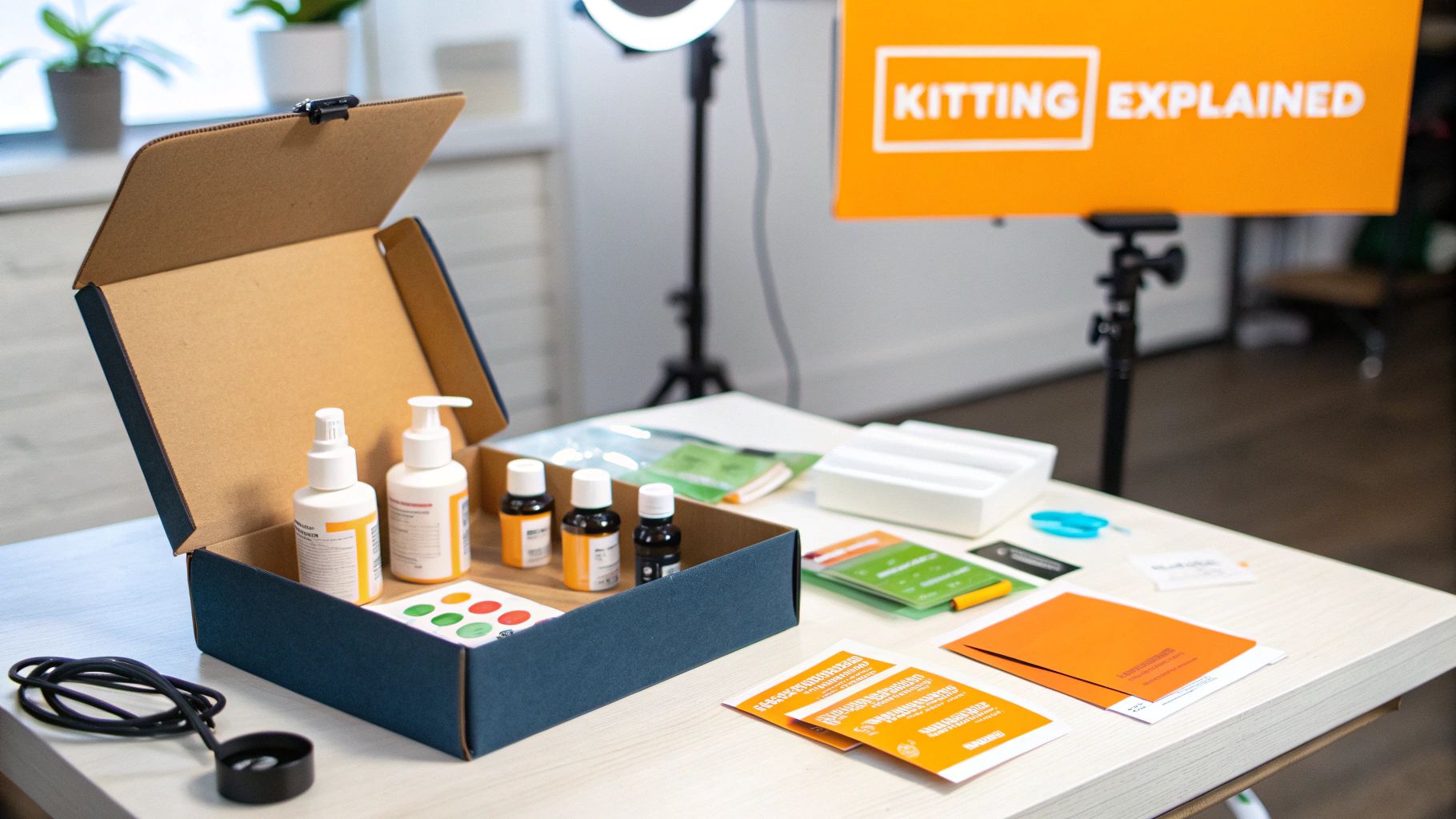
An open kitting box filled with product bottles, papers, and accessories on a table.

Think of kitting like a meal-prep service for your products. Instead of a customer (or your warehouse team) having to pick out a tomato, an onion, and a packet of spices individually, your fulfillment partner acts as the chef. They gather everything needed for the "recipe" ahead of time and package it into one convenient box.

This has a massive impact on your inventory. It takes multiple individual SKUs (Stock Keeping Units) and transforms them into one new, easy-to-manage master SKU. For anyone selling on platforms like Amazon, Shopify, or Walmart, this is a total game-changer. Instead of your pickers hunting down five different items for a holiday gift set, they just grab one pre-made box. This cuts down on labor, virtually eliminates picking errors, and gets orders flying out the door.

It's no surprise the demand for these services is exploding. The global market for kitting and assembly has skyrocketed from USD 8.4 billion and is projected to hit USD 17.0 billion by 2034. This boom is driven by brands just like yours, looking to create special promotions, subscription boxes, and value-added multi-packs. You can learn more about these kitting market growth projections and see what's fueling the trend.

Kitting vs. Assembly: What’s the Real Difference?

The terms "kitting" and "assembly" are often thrown around together, but they’re two distinct processes. Nailing down the difference is critical when you’re talking to a fulfillment partner, as it defines the entire scope of your project.

Simply put: kitting is about grouping, while assembly is about building.

Let’s break it down further. The table below gives a quick side-by-side look at how these two services differ in practice.

Kitting vs Assembly At a Glance

Aspect Kitting Services Assembly Services
Core Function Grouping separate, finished items into a single package. Combining multiple parts to create a new, single product.
Product State Individual items remain unchanged. Individual parts are altered or combined; light manufacturing.
Example A "Welcome Kit" with a water bottle, towel, and keychain. Screwing together parts of a chair before boxing it.
Complexity Lower; primarily a pick-and-pack process. Higher; requires instructions, tools, and quality checks.
Labor Skill Basic warehouse skills. Requires training and sometimes specialized tools.

As you can see, kitting is more about curation, while assembly is about creation. One gathers existing items, and the other builds a new one from scratch.

Here's an easy way to remember it: Kitting creates a collection of items. Assembly creates a single, new item from multiple parts.

In many fulfillment projects, these two services actually go hand-in-hand. A 3PL might first perform assembly—like putting together an electronic device—and then kit it with accessories like a charger and manual before creating the final retail-ready package.

The key takeaway is that both services streamline your operations by doing the heavy lifting before a customer ever clicks "buy."

Strategic Benefits of Outsourcing Kitting to a 3PL

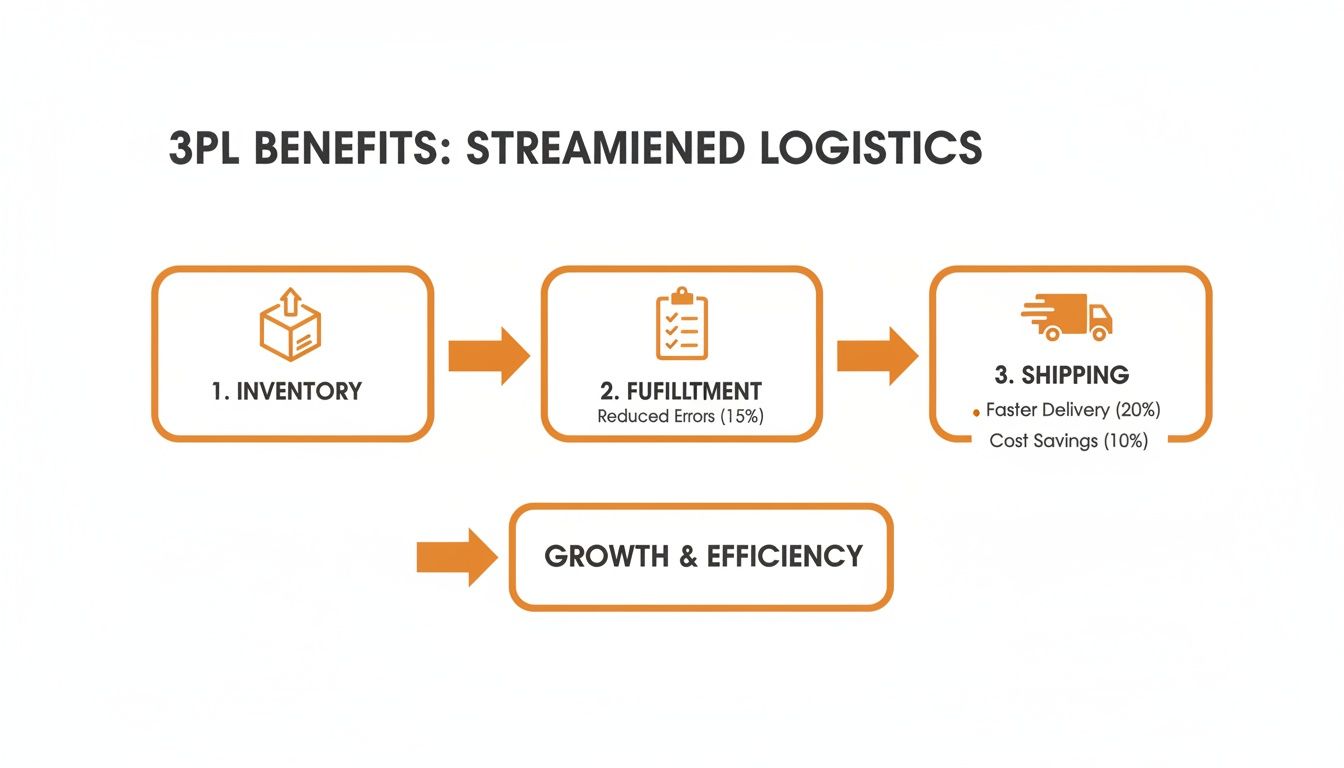
Partnering with a third-party logistics (3PL) provider for your kitting and assembly services does way more than just free up your time—it’s a strategic move that directly boosts your bottom line, protects your brand, and lets you grow. Trying to manage kitting in-house might feel like you have more control, but it often brings a ton of hidden costs and operational headaches that can actually hold you back.

When you outsource, you turn a complex, often messy process into a smooth, efficient engine for your business. It lets you swap fixed costs, like warehouse rent and employee salaries, for variable costs that scale up or down with your sales. That kind of financial flexibility is a game-changer, especially for brands with seasonal peaks or those growing like crazy.

Driving Down Operational Costs

One of the first things you'll notice is a serious drop in your expenses. When you handle kitting yourself, you’re not just paying for labor. You're also on the hook for dedicated workspace, packing supplies, costly mistakes, and the lost opportunity of what your team could be doing instead. A 3PL just absorbs all of that.

A specialized fulfillment partner operates at a massive scale, which means they get better prices on things like boxes and packing materials—savings they can pass right on to you. It's a proven fact that direct-to-consumer (DTC) brands can see cost savings of 20-25% on labor and materials alone by outsourcing kitting. For sellers on tough marketplaces like Amazon and Shopify, that financial edge can be the difference between thriving and just getting by.

Enhancing Order Accuracy and Customer Experience

Fulfillment mistakes are expensive. Sending a customer a kit with the wrong item doesn't just mean a costly return; it chips away at the trust you've built with them. A single bad review can scare off countless future customers. Professional 3PLs, on the other hand, build their entire business on getting it right.

They use multi-step verification, like barcode scanning and weight checks, at every single point on the assembly line. This systematic approach pretty much eliminates human error.

By outsourcing, you’re not just handing off a task—you’re investing in a system built for near-perfect accuracy. This precision means the awesome unboxing experience you designed is the one your customer actually gets, every single time.

This focus on quality is also critical for staying compliant with marketplaces. For Amazon FBA sellers, a bad kitting job can get your inbound shipments rejected, a problem that hits an estimated 15-20% of shipments from sellers who aren't prepared. A good 3PL knows Amazon's strict rules inside and out—from FNSKU labeling to poly bagging—so your inventory gets checked in smoothly without any penalties. If you want to get a better handle on what a fulfillment partner does, our guide on what a 3PL warehouse does is a great place to start.

Unlocking Scalability and Business Focus

Picture this: you launch a new subscription box or a huge holiday sale. Can your current setup handle a sudden jump from 100 orders a day to 1,000? For most brands, that kind of spike would cause total chaos, shipping delays, and a lot of unhappy customers.

This is where a 3PL partner becomes your secret weapon for growth. They already have the warehouse space, technology, and trained staff to handle massive swings in order volume without breaking a sweat.

Here’s how a 3PL helps you scale:

  • Elastic Workforce: They can throw more staff at your project during peak season and scale back when things quiet down.
  • Optimized Space: You get access to a massive warehouse without signing a long-term lease, and you only pay for the space you actually use.
  • Expert Processes: They’ve already perfected workflows for high-volume kitting and assembly services, so there’s no learning curve.

By handing off all these logistical headaches, you and your team can finally stop packing boxes and get back to what you're best at: creating amazing products, marketing your brand, and talking to your customers. That shift in focus is the real strategic advantage.

A Look Inside the Kitting and Assembly Workflow

Ever wonder what actually happens when you hand off a kitting project to a 3PL? It’s not just a matter of tossing items into a box. It's a finely tuned process built for speed and, most importantly, accuracy.

Getting a peek behind the curtain helps you understand where the real value is created. Let's walk through the entire journey, from creating your kit’s “recipe” to getting it stocked and ready to ship at a moment's notice.

Step 1: Defining the Project Scope

Everything starts with a detailed consultation. Think of this as you and your 3PL partner acting as architects, drawing up the exact blueprint for your finished kit. You’ll define the bill of materials—a precise list of every single component SKU that goes into the final product.

This isn’t just a simple checklist; it's a complete set of instructions. You’ll specify everything from how items should be placed inside the box to where to put that marketing insert or special sticker. The goal is to create a crystal-clear, repeatable process that guarantees every single kit looks and feels identical.

Step 2: Receiving and Inspecting Components

Once the plan is locked in, your 3PL is ready to receive all the individual parts at their warehouse. As items arrive, each one is carefully inspected to make sure it matches the specs and hasn't been damaged in transit. This initial quality check is absolutely critical.

A single scuffed item can ruin the unboxing experience, and catching these issues upfront saves you from major headaches and costs later on. Every component is counted and its SKU is logged into the Warehouse Management System (WMS), giving you total inventory visibility from day one.

Step 3: Workstation Setup and Assembly

With all the components checked in and ready, the 3PL sets up a dedicated assembly line. Picture a professional kitchen, where every ingredient and tool is perfectly placed to make the workflow as efficient as possible. These stations are designed to minimize wasted movement and shave precious seconds off each kit's build time.

Then, the assembly begins. Trained staff follow the blueprint from step one to the letter. Every action is standardized, from folding the box just right to applying the final sealing tape. For Amazon sellers, this is also the moment when crucial FNSKU labels are applied—a step that demands total precision to avoid frustrating FBA check-in problems. You can learn more about these strict guidelines in our guide to Amazon FBA labeling requirements.

Step 4: Quality Control and SKU Creation

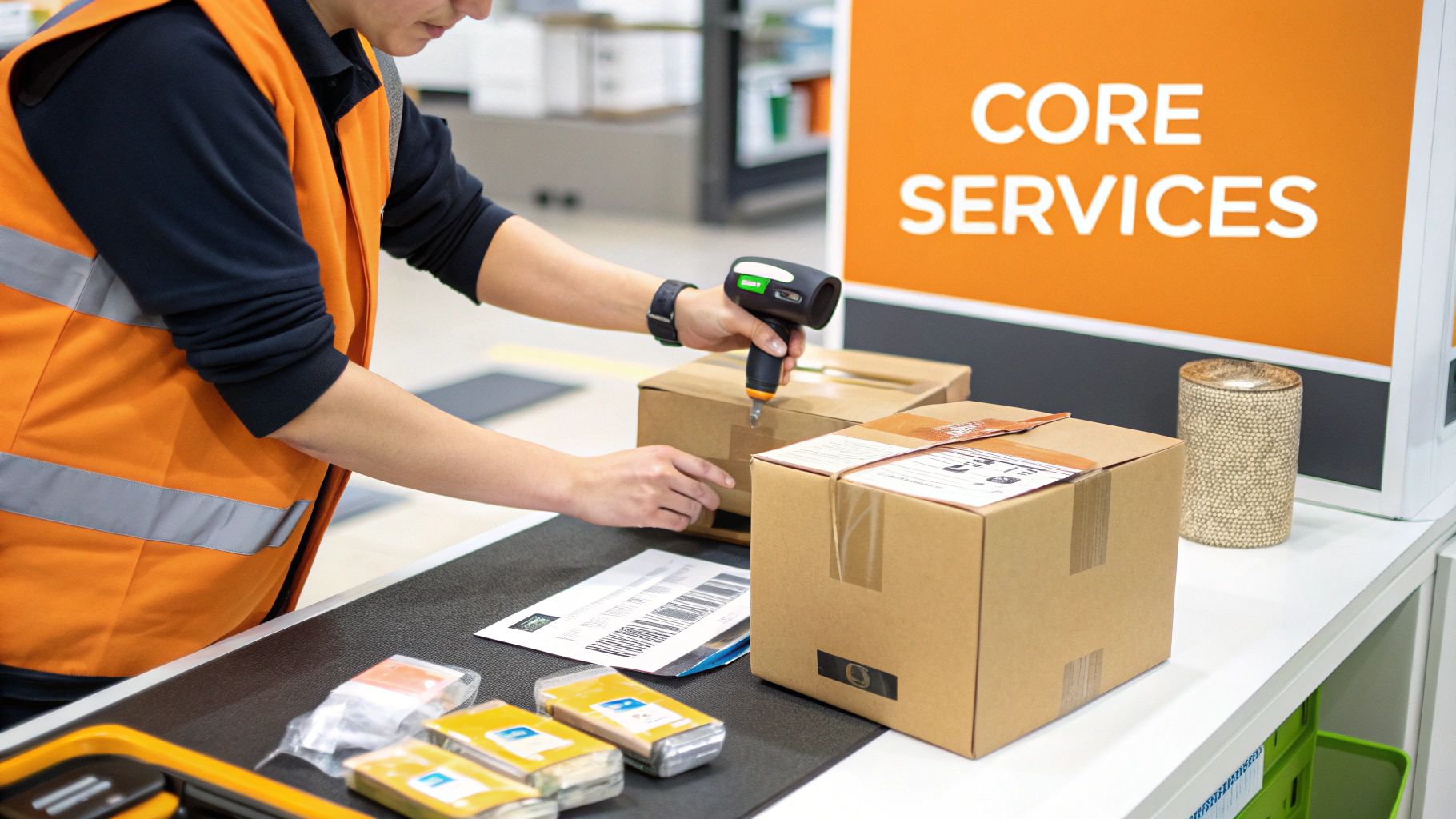
Throughout the assembly process, there are multiple quality control checkpoints. Supervisors will spot-check kits, while tools like barcode scanners and digital scales can instantly verify that each kit contains the correct items and weighs exactly what it should. This layered approach is how high accuracy rates are maintained.

After a kit is fully assembled and passes its final inspection, it's assigned a brand new, single master SKU. This new SKU is created in the WMS, officially turning a pile of separate parts into one unified, sellable product.

This master SKU is the key to simplifying your inventory. Instead of tracking five different components for a gift set, your ecommerce platform now only needs to track one—the finished kit.

Step 5: Storage and Fulfillment Readiness

The last step is to move the completed kits to their designated storage spot in the warehouse. They're no longer treated as individual parts but as finished goods, ready for immediate picking. So, when a customer orders that kit from your Shopify or Walmart store, there's no frantic scramble to find and pick multiple items.

Your fulfillment team just picks one box with the master SKU, packs it for shipping, and sends it on its way. This is how you drastically cut down on order processing time.

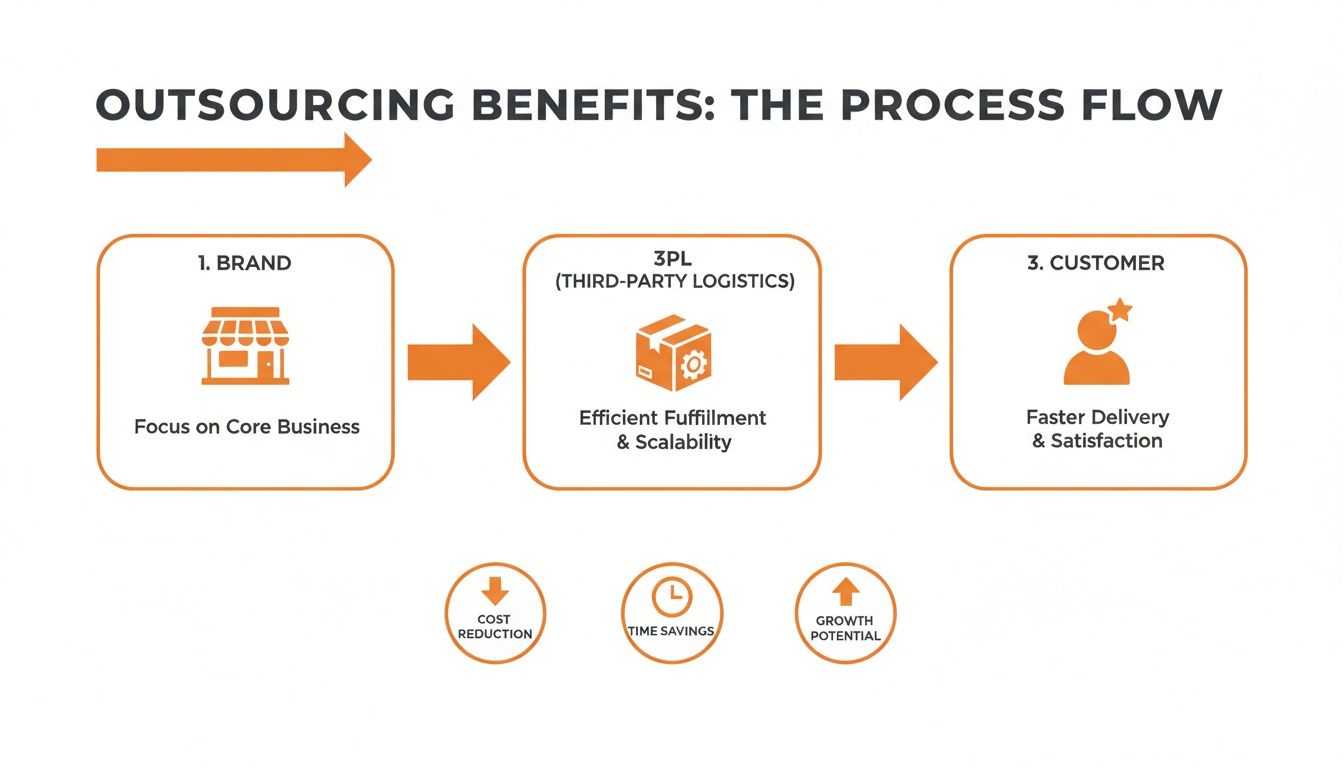
This visual shows how outsourcing connects your brand, your fulfillment partner, and your end customer into a seamless operation.

Infographic showing the outsourcing benefits process flow from brand to customer with key advantages.

This workflow turns what could be a chaotic internal project into a predictable, scalable, and highly accurate operation run by pros.

How Technology is Actually Changing Modern Kitting

If you think kitting and assembly is still just about people carefully packing boxes by hand, you’re missing the bigger picture. The entire process has been overhauled by technology, turning it into a high-precision, data-driven operation.

For e-commerce sellers and ops leaders, this shift is a game-changer. It’s the difference between hoping your orders are right and knowing they are. Modern 3PLs now deliver a level of speed, accuracy, and transparency that was simply impossible a decade ago. It means you get more than just bundled products—you get a fulfillment partner you can actually rely on.

The Warehouse Management System: Your Kitting Command Center

At the core of any tech-forward fulfillment center is its Warehouse Management System (WMS). Think of it as the brain of the entire kitting operation. It’s not just counting inventory; it's orchestrating every single step with digital precision.

This system is your single source of truth. It knows exactly how many screws, widgets, and instruction manuals you have in stock. It knows how many finished kits are ready to ship. And it knows which components are currently being assembled into new kits. That level of detail is non-negotiable for running a smooth operation.

A solid WMS lets a 3PL:

  • Keep Inventory Separate: It digitally tags your raw component SKUs and your finished, ready-to-sell master SKUs. No more accidental shipments of loose parts.
  • Give You Real-Time Updates: You can log into a portal anytime and see exactly what’s happening with your inventory. This is huge for making smart forecasting and purchasing decisions.
  • Set Automatic Reorder Points: The system can ping you when a specific component is running low, so a single missing part doesn’t bring your entire production to a halt.

This digital oversight takes the guesswork out of inventory management, ensuring the parts for your kitting and assembly services are always on hand when you need them.

Barcode Scanning: The Simple Fix for Human Error

Let’s be honest—human error is the biggest killer of kitting accuracy. A warehouse picker grabs the blue shirt instead of the black one, and suddenly you’re dealing with an unhappy customer and a costly return. This is where barcode scanning becomes your best friend. It’s a simple, foolproof check at every single step.

When your components first arrive at the warehouse, they’re scanned into the WMS. During assembly, each item is scanned again to confirm it matches the kit’s “recipe.” This forces a digital handshake, catching mistakes before they ever get inside a box.

By integrating barcode scanning, a 3PL can all but eliminate picking errors. It’s a simple but incredibly powerful layer of quality control that guarantees what you designed is what your customer actually gets.

Automation and Robotics: Kitting at Scale

The next big leap is automation. Robots and other automated systems are now handling the repetitive tasks, allowing 3PLs to scale up to massive volumes without compromising on quality. And this isn't just for massive corporations anymore—it’s becoming a must-have for successful e-commerce brands dealing with high order volumes.

Automation is already making a huge impact. The global market for kitting automation is valued at USD 2.10 billion and is projected to hit USD 7.15 billion by 2033. In North America, advanced robotics are cutting picking errors by 50% and boosting how many orders can get out the door. For high-volume sellers, this translates to a 15-30% drop in operational costs while hitting 99%+ accuracy. You can dive deeper into how automation is reshaping the kitting industry on snsinsider.com.

When you combine a powerful WMS, mandatory scanning, and smart automation, a modern 3PL truly becomes an extension of your business—one that’s built to be reliable, transparent, and ready to handle your growth.

Finding the Right Kitting and Assembly Partner

Picking a 3PL partner is one of the biggest calls you’ll make for your e-commerce brand. This isn’t just about renting warehouse space or finding someone to slap a label on a box. It’s about trusting another company with your inventory and, ultimately, your customer's happiness.

A great partner feels like an extension of your own team, proactively solving problems and helping you scale. The wrong one? They become a source of constant headaches, creating costly bottlenecks and damaging the reputation you’ve worked so hard to build.

Evaluating Core Competencies and Experience

Let's be clear: not all 3PLs are created equal, especially when it comes to the detailed work of kitting and assembly services. A warehouse that's great at basic pick-and-pack for simple t-shirt orders might completely fall apart when faced with a complex subscription box with ten different components.

Your first job is to find out if they have real, hands-on experience with businesses like yours. Do they live and breathe the strict compliance rules for Amazon FBA, or is their sweet spot direct-to-consumer fulfillment for Shopify brands? Deep experience with your primary sales channels is non-negotiable. A 3PL that already knows FBA prep inside and out will save you from the painful—and expensive—reality of rejected inbound shipments.

Don't just take their word for it. Ask for case studies or, even better, a few client references who sell similar products and have a comparable order volume. This is how you get undeniable proof of their skills.

Key Questions for Potential Partners

The best way to cut through the slick sales pitch is to come prepared with sharp, specific questions. Vague, hand-wavy answers are a major red flag. You want a partner who can confidently walk you through their exact processes, step-by-step.

Here are a few essential questions to get the conversation started:

  • Technology and Inventory: "Show me how your WMS tracks component parts versus finished kits. Can I see a live demo of your client portal and how I can view my stock levels for both?"
  • Quality Control: "Walk me through your QC process for a typical kitting project. What happens when your team finds a damaged component? What’s the communication process back to me?"
  • Scalability: "Tell me about a time you handled a sudden, massive spike in kitting volume for a client during a promotion. How did your team manage it, and what was the outcome?"
  • Billing and Transparency: "Can you provide a sample invoice for a kitting project? I want to see every potential line item and fee so there are no surprises."

How they answer these questions tells you everything you need to know about their operational maturity and their commitment to transparency. A great partner will welcome this level of detail.

A 3PL’s ability to clearly articulate their quality control and inventory management procedures is a direct indicator of their operational maturity. If they can't explain it simply, they likely can't execute it reliably.

A Quick Checklist for Vetting Partners

To keep your evaluation process organized, it helps to use a checklist. This ensures you're comparing each potential 3PL using the same objective criteria, making the final decision much clearer.

Use this checklist to systematically compare potential kitting and assembly partners on the factors that matter most for your business.

3PL Partner Evaluation Checklist

Evaluation Criteria Key Questions to Ask Ideal Answer/Capability
Relevant Experience "Can you share case studies or references from clients in my industry (e.g., subscription boxes, cosmetics, supplements)?" Demonstrates a portfolio of successful clients with similar needs and compliance requirements (e.g., FBA, Walmart).
Technology & WMS "How does your system manage component vs. finished kit inventory? Can I see real-time levels? Does it integrate with my platforms?" The WMS provides real-time, segregated visibility. Offers seamless integrations with Shopify, Amazon, etc.
Quality Control "What is your documented process for QA checks during assembly? How are errors tracked and corrected?" Has a multi-step, documented QC process with clear protocols for handling damaged items and reporting errors.
Scalability "How do you handle sudden volume spikes? Do you have dedicated kitting lines or cross-trained staff?" Has a proven plan for flexing labor and resources to meet demand without sacrificing quality or speed.
Pricing Transparency "Can I see a full fee schedule, including receiving, storage, assembly, and outbound shipping? Are there hidden fees?" Provides a clear, all-inclusive quote with no vague "miscellaneous" charges. Explains all potential costs upfront.
Communication "Who will be my dedicated point of contact? What are your standard response times for support inquiries?" Offers a dedicated account manager and a clear Service Level Agreement (SLA) for communication.

Treat this process like you're hiring a key employee, because you are. A thorough vetting process now prevents massive operational fires later.

Finalizing Your Decision

Once you’ve narrowed it down to a few top contenders, the final choice comes down to a balance of cost, capability, and culture. While it’s tempting to go with the lowest price, the cheapest 3PL is almost never the best value. A partner who invests in solid technology and bulletproof quality control might have a slightly higher per-kit fee, but they’ll save you thousands in the long run by preventing costly errors.

For brands with big growth plans, it's also smart to look at a provider's full range of e-commerce order fulfillment services to understand their long-term potential. Can they handle your freight, returns, and FBA replenishment down the road?

Ultimately, you need to feel confident that the 3PL truly gets your brand and has a clear plan to help you hit your goals. This decision isn't just a line item on your P&L; it's a long-term investment in your brand’s operational backbone.

Common Kitting Use Cases for Ecommerce Brands

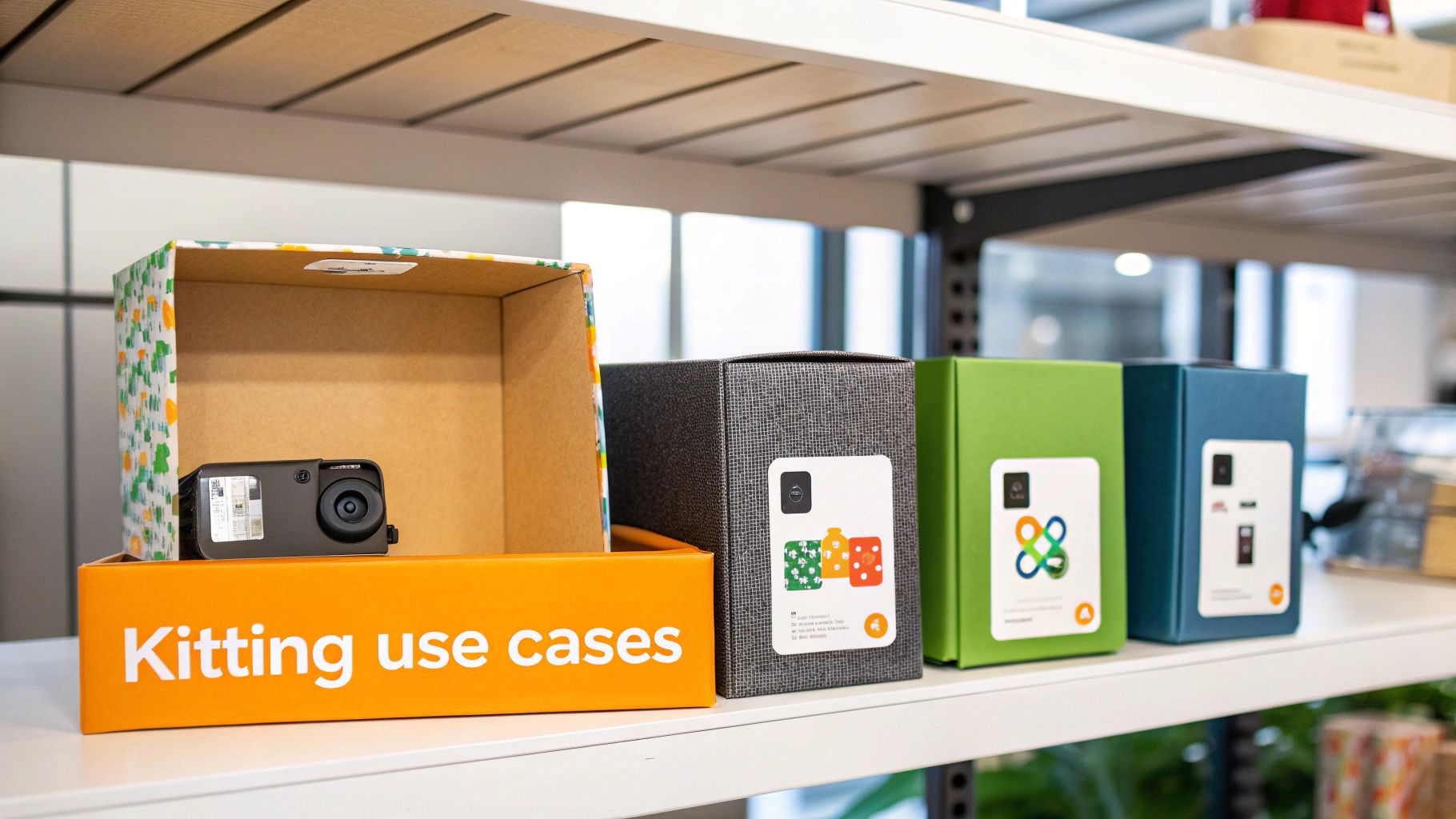
Various product kitting boxes displayed on a white shelf, with one open box revealing a camera.

The real power of kitting and assembly services clicks when you see how smart ecommerce brands put them to work. This isn’t just some back-end operational task; it's a core strategy for driving sales, making customers happier, and taming logistical headaches.

From subscription boxes to Black Friday promotions, kitting gives brands a framework to create unique product offers that would be an absolute nightmare to manage in-house. Let’s walk through a few common scenarios where this strategy really delivers.

The Subscription Box Model

Subscription box companies are built on one thing: delivering a fresh, curated experience month after month. The problem? The contents are always changing, which means you're constantly juggling dozens of different items for every single shipment cycle.

A 3PL partner cuts right through that chaos. Each month is a new kitting project. They receive all the different products, follow that month's specific "recipe" to assemble the boxes, and get them ready for a massive, coordinated shipment. It turns a messy, unpredictable process into a smooth, repeatable workflow.

Boosting Sales with Bundles and Multi-Packs

If you're selling on a competitive marketplace like Amazon, bumping up your average order value (AOV) is the name of the game. Kitting is the perfect play here. Instead of just selling one bottle of shampoo, you can create a bundled "Hair Care Kit" with shampoo, conditioner, and a styling cream.

This one move accomplishes several goals at once:

  • Higher AOV: Customers spend more in one go.
  • Increased Sell-Through: It’s a great way to move slower-selling items by pairing them with your bestsellers.
  • Simplified Listings: One product page is much easier for a customer to navigate and buy than three separate ones.

Your fulfillment partner can crank out these multi-packs, apply the right FNSKU labels for FBA, and make sure every bundle meets Amazon’s strict packaging rules. This saves you from the pain of costly rejections at the fulfillment center.

By bundling products, you transform individual items into a high-value solution. The customer gets a convenient package, and you get a healthier bottom line with a stronger competitive position on the marketplace.

Creating Memorable Holiday and Gift Sets

Seasonal sales events are a huge opportunity for ecommerce brands. A beautifully packaged gift set can become a massive revenue driver, but trying to assemble thousands of them in-house during your busiest season is a recipe for disaster. This is a classic use case for outsourced kitting and assembly services.

Picture a beauty brand launching a special holiday gift box. They ship their custom-branded boxes, tissue paper, and products to their 3PL. The fulfillment team then carefully assembles each gift set exactly to the brand’s specs, creating that premium unboxing experience that customers love and rave about in reviews. By outsourcing, the brand can focus on marketing the big promotion instead of getting buried in packing tape and crinkle paper.

Kitting Services: Your Questions Answered

Even after getting the big picture, you probably still have questions about how kitting and assembly services actually work day-to-day. We get it. Here are the most common questions we hear from ecommerce brands just like yours.

What's the Real Cost of Kitting Services?

Kitting is almost always priced on a simple, per-kit basis. The fee depends on a few things: how many items go into each kit, how tricky the assembly is, and the total number of kits you need.

Sure, it’s a line item on your invoice, but it's often a fraction of the cost of doing it yourself. Once you add up your team's labor, the warehouse space you're using, all the packing materials, and the steep cost of a single fulfillment mistake, outsourcing starts to look like a bargain.

How Will Kitting Mess With My Inventory Management?

It actually does the opposite—it makes it way simpler. Your 3PL partner handles tracking all the individual component SKUs as they arrive and get assembled. Once a kit is built, it gets a brand new "master" SKU in their system.

What does this mean for you? Your ecommerce store, whether it’s on Shopify or Amazon, only has to track one final, sellable product. This single SKU dramatically cuts down on picking errors, makes sales forecasting easier, and gives you a much clearer, real-time view of your ready-to-ship stock.

Can a 3PL Use My Custom Branded Packaging?

Absolutely. This is one of the best parts of working with a pro 3PL—they bring your unboxing experience to life. You just send them your custom boxes, branded tissue paper, logo stickers, or any little marketing cards you want to include.

The kitting team will follow your directions to a T, making sure every single package looks exactly how you envisioned it. It's a small touch that goes a long way in building brand loyalty and getting those five-star reviews.

What Are the Minimum Order Quantities for Kitting?

This really varies from one 3PL to another. Some of the giant logistics companies are built for enterprise-level clients and have pretty high minimum order quantities (MOQs).

But plenty of others, like us, are set up to help growing ecommerce brands. A good partner will be flexible enough to handle a small test run for a new product launch and then easily scale up with you as your orders start pouring in.


Ready to stop worrying about logistics and start scaling your brand? Snappycrate offers expert kitting and assembly services designed for growth-minded sellers. Let us handle the details so you can focus on your business. Learn more and get a quote from SnappyCrate.

0 Continue Reading →

Shopify order fulfillment services: Scale Your Brand with Expert Fulfillment

So, what exactly is a Shopify order fulfillment service? Think of it as your brand's dedicated warehouse and shipping department, rolled into one expert partner. After a customer clicks "buy" on your Shopify store, these specialists take over, handling every physical step—from storing your inventory and picking products to packing and shipping them out the door.

This lets you get back to what you do best: building your brand, designing amazing products, and connecting with customers, without getting buried in bubble wrap and shipping labels.

The Engine Room of Your Ecommerce Store

Imagine your fulfillment partner as the mission control for your online store. Your Shopify site is the beautiful, customer-facing storefront, but the fulfillment center is the powerful, unseen engine room making sure every order actually happens. It’s the crucial link between a customer’s “Order Confirmed!” email and the unboxing experience on their doorstep.

Without this operational backbone, even the most brilliant marketing campaigns and must-have products can fizzle out. In fact, a recent study showed that a staggering 48% of online shoppers abandon their carts because of high or unexpected shipping costs. That number alone shows just how critical a fast, affordable fulfillment strategy really is. For scaling brands, outsourcing is no longer a luxury—it's a strategic necessity.

Why Outsource Your Fulfillment?

For any growing Shopify business, there comes a point where packing boxes in your garage just doesn't cut it anymore. The hours spent printing labels, wrangling tape guns, and running to the post office are hours you're not spending on marketing, product development, or customer service.

A dedicated fulfillment partner changes the game completely. Here's how:

  • Scalability: Effortlessly handle a Black Friday sales surge without frantically hiring temp staff or running out of space. Your operations expand and contract with your order volume.
  • Expertise: You're tapping into a team of logistics pros who live and breathe this stuff. They negotiate better shipping rates with carriers than most small businesses could ever get on their own.
  • Focus: Free up your time, energy, and headspace. You can finally concentrate on the core activities that actually generate revenue and move your business forward.
  • Customer Experience: Deliver the fast, reliable shipping that modern shoppers demand. A great delivery experience builds trust, earns glowing reviews, and brings customers back for more.

By partnering with a third-party logistics (3PL) provider, you turn fulfillment from a massive headache into a serious competitive advantage. You can dive deeper into how a 3PL warehouse operates and what it can offer your business in our detailed guide.

Comparing Shopify Fulfillment Models

To really see where Shopify order fulfillment services shine, it helps to look at the three main ways to get products to your customers. Each approach is built for different stages of a business, from a brand just launching out of a spare bedroom to one shipping thousands of orders a month. The right path for you depends entirely on your current sales volume, product type, and where you want to go.

Here's a quick look at how the three main models stack up against each other.

Comparing Shopify Fulfillment Models

Fulfillment Model Best For Pros Cons
Self-Fulfillment New stores with low order volume or local customers. You have complete control over branding, packaging, and quality. Incredibly time-consuming; impossible to scale; you'll pay higher shipping costs.
Dropshipping Merchants who want to sell products without holding any inventory. No upfront inventory costs; easy to offer a wide variety of products. Paper-thin profit margins; zero control over product quality or shipping speed.
3PL Fulfillment Scaling brands that need efficiency and a professional customer experience. Offers fast, cost-effective shipping; scales with your growth; lets you focus on your brand. You have to trust an outside partner; involves an initial setup and integration process.

As you can see, while packing your own orders offers total control, it quickly becomes a bottleneck to growth. And while dropshipping is low-risk, it gives you almost no control over the customer experience. For serious Shopify brands, partnering with a 3PL strikes the perfect balance, giving you the power to scale without sacrificing quality.

How a Fulfillment Workflow Actually Works

So, you've partnered with a Shopify order fulfillment service. What happens next? That complex dance of getting an order from a customer's click to their front door suddenly becomes a smooth, automated process.

But what really goes on behind the scenes after someone hits "buy" on your store? Let's walk through the entire journey, step by step.

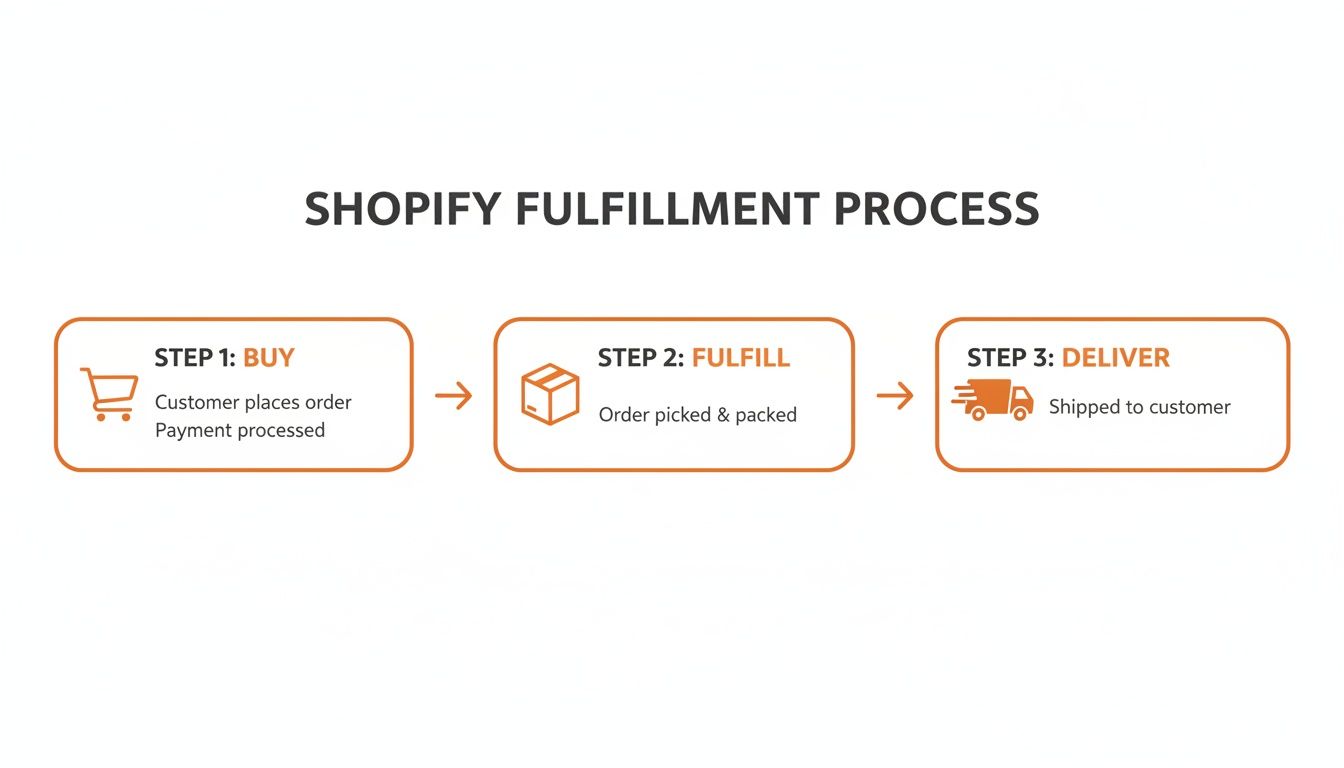
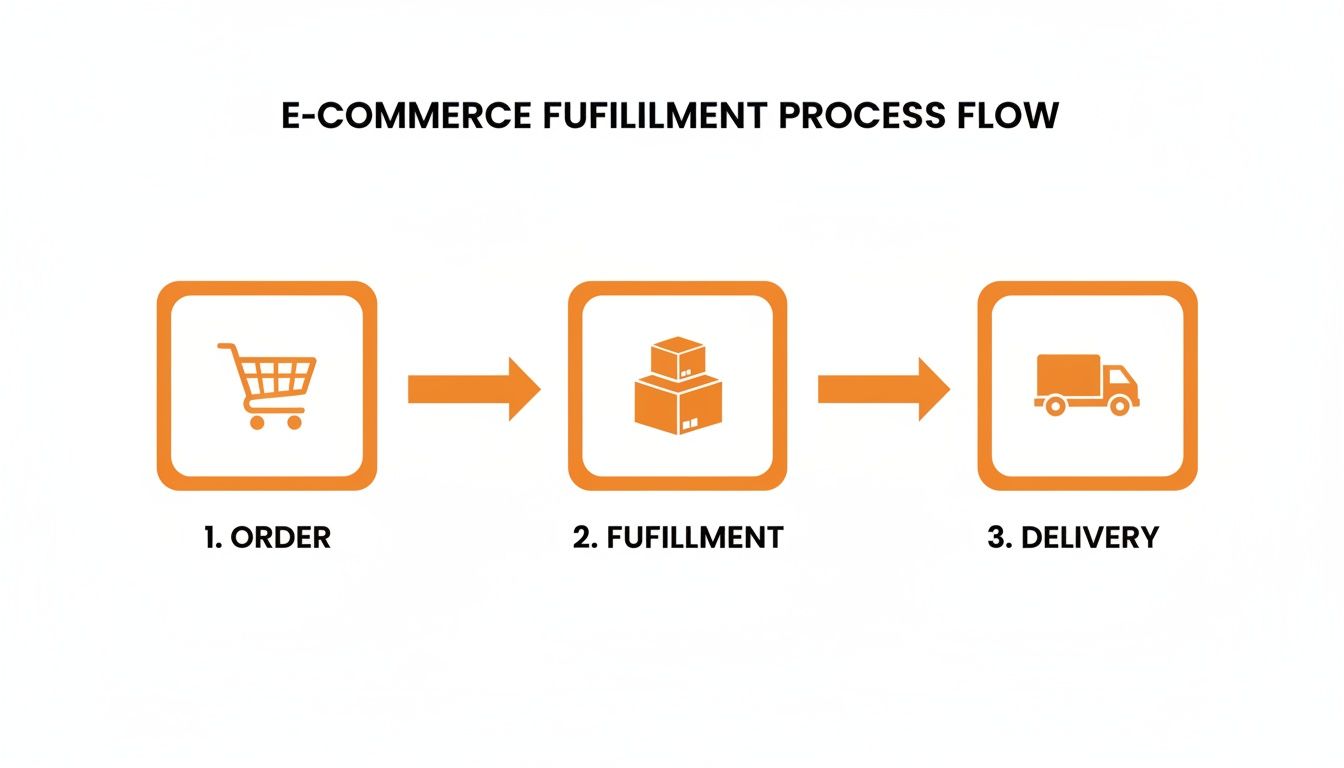
This simple diagram breaks down the three main stages every single order goes through.

Diagram showing Shopify order fulfillment process: Customer buys, order is fulfilled, and then delivered.

From that initial purchase to the final delivery, each phase is powered by smart technology and expert hands, all working together to create a seamless experience for your customer.

Step 1: Receiving and Storing Your Inventory

The whole process kicks off long before a single order is even placed. It starts the moment you ship your products to your fulfillment partner’s warehouse. This isn’t just dropping off a few boxes; it's a carefully managed process called inbound receiving.

When your inventory arrives, the warehouse team immediately inspects the shipment. They check that the product count is spot-on and that nothing was damaged in transit. Each item, or SKU, is then scanned and given a specific, strategic home within the warehouse—a critical step that prevents mix-ups and makes finding products later lightning-fast.

This organized storage is the bedrock of an efficient operation. A great warehouse runs on a sophisticated Warehouse Management System (WMS) that tracks every single unit, giving you a live, real-time view of your inventory levels right from your partner's dashboard.

Step 2: Order Sync and Processing

This is where the tech magic really happens. The second a customer places an order on your Shopify store, all the details are zapped over to your fulfillment partner's WMS. It happens instantly and automatically. No more manual data entry, which means a huge source of human error is completely eliminated.

The system quickly confirms the items are in stock and pushes the order to the warehouse floor. This is the crucial handoff where a digital transaction becomes a physical to-do list. The order pops up on a picker's handheld scanner, showing them the exact items, quantities, and their precise locations in the warehouse.

A seamless integration between your Shopify store and a 3PL's software is the central nervous system of your fulfillment operation. It ensures that data flows instantly and accurately, from order placement to inventory updates, keeping both you and your customers informed.

Step 3: The Pick and Pack Process

With the order now live in the system, a trained warehouse associate gets to work on the pick and pack process. Forget wandering around looking for things on a shelf; this is a highly optimized routine. Using handheld scanners, pickers are guided along the most efficient path through the warehouse to gather all the items for an order.

  • Picking: The scanner tells the picker exactly where to go and what to grab. They scan the item's barcode to confirm it’s the right product, which is how top 3PLs achieve 99.9% order accuracy.
  • Packing: Once everything is picked, the items are taken to a packing station. Here, a packer chooses the perfect-sized box or mailer, adds any necessary padding (like bubble wrap or air pillows), and includes any custom touches you've provided, like branded tissue paper or thank-you cards.

The box is then sealed, weighed, and a shipping label is automatically printed based on the customer’s address and the shipping method they selected.

Step 4: Shipping and Tracking

Finally, it's time to get the package on its way. The fulfillment center's system automatically picks the best carrier and service to meet the delivery promise while keeping costs low. Because 3PLs ship in massive volumes, they get huge discounts from major carriers like UPS, FedEx, and USPS—and those savings are passed directly on to you.

Once the package is labeled, it joins other outbound shipments waiting for carrier pickup. As soon as the carrier scans it, the tracking number is automatically pushed back to your Shopify store. This is what triggers that shipping confirmation email to your customer and updates their order status, giving them full visibility until the moment it arrives at their door.

Integrating Your Store with a Fulfillment Partner

Hooking up your Shopify store to a fulfillment partner isn't some massive technical project you need to dread. Honestly, it's more like plugging in a new appliance. Modern Shopify order fulfillment services are designed with simple, secure connections that make the whole process surprisingly fast and straightforward.

Think of this connection as the digital handshake between your storefront and your warehouse. It creates a seamless flow of information, completely wiping out the need for manual data entry—which, as we all know, is where costly mistakes and wasted hours are born.

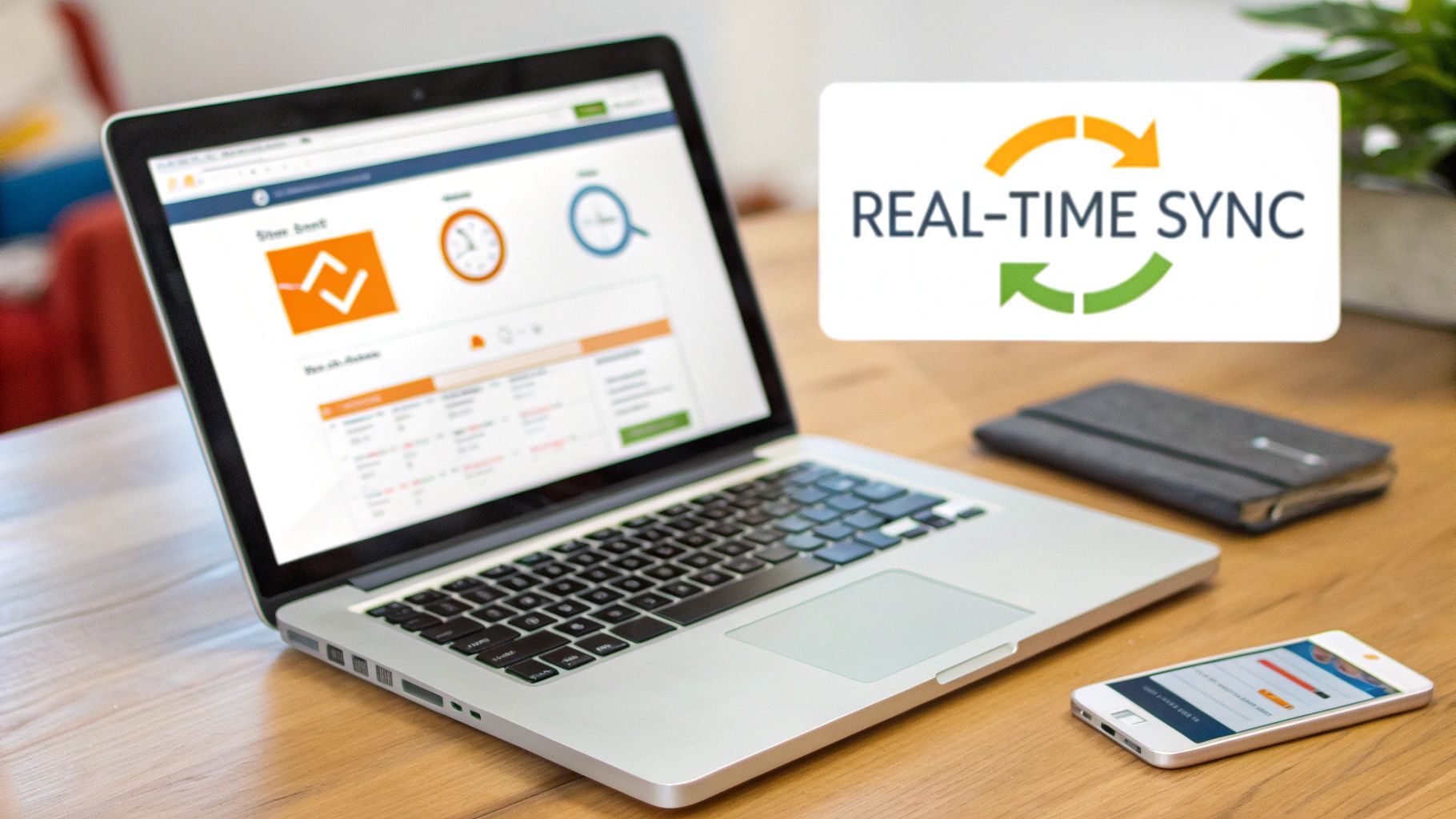
A laptop displaying a dashboard with charts, a smartphone, and a "REAL-TIME SYNC" graphic on a wooden desk.

The Simple Steps of Integration

While every 3PL has its own dashboard, the actual steps to get your store connected are remarkably similar across the board. The best part? You absolutely do not need to be a developer to get it done.

It usually breaks down into three key stages:

  1. Authorize the Connection: You'll typically start by finding your partner's app in the Shopify App Store or logging into their portal. With just a few clicks, you give their system permission to access your store's order and product data.
  2. Map Your Product SKUs: This is a crucial step. You’re essentially telling the warehouse's system which of your products is which by linking the SKUs (Stock Keeping Units) in your Shopify catalog to the physical items they're storing for you.
  3. Configure Shipping Options: Here, you'll map the shipping choices your customers see at checkout (like "Standard Shipping" or "2-Day Express") to the actual carrier services your fulfillment partner will use to send the packages.

Once that's done, your automated workflow is live and ready to run. You can see how Snappycrate's direct integration simplifies this entire process and gets you up and running in no time.

The Power of Automation and Real-Time Sync

A direct integration does way more than just grab new orders. It opens up a powerful, two-way street for data that fuels real efficiency and growth. This is the secret sauce that lets a brand scale from 100 orders a month to 10,000 without the wheels falling off.

The real value of a direct Shopify integration is turning your fulfillment from a reactive, manual task into a proactive, automated system. It ensures data accuracy, provides real-time visibility, and frees up your team to focus on strategic growth instead of operational chores.

This kind of automated sync isn't just a "nice-to-have"—it's a necessity. In 2023, Shopify stores processed an average of 199 million orders per month. During the Black Friday Cyber Monday weekend, the platform was handling peaks of 284 million requests per minute. Those numbers are staggering, and they make it crystal clear why trying to keep up manually is a recipe for disaster for any serious brand. You can dig into more of Shopify’s incredible performance metrics at Red Stag Fulfillment.

Key Benefits of a Seamless Connection

The payoff from a properly integrated system is immediate and touches every part of your business, from inventory control to customer happiness.

  • Automatic Order Pulling: The second a customer clicks "buy," their order is securely sent to the fulfillment center's queue. No copy-pasting, no CSV uploads.
  • Real-Time Inventory Updates: When the warehouse ships an order or receives new inventory, your stock levels in Shopify are updated instantly. This is how you kill overselling for good.
  • Automated Shipping Confirmations: As soon as a carrier scans a packed order, the tracking number is sent right back to Shopify, which automatically triggers that "Your Order Has Shipped!" email to your customer.

This seamless loop of data is the engine that keeps a modern, scalable e-commerce business humming along.

Value-Added Services That Fuel Your Growth

The best Shopify order fulfillment services do a whole lot more than just stick products in boxes. They become a genuine partner in your growth, offering specialized services that solve tricky logistics puzzles, create unforgettable customer experiences, and even open up new ways to make money. These "value-adds" are what separate a basic warehouse from a true growth engine for your brand.

Think of it like this: standard fulfillment is the mailman who reliably gets a package from point A to point B. Value-added services are like having a pit crew, a custom mechanic, and a branding expert all working on your products before they even leave the warehouse. They make sure everything is perfectly prepared for any sales channel and ready to wow your customers the moment it arrives.

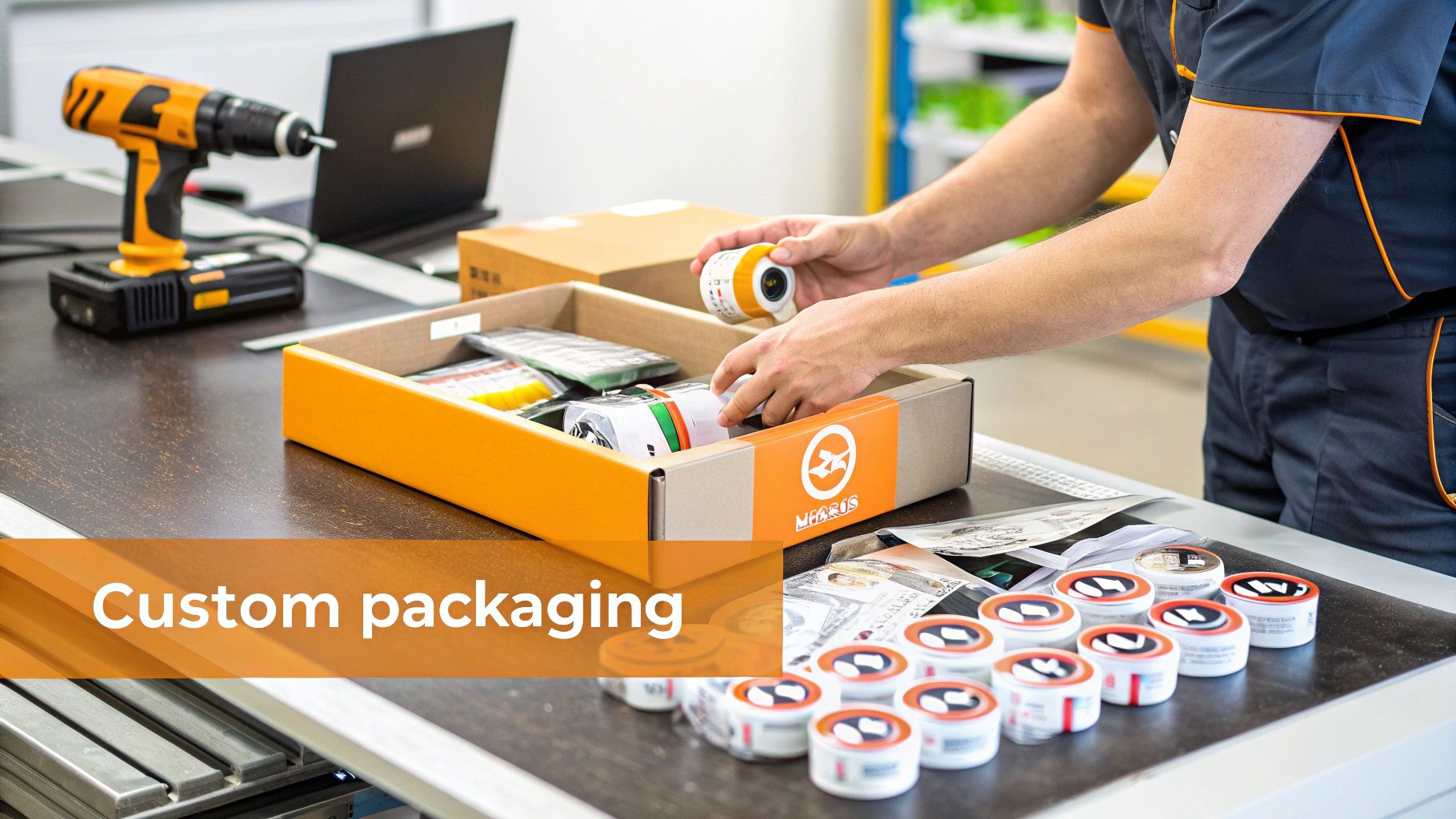
Hands placing products into a custom orange box with a logo during order fulfillment.

Preparing Products for Amazon FBA

Selling on Amazon is a huge opportunity, but it comes with a notoriously strict rulebook. Amazon's Fulfillment by Amazon (FBA) program has incredibly precise requirements for how your inventory must be prepped before it even touches their warehouse docks. One small mistake can lead to costly fines, rejected shipments, or even getting your account suspended.

This is where FBA prep services are an absolute game-changer. Your fulfillment partner can take all these tedious—but critical—tasks off your plate.

  • FNSKU Labeling: Applying Amazon-specific barcodes that completely cover any existing manufacturer UPCs.
  • Poly Bagging: Placing items in clear protective bags, complete with the required suffocation warnings.
  • Inspection: Catching any damages or defects before your products are sent to Amazon's network.
  • Case Packing: Making sure all items are correctly packed into master cartons according to Amazon's specs.

By handing off FBA prep, you guarantee compliance, dodge expensive chargebacks, and keep your inventory flowing smoothly into Amazon's system, ready for that coveted Prime badge.

Creating New Products with Kitting and Bundling

Ever wanted to sell a "Holiday Gift Set" or a "Beginner's Starter Kit"? Kitting and bundling services make that happen without you ever having to touch a single product. This service is all about combining multiple separate SKUs into a brand-new, single product that you sell as one complete unit.

Let's say a skincare brand wants to offer a gift set with a cleanser, a moisturizer, and a serum. Their fulfillment partner can:

  1. Pick one of each individual item from the shelves.
  2. Assemble them together in a custom-branded gift box.
  3. Assign this newly created bundle its own unique SKU in the inventory system.

Now, when a customer buys the gift set on your Shopify store, the warehouse team grabs the pre-assembled kit, not the three individual items. You can learn more about how kitting and assembly services create powerful new sales opportunities for your brand.

Kitting transforms your inventory into a flexible marketing tool. It allows you to increase average order value, create unique promotions, and move slower-selling items by bundling them with popular products.

Crafting a Memorable Unboxing Experience

In the world of e-commerce, the shipping box is your new storefront. A memorable unboxing experience is one of the most powerful ways to cement your brand identity, build die-hard customer loyalty, and get people talking about you on social media. A top-tier fulfillment partner can bring your vision to life, perfectly, every single time.

This is about more than just a custom-printed box. It includes all the little details that make a big impact:

  • Branded tissue paper or crinkle-cut fill
  • Promotional flyers or personalized thank-you cards
  • Custom stickers or branded packing tape
  • A strategically placed product sample

Executing this experience at scale is a huge part of the economic engine powered by Shopify. The platform's gross merchandise volume (GMV) hit $292.3 billion annually in 2025, with peak Black Friday Cyber Monday sales reaching an incredible $4.2 million per minute. With over 61 million global consumers buying from Shopify brands during that weekend alone, a standout unboxing experience is absolutely key to capturing repeat business. You can find more compelling Shopify statistics and trends on The Hub Content.

Choosing the Right Fulfillment Partner

Picking a fulfillment provider is one of the biggest decisions you’ll ever make for your Shopify store. This isn’t just about finding the cheapest place to stash your inventory. It’s about hiring a partner that becomes a direct extension of your brand and, ultimately, a huge part of your customer experience.

Get this right, and you’ll accelerate your growth. Get it wrong, and you’re in for a world of logistical nightmares that can sink your reputation. You have to look past the price tag and dig into a provider’s technology, their operational reliability, and whether they can actually grow with you. Think of it like hiring a key employee who will be responsible for every single one of your customers' orders. You need to trust them completely.

Evaluating Technology and Integration

The backbone of any modern fulfillment partnership is a rock-solid tech connection. Without a seamless integration between your Shopify store and their warehouse, you’ll be drowning in manual work, order errors, and wasted time. The quality of a provider's software is absolutely non-negotiable.

When you're vetting a potential partner, insist on a demo of their client portal. Is it easy to use? Can you quickly find your inventory levels, check on order statuses, or pull up a report? The integration has to be a two-way street, syncing data in real-time. This ensures your inventory counts on Shopify are always spot-on and that tracking numbers get pushed back to customers automatically.

The right technology turns your fulfillment operation into an automated, self-sustaining system. It kills human error in order entry, stops you from overselling, and keeps your customers in the loop without you lifting a finger.

Assessing Scalability and Specialization

Your business is going to grow—that’s the whole point. Your fulfillment partner has to be ready to scale right alongside you. A provider that’s great at handling 200 orders a month might completely fall apart during a 5,000-order Black Friday weekend. Be direct and ask them how they manage seasonal spikes and sudden growth.

You also need to think about your specific products. Do you sell fragile items that need extra padding? Subscription boxes that have to be kitted every month? It’s crucial to find a Shopify order fulfillment service that has real-world experience with your business model.

  • Fragile Goods: Ask about their packing materials and find out their damage rates.
  • Subscription Boxes: Make sure they have proven kitting and assembly workflows.
  • Apparel: Confirm they can handle returns and complex SKUs with tons of variants.
  • Food & Beverage: Ensure they have the right certifications for handling FDA-regulated items.

A specialist who already knows the quirks of your products will save you from costly mistakes. A generalist might not have the right processes in place, putting your inventory and your reputation at risk.

Fulfillment Partner Evaluation Checklist

Choosing a 3PL isn't just about comparing price sheets. It's a deep dive into their technology, operations, and culture. Use this checklist to structure your evaluation and make sure you're asking the right questions. A thorough review now prevents massive headaches later.

Evaluation Criteria What to Look For Why It Matters
Technology & Integration Direct Shopify API integration, real-time inventory sync, intuitive client portal. Prevents overselling, automates order flow, and gives you clear visibility without manual work.
Operational Scalability Proven ability to handle order spikes (like BFCM), clear processes for growth. You need a partner who can support you during your busiest seasons, not one who crumbles under pressure.
Product Specialization Experience with your specific product category (e.g., apparel, fragile goods, subscriptions). A specialist understands the unique handling, packing, and storage needs of your items, reducing errors and damage.
Shipping Network & Rates Access to discounted rates with major carriers, multi-carrier options. Lower shipping costs directly impact your bottom line and allow for more competitive pricing.
Service Level Agreements (SLAs) Guaranteed receiving, order processing, and shipping times. Clear SLAs ensure consistency and help you set accurate delivery expectations for your customers.
Customer Support Dedicated account manager, responsive support team, clear communication channels. When problems arise, you need a real human you can talk to who understands your business and can solve issues fast.
Pricing Transparency Simple, all-inclusive pricing model with no hidden fees for receiving, storage, or pick/pack. Complex fee structures can quickly eat into your profits. You need to know your true cost per order.

After comparing a few providers against this list, you'll have a much clearer picture of who can truly act as a strategic partner for your Shopify store.

Understanding Shipping and Communication

A fulfillment partner’s true power often comes from its shipping network. They ship in such massive volumes that they get access to carrier discounts you could never get on your own. Ask for total transparency on these shipping costs and see how those savings are passed on to you. A great partner will work with you to find the perfect balance between cost and speed.

Let’s be honest, customer expectations for fast delivery are higher than ever. Research shows 55% of customers will likely ditch a brand after just two or three late deliveries. Automation is your best friend here. Brands that automate their fulfillment see delivery times drop by 30% and shipping costs fall by 25%, all while keeping customers happier. You can learn more about how streamlining fulfillment impacts your business on CommercePundit.

Finally, size up their communication style. When something inevitably goes wrong, how do you get help? Look for a provider with a dedicated account manager or a support team that feels like an extension of your own. Open, proactive communication is the glue that holds a great partnership together for the long haul.

Common Questions About Shopify Fulfillment

Even after you've seen how it all works, partnering with a Shopify order fulfillment service can feel like a huge leap of faith. It’s totally normal to have questions about the practical side of things—the costs, the timelines, and what it’s really like to hand over your inventory.

We get it. We’ve answered these questions hundreds of times. Here are the most common ones we hear from Shopify merchants, with clear, straightforward answers to help you see exactly how this works.

What Is the Average Cost of Shopify Order Fulfillment Services?

This is always the first question, but the honest answer is: there's no simple price tag. The cost of fulfillment isn't a single fee. It's a combination of charges that reflect the actual work being done for your brand. Think of it less like buying a product and more like paying for a service that adapts to your needs.

Generally, you'll see costs broken down into four key buckets:

  1. Receiving: This is the one-time cost to accept your inventory at the warehouse. It’s usually charged per pallet or per carton, and it covers the labor to inspect, count, and get your products put away on the shelves.
  2. Storage: This is a recurring monthly fee for the physical space your inventory takes up. It’s typically calculated per pallet, per shelf, or sometimes by the cubic foot.
  3. Pick and Pack: This is a per-order fee for the work of grabbing items off the shelf and packing them up. It might be a flat fee per order, plus a small charge for each additional item in an order.
  4. Shipping: This is the actual postage cost from the carrier (like UPS, FedEx, or USPS). The good news is that 3PLs pass their heavily discounted shipping rates directly on to you.

As a quick example, a simple, one-item order might have a pick-and-pack fee of $2.50 to $3.00. A more complex order with five different items might be closer to $5.00. Your final cost really depends on your order volume, how big your products are, and any special handling they need.

The only way to get a true picture of your costs is to ask for a quote. Give a potential partner your average order data, and they can build a precise estimate that reflects how your business actually operates.

How Quickly Can a 3PL Fulfill My Shopify Orders?

Once you’ve made the decision, you want to get going—fast. A common worry is that the onboarding will be some long, drawn-out process that disrupts your sales. The reality? An experienced 3PL has this down to a science and can get you up and running surprisingly quickly.

For most Shopify stores, the entire process from signing an agreement to shipping your first order can take as little as one to two weeks.

Here’s what that timeline usually looks like:

  • Integration (1-2 Days): Connecting your Shopify store to the 3PL’s software is the easy part. Modern API connections mean this is often done in a few hours with just a couple of clicks.
  • Inventory Transit (Varies): The biggest variable is just how long it takes for your products to physically travel from where they are now to the fulfillment center.
  • Receiving (1-3 Days): Once your inventory arrives, the warehouse team needs a little time to receive it into their system. A good partner will have a clear Service Level Agreement (SLA) for this, often guaranteeing a 48-72 hour turnaround.

As soon as your inventory is scanned into the system, your 3PL can start fulfilling new orders almost instantly. The key is to find a partner with a clear, step-by-step onboarding plan.

Can a Fulfillment Service Use My Branded Packaging?

Absolutely. In fact, any fulfillment partner worth their salt should not only offer this but excel at it. Your packaging is a huge part of your brand and customer experience, and a great 3PL completely understands and supports that.

You can ship all of your custom materials directly to the warehouse, including:

  • Custom-printed boxes or mailers
  • Branded tissue paper and packing tape
  • Promotional inserts, flyers, or thank-you cards
  • Stickers or other unique branding elements

These materials are stored right alongside your products. When an order comes in, the warehouse team follows your exact instructions to assemble the package just the way you designed it. This ensures every single customer gets the same fantastic unboxing experience you envision.

How Are Customer Returns Handled?

Managing returns—what we in the industry call reverse logistics—is one of the biggest headaches in e-commerce. It can be a massive operational drain for merchants, but for a professional fulfillment center, it's a standard, streamlined service.

When a customer needs to return a product, the process is simple and efficient.

  1. Return Shipment: The customer ships the item back directly to the fulfillment center.
  2. Inspection: When it arrives, the returns team opens the package and inspects the item based on your rules. They'll check if it's in new, sellable condition, if it's damaged, or if it's even the right item.
  3. Processing: Based on that inspection, they take action. They can restock the item into your available inventory, set it aside for you to review, or dispose of it according to your instructions.

This whole process is tracked in the fulfillment partner’s software, and your inventory levels in Shopify get updated automatically. This gets good-as-new products back in stock and ready to sell way faster, and it saves you from the nightmare of processing returns yourself.


Ready to stop worrying about logistics and start focusing on growth? At Snappycrate, we provide reliable, scalable Shopify order fulfillment services designed for ambitious brands. From secure warehousing to fast, accurate shipping and expert FBA prep, we act as a true extension of your team. Discover how Snappycrate can streamline your operations today.

0 Continue Reading →

Your Guide to Ecommerce Order Fulfillment Services

So, you’ve built a great product and your online store is finally getting traction. The orders are rolling in. Now what? Suddenly, you're not just a brand owner—you're a warehouse manager, a box packer, and a shipping coordinator. This is where most growing businesses hit a wall.

That's where an ecommerce order fulfillment service comes in. Think of them as your expert backstage crew. While you’re on stage focusing on marketing, product design, and connecting with customers, they're handling all the logistics behind the curtain to make sure every order ends with a happy customer.

What Are Ecommerce Order Fulfillment Services?

An ecommerce order fulfillment service, often called a 3PL (third-party logistics), is a partner company that manages the entire physical journey of your products after a customer clicks "buy." They handle everything from receiving your inventory from manufacturers to picking, packing, and shipping orders directly to your customers.

Basically, they take over the most time-consuming, physical parts of running an ecommerce business. This frees you from getting buried in packing tape and shipping labels so you can focus on what you do best: growing your brand.

The Core Functions of a Fulfillment Partner

A good fulfillment partner does way more than just stick a label on a box. They become an extension of your operations, managing the critical steps that define your customer's experience.

Here’s a breakdown of what they handle:

  • Receiving Inventory: Your products arrive at their warehouse, where their team inspects everything, counts it, and adds it to your inventory so it’s ready to sell.
  • Secure Storage: They store your products safely in an organized, professional warehouse, using software to keep track of every single unit. No more storing boxes in your garage.
  • Picking and Packing: As soon as an order comes through your store, their team gets an alert. They find the right items, pack them securely, and get them ready for shipment.
  • Shipping Logistics: They have relationships with major carriers like USPS, FedEx, and UPS. This means they can find the best shipping rates and speeds for each order, saving you time and money.
  • Returns Management: Handling returns is a headache. A 3PL manages this "reverse logistics" process for you, inspecting returned items and putting them back into your inventory if they’re in good condition.

This model is exploding in popularity for a reason. The global market for these services was valued at $141.35 billion in 2025 and is on track to hit a staggering $468.44 billion by 2034. Why the massive growth? Because brands are realizing they can't compete on customer experience without expert logistics. You can explore more data on this market trend to see just how big this shift is.

Outsourcing your fulfillment isn't just about offloading work—it's a strategic move. It allows a small but ambitious brand on Shopify, Amazon, or Walmart to offer the same fast, reliable shipping as a major corporation, without needing to invest millions in their own warehouse and staff.

To give you a clearer picture, let's summarize these core responsibilities.

Key Functions of an Order Fulfillment Service

Here’s a quick overview of what a 3PL partner takes off your plate.

Function Description Benefit for Your Business
Inventory Receiving Inspecting, counting, and stocking incoming shipments from your suppliers. Ensures inventory is accurate and ready for sale immediately upon arrival.
Warehousing & Storage Securely storing your products in an organized and professional facility. Frees up your space and provides a scalable solution as your inventory grows.
Pick & Pack Accurately selecting the correct items for an order and packing them safely. Guarantees orders are correct and protected during shipping, reducing errors and damages.
Shipping & Carrier Mgmt Managing carrier relationships to access discounted rates and multiple shipping options. Saves you money on shipping and lets you offer customers faster delivery choices.
Returns Processing Handling inbound customer returns, inspecting products, and restocking them. Streamlines the returns process, improving customer satisfaction and recovering inventory value.

Ultimately, a fulfillment partner handles the operational complexity so you can stay focused on growth. They provide the infrastructure, technology, and expertise needed to create a seamless experience for your customers from checkout to delivery.

The Five Stages of the Fulfillment Workflow

To really get why ecommerce order fulfillment services are such a game-changer, you have to picture the journey your product takes. It's less of a straight line and more of a well-oiled machine, where every single step is fine-tuned for speed and accuracy. This entire process, managed by a 3PL partner, breaks down into five key stages that make or break your customer's experience.

This simple flowchart nails the basic journey, from the customer's "buy now" click to the package landing on their doorstep.

Flowchart showing three steps of e-commerce fulfillment: order, fulfillment, and delivery process.

This shows the handoff from your digital storefront to the real-world logistics that get things done. Let's pull back the curtain on the five stages happening behind the scenes.

Stage 1: Receiving Inventory

It all starts the second your products hit the fulfillment center's loading dock. This isn't just a simple drop-off; it’s a critical checkpoint known as receiving or inbound logistics.

The warehouse crew unloads your shipment, whether it’s a few parcels or a full 40-foot container. Every box is opened, and the contents are inspected for damage and counted to make sure they match the packing slip or purchase order you sent over. This is your first line of defense against sending out damaged goods.

Once everything checks out, each item is scanned into the Warehouse Management System (WMS). Instantly, it appears in your inventory dashboard. This is the official moment your fulfillment partner takes custody of your stock.

Stage 2: Storage and Inventory Management

With your products received, they need a home. In a professional 3PL, this is all about strategic storage, not just stuffing things on a random shelf. Items get assigned specific spots—bins, shelves, or pallets—based on their size, weight, and how often they sell.

This is where a powerful WMS really shines. It’s the brain of the whole operation, tracking the exact location and quantity of every single SKU. This system makes several key things possible:

  • Real-Time Visibility: You can log in anytime and see precisely what you have in stock. No guesswork.
  • Low-Stock Alerts: The system can ping you automatically when a product's inventory dips below a certain level, helping you avoid painful stockouts.
  • Smart Placement: Your fastest-selling products are often stored in the most accessible spots to slash the time it takes to pick an order.

A well-run warehouse is like a library with a flawless digital catalog. The picker knows exactly where to find any product in seconds, cutting out wasted time and making sure the right item gets pulled every single time.

This organized approach is the foundation for hitting high accuracy rates and getting orders out the door fast.

Stage 3: Picking and Packing

The moment a customer places an order on your Shopify, Amazon, or Walmart store, the WMS springs into action and generates a picking list. This kicks off the picking and packing stage—the most hands-on part of the whole workflow.

A warehouse team member, or "picker," gets the order on a mobile scanner that maps out the most efficient route to grab the items. Once everything for the order is collected, it goes to a packing station. Here, a "packer" double-checks the items against the order, chooses the right-sized box or mailer, and adds protective material like bubble wrap to prevent damage. This is also where any custom touches, like marketing inserts or branded tape, get added.

Stage 4: Shipping the Order

With the order all packed up, it's ready for shipping. The package is weighed and measured, and the fulfillment center’s software instantly shops for the best shipping rate across carriers like USPS, FedEx, or UPS. It automatically selects the right service based on the customer’s location and the delivery speed they chose at checkout.

This is way more efficient than doing it yourself. 3PLs ship in enormous volumes, giving them access to deeply discounted shipping rates they can pass on to you. A shipping label is printed, slapped on the box, and the package is moved to the pickup area. As soon as the carrier scans it, tracking info is pushed back to your e-commerce store, which triggers that "Your order has shipped!" email to your customer.

Stage 5: Managing Returns

The customer's journey doesn't always end at delivery. Returns management, often called reverse logistics, is the last—and frequently forgotten—stage. When a customer needs to send something back, a seamless process is crucial for keeping them happy.

Your fulfillment partner manages this whole process. They receive the returned package, inspect the item's condition, and handle it based on your rules. If the product is good as new, it's restocked and added back to your sellable inventory. If it's damaged, it's set aside for you to decide what to do. This closes the loop, helping you recover value from returns while giving your customers a hassle-free experience.

Mastering Amazon FBA Prep and Compliance

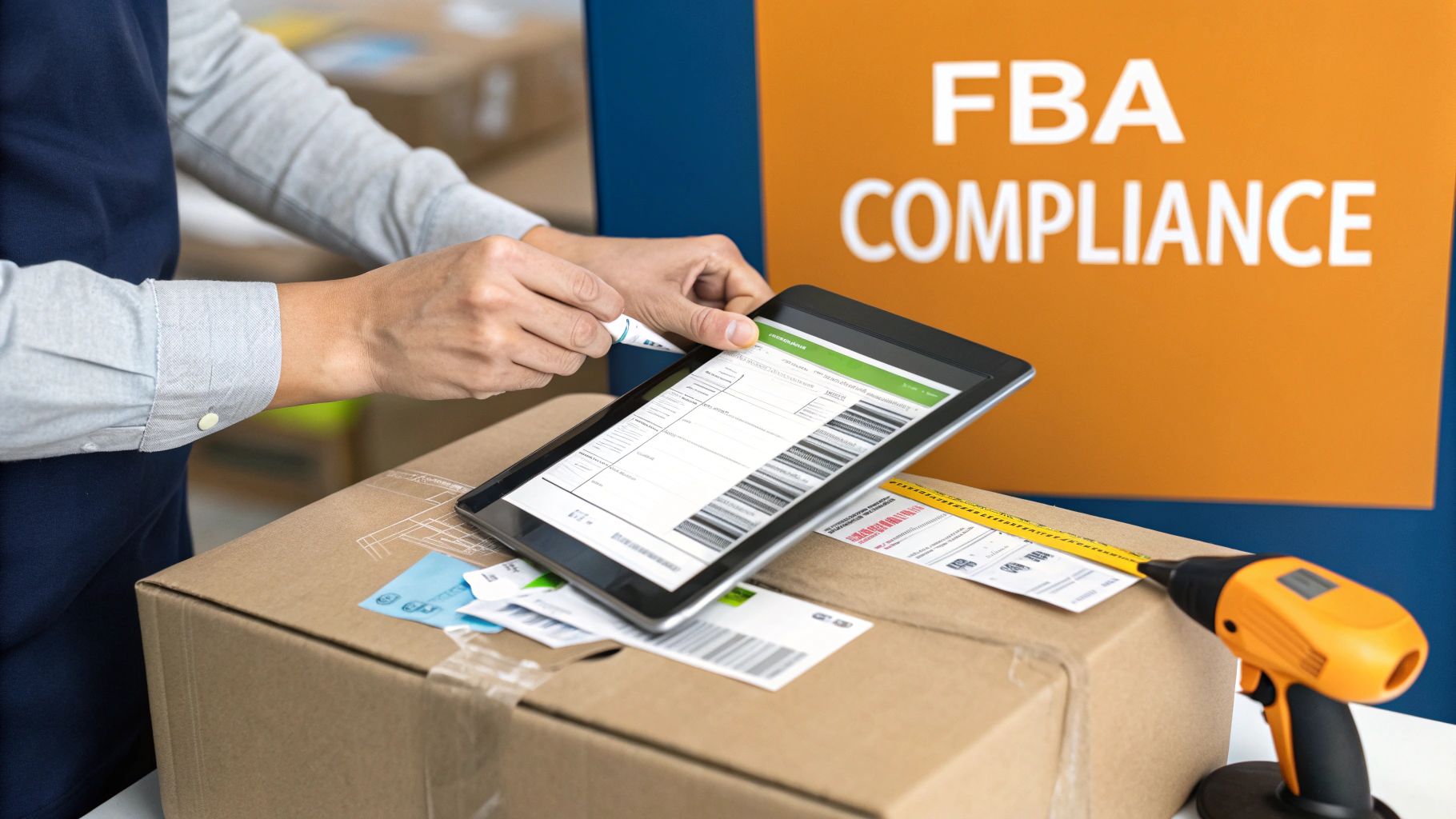
A person uses a tablet to manage FBA compliance for e-commerce order fulfillment, with a shipping box and labels.

Selling on Amazon FBA is a game-changer. It gives you instant access to millions of customers and Amazon's world-class logistics. But there's a catch: you have to play by their rules. And trust me, Amazon's rulebook is thick, specific, and non-negotiable.

You can't just toss your products in a box and ship them off to a fulfillment center. Every single item has to meet a long checklist of prep requirements. If they don't, you're looking at costly penalties, rejected shipments, or even having Amazon dispose of your valuable inventory.

Think of an Amazon warehouse—it's a symphony of automation, with robots and scanners moving at lightning speed. For that system to work flawlessly, every product needs to be standardized. That's where FBA prep and compliance come in. A good fulfillment partner is your expert on the ground, making sure every shipment is perfect before it ever leaves their warehouse.

Why FBA Prep Is a Non-Negotiable Step

Getting FBA prep wrong isn't a small slip-up; it can bring your entire Amazon operation to a screeching halt. Amazon will absolutely refuse shipments that don't meet their guidelines, leaving you with stranded inventory racking up storage fees and zero sales.

Worse yet, repeated mistakes hurt your seller reputation and your Account Health score. That can lead to selling restrictions or worse. Proper prep is your insurance policy against these headaches. It’s what ensures your products get checked in quickly and go live for sale without a hitch.

Core FBA Prep Services Your Partner Handles

An experienced partner offering ecommerce order fulfillment services manages every last detail of the FBA prep process. It’s way more than just boxing things up; it's a meticulous, checklist-driven process to guarantee compliance.

Here are the must-have services they'll take off your plate:

  • FNSKU Labeling: Every unit needs an Amazon-specific barcode (the FNSKU) that covers the original UPC. This is how Amazon tracks your inventory in their massive network, so it has to be perfect.
  • Poly Bagging: Got t-shirts, plush toys, or products with small parts? They'll need to be sealed in a protective poly bag to stay clean and contained.
  • Suffocation Warnings: This is a big one. Any poly bag with an opening 5 inches or wider must have a suffocation warning label. It’s a safety requirement Amazon takes very seriously.
  • Bundling and Kitting: If you sell a shampoo and conditioner set, for example, it needs to be packaged together and slapped with a "Sold as Set" or "This is a Set, Do Not Separate" sticker. This prevents warehouse workers from splitting them up.
  • Quality Control Inspections: Before anything heads to Amazon, your partner should be doing a final check for damage or defects. This simple step can save you from a flood of negative reviews.

A skilled FBA prep service acts as a final quality gatekeeper. They are your eyes and ears, catching potential issues before they reach Amazon's fulfillment centers, safeguarding your inventory and your brand's reputation with every shipment.

Handing this off to a specialist means you skip the painful learning curve and avoid the expensive mistakes. To see what a dedicated service looks like, check out this breakdown of Amazon FBA prep services and what to look for. It lets you tap into the power of FBA without getting lost in the weeds of its complex rules.

Integrating Your Sales Channels for Seamless Operations

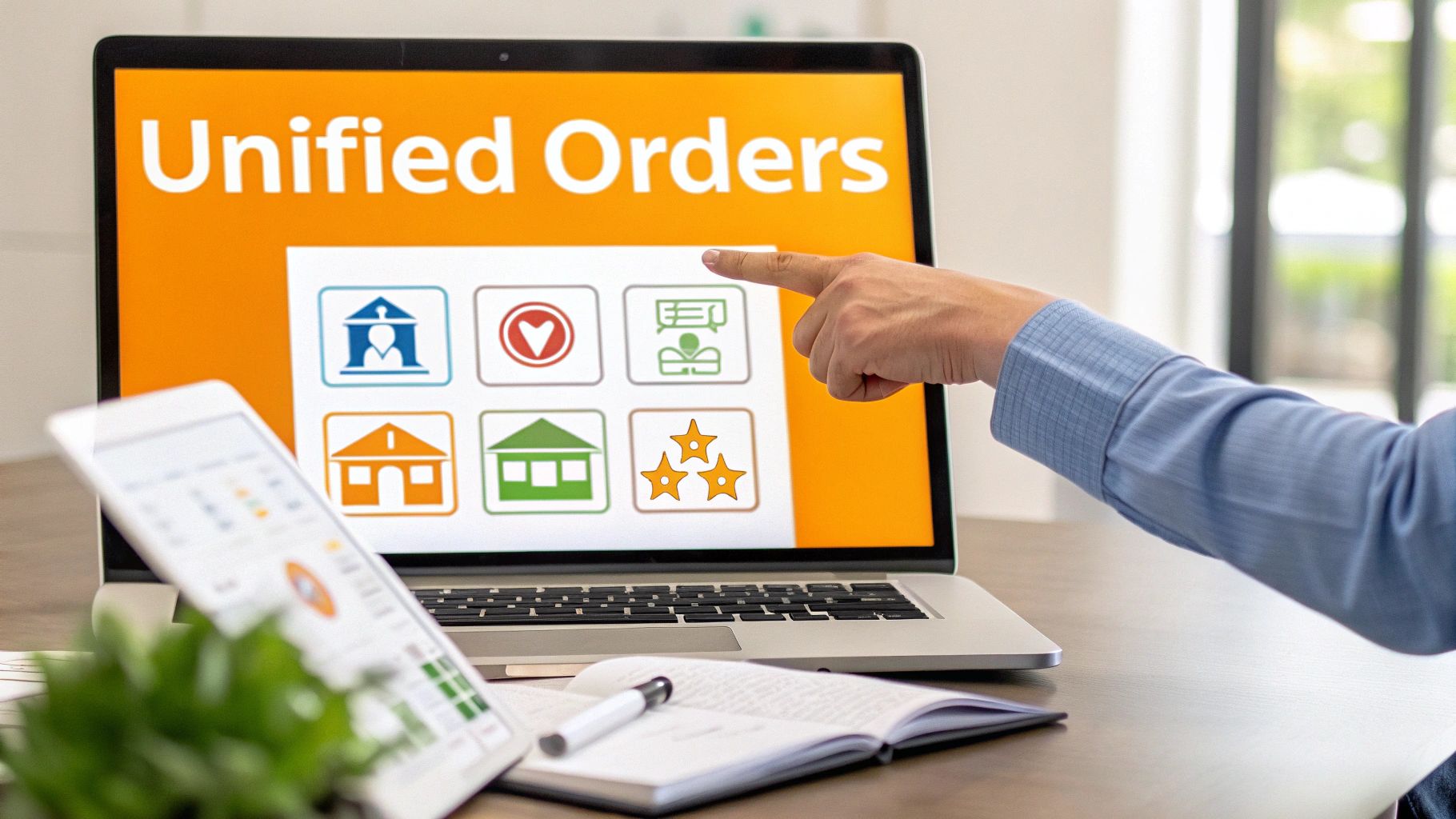
A hand points at a laptop screen displaying 'Unified Orders' and various business-related icons.

Today’s ecommerce brands don't live in just one place. You might have your main store on Shopify, a huge presence on Amazon, and a growing shop on Walmart Marketplace. Trying to manage orders from all those channels by hand is a recipe for disaster—it’s slow, full of errors, and simply won't scale with you.

This is where technology becomes the backbone of your partnership with an ecommerce order fulfillment services provider. The real magic is the seamless integration between your sales platforms and your partner’s Warehouse Management System (WMS).

Think of this digital link as the central nervous system for your entire operation. It works quietly in the background, making sure every part of your business talks to each other perfectly, without you having to lift a finger. This automation is what separates a chaotic, reactive process from a smooth, scalable one.

The Power of Automated Order Syncing

The second a customer hits "buy" on any of your channels, the integration instantly pulls that order data straight into the 3PL's system. This completely gets rid of the need for you to manually export order sheets and email them over. No more spreadsheets.

This direct connection is more than just a convenience; it's a must-have for modern commerce. The benefits are immediate and obvious.

  • Drastically Reduces Human Error: Manually typing in orders always leads to mistakes—wrong addresses, incorrect products, you name it. Automation wipes out this risk, driving up your order accuracy.
  • Saves a Ton of Time: All those hours you used to spend on order admin? You get them all back. Now you can focus on what really grows your business: marketing, product development, and customer service.
  • Gets Orders Out Faster: Orders hit the warehouse floor in minutes, not hours. This seriously cuts down the time from click to ship, which is exactly what customers love to see.

This integration turns your fulfillment from a bunch of manual chores into a single, automated workflow. It’s the engine that lets you process hundreds or even thousands of orders across multiple channels just as easily as you’d handle one.

Real-Time Inventory Management Across Channels

Maybe the biggest win from a fully integrated system is unified inventory management. When your fulfillment partner ships an order from your Walmart store, the WMS automatically updates your stock levels. That change is then instantly pushed back to your Shopify and Amazon listings.

This real-time sync prevents one of the worst headaches for multi-channel sellers: overselling. You'll never have to cancel an order and tick off a customer because you sold something on one platform that was already gone from a sale on another.

It makes sure the inventory counts on all your storefronts are always spot-on. This builds trust with your customers and protects your seller ratings, which are vital for staying visible on competitive marketplaces. You can learn more about how these crucial ecommerce integrations connect your whole tech stack.

By plugging your sales channels directly into your fulfillment provider, you create a single, cohesive ecosystem. Every order, from any source, flows into one central hub for picking, packing, and shipping, while your inventory stays perfectly managed across your entire business.

Decoding Fulfillment Pricing and Performance Metrics

Choosing the right partner for your ecommerce order fulfillment services is about so much more than just finding someone to pack boxes. It’s about finding a partner whose costs make sense for your business and whose performance you can actually measure. Let's pull back the curtain on how fulfillment pricing really works and the critical numbers you need to watch.

Understanding a fulfillment quote can feel like you're trying to read a foreign language at first. But once you get the hang of the core components, it all starts to click. Most 3PL pricing is built around four key activities.

The Four Pillars of Fulfillment Costs

Think of fulfillment pricing less like a fixed-price meal and more like an à la carte menu. You only pay for the specific services you actually use, which keeps you from getting stuck with a bill for things your business doesn't need.

Here are the main fees you’ll run into:

  • Receiving Fees: This is the cost to get your inventory checked in and ready for sale. It covers the labor for unloading trucks, inspecting your products, counting them, and putting them away in the warehouse. This is usually billed by the hour, per pallet, or sometimes per unit.
  • Storage Fees: You’re essentially renting shelf space. This fee is charged monthly and is based on how much room your inventory takes up. It's often calculated in cubic feet, per pallet, or per bin.
  • Pick and Pack Fees: This covers the labor involved in grabbing the items for an order and packing them up for shipment. It’s typically billed as a fee per order, plus a small extra fee for each item in that order.
  • Shipping Fees: This is the actual postage cost to send a package through carriers like USPS, FedEx, or UPS. The good news? Because 3PLs ship in massive volumes, they get huge discounts and pass those savings on to you.

Once you understand these four fees, you can compare quotes from different providers and have a real conversation about what you need.

It's one thing to understand the bill, but it's another to know if you're getting your money's worth. Here's a quick look at the typical fees you'll see on a fulfillment quote.

Common Fulfillment Service Fees Explained

Fee Type What It Covers Common Pricing Structure
Onboarding/Setup The initial work to integrate your store, set up your products in the system, and train the team on your specific needs. One-time flat fee
Receiving Labor to unload, count, inspect, and put away your incoming inventory. Per hour, per pallet, or per unit
Storage Renting warehouse space for your products. Per pallet, per bin, or per cubic foot (charged monthly)
Pick & Pack Labor to retrieve items for an order, package them, and prepare the shipping label. Per order + per item in the order
Shipping The actual cost paid to the mail carrier (e.g., USPS, FedEx, UPS). Based on package weight, dimensions, and destination
Packaging Materials The cost of boxes, mailers, tape, and void fill used for your orders. Per order or included in the pick & pack fee
Returns Processing Handling returned items, including inspection, restocking, and updating your inventory. Per item processed
Account Management A dedicated point of contact and ongoing support from the 3PL's team. Monthly flat fee or included in other charges

Having this breakdown makes it much easier to see where your money is going and ensures there are no surprises when the invoice arrives.

Key Performance Indicators to Measure Success

So, your fulfillment is up and running. How can you tell if your 3PL is crushing it or dropping the ball? You have to track the right data. These Key Performance Indicators (KPIs) are the official report card for your fulfillment operation, showing you exactly what’s working and what needs a little help.

And make no mistake, performance is everything. Today's customers are demanding. A staggering 60% of online retailers outsource at least some of their fulfillment, largely because 52% of consumers get frustrated by shipping delays and 77% want their stuff delivered fast. Tracking performance isn’t just a good idea—it’s how you stay in business. You can discover more ecommerce fulfillment statistics on Capital One Shopping to see just how high the stakes have gotten.

Measuring performance isn't about micromanaging your 3PL. It's about establishing a shared understanding of success. When you and your partner are aligned on these metrics, you can work together to consistently delight your customers.

Here are the non-negotiable KPIs you should be watching like a hawk:

  1. Order Accuracy Rate: What percentage of your orders are shipped perfectly, with no mistakes? A great partner should hit 99.5% or better. Anything less means you're dealing with unhappy customers and expensive returns.

  2. On-Time Shipping Rate: This tracks how many orders are picked, packed, and out the door within the agreed-upon window (usually 24 hours). Hitting this goal is the first step to meeting your customers' delivery expectations.

  3. Dock-to-Stock Time: How fast does your new inventory go from the delivery truck to being available for sale? A quick turnaround of 24-48 hours is crucial. Any longer, and you risk selling out of a product you technically have in the building.

  4. Inventory Accuracy: Does the number in the computer match the number of units on the shelf? Your 3PL’s inventory count should be above 99% accurate. If not, you could easily oversell products you don’t actually have.

How to Choose the Right Fulfillment Partner

Picking a partner to handle your ecommerce order fulfillment services is one of the biggest decisions you'll make for your brand. This isn't just about hiring another vendor; it’s about trusting someone with the final, crucial step of your customer experience.

Get it right, and your fulfillment partner acts as a launchpad for growth. Get it wrong, and they become a bottleneck, frustrating customers and grinding your progress to a halt.

The stakes are massive. By 2025, the world is projected to ship a mind-boggling 217 billion parcels. That breaks down to nearly 5,900 packages flying out the door every single second. With 52% of shoppers admitting they get frustrated by slow deliveries, the pressure has never been higher. For a closer look at these numbers, you can discover more insights about global shipping statistics on Swell.is.

To make a smart choice, you need to go beyond the sales pitches. It’s all about asking the right questions to figure out what truly matters for your business.

Assess Their Expertise and Specialization

Not all fulfillment centers are built the same. A 3PL that's fantastic at shipping t-shirts might be completely lost when it comes to fragile glassware or oversized furniture. Your first filter should always be finding a partner whose expertise actually matches what you sell.

Ask them point-blank: "What other clients do you have in my product category?" You need to know if they understand the unique requirements of your inventory. Do your products need temperature control? Batch tracking for consumables? Special handling for delicate items? A partner who already gets your niche won't be learning the ropes on your dime.

Evaluate Their Technology and Integrations

Modern fulfillment is driven by technology. A partner’s Warehouse Management System (WMS) has to connect seamlessly with your ecommerce platform, whether that’s Shopify, Amazon, Walmart, or a custom-built site. A clunky, manual integration is a deal-breaker.

Here’s what to dig into:

  • How seamless is the integration process? Ask for a live demo. Watch how an order flows from your storefront into their system.
  • What level of visibility will I have? You absolutely need a real-time dashboard to see inventory levels, check order statuses, and manage your stock.
  • How are inventory levels synced across channels? This is critical for preventing overselling and keeping customers happy.

Analyze Their Location and Scalability

A warehouse’s physical location has a direct impact on your shipping costs and delivery times. A partner with a warehouse network strategically placed near your customers can help you offer faster, cheaper shipping. If most of your buyers are on the East Coast, a facility in New Jersey makes a lot more sense than one in California.

But it’s not just about today. You have to think about tomorrow. The right partner needs to be able to grow with you. Ask them how they handle seasonal rushes and whether their operations can support you as you scale from 100 orders a month to 10,000. Their ability to flex is what separates a good partner from a great one.
By methodically working through these key areas, you can move past a simple price comparison. This approach helps you find a true operational partner who understands your business and is ready to help you scale. For more foundational knowledge, check out our guide on what a 3PL warehouse is and how it functions.

Frequently Asked Questions

Jumping into the world of ecommerce order fulfillment services always brings up a few questions. We get it. To help you make a confident decision for your brand, here are the straight-up answers to the most common things business owners ask us.

When Is the Right Time to Outsource My Fulfillment?

Most founders start seriously looking for a 3PL partner when they find themselves consistently shipping 10-20 orders per day. This is usually the tipping point where the hours you spend taping up boxes start to feel like they're actively stealing time from growth tasks like marketing, product development, or customer service.
Other classic triggers? You’re tripping over inventory in your garage, or you realize you can't compete with the fast, affordable shipping your customers have come to expect. If logistics feel more like a bottleneck than a competitive advantage, it’s probably time to start the conversation.

What’s the Difference Between a 3PL and a Fulfillment Center?

Great question. The terms get thrown around a lot, but there’s a key difference. A fulfillment center is simply the physical building—the warehouse where your inventory is stored and orders get packed.

A 3PL (Third-Party Logistics) is the company that runs that center and provides the entire suite of services that go with it. They manage the inventory, handle the transportation, and integrate with your sales channels. A 3PL uses fulfillment centers to deliver a complete, end-to-end logistics solution.

Think of it like this: the fulfillment center is the kitchen, but the 3PL is the entire catering company. They don't just cook the food; they plan the menu, manage the chefs, and make sure everything gets delivered perfectly, every time.

Can a Fulfillment Service Handle My Custom Packaging and Branding?

Absolutely—and any good one should. We know how critical the unboxing experience is, especially for direct-to-consumer brands that live and die by their customer connection.

Most modern 3PLs are built to support your brand identity. This often includes:

  • Using your custom-branded boxes, mailers, or poly bags.
  • Inserting promotional flyers, samples, or thank-you cards.
  • Applying branded tape or stickers to seal the package.

These little touches are what keep customers coming back, even when you're not the one packing the box yourself. Just be sure to ask any potential partner exactly what level of customization they can handle before you sign on the dotted line.


Ready to stop packing boxes and start scaling your business? Snappycrate offers specialized fulfillment and Amazon FBA prep services designed for ambitious ecommerce brands. Get a quote and see how we can streamline your operations.

0 Continue Reading →

What is a 3pl warehouse? Unlock Faster, Cheaper Fulfillment

Let's be honest, "logistics" is one of those words that sounds complicated and expensive. But a 3PL (Third-Party Logistics) warehouse is actually pretty simple: it's your outsourced operations partner. Think of them as the team that handles all the physical stuff—storing your products, packing your orders, and shipping them out—so you don't have to.

Your Business Command Center, Not Your Garage

Every successful e-commerce brand reaches a point where the garage, spare bedroom, or basement is overflowing with inventory. That's the moment you graduate to a professional command center that runs your fulfillment on autopilot.

That’s what a 3PL warehouse really is. It’s not just a storage unit; it's an active, integrated partner that plugs into your online store and manages the entire journey of your product, from the moment it arrives at their dock to the second it lands on your customer's doorstep. This frees you up to focus on what actually grows your brand: marketing, product development, and customer relationships. No more printing labels and wrestling with packing tape.

And you wouldn't be alone. More and more businesses are turning to logistics experts to stay competitive. The Third-Party Logistics industry in the United States now includes over 72,000 businesses, with revenues expected to hit a massive $138.4 billion in 2025. This isn't just a trend; it's a fundamental shift in how modern e-commerce brands operate. You can see more data on this growth at Grandviewresearch.com.

Core Functions of a 3PL Warehouse at a Glance

So, what does a 3PL warehouse actually do day-to-day? While every partner is different, their work boils down to a few core services that solve the biggest headaches for online sellers.

This table breaks down the three main pillars of 3PL services and what they mean for your business in practical terms.

Core Service What It Means for Your Business Key Benefit
Warehousing Securely storing your inventory in an organized, professional facility. Frees up your personal space and ensures products are safe and accounted for.
Inventory Management Using software to track stock levels in real time, preventing overselling. Maintains accurate counts and provides the data you need for restocking.
Pick, Pack, & Ship Fulfilling customer orders by picking items, packing them, and shipping them out. Achieves faster shipping times and higher order accuracy without your effort.

Ultimately, the right 3PL warehouse acts as a true extension of your own team. They bring the infrastructure, technology, and expertise you need to scale your operations without the massive upfront investment.

By understanding these core functions, you can start to see how a 3PL can directly support your business goals. For a deeper dive into scaling your business, you might be interested in our guide on getting started.

The Journey of a Product Inside a 3PL

To really get what a 3PL warehouse does, let’s follow one of your products from the moment it hits our dock. Thinking about it this way pulls back the curtain on the whole fulfillment process, turning an abstract idea into the concrete steps we take every single day for e-commerce brands just like yours.

The journey starts the second your inventory arrives at our loading dock. This could be a handful of boxes you shipped over or a full-on shipping container straight from your supplier. We call this first step inbound receiving.

Our team gets to work unloading the shipment, checking that everything matches the list you sent us—no surprises. Each product gets a quick inspection for damage before it's scanned into our Warehouse Management System (WMS). Just like that, it’s officially part of your on-hand inventory, ready to be sold.

Strategic Storage and Smart Placement

Once your products are checked in, they don’t just get tossed onto a random shelf. This isn't your garage. The WMS assigns every single item a specific home—a bin, a shelf spot, or a pallet rack location.

And there’s a method to the madness. Your best-sellers? We keep those in easy-to-reach spots to make picking them for orders super fast. Slower-moving items might go a bit higher up or further back. It’s all about organized chaos, designed for maximum efficiency and accuracy.

The Order Fulfillment Cycle

This is where the real action begins. A customer clicks "buy" on your Shopify or Amazon store, and that order zips right into our system automatically. That single click kicks off a finely tuned workflow:

  1. Order Picking: A warehouse team member gets a "pick list" on their handheld scanner. The device maps out the fastest route through the warehouse to grab everything for an order. They scan each item as they go to ensure 100% accuracy.

  2. Order Packing: The items are whisked over to a packing station. Here, a packer finds the perfect-sized box, adds any needed dunnage (like bubble wrap), tucks in any marketing inserts you’ve sent us, and seals it all up.

  3. Shipping: The sealed box hits the scale, and our system spits out the right shipping label based on what the customer selected at checkout. From there, it joins a sea of other packages, all ready for carriers like UPS, FedEx, or USPS to scoop them up.

This infographic breaks down how all these moving parts—inventory, fulfillment, and shipping—come together in one smooth operation.

Infographic detailing 3PL benefits: streamlined logistics from inventory to shipping, resulting in growth and efficiency.

As you can see, a good 3PL partner turns what feels like a logistical nightmare into a simple, straightforward process. It frees you up to actually focus on growing your business.

The second the carrier picks up that package, tracking info is automatically pushed to your store and sent to your customer. The journey is complete, and another happy customer is about to get their order.

Core Services That Fuel E-Commerce Growth

A logistics worker in an orange high-visibility vest scans packages at a service counter.

Sure, warehousing and shipping are the basics. But the real magic of a 3PL warehouse isn't just storing boxes—it's the specialized services that help e-commerce brands actually grow. These aren't just fluffy add-ons; they're strategic tools that boost your efficiency, wow your customers, and keep you compliant with giants like Amazon.

Think of these services as the high-performance parts that turn a standard fulfillment operation into a growth engine.

At the center of it all is a powerful tech backbone. Modern 3PLs run on sophisticated software that gives you a live look into your inventory and orders. This isn't a minor upgrade; it's a fundamental shift. Today, 86% of 3PLs rely on a Warehouse Management System (WMS) to run the show. Why? 87% want real-time inventory tracking, and 75% are laser-focused on making their operations more efficient. You can see more on how tech is changing the game in this detailed 3PL statistics report.

Essential FBA Prep and Compliance Services

Selling on Amazon FBA is a massive opportunity, but let's be honest—it comes with a notoriously strict rulebook. One small mistake in prepping your inventory can lead to rejected shipments, frustrating penalties, and lost sales. This is where a 3PL that knows Amazon inside and out becomes your most valuable partner.

A good 3PL handles all the nitpicky tasks to make sure every shipment sails through Amazon's receiving docks.

  • FNSKU Labeling: Amazon uses its own FNSKU barcodes to track every item. Your 3PL will label each unit perfectly, covering any old manufacturer barcodes to prevent scanning errors that can wreak havoc on your inventory.
  • Poly Bagging: Got apparel, plush toys, or items that could get dusty? They need to be in a poly bag, often with a specific suffocation warning. A 3PL knows the rules and gets it done right.
  • Bundling and Multipacks: If you sell a shampoo and conditioner combo, your 3PL will physically bundle them and slap on a "Sold as a Set" label. This tells Amazon's warehouse team not to split them up.

Outsourcing these tedious tasks saves you from the headache of keeping up with Amazon’s constantly changing requirements. You can dive deeper into this process in our guide on Amazon FBA prep services.

Value-Added Services That Build Your Brand

Beyond just following the rules, the right 3PL partner can help you build your brand identity. These value-added services are all about creating a memorable customer experience that makes you stand out.

A memorable unboxing experience can turn a one-time buyer into a loyal customer. It’s often the first physical interaction a customer has with your brand, making it a powerful marketing opportunity.

Kitting is a perfect example. This is where a 3PL assembles multiple separate items into a single package, like a subscription box or a holiday gift set. It lets you create brand-new product offerings without touching your manufacturing process.

Plus, a 3PL can use your custom branded boxes, tissue paper, and thank-you cards to create an unboxing experience that screams quality and shows off your brand’s unique personality.

Understanding the Real ROI of a 3PL Partnership

Calculating the true value of a 3PL warehouse isn't about comparing your current costs to their monthly invoice. The real return on investment isn't just saving a few bucks on rent or shipping labels—it’s about buying back your most valuable asset: your time.

Think about the daily grind of running an e-commerce brand from your garage. You lose hours receiving inventory, fighting with packing tape, and making runs to the post office. This isn’t just inefficient; it’s a massive bottleneck. Every hour spent on logistics is an hour you can't spend on marketing, product development, or customer service—the things that actually grow your business.

From Direct Savings to Strategic Growth

The most obvious ROI comes from ditching direct operational costs. You get to eliminate a warehouse lease, payroll for pickers and packers, and big investments in equipment like forklifts and shelving. This frees up a ton of capital that you can pump right back into more inventory or a new marketing campaign.

But the real magic happens with the operational efficiencies a 3PL brings to the table.

  • Reduced Shipping Costs: 3PLs ship in huge volumes, which gives them access to heavily discounted carrier rates that a small business could never get on its own.
  • Fewer Errors: Professional fulfillment centers have processes that minimize costly mistakes, like sending the wrong item or shipping to an old address. This protects both your profits and your brand’s reputation.
  • Faster Fulfillment: With optimized workflows and a dedicated team, a 3PL gets orders out the door much faster, leading to happier customers and better reviews.

The Ultimate Return: Time and Scalability

This shift from DIY fulfillment to a professional partnership is where you unlock true scalability. And market conditions are making it easier than ever. The national warehouse vacancy rate recently hit 7.1%, its highest point since 2014, meaning there’s more space available for growing brands. This is a big reason why 87% of shippers increased their use of outsourced logistics in 2025—a 25% jump from the year before. You can dig into more of this data in a recent report on industrial leasing.

By outsourcing logistics, you aren't just offloading tasks; you are investing in a system designed for growth. It allows you to focus on strategic initiatives while your fulfillment engine runs seamlessly in the background.

Ultimately, partnering with a 3PL warehouse transforms your daily workflow from reactive to proactive. You stop putting out fires and start building your brand. That shift doesn’t just improve your bottom line—it gives you the freedom to lead.

How to Choose the Right 3PL Warehouse

A wooden desk with two laptops, a pen, and a document. One laptop screen displays options; text reads 'Choose Wisely'.

Picking a fulfillment partner is one of the biggest moves you’ll make for your e-commerce brand. This isn't just about renting some shelf space; you're handing over a huge piece of your customer experience to an outside team. Get it right, and a 3PL can be the engine for massive growth. Get it wrong, and you're in for a world of logistical nightmares and angry customers.

To make a smart choice, you need to look past the price sheets. It’s all about finding a partner whose tech, skills, and culture line up with where your brand is now—and where you plan on taking it.

Technology and Integrations

Think of your 3PL as a technology partner first, a warehouse second. Their ability to plug directly into your e-commerce store is absolutely non-negotiable. If their systems can’t talk to yours, you’ll find yourself manually keying in orders, which completely defeats the purpose of outsourcing in the first place.

Before you even think about signing a contract, insist on a live demo of their software. You need to see exactly how it works and confirm they have solid, ready-to-go integrations for your tech stack.

  • E-commerce Platforms: Can they connect directly to your Shopify, BigCommerce, or whatever platform you use to sell?
  • Marketplaces: Does their system automatically pull in orders from Amazon, Walmart, or other channels you rely on?
  • Inventory Sync: How quickly does their system update your store’s stock levels? Real-time syncing is critical to prevent overselling.

A modern tech stack is what keeps the data flowing, ensuring your operations are accurate and efficient without you having to lift a finger.

A 3PL’s technology is the central nervous system of your fulfillment operation. Without seamless integration, you're creating more problems than you solve. A modern warehouse runs on data, not just forklifts.

Specialization and Expertise

Let’s be clear: not all 3PLs are the same. Some are pros at handling tiny, lightweight items, while others are built to move heavy freight. Finding a partner who actually gets your product category is key to making sure everything is handled correctly and stays compliant.

For instance, a 3PL that focuses on apparel will know all about poly bagging, SKU management for different sizes and colors, and returns processing. On the other hand, a partner who works with supplements will be an expert in lot tracking and managing expiration dates.

And if you sell on Amazon, their FBA prep expertise is make-or-break. Navigating Amazon's increasing non-compliant fees is a full-time job, and you need a partner who knows Amazon's rulebook backward and forward.

Scalability and Growth Potential

Finally, you have to think about the future. The 3PL that’s a perfect fit today might be a bottleneck in two years when your order volume explodes. You need a partner who can grow with you, not hold you back.

Don’t be shy about asking direct questions about their capacity and plans for expansion:

  • What’s their typical daily order volume, and what’s their absolute max capacity?
  • Do they operate multiple warehouses? This can be a game-changer for reducing shipping times and costs as you expand.
  • How do they handle crunch time during seasonal peaks like Black Friday?

Choosing a 3PL with a clear path for growth means your fulfillment will always be a strength, not a weakness, as your business takes off.

Common Questions About 3PL Warehouses

Jumping into the world of fulfillment always brings up a few questions. To help you get clear, we’ve put together answers to some of the most common things business owners ask when they’re thinking about bringing on a 3PL partner.

How Much Does a 3PL Warehouse Cost?

There's no single price tag for 3PL services—and that's a good thing. Pricing is almost always tailored to your specific needs, so you only pay for what you actually use. Think of it less like a fixed monthly rent and more like a pay-as-you-go utility for your entire logistics operation.

Most pricing models are broken down into these core activities:

  • Receiving: This is a one-time fee for getting your inventory in the door, which includes inspecting it and putting it away. It's often charged by the pallet, by the hour, or per unit.
  • Storage: A recurring monthly fee for the physical space your products take up. This is usually calculated by the pallet, by the bin, or by cubic footage.
  • Pick and Pack: A fee for every order we fulfill. This might be a flat rate per order or a smaller fee for each item we have to pick to complete an order.
  • Shipping: This is the actual postage cost, which is passed through to you. One of the biggest perks here is that 3PLs get massive discounts from carriers due to their high shipping volumes, and those savings get passed on.

Since the final cost really depends on your order volume, product size, and any special handling needs, it’s always best to get a detailed quote.

When Is the Right Time to Switch to a 3PL?

Knowing when to hand over fulfillment can feel like a big decision, but there are usually some pretty clear signs that you've outgrown your current system. The real tipping point is when managing logistics starts taking up more of your time than actually growing the business.

Here are a few practical benchmarks that tell you it might be time to outsource:

  • You're consistently shipping over 100 orders per month and feel like you’re barely keeping your head above water.
  • You’re spending more than 10-15 hours a week just packing boxes instead of working on marketing, product development, or customer relationships.
  • You’ve officially run out of space in your garage, office, or that storage unit you rented.
  • Your order accuracy is starting to slip, which means more customer service headaches and costly returns.

Making the switch isn’t just about getting bigger; it’s about working smarter. Outsourcing fulfillment gives you back your time so you can focus on the strategic work that will actually scale your brand.

Can a 3PL Handle Both Amazon FBA and FBM?

Absolutely. In fact, finding a 3PL that truly understands the Amazon ecosystem is a massive strategic advantage. They can act as a flexible hub, managing your inventory and fulfilling orders for both FBA (Fulfillment by Amazon) and FBM (Fulfillment by Merchant) seamlessly.
For Amazon FBA, the 3PL serves as your prep center. They handle all the mission-critical compliance tasks—like applying FNSKU labels, poly bagging items, and creating bundles—to meet Amazon’s notoriously strict inbound requirements. This is your insurance policy against rejected shipments.

For Amazon FBM, the 3PL simply fulfills orders directly from their warehouse to your customer. This gives you far more control over your inventory and can often be a more profitable route for certain products. Using one 3PL for both lets you build a powerful, multi-channel fulfillment strategy without the logistical nightmare.


Ready to stop packing boxes and start scaling your business? Snappycrate is an e-commerce 3PL that acts as a true extension of your team, handling everything from storage and FBA prep to fast, accurate order fulfillment. Discover how we can streamline your operations by visiting us at https://www.snappycrate.com.

0 Continue Reading →