Think of trying to navigate a busy city with a paper map printed yesterday. You'd hit unexpected road closures, get stuck in traffic jams that popped up overnight, and completely miss your appointments. For a long time, that's how e-commerce inventory worked.
Real time inventory management is your business's live GPS. It's the practice of tracking your stock levels and every single movement—sales, returns, transfers—as it happens, giving you a constantly accurate view of every item you own.
What Is Real Time Inventory Management
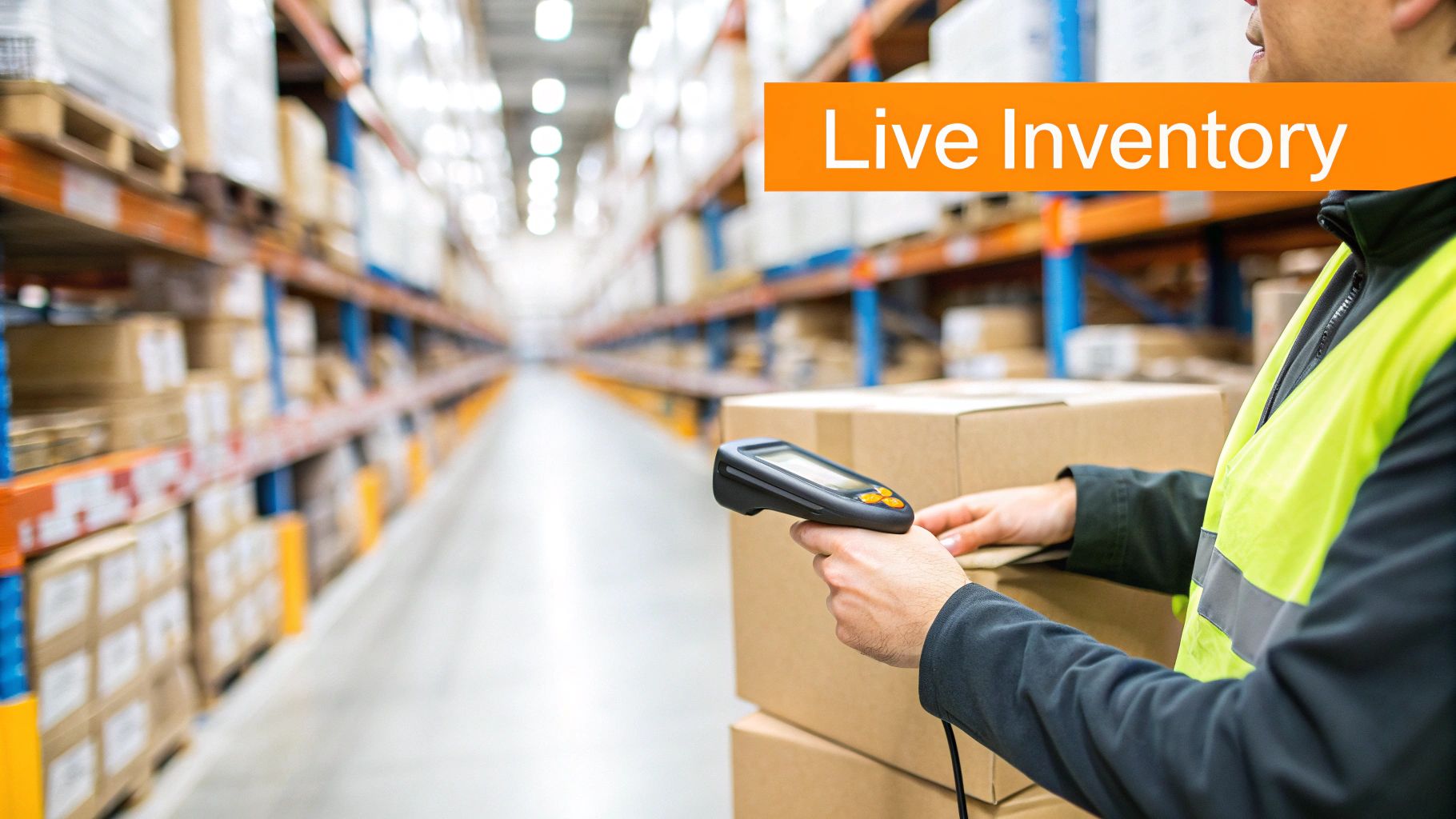
Unlike old-school methods that update your stock counts periodically, a real time system ensures your data is always current. Every sale, return, or new shipment triggers an immediate update across all your connected systems.
This live, moment-by-moment picture of your entire inventory prevents the kind of costly mistakes that sink growing brands, like overselling a hot product during a flash sale or running out of stock when you thought you had plenty.
The Problem with Old-School Methods
In today's multi-channel world, legacy methods like batch updates are a recipe for disaster. Batch updates collect inventory changes over a set period—maybe a few hours, or even an entire day—and then sync everything at once.
This delay creates a dangerous information gap. If you’re running a sale, you could easily sell hundreds of units before your system even realizes you're sold out. The consequences are painful:
- Overselling: You sell products you don’t actually have, forcing you to cancel orders and deal with angry customers.
- Stockouts: You miss out on sales because your website incorrectly shows an item as unavailable.
- Bad Decisions: You end up ordering new stock based on data that's already hours or days old.
The digital shelf is unforgiving. When a customer sees an item as “in stock” only to get a cancellation email later, they probably aren't coming back. Real-time visibility closes the gap between what a customer expects and what your warehouse can actually deliver.
To put it in perspective, let's compare the two approaches side-by-side.
Traditional vs Real Time Inventory Management
The difference isn't just about speed; it's about fundamentally changing how you operate your business. The table below breaks down the core differences.
| Feature | Traditional Inventory Management (Batch Updates) | Real Time Inventory Management (Live Syncing) |
|---|---|---|
| Data Freshness | Data can be hours or even a full day old. | Data is updated instantly, within seconds of an event. |
| Accuracy | Prone to errors due to manual entry and delays. | High accuracy with automated, event-triggered updates. |
| Overselling Risk | High. A major risk during sales or high-traffic periods. | Low. Stock levels are synced across all channels immediately. |
| Stockout Risk | High. Lagging data makes it hard to know when to reorder. | Low. Live data provides accurate reorder points and low-stock alerts. |
| Decision Making | Based on outdated information, leading to reactive choices. | Based on live data, enabling proactive, strategic decisions. |
| Customer Experience | Poor. Leads to canceled orders and customer frustration. | Excellent. Ensures a reliable and trustworthy shopping experience. |
The takeaway is clear: while traditional methods were once manageable, the speed and complexity of modern e-commerce demand a live, synchronized system.
A Single Source of Truth
At its core, real time inventory management creates a single, reliable source of truth for your entire operation.
When you sell a product on Shopify, your available quantity on Amazon and Walmart updates instantly. When your 3PL partner receives a new shipment, that inventory becomes available for sale across all your channels in seconds, not hours.
This synchronization is no longer a "nice-to-have"—it's a must-have for growth. For 3PLs managing inventory for brands selling across multiple marketplaces, this real-time sync is an absolute necessity to prevent chaos. You can explore more about how these evolving industry standards are critical for modern supply chains.
This live data empowers you to make smarter, faster decisions, turning what was once a logistical headache into a real competitive advantage. It's the foundation for building a scalable, efficient, and customer-focused e-commerce business.
The Engine Behind a Real-Time Inventory System
A real-time inventory system can feel like magic, but it’s really just a smart, coordinated network of technologies working together. Think of it less like a single piece of software and more like your business’s central nervous system—a team of specialists constantly talking to each other to keep every piece of data perfectly in sync.
At its core, the system needs eyes and ears on your warehouse floor. These are the tools that see physical events happen and instantly translate them into digital data. This is where it all starts.
Capturing Every Movement
Every single action in the warehouse—from a new shipment arriving from your supplier to one tiny item being picked for an order—is an "event" that has to be recorded. If you miss these events, the entire system’s accuracy starts to crumble.
The most common tools for this job are pretty straightforward:
- Barcode Scanners: These are the trusty workhorses of any modern warehouse. Your team uses handheld scanners to zap items as they’re received, moved to a new shelf, picked for an order, or packed into a box. Each scan is an instant, error-free data entry point. No more manual spreadsheets.
- RFID (Radio-Frequency Identification): This is the next level up from barcodes. RFID tags don't need a direct line of sight to be read, which means you can process things much faster. Imagine scanning an entire pallet of goods just by wheeling it past a reader, instead of having to scan every single box on it.
These devices make sure that what’s physically happening on the warehouse floor is immediately reflected in your digital records. This instant data capture is the first critical link in the chain.
Connecting Your Digital Storefronts
Once an event is captured, that new information has to be shared with every other system your business relies on. This is where APIs (Application Programming Interfaces) come into play.
Think of APIs as universal translators or digital messengers. They build a seamless bridge that lets different software platforms talk to each other, even if they were built by different companies. Your Warehouse Management System (WMS), for instance, uses an API to push a stock update to your Shopify store. In turn, Shopify uses an API to send a new order right back to the WMS for fulfillment. You can learn more about how a powerful WMS is the cornerstone of effective warehouse management for e-commerce.
An API is the digital handshake between your warehouse and the outside world. It ensures that a sale on Amazon doesn’t happen in a vacuum—it’s an event that your entire operation is aware of instantly.
This constant, two-way conversation is what gives you a single source of truth. Without it, your systems would just be isolated islands of information, quickly becoming outdated and totally unreliable.
Using Event-Driven Triggers
The final piece of the puzzle is what makes the system truly "real-time": event-driven triggers. This just means that updates aren't based on a clunky schedule, like refreshing data every hour. Instead, updates are triggered automatically and immediately by specific events.
Here’s what that looks like in the real world:
- A Customer Buys a Product: The second a customer clicks "buy" on your website, an event is triggered. An API instantly tells your WMS to decrease the available stock for that SKU by one.
- A Return is Processed: When a returned item is inspected and scanned back into sellable inventory, that event triggers an update, adding that unit back to your available stock across all your sales channels.
- New Stock Arrives: Your warehouse team scans a new shipment from your supplier. This event instantly increases your inventory levels, making those new products available for sale right away.
This isn’t about doing periodic check-ins. It’s a living, breathing network that reacts to actions as they happen, guaranteeing your inventory data is always accurate and ready for you to act on.
Unlock Growth with Real Time Inventory Control
Knowing the mechanics of a real-time system is one thing, but seeing how it actually transforms your business is another. This is where abstract ideas like APIs and data triggers turn into real revenue, happier customers, and a warehouse that just works. For e-commerce brands, real time inventory control isn't just a nice-to-have upgrade—it's a serious growth engine.
The most immediate and powerful benefit? You can finally say goodbye to overselling and stockouts for good.
Imagine your product suddenly goes viral on TikTok. A traditional, slow-moving inventory system would completely buckle under the pressure. You'd end up selling hundreds of units you don't actually have, creating a customer service disaster that could take weeks to clean up.
With a live system, every single sale—no matter which channel it comes from—instantly adjusts your available stock count. The moment the 100th unit is sold, an "out of stock" message appears on all your platforms at the same time. This simple action preserves customer trust and prevents a flood of angry emails and canceled orders.
This flow shows how data travels from a physical scan in the warehouse all the way to a digital update on your storefront.
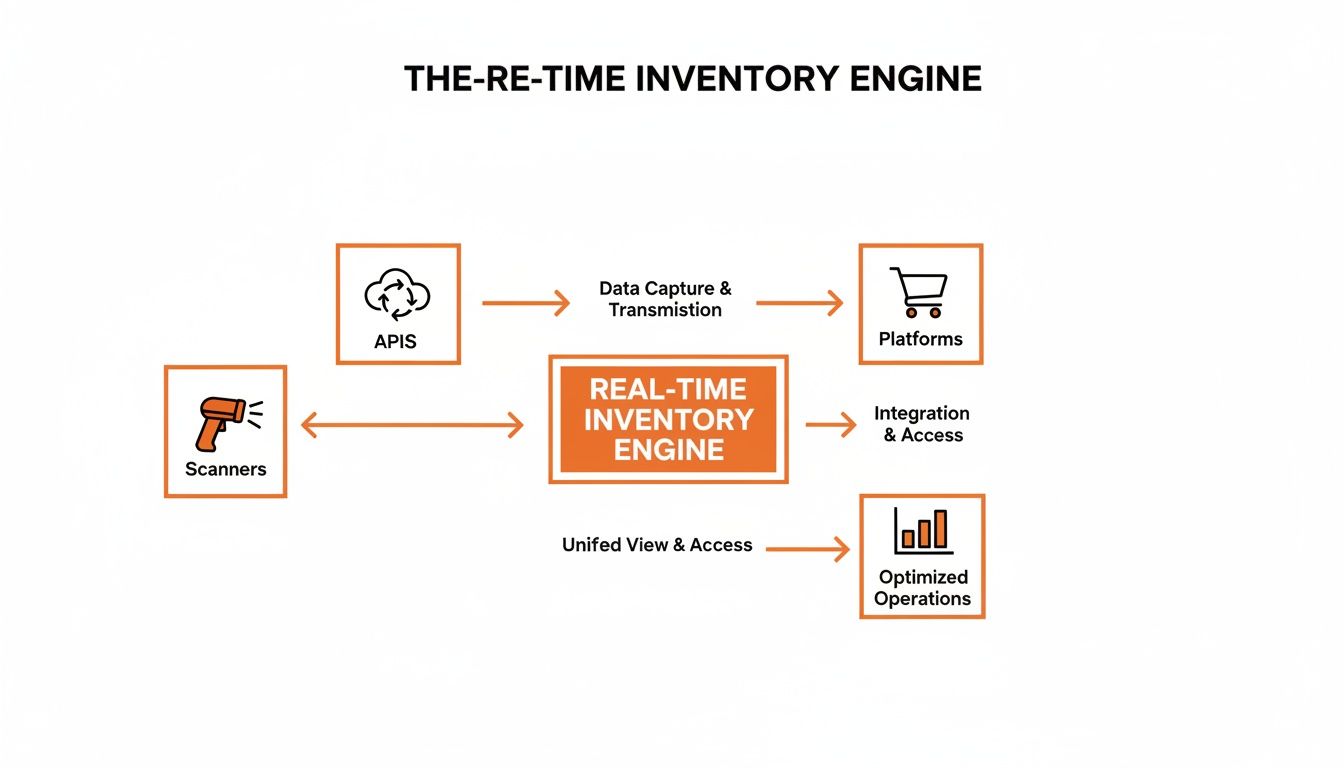
It’s a clear picture of how your hardware, software, and sales channels have to talk to each other seamlessly to make those instant updates happen.
Drive Fulfillment Speed and Accuracy
Beyond preventing stock issues, accurate inventory data is the foundation of fast, error-free fulfillment. When your warehouse management system (WMS) knows the exact location and quantity of every single item, your whole fulfillment process becomes incredibly efficient.
- Faster Picking: Your warehouse team gets sent to the precise bin location, which means no more wasted time searching for products.
- Fewer Errors: Barcode scanning at the packing station confirms that the right items are going into each box, slashing mis-picks and expensive returns.
- Improved Order Throughput: With smoother workflows, your team can process more orders every hour, helping you hit tight shipping deadlines and keep customers happy.
When people consistently get the right items on time, they start to trust your brand. That trust has a direct impact on how often they come back and how much they spend over time.
Smarter Decisions and Lower Costs
Live inventory data gives you the clarity you need to make smarter, more profitable decisions. Instead of waiting for weekly reports, you’re operating with a view of your business that's updated to the minute.
Real-time inventory management moves you from being reactive to proactive. You’re no longer fixing past mistakes; you’re making intelligent decisions based on what’s happening right now.
This shift makes a huge difference to your bottom line. With a clear picture of sales velocity and current stock levels, you can stop overstocking products that aren't selling. This directly cuts your carrying costs—the money tied up in storage, insurance, and unsold goods. For more on this, you can dig into these inventory management best practices.
This level of control also helps you manage more than just stock. Real-time project tracking, when tied to inventory and team data, has become essential. Businesses now rely on live dashboards to make faster decisions because old-school tools often create blind spots between tasks and inventory.
Elevate the Customer Experience
At the end of the day, every operational improvement should come back to the customer. Real time inventory control helps build a better customer experience from the very first click.
When a shopper lands on your product page, the availability info they see is actually accurate. That small detail is a massive trust signal. It tells them your operation is buttoned-up and professional, giving them the confidence to go ahead and make the purchase.
This reliability builds a strong brand reputation, lowers cart abandonment, and helps turn one-time buyers into loyal fans. It transforms inventory from a simple logistical task into a core part of your brand’s promise to your customers.
How a Modern 3PL Enables Your Real-Time Strategy
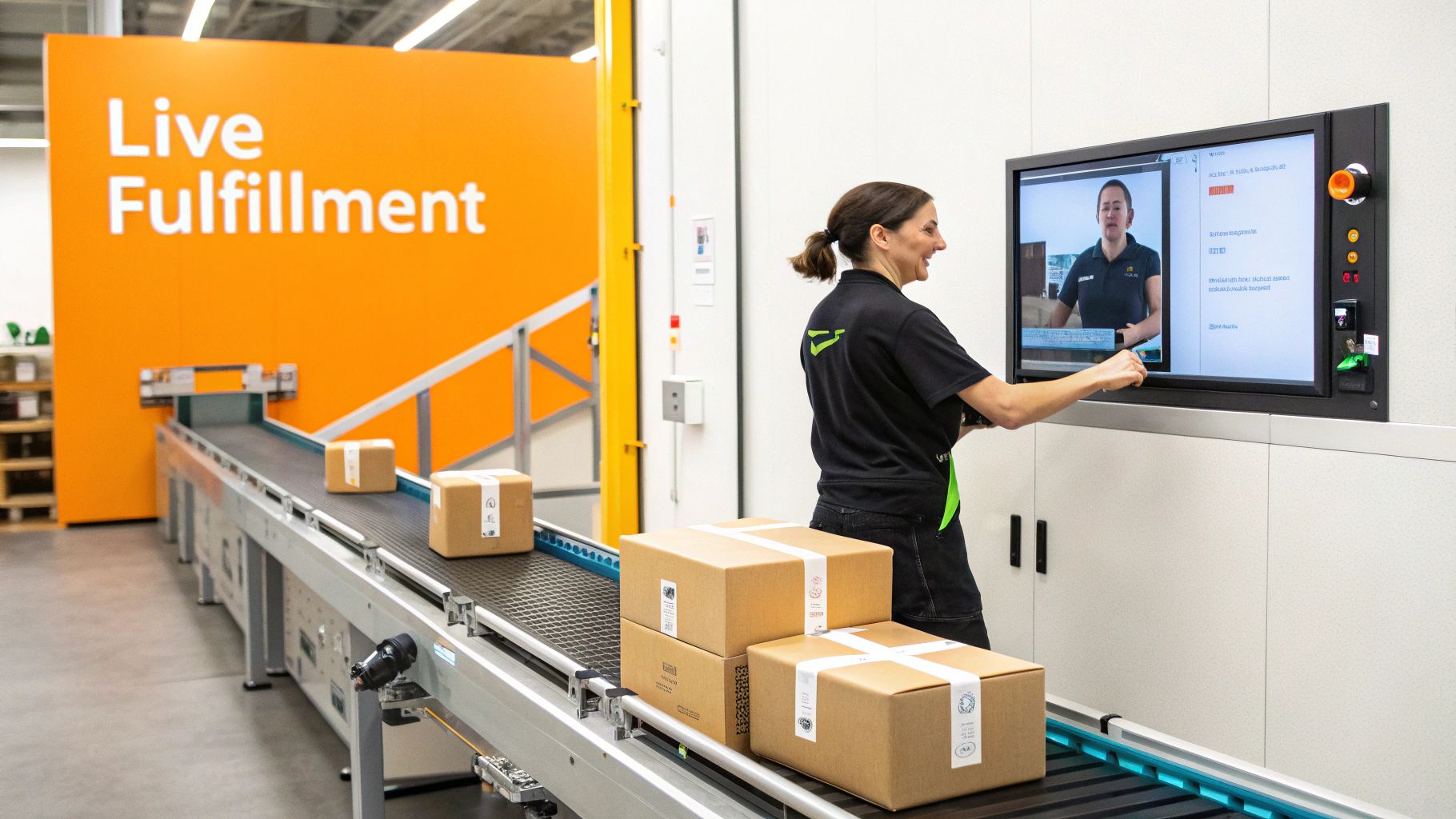
Let's be honest: building a true real-time inventory management system from scratch is a massive undertaking. It demands a huge investment in warehouse space, technology, and a team of experts to run it. For most growing e-commerce brands, that's just not realistic.
This is exactly where partnering with a modern third-party logistics (3PL) provider changes the entire game. A tech-forward 3PL like Snappycrate already has the infrastructure, software, and know-how built and running. You get all the power of a sophisticated, real-time system without the crippling upfront costs and operational headaches.
Tapping into a Ready-Made Infrastructure
When you work with an advanced 3PL, you're not just renting shelf space. You’re plugging your business directly into a fully operational, real-time ecosystem. From day one, your products are managed inside a warehouse built for speed, accuracy, and scalability.
Our Warehouse Management System (WMS) is the brain of the entire operation. It's engineered to integrate seamlessly with major sales channels like Shopify, Amazon, and Walmart, creating that essential single source of truth for your inventory. You don't have to build or buy any complex software—you just connect your stores to our existing, powerful platform. If you want a deeper dive into how these facilities operate, you can learn more about what a 3PL warehouse does in our guide.
This tight integration means every single product movement—from the moment your inventory hits our dock to the second an order ships—is tracked and synced across your entire business. Instantly.
Following a Product Through Our System
To see how this works in practice, let’s follow one of your products on its journey through our fulfillment center. This path is a series of precise, scan-based events that keep your data perfectly accurate at all times.
- Receiving and Inbounding: Your shipment arrives. Our team inspects it and scans the barcode on every single unit. This first scan is the critical trigger—it instantly adds the new items to your available inventory, making them live for sale across all your channels.
- Putaway: Each item is then scanned again as it’s placed into a specific bin or shelf location. Our WMS now knows not only that you have 100 units of a product, but precisely where each one is sitting.
- Picking and Packing: A customer places an order. Our system immediately generates a pick list, directing a team member to the exact location. They scan the item as they pick it, and then again at the packing station to confirm it’s the right product for the right order.
- Shipping: The final scan happens when we print and apply the shipping label. This event triggers the final inventory deduction and automatically pushes tracking information back to your sales channel and out to your customer.
Every scan is a conversation. It's the warehouse telling your online store, "One unit has been picked for an order," or "A new shipment of 50 units is now available for sale." This constant communication is the engine of your real-time strategy.
Handling Complexity with Flawless Accuracy
A modern 3PL does far more than just pick, pack, and ship. We're built to handle complex inventory scenarios while maintaining that same level of real-time accuracy.
- Kitting and Bundling: Selling a product bundle, like a skincare set? Our system tracks the individual components. When a bundle sells, the WMS automatically deducts one of each component from your stock, keeping your counts for individual items perfectly in sync.
- FBA Prep: For Amazon sellers, we manage the entire FBA prep process. Every label, poly bag, and case pack is handled according to Amazon's strict, ever-changing rules. Your inventory is tracked precisely as it's prepared and updated the moment it leaves our warehouse for an Amazon fulfillment center.
By handing off these operations, you gain complete visibility and control without getting bogged down in the complex details yourself. Your 3PL becomes a true extension of your team, providing the foundation you need to scale your business with confidence.
Your Checklist for Implementing Live Inventory Tracking
Making the switch to a real-time inventory management system is a big move, but it doesn't have to be a headache. Think of this checklist as your game plan. We'll break the whole process down into manageable steps, guiding you from a simple audit all the way to a successful launch.
The first step is always getting a lay of the land. A thorough review of what you’re already doing prevents nasty surprises down the road and makes sure your new system solves real problems, not just the ones you think you have.
Phase 1: Audit and Define Your Needs
Before you can build something better, you need a blueprint of your current operation and where you want to go. This first phase is all about asking the right questions to figure out what you actually need.
- Audit Your Current Tech Stack: Get a clear list of every single piece of software that touches your inventory. We're talking about your e-commerce platform (like Shopify or BigCommerce), your accounting software, and yes, even those messy spreadsheets. Find the weak spots and the things that just don’t talk to each other.
- Define Your Sales Channels: Where do you sell? Write it all down—your own website, marketplaces like Amazon and Walmart, and anywhere else. Every single one needs to be perfectly synced.
- Map Your Physical Inventory Flow: Follow a product on its journey through your business right now. Trace it from the moment a shipment arrives from your supplier to the second it’s handed off to a carrier. This is how you’ll spot the real-world bottlenecks.
Once you have a crystal-clear picture of where you are today, it's time to find the right tools and people to build your future.
A successful implementation isn't about finding the "best" software. It's about finding the right combination of tech and partners that fits your unique workflow and business goals.
Phase 2: Select Your Partners and Plan the Transition
With your needs clearly mapped out, you can start looking at potential partners and technologies. This is where you pick the core pieces of your new real-time inventory system.
- Choose the Right 3PL Partner: For most e-commerce brands, this is the most important decision you'll make. Look for a 3PL with proven, ready-to-go integrations for the channels you sell on. Don't be afraid to ask for case studies or proof that their WMS can handle your specific needs, whether it's kitting, bundling, or FBA prep.
- Plan Your Data Migration: You need a solid plan for moving your product data (SKUs, barcodes, and current stock counts) into the new system. Work with your partner on this. A clean data import from the get-go is critical for accuracy.
- Establish Operational Procedures: Get your Standard Operating Procedures (SOPs) down on paper. How will you handle receiving new inventory? What's the process for returns? How do you flag and fix a discrepancy? Make sure both your internal team and your 3PL are on the same page.
With your partners locked in and a clear plan in place, the final phase is all about execution, testing, and making sure it all works.
Phase 3: Go Live and Measure Success
Flipping the switch on your new system is just the beginning. The real magic happens when you start using the data to make smarter decisions and fine-tune your operations.
- Conduct Thorough Testing: Before you go fully live, run some test orders through the entire system. Make sure a sale on Shopify correctly deducts inventory from Amazon, and that all the data is flowing back and forth exactly as it should.
- Set Your Key Performance Indicators (KPIs): You can't improve what you don't measure. Decide what success looks like and track it. A few essential metrics are your inventory accuracy rate, stockout frequency, order fulfillment cycle time, and overall carrying costs.
- Train Your Team: Make sure everyone on your team knows how to use the new system, pull reports, and actually understand the data. When they have real-time visibility, they can make better decisions every single day.
Common Pitfalls to Avoid in Real Time Inventory Management
Putting a powerful real time inventory management system in place is a massive leap forward, but it's no silver bullet. Even the most sophisticated software will fail if you stumble into a few common, and totally preventable, traps. Knowing what to watch out for is key to building a system that’s not just powerful, but actually reliable.
The single biggest mistake? Thinking the technology does all the work for you. It doesn't. Your software is only as good as the people and processes behind it. If you don't train your team properly, you're just undermining your own investment.
Overlooking System Integrations
One of the quickest ways to fail is by creating a "franken-system" of cobbled-together software that barely speaks the same language. If your Warehouse Management System (WMS) isn’t flawlessly synced with your Shopify store or Amazon account, you’re just creating data silos. Before you know it, one system shows 100 units in stock while the other shows 95.
This leads right back to the problems you were trying to solve in the first place: overselling, surprise stockouts, and a total loss of faith in your own numbers. Real-time management absolutely depends on a seamless, two-way street of information where every platform sees the exact same count, all the time.
Relying on a system with weak integrations is like having a translator who only knows half the language. Critical information gets lost, leading to confusion and costly errors that damage your customer relationships and bottom line.
Ignoring the Physical Realities
Another classic error is trusting your software blindly without ever checking it against the real world. That clean digital dashboard is only as accurate as the physical, hands-on processes that feed it information.
Two areas where this breaks down constantly are returns and physical counts:
- Unprocessed Returns: A customer's return sitting in a receiving bin is basically "ghost inventory." It’s physically back in your warehouse, but it’s not digitally available for anyone to buy. If you don't have a fast, consistent process for scanning returns back into stock, you're creating huge discrepancies.
- Skipping Physical Counts: No system is 100% perfect. People make mistakes—a mis-scan happens, an item gets damaged, or worse, things go missing. Relying only on software without doing regular cycle counts is a recipe for disaster. These physical checks are your reality check, making sure your digital records match what’s actually on the shelf.
Neglecting Process Discipline
Finally, even the best tech falls apart without good old-fashioned operational discipline. Your team has to follow the right procedure for every single inventory movement. A single unscanned pallet or a misplaced box can throw your entire system out of whack.
This comes down to creating and enforcing clear Standard Operating Procedures (SOPs) for every task, from receiving a new shipment to processing a return. Every single person on your team needs to understand their role in keeping the data clean. Without that discipline, your fancy real-time system will quickly become just another source of unreliable, outdated numbers.
Got Questions? We’ve Got Answers.
Moving to a real-time system is a big step, and it’s natural to have questions about how it all works in the real world. Let's tackle a few of the most common ones we hear from brands to connect the final dots.
How Does This Work for Product Bundles?
This is a classic. What happens when you sell a gift set with three different items? A smart inventory system doesn't just see the "gift set" SKU. It sees the individual components.
When a customer buys one bundle, the system automatically deducts one of each component from your total inventory. This keeps your stock levels for the individual items perfectly accurate, so you never accidentally sell a standalone product that was supposed to be part of a kit.
What’s the Difference Between an Inventory Tracker and True Sync?
This one trips a lot of people up. Think of a simple inventory tracker like a personal to-do list on a sticky note. It tells you what you have in one place, but it doesn't share that info with anyone else. It's static.
A true synchronization system, powered by a Warehouse Management System (WMS), is more like a shared, cloud-based project board. It’s the single source of truth that every sales channel—Shopify, Amazon, Walmart—is constantly checking. A sale on Shopify instantly updates the available quantity on Amazon and Walmart. No delays, no manual updates.
A simple tracker tells you what you have. A true synchronization system tells your entire business—and all your customers—what's available to sell right now, preventing overselling and ensuring a seamless customer experience across every platform.
Can a Small Business Actually Afford This?
Finally, the big one: the cost. Many small business owners assume this kind of tech requires a massive upfront check for software, hardware, and an IT team. And if you were building it all from scratch, you'd be right—it’s incredibly expensive.
But here’s the game-changer: partnering with a modern 3PL makes this power accessible to everyone.
A 3PL like Snappycrate has already made the huge investment in the warehouse, the WMS, the scanners, and the expert team. When you partner with us, you’re plugging your business directly into our existing real-time infrastructure. You get all the benefits—flawless accuracy, lightning speed, and unlimited scalability—for a predictable operational cost. It completely levels the playing field, giving growing brands the exact same tools that power the biggest retailers in the world.
Ready to unlock real-time inventory management without the massive upfront investment? Snappycrate provides the infrastructure, technology, and expertise to manage your inventory with flawless accuracy across all your sales channels. Let us handle the logistics so you can focus on growth. Learn more about our fulfillment services.