So, what exactly is a Shopify order fulfillment service? Think of it as your brand's dedicated warehouse and shipping department, rolled into one expert partner. After a customer clicks "buy" on your Shopify store, these specialists take over, handling every physical step—from storing your inventory and picking products to packing and shipping them out the door.
This lets you get back to what you do best: building your brand, designing amazing products, and connecting with customers, without getting buried in bubble wrap and shipping labels.
The Engine Room of Your Ecommerce Store
Imagine your fulfillment partner as the mission control for your online store. Your Shopify site is the beautiful, customer-facing storefront, but the fulfillment center is the powerful, unseen engine room making sure every order actually happens. It’s the crucial link between a customer’s “Order Confirmed!” email and the unboxing experience on their doorstep.
Without this operational backbone, even the most brilliant marketing campaigns and must-have products can fizzle out. In fact, a recent study showed that a staggering 48% of online shoppers abandon their carts because of high or unexpected shipping costs. That number alone shows just how critical a fast, affordable fulfillment strategy really is. For scaling brands, outsourcing is no longer a luxury—it's a strategic necessity.
Why Outsource Your Fulfillment?
For any growing Shopify business, there comes a point where packing boxes in your garage just doesn't cut it anymore. The hours spent printing labels, wrangling tape guns, and running to the post office are hours you're not spending on marketing, product development, or customer service.
A dedicated fulfillment partner changes the game completely. Here's how:
- Scalability: Effortlessly handle a Black Friday sales surge without frantically hiring temp staff or running out of space. Your operations expand and contract with your order volume.
- Expertise: You're tapping into a team of logistics pros who live and breathe this stuff. They negotiate better shipping rates with carriers than most small businesses could ever get on their own.
- Focus: Free up your time, energy, and headspace. You can finally concentrate on the core activities that actually generate revenue and move your business forward.
- Customer Experience: Deliver the fast, reliable shipping that modern shoppers demand. A great delivery experience builds trust, earns glowing reviews, and brings customers back for more.
By partnering with a third-party logistics (3PL) provider, you turn fulfillment from a massive headache into a serious competitive advantage. You can dive deeper into how a 3PL warehouse operates and what it can offer your business in our detailed guide.
Comparing Shopify Fulfillment Models
To really see where Shopify order fulfillment services shine, it helps to look at the three main ways to get products to your customers. Each approach is built for different stages of a business, from a brand just launching out of a spare bedroom to one shipping thousands of orders a month. The right path for you depends entirely on your current sales volume, product type, and where you want to go.
Here's a quick look at how the three main models stack up against each other.
Comparing Shopify Fulfillment Models
| Fulfillment Model | Best For | Pros | Cons |
|---|---|---|---|
| Self-Fulfillment | New stores with low order volume or local customers. | You have complete control over branding, packaging, and quality. | Incredibly time-consuming; impossible to scale; you'll pay higher shipping costs. |
| Dropshipping | Merchants who want to sell products without holding any inventory. | No upfront inventory costs; easy to offer a wide variety of products. | Paper-thin profit margins; zero control over product quality or shipping speed. |
| 3PL Fulfillment | Scaling brands that need efficiency and a professional customer experience. | Offers fast, cost-effective shipping; scales with your growth; lets you focus on your brand. | You have to trust an outside partner; involves an initial setup and integration process. |
As you can see, while packing your own orders offers total control, it quickly becomes a bottleneck to growth. And while dropshipping is low-risk, it gives you almost no control over the customer experience. For serious Shopify brands, partnering with a 3PL strikes the perfect balance, giving you the power to scale without sacrificing quality.
How a Fulfillment Workflow Actually Works
So, you've partnered with a Shopify order fulfillment service. What happens next? That complex dance of getting an order from a customer's click to their front door suddenly becomes a smooth, automated process.
But what really goes on behind the scenes after someone hits "buy" on your store? Let's walk through the entire journey, step by step.
This simple diagram breaks down the three main stages every single order goes through.
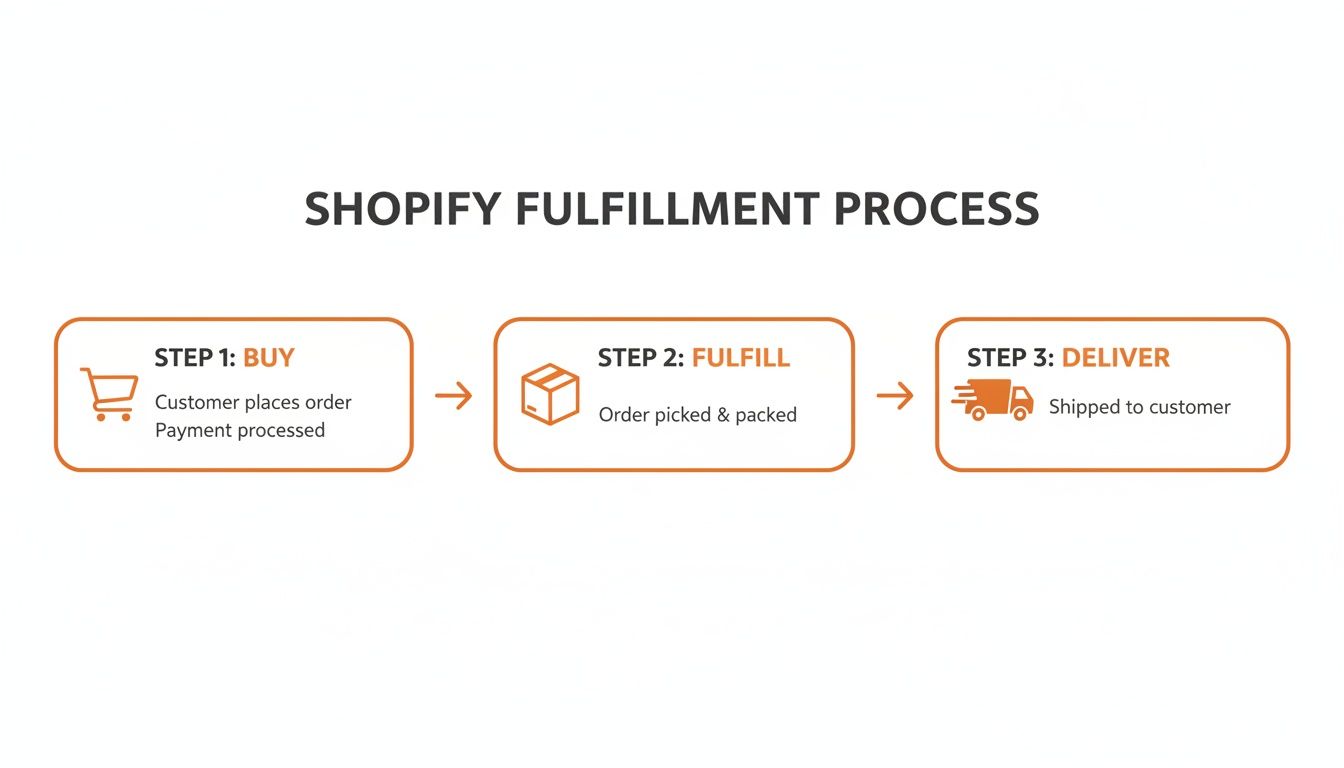
From that initial purchase to the final delivery, each phase is powered by smart technology and expert hands, all working together to create a seamless experience for your customer.
Step 1: Receiving and Storing Your Inventory
The whole process kicks off long before a single order is even placed. It starts the moment you ship your products to your fulfillment partner’s warehouse. This isn’t just dropping off a few boxes; it's a carefully managed process called inbound receiving.
When your inventory arrives, the warehouse team immediately inspects the shipment. They check that the product count is spot-on and that nothing was damaged in transit. Each item, or SKU, is then scanned and given a specific, strategic home within the warehouse—a critical step that prevents mix-ups and makes finding products later lightning-fast.
This organized storage is the bedrock of an efficient operation. A great warehouse runs on a sophisticated Warehouse Management System (WMS) that tracks every single unit, giving you a live, real-time view of your inventory levels right from your partner's dashboard.
Step 2: Order Sync and Processing
This is where the tech magic really happens. The second a customer places an order on your Shopify store, all the details are zapped over to your fulfillment partner's WMS. It happens instantly and automatically. No more manual data entry, which means a huge source of human error is completely eliminated.
The system quickly confirms the items are in stock and pushes the order to the warehouse floor. This is the crucial handoff where a digital transaction becomes a physical to-do list. The order pops up on a picker's handheld scanner, showing them the exact items, quantities, and their precise locations in the warehouse.
A seamless integration between your Shopify store and a 3PL's software is the central nervous system of your fulfillment operation. It ensures that data flows instantly and accurately, from order placement to inventory updates, keeping both you and your customers informed.
Step 3: The Pick and Pack Process
With the order now live in the system, a trained warehouse associate gets to work on the pick and pack process. Forget wandering around looking for things on a shelf; this is a highly optimized routine. Using handheld scanners, pickers are guided along the most efficient path through the warehouse to gather all the items for an order.
- Picking: The scanner tells the picker exactly where to go and what to grab. They scan the item's barcode to confirm it’s the right product, which is how top 3PLs achieve 99.9% order accuracy.
- Packing: Once everything is picked, the items are taken to a packing station. Here, a packer chooses the perfect-sized box or mailer, adds any necessary padding (like bubble wrap or air pillows), and includes any custom touches you've provided, like branded tissue paper or thank-you cards.
The box is then sealed, weighed, and a shipping label is automatically printed based on the customer’s address and the shipping method they selected.
Step 4: Shipping and Tracking
Finally, it's time to get the package on its way. The fulfillment center's system automatically picks the best carrier and service to meet the delivery promise while keeping costs low. Because 3PLs ship in massive volumes, they get huge discounts from major carriers like UPS, FedEx, and USPS—and those savings are passed directly on to you.
Once the package is labeled, it joins other outbound shipments waiting for carrier pickup. As soon as the carrier scans it, the tracking number is automatically pushed back to your Shopify store. This is what triggers that shipping confirmation email to your customer and updates their order status, giving them full visibility until the moment it arrives at their door.
Integrating Your Store with a Fulfillment Partner
Hooking up your Shopify store to a fulfillment partner isn't some massive technical project you need to dread. Honestly, it's more like plugging in a new appliance. Modern Shopify order fulfillment services are designed with simple, secure connections that make the whole process surprisingly fast and straightforward.
Think of this connection as the digital handshake between your storefront and your warehouse. It creates a seamless flow of information, completely wiping out the need for manual data entry—which, as we all know, is where costly mistakes and wasted hours are born.
The Simple Steps of Integration
While every 3PL has its own dashboard, the actual steps to get your store connected are remarkably similar across the board. The best part? You absolutely do not need to be a developer to get it done.
It usually breaks down into three key stages:
- Authorize the Connection: You'll typically start by finding your partner's app in the Shopify App Store or logging into their portal. With just a few clicks, you give their system permission to access your store's order and product data.
- Map Your Product SKUs: This is a crucial step. You’re essentially telling the warehouse's system which of your products is which by linking the SKUs (Stock Keeping Units) in your Shopify catalog to the physical items they're storing for you.
- Configure Shipping Options: Here, you'll map the shipping choices your customers see at checkout (like "Standard Shipping" or "2-Day Express") to the actual carrier services your fulfillment partner will use to send the packages.
Once that's done, your automated workflow is live and ready to run. You can see how Snappycrate's direct integration simplifies this entire process and gets you up and running in no time.
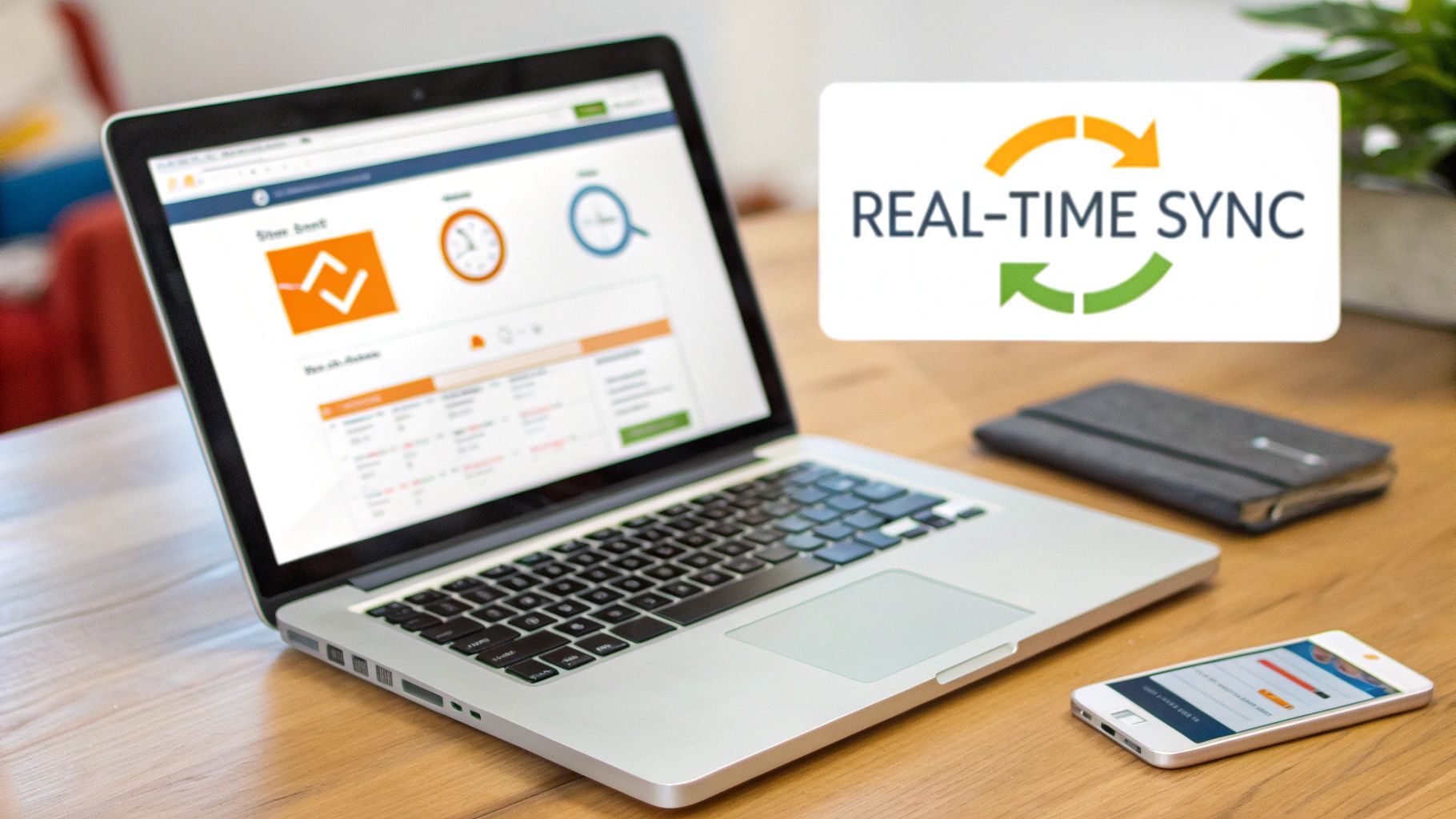
The Power of Automation and Real-Time Sync
A direct integration does way more than just grab new orders. It opens up a powerful, two-way street for data that fuels real efficiency and growth. This is the secret sauce that lets a brand scale from 100 orders a month to 10,000 without the wheels falling off.
The real value of a direct Shopify integration is turning your fulfillment from a reactive, manual task into a proactive, automated system. It ensures data accuracy, provides real-time visibility, and frees up your team to focus on strategic growth instead of operational chores.
This kind of automated sync isn't just a "nice-to-have"—it's a necessity. In 2023, Shopify stores processed an average of 199 million orders per month. During the Black Friday Cyber Monday weekend, the platform was handling peaks of 284 million requests per minute. Those numbers are staggering, and they make it crystal clear why trying to keep up manually is a recipe for disaster for any serious brand. You can dig into more of Shopify’s incredible performance metrics at Red Stag Fulfillment.
Key Benefits of a Seamless Connection
The payoff from a properly integrated system is immediate and touches every part of your business, from inventory control to customer happiness.
- Automatic Order Pulling: The second a customer clicks "buy," their order is securely sent to the fulfillment center's queue. No copy-pasting, no CSV uploads.
- Real-Time Inventory Updates: When the warehouse ships an order or receives new inventory, your stock levels in Shopify are updated instantly. This is how you kill overselling for good.
- Automated Shipping Confirmations: As soon as a carrier scans a packed order, the tracking number is sent right back to Shopify, which automatically triggers that "Your Order Has Shipped!" email to your customer.
This seamless loop of data is the engine that keeps a modern, scalable e-commerce business humming along.
Value-Added Services That Fuel Your Growth
The best Shopify order fulfillment services do a whole lot more than just stick products in boxes. They become a genuine partner in your growth, offering specialized services that solve tricky logistics puzzles, create unforgettable customer experiences, and even open up new ways to make money. These "value-adds" are what separate a basic warehouse from a true growth engine for your brand.
Think of it like this: standard fulfillment is the mailman who reliably gets a package from point A to point B. Value-added services are like having a pit crew, a custom mechanic, and a branding expert all working on your products before they even leave the warehouse. They make sure everything is perfectly prepared for any sales channel and ready to wow your customers the moment it arrives.
Preparing Products for Amazon FBA
Selling on Amazon is a huge opportunity, but it comes with a notoriously strict rulebook. Amazon's Fulfillment by Amazon (FBA) program has incredibly precise requirements for how your inventory must be prepped before it even touches their warehouse docks. One small mistake can lead to costly fines, rejected shipments, or even getting your account suspended.
This is where FBA prep services are an absolute game-changer. Your fulfillment partner can take all these tedious—but critical—tasks off your plate.
- FNSKU Labeling: Applying Amazon-specific barcodes that completely cover any existing manufacturer UPCs.
- Poly Bagging: Placing items in clear protective bags, complete with the required suffocation warnings.
- Inspection: Catching any damages or defects before your products are sent to Amazon's network.
- Case Packing: Making sure all items are correctly packed into master cartons according to Amazon's specs.
By handing off FBA prep, you guarantee compliance, dodge expensive chargebacks, and keep your inventory flowing smoothly into Amazon's system, ready for that coveted Prime badge.
Creating New Products with Kitting and Bundling
Ever wanted to sell a "Holiday Gift Set" or a "Beginner's Starter Kit"? Kitting and bundling services make that happen without you ever having to touch a single product. This service is all about combining multiple separate SKUs into a brand-new, single product that you sell as one complete unit.
Let's say a skincare brand wants to offer a gift set with a cleanser, a moisturizer, and a serum. Their fulfillment partner can:
- Pick one of each individual item from the shelves.
- Assemble them together in a custom-branded gift box.
- Assign this newly created bundle its own unique SKU in the inventory system.
Now, when a customer buys the gift set on your Shopify store, the warehouse team grabs the pre-assembled kit, not the three individual items. You can learn more about how kitting and assembly services create powerful new sales opportunities for your brand.
Kitting transforms your inventory into a flexible marketing tool. It allows you to increase average order value, create unique promotions, and move slower-selling items by bundling them with popular products.
Crafting a Memorable Unboxing Experience
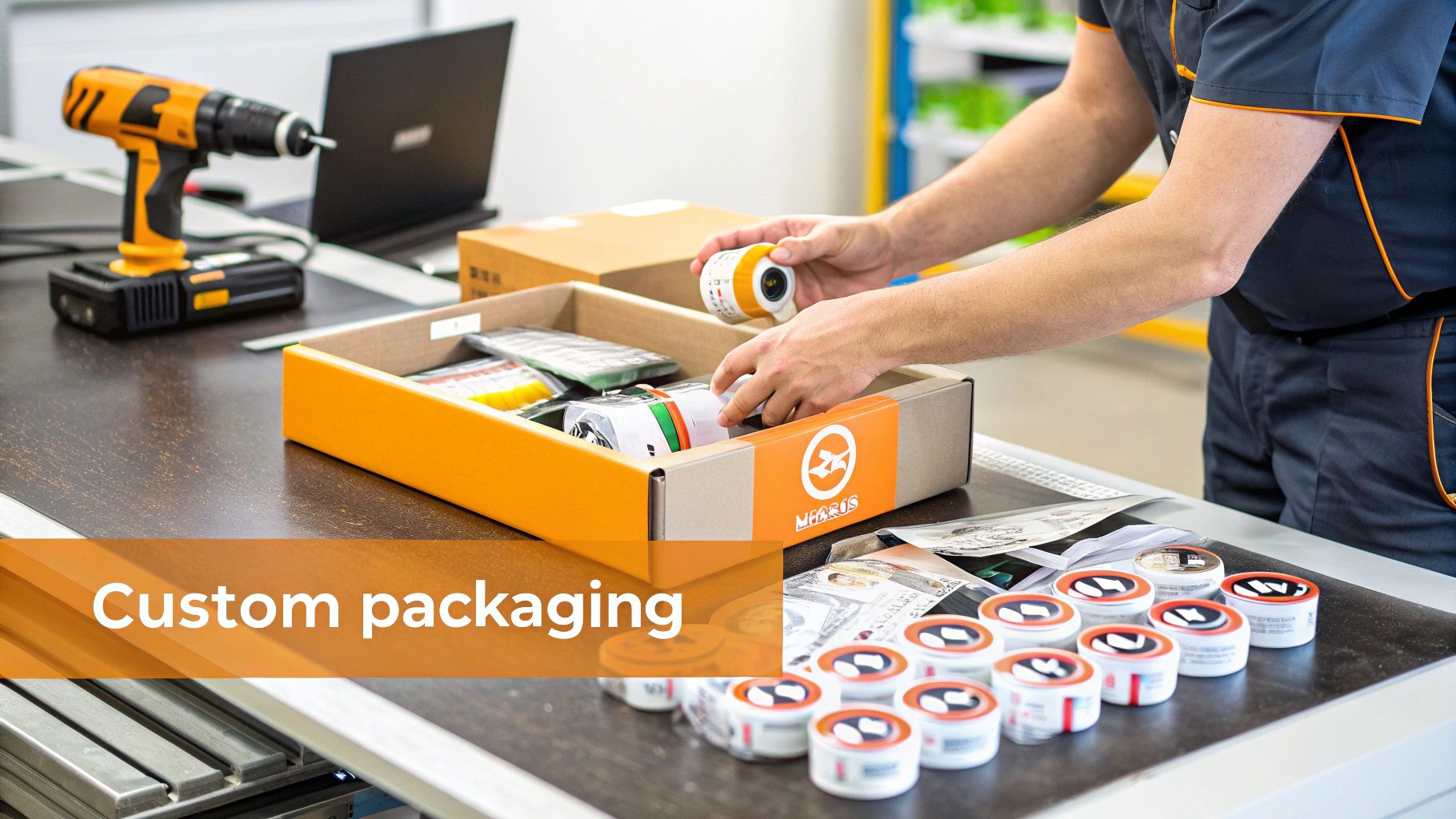
In the world of e-commerce, the shipping box is your new storefront. A memorable unboxing experience is one of the most powerful ways to cement your brand identity, build die-hard customer loyalty, and get people talking about you on social media. A top-tier fulfillment partner can bring your vision to life, perfectly, every single time.
This is about more than just a custom-printed box. It includes all the little details that make a big impact:
- Branded tissue paper or crinkle-cut fill
- Promotional flyers or personalized thank-you cards
- Custom stickers or branded packing tape
- A strategically placed product sample
Executing this experience at scale is a huge part of the economic engine powered by Shopify. The platform's gross merchandise volume (GMV) hit $292.3 billion annually in 2025, with peak Black Friday Cyber Monday sales reaching an incredible $4.2 million per minute. With over 61 million global consumers buying from Shopify brands during that weekend alone, a standout unboxing experience is absolutely key to capturing repeat business. You can find more compelling Shopify statistics and trends on The Hub Content.
Choosing the Right Fulfillment Partner
Picking a fulfillment provider is one of the biggest decisions you’ll ever make for your Shopify store. This isn’t just about finding the cheapest place to stash your inventory. It’s about hiring a partner that becomes a direct extension of your brand and, ultimately, a huge part of your customer experience.
Get this right, and you’ll accelerate your growth. Get it wrong, and you’re in for a world of logistical nightmares that can sink your reputation. You have to look past the price tag and dig into a provider’s technology, their operational reliability, and whether they can actually grow with you. Think of it like hiring a key employee who will be responsible for every single one of your customers' orders. You need to trust them completely.
Evaluating Technology and Integration
The backbone of any modern fulfillment partnership is a rock-solid tech connection. Without a seamless integration between your Shopify store and their warehouse, you’ll be drowning in manual work, order errors, and wasted time. The quality of a provider's software is absolutely non-negotiable.
When you're vetting a potential partner, insist on a demo of their client portal. Is it easy to use? Can you quickly find your inventory levels, check on order statuses, or pull up a report? The integration has to be a two-way street, syncing data in real-time. This ensures your inventory counts on Shopify are always spot-on and that tracking numbers get pushed back to customers automatically.
The right technology turns your fulfillment operation into an automated, self-sustaining system. It kills human error in order entry, stops you from overselling, and keeps your customers in the loop without you lifting a finger.
Assessing Scalability and Specialization
Your business is going to grow—that’s the whole point. Your fulfillment partner has to be ready to scale right alongside you. A provider that’s great at handling 200 orders a month might completely fall apart during a 5,000-order Black Friday weekend. Be direct and ask them how they manage seasonal spikes and sudden growth.
You also need to think about your specific products. Do you sell fragile items that need extra padding? Subscription boxes that have to be kitted every month? It’s crucial to find a Shopify order fulfillment service that has real-world experience with your business model.
- Fragile Goods: Ask about their packing materials and find out their damage rates.
- Subscription Boxes: Make sure they have proven kitting and assembly workflows.
- Apparel: Confirm they can handle returns and complex SKUs with tons of variants.
- Food & Beverage: Ensure they have the right certifications for handling FDA-regulated items.
A specialist who already knows the quirks of your products will save you from costly mistakes. A generalist might not have the right processes in place, putting your inventory and your reputation at risk.
Fulfillment Partner Evaluation Checklist
Choosing a 3PL isn't just about comparing price sheets. It's a deep dive into their technology, operations, and culture. Use this checklist to structure your evaluation and make sure you're asking the right questions. A thorough review now prevents massive headaches later.
| Evaluation Criteria | What to Look For | Why It Matters |
|---|---|---|
| Technology & Integration | Direct Shopify API integration, real-time inventory sync, intuitive client portal. | Prevents overselling, automates order flow, and gives you clear visibility without manual work. |
| Operational Scalability | Proven ability to handle order spikes (like BFCM), clear processes for growth. | You need a partner who can support you during your busiest seasons, not one who crumbles under pressure. |
| Product Specialization | Experience with your specific product category (e.g., apparel, fragile goods, subscriptions). | A specialist understands the unique handling, packing, and storage needs of your items, reducing errors and damage. |
| Shipping Network & Rates | Access to discounted rates with major carriers, multi-carrier options. | Lower shipping costs directly impact your bottom line and allow for more competitive pricing. |
| Service Level Agreements (SLAs) | Guaranteed receiving, order processing, and shipping times. | Clear SLAs ensure consistency and help you set accurate delivery expectations for your customers. |
| Customer Support | Dedicated account manager, responsive support team, clear communication channels. | When problems arise, you need a real human you can talk to who understands your business and can solve issues fast. |
| Pricing Transparency | Simple, all-inclusive pricing model with no hidden fees for receiving, storage, or pick/pack. | Complex fee structures can quickly eat into your profits. You need to know your true cost per order. |
After comparing a few providers against this list, you'll have a much clearer picture of who can truly act as a strategic partner for your Shopify store.
Understanding Shipping and Communication
A fulfillment partner’s true power often comes from its shipping network. They ship in such massive volumes that they get access to carrier discounts you could never get on your own. Ask for total transparency on these shipping costs and see how those savings are passed on to you. A great partner will work with you to find the perfect balance between cost and speed.
Let’s be honest, customer expectations for fast delivery are higher than ever. Research shows 55% of customers will likely ditch a brand after just two or three late deliveries. Automation is your best friend here. Brands that automate their fulfillment see delivery times drop by 30% and shipping costs fall by 25%, all while keeping customers happier. You can learn more about how streamlining fulfillment impacts your business on CommercePundit.
Finally, size up their communication style. When something inevitably goes wrong, how do you get help? Look for a provider with a dedicated account manager or a support team that feels like an extension of your own. Open, proactive communication is the glue that holds a great partnership together for the long haul.
Common Questions About Shopify Fulfillment
Even after you've seen how it all works, partnering with a Shopify order fulfillment service can feel like a huge leap of faith. It’s totally normal to have questions about the practical side of things—the costs, the timelines, and what it’s really like to hand over your inventory.
We get it. We’ve answered these questions hundreds of times. Here are the most common ones we hear from Shopify merchants, with clear, straightforward answers to help you see exactly how this works.
What Is the Average Cost of Shopify Order Fulfillment Services?
This is always the first question, but the honest answer is: there's no simple price tag. The cost of fulfillment isn't a single fee. It's a combination of charges that reflect the actual work being done for your brand. Think of it less like buying a product and more like paying for a service that adapts to your needs.
Generally, you'll see costs broken down into four key buckets:
- Receiving: This is the one-time cost to accept your inventory at the warehouse. It’s usually charged per pallet or per carton, and it covers the labor to inspect, count, and get your products put away on the shelves.
- Storage: This is a recurring monthly fee for the physical space your inventory takes up. It’s typically calculated per pallet, per shelf, or sometimes by the cubic foot.
- Pick and Pack: This is a per-order fee for the work of grabbing items off the shelf and packing them up. It might be a flat fee per order, plus a small charge for each additional item in an order.
- Shipping: This is the actual postage cost from the carrier (like UPS, FedEx, or USPS). The good news is that 3PLs pass their heavily discounted shipping rates directly on to you.
As a quick example, a simple, one-item order might have a pick-and-pack fee of $2.50 to $3.00. A more complex order with five different items might be closer to $5.00. Your final cost really depends on your order volume, how big your products are, and any special handling they need.
The only way to get a true picture of your costs is to ask for a quote. Give a potential partner your average order data, and they can build a precise estimate that reflects how your business actually operates.
How Quickly Can a 3PL Fulfill My Shopify Orders?
Once you’ve made the decision, you want to get going—fast. A common worry is that the onboarding will be some long, drawn-out process that disrupts your sales. The reality? An experienced 3PL has this down to a science and can get you up and running surprisingly quickly.
For most Shopify stores, the entire process from signing an agreement to shipping your first order can take as little as one to two weeks.
Here’s what that timeline usually looks like:
- Integration (1-2 Days): Connecting your Shopify store to the 3PL’s software is the easy part. Modern API connections mean this is often done in a few hours with just a couple of clicks.
- Inventory Transit (Varies): The biggest variable is just how long it takes for your products to physically travel from where they are now to the fulfillment center.
- Receiving (1-3 Days): Once your inventory arrives, the warehouse team needs a little time to receive it into their system. A good partner will have a clear Service Level Agreement (SLA) for this, often guaranteeing a 48-72 hour turnaround.
As soon as your inventory is scanned into the system, your 3PL can start fulfilling new orders almost instantly. The key is to find a partner with a clear, step-by-step onboarding plan.
Can a Fulfillment Service Use My Branded Packaging?
Absolutely. In fact, any fulfillment partner worth their salt should not only offer this but excel at it. Your packaging is a huge part of your brand and customer experience, and a great 3PL completely understands and supports that.
You can ship all of your custom materials directly to the warehouse, including:
- Custom-printed boxes or mailers
- Branded tissue paper and packing tape
- Promotional inserts, flyers, or thank-you cards
- Stickers or other unique branding elements
These materials are stored right alongside your products. When an order comes in, the warehouse team follows your exact instructions to assemble the package just the way you designed it. This ensures every single customer gets the same fantastic unboxing experience you envision.
How Are Customer Returns Handled?
Managing returns—what we in the industry call reverse logistics—is one of the biggest headaches in e-commerce. It can be a massive operational drain for merchants, but for a professional fulfillment center, it's a standard, streamlined service.
When a customer needs to return a product, the process is simple and efficient.
- Return Shipment: The customer ships the item back directly to the fulfillment center.
- Inspection: When it arrives, the returns team opens the package and inspects the item based on your rules. They'll check if it's in new, sellable condition, if it's damaged, or if it's even the right item.
- Processing: Based on that inspection, they take action. They can restock the item into your available inventory, set it aside for you to review, or dispose of it according to your instructions.
This whole process is tracked in the fulfillment partner’s software, and your inventory levels in Shopify get updated automatically. This gets good-as-new products back in stock and ready to sell way faster, and it saves you from the nightmare of processing returns yourself.
Ready to stop worrying about logistics and start focusing on growth? At Snappycrate, we provide reliable, scalable Shopify order fulfillment services designed for ambitious brands. From secure warehousing to fast, accurate shipping and expert FBA prep, we act as a true extension of your team. Discover how Snappycrate can streamline your operations today.