Skip to Content

Blog Archives

What Is Intermodal Trucking and How Does It Boost Efficiency

So, what exactly is intermodal trucking? Think of it like a relay race for your products, but instead of a baton, the handoff is an entire shipping container. The best part? The container is never opened from start to finish.

Your goods stay sealed and secure inside the same steel box as they move across different types of transportation—usually a combination of ship, rail, and truck.

What Is Intermodal Trucking Explained

It all starts when your container arrives at a port on a massive cargo ship. Instead of a crew unloading thousands of individual boxes, a giant crane simply lifts the entire container off the ship and places it onto a special truck trailer called a chassis.

This first truck leg of the journey is handled by a drayage truck. These aren't your typical long-haul drivers; they specialize in short, quick trips, shuttling containers between the port and a nearby rail yard.

Once at the rail yard, another crane lifts the container off the truck and onto a train. This truck-to-rail handoff is the secret sauce that makes intermodal so powerful for cross-country shipping.

Key Elements of the Process

The whole system works because of a few key pieces that fit together perfectly:

  • Standardized Containers: These are the unsung heroes of global trade. The familiar 20ft and 40ft steel boxes are designed to lock seamlessly onto ships, trains, and truck chassis anywhere in the world.
  • Drayage Trucking: This is the critical connector. Drayage is all about moving containers over short distances—from the port to the rail terminal, or from the rail terminal to a final destination warehouse like ours.
  • Rail Transport: For any trip over 500 miles, rail is the clear winner for cost and fuel efficiency. It’s the workhorse of the intermodal network, handling the long-haul portion of the journey.

The genius of this system is that the cargo itself is never handled. By keeping your products sealed inside the container from the port all the way to the final warehouse, the risk of damage, loss, or theft drops significantly. It's a huge boost for supply chain security.

This whole concept, pioneered by Malcolm McLean with his standardized containers in the 1950s, has completely reshaped global logistics. The global intermodal freight market is still growing like crazy, which is why it's a strategy we use all the time for our e-commerce and import clients.

To get a deeper look into how these systems move freight, you can check out our guide on what is intermodal freight. Understanding this process helps you build a smarter, more resilient, and cost-effective supply chain. You can read the full research about the growth of the intermodal freight market to see just how big this trend is becoming.

Mapping the Journey of an Intermodal Shipment

To really understand intermodal trucking, you have to follow the container. Let’s imagine your inventory has just sailed across the ocean and is about to hit a busy U.S. port. This is where the clock starts ticking and the real logistics begin.

The first move isn't a long-haul truck. Instead, it’s a specialized service called drayage. A drayage driver shows up at the port with a truck chassis, a massive crane lifts your container off the ship, and places it right on top.

The First and Last Mile Connections

This first truck move is the critical "first mile." The drayage driver navigates the crowded port—a complex dance of trucks, cranes, and containers—to get your cargo over to a nearby rail terminal. These trips are usually short, often under 50 miles, but they’re the essential link between sea and rail.

Once at the railyard, the process happens in reverse. Another giant crane lifts the container off the truck’s chassis and onto a train car. Now your container is set for the most efficient part of its trip: the long-haul by rail.

This infographic breaks down the handoffs between the ship, train, and truck.

An infographic illustrating the intermodal trucking process: ship loading, train transport, and final mile truck delivery.

As you can see, the container stays sealed the entire time. The freight inside is never touched. This single-unit approach dramatically cuts down on handling, which means far less risk of damaged products.

The Cross-Country Rail Leg

When it comes to moving freight long-distance, trains are the undefeated champions. A single train can haul the cargo of hundreds of trucks while burning significantly less fuel per ton-mile. This is where you see the huge cost and environmental savings of intermodal shipping.

It’s on these long routes where intermodal really shines. For any shipment traveling over 500 miles, the efficiency of rail delivers savings that traditional over-the-road trucking just can't compete with.

Rail is also getting faster. Some major rail lines can now get a container from Los Angeles to New Jersey in under 130 hours—rivaling truck transit times but at a lower cost.

Arrival and Final Delivery

After its cross-country trip, your container arrives at an inland rail terminal near its final destination. Here, the process reverses one last time. A second drayage truck hooks up to the container for the "last mile" delivery to a warehouse or 3PL like SnappyCrate.

This final step completes the journey. The container is delivered, the seal is broken for the first time since it was loaded at the factory, and your inventory is ready to be unloaded and prepped for customers.

Want to learn more about the specifics? Check out our complete guide to intermodal freight shipping.

The Essential Hardware of Intermodal Logistics

A semi-truck chassis carrying a yellow shipping container at an intermodal port with cranes.

For an intermodal shipment to move seamlessly, a few key pieces of hardware have to work together like a well-oiled machine. It’s easy to think of it as just trucks and trains, but the reality is much more specialized. To really get what intermodal trucking is all about, you have to understand the physical tools that make it happen.

Three pieces of the puzzle are absolutely critical: the drayage trucks, the chassis they pull, and the intermodal terminals where everything connects. Each one has a specific job, and if any of them fails, the whole system grinds to a halt.

What is a Drayage Truck and a Chassis?

Drayage is the industry term for the specialized, short-haul trucking that moves containers to and from ports and rail yards. Think of drayage drivers as the special ops of trucking—they’re experts at navigating the chaotic, highly regulated world of terminals and railyards. Their job isn’t to drive across the country; it's to make precise, quick moves that link the long-haul journey to the local roads.

But the truck is only half the story. To move a container, a drayage truck has to pull a chassis—that’s the wheeled steel frame you see a container locked onto. A shipping container has no wheels of its own, so it’s useless on the road until it’s secured to a chassis, which effectively turns it into a road-legal trailer.

Here’s a pro tip: chassis availability is one of the biggest bottlenecks in the supply chain. If there’s a shortage at the terminal, your container is stuck sitting there, racking up fees until a chassis becomes available.

The Role of the Intermodal Terminal

Intermodal terminals are the beating heart of the entire operation. These massive, sprawling yards are where the handoff between ship, rail, and truck happens. When your container gets lifted off a train, it’s placed in a designated slot, ready for a drayage truck to hook up and haul it away.

An intermodal terminal is much more than just a giant parking lot for containers. It's a high-tech logistics hub where every box is tracked, and every move is scheduled down to the minute. A slowdown here can cause a ripple effect that snarls supply chains for days.

The final leg of the journey begins when the drayage truck leaves the terminal and heads to a warehouse or distribution center. This last step is often complicated by its own set of last-mile delivery challenges that the driver has to navigate. Getting a handle on these three components—drayage, chassis, and terminals—is the key to understanding how your products really move from port to door.

Weighing the Pros and Cons of Intermodal Shipping

So, is intermodal the right move for your business? It’s a powerful tool in your logistics arsenal, but it’s definitely not a one-size-fits-all solution.

Making the right call means understanding the trade-offs. You need to know when to pull the trigger on intermodal and when to stick with traditional trucking. Let's break down the good, the bad, and what it means for your bottom line.

The Upside: Why E-commerce Sellers Love Intermodal

The biggest draw, without a doubt, is cost savings. It’s simple math. For any shipment traveling long distances—we’re typically talking over 500 miles—the economics of rail are tough to beat.

A single train can haul the equivalent of hundreds of trucks, and it does so with far greater fuel efficiency. Once your container is on the rails, that per-mile cost drops in a big way.

Beyond the savings, intermodal brings a few other key advantages to the table, especially for importers and e-commerce brands:

  • Better Security: Your products stay sealed inside a single container from the port all the way to the final warehouse. With far fewer touchpoints and less manual handling, the risk of damage, loss, or theft plummets.
  • A Greener Supply Chain: If sustainability is part of your brand identity, intermodal is a clear win. Rail is dramatically more fuel-efficient than over-the-road trucking, which helps shrink your supply chain's carbon footprint.
  • Access to Capacity: When trucking capacity gets tight during peak season or market disruptions, the rail network often provides a reliable alternative. It can keep your inventory moving when everyone else is scrambling to find an available truck.

This is exactly why learning the ins and outs of intermodal can be a game-changer for businesses looking to scale.

The Downsides You Can't Ignore

Of course, it’s not all smooth sailing. Intermodal comes with its own set of challenges, and the most significant one is slower transit times.

The journey through a port, the drayage move to a rail terminal, and the time spent waiting for the train to be loaded all add up. A direct truck can often get from A to B a day or two faster.

Intermodal is a game of trade-offs. You are often trading a bit of speed for significant cost savings and increased security. It's a strategic choice, not just a logistical one.

Another headache you might run into is terminal congestion. Ports and rail yards are incredibly complex operations. A sudden chassis shortage, a labor slowdown, or just a massive influx of containers can create bottlenecks that leave your shipment sitting for days. These delays are unpredictable, which is why having an experienced 3PL partner to navigate them is a must.

Finally, intermodal just doesn't make sense for short-haul or time-sensitive shipments. The costs and time burned during those terminal handoffs make it totally inefficient for distances under 500 miles. If you have urgent cargo, the speed and directness of traditional trucking is still the king.

Intermodal Decision Matrix: When to Use It

To make it even simpler, here’s a quick-reference table. Use this to gut-check whether intermodal is the right fit for a specific shipment.

Consideration Choose Intermodal When… Stick to Traditional Trucking When…
Distance Your shipment is traveling 500+ miles across the country. The destination is less than 500 miles away.
Cost Your top priority is reducing freight spend and you have some flexibility on delivery dates. You need to meet a tight delivery window and are willing to pay a premium for speed.
Speed You have 3-5+ extra days in your transit timeline and can plan inventory accordingly. Your shipment is urgent, time-sensitive, or for a "just-in-time" delivery.
Freight Type You are shipping full container loads (FCL) of standard, non-perishable goods. You are shipping small parcels (SPD), less-than-truckload (LTL), or perishable items.

By weighing these factors, you can make a strategic call that aligns with your budget, timeline, and inventory needs. For many sellers, a blended approach—using intermodal for planned stock replenishment and trucking for urgent restocks—offers the best of both worlds.

How E-commerce Brands Use Intermodal Trucking

Workers are efficiently loading and checking boxes at a warehouse, showcasing e-commerce logistics.

For online sellers and importers, figuring out what is intermodal trucking isn't just a logistics lesson—it's a real-world strategy that can directly boost your profit margins. This is where the complicated world of freight meets the practical needs of your e-commerce business.

Let's say you're an Amazon FBA seller. Your container packed with your hottest new product just landed at the Port of Long Beach. You could pay for a truck to haul it all the way to your inland prep center in Dallas, but that's expensive. This is where you use intermodal.

From Port to Prep Center

Your container's journey starts with a short trip called first-mile drayage. A special truck picks up your container right at the port and drives it just a few miles to a nearby rail yard.

From there, it’s loaded onto a train for the long-haul journey to Dallas. This is the secret sauce. Moving goods by rail over long distances is drastically cheaper and more fuel-efficient than sending a truck across the country.

Once the train pulls into the Dallas rail terminal, the whole process happens in reverse. Another drayage truck handles the last-mile delivery, grabbing your container and taking it straight to your third-party logistics (3PL) partner, like SnappyCrate. This keeps your freight costs stable and predictable, which is huge for any e-commerce brand.

The real win for e-commerce sellers? Intermodal effectively turns the entire country into your local delivery zone. By using affordable rail for the long-haul, you can place your inventory with a 3PL that's perfectly located for nationwide shipping—even if it's a thousand miles from the coast.

This gives you incredible freedom. You're no longer stuck with expensive warehouses near the port. Instead, you can pick a fulfillment partner based on their service, skills, and ability to get products to your customers fast.

Integrating Intermodal with E-commerce Fulfillment

But the journey isn't over when the container hits the warehouse dock. For an e-commerce seller, this is where the real work begins, and it’s all part of a single, smooth workflow managed by your 3PL.

As soon as your container arrives, your 3PL partner kicks off a series of essential services that turn that bulk shipment into inventory that's ready to sell.

Common Post-Intermodal Services:

  • Live Unload: A team is on standby to empty the container the moment it backs up to the dock. A standard 40ft container can be packed with thousands of units, so speed is everything.
  • Pallet Breakdown: Your products are likely "floor-loaded" (stacked from floor to ceiling) to save space. The 3PL team carefully unloads every box and organizes them onto pallets for storage.
  • Inventory Inspection: This is your first line of defense for quality control. The team inspects for any damage from the long journey and makes sure the box count matches your packing list.
  • FBA Prep Services: If you sell on Amazon, this step is non-negotiable. Your 3PL will handle all the prep to meet Amazon’s strict rules, like applying FNSKU labels, poly bagging, bundling items, or building case packs.

When you pair the cost savings of intermodal with the hands-on services of a smart e-commerce 3PL, you get a seamless logistics machine. It's a system designed to move your goods from a factory overseas to your customer’s front door with precision and without breaking the bank.

Common Questions We Hear About Intermodal

Even after getting the basics down, you probably have some practical questions about whether intermodal is the right move for your business. We get it.

Let's cut through the noise and tackle the questions we hear most often from importers and e-commerce sellers. This is the real-world stuff you need to know to make a smart call.

How Far Does My Shipment Need to Go for Intermodal to Make Sense?

This is the big one, and it all boils down to distance and cost. As a rule of thumb, the intermodal "sweet spot" really starts on hauls of 500-750 miles or more.

For anything shorter, the costs of the short-haul truck moves at both ends (the drayage) plus the terminal fees usually make a traditional truckload shipment cheaper. But once you cross that mileage threshold, the incredible fuel efficiency of rail kicks in, and the savings start to add up fast. The longer the haul, the more you save.

What’s the Real Difference Between Drayage and Regular Trucking?

While both use a truck, their jobs are worlds apart. Drayage is a highly specialized, short-distance service focused entirely on moving containers between a port, a rail yard, and a local warehouse.

Drayage drivers are masters of their domain. They know how to navigate packed terminals, handle complex gate procedures, and get containers moved quickly and precisely. Regular over-the-road (OTR) trucking, on the other hand, is all about the long haul, moving freight directly from shipper to receiver over the highway and skipping the rail part completely.

Think of it this way: A drayage driver is like a specialized port pilot who knows every current and channel in the harbor. An OTR driver is the captain of an ocean liner, focused on the long, open-water journey between ports.

Can I Track My Shipment During an Intermodal Move?

Absolutely. Modern 3PLs give you full visibility. The container number is your single source of truth from start to finish.

You can track every key step: when the container is offloaded from the ship, when it "gates in" at the rail yard, its journey across the country by train, and its final arrival for last-mile delivery. This kind of tracking is crucial for planning your warehouse receiving schedule. For those shipping internationally, it's also helpful to learn more about key shipping terms, and you can explore our guide on what FOB means in shipping.

Is Intermodal Bad for Fragile Goods?

Not at all—in fact, it can be a safer ride when done right. While a train journey might have more general vibration than a truck with an air-ride suspension, the key is that your products are handled far less.

Once your goods are loaded and secured inside that steel container, they aren’t touched again until they reach the final warehouse. This dramatically cuts down on the risk of damage from being loaded and unloaded multiple times. The secret weapon here is proper blocking and bracing inside the container. If it's packed tight, your fragile goods will be just fine.


Ready to see how intermodal trucking can streamline your e-commerce operations? SnappyCrate specializes in creating efficient supply chains for importers and online sellers. We manage everything from container receiving and FBA prep to fast and accurate order fulfillment. Let us handle the logistics so you can focus on growing your brand. Get a quote and scale smarter today.
0 Continue Reading →

Ways to improve supply chain efficiency: Tactics for faster operations

Improving your e-commerce operations really boils down to a handful of core strategies: getting visibility across all your channels, automating the right processes, nailing inventory management, and building rock-solid supplier relationships. These aren’t just line items on a P&L; they’re the pillars that shift your supply chain from a reactive cost center to a proactive, strategic weapon that actually drives growth.

Why Supply Chain Efficiency Is Your Greatest Competitive Edge

It’s time to stop thinking of your supply chain as just a series of costs to be managed—it's your most powerful competitive tool. For way too many e-commerce brands, frustrating stockouts, expensive fulfillment mistakes, and sky-high shipping costs just feel like the price of doing business. This guide is your playbook to change that narrative.

We're going to dive into the real-world strategies that take chaotic operations and turn them into a hyper-efficient growth engine. The goal here is to move beyond just shipping boxes and start building a tough, responsive system that keeps customers happy and protects your bottom line. An efficient supply chain isn't about cutting every possible corner; it's about making smart, data-driven moves that save you money while making your service better.

The Four Pillars of an Efficient Supply Chain

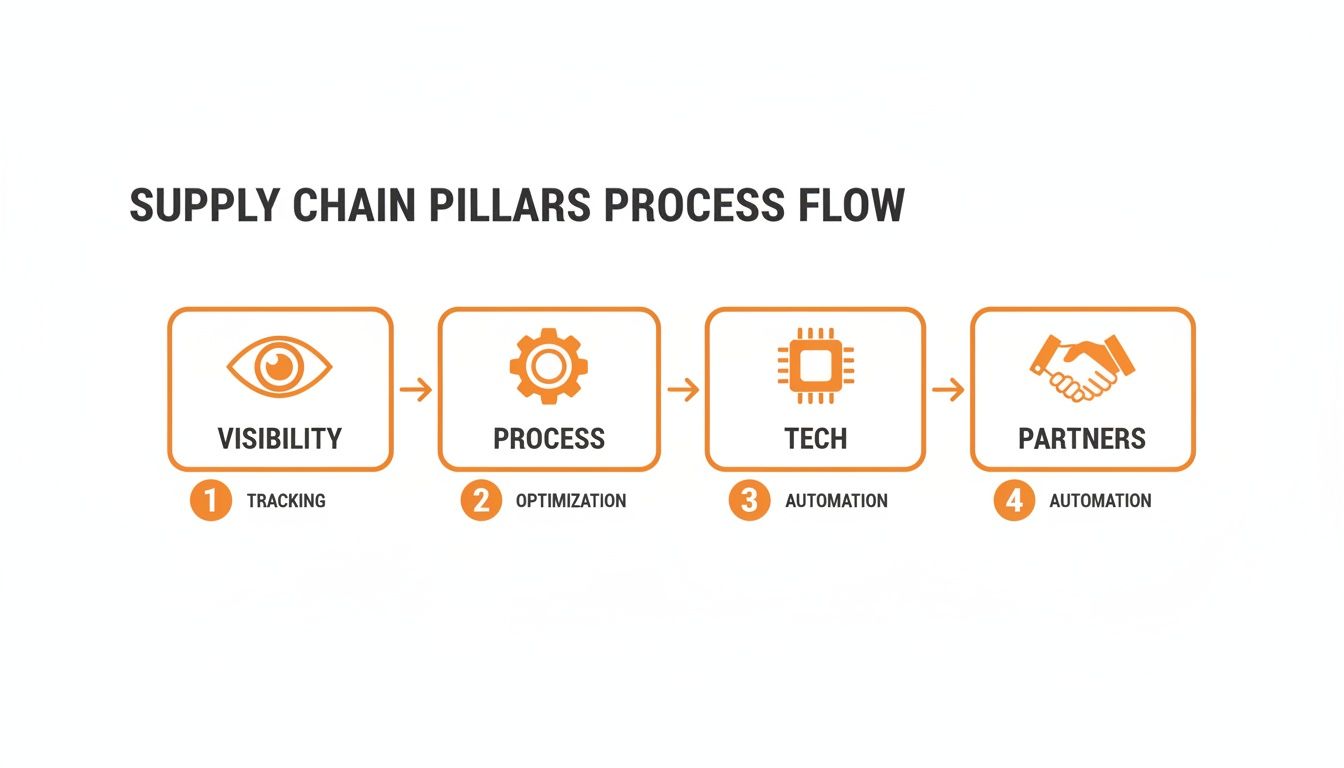
To really get a handle on your logistics, you need to focus on four connected areas. What’s great is that improving one almost always creates a positive ripple effect on the others, creating a powerful flywheel of efficiency.

  • Visibility: You can't fix what you can't see. The first, most critical step is getting a clear, real-time view of your inventory, orders, and shipments across every single warehouse and sales channel.
  • Process: This is all about refining the physical and digital workflows in your warehouse—everything from the moment a shipment arrives at your dock to the way you pick, pack, and get it out the door.
  • Technology: Putting the right software in place, like a Warehouse Management System (WMS), automates those repetitive tasks, cuts down on human error, and gives you the hard data you need to make sharp decisions.
  • Partnerships: Your suppliers, freight carriers, and any 3PLs are extensions of your team. Strong, collaborative relationships are absolutely essential for navigating disruptions and finding ways to win together. You can learn more about how a strong supply chain and warehouse management go hand-in-hand in our detailed article.

This diagram shows how these four pillars—Visibility, Process, Technology, and Partnerships—build on each other to create a more efficient operation.

Process flow diagram detailing four supply chain pillars: Visibility, Process, Tech, and Partners.

As you can see, operational excellence isn’t a one-and-done fix. It's a sequence of building blocks, with each one supporting the next. By tackling each pillar systematically, you can build a robust and scalable operation that’s ready for whatever comes its way.

Diagnosing Your Warehouse and Process Bottlenecks

You can't fix what you can't see. Before you start overhauling your supply chain, you have to get an honest, boots-on-the-ground picture of what’s actually happening in your warehouse. This is the diagnostic phase—moving beyond gut feelings to find the real friction points that are quietly draining your time and money.

The best way to start? Walk the path of an order. Literally. Follow its entire journey from the moment it’s received to the second it leaves your dock. How many steps does a picker take to grab a single item? How many different people touch a single order before it’s sealed in a box? These simple observations often reveal shocking inefficiencies that never show up on a spreadsheet.

Where to Look for Hidden Inefficiencies

Pinpointing the exact source of a delay means zooming in on specific stages of your fulfillment process. Every step is an opportunity for improvement, but some areas are notorious for hiding the biggest bottlenecks. You're not just looking for obvious train wrecks; you're hunting for the small, repetitive actions that compound into massive wasted effort over thousands of orders.

A classic culprit is your warehouse layout. Is it actually designed around how you sell, or is it just organized by SKU number or whenever the inventory showed up? I see this all the time: a brand’s fastest-selling products are tucked away in the back of the warehouse, forcing the team to walk past slow-moving junk on every single pick.

I worked with a Shopify seller selling custom phone cases who was stuck with a two-day processing time. A quick audit revealed their top 20 SKUs made up 80% of their sales but were scattered randomly across the shelves. We moved those items into a dedicated "fast-mover" zone right next to the packing station, and just like that, they cut their average order processing time in half.

Key Metrics to Guide Your Audit

To take the guesswork out of your diagnosis, you need to track the right data. Numbers don’t have opinions—they point you directly to your biggest operational headaches. Focusing on a few key performance indicators (KPIs) gives you a clear baseline to measure your improvements against.

Get started with these critical metrics:

  • Order Cycle Time: This is the total time from when a customer clicks "buy" to when the package lands on their doorstep. A long cycle time can signal anything from picking delays to slow carrier handoffs.
  • Pick Accuracy: What percentage of your orders are picked perfectly the first time? Anything below 99% is a red flag. It points to issues with slotting, labeling, or your picking process, and it always leads to costly returns and angry customers.
  • Receiving Dock-to-Stock Time: How long does it take for new inventory to get checked in, put away, and become available for picking? If this process takes days instead of hours, you're risking stockouts even when the product is sitting in your building.

Analyzing these numbers gives you a data-backed roadmap for what to fix first. This methodical approach is a cornerstone of effective warehouse management for e-commerce, ensuring your efforts are focused where they’ll make the biggest difference.

Finally, pull your findings together into a simple self-audit. It doesn't need to be fancy; a basic checklist is all you need to organize your thoughts and prioritize what to tackle.

Key Areas for Your Supply Chain Self-Audit

Use this table as a starting point to turn your observations into a concrete action plan. Ask yourself these questions for each key area of your operation to identify where the biggest opportunities for improvement lie.

Operational Area Key Question to Ask Metric to Measure
Warehouse Layout Are my fastest-selling items easily accessible? Average pick time per order
Picking Workflow How many steps does my team take to fulfill an order? Steps per pick; orders per hour
Packing Station Are all necessary supplies within arm's reach? Units packed per hour
Inbound Receiving How quickly is new inventory available for sale? Dock-to-stock time (in hours)

This simple framework transforms that vague feeling that "things could be faster" into a clear list of problems to solve. By methodically diagnosing these bottlenecks, you’re laying the essential groundwork to build a truly efficient supply chain.

Turning Inventory Into Your Smartest Asset

Inventory is the lifeblood of any e-commerce brand, but let's be honest—it’s also a massive headache. Carry too much, and your cash is tied up in boxes gathering dust. Carry too little, and you're dealing with stockouts, lost sales, and frustrated customers.

The secret to improving your supply chain isn't just counting what you have. It's about turning your inventory into a dynamic, intelligent asset that actively works for you. This means getting strategic about how you manage, prioritize, and forecast every single product.

A fantastic place to start is with ABC analysis. It’s a simple but incredibly powerful method for categorizing your inventory based on its real value to your business, ensuring your most important products always get the VIP treatment they deserve.

Man in a warehouse scanning a box, performing a warehouse audit for supply chain efficiency.

Prioritizing Your Products With ABC Analysis

Ever heard of the 80/20 rule? ABC analysis is basically that principle applied directly to your warehouse shelves. You break down your entire product catalog into three tiers:

  • A-Items: These are your superstars. They represent the top 10-20% of your SKUs but generate a whopping 80% of your revenue. These products demand the tightest inventory control, the most frequent cycle counts, and the best real estate in your warehouse.
  • B-Items: This is your solid middle group. They typically make up 30% of your SKUs and contribute about 15% of your revenue. They need moderate attention but don't require the constant babysitting your A-Items do.
  • C-Items: These are the slow-movers, the long-tail products. They might make up 50% of your total SKUs but only bring in around 5% of revenue. You can manage this inventory with a much looser grip, maybe using a periodic review system instead of constant monitoring.

Once you categorize your products this way, you can stop treating every SKU the same. It lets you focus your limited time and money where it will make the biggest impact.

Setting Smart Reorder Points and Buffer Stock

Now that you know which products are your breadwinners, the next job is to prevent stockouts without over-ordering. This is where setting automatic reorder points is a game-changer. A reorder point is simply the lowest stock level a product should hit before you place a new order with your supplier.

To calculate it properly, you'll need your lead time demand (that's your average daily sales multiplied by the supplier's lead time in days). Then, you add a layer of buffer stock, also called safety stock.

Buffer stock is your insurance policy against the chaos of e-commerce. It’s the extra inventory you keep on hand to guard against a sudden spike in demand or an unexpected delay from your supplier. A common mistake is applying a generic buffer—like two weeks of stock—to everything. Your A-Items need a much healthier buffer than your slow-moving C-Items.

For example, say you sell 10 units of a popular A-Item per day, and your supplier takes 14 days to deliver. Your lead time demand is 140 units. If you add a 7-day buffer (70 units), your reorder point should be set at 210 units. This simple calculation ensures you have enough stock to keep selling while the new shipment is on its way, plus a cushion for when things go sideways.

The Amazon Seller Challenge: IPI Score and FBA

For Amazon sellers, this whole inventory game gets an extra layer of difficulty: the Inventory Performance Index (IPI) score. This metric, from 0 to 1,000, is how Amazon grades your FBA inventory management. A low score can slam you with storage limits and higher fees, directly hitting your bottom line.

To keep your IPI score healthy, you have to juggle a few key factors:

  • Excess Inventory: Don't clog up FBA with slow-moving products.
  • Sell-Through Rate: Keep your products turning over by aligning stock levels with sales velocity.
  • Stranded Inventory: Fix any listing problems immediately so your products are actually buyable.
  • In-Stock Inventory: Make sure your most popular and profitable items are always available.

Many smart sellers use a hybrid strategy. They keep a small, fast-moving supply at FBA to protect their IPI score, while holding the rest of their inventory with a 3PL partner. This lets them replenish FBA in a flash without getting hit with long-term storage fees on slower products. To really nail this down, you can learn more about these inventory management best practices.

When you make your inventory work for you, not against you, you’re building the foundation for a truly efficient supply chain.

Using Automation and Tech to Scale Your Operations

A tablet displaying smart inventory software on a shelf amidst clear storage bins in a warehouse.

If you're still running your warehouse on spreadsheets and gut feelings, you're going to hit a wall. Sooner or later, manual processes become the bottleneck that chokes your growth. This is the point where technology isn't just a nice-to-have; it's the only way to scale without everything falling apart.

Embracing automation isn't about filling your warehouse with robots (though that can be part of it). It’s about being smart with software to kill repetitive tasks, slash human error, and get the data you need to make quick, informed decisions. Your tech stack is the central nervous system of your entire supply chain.

Implementing a Warehouse Management System

One of the biggest levers you can pull for efficiency is adopting a Warehouse Management System (WMS). A WMS is basically the mission control for your warehouse, giving you a live look at everything from the moment a product hits your dock to the second it’s on a truck to a customer.

It digitizes your entire workflow, and the improvements are almost immediate.

  • Real-Time Inventory Visibility: A WMS tracks every single item, so you know exactly where it is. No more hunting for "lost" products, and your website's stock levels are always spot on.
  • Optimized Picking Paths: The system tells your team the most efficient route to pick an order, which dramatically cuts down on wasted steps and boosts how many orders one person can pick in an hour.
  • Fewer Picking Errors: With barcode scanners and system checks, a WMS can get your picking accuracy close to 100%. That means fewer returns, happier customers, and less money wasted on fixing mistakes.

A WMS turns organized chaos into a finely tuned, data-driven operation. It's the foundation that lets you scale from hundreds of orders a month to thousands without your team breaking a sweat.

A lot of smaller brands think a WMS is just for giants like Amazon. That's not true anymore. There are plenty of cloud-based WMS platforms built specifically for growing e-commerce businesses, and they're more affordable than you think.

The Rise of AI in Supply Chain Management

Beyond a WMS, Artificial Intelligence (AI) is quickly becoming the go-to tool for getting ahead of problems. AI isn't just about automating simple tasks; it’s about predictive analytics that help you make decisions before you're in crisis mode.

AI can sound intimidating, but its real-world uses are incredibly practical. For instance, an AI-powered system can chew through your sales history, current market trends, and even social media chatter to give you a demand forecast that's way more accurate than any human could create.

Imagine getting an alert that a key product is at risk of stocking out in three weeks because an influencer just mentioned it. That's the power of AI. It gives you a heads-up so you can place a PO and avoid a stockout entirely. It can also flag a delayed inbound shipment and suggest reallocating inventory from another channel to cover your immediate needs.

The results speak for themselves. Companies using these tools are seeing huge efficiency gains. In markets like the US and Europe, brands report up to 20-30% faster order fulfillment when AI flags issues and suggests solutions. For a deep dive into what's coming, check out these supply chain AI trends on dataiku.com.

Choosing the Right Tech for Your Business

With so many options out there, it’s easy to get overwhelmed. The secret is to start by tackling your biggest headache first.

If your problem is… Look for technology that offers…
Frequent stockouts or overstocking Advanced inventory forecasting and automated reorder points.
High rate of picking/shipping errors A WMS with barcode scanning and order verification features.
Slow order fulfillment times Software with smart picking strategies and batch processing.
Lack of operational visibility A centralized dashboard with real-time analytics and reporting.

You don't need to buy a massive, do-it-all system on day one. Start small, focus on the tools that solve your most expensive problems, and build from there. By adding technology strategically, you build a resilient operation that's ready for whatever growth comes your way.

Building Stronger Supplier and Inbound Logistics

Worker in a warehouse using a tablet to monitor and automate operations on conveyor belts.

A slick supply chain doesn't just happen after a customer clicks "buy." It starts way, way back with the partners who actually make your products. If your inbound game is a mess—unpredictable, slow, and disorganized—you'll spend all your time putting out fires instead of growing your brand.

This is all about building a foundation of resilience and predictability. You need to trust that your suppliers can deliver on time, every time. And you need a rock-solid process for getting that inventory off the truck and onto your shelves without creating a massive traffic jam at the receiving dock.

Diversify Suppliers and Rethink Your Geography

Relying on a single factory for your best-selling product is just asking for trouble. One hiccup on their end—a production delay, a shipping nightmare, a port shutdown—and your entire business grinds to a halt. It's a massive single point of failure.

That's why smart brands always have a backup plan. Having a primary and a secondary supplier for your A-Items is non-negotiable. It gives you a safety net, strengthens your negotiating power, and helps keep quality high.

But it’s not just about having more names on a list. It’s also about where they are.

The move toward nearshoring—sourcing from countries closer to home—is exploding for a reason. With global supply chains still feeling shaky, brands are strategically shifting production to more stable regions. We're seeing businesses cut their lead times and risk exposure by 15-25% just by making this change. It's not about ditching your global partners, but about creating a more balanced, bulletproof network. You can dig deeper into these evolving supply chain trends on rfgen.com.

Establish Crystal-Clear Inbound Guidelines

Want to speed up receiving? Make it painfully easy for your suppliers to send you inventory exactly how you want it. Stop assuming they know your process. Create a formal Supplier Inbound Guide and bake it into every purchase order you send.

This document needs to be brutally specific, with pictures and diagrams—leave zero room for error.

  • Carton Labeling: Show the exact size, format, and placement for all carton labels. Mandate barcodes, SKUs, quantities, PO numbers, and country of origin.
  • Pallet Configuration: Lay out the rules for how cartons are stacked. Define the max height and weight. Specify if pallets can contain mixed SKUs or must be single-SKU only.
  • Documentation: Make an electronic Advanced Shipping Notice (ASN) mandatory. It should be sent the second the freight leaves their facility, giving your team a critical heads-up to plan labor and space.

A well-defined inbound guide is a massive efficiency lever. When your team can scan a pallet and know exactly what's on it without opening a single box, your dock-to-stock time can shrink from days to just a few hours.

Master Your Receiving and Quality Control Process

Finally, your own inbound process needs to run like clockwork. When a container shows up, your team should have a clear, repeatable workflow ready to go.

This starts with scheduling delivery appointments. The last thing you want is three trucks showing up at once, completely overwhelming your dock crew and creating chaos.

As pallets come off the truck, step one is verification. Does the physical shipment match the ASN and the PO? Any issues get flagged on the spot. From there, your QC team can jump in to perform spot checks based on your quality standards. This ensures you catch any defects before a product ever hits a pickable shelf location.

Nailing your supplier relationships and inbound logistics creates a powerful ripple effect. Predictable lead times make your forecasting more accurate. Clear labeling makes putaway faster. And tight quality control stops bad products from ever reaching your customers.

When to Partner With a 3PL for Strategic Growth

At some point, every successful e-commerce founder has the same realization: they're spending more time wrestling with packing tape and shipping labels than they are actually growing their business.

Handling fulfillment in-house feels like the ultimate form of control when you're starting out. But as you scale, that control quickly becomes a bottleneck. Your time is your most valuable asset, and if it's being spent in the warehouse instead of on marketing, product development, or building your brand, you're holding yourself back.

This is the inflection point where partnering with a Third-Party Logistics (3PL) provider stops being a "nice to have" and becomes one of the smartest strategic moves you can make. It’s not about admitting defeat; it’s about recognizing that your genius lies in creating and selling great products, not in the highly specialized, capital-intensive world of logistics.

Telltale Signs You've Outgrown In-House Fulfillment

So, how do you know when it's time? The signs are usually pretty clear. If you find yourself nodding along to any of these scenarios, it’s time to start looking for a logistics partner. These aren't just minor growing pains—they're signals that your current operations are capping your growth.

  • You’re the Chief Packing Officer: If you, the founder, are still packing boxes, you're the most expensive person on your own pick-and-pack line. Your focus should be on strategy, not on fulfilling individual orders.
  • You Can't Keep Up With Orders: Are you constantly underwater during peak season? Or maybe even just a busy Tuesday? A good 3PL is built for this. They scale their labor and resources up or down in real-time, so you never become a victim of your own success.
  • Your "Warehouse" Is Your Garage: When inventory starts taking over your office, your garage, and every spare closet, you’re not just creating a mess—you're running an inefficient operation. A 3PL gives you instant access to professional warehouse space without the headache of a long-term commercial lease.
  • Your Shipping Rates Are Too High: 3PLs ship millions of packages a year. They have access to deeply discounted rates from carriers like UPS, FedEx, and USPS that a small or mid-sized business could never get on its own.

Partnering with a 3PL shifts fulfillment from a fixed cost to a variable one. You pay for what you use, which means your logistics expenses scale perfectly with your revenue.

The Power of Centralization and Scale

One of the biggest wins you get with a 3PL is centralization. Instead of juggling a dozen different tasks and systems, a 3PL becomes your single operational hub. This approach is designed to unify all the repetitive work under one roof, using scale to drive down costs and improve efficiency. In fact, industry reports show this model can cut operational costs by 10-20% while making your business far more agile. You can find more insights on this in Supply Chain Dive's recent analysis.

You get the benefits of enterprise-level technology and infrastructure without having to build or pay for it yourself.

A great 3PL isn't just a vendor; they are a true extension of your team. They bring the operational expertise, the tech stack, and the physical space that allows you to compete with much larger brands.

Specialized Services a 3PL Handles Seamlessly

Beyond just picking, packing, and shipping, a modern 3PL offers a whole menu of value-added services that are a massive headache to manage in-house. These services are often what unlock new sales channels and create a better customer experience.

Think about common e-commerce needs:

  • Amazon FBA Prep: Selling on Amazon means playing by their rules, and those rules are complex. A good 3PL can handle everything—from applying FNSKU labels and poly bagging to creating case packs—to ensure your inbound shipments are 100% compliant. This saves you from costly penalties and receiving delays.
  • Custom Kitting and Bundling: Want to sell a "starter kit" or bundle three of your products for a holiday promotion? A 3PL can build these kits on demand, turning your individual SKUs into new, high-value offerings without you having to pre-assemble a single one.
  • Freight Management: Getting your inventory from your supplier to the warehouse is a job in itself. Whether it’s a full container from overseas or a smaller LTL shipment, a 3PL with freight capabilities can coordinate the entire process—receiving, unloading, pallet breakdowns, and quality checks—so your inventory gets from the dock to a stockable shelf fast.

When you hand off these complex operational tasks, you free up an incredible amount of mental and physical energy. You can finally stop worrying about the tactical details and pour that energy back into what really moves the needle: building an amazing brand.


Ready to stop packing boxes and start scaling your brand? Snappycrate is the trusted 3PL partner for growth-minded e-commerce sellers. We handle everything from secure storage and inventory management to fast, accurate order fulfillment and compliant Amazon FBA prep, so you can focus on what you do best. Get a quote and see how we can streamline your operations.

0 Continue Reading →