Skip to Content

Blog Archives

What Is S&OP A Guide to Sales and Operations Planning

So, what exactly is Sales and Operations Planning, or S&OP? Think of it as the ultimate game plan for your e-commerce business. It’s the process that gets your sales, marketing, operations, and finance teams to stop working in their own little worlds and start collaborating on a single, unified strategy. The goal is to turn operational chaos into predictable, scalable growth.

Uniting Your Business with a Single Plan

Ever feel like your business is a rowing team where everyone has a different idea of the finish line? Your sales team is rowing at a sprint pace, fueled by a new promotion your marketing team just launched. But your warehouse and fulfillment team is rowing at a completely different rhythm, totally unprepared for the sudden surge in orders. The boat goes in circles, energy is wasted, and nobody wins.

That’s what running a business without a solid plan feels like. S&OP is the coxswain in the boat—the one calling out a unified rhythm, making sure every single person is rowing in perfect sync. It’s a formal, recurring meeting cycle designed to perfectly balance what you want to sell with what you can actually produce, stock, and deliver.

From Silos to Synergy

At its core, S&OP is about one thing: breaking down the invisible walls between your departments. No more sales team creating forecasts in a vacuum. No more operations scrambling to fulfill surprise orders. Everyone gets in the same room (virtual or physical) and shares data to build one achievable plan.

This proactive approach helps your e-commerce brand:

  • Anticipate Demand: Get ahead of the curve. Plan for those big holiday sales spikes or marketing promotions instead of just reacting to stockouts.
  • Optimize Inventory: Stop tying up precious cash in products that aren't moving, and never again lose a sale because a bestseller is out of stock.
  • Align Financial Goals: Directly connect your operational plans to your revenue targets and profit margins. Every decision made supports the bottom line.

To show the real-world difference, let's compare the old way with the S&OP way.

S&OP At a Glance: From Silos to Synergy

Business Area Without S&OP (Siloed) With S&OP (Integrated)
Forecasting Sales team creates its own forecast based on targets, not reality. Collaborative forecast created with input from sales, marketing, and operations.
Inventory Constant cycle of stockouts on popular items and overstock on slow movers. Inventory levels are optimized to meet demand without tying up excess cash.
Promotions Marketing launches a surprise sale, causing warehouse chaos and fulfillment delays. Marketing plans are built into the operational forecast, ensuring stock is ready.
Finance Financial plans are disconnected from what's actually happening on the ground. The budget is directly tied to an achievable sales and production plan.
Problem Solving Reactive "firefighting" is the norm. Everyone blames everyone else. Proactive problem-solving based on shared data and a single source of truth.

This integrated approach syncs your entire operation, creating a business that's far more resilient and profitable.

This isn't some new-age business trend. S&OP has been around since the 1980s, born out of the need to sync up manufacturing output with sales goals. But in today's fast-moving e-commerce world, it's more critical than ever. A 2023 Gartner report found that companies with mature S&OP processes achieve 15-20% higher forecast accuracy. For a 3PL partner like Snappycrate, that accuracy is the difference between smooth fulfillment and costly delays.

S&OP transforms a business from a collection of competing departmental priorities into a single, cohesive unit focused on a common objective. It replaces reactive firefighting with forward-looking, strategic decision-making.

By putting a real S&OP process in place, you create a powerful feedback loop. Sales insights directly inform your supply chain decisions, while your operational capacity helps create realistic sales targets. This constant, structured communication is the secret to building an agile business that can handle anything e-commerce throws at it. You can learn more about how this all connects in our guide on supply chain integration.

The result? A more stable, predictable, and profitable operation ready for whatever comes next.

The 5 Steps of a Winning S&OP Cycle

A strong S&OP process isn't just one big meeting. It’s a disciplined, repeatable monthly cycle that turns a mountain of data into profitable business decisions. Most businesses find a four or five-week cycle works best, giving each step the attention it deserves.

Think of it like building a house. You don't just show up with a hammer and hope for the best. You need a solid blueprint (the plan), the right materials (the data), and a step-by-step process to ensure the foundation is poured before the walls go up. This structured approach is what moves your business from a collection of siloed departments into a single, unified team.

This is what we mean when we talk about breaking down silos and getting everyone on the same page. S&OP is the connective tissue that makes it happen.

Diagram illustrating the S&OP process flow from disconnected silos to integrated synergy using gears and puzzle pieces.

As the visual shows, S&OP bridges the gaps between your core business functions. It ensures every part of your operation is aligned and working from the same playbook.

The Foundational S&OP Framework

Each step in the cycle has a specific purpose, a clear set of players, and a definite output that feeds directly into the next stage. It’s a deliberate march from operational chaos to total clarity.

Let's walk through the five core steps that make up this powerful planning engine.

Step 1: Data Gathering and Product Review

This first step is all about looking back to look forward. Your team digs into historical sales data, checks current inventory levels, and gets a clear picture of production performance.

This is also where you review your product portfolio. Are you phasing out an old product? Gearing up for a new launch? All of that information gets put on the table right here.

Step 2: Demand Planning

With the data gathered, it's time for the demand planning team—usually led by your sales and marketing folks—to build a consensus demand forecast.

This isn't just a sales goal. It's a realistic, unconstrained forecast of what you could sell based on market trends, planned promotions, and past performance. It’s the "demand" side of the equation, representing what the market wants, regardless of your ability to produce it.

Step 3: Supply Planning

Now, the ball is in operations' court. The supply planning team takes that demand forecast and runs it against reality. Do we have the materials, labor, and machine time to actually meet this demand?

This is where they create a "constrained" supply plan, highlighting any potential shortfalls or, just as importantly, any excess capacity.

Step 4: Pre-S&OP Reconciliation

Here's where the real magic happens. Key leaders from sales, marketing, operations, and finance get in a room to close the gaps between the demand and supply plans.

If demand is higher than supply, they brainstorm solutions. Should we pay for overtime? Can we push a big promotion back a month? If supply is greater than demand, they figure out how to handle the excess inventory. Having a solid grip on capacity planning is crucial here, as it helps you make smarter, data-backed decisions instead of just guessing.

Step 5: Executive S&OP Meeting

In the final step, the reconciled plan—along with any issues that couldn't be solved in the pre-S&OP meeting—is presented to senior leadership.

The executive team makes the final, high-level calls, approves the single unified plan for the coming period, and officially allocates the resources to make it happen. This top-down sign-off ensures the entire organization is committed to and executing against the same set of numbers.

Who Owns What in the S&OP Process

A great process is nothing without great people, and S&OP is no exception. For this planning cycle to actually work, it can't just be some abstract idea on a whiteboard. It has to be a team effort where everyone knows their role and is held accountable.

When you get the ownership right, you transform a decent plan into a powerful business driver.

Three colleagues brainstorming team roles like Sales, Marketing, Ops, and Finance on a whiteboard.

Think of it like an orchestra. You have different sections—sales, marketing, operations, finance—and they all have to play in sync to create something great. If one section is off-key or out of time, the whole performance falls apart. Your business is no different.

Core Departmental Roles

Each department brings a critical piece of the puzzle to the table. When everyone shows up and contributes, you get a balanced plan. More importantly, you stop the finger-pointing that always happens when things go wrong because everyone helped build the plan together.

  • Sales: This team is your eyes and ears on the ground. They bring in the real-world view of customer demand, what competitors are up to, and direct feedback from the market. Their input is the foundation for your first, best guess at a forecast.

  • Marketing: These are your demand shapers. The marketing team lays out all upcoming promotions, product launches, and ad campaigns. Their job is to tell the rest of the business about the demand spikes they are creating so you can plan for them.

  • Operations: This is your reality check. The ops team—including your warehouse and 3PL partners like Snappycrate—comes to the table with the hard numbers on production capacity, current inventory, and fulfillment constraints. They answer the million-dollar question: "Can we actually make and ship what we plan to sell?"

  • Finance: The finance team is the official scorekeeper. They connect every operational decision back to the profit and loss (P&L) statement. They run the numbers on different scenarios to make sure the final plan isn't just possible, but profitable.

The Conductor of the Orchestra

While every department has a part, there's one role that makes or breaks the entire process: the S&OP Process Owner. This person, often a director or manager in supply chain or planning, is the conductor of the entire orchestra.

This person doesn't make decisions for each department. Their job is to run the process, make sure data gets shared on time, keep the meetings on track, and hold everyone accountable for their part.

The process owner is a neutral guide who keeps the S&OP cycle humming month after month. They are the glue holding the team together, steering everyone toward a single, consensus-driven plan that the entire business can execute. Without someone in this dedicated role, S&OP often loses steam and falls apart.

Metrics That Matter: How to Measure S&OP Success

S&OP sounds great in theory, but how do you know if it's actually working? The answer is in the numbers. Without the right data, you’re just guessing. To really see the value, you need to track a few key performance indicators (KPIs) that act as a health report for your entire supply chain.

Think of it like the dashboard in your car. You wouldn't drive cross-country without a fuel gauge or a speedometer. S&OP KPIs give you that same at-a-glance clarity, showing you exactly what’s running smoothly and what needs a serious tune-up.

A laptop and tablet display business charts and graphs, with an orange overlay saying 'KEY KPIS'.

Tracking Your Primary S&OP KPIs

For most e-commerce businesses, a handful of core metrics tell you almost everything you need to know. Nailing these down is what separates the pros from the amateurs.

  • Forecast Accuracy: This is the big one. It’s a simple measure of how close your demand plan was to what customers actually bought. Higher accuracy means less wasted money, fewer stockouts, and happier customers.
  • Inventory Turns: This KPI tells you how quickly you’re selling through your entire stock. A high number is a great sign—it means your cash isn't just sitting on a shelf collecting dust.
  • Perfect Order Percentage (POP): Did the customer get the right product, on time, with the right paperwork, and in perfect condition? This metric measures your ability to get it right the first time and is a direct reflection of the customer experience you're providing.

Improving these KPIs has a direct impact on your bottom line. Better forecasting prevents lost sales from stockouts. Higher inventory turns free up capital you can reinvest in growth. And a stellar perfect order rate builds the kind of brand loyalty that keeps customers coming back. You can learn more about how to track these numbers in our guide to analytics in logistics.

The Tangible Business Impact of S&OP

When you get S&OP right, the results are undeniable. Companies with a mature process report a 10-30% improvement in forecast accuracy alone.

Across the board, businesses see a 15% reduction in stockouts, which can boost customer satisfaction scores by an average of 20 points. For a brand working with a 3PL partner like Snappycrate, that can mean jumping to 92% on-time fulfillment while improving working capital efficiency by 18%.

By consistently tracking these KPIs, your monthly S&OP meeting stops being about opinions and starts being about facts. The numbers tell the real story, giving your team the hard data needed to make smarter decisions that fuel real growth.

Putting S&OP into Practice in Your E-Commerce Business

Knowing what S&OP is and actually putting it to work are two different animals. For a growing e-commerce brand, the whole idea can feel a little overwhelming. But here's the good news: you don’t need a huge team or a six-figure software budget to get started. You just need a practical roadmap.

The first step? Get your leadership on board. Don't frame S&OP as some complicated operational chore. Instead, show them how it's a direct path to better profitability. Explain how aligning your teams will cut down on costly stockouts, slash excess inventory holding costs, and make the entire business more predictable.

Assembling Your Team and Tools

Once leadership gives the green light, it’s time to build your cross-functional team. This doesn't have to be some formal, stuffy committee. It can simply be the key players from sales, marketing, and operations who have their finger on the pulse of the business.

Get a recurring monthly meeting on the calendar and treat it as non-negotiable. This regular rhythm is the very heartbeat of a successful S&OP cycle.

Next up, your tools. You can absolutely start with a well-organized set of spreadsheets. The goal is to have a single source of truth for your demand forecast, inventory levels, and operational capacity. As you scale, you can always graduate to specialized S&OP software.

To make this work, you need a solid demand forecast. That means digging into comprehensive Voice of Customer insights to understand what your market actually wants. This isn’t just guesswork; it’s data that helps your sales and marketing teams paint an accurate picture of future sales.

Integrating Your 3PL Partner

For any Amazon or Shopify seller, your 3PL partner isn't just a vendor—they're a critical extension of your operations team. Pulling them into your S&OP process is non-negotiable. They hold the keys to invaluable data on fulfillment capacity, receiving speeds, and real-time inventory levels.

This data is the reality check for your supply plan. Ask your 3PL for regular reports on:

  • Receiving Capacity: How many inbound shipments can they realistically process each week?
  • Fulfillment Throughput: What's their max daily order output during normal and peak times?
  • Storage Utilization: How much warehouse space are you actually using versus what you have available?

This information ensures your supply plan is grounded in what’s actually achievable, not just what you hope is achievable. For more tips on getting this sync right, check out our guide on inventory management best practices.

Your S&OP Implementation Checklist

Getting started can feel like a lot, so we've put together a simple checklist to guide you through the initial phases. Think of this as your step-by-step launch plan.

Phase Action Item Key Consideration
1. Foundation Secure Leadership Buy-In Focus on profitability: reduced stockouts, lower inventory costs, and predictable revenue.
1. Foundation Assemble a Cross-Functional Team Start with key leads from sales, marketing, and operations. Keep it lean and agile.
2. Process Schedule a Recurring Monthly Meeting Make this meeting non-negotiable. This cadence is the engine of your S&OP cycle.
2. Process Define Key Metrics to Track Start with simple metrics like Forecast Accuracy, Inventory Days of Supply, and Order Fill Rate.
3. Tools & Data Establish a "Single Source of Truth" Begin with a shared spreadsheet for demand, supply, and inventory data.
3. Tools & Data Integrate Your 3PL Partner Request regular reports on receiving, fulfillment, and storage capacity from your 3PL.
4. Execution Run Your First S&OP Cycle Don't aim for perfection. Focus on collaboration and making one data-driven decision.
4. Execution Review and Refine the Process After the first few cycles, gather feedback from the team and make small adjustments.

This checklist provides a clear path forward. The goal isn't to be perfect on day one, but to build momentum and foster a culture of collaborative planning.

The financial upside of this integrated approach is huge. Companies that get S&OP right see profit margins climb by 5-11% from reduced waste and higher efficiency. You’re looking at 20-30% lower inventory levels and service levels hitting above 95%—which is critical for meeting strict FBA inbound standards. For Shopify sellers, this translates to cycle times dropping by 15-25%, creating a much happier customer. You can find more details on these outcomes at gocrisp.com.

We saw this firsthand with a Snappycrate client. After implementing basic S&OP principles, they reported zero FBA inbound issues and a 30% faster turnaround. They scaled seamlessly from 100 to 5,000 orders a month while keeping their capacity utilization at a smooth 90%.

By starting small, focusing on collaboration, and treating your 3PL as a true partner, you can turn operational planning from a headache into your biggest competitive advantage.

Got S&OP Questions? We’ve Got Answers.

When you first dive into Sales & Operations Planning, a few questions pop up almost immediately. Let's clear the air and tackle the most common points of confusion so you can move forward with confidence.

S&OP vs. Forecasting: What's the Real Difference?

It’s easy to mix these two up, but they play fundamentally different roles. Think of your demand forecast as a single, crucial ingredient in a much larger recipe.

Forecasting is an input—a prediction of what might happen. S&OP is the decision-making process that takes that forecast, along with a dozen other data points, and creates a unified plan of action.

Here’s a simple analogy: a weather forecast tells you there's a 70% chance of rain. That's just data. S&OP is the meeting where you decide, based on that forecast, whether to host the event outdoors, rent a tent, or move it inside.

Forecasting predicts the future. S&OP decides how your business will respond to it.

Is S&OP Only for Huge Corporations?

Absolutely not. While giant companies have massive, complex S&OP frameworks, the core principles are just as powerful for a growing Shopify brand or Amazon seller. You just need a "lean" version that fits your business.

For an e-commerce brand, a practical S&OP process might look like this:

  • A dedicated monthly meeting with key players—sales, marketing, and your warehouse or 3PL partner.
  • A shared spreadsheet tracking your demand forecast, current inventory, and any supply constraints.
  • A firm commitment to making decisions as a team, not in separate departments.

The goal is the same at any scale: get everyone aligned on a single, achievable plan. The tools can be simple to start and grow as you do.

How Is S&OP Different From IBP (Integrated Business Planning)?

This is another common one. The easiest way to think about it is that IBP is the evolution of S&OP.

S&OP is primarily focused on balancing demand and supply—the physical units. IBP takes that operational plan and connects it directly to the company's financials. It asks not just "Can we make and ship this?" but also, "What is the impact on our profit and loss, cash flow, and balance sheet?"

Essentially, IBP ensures the operational plan fully supports the company's financial and strategic goals. Many businesses start with a solid S&OP process and mature into a full IBP framework over time.


Ready to stop guessing and start planning? Let Snappycrate act as the reliable operational partner you need to make your S&OP process a success. We provide the fulfillment capacity, inventory data, and FBA prep expertise that lets you scale confidently. Get your free quote and see how we can help at https://www.snappycrate.com.
0 Continue Reading →

Difference between 3pl and 4pl logistics: A Concise Guide for 2026

Thinking about outsourcing your logistics? You've probably heard the terms 3PL and 4PL thrown around. They sound similar, but they represent two completely different approaches to managing your supply chain. Getting this choice right is crucial for scaling your e-commerce business without creating a logistical nightmare.

Let's cut through the jargon. The core difference between 3PL and 4PL logistics really comes down to one thing: execution vs. orchestration.

3PL vs 4PL Logistics: The Core Difference Explained

A 3PL (Third-Party Logistics) provider is your boots-on-the-ground partner. They're the ones physically handling your products—receiving inventory, storing it in a warehouse, and picking, packing, and shipping orders. They are a tactical, service-based partner.

A 4PL (Fourth-Party Logistics) provider is more like a general contractor for your entire supply chain. They manage the big picture, often hiring and coordinating multiple 3PLs, freight carriers, and tech platforms on your behalf. They are a strategic, management-based partner.

For most Amazon FBA sellers, Shopify merchants, and growing DTC brands, understanding this distinction is key.

Desk with a model warehouse, a cardboard box, and a laptop comparing 3PL and 4PL logistics.

Tactical Execution vs. Strategic Oversight

When you hire a 3PL, you're outsourcing the doing. You still call the shots on strategy, but you're handing off the daily grind of fulfillment. A 3PL owns or leases the warehouses, employs the pickers and packers, and negotiates rates with carriers. It's a direct relationship perfect for brands that want to offload operations but keep a firm grip on their overall supply chain strategy.

In contrast, partnering with a 4PL means outsourcing the managing. A 4PL is typically "asset-light," meaning they don't own the warehouses or trucks. Instead, their value is in their expertise and technology. They act as a single point of contact to design, build, and run your entire logistics network, optimizing for cost, speed, and efficiency across all partners.

The simplest way to think about it is this: A 3PL executes the logistics tasks you give them. A 4PL designs and manages the entire logistics system for you.

For an e-commerce brand, knowing which role you need to fill is everything. The table below breaks down the fundamental differences to give you a quick, at-a-glance comparison. This should help clarify whether you need a hands-on operational partner or a high-level supply chain architect.

3PL vs 4PL at a Glance

Aspect 3PL (Third-Party Logistics) 4PL (Fourth-Party Logistics)
Primary Role Tactical execution of physical logistics tasks like warehousing, picking, packing, and shipping. Strategic management and optimization of the entire supply chain.
Scope Focused on specific operational functions as defined by the client. A holistic view, managing all logistics partners, technology, and processes.
Assets Typically owns or leases physical assets like warehouses and fulfillment centers. Generally "asset-light," managing resources rather than owning them.
Client Relationship A service provider relationship, often transactional and based on specific tasks. A deeply integrated partnership, acting as a single point of contact for the supply chain.
Best For Scaling e-commerce brands, DTC sellers, and businesses needing operational support. Large enterprises with complex, global supply chains needing high-level orchestration.

Ultimately, a 3PL is a vendor you hire to perform a service, while a 4PL is a partner you bring in to manage an entire function of your business.

Understanding the Players in Your Supply Chain

Trying to figure out the difference between a 3PL and a 4PL can feel confusing, but it’s actually pretty straightforward once you get it. Think of it like building a house: your 3PL is the hands-on crew—the framers, electricians, and plumbers doing the physical work. Your 4PL is the general contractor overseeing the entire project, making sure all the crews work together on schedule.

Each one plays a totally different role. One is about doing the work, and the other is about managing the work. Let's dig into what that actually means for your business.

The 3PL: The Tactical Execution Engine

A third-party logistics (3PL) provider is your outsourced operations team. They are the specialists on the ground, physically handling your products every step of the way—from the warehouse shelf to your customer’s front door. They are focused entirely on tactical execution.

As an experienced 3PL, we see these as the core, non-negotiable services:

  • Multi-Channel Inventory Management: Keeping your stock organized and synced, whether you sell on Shopify, Walmart, or your own DTC site.
  • Pick-and-Pack Fulfillment: The moment an order comes in, they’re the ones grabbing the items, packing them securely, and getting them ready to ship out.
  • FBA Preparation Services: This is a big one. A good 3PL handles all of Amazon's tricky rules—FNSKU labeling, poly bagging, creating bundles, and building case packs so your inventory gets checked in at Amazon without a hitch.
  • Freight and Shipping Coordination: Managing everything from inbound container shipments to the daily grind of dispatching parcel orders. You can get a deeper dive by checking out our guide on what a 3PL warehouse does.

A 3PL is at its best when it's given a clear set of tasks. You tell them what needs to be done, and they use their warehouses, staff, and systems to do it efficiently.

There’s a reason this model is so popular with growing brands. The entire logistics sector is expected to hit $3,112.24 billion by 2034, and 3PLs are a massive part of that. They offer economies of scale that can cut your operational costs by 15-25% with a simple pay-per-service model. The global 3PL market alone is on track to nearly double to $1.9 trillion by 2030, which shows just how essential they are for brands that need to scale.

The 4PL: The Strategic Supply Chain Architect

A fourth-party logistics (4PL) provider, sometimes called a Lead Logistics Provider (LLP), sits a level above the day-to-day action. They don’t own the warehouses or the trucks. Instead, their main asset is their expertise and technology, which they use to manage your entire supply chain.

A 4PL is your single point of contact for orchestrating all the moving parts, including:

  • Hiring and managing multiple 3PLs or other vendors for you.
  • Overseeing all transportation and freight networks.
  • Putting in place the right supply chain software and technology.
  • Providing high-level data analytics to continuously find and fix weak spots in your network.

In short, you’re handing over the entire strategy and management of your logistics to a 4PL. They design the whole system and make sure every partner—including your 3PLs—is working in sync to hit your business goals. This makes them a true strategic partner, deeply woven into your company's long-term planning.

A Nuanced Comparison of 3PL and 4PL Services

Choosing between a 3PL and a 4PL is one of the most important decisions an e-commerce business can make. It’s not just about outsourcing a few tasks; it’s about defining who controls your supply chain. One gives you tactical muscle on the ground, while the other acts as your strategic command center.

So, how do you decide which is right for you? It really comes down to what you need: a doer or a manager.

A balance scale weighing a small item and a map on a tablet, with 'TACTICAL VS STRATEGIC' text.

Let's break down how their roles impact your operations, your budget, and your ability to scale. This comparison will cut through the noise and show you exactly what each partner brings to the table.

Scope: Execution vs. Orchestration

Think of a 3PL as your hands-on execution team. You hire them to perform specific, physical jobs: store your inventory, pick and pack your orders, and ship them out. They’re the experts at getting your product from point A to B efficiently. You’re still the one calling the shots and making the strategic decisions.

A 4PL, on the other hand, is your supply chain architect. They don’t just perform tasks; they design, manage, and optimize your entire logistics network. A 4PL is your single point of contact, responsible for everything from selecting vendors (including 3PLs and carriers) to integrating technology.

A 3PL is like a high-performance engine you install in your car. A 4PL is the master mechanic who designs the whole car for you—choosing the engine, transmission, and every other part to create a perfectly tuned machine.

Assets: Heavy vs. Light

Most 3PLs are asset-heavy, and for good reason. They own or lease the warehouses, forklifts, and packing stations. They employ the staff who physically handle your products. This direct control is a huge plus, giving them the ability to offer specialized services like FBA prep, kitting, or cold storage with reliability you can count on.

In contrast, 4PLs are typically asset-light. Their value isn’t in physical infrastructure; it's in their people, processes, and technology. They don’t own the trucks or warehouses. Instead, they act as a neutral party, using their network and expertise to find and manage the best asset-based providers (like 3PLs) for your specific needs. This lets them build a "best-of-breed" solution without being tied to their own locations.

The market reflects this divide. While the entire logistics market is booming, the 3PL sector is on track to hit $1.9 trillion by 2030, largely by executing physical fulfillment. A great 3PL can cut your costs by up to 25% through shared resources. A 4PL, focused on complex, multi-location operations, aims for network-wide efficiency gains of 15% or more.

Relationship: Service Provider vs. Integrated Partner

Your relationship with a 3PL is that of a service provider. It's built on a service level agreement (SLA) that clearly defines tasks, performance metrics, and costs. You pay for activities like storage space, picks, and shipments. A good 3PL is a trusted vendor, but the relationship is fundamentally transactional.

Working with a 4PL is a true integrated partnership. This model requires a deep level of trust because you’re handing over significant strategic control. The 4PL effectively becomes an extension of your leadership team, and their success is directly tied to your supply chain's overall cost and performance. This demands a strong cultural fit and aligned long-term goals.

If you want to see how this plays out in the real world, it's worth understanding the power of true supply chain integration.

Technology: Focused Tools vs. Holistic Platform

A 3PL's tech stack is built for operational excellence. They give you access to a Warehouse Management System (WMS) to track inventory and an Order Management System (OMS) to manage orders. These tools are designed to give you clear visibility into the specific tasks they are performing for you.

A 4PL, however, delivers a holistic visibility platform. Their technology is designed to pull data from everywhere—multiple 3PLs, carriers, suppliers, and sales channels—into one central dashboard. This gives you a complete, top-down view of your entire supply chain, enabling powerful analytics, demand forecasting, and network-wide optimization.

3PL vs. 4PL A Detailed Functional Breakdown

To make the choice crystal clear, we’ve put together a side-by-side comparison of how 3PLs and 4PLs function across the most important criteria for an e-commerce business.

Criterion 3PL (Third-Party Logistics) 4PL (Fourth-Party Logistics)
Scope of Work Tactical execution of warehousing, fulfillment, and shipping. Strategic orchestration of the entire supply chain, including vendor management.
Asset Ownership Often asset-heavy; owns or leases warehouses and equipment. Generally asset-light; manages resources and partners rather than owning them.
Client Relationship A transactional service provider focused on fulfilling defined tasks. A deeply integrated strategic partner focused on overall supply chain performance.
Technology Stack Focused tools like WMS/OMS for operational visibility. A comprehensive suite for end-to-end supply chain visibility and analytics.

This table lays out the core differences in black and white. A 3PL is a hands-on partner for getting things done, while a 4PL is a strategic brain trust for managing the entire system.

Choosing the Right Model for Your E-commerce Business

Knowing the textbook difference between a 3PL and a 4PL is one thing, but figuring out which one actually makes sense for your bottom line is what really counts. The right choice comes down to your business model, where you are in your growth journey, and the specific headaches you're trying to solve.

For the vast majority of e-commerce brands, the answer is pretty clear-cut. Let's walk through a few real-world scenarios to see why.

The Amazon FBA Seller

If you live and breathe Amazon, your biggest logistics challenge isn't just getting orders out the door—it's staying on Amazon's good side. Their inbound requirements for prepping, labeling, and bundling are notoriously strict. One small mistake can lead to costly rejections, long delays, and lost sales.

This is where a 3PL that specializes in FBA preparation becomes your best friend. They know Amazon's rulebook inside and out and make sure every shipment is 100% compliant before it ever leaves their facility.

  • FNSKU Labeling: They handle applying the correct Amazon-specific barcodes to every single unit.
  • Kitting and Bundling: Assembling multi-packs or promotional bundles exactly to Amazon's spec.
  • Inbound Coordination: They manage the freight and schedule the delivery appointments with Amazon's fulfillment centers, which can be a nightmare on your own.

A 4PL’s big-picture strategy is just overkill here. An FBA seller needs a partner on the ground who can execute prep work flawlessly and fast. That’s the core job of a specialized 3PL. As an e-commerce seller, a key decision is how to manage fulfillment, and understanding the nuances of models like Amazon FBA vs FBM can offer valuable perspective when selecting a logistics partner.

The Scaling Shopify Merchant

Picture a Shopify store that’s blowing up, going from 100 orders a month to over 1,000. Suddenly, packing boxes in the garage isn't just slow—it's a massive bottleneck holding the entire business back. The main hurdles are keeping up with fluctuating order volumes and maintaining fast shipping, all while keeping inventory levels accurate.

This is the classic scenario where partnering with a 3PL makes perfect sense. A good 3PL gives you the scalability you need without losing control. When a flash sale causes orders to spike, they have the team and systems to handle it. When things are quiet, you're not paying for a warehouse and staff to sit idle.

For Shopify stores hitting that critical growth phase, a 3PL is the ideal fit. It’s how you get fast, professional fulfillment without tying up all your capital. This is a major reason why brands that outsource to a 3PL achieve a 25% faster time-to-market. A 4PL, with its higher management fees and focus on complex supply chains, is designed for a level of complexity that most growing DTC brands simply don't have yet.

The DTC Brand Focused on Experience

For many direct-to-consumer (DTC) brands, the unboxing experience is everything. Custom boxes, branded tissue paper, and handwritten notes are part of what builds a loyal following. The challenge is delivering that special touch consistently, order after order, as you scale.

A flexible 3PL is the only partner that can pull this off. You can work directly with them to create Standard Operating Procedures (SOPs) for your unique packing ritual. A 4PL, on the other hand, is too far removed from the packing station—they manage other logistics providers, not the physical fulfillment itself.

A 3PL allows you to outsource the labor of fulfillment without outsourcing your brand identity. You maintain full control over the customer experience, while the 3PL provides the operational muscle to execute it perfectly every time.

In almost every common e-commerce situation, a 3PL provides the right blend of hands-on support, flexibility, and cost-effectiveness. The 4PL model, built for orchestrating massive, global supply chains, is simply more than what most online businesses need. Unless you’re a global enterprise juggling factories and distribution networks across multiple continents, a 3PL is almost always the right partner to help you grow.

Analyzing the Impact on Cost, Contracts, and Control

When you’re deciding between a 3PL and a 4PL, you're not just picking a vendor—you're making a choice that will ripple through your finances, legal agreements, and your day-to-day control over your brand. These three things—cost, contracts, and control—are tightly connected, and understanding the trade-offs is everything.

The first place you'll feel the difference is on your invoice. The cost structures for 3PLs and 4PLs are worlds apart, and it’s a crucial distinction.

Decoding the Cost Models

With a 3PL partnership, you’ll almost always find an activity-based, transactional pricing model. Think of it as 'pay-as-you-go' logistics. You only get billed for the specific services you actually use.

Most 3PL invoices break down into a few simple, itemized costs:

  • Storage Fees: Usually charged per pallet or per bin—the physical space your inventory takes up.
  • Pick-and-Pack Fees: A per-order or per-item charge for the labor it takes to get an order out the door.
  • Shipping Costs: The postage cost, which often includes a carrier discount that the 3PL passes on to you.

This model is incredibly flexible and transparent, which is perfect for growing e-commerce brands. Have a slow month? Your fulfillment costs drop. Hit a huge sales spike? You pay more, but you also have the support to meet that demand without hiring a full-time team.

A 4PL, on the other hand, runs on a strategic management fee structure. Instead of billing for each task, a 4PL charges a recurring fee, often a percentage of your total logistics spend or a flat retainer. This fee pays for them to manage your entire supply chain, from sourcing vendors to high-level optimization and analytics.

This approach really only makes sense for massive corporations with sprawling, global supply chains where the savings from network-wide optimization can offset that hefty management fee. For most e-commerce brands, it's an unnecessary and expensive fixed cost.

Comparing Contract Structures

The contracts you sign will reflect these different relationships. A 3PL agreement is operational and to the point. It's built around a Service Level Agreement (SLA) that spells out clear, measurable metrics: order accuracy rates, dock-to-stock times, and shipping deadlines. It’s a tactical document focused on making sure they do the job right.

A 4PL contract is a different beast entirely. It’s a complex, long-term strategic partnership agreement. It moves way beyond simple SLAs to outline broad goals like cost reduction targets, efficiency improvements, and total network optimization. These agreements require deep integration and shared risk, making the 4PL a core part of your company's strategic planning.

The core difference is simple: a 3PL contract is about what they will do, while a 4PL contract is about what you will achieve together. One is a service agreement; the other is a partnership charter.

The Critical Question of Control

Finally, we get to the most important piece of the puzzle for most founders: control.

When you partner with a 3PL, you keep full strategic command of your supply chain. You choose your 3PL, you direct their work, and you're the one making the final calls. A good 3PL acts as an extension of your own team, there to execute your vision.

Working with a 4PL means giving up a huge amount of operational and strategic oversight. You are literally handing the keys to an outside manager who will make critical decisions about your logistics network, including which carriers and even which 3PLs to use.

While that might free up some of your time, it puts a barrier between you and the people physically handling your products. You're entrusting them to manage critical functions on your behalf, and the best practices in inventory management are no longer under your direct supervision. For most brand owners who want to maintain a tight grip on their operations and customer experience, this loss of direct control is a total deal-breaker.

Your Decision-Making Checklist for a Logistics Partner

Choosing between a 3PL and a 4PL can feel overwhelming, but it gets a lot simpler once you know which questions to ask about your own business. We’ve seen hundreds of brands grapple with this decision, and it almost always comes down to a few key factors.

This isn't just a theoretical exercise. Your answers will point you directly to the right logistics model for where your business is today and where you want it to be tomorrow. Let's break it down.

What's Your Current Scale and Growth Plan?

First, get real about your numbers. Are you a Shopify brand that just jumped from 200 to 2,000 orders a month? Or are you a global enterprise juggling tens of thousands of orders across different continents?

  • If you're scaling from a few hundred to a few thousand monthly orders, a 3PL is almost always the right call. Their model is built for this exact kind of growth, with pricing that scales directly with your volume.
  • If you're managing a massive, multinational supply chain, the high-level strategic oversight of a 4PL starts to make sense.

What's the #1 Problem You're Trying to Solve?

Next, you need to identify your biggest headache. Is it the daily grind of getting orders picked, packed, and shipped out the door without errors? Or are you facing a bigger, more strategic challenge, like redesigning your entire supply chain from the ground up?

A 3PL solves the physical problems: warehousing, picking, and shipping. A 4PL solves the strategic problems: designing and managing the entire logistics network.

This flowchart maps out how your priorities should guide your choice.

Flowchart guiding logistics partner selection based on control, cost, and scale priorities.

As you can see, if you need to keep direct control over your brand and manage costs on a per-order basis, the path leads straight to a 3PL.

How Much Control Do You Want to Keep?

For most founders, this is a big one. Your brand's reputation is tied to the customer experience, from the custom unboxing to how fast that package lands on their doorstep. Giving up control over those details is often a non-starter.

  • Working with a 3PL means you outsource the hands-on work but keep full strategic control. You call the shots on packaging, carriers, and service levels; they execute your vision.
  • Signing on with a 4PL means you hand over significant control. You're trusting them to choose the vendors and run the whole show on your behalf.

What's Your Budget and Preferred Pricing Model?

Finally, it all comes down to the money. The way you pay for a 3PL versus a 4PL is fundamentally different and a major deciding factor. Are you looking for a flexible, 'pay-as-you-go' model, or can your business support a large, fixed management fee?

For the vast majority of e-commerce sellers, a 3PL’s clear, activity-based pricing provides the perfect blend of scalability and cost control. If you're just starting to explore outsourcing, our guide to the best 3PL for small business is a great place to begin your search. A good 3PL gives you the expert execution you need without forcing you to give up control of your brand.

Frequently Asked Questions

Even after you get the hang of the 3PL vs. 4PL difference, some practical questions always seem to pop up. Here are the answers to a few common ones we hear from brands trying to choose the right logistics partner.

Can a 3PL Handle International Shipping and Customs?

Absolutely. A good 3PL doesn't just stop at the water's edge. Many have deep expertise in international shipping and act as your all-in-one partner for getting products from an overseas factory to your customers' doorsteps.

This usually means they handle things like:

  • Customs Brokerage: Managing all the tedious paperwork, duties, and taxes to get your shipments cleared without a hitch.
  • Freight Forwarding: Coordinating the ocean or air freight needed to move your goods from your manufacturer to their warehouse.
  • Global Compliance: Keeping up with the constantly changing rules and regulations for different countries, which is a massive headache for brands to manage on their own.

While a 4PL can manage this process, a capable 3PL executes it directly. You get one point of contact for both your domestic fulfillment and your international freight.

A 3PL with global services simplifies your entire operation by combining physical fulfillment and international logistics under one roof. That means fewer vendors to juggle.

At What Scale Should a Business Consider a 4PL?

Honestly, a 4PL is overkill for the vast majority of e-commerce businesses. You should only start thinking about a 4PL when your supply chain becomes so massive and complex that a single 3PL just can't handle it all.

We're talking true enterprise-level stuff here:

  • Running multiple, separate distribution networks across different continents.
  • Juggling a complicated web of suppliers, factories, and specialized 3PL partners.
  • Needing one single technology platform to see what's happening across your entire global operation.

If your main goal is to scale from hundreds to thousands of orders a month, a solid 3PL is exactly what you need. The high-level strategic oversight a 4PL provides only makes sense (and becomes cost-effective) at a global, enterprise scale.

How Do I Transition from In-House Fulfillment to a 3PL?

Moving from packing boxes in your garage to outsourcing to a 3PL is a huge—and exciting—step. The key to a smooth switch is all about prep work and clear communication.

Start by mapping out exactly what you need operationally. Then, find potential partners and vet them on their ability to meet those needs. Once you've picked one, work closely with them to create a detailed onboarding plan to get your inventory moved and your systems connected.


Ready to scale your e-commerce business without the logistical headaches? Snappycrate offers expert 3PL services, including Amazon FBA prep and multi-channel fulfillment, designed to help you grow. Learn more and get a quote today.

0 Continue Reading →

Your Guide to Intermodal Freight Shipping in 2026

If you’ve ever wondered how your products get from a factory halfway across the world to your warehouse, you’ve likely encountered intermodal freight shipping without even knowing it. It’s the workhorse of global logistics.

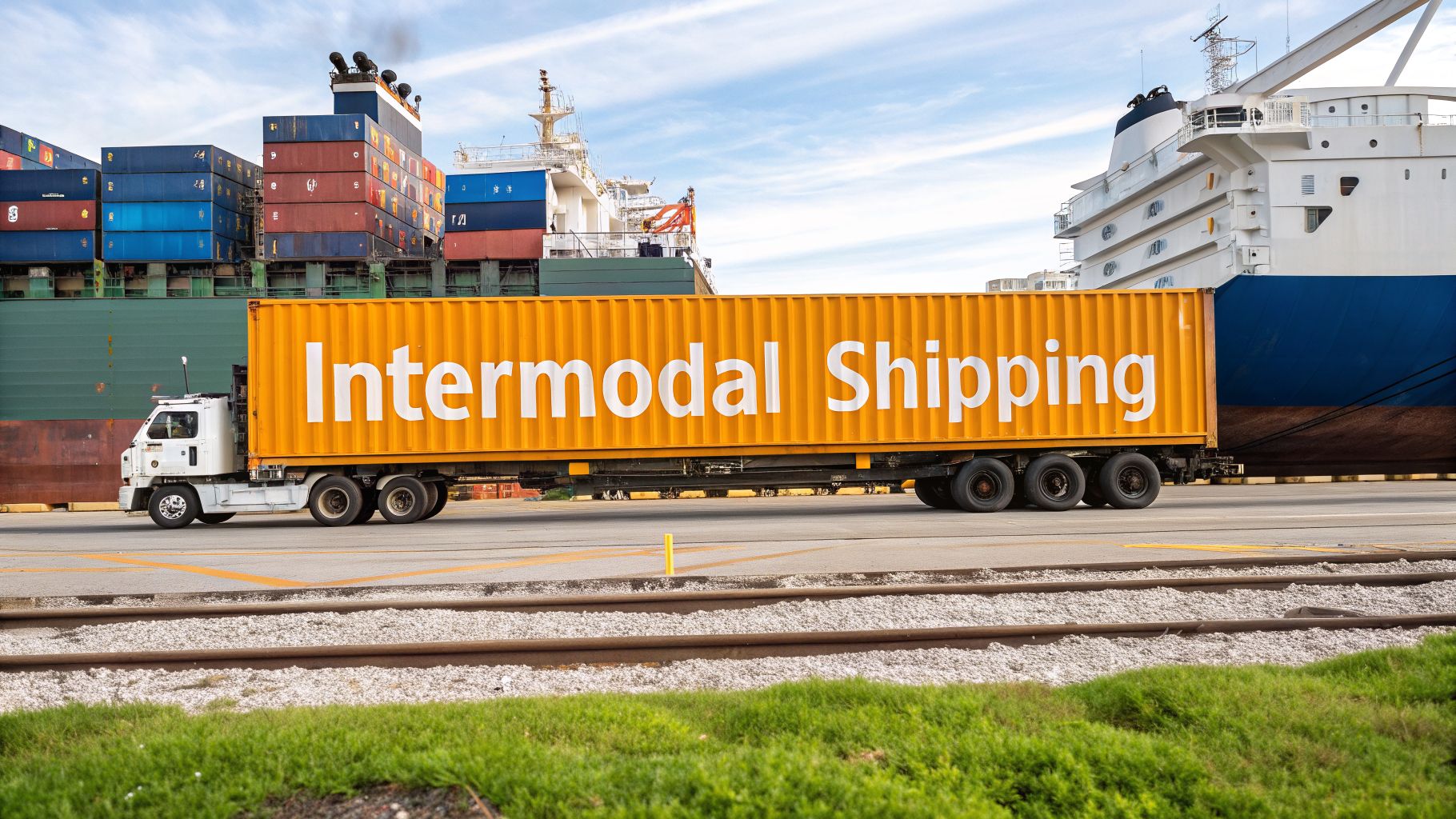
So, what is it? Simply put, intermodal shipping moves your goods using multiple types of transport—like ships, trains, and trucks—all without ever unpacking the container. The cargo stays sealed inside its steel box from start to finish.

A Relay Race for Your Cargo

Large gantry crane transferring a container onto a semi-truck at a busy intermodal shipping port.

Think of it like a relay race. The shipping container is the baton, and it’s passed seamlessly between different runners. A typical journey might start on a massive ocean vessel, get lifted onto a train for a long haul across the country, and finally get loaded onto a truck for that last-mile delivery to a 3PL like SnappyCrate.

The whole system works because of one thing: standardization. Every container is built to the same specs, allowing giant cranes to lift and lock them onto ships, railcars, and truck chassis with incredible speed. This universal design is the secret sauce that makes the global supply chain hum.

Playing to Each Mode's Strengths

Instead of one truck driving thousands of grueling miles, intermodal breaks the journey into specialized legs. Each mode is used for what it does best, creating a powerful and efficient combination.

  • Ocean Liners: The undisputed champ for moving huge volumes between continents. Nothing beats a ship for the lowest cost-per-container on international routes.
  • Rail: The most cost-effective way to move goods over long domestic distances. A single train can haul the cargo of over 280 trucks, delivering massive fuel and labor savings.
  • Trucks (Drayage): The flexible finisher. Trucks are perfect for the short "first and last mile" moves—getting containers from the port to the railyard, and from the railyard to your final destination.

This isn't just a clever trick; it's the engine of modern trade. The market's explosive growth proves its value. The global intermodal freight market hit around US$51.6 billion in 2023 and is on track to reach a staggering US$155.9 billion by 2031, growing at a rate of 15.09 percent annually. This isn't just growth; it's a sign of massive investment in making the process even smoother. You can read more about the sector's rapid expansion and its drivers.

The real magic of intermodal is efficiency. By keeping your goods locked in a single container, you drastically cut down on handling. Less handling means less risk of damage, loss, and theft.

Why This All Matters for Your Business

For any e-commerce brand or importer, getting a grip on intermodal shipping is key to building a supply chain that's both affordable and reliable. It’s the main way products make their way from overseas factories into the hands of your domestic customers.

For any shipment traveling over 750 miles, using an intermodal strategy almost always beats the cost of an all-truck journey. It gives you a more predictable, sustainable, and budget-friendly way to manage logistics. This allows you to plan inventory better, reduce your transportation spend, and ultimately scale your business without breaking the bank.

The Key Players in an Intermodal Shipment

A large truck transports colorful shipping containers at a bustling port with a ship and cranes.

An intermodal shipment is like a well-choreographed relay race for your freight. A whole team of specialized players is involved, each responsible for running one leg of the journey. When the handoffs are smooth, your cargo arrives on time and on budget.

But if one player drops the baton, the whole thing can grind to a halt. Knowing who does what is the first step to keeping your supply chain in motion. Let's break down the cast of characters who make intermodal freight shipping a reality.

The Ocean Voyagers and Long-Distance Runners

The big journey usually starts with the Steamship Lines. Think of them as the ocean-crossing titans of trade. Companies like Maersk, MSC, or ONE operate the huge container ships that carry goods between continents, handling that long, international sea leg.

Once your container hits a domestic port, it's often passed to a Class I Railroad. These are the long-distance runners—the major rail networks like BNSF and Union Pacific that stretch across the country. Rail is the workhorse of domestic intermodal, capable of moving massive amounts of freight over land with incredible fuel efficiency.

The Local Sprinters and Exchange Zones

So how does your container get from the ship to the train? That's where the drayage companies come in. These are specialized trucking carriers that act as the local sprinters, handling the short—but critical—moves connecting the different modes. They shuttle containers from the port to a rail yard (first-mile) or from a rail yard to your warehouse (last-mile).

All these handoffs happen at Intermodal Terminals. These are the bustling exchange zones where cargo is swapped between trucks and trains.

An intermodal terminal is a highly coordinated hub where giant cranes—called reach stackers or transtainers—lift containers off a train and onto a truck chassis (or vice versa), often in just a few minutes.

This quick-change artistry is what makes the system work, ensuring the container "baton" is passed seamlessly from one runner to the next.

Following the Paper Trail

Beyond the physical moves, there's a paper trail that keeps everything straight: the Bill of Lading (BOL). A simple truckload shipment might have just one BOL. An intermodal move? It can have several. You'll likely have one for the ocean voyage and another for the domestic rail and truck portions.

Juggling these players and their paperwork can feel like a full-time job. That's why many businesses rely on a logistics partner. If you're looking to offload this complexity, it pays to understand how a third-party logistics provider can manage these moving parts for you.

Let's walk through a real-world scenario. A container full of electronics arrives at the Port of Long Beach.

  1. A drayage truck picks up the sealed container and hauls it to a local rail terminal.
  2. The container is loaded onto a railcar for a cross-country trip to a Chicago rail yard.
  3. In Chicago, a second drayage truck picks up the container for the final delivery to a warehouse for unloading.

Notice what didn't happen? The electronics inside the container were never touched from the moment the container was sealed overseas until it was opened at the final destination in Illinois. That seamless, secure journey is the power of intermodal shipping.

Comparing Intermodal and Over-The-Road Trucking

When you're trying to move freight, it often feels like you're stuck between two choices: intermodal and traditional over-the-road (OTR) trucking. The right decision usually boils down to two simple questions: How far is it going, and how fast do you need it there?

For shorter trips, OTR trucking gives you speed and flexibility that’s hard to beat. But once the miles start piling up, intermodal shipping really starts to make sense. For importers and e-commerce sellers, understanding the trade-offs between cost, speed, and even environmental impact is key to building a smart, resilient supply chain.

Finding the Intermodal Sweet Spot

So, when does intermodal become the obvious choice? The industry sweet spot is any shipment traveling over 750 miles. On these long-haul routes, the cost savings are simply too big to ignore. This is where the incredible efficiency of rail freight takes center stage.

To put it in perspective, a single train can haul a ton of freight more than 400 miles on just one gallon of fuel. Now, imagine hundreds of individual trucks burning diesel to cover that same distance. The savings on fuel and labor alone are massive, making intermodal a powerful lever for controlling your transportation spend.

And the case for intermodal is only getting stronger. We’re seeing rising long-haul trucking costs everywhere, thanks to everything from global events and inflation to soaring fuel prices. The trucking industry is also wrestling with a major labor shortage—in 2023, more than 50 percent of trucking companies had trouble finding drivers. All these factors push operational costs up and make intermodal an even more attractive alternative.

A Head-to-Head Comparison

To pick the right mode for your business, you need to weigh the pros and cons based on your shipment's specific needs. Let's break down a head-to-head comparison for a typical long-haul shipment traveling over 750 miles.

Intermodal vs. Over-The-Road (OTR) Trucking Comparison

Here’s a look at how the two stack up across the factors that matter most to your bottom line and your operations.

Factor Intermodal Shipping Over-The-Road (OTR) Trucking
Cost Typically 10-30% less expensive for long hauls due to fuel and labor efficiencies on the rail portion. Higher cost per mile on long hauls due to fuel, driver pay, and equipment wear.
Transit Time Generally adds 1-2 days to the total transit time compared to a solo driver, but can be competitive with team drivers. The fastest option for most distances, especially under 750 miles. Direct from point A to B.
Fuel Volatility Less exposed to sudden spikes in diesel prices, as rail is more fuel-efficient and costs are more stable. Directly impacted by fluctuations in diesel fuel prices, leading to unpredictable fuel surcharges.
Carbon Footprint Significantly more sustainable. Moving freight by rail instead of truck can reduce greenhouse gas emissions by up to 75%. Higher carbon emissions per ton-mile, contributing more significantly to environmental impact.
Flexibility Less flexible. Operates on fixed rail schedules and requires drayage moves at both ends. Highly flexible. Can go anywhere a road exists and can be easily rerouted to accommodate changes.
Cargo Security Very secure. The container is sealed at the origin and remains locked until it reaches the final destination, minimizing handling. Generally secure, but cargo is more accessible and subject to more stops and potential handling.

The bottom line is this: OTR trucking wins on speed and flexibility for short-to-medium hauls. But for long hauls, intermodal is the clear winner on cost and sustainability, making it the go-to for budget-conscious and eco-friendly supply chains.

By carefully weighing these factors, you can align your freight strategy with your business goals. For any shipper looking to get their budget under control, learning how to reduce shipping costs is a critical first step—and integrating intermodal is one of the most effective ways to do it.

To really wrap your head around intermodal freight shipping, you have to picture the journey. It’s less of a single trip and more of a multi-stage relay race. Let's follow a single container from a factory overseas all the way to a 3PL warehouse door, like SnappyCrate.

Visualizing this four-part handoff makes the whole process click. At each stage, different players take over, but your cargo stays safely locked inside its steel box from start to finish.

Step 1: The Ocean Leg

Everything starts with the ocean leg. After your products are boxed up at the factory, the container is loaded and trucked to a port. There, it's hoisted onto a massive container ship run by a steamship line. This is almost always the longest part of the journey, often taking weeks to cross the ocean.

The steamship line is in charge here. The biggest headache? Port congestion. A traffic jam of ships at the origin or destination port can leave your container sitting for days—or even weeks—before it ever gets moving.

Step 2: The First Drayage

Once the ship finally docks, the first drayage move kicks off. A specialized drayage truck—a short-haul specialist—picks up your container from the port and takes it to a nearby rail terminal. This first-mile trip is short, but it's an absolutely critical link in the chain.

A major bottleneck at this point is a chassis shortage. Drayage trucks need a specific trailer frame, called a chassis, to haul a container. When ports are busy, there often aren't enough chassis to go around, leaving your container stuck at the port and racking up expensive fees.

The entire intermodal move hinges on smooth handoffs. The container has to move from the port to the rail yard like clockwork. Any delay means you're on the hook for costly demurrage and per diem fees.

To keep the container locked down as it moves between the ship, train, and truck, they're all secured with specialized hardware like reliable twist lock containers.

Step 3: The Rail Journey

Next up is the rail journey. At the rail terminal, giant cranes lift the container off the truck chassis and onto a train car. This is the long-haul domestic part of the trip, where the train will carry the container hundreds or even thousands of miles inland.

This leg is managed by a Class I railroad. Rail is incredibly efficient for covering long distances, but you can still run into trouble. The main culprits are congestion at major rail hubs or service interruptions somewhere along the line. Mastering the movement of goods is what separates good logistics from great logistics. You can dive deeper into the fundamentals of dispatching and logistics services.

The intermodal sector has seen some serious momentum lately. In fact, some reports showed year-over-year growth hitting a massive 27 percent in January 2025, thanks to high export volumes and retailers stocking up. You can discover more insights about recent intermodal market growth and see what it means for the industry.

Step 4: The Final Drayage

Finally, the container reaches its destination rail terminal for the final drayage—the last-mile delivery. Another drayage truck picks it up and hauls it to the final destination, whether that's your warehouse or a distribution center.

This is where scheduling becomes everything. The drayage company, the shipper, and the receiving warehouse have to be in perfect sync to hit the delivery appointment. A common problem is the warehouse not having any available appointments, leaving the container stuck at the rail yard, once again racking up fees.

By understanding each step of this journey, you’re in a much better position to anticipate—and manage—the delays that can pop up along the way.

Best Practices for Using Intermodal Freight

Getting the hang of intermodal freight shipping is more than just booking a container. It’s about building a repeatable process that turns complex logistics into a smooth, reliable part of your supply chain. For importers and e-commerce brands, this is where the real magic happens.

Let's walk through the playbook we use at SnappyCrate to help our partners master intermodal from planning to receiving.

First, you have to adjust your mindset. Intermodal isn't like over-the-road trucking, where you can get just-in-time delivery. Transit times are longer, but the upside is they're incredibly predictable. This means smart inventory planning is a must—you need to factor in the entire journey, from port departure to final delivery, so you never risk running out of stock.

For businesses looking to squeeze every bit of efficiency out of their supply chain, understanding the principles of route optimization is a game-changer. Proactive planning like this is what separates the pros from the amateurs and helps you avoid paying for last-minute air freight.

Prepare Your Cargo for the Rails

A trip on a train is a different beast than a trip on the highway. The gentle rocking and occasional shunting—the industry term for coupling rail cars—can easily cause cargo to shift and break if it’s not properly secured.

Blocking and bracing are absolutely non-negotiable for rail. This means using dunnage bags, wooden blocks, and straps to lock your pallets in place inside the container. You’re essentially creating one solid, unmovable block of freight that can handle the normal bumps and sways of rail travel. A well-braced container is the best insurance policy you can have against damaged goods.

Coordinate Like a Pro with Your 3PL

Think of your 3PL partner, like SnappyCrate, as the quarterback of your intermodal shipment. We’re the ones coordinating with the drayage carriers, warehouses, and rail lines. That’s why clear and timely communication from you is the backbone of the entire operation.

A few key communication points make all the difference:

  • Advance Shipping Notices (ASNs): As soon as your container is loaded and moving, send over the ASN. This digital heads-up tells your 3PL exactly what’s coming so they can get ready for its arrival.
  • Container ETA Updates: Share every tracking update and Estimated Time of Arrival you get. This allows your 3PL to schedule the right people and free up dock space, preventing logjams when the container shows up.

This diagram shows a bird’s-eye view of a typical intermodal journey and all the critical handoffs.

Diagram illustrating an intermodal freight journey by ocean, drayage, and rail, detailing transit time and cost savings.

Each one of those transitions—from the port to the truck, to the train, and back to a truck—is a point where seamless coordination keeps your freight on track.

Master Container Receiving at Your Warehouse

The final mile is often where even the best-laid plans can fall apart. Being ready for the container’s arrival is just as crucial as planning the long-haul portion of its journey. You generally have two ways to handle the unload.

A "live unload" is when the drayage driver waits while your team unloads the container, usually within a two-hour window. A "drop-and-hook" is when the driver leaves the full container at your facility and comes back later to pick up the empty one.

While a drop-and-hook gives you more flexibility, it also means you need enough space to store a 40-foot container and its chassis. For most businesses, a well-coordinated live unload is the more practical choice.

Once those container doors swing open, your receiving team needs a clear game plan:

  1. Inspect the Load: Before anyone touches anything, check for shifted cargo. Snap photos of any damage you see—you’ll need them for any potential claims.
  2. Break Down Pallets: Get the pallets unloaded and move them to a staging area for processing.
  3. Verify Inventory: Count the goods and check them against your packing list and ASN to make sure all the SKUs and quantities match up.
  4. Report Discrepancies: If you find any shortages, overages, or damages, notify your supplier and 3PL immediately.

By turning these tips into standard operating procedures, you can transform the complexities of intermodal freight shipping into a cost-effective, reliable, and scalable engine for your supply chain.

Of course. Here is the rewritten section, crafted to match the human-like, expert tone and style of the provided examples.


Common Questions About Intermodal Shipping

Thinking about using intermodal freight shipping? It's a smart move, but we get it—it’s a big change that comes with a lot of questions. Before you dive in, you need to know how it really works on the ground.

We hear the same concerns from businesses all the time. Let’s tackle them head-on, giving you the straightforward answers you need. Making the switch to intermodal means planning a bit differently, but the payoff in cost savings and reliability is huge.

How Long Does Intermodal Shipping Take?

This is always the first question, and the answer is simple: intermodal shipping usually takes a little longer than a standard truck. As a general rule, you should plan for an extra one to two days of transit time compared to what you’d expect from a direct truckload.

A truck can get loaded and head straight to its destination. Intermodal has a few more moving parts: the first drayage trip to the rail terminal, the time spent getting loaded onto the train, the rail journey itself, and the final drayage to your warehouse. Each of those handoffs adds a little time.

But that’s not the whole story. Here’s how it really stacks up:

  • Versus a Solo Driver: A solo truck driver has to stop and rest due to hours-of-service rules. While the truck is often still faster, the time gap on a long cross-country haul isn't as massive as you might think.
  • Versus a Team Driver: A team-driven truck that runs 24/7 is the fastest way to move freight on the ground, period. Intermodal will always be slower than this premium service.

The real advantage of intermodal isn't speed—it's predictability. Rail schedules are fixed and incredibly reliable. Once you build that slightly longer lead time into your inventory plan, you get a delivery window you can count on. That consistency is a game-changer for managing your stock and avoiding last-minute, high-cost shipments.

Is My Freight Safe During Transit?

Absolutely. In fact, intermodal freight is one of the most secure ways to ship goods over land. The reason is simple: less handling.

Once your container is loaded and sealed at the origin, it stays locked until it reaches you. It’s basically a giant steel safe that’s never opened mid-journey.

Think of your cargo as being locked in a personal vault. That vault gets moved from a truck chassis to a train and back again, but the door is never unlocked. This cuts way down on the chances for theft or damage that can happen when goods are repeatedly handled.

The journey itself is also more secure. Rail yards and port terminals are high-security zones with controlled access and constant surveillance. A container on a train crossing the country is a much harder target for thieves than a truck sitting in a public rest stop overnight.

Security Wins with Intermodal:

  • Sealed for Security: The container is locked from start to finish, giving you an unbroken chain of custody.
  • Minimal Handling: Your products aren't touched, which nearly eliminates the risk of damage or items going missing.
  • Secure Terminals: Access to cargo inside rail yards is heavily restricted.
  • Lower Overall Risk: The whole system is built to move massive volumes with very little human intervention, making it inherently safer.

If you’re shipping high-value electronics, pharmaceuticals, or anything sensitive, the security of an untouched container is a major plus.

What Is the Ideal Distance for Intermodal?

You can use intermodal for shorter trips, but it really shines on long-haul routes. That’s where you see the massive cost and fuel efficiencies of rail kick in.

The magic number in our industry is 750 miles. For any shipment traveling less than that, a direct truck is almost always cheaper and faster. The costs of the two drayage moves (getting the container to and from the train) just don't make sense on shorter runs.

But once you go past that 750-mile mark, the numbers start looking very different. A train can move a ton of freight over 400 miles on just one gallon of fuel—an efficiency a truck can't even come close to. On a cross-country trip, those savings add up fast, often making intermodal 10-30% cheaper than a truck.

Here’s a quick breakdown:

  • Under 500 Miles (e.g., Los Angeles to Phoenix): Stick with a truck. It’s faster and more cost-effective.
  • 750-1,500 Miles (e.g., Chicago to Dallas): You're in the intermodal sweet spot. Expect solid cost savings for a manageable increase in transit time.
  • Over 1,500 Miles (e.g., New York to Los Angeles): For coast-to-coast freight, intermodal is the hands-down winner for cost-efficiency. The savings are too good to ignore.

By planning for slightly longer transit, taking advantage of the built-in security, and focusing on long-haul routes, you can turn intermodal into a cost-cutting powerhouse for your supply chain.


Navigating the complexities of container receiving, drayage coordination, and warehouse prep is what we do all day, every day. At Snappycrate, we act as a true extension of your team, turning the challenges of intermodal logistics into a smooth, scalable process. Discover how Snappycrate can streamline your e-commerce fulfillment.

0 Continue Reading →

The Strategic Third Party Logistics Benefits for E-Commerce Growth

If you’ve ever found yourself drowning in a sea of packing tape, shipping labels, and warehouse dust while your e-commerce store is booming, you already know the problem. You're stuck working in your business, not on it.

This is exactly where a Third-Party Logistics (3PL) provider comes in. They become the operational engine for your brand, handling the physical side of your business so you can get back to what you do best: growing it.

What Exactly Is Third-Party Logistics

Two logistics workers, a woman and a man, reviewing inventory on a tablet in a warehouse.

Think of a 3PL as your dedicated, off-site logistics team—one you don't have to hire, train, or manage. They handle all the gritty, time-sucking tasks that become a massive bottleneck for any growing online store. This isn't just about renting some shelf space; it's about handing off your entire fulfillment operation to a team of experts.

A 3PL receives your inventory, stores it securely, and the moment an order hits your Shopify or Amazon store, they pick it, pack it, and ship it directly to your customer. They're the silent partner who makes sure the promise you made online is delivered—literally—to your customer’s doorstep.

The Role of a 3PL in E-Commerce

For an e-commerce brand, a 3PL’s job is simple: turn clicks into packages on porches. Their day-to-day work covers the entire fulfillment lifecycle.

  • Receiving & Warehousing: They take in your inventory shipments, check them for accuracy, and organize everything in a secure, professional facility.
  • Inventory Management: Your 3PL keeps a constant, accurate count of your stock, giving you a clear view of what you have on hand through their software.
  • Order Fulfillment: When an order comes in, they accurately pick the items, pack them just the way you want, and get them ready to ship out.
  • Shipping & Distribution: Using their deep relationships with carriers, they find the best shipping rates and speeds to get orders to your customers fast.

Making the switch from DIY fulfillment to a 3PL is a sure sign of a healthy, growing business. Let's be real—the time you spend printing labels and taping boxes is time you're not spending on marketing, product development, or building your community. That hidden cost adds up fast.

The move to outsource logistics isn't a niche strategy anymore—it's the standard for brands that want to scale. The global third-party logistics market is on track to hit $1.6 trillion by 2025, and over 90% of Fortune 500 companies already rely on at least one 3PL provider.

Ultimately, working with a 3PL isn’t about losing control. It’s about gaining expertise and buying back your time. To get a better handle on the specifics, check out our deep dive into what a 3PL warehouse does. It lays the groundwork for understanding just how much a dedicated logistics partner can bring to the table.

The Core Benefits of Outsourcing Your Logistics

Partnering with a 3PL isn't just about clearing space in your garage; it's a strategic move that plugs powerful efficiencies and hard-won expertise directly into your operation. The decision to outsource kicks off a cascade of advantages that immediately impact your bottom line, keep your customers happy, and clear the runway for growth.

These are the core benefits that will fundamentally change how you do business.

Unlock Major Cost Savings

At first glance, outsourcing logistics looks like just another expense. In reality, it eliminates a whole host of hidden, unpredictable costs that come with doing it all yourself, leading to some serious net savings. A 3PL operates at a massive scale, which gives you access to perks you could never get alone.

Take shipping, for example. A 3PL bundles shipping volume from hundreds of clients, giving them huge negotiating power with carriers like UPS, FedEx, and USPS. They get deeply discounted rates that are simply off-limits to individual small or medium-sized businesses. The data backs this up—80% of businesses confirm that using a 3PL helps slash their overall logistics costs.

Beyond postage, you completely sidestep massive capital costs. You no longer need to lease (or buy) a warehouse, sink cash into expensive shelving and equipment, or purchase a pricey warehouse management system (WMS). You also dodge recurring operational costs like utilities, insurance, and salaries for a fulfillment team.

A 3PL flips your fixed logistics costs into variable ones. Instead of paying for a whole warehouse and staff no matter what your sales look like, you only pay for the services you actually use. Your expenses scale perfectly with your revenue.

This model isn't just about saving money; it's about making your cash flow healthier and more predictable. That frees up capital to pour back into what really grows your business: marketing and product development.

To put this in perspective, let’s break down what it really costs to run your own logistics versus handing it off to an expert partner.

In-House Logistics vs Outsourced 3PL A Cost and Effort Comparison

Many sellers underestimate the sheer number of hats they have to wear—and pay for—when managing their own fulfillment. This table highlights the stark difference between the DIY grind and the strategic advantage of outsourcing.

Logistic Component In-House Management Outsourced to a 3PL (e.g., Snappycrate)
Warehouse Space Monthly rent/mortgage, utilities, insurance, property taxes. High fixed costs regardless of sales volume. Included in service fees. Pay only for the space your inventory occupies. Scales up or down as needed.
Labor Salaries, benefits, payroll taxes, workers' comp for warehouse staff. Costly and difficult to scale for peak seasons. Professional, trained staff included. Labor costs are variable and tied directly to order volume.
Shipping Rates Standard commercial rates. Little to no negotiating power with major carriers. Deeply discounted, high-volume rates. Immediate access to significant savings on every shipment.
Technology & Equipment Must purchase and maintain WMS software, scanners, printers, forklifts, and shelving. Significant upfront capital. State-of-the-art technology and equipment are provided. No capital expenditure or maintenance headaches.
Supplies Must source and purchase boxes, tape, void fill, and labels. Costs fluctuate and require inventory management. All packing supplies are included in the fulfillment fee, often at a lower cost due to bulk purchasing.
Time & Focus Countless hours spent on packing, shipping, inventory counts, and troubleshooting. Diverts focus from growth. Zero time spent on fulfillment. Allows you to focus 100% on marketing, product development, and strategy.

As you can see, outsourcing isn't just an expense—it's an investment in efficiency, predictability, and your own sanity.

Achieve Effortless Scalability

For an e-commerce brand, growth is a double-edged sword. A sudden spike in orders from a viral TikTok or the Black Friday rush can absolutely cripple an in-house operation. The result? Shipping delays, frantic all-nighters, and angry customers.

A 3PL is built for this exact scenario.

Their infrastructure—the space, the staff, the technology—is designed to handle wild swings in order volume without breaking a sweat. You can go from shipping 50 orders a day to 5,000 without having to frantically hire temporary staff or scramble for more warehouse space. Your fulfillment capacity expands and contracts seamlessly with your sales.

This elasticity lets you chase growth opportunities without fear, knowing your operational backbone can handle whatever you throw at it. It’s the difference between seeing a sales surge as a crisis versus a massive win.

Instantly Expand Your Market Reach

Want to offer nationwide two-day shipping without building a dozen warehouses? A 3PL with a distributed network of fulfillment centers makes this a reality overnight.

By storing your inventory in multiple warehouses strategically located across the country, you place your products closer to your customers. This simple move dramatically cuts down on shipping times and costs. Instead of a package traveling from California to New York, your 3PL ships it from a warehouse in New Jersey.

This not only delights your customers with lightning-fast delivery but also lowers your shipping expenses by reducing the number of zones a package has to cross.

Elevate the Customer Experience

In e-commerce, that final mile—the delivery—is a make-or-break moment for your brand. A slow or wrong order can ruin an otherwise perfect experience.

Professional 3PLs operate with near-perfect precision, often boasting order accuracy rates of 99.9% or higher.

This obsession with accuracy means fewer costly errors, fewer returns, and way fewer customer service headaches. When you combine that with faster shipping speeds, you’ve got a powerful recipe for customer loyalty. A fantastic delivery experience is a huge driver of five-star reviews and repeat business, creating a positive feedback loop that fuels your growth.

Gain an Expert Advantage

You're an expert in your product and brand, not necessarily in the nitty-gritty of logistics. A 3PL partner brings decades of specialized knowledge to your team. They live and breathe the complexities of inventory management, warehouse optimization, and carrier negotiations.

This expertise is especially crucial for managing supply chain disruptions, where a 3PL's established networks and know-how can keep your business running smoothly when things get chaotic.

Plus, they give you access to sophisticated technology and automation that would be way too expensive to implement on your own. This ensures your operations aren't just managed—they're optimized for peak performance from day one.

Reclaim Your Most Valuable Asset: Your Time

Ultimately, the single biggest benefit is the freedom a 3PL gives you.

Every hour you spend counting inventory, packing boxes, or chasing down a shipping issue is an hour you don't spend on high-impact activities like product innovation, marketing strategy, and building customer relationships.

By offloading the entire fulfillment process, you reclaim your focus. You get to graduate from being the chief box-packer to being the CEO, guiding your brand’s vision instead of getting bogged down in the daily grind.

If you’re ready to see how this works for your business, you can learn more about our 3PL e-commerce fulfillment services and how we can help you scale smarter.

Specialized 3PL Services That Drive E-Commerce Success

The standard perks of a 3PL—saving money and scaling up—are great, but they're just the beginning. The real magic for e-commerce brands happens with value-added services. These are the specialized jobs that solve your biggest headaches, create incredible customer experiences, and even open up new ways to make money.

These services turn your 3PL from a simple warehouse into a true partner in your growth.

A concept map showing the benefits of a 3PL provider: reduces overhead, adapts to demand, and expands market.

This map nails it. A 3PL connects the dots between lower costs, flexible operations, and reaching new customers, giving your brand the engine it needs to grow faster and more efficiently.

Navigating Amazon FBA Prep and Compliance

Selling on Amazon FBA is a huge opportunity, but let's be honest—their rulebook is a nightmare. One tiny mistake with a label or a polybag can get your entire shipment rejected. That means penalty fees, lost sales from stockouts, and a major headache for you.

A 3PL that specializes in FBA prep is your secret weapon. They live and breathe Amazon's ever-changing guidelines.

  • Precise Labeling: They handle all the tedious stuff—FNSKU barcodes, suffocation warnings, and "Sold as a Set" stickers—so every item scans perfectly when it arrives at Amazon.
  • Correct Packaging: From poly-bagging a single t-shirt to building compliant case packs and master cartons, they get it right every single time.

When you hand this off to a 3PL like Snappycrate, your inventory flows into FBA without a hitch. No more costly delays or dings to your seller account. You get to focus on selling, not on fighting with Amazon's receiving department.

Boosting Revenue with Kitting and Bundling

Want to increase your average order value (AOV) and create offers your competitors can't easily copy? Kitting is the answer. This is simply the process of taking multiple different products and bundling them together into a single new product, or "kit."

For example, if you sell skincare, you could create a "Morning Routine Kit" by bundling a cleanser, moisturizer, and serum. A 3PL physically assembles these kits for you, creating a brand new, high-value SKU without you lifting a finger. It’s also a brilliant way to move slower-selling products by pairing them with your bestsellers. You can see how we make this happen with our kitting and assembly solutions.

Real-World Example: A coffee brand works with its 3PL to create a "Holiday Gift Box." The 3PL team takes a bag of coffee, a branded mug, and a small pack of biscotti and assembles them into a beautiful, ready-to-ship gift box. This new kit becomes their top-selling item in Q4, driving a huge spike in holiday revenue and introducing new customers to three products at once.

Creating Memorable Unboxing Experiences

In e-commerce, the box that arrives on your customer's doorstep is your brand's first physical handshake. A plain brown box is a forgotten opportunity. But a custom, branded unboxing experience? That creates a "wow" moment that builds loyalty and gets people sharing on social media.

An e-commerce 3PL can store all your custom materials and build this experience into every order.

  • Custom Branded Boxes: Your logo and brand colors, right on the box.
  • Printed Inserts: A simple thank-you card, a discount for their next order, or a guide on how to use the product.
  • Branded Fill & Tape: Custom tissue paper or packing tape that reinforces your brand’s identity with every detail.

Trying to manage this yourself is a logistical nightmare, especially as you grow. A 3PL makes it easy, ensuring every single package looks and feels like it came directly from you.

Streamlining Inbound Freight Management

If you import your products, you know the pain of getting inventory from the factory to the warehouse. Dealing with container unloading, inspecting every item, and palletizing it all correctly is a massive operational burden.

A good 3PL can take over this entire inbound process. They’ll receive your containers or truckloads, unload everything, and perform quality checks on the spot. From there, they sort, palletize, and get the inventory into the warehouse system so it's ready to sell almost immediately. This is absolutely critical for keeping your supply chain moving and avoiding stockouts.

The numbers don't lie. Operations leaders report that using 3PLs helps drive annual sales growth of 5-20%, and 90% of top providers offer this kind of inbound logistics management. This isn't just about saving time—it's about building a more resilient and profitable business.

Calculating the True ROI of a 3PL Partnership

It’s easy to see the qualitative benefits of a 3PL—getting your time back, ditching the packing tape, and making customers happy. But do the numbers actually work? Is partnering with a 3PL really worth the money?

To figure that out, you can't just compare a 3PL's invoice to what you think you're spending now. The real calculation starts when you uncover all the "hidden costs" of fulfilling orders yourself. These are the expenses quietly eating away at your profits that don't always show up on a spreadsheet.

Uncovering Your Hidden Fulfillment Costs

Before you can compare apples to apples, you need a painfully honest look at what you’re spending on fulfillment right now. Most e-commerce founders drastically underestimate their all-in cost per order because they forget to factor in these things:

  • Labor Opportunity Cost: This is the big one. Every hour you or your team spends printing labels, packing boxes, or driving to the post office is an hour you aren't spending on marketing, product development, or customer service.
  • Packing Supplies: The cost of boxes, mailers, tape, dunnage, and printer ink adds up alarmingly fast. A 3PL buys these materials by the truckload, getting them for way cheaper than you ever could.
  • Shipping Errors & Returns: When you ship the wrong item, you pay for shipping three times: once to the customer, once for the return label, and a third time to send the correct product out. It’s a costly mistake that also chips away at your brand's reputation.
  • Warehouse Overhead: Even if you're working from your garage, that space isn't free. You're paying for electricity, insurance to cover the inventory, and the opportunity cost of using that square footage. For larger brands, this includes rent, utilities, and security systems.

Once you add all of that up, you get your true current "cost per order." This number is your baseline.

Understanding the 3PL Fee Structure

A good 3PL partner will be transparent about their pricing, which usually boils down to a few core components. While the exact model can vary, you can typically expect to see charges for these services:

  1. Receiving: A one-time fee to take in your inventory, count it, and get it put away on the shelves. This is often charged per pallet, per carton, or as a simple hourly rate.
  2. Storage: A recurring monthly fee for the physical space your products occupy. This is usually calculated per pallet, per bin, or per cubic foot.
  3. Fulfillment (Pick & Pack): This is the main fee for processing an order. It’s typically a base charge for picking the first item and a smaller charge for each additional item in the same order.
  4. Shipping: The actual cost of postage. The 3PL passes this cost through to you, but at their heavily discounted carrier rates.

By outsourcing, you transform unpredictable, fixed costs (like rent and employee salaries) into predictable, variable costs that scale directly with your sales. You only pay for what you use, which makes managing your cash flow a whole lot easier.

The Formula for Calculating Your ROI

Now that you have both sets of numbers, you can run a direct comparison. The goal is to calculate your "all-in cost per order" for both scenarios.

Your In-House Cost Per Order = (Monthly Labor Costs + Monthly Supply Costs + Monthly Overhead + Shipping Costs) / Total Monthly Orders

Your 3PL Cost Per Order = (Monthly Storage Fees + Fulfillment Fees + Shipping Costs) / Total Monthly Orders

When you actually map this out, the financial upside of using a 3PL becomes incredibly clear, especially as your order volume starts to climb.

Mini Case Study: A Shopify Store’s Growth

Let's look at a Shopify store shipping 300 orders a month. The founder is spending 20 hours a week on fulfillment—a massive opportunity cost—and paying standard consumer rates for shipping.

The moment they partner with a 3PL, they start saving on shipping for every single order thanks to the 3PL’s bulk discounts. Their fulfillment fee is now a predictable per-order cost, and they completely reclaim the 80 hours a month they were losing to manual labor.

Now, let's say they scale to 1,000 orders a month. This is where the ROI really explodes. To handle that volume in-house, they'd need to hire an employee and rent a small warehouse, which is a huge jump in fixed costs. But with the 3PL, their cost per order stays stable and predictable. The savings from the shipping discounts alone now cover a huge chunk of their fulfillment fees, and the founder's time is still 100% focused on growth. That’s the real power of scalable logistics.

How to Choose the Right 3PL for Your Business

Two logistics workers review a digital checklist on a tablet in a busy warehouse.

The benefits we've covered are huge, but they only happen if you find the right partner. Let’s be blunt: picking the wrong 3PL can create more headaches than it solves. It can lead to shipping disasters, angry customers, and a logistics bill that’s higher than when you were doing it all yourself.

This decision is too important to rush. It's about more than just comparing price quotes. You need to dig into their technology, their experience, and their transparency to find a partner who truly gets your brand and can grow with you.

Ask About Their Sales Channel Experience

Your first question should always be about their direct experience with your sales channels. A 3PL that's great at shipping pallets to big-box retailers might be completely lost when it comes to the fast-paced, high-stakes world of a Shopify store. You need a partner who speaks your language.

For example, if you sell on Amazon FBA, don't just ask if they do "FBA prep." Ask them to walk you through their process for FNSKU labeling, poly-bagging, and bundling. A good partner will talk specifics about how they prevent rejections at Amazon's fulfillment centers. For direct-to-consumer brands, you'll want to see their live integrations with platforms like Shopify or Walmart Marketplace.

Evaluate Their Technology and Integration

A modern 3PL is really a tech company that happens to move boxes. Their software is the central nervous system of your entire fulfillment operation, and you need to be sure it’s up to the task. When vetting their Third Party Logistics software, make sure it delivers.

A solid technology platform should offer:

  • Seamless Integrations: The software must connect directly with your e-commerce store to automatically pull orders in and push tracking numbers back out. No manual entry, no delays.
  • Live Inventory Visibility: You should be able to log in at any time and see exactly what’s in stock, what’s on backorder, and what’s heading out the door.
  • Robust Reporting: Look for simple, clear dashboards. You need easy access to data on order accuracy, shipping times, and inventory turnover so you can make smarter decisions for your business.

Scrutinize the Pricing Model for Transparency

Hidden fees can kill your margins and turn a good deal into a nightmare. A trustworthy 3PL will give you a clear, line-by-line breakdown of every possible charge. Don't be shy about asking direct questions.

Be wary of any provider who is vague about their fee structure. Ask for a sample invoice and have them walk you through every line item, including potential surcharges for oversized items, special projects, or account management.

This isn’t just a nice-to-have; it's a dealbreaker. Your goal is to create a predictable cost model, and that’s impossible if you’re getting hit with surprise fees every month.

Confirm Service Levels and Return Processes

Finally, you need to know what they promise and how they fix things when they go wrong. Ask for their specific Service Level Agreements (SLAs). What’s their guaranteed dock-to-stock time for receiving new inventory? What’s their order accuracy rate? How quickly do they promise to ship an order once it comes in?

The logistics world is global. Many e-commerce brands source products from Asia and need a 3PL partner who understands how to manage everything from inbound container shipments to fast North American distribution. That’s where a partner like Snappycrate shines, bridging that gap seamlessly.

Just as important is their returns process, or reverse logistics. A clunky, slow returns experience can destroy customer loyalty. A great 3PL has a streamlined system for receiving returned items, inspecting them, and getting perfectly good inventory back on the virtual shelf, ready to be sold again.

Your Next Steps to Smarter Logistics

Knowing you need a 3PL is one thing. Actually making the move is what changes the game for your business. The good news is that handing off your fulfillment isn't some complicated, intimidating process. It’s a clear path designed to get you back to what you do best—growing your brand.

It all starts with a simple conversation. This isn't a hard sell; it's a strategic chat about your business, your headaches, and where you want to go. Any real logistics partner will want to understand your operation inside and out before they even think about offering a solution.

Your Path to Effortless Fulfillment

Going from an overwhelmed founder to an empowered CEO only takes a few straightforward steps. The whole point is to make sure it's a perfect fit and set you up for success right from day one.

  1. Schedule a Discovery Call: This is where you connect with a logistics pro. You’ll talk through your order volume, how many SKUs you have, and any unique needs like Amazon FBA prep or custom kitting. It's a two-way street to see if the partnership makes sense for everyone.
  2. Receive a Transparent Quote: After that initial chat, you should get a clear, itemized quote. There should be zero hidden fees—just a simple breakdown of receiving, storage, and fulfillment costs. This makes it easy for you to see the real ROI.
  3. Seamless Onboarding: The last step is hooking up your sales channels, like Shopify or Amazon, to the 3PL's software. From there, you just coordinate sending in your first batch of inventory and get ready to have your orders shipped professionally.

This whole process is about empowerment. It’s a low-friction transition that offloads your biggest operational burdens and replaces them with a reliable, scalable system that grows with you.

By looking into a partnership, you're not just renting warehouse space. You're investing in expertise and buying back your most valuable asset: your time.

Connect with a Snappycrate logistics expert today to start the conversation and see how a dedicated fulfillment partner can fuel your growth.

Common Questions About 3PL Services

Even after seeing all the benefits, you probably still have a few questions about how this all actually works on the ground. Let's tackle the most common things e-commerce founders ask when they're thinking about partnering with a 3PL.

When Is It Actually Time to Switch to a 3PL?

There’s no magic number of orders that tells you it's time to outsource. It’s less about a specific metric and more about the pain you're feeling.

A huge red flag is when you find yourself spending more time with a tape gun in hand than you do on marketing, product development, or just growing the business. If packing boxes has become your main job, it’s time for a change.

Another major trigger is when fulfillment starts damaging your brand. Are you seeing an uptick in shipping mistakes? Getting negative reviews about slow delivery? Struggling to keep pace during the holidays? Those are all signs that your in-house logistics have become a bottleneck.

How Does 3PL Pricing Really Work?

A good 3PL partner won’t hide their fees. The pricing should be transparent and broken down into four main buckets, which helps you turn unpredictable overhead into manageable, per-order costs.

  • Receiving: This is a one-time charge for taking in your inventory, counting it, and putting it away on the shelves.
  • Storage: A simple monthly fee for the physical space your products take up in the warehouse.
  • Pick & Pack: This is a per-order fee that covers the labor of finding the right items and packing them into a box.
  • Shipping: The actual cost of the shipping label from the carrier, which is passed on to you—usually with the 3PL's volume discount baked in.

The goal is to find a partner with a clear, straightforward fee structure. This is what allows you to accurately forecast your cost per order and avoid those nasty surprise fees that can absolutely wreck your profit margins.

Can a 3PL Use My Custom Branded Packaging?

Yes, absolutely! Any modern 3PL worth its salt knows how important the unboxing experience is. You can send them all your custom materials—branded boxes, poly mailers, printed tape, and even thank-you cards or promotional inserts.

They’ll store all your branding materials right alongside your products and use them exactly how you specify for every order. It ensures your customers get that memorable "wow" moment when their package arrives, without you having to manage a single roll of tape.

What’s the Difference Between a 3PL and a Fulfillment Center?

This is a really common point of confusion, but the distinction is simple. Think of it this way: the fulfillment center is the building, but the 3PL is the brain and the muscle running the whole operation inside it.

A fulfillment center is just a warehouse with shelves and workers. A 3PL, on the other hand, is the complete service partner providing the strategy, the software, and the expertise to manage your entire logistics chain—from receiving and inventory management to picking, packing, and shipping. One is just a place; the other is a growth partner.


Ready to stop packing boxes and start scaling your brand? The team at Snappycrate can provide a clear, transparent quote and show you how a dedicated fulfillment partner can fuel your growth. Learn more and get in touch with a logistics expert at Snappycrate today.

0 Continue Reading →

Vendor Managed Inventories A Guide for E-Commerce Growth

Think of vendor managed inventory (VMI) less as a complicated system and more like a strategic partnership. In a nutshell, it's an arrangement where you stop manually placing purchase orders and instead let your supplier monitor your sales and proactively restock products for you. It’s a collaborative game-plan that gets products shipped just before you run out.

A New Way to Manage Your Inventory

A smartphone with a checkmark icon next to a 'Vendor Managed Inventory' sign in a warehouse, depicting logistics.

Imagine your best-selling product is handled like a smart thermostat. It automatically senses when inventory is running low and signals for a restock without you lifting a finger. That’s the core idea behind vendor managed inventory. This model flips the old, reactive ordering process completely on its head.

Instead of your team getting buried in spreadsheets, trying to forecast demand, and creating purchase orders one by one, your vendor takes the wheel. By sharing real-time sales and stock data, you give them the direct line of sight they need to anticipate demand and schedule shipments.

The responsibility for replenishment shifts from you to the expert—the very company that makes or supplies the product.

Traditional Inventory vs. The VMI Partnership

To really get why VMI is a big deal, it helps to see how it stacks up against the old way of doing things. The traditional model often feels like a constant cycle of guessing games and administrative headaches. You order based on last year's data, react to surprise sales spikes with expensive rush shipping, and tie up cash in "just-in-case" safety stock.

But what if you could replace all that guesswork with real data? That's what a VMI partnership is all about.

It transforms the buyer-supplier relationship from a series of separate transactions into a continuous, collaborative flow designed to make the entire supply chain work better for everyone involved.

To get a clearer picture, let's break down the key differences between the two models.

Traditional Inventory vs Vendor Managed Inventory (VMI)

Aspect Traditional Inventory Model (Seller-Managed) Vendor Managed Inventory (VMI) Model
Responsibility The seller is 100% responsible for tracking stock and placing orders. The vendor takes charge of monitoring stock and initiating replenishment.
Ordering Process Manual and reactive, based on forecasts and manual purchase orders. Automated and proactive, triggered by real-time sales and inventory data.
Data Flow Limited data sharing; the vendor only sees individual purchase orders. Transparent data sharing; the vendor has visibility into the seller's sales data.
Inventory Levels Often leads to higher safety stock levels ("just-in-case" inventory). Optimizes stock to reduce carrying costs and prevent stockouts.
Relationship Transactional; focused on individual orders and price negotiations. Collaborative; a long-term partnership focused on mutual efficiency.
Team Focus Seller's team spends significant time on tactical ordering tasks. Seller's team is freed up to focus on strategic growth, like marketing.

In the end, VMI is built on partnership and transparency. By giving your supplier a direct look at your inventory, they can plan their own production and logistics way more effectively. This is a massive shift, and the market reflects it.

The global vendor managed inventory market was valued at $3.9 billion in 2023 and is projected to hit $6.3 billion by 2030, all because brands are chasing greater supply chain efficiency.

To really nail this strategy, it's good to first understand the bigger picture of e-commerce inventory management best practices. This context will show you exactly how a 3PL partner can step in and make a VMI relationship not just possible, but incredibly powerful for a growing brand.

The Strategic Benefits of VMI for Your Brand

A smiling man works on a laptop at a desk with charts, preventing stockouts in a warehouse.

Thinking about vendor managed inventory (VMI) as just another operational change is a mistake. It’s a strategic pivot that directly fuels your brand’s growth and profitability. When you hand over replenishment duties to your supplier, you set off a chain reaction of benefits that solves some of the biggest headaches for ambitious e-commerce sellers.

This isn't about jargon; it's about real results that strengthen your position in the market.

The biggest and most immediate win? You’ll see a massive drop in stockouts. For any online brand, especially on a platform like Amazon, going out of stock is the kiss of death. It doesn't just stop your revenue—it kills your Best Seller Rank (BSR) and search visibility, making it a nightmare to climb back up once you're finally restocked.

With VMI, your supplier gets a real-time feed of your sales data, letting them see demand as it happens. They can proactively ship products to your 3PL’s warehouse, making sure you always have enough inventory to keep orders flowing without a hitch.

Liberate Capital and Reduce Holding Costs

Beyond just saving sales, a VMI partnership helps you run a much leaner operation. Old-school inventory management forces you to sink a ton of capital into "just-in-case" safety stock. That inventory just sits there, racking up storage fees and tying up cash that should be funding your growth.

VMI completely flips that script. It optimizes your stock levels based on real demand, not educated guesses. Instead of over-ordering to create a buffer, your supplier sends exactly what's needed, when it's needed. This leads to a huge reduction in carrying costs.

The numbers don't lie. A well-implemented VMI program often leads to 20-30% savings in inventory holding costs—a total game-changer for scaling brands.

This model proved its toughness post-2019, when companies using VMI had 15-20% fewer disruptions during major supply chain chaos. You can dive deeper into these VMI market trends to see just how resilient it is. That freed-up capital can go straight back into high-impact activities like marketing, new product development, or expanding to new sales channels.

Eliminate Administrative Burdens

Growing an e-commerce brand means juggling a million tasks, but few are as repetitive and soul-crushing as manual inventory management. The endless cycle of forecasting, creating purchase orders, tracking shipments, and reconciling invoices eats up countless hours.

That administrative grind pulls your best people away from work that actually moves the needle. A VMI program automates this entire headache.

  • No More Manual Forecasting: Your supplier’s system crunches the data to predict demand for you.
  • Automated Replenishment: Shipments get triggered automatically based on agreed-upon stock levels.
  • Reduced PO Management: The constant back-and-forth of creating and approving purchase orders vanishes.

This frees up your team to focus on the big picture, like optimizing logistics, improving the customer experience, or finding new growth opportunities. You’re essentially outsourcing a tactical burden so you can focus on strategic growth.

Strengthen Supplier Relationships

Finally, VMI changes your relationship with suppliers from a simple transaction to a genuine strategic partnership. When you share data and align your goals, your vendor becomes deeply invested in your success. Their efficiency now depends on your sales, creating a true win-win.

This collaborative vibe naturally leads to better communication and faster problem-solving. A supplier with a direct window into your operations can offer powerful insights, suggest product improvements, or give you a heads-up on potential supply chain issues. When demand spikes or materials are short, who do you think they’ll prioritize? The partner they’re deeply integrated with.

This turns a simple vendor into a growth engine, giving you a competitive edge that’s tough for anyone else to copy.

Implementing Your First VMI System

Making the switch to vendor managed inventory can feel like a massive operational jump. But think of it less like a technical nightmare and more like a structured journey. When you break it down into clear, manageable stages, you can roll out your first VMI program without the headaches and set your brand up for serious growth.

Let's walk through a practical roadmap, from initial planning all the way to a fully integrated system.

The whole thing starts with being smart about who you partner with and what products you choose for a pilot program. You don’t need to (and shouldn't) flip your entire catalog to VMI overnight. Pick a high-volume, predictable product to start. More importantly, pick a supplier you already have a solid, trusting relationship with. A VMI partnership lives and dies by communication, so you need a vendor who’s as bought-in as you are.

This first step is crucial because it sets the vibe for the entire project. A successful pilot builds confidence internally and gives you a proven playbook you can use with other suppliers down the line.

Forging a Rock-Solid VMI Agreement

Once you’ve got your pilot partner picked out, the next step is hammering out a VMI agreement. Think of this document as the official rulebook for the partnership. Its job is to kill any ambiguity and make sure both sides are 100% clear on expectations, who's responsible for what, and how you’ll measure success. A fuzzy agreement is just asking for trouble later.

Your agreement needs to nail down a few key elements. These are the non-negotiables for a healthy VMI relationship.

  • Inventory Levels: Get specific. What’s the minimum stock level that triggers a new order? What’s the maximum level to keep you from getting swamped with too much product?
  • Performance Metrics: Define what “good” looks like. Agree on the Key Performance Indicators (KPIs) you'll track, like a target fill rate of 99.5% or specific inventory turnover goals.
  • Data-Sharing Protocols: How are you going to communicate? Outline exactly what data gets shared (like daily sales numbers and current stock levels), how often, and through what secure channels.
  • Ownership Transfer: Clarify the exact moment the inventory officially becomes yours (and your liability). This is usually when it’s delivered to and accepted by your 3PL.

This agreement becomes your shared source of truth. It’s what you’ll both refer back to, guiding decisions and preventing the partnership from going off the rails because of a simple misunderstanding.

Demystifying the Technology Integration

Okay, this is the part that usually sounds the most intimidating. But with a modern, tech-forward 3PL partner, it’s actually surprisingly simple. Your 3PL acts as the central hub, connecting your sales channels to your vendor’s systems so you don’t have to build any complicated, direct integrations yourself.

Here’s how the data flows. First, your sales channels—like your Shopify store or Amazon account—are plugged into your 3PL’s warehouse management system (WMS). This gives your fulfillment partner a real-time, ground-level view of what’s selling and what’s sitting on the shelves. This is a core part of what a 3PL warehouse does every single day.

From there, the 3PL’s system securely passes the necessary inventory and sales data over to your vendor. This is usually done through an API or EDI, which are just fancy terms for standardized, secure ways for different software to talk to each other. Your vendor then uses this live data to manage replenishment automatically.

The beauty of this model is that the 3PL handles the technical heavy lifting. You don't need an in-house IT team to build custom connections; you simply plug into your 3PL’s existing infrastructure.

This setup doesn't just make things easier; it also adds a layer of security and control. Your 3PL makes sure the vendor only sees the specific data they need to do their job, protecting the rest of your sensitive business info.

By following this staged approach—starting small with a trusted partner, creating a crystal-clear agreement, and leaning on your 3PL for the tech piece—you can implement a powerful vendor managed inventories system that crushes stockouts, frees up capital, and lets you get back to focusing on growing your brand.

The Technology Behind Modern VMI

Effective vendor managed inventories don’t run on trust and handshakes alone; they’re powered by a smart, secure technology stack. This is what creates the seamless flow of information that makes proactive replenishment possible. Think of it as the central nervous system connecting you, your 3PL, and your supplier into a single, intelligent unit.

At the core of all this are a few foundational software platforms. Your Inventory Management Software (IMS) or Enterprise Resource Planning (ERP) system is your brand’s source of truth for what you own. Meanwhile, your 3PL uses a Warehouse Management System (WMS) to track every single item’s physical location and movement. For VMI to work, these systems have to communicate flawlessly.

This flowchart maps out the journey of getting this tech framework right, starting with a small pilot program before moving to full integration.

Flowchart illustrating the VMI (Vendor-Managed Inventory) implementation journey, detailing pilot, agreement, and integration steps.

As you can see, a successful VMI setup isn’t a flick of a switch. It’s a structured process that starts small and scales into a deeply integrated partnership.

Creating Secure Data Bridges with APIs

So, how do these different systems actually talk to each other? The magic happens through Application Programming Interfaces (APIs). An API is basically a secure messenger that carries specific information between different software programs. It’s not about giving your vendor the keys to your entire system.

Instead, an API creates a secure bridge that lets your vendor “ask” for very specific data—like daily sales figures from your Shopify store or current on-hand levels from your 3PL's WMS. The API then delivers only that requested info, keeping the rest of your business data private. This controlled data flow is absolutely essential for building trust.

Your 3PL acts as the central data hub here, translating information between your e-commerce platform and your supplier’s system. This creates frictionless, real-time communication without forcing you to build complex, custom integrations from scratch.

The Power of AI in Demand Forecasting

While APIs provide the raw data, modern VMI uses Artificial Intelligence (AI) and machine learning to make sense of it all. This is where the strategy shifts from simply reactive to truly predictive. AI-powered forecasting tools do a lot more than just look at last month's sales.

These smart algorithms can dig through years of historical data to spot complex patterns, including:

  • Seasonality: Predicting the pre-holiday rush for a specific gift set.
  • Market Trends: Noticing a sudden spike in demand tied to a viral TikTok video.
  • Promotional Lifts: Figuring out exactly how a planned "BOGO" sale will drain your stock.

This level of insight lets your vendor anticipate your needs with an accuracy that manual forecasting just can’t match. The technology's impact is huge—the VMI platform market hit $4.12 billion in 2024. This growth is fueled by AI-powered analytics that deliver 20-35% improvements in inventory accuracy, a massive advantage for any e-commerce brand. You can dig into more data on the growth of VMI technology to see its market-wide impact.

By combining secure data integration with intelligent forecasting, modern technology turns vendor managed inventories from a simple agreement into a data-driven growth engine for your brand. This tech foundation is the key to mastering real-time inventory management and staying ahead of the competition.

How to Measure VMI Program Success

A vendor managed inventory partnership isn't a "set it and forget it" solution. To make sure it’s actually delivering the results you signed up for, you need a straightforward way to measure its impact.

Tracking the right Key Performance Indicators (KPIs) gives you the hard data to see what’s working, what isn't, and how the program is strengthening your bottom line.

Without clear metrics, you're flying blind. You might feel like things are running smoother, but you won't be able to prove the return on your investment or hold your 3PL partner accountable. The goal is to move beyond assumptions and manage the relationship with objective, data-driven insights that both you and your vendor agree on.

Core Metrics for VMI Performance

To get a clear picture of your VMI program's health, you should focus on a few essential KPIs. These metrics cut through the noise and give you a direct look at inventory efficiency, customer satisfaction, and overall operational performance.

Think of them as the shared language for productive conversations with your supplier.

Here are the non-negotiable metrics to track:

  • Inventory Turnover Rate: This tells you how many times your inventory is sold and replenished over a set period. A higher turnover rate is a great sign—it means you're efficiently turning stock into cash without tying up capital.
  • Stockout Percentage: This calculates how often you run out of stock on an item. A primary goal of vendor managed inventory is to make stockouts a thing of the past, so this number should be as close to zero as humanly possible.
  • Fill Rate: This measures the percentage of customer orders you can ship completely without backorders or delays. A high fill rate (ideally 99% or more) is a direct signal of happy customers and an effective VMI program.

These three KPIs are the bedrock of VMI measurement. They give you a quick, powerful snapshot of whether your inventory is working for you or against you.

Essential KPIs for VMI Program Success

To truly get a handle on performance, it helps to centralize your metrics. The table below breaks down the most critical KPIs, explaining what they measure and why they are so important for evaluating your VMI partnership.

KPI (Key Performance Indicator) What It Measures Why It's Important for VMI
Inventory Turnover Rate The speed at which stock is sold and replaced. A high rate shows that VMI is keeping inventory lean and capital-efficient.
Stockout Percentage The frequency of items being unavailable when ordered. This directly measures how well the VMI program is preventing lost sales.
Fill Rate The percentage of orders shipped complete and on time. A high fill rate proves the system is meeting customer demand effectively.
Inventory Carrying Costs The total cost of holding unsold inventory. VMI should significantly reduce these costs by optimizing stock levels.

Tracking these consistently will give you a clear, honest view of how your VMI strategy is performing over time.

Governance and Continuous Improvement

Metrics are only half the battle. Real success comes from using that data to build a truly collaborative partnership. This is where governance comes in.

Regular, structured communication is the secret sauce for refining your strategy and solving challenges before they spiral into major problems.

A successful VMI partnership isn't just about data exchange; it's about building a rhythm of communication that turns insights into action and keeps both parties aligned on strategic goals.

Make a point to schedule Quarterly Business Reviews (QBRs) with your VMI partner. These aren't just casual check-ins; they are dedicated sessions to dive deep into the KPI data, analyze trends, and plan for what's next.

Use this time to address any issues—like a small dip in fill rate or a one-off stockout—and brainstorm solutions together. This proactive approach ensures your VMI program doesn’t just run, but continuously evolves to become more efficient and valuable over time.

Common VMI Pitfalls and How to Avoid Them

While vendor managed inventory sounds great on paper, a successful program is more than just flipping a switch. Like any real partnership, it has potential tripwires that can derail the whole thing if you aren't paying attention. Knowing these common pitfalls ahead of time is the key to building a VMI strategy that actually works—and doesn't cost you a fortune in preventable mistakes.

Making the move to VMI is a big operational shift. Being honest about the risks helps you walk into the implementation with your eyes open, making sure the partnership truly delivers on its promise of a leaner, more efficient supply chain.

Navigating Supplier and Data Challenges

One of the biggest mistakes we see is picking a supplier who isn't actually ready for a VMI relationship. A partner might not have the right tech—like solid inventory software or the ability to handle API integrations—which turns data sharing into a manual, typo-filled nightmare. Even worse, they might not be strategically bought in, treating VMI as just another sales gimmick instead of a genuine collaboration.

Another landmine is bad data. The entire VMI model runs on accurate, real-time information. If your sales forecasts are a mess or your inventory counts are always off, you’re just feeding your supplier garbage. This "garbage in, garbage out" problem leads you right back to the headaches you were trying to escape: stockouts and overstocking.

A VMI partnership is only as strong as the data it's built on. Getting your data clean from day one isn't just a good idea—it's non-negotiable if you want the accuracy and efficiency you're paying for.

Understanding the issues that can wreck an inventory system is a huge advantage. It's worth diving into the five tricky challenges of inventory management to see what you're up against.

Proactive Strategies for Success

The good news? You can sidestep most of these issues with some smart planning and clear communication. These strategies help build a rock-solid foundation for your VMI program.

  1. Start with a Pilot Program: Don't go all-in with your most important products right out of the gate. Pick one reliable, high-volume product and a supplier you trust to run a pilot test. This small-scale trial lets you iron out all the kinks in the data-sharing process and supplier workflow without putting your whole business at risk.

  2. Create a Detailed VMI Agreement: Vague agreements are a recipe for disaster. Your contract needs to spell out everything: minimum and maximum stock levels, lead times, performance KPIs (like a 99.5% fill rate), and a clear-cut process for handling exceptions or disputes.

  3. Prioritize Data Hygiene: Before you even think about launching, do a full audit of your inventory data. Put strict processes in place to keep it accurate moving forward. To get your data in top shape, check out our detailed guide on inventory management best practices.

By tackling these potential problems head-on, you can turn vendor managed inventories from a potential risk into a real competitive advantage that makes your supply chain stronger and more resilient.

Unpacking Common VMI Questions

Switching to a vendor managed inventory model is a big move, and it's smart to have questions. This is a very different way of working compared to traditional PO-based replenishment, so let's clear up a few of the most common concerns we hear from brands.

"Will I Lose Control of My Inventory?"

This is hands-down the number one question, and the answer is a firm no. A well-designed VMI program isn't about giving up control—it's about delegating the tedious, day-to-day replenishment tasks so you can focus on strategy.

You're still in the driver's seat. In your VMI agreement, you and your supplier agree on the rules of the road, including the minimum and maximum inventory levels they must stick to. You can adjust these goalposts anytime, monitor performance with KPIs, and hold your partner accountable. Think of it less like handing over the keys and more like putting your inventory on a pre-approved, highly intelligent autopilot.

"How Is VMI Different From Consignment?"

It’s easy to mix these two up since they both involve tight supplier relationships, but the core difference is all about ownership.

  • Vendor Managed Inventory (VMI): Your supplier is in charge of replenishment, but you own the inventory the moment it arrives at your 3PL. You pay for the goods when you receive them.
  • Consignment Inventory: The supplier keeps ownership of the products even after they’re sitting in your warehouse. You only pay for what you sell, when you sell it.

So, VMI is about who manages the inventory, while consignment is about who owns it.

"What Happens if We Get a Sudden Sales Spike?"

This is exactly where a VMI partnership proves its worth. Since your vendor has a direct, real-time feed of your sales data, they can see a demand surge happening almost instantly—way faster than you could by manually checking reports and firing off a purchase order.

A good VMI agreement has a playbook for this. The shared system flags the unusual sales velocity, triggering an alert for your vendor to get a replenishment shipment out the door, fast. This data-driven, proactive communication turns a potential stockout crisis into just another day at the office.

"Is VMI Expensive to Set Up?"

There's usually an initial cost for the tech integration, but the long-term ROI is almost always a huge net positive. A VMI program is specifically designed to save you money by cutting waste and inefficiency from your supply chain.

Most brands see massive savings in a few key areas:

  • Lower Carrying Costs: Optimized stock levels mean you have less cash tied up in products just sitting on a shelf. VMI can often lead to a 20-35% reduction in total inventory.
  • Reduced Admin Work: Think of all the time your team spends creating, sending, and tracking purchase orders. VMI gets rid of that.
  • Fewer Emergency Shipments: Proactive replenishment all but eliminates the need for expensive, last-minute air freight to prevent a stockout.

The upfront investment in VMI quickly pays for itself through a much leaner and more responsive operation.


Ready to stop guessing and start growing? Snappycrate acts as the central hub for your VMI strategy, seamlessly connecting your sales channels to your suppliers. Let us handle the technical integration and operational heavy lifting so you can focus on building your brand. Learn how we can streamline your supply chain at https://www.snappycrate.com.

0 Continue Reading →