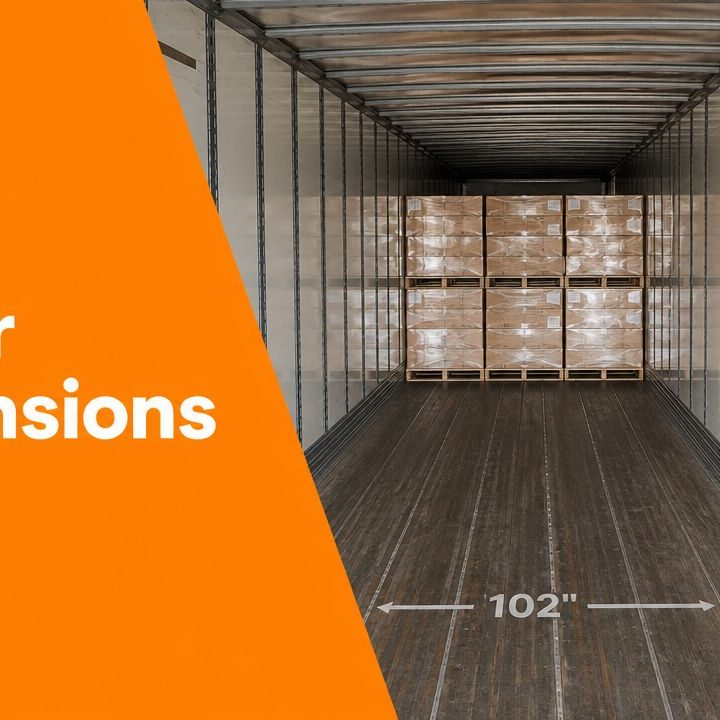
A standard 53 ft trailer is 53 feet long, 102 inches wide, and 13 feet 6 inches high on the outside, with a typical interior of about 52 feet 5 inches to 52 feet 6 inches long, 99 to 101 inches wide, and 9 to 9 feet 2 inches high. For most e-commerce shippers, those are the headline numbers, but the key question isn't the datasheet size. It's how much of that space is usable once pallets, prep requirements, door clearance, and loading patterns get involved.
That gap is where first truckload shipments usually get expensive.
A brand starts with parcel. Then LTL. Then one busy month turns into a reorder cycle big enough to justify a full truckload, and suddenly the conversation shifts from cartons and labels to trailer width, dock doors, pallet count, and axle placement. That's usually the moment a seller realizes freight isn't just transportation. It's a planning problem.
The dimensions of 53 ft trailer equipment matter because they affect almost every downstream decision. They shape whether your product should move floor-loaded or palletized, whether your inbound can go straight to an Amazon prep line, whether an oversized bundled unit will clear the trailer opening, and whether you're paying for a full truck that still leaves money on the floor because the load wasn't designed correctly.
Your First Truckload Shipment Demystified
The first full truckload usually starts with a simple assumption: "If I book a 53-footer, everything should fit."
Then the questions start. Can the pallets be double-stacked? Will the cartons clear the trailer door? Does the carrier need a dry van or something else? If the load is dense, will the shipment cube out first or weigh out first? New shippers often hear terms like FTL, dry van, reefer, payload, and axle weight in the same conversation, and it can feel like the rules changed overnight.

A common example is an Amazon FBA seller who has outgrown parcel inbound. They used to send cartons in small batches. Now inventory is arriving by the pallet, prep has to happen on a tighter schedule, and one missed assumption about trailer fit can mean rework at the dock, delayed appointments, or cartons that need to be broken down and reconfigured before they can move.
What changes when you move to truckload
Truckload shipping gives you control, but it also removes guesswork only if the load plan is sound.
- Freight cost gets tied to trailer efficiency: If you use the space poorly, your landed cost per unit rises.
- Compliance starts before the truck arrives: Amazon prep, pallet labels, overhang, and inspection access all affect the load.
- Dock execution matters: Forklift handling, unload sequence, and trailer dimensions affect receiving speed.
Most first-time truckload issues aren't caused by the carrier. They're caused by a load plan that looked fine on paper but ignored the way freight actually moves through a dock.
When e-commerce brands understand the dimensions of 53 ft trailer equipment, they stop treating the trailer as a giant empty box. They start treating it like a fixed operating constraint. That's a much better place to make decisions from.
Quick Reference 53 Ft Trailer Specifications
The standard 53-foot dry van trailer is the default equipment for interstate full truckload shipping because it hits the legal maximum size allowed on U.S. interstate highways without special permits. Exterior dimensions are fixed at 53 feet long, 102 inches wide, and 13 feet 6 inches high, and typical interior dimensions run 52 feet 5 inches to 52 feet 6 inches long, 99 to 100 inches wide, and 9 to 9 feet 2 inches high, with usable cargo volume around 3,800 to 4,060 cubic feet and 430 square feet of floor space, according to Hale Trailer's dry van dimensions reference.
For a shipper, the value of this chart isn't academic. These numbers tell you whether your pallets fit, whether your bundled cartons clear the opening, and whether your freight profile is more likely to run out of space or run into weight limits first.
Standard 53 foot dry van trailer dimensions
| Specification | Measurement |
|---|---|
| Exterior length | 53 feet |
| Exterior width | 102 inches (8.5 feet) |
| Maximum exterior height | 13 feet 6 inches |
| Interior length | Approximately 52 feet 5 inches to 52 feet 6 inches |
| Interior width | Approximately 99 to 100 inches, up to 101 inches on newer composite trailers |
| Interior height | Approximately 9 feet to 9 feet 2 inches |
| Cargo volume | Approximately 3,800 to 4,060 cubic feet |
| Floor space | 430 square feet |
| Typical GVWR | 65,000 to 68,000 pounds |
| Maximum gross truck and trailer weight on U.S. roads without special permits | 80,000 pounds |
Which numbers matter most in day-to-day planning
If you're booking your first truckload, don't try to memorize everything. Focus on the numbers that tend to create real operational consequences.
- Interior width: This drives side-by-side pallet fit and tells you how much tolerance you have for overhang.
- Interior length: This affects row count, especially when you're deciding between straight loading and turned pallets.
- Interior height: This matters for stacked freight, tall retail displays, and whether a double-stack plan is realistic.
- Door opening and floor area: These determine whether the load can physically enter the trailer and how much working room the dock team has.
Why the outside measurement can mislead you
A seller hears "53 feet" and assumes they have a clean, full 53 feet to work with. They don't. Interior trailer length is shorter than exterior length, interior width is narrower than exterior width, and usable space gets tighter once real freight enters the picture.
Practical rule: Use the published dimensions to screen feasibility. Use a dock-level load plan to decide whether the shipment will actually work.
That's the mindset that prevents expensive surprises.
Why Usable Interior Space Is Less Than You Think
Your team books a full truckload based on the spec sheet, the product count fits on paper, and the trailer still cubes out early at the dock. I see this with e-commerce inbound all the time. The missing piece is the gap between listed dimensions and the space you can use once pallets, wrap, labels, and forklift movement enter the equation.
A standard 53-foot dry van gives you a broad planning envelope. It does not give you wall-to-wall, floor-to-ceiling working room for every load pattern. Published cubic capacity and interior measurements help you screen whether a shipment is even in range. They do not tell you how much sellable inventory you can load without creating delay, damage risk, or receiving issues.
The trailer door is often the primary choke point
Teams new to truckload planning usually start with interior width and length. At the warehouse, the first hard limit is often the door opening.
If a pallet, display, or crated unit only fits with perfect alignment, it is already a risky load plan. Forklifts need approach angle. Stretch wrap adds width. Cartons bulge. A pallet that looks fine in a spreadsheet can bind at the threshold and force a rework on the dock.
That shows up in a few common ways:
- The unit fits inside the trailer but will not clear the door opening
- The pallet fits only if it enters perfectly straight, which is hard to maintain in live loading
- Wrap, corner boards, or carton overhang turn a tight fit into a rejected fit
Usable width shrinks once freight is palletized
E-commerce sellers feel this faster than commodity shippers because inbound freight is rarely uniform. FBA prep changes carton dimensions. Label pouches catch on wrap. Mixed-SKU pallets do not hold a clean edge the way a single-SKU beverage or paper load does.
Even small pallet overhang creates problems. One side rubs the wall. The next pallet loses clearance. By the time the loader reaches the middle rows, the trailer may still have theoretical floor space left, but not enough clean width to keep loading efficiently.
At this point, costs begin to shift. A trailer that should have taken one more row now needs a second shipment, or your team spends extra labor time rebuilding pallets to recover inches.
Interior hardware and loading practice reduce clean capacity
Trailer interiors are not empty boxes. Wall liners, scuff bands, E-track, logistics posts, and nose shape all affect how freight sits. Those details matter if you are loading close to the limit or trying to maximize pallet count for a retail or FBA delivery.
The same applies to unloading. If the receiver needs quick access for inspection, relabeling, or pallet breakdown, a floor-to-ceiling packout can create downstream labor costs that wipe out the savings from tighter loading.
If your load plan only works with perfect pallet geometry and zero overhang, build a looser plan before you book the truck.
For e-commerce, trailer capacity should be read in two different ways:
- Datasheet capacity, which shows the trailer's theoretical envelope
- Operational capacity, which reflects pallet quality, prep requirements, overhang, and dock handling constraints
That second number is the one that protects margin. It is also the number that determines whether your shipment arrives as a smooth inbound appointment or an expensive receiving problem.
Common 53 Ft Trailer Variants and Their Dimensions
Not every 53-footer behaves the same way at the dock. Two trailers can share the same basic outside footprint and still perform differently depending on wall construction, insulation, and the kind of freight restraint they support.

For most e-commerce shippers, the decision starts with one simple question: do you need a standard dry environment, temperature control, or open-deck flexibility for oversized freight?
Dry van, reefer, and flatbed serve different jobs
A dry van is the standard enclosed trailer used for most non-perishable consumer goods, palletized inventory, and general retail freight.
A reefer uses insulated walls and refrigeration equipment. That protects temperature-sensitive products, but insulation cuts into interior cargo space. One verified benchmark notes refrigerated variants drop to about 3,800 cubic feet, which matters if you're already loading close to the trailer's cubic limit.
A 53-foot flatbed is a different tool entirely. It has a deck size of 53 feet by 102 inches, a floor height of 305 mm (12 inches), and a maximum payload of 20,408 kg (45,000 lbs), according to Cargo Planner's 53-foot flatbed equipment reference. That's useful for oversized importer freight, machinery, or shipments that can't be loaded through a van door.
Sheet and post versus composite plate
The biggest dry van trade-off is often wall construction. Hale Trailer's trailer variant guide notes that sheet and post trailers provide stronger structural support and tighter logistics post spacing, which makes them better for securing mixed-SKU loads. Composite plate trailers reduce wall thickness and maximize cubic capacity, though interior scuff liners can reduce usable volume by 1-2%.
That sounds technical, but the implication is practical:
- Sheet and post works well when the load is irregular, mixed, or needs more securement options.
- Composite plate works well when cubic efficiency matters more and the freight is more uniform.
- Spec sheets alone don't tell the full story because liner and wall construction affect usable fit.
Here's a visual explainer if you want to see trailer differences in context:
How to choose the right variant
The wrong trailer choice usually shows up as either wasted space or unnecessary cost.
| Trailer type | Best use case | Main trade-off |
|---|---|---|
| Dry van | General e-commerce, retail, non-perishable freight | No temperature control |
| Reefer | Temperature-sensitive freight or loads needing insulation | Reduced interior capacity |
| Flatbed | Oversized, irregular, or top/side-load cargo | Exposure to weather, different securement needs |
If your freight is standard palletized inventory, a dry van is usually the cleanest option. If your load depends on exact interior cube, ask the carrier which trailer construction they're sending, not just whether it's a 53-footer.
Calculating Pallet Capacity and Optimal Layouts
A 53-foot trailer gets expensive fast when the load plan lives on a spec sheet instead of the dock floor.
On paper, shippers often hear one clean answer for pallet count. In practice, actual capacity depends on the freighted pallet size, label access, stack stability, and whether the receiving side can unload in the sequence you built. For e-commerce brands, that gap between theoretical positions and usable positions is where margin gets lost.

Start with the freighted pallet, not the nominal pallet size
A 48 x 40 pallet is the standard starting point for North American freight. It is not the actual planning number unless the cases stay inside the pallet edge, the wrap is tight, and the unit stays square after forklift handling.
I tell clients to measure the pallet exactly as it will ship. That means the loaded footprint, not the wood base. A small carton overhang across every row can turn a clean layout into a partial row, and one lost row in a full trailer changes your cost per unit more than many sellers expect.
Use this dock-level check before you book a truckload:
- Measure the true footprint: Include carton bulge, corner boards, wrap, and any overhang.
- Confirm loaded height: Check trailer interior height and door clearance, especially if pallets are tall after FBA prep.
- Verify stack integrity: If the top layer shifts under transit, the pallet count you planned is irrelevant.
- Account for unload requirements: If the consignee needs label visibility, inspection access, or pallet-by-pallet sorting, a packed-tight layout can create labor cost and delays.
Layout choice changes both fit and handling time
The basic loading patterns are straightforward. The trade-offs are not.
| Loading pattern | How it works | Best when |
|---|---|---|
| Straight load | Pallets are loaded in uniform rows | Freight is uniform, square, and easy to count |
| Turned load | Pallets are rotated to adjust row depth | A rotated pattern gives a better fit along trailer length |
| Double stack | A second pallet layer uses vertical space | Freight is crush-safe, stable, and receiver-approved |
A straight load is usually fastest at both ends. A turned pattern can recover floor space, but only if the freight holds its shape and the dock team can place it accurately. Double stacking can improve cube use, but only for freight that can handle the weight and still clear the roof and door opening.
The infographic above shows common 48 x 40 pallet layouts. The right pattern depends on what is limiting the load first. Floor space, height, product fragility, or the receiver's handling rules.
The highest pallet count is not always the lowest landed cost. If a tight layout causes restacks, relabeling delays, or damaged cartons at receiving, transportation savings disappear into warehouse labor and chargebacks.
Why e-commerce and FBA freight rarely loads at theoretical maximum
FBA-bound inventory is where datasheet math breaks down fastest. Polybagging, suffocation labels, carton relabeling, bundling, and case-pack corrections can change carton dimensions enough to create overhang or unstable top layers. The pallet still looks like a 48 x 40 on paper, but it stops behaving like one in the trailer.
That matters for inbound planning. If your inventory moves from truckload receiving into prep before marketplace routing, trailer planning should be tied to your packaging and warehousing workflow, not handled as a separate freight decision.
The practical rule is simple. Count usable pallet positions, not theoretical pallet positions. That is the number that protects freight spend, unload time, and FBA compliance.
Mastering Weight Capacity and Legal Load Limits
A trailer can have space left and still be full. Dense freight proves that fast.
A typical 53-foot dry van trailer has a GVWR of 65,000 to 68,000 pounds, while the total truck and trailer combination generally can't exceed 80,000 pounds on U.S. roads without special permits, as noted earlier in the specifications section. For operators, though, the bigger issue is distribution. A legal gross weight can still become an illegal load if too much weight sits on the wrong axle group.

The three weight terms that matter
Shippers don't need to become compliance specialists, but they do need to understand the language.
- Tare weight: The empty weight of the trailer, and sometimes the equipment combination depending on how the carrier quotes it.
- Payload: The weight of your cargo only.
- GVWR: The rated maximum for the trailer. On the road, the total combined legal limit matters too.
If your products are heavy for their size, you may weigh out long before you use the full cubic capacity of the trailer.
Why axle placement matters as much as total weight
Verified guidance on trailer loading notes that operators should keep axle loads under 20,000 to 23,000 pounds for tandem or tri-axle groupings within the 80,000-pound gross limit, because uneven loading shifts the center of gravity and increases rollover risk, as described qualitatively in the trailer variants discussion.
In warehouse terms, that means you can't place every heavy pallet at the nose or all at the tail and assume the driver will sort it out later. Load pattern affects safety, legality, and whether the truck even leaves the yard without requiring rework.
A practical loading sequence for heavy freight
When a shipment is weight-sensitive, this is the discipline that tends to work:
- Identify the heaviest pallets first. Dense loads need placement planning before the forklift starts moving.
- Center weight over the axle area. Keep the mass balanced through the trailer, not concentrated at one extreme.
- Use lighter or more crush-sensitive freight toward the ends where appropriate.
- Recheck after changes. Last-minute pallet swaps can ruin a good balance plan.
Dock-floor advice: If the load plan changes after staging, treat it like a new load, not a small edit.
Shippers who ignore weight distribution usually pay in delays, reload labor, or compliance issues. Shippers who plan it at the pallet stage move faster and with fewer surprises.
How 3PLs Use 53 Ft Trailers for E-commerce Fulfillment
The most useful way to think about a 53-footer in e-commerce isn't as transportation equipment. It's as inbound production capacity.
A 3PL sees the trailer as the first step in a chain that includes receiving, inspection, pallet breakdown, storage, prep, and outbound fulfillment. When the inbound load is designed well, every downstream process gets easier. When it's designed poorly, the warehouse team spends time fixing basic freight problems before value-added work can even start.
Where the datasheet breaks down in fulfillment
Verified guidance on real-world trailer use notes that usable space often loses 20-25% to palletizing, strapping, and Amazon prep requirements, and that while a trailer may hold 26 standard pallets, FBA prep can reduce that to 22-24 because of overhang and inspection access, according to Silver Moon Trailer's discussion of 53-foot trailer cubic capacity.
For a warehouse, that gap changes labor planning.
An inbound that arrives as clean commodity pallets can often move straight from dock to rack. An inbound built for Amazon prep usually can't. It may need relabeling, polybagging, bundling, carton inspection, or case-pack correction before it can move back out. That's why truckload planning and fulfillment planning need to live in the same conversation.
Two common 3PL workflows
One common workflow is container transloading. Imported goods arrive in ocean equipment, then move into a domestic trailer for inland transport because the domestic footprint is better aligned with over-the-road distribution and local warehouse scheduling.
The second is pallet breakdown and rework. A full truckload arrives, the warehouse unloads it, sorts mixed SKUs, checks prep status, and routes inventory either to storage or straight into a compliance workflow. If you're still deciding what support a provider should own in that process, this overview of what a 3PL warehouse does is a useful baseline.
Security and load integrity matter too
E-commerce operators usually focus on speed and compliance first. They should also think about site control, trailer handling discipline, and inbound freight visibility, especially when shipments contain high-value consumer goods. For teams tightening warehouse-side controls, this resource on logistics support and supply chain security is worth reviewing because physical handling and freight security are tightly connected during inbound operations.
A trailer that arrives full but disorganized usually creates more labor than a slightly smaller load that was built for clean receiving.
That's the trade-off many growing brands miss. Maximum theoretical fill isn't always maximum operational efficiency.
Practical Loading and Unloading Tips for Your Warehouse
Warehouse execution is where small dimension mistakes become expensive labor. A trailer can be legally booked, correctly routed, and still create dock problems if the loading sequence, pallet build, or unloading plan wasn't thought through.
The best warehouse teams work from a repeatable checklist, not memory.
Before the trailer is opened
Start with equipment control and dock safety. Trailer movement during live loading or unloading is a serious risk, and it gets worse when teams are rushing to turn trucks quickly.
A solid pre-unload routine includes:
- Secure the trailer: Use wheel chocks and a dock lock before anyone enters.
- Check trailer condition: Look for floor damage, moisture, odors, and shifted freight before unloading starts.
- Confirm load sequence: Know which pallets should come off first and which ones need special handling.
- Match equipment to freight: A standard forklift setup may not be ideal for tall, unstable, or oddly wrapped loads.
Inside-the-trailer handling that works
Forklift operators don't have much tolerance inside a dry van. Wall contact, poor angle control, and rushed reversing can damage both freight and trailer interiors.
A few habits make a real difference:
- Keep pallet builds square before loading. You can't fix bad geometry inside the trailer.
- Place heavier freight in the planned center zone. Don't improvise heavy-pallet placement at the last minute.
- Build a stable rear section. The tail end of the trailer should resist movement during transit.
- Use straps or load bars when freight mix requires it. Mixed-SKU loads need more securement than uniform pallet blocks.
Make the warehouse system support the load plan
The loading team performs better when staging, labeling, and inventory visibility are already organized. That's one reason strong operators tie truckload execution to the broader warehouse management for ecommerce process instead of treating the dock as a separate function.
Freight moves best when the warehouse stages it in the same order the trailer will actually be loaded.
That sounds simple, but it removes a lot of preventable chaos. The cleanest truckloads usually come from disciplined staging, not heroic dock work.
Frequently Asked Questions About 53 Ft Trailers
Can I mix Amazon FBA freight and direct-to-consumer inventory in one 53-foot trailer
Yes, but only if the load is built around receiving reality. Mixed freight often creates unload inefficiency because one part of the load needs immediate prep work while another part should move directly to storage or outbound allocation. Keep the freight clearly separated and labeled by destination workflow.
Is a 53-foot dry van always the best option for e-commerce products
No. It's usually the default for non-perishable palletized inventory, but it isn't always the right fit. Temperature-sensitive products may require a reefer, and oversized or awkward cargo may need flatbed handling instead of forcing a poor fit through a van door.
What measurement should I check first if my freight is oversized
Check the door opening and the palletized unit dimensions together. Sellers often focus on trailer interior size and forget the freight has to enter the trailer safely and cleanly through the opening.
Do trailer dimensions matter if my warehouse dock is tight
Absolutely. Trailer handling isn't only about the freight. Dock geometry, yard space, and building access all matter. If you're comparing opening clearances and facility fit on the building side, a practical reference on garage door sizes can help frame how opening dimensions affect equipment access in real-world operations.
What's the first thing I should send a carrier or 3PL before booking
Send the actual freight profile, not a rough estimate. That means pallet count, true pallet dimensions with overhang, stack height, carton type, whether the load is floor-loaded or palletized, and any prep or compliance requirements. That information matters more than a generic note saying "it should fit in a 53-footer."
If you're moving into truckload freight, Amazon FBA prep, pallet breakdowns, or multi-channel fulfillment, Snappycrate can help you turn trailer specs into a workable inbound plan. Reach out if you want a practical review of your freight profile, prep requirements, and warehouse flow before your next shipment hits the dock.