Let's get one thing straight: dispatching and logistics are not the same thing. Mistaking one for the other is a classic rookie mistake that can quietly sabotage an e-commerce operation.
Think of it like this: Logistics is the entire game plan—it's the strategy, the playbook, and all the behind-the-scenes work that sets your team up to win. Dispatching is the final, game-winning play—the single action that sends the product out the door and into your customer's hands.
Your E-Commerce Operations Playbook
For any e-commerce seller, nailing the difference is absolutely critical.
Logistics is the big-picture thinking. It’s all about making sure your products are in the right place, at the right time, and in perfect condition. It’s the unglamorous but essential work of inventory planning, warehousing, and carrier negotiations that makes fulfillment even possible.
Dispatching, on the other hand, is the moment of truth. It’s the tactical, real-time execution that kicks into gear the second a customer clicks “Buy.” That single click triggers a rapid-fire sequence of events: picking the item from the shelf, packing it securely, and handing it off to the carrier.
Why This Distinction Matters
When you don't treat these as two separate but connected functions, things start to break. A weak logistics plan leads to painful stockouts or, just as bad, cash tied up in excess inventory. Sloppy dispatching creates shipping bottlenecks, fulfillment errors, and unhappy customers.
A truly seamless operation ensures the strategy (logistics) perfectly fuels the execution (dispatching).
Mastering both is how you scale, especially on demanding marketplaces like Amazon or Shopify where customer expectations are sky-high. For example, a flawless logistics plan makes sure your products are prepped and stored correctly for FBA. Sharp dispatching guarantees they actually ship out on time, every single time. If you're deep in the weeds of FBA, you might want to check out our guide on effective warehouse management for e-commerce.
Dispatching vs Logistics At a Glance
To make it even clearer, here’s a quick breakdown of where each function's responsibilities begin and end.
| Aspect | Logistics (The Big Picture) | Dispatching (The Final Action) |
|---|---|---|
| Timeframe | Long-term planning (weeks, months, quarters) | Real-time and immediate (minutes, hours) |
| Core Focus | Strategy, planning, and optimization | Execution, action, and movement |
| Key Activities | Inventory forecasting, warehouse layout, carrier selection, supply chain management | Picking orders, packing boxes, generating shipping labels, coordinating carrier pickups |
| Main Goal | Ensure resources are available and processes are efficient | Get the correct order to the right customer on time |
Think of it this way: Logistics makes sure the players are on the field and know the playbook. Dispatching is the quarterback calling the specific play at the line of scrimmage. You absolutely cannot have one without the other.
This powerful synergy is what’s fueling massive industry growth. The global logistics market hit a mind-boggling USD 5.65 trillion and is on track to climb to USD 8.07 trillion by 2033. This explosion is a direct result of e-commerce demand, highlighting just how critical sharp dispatching is to handling the non-stop flood of online orders. Building a resilient business starts with getting this fundamental relationship right.
The Inbound Journey from Dock to Shelf
Before a single product can be picked, packed, and shipped out, it has to complete its inbound journey. This is the foundation of your entire fulfillment operation, and getting it wrong is a guarantee for chaos down the road—think inaccurate inventory counts, shipping the wrong items, and hours wasted chasing mistakes. The whole process kicks off the second a truck backs into the loading dock.
This first step is called receiving, but it's way more than just unloading boxes. It’s a crucial checkpoint where every single incoming shipment is checked against its purchase order. Our team confirms the right number of cartons arrived, gives them a quick once-over for any obvious damage, and starts logging everything into the system.
From Pallets to Bins
Once the freight is off the truck, we move on to the pallet breakdown. A single pallet can hold dozens of boxes, and each of those boxes is filled with individual products. Teams carefully break down these pallets, sorting everything by its SKU (Stock Keeping Unit).
This sorting stage is all about accuracy. Each item is then individually scanned, officially entering it into our Warehouse Management System (WMS). It's like a digital handshake that creates a record for every unit now in our care. This is what gives you the real-time data you need for smart dispatching and logistics.
A single mistake during receiving—like miscounting one carton or not flagging a damaged box—doesn't just affect that one item. It creates a ripple effect that can lead to overselling stock you don't actually have, sending damaged goods to customers, and burning hours trying to figure out where things went wrong.
After an item is scanned, it gets assigned a specific home in the warehouse, usually called a bin. This isn't random. The WMS strategically assigns spots to make the picking process faster later on. For example, your best-selling products are often stored in the easiest-to-reach locations to speed up fulfillment.
Meeting Strict Marketplace Demands
If you’re selling on a platform like Amazon, this whole inbound process becomes even more critical. Amazon has incredibly strict compliance requirements for FBA (Fulfillment by Amazon), and one mistake can get your entire shipment rejected, costing you fees and serious delays.
A few non-negotiable FBA prep steps include:
- FNSKU Labeling: Every single unit needs a unique Amazon barcode that completely covers any old manufacturer barcodes.
- Poly Bagging: Certain products, like t-shirts or items with small parts, need to be put in a protective poly bag that has a suffocation warning printed on it.
- Case Pack Creation: Your products often need to be bundled into specific case quantities with the correct labels before we can send them off to Amazon’s warehouses.
Each of these steps is a hard-and-fast rule. For instance, if a clothing brand’s shipment shows up at Amazon without the right poly bags, Amazon will either turn it away or charge you expensive fees to fix it themselves. This makes a detail-obsessed inbound process not just a good idea, but an absolute must for staying profitable on the world’s biggest marketplace.
The Outbound Engine: Fulfilling Customer Promises
This is it—the moment of truth. Outbound logistics is where your brand's promise shifts from a digital click to a physical reality. It's the fast-paced, high-stakes sprint that gets a product from your warehouse shelf to a customer's front door. Everything you've planned around dispatching and logistics comes together here with one critical mission: fulfill the order, perfectly.
The whole dance starts the second an order notification hits your system. That digital ping is the starting gun for the first physical action in the warehouse: order picking. This isn't just someone wandering the aisles and grabbing items. Smart warehouses use specific strategies to move fast and keep errors close to zero.
Think of it this way: a smooth outbound process is only possible because of a solid inbound one. The infographic below shows how products are received, checked, and put away correctly.
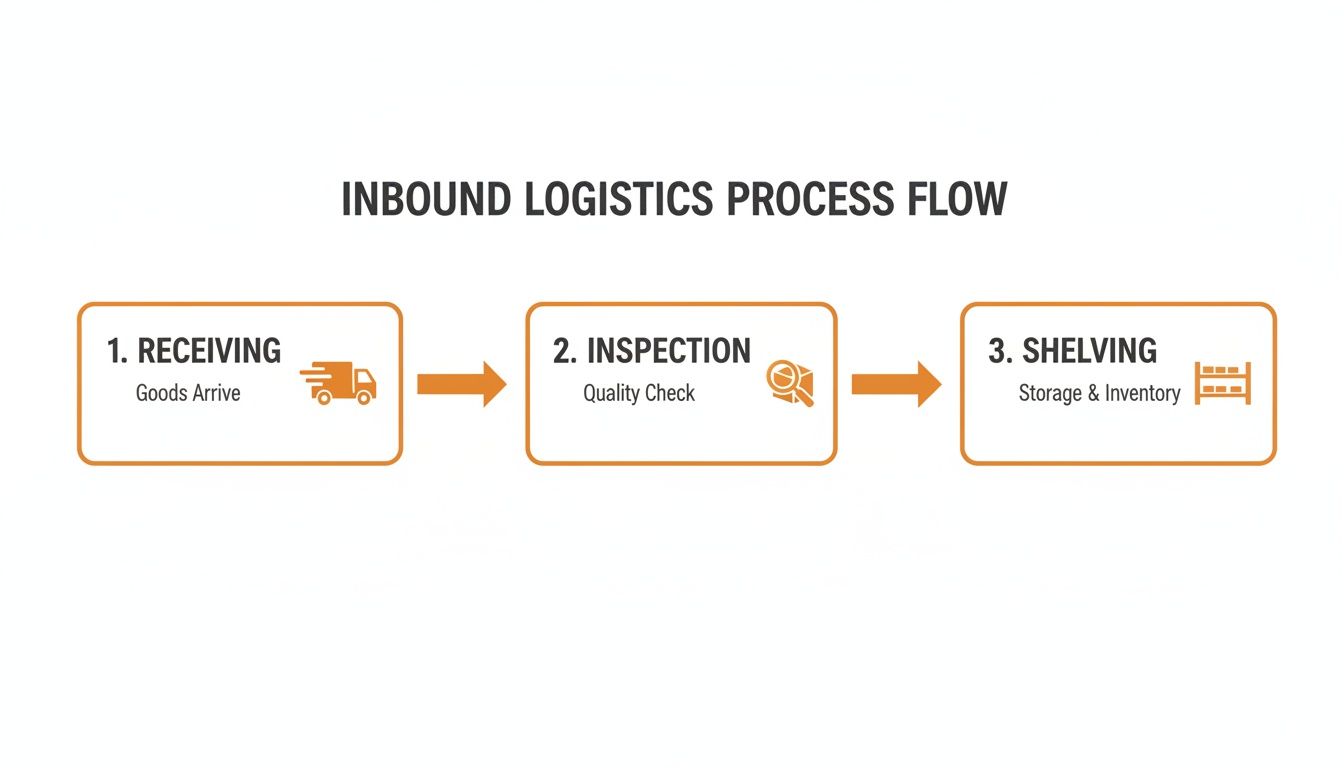
Getting that first step right—receiving and shelving—is the foundation. If your inventory isn't where it's supposed to be, the whole outbound engine grinds to a halt.
From Picking to Packing
Picking strategies are all about minimizing wasted steps and saving time. Two of the most common methods are absolute game-changers:
- Batch Picking: A picker grabs items for a bunch of different orders all in one trip. This is a huge time-saver for businesses that get a lot of single-item orders.
- Zone Picking: Each worker owns a specific "zone" in the warehouse and only picks items from their area. Orders get passed from zone to zone, almost like a factory assembly line, until they're complete.
Once every item for an order is gathered, it's off to the packing station. Here, everything gets a final quality check before being placed in the right-sized box with the right amount of protective dunnage. This is also your chance to add branded touches—like custom tape or a thank-you insert—to create that memorable unboxing experience.
Every single step in your outbound process is a chance to either build or destroy customer trust. One wrong item or a shipment that’s a day late can completely undo all the hard work your marketing team did to win that customer.
The Final Handoff and Dispatch
Finally, the packed box is weighed, measured, and matched with the correct shipping label. The order is now officially ready for dispatching—that crucial final handoff to a carrier like FedEx, UPS, or USPS. This step has to be seamless, especially since most packages will be hitting the road.
Road transport owns a massive 38.7% market share in global logistics, making it the undisputed king of flexible, cost-effective last-mile delivery. With the entire logistics market expected to more than double by 2032, making that final handoff efficient is more critical than ever. You can dig into more of these logistics industry trends on Infosys.com.
This finely tuned engine of picking, packing, and dispatching is what lets an e-commerce brand grow from ten orders a day to ten thousand, all while delivering the speed and accuracy that turns one-time buyers into loyal fans.
Measuring What Matters in Your Supply Chain
You can’t improve what you don’t measure. It’s an old saying, but it’s the absolute truth in e-commerce fulfillment. To really understand how your operation is performing, you need to look at the numbers—the Key Performance Indicators (KPIs) that tell the true story of your dispatching and logistics health.
These aren't just vanity metrics for a dashboard. Think of them as the vital signs of your business. Tracking the right KPIs is how you spot hidden bottlenecks, find opportunities to get better, and ultimately prove that your fulfillment system is a well-oiled machine. This data-driven mindset is critical, whether you run your own warehouse or partner with a 3PL.
Core Metrics for E-Commerce Success
For any e-commerce seller, a few key metrics paint a clear picture of your effectiveness, from the moment an order is placed to when it lands on the customer's doorstep. If you want to turn your supply chain into a competitive advantage, start by mastering these.
Order Accuracy Rate: This is as simple as it sounds: what percentage of your orders go out perfectly, with no wrong items, incorrect quantities, or damages? A high rate means happy customers and fewer expensive returns. The gold standard is 99.5% or higher.
On-Time Shipping Rate: This tracks the percentage of orders you ship out on or before the promised date. It's a direct reflection of your dispatching speed and a massive factor in customer satisfaction and repeat business. You should be aiming for 99% or better.
An On-Time Shipping Rate of 98% might not sound like a disaster, but for a business shipping 1,000 orders a month, that means at least 20 customers are getting a late shipment notification. Over a year, that's 240 negative experiences that could have been avoided.
Financial and Inventory Health KPIs
Beyond keeping customers happy, you have to make sure your operations are profitable. These next KPIs dig into the financial efficiency of your inventory and fulfillment, ensuring you’re not just fast, but also smart with your money.
Inventory Turnover: How many times do you sell and replace your entire stock over a certain period? A higher number is a great sign—it means your products are selling well and you aren't tying up precious cash in dusty, slow-moving inventory. The ideal rate varies, but a healthy range is often between 4 and 6.
Cost Per Order: This is the all-in cost to get an order out the door, divided by the total number of orders. It should include everything from labor and packing materials to shipping fees. Keeping a close eye on this number helps you manage expenses and price your products for real profit.
By consistently monitoring these KPIs, you gain the clarity needed to make smart decisions. You'll know exactly where to focus your energy to speed things up, slash error rates, and cut unnecessary costs.
To give you a quick reference, here’s a breakdown of the essential KPIs every e-commerce seller should be tracking.
Essential E-Commerce Logistics KPIs
| KPI | What It Measures | Industry Benchmark |
|---|---|---|
| Order Accuracy Rate | The percentage of orders fulfilled without errors (wrong item, quantity, damage). | 99.5%+ |
| On-Time Shipping Rate | The percentage of orders dispatched on or before the promised ship date. | 99%+ |
| Inventory Turnover | The number of times inventory is sold and replaced within a specific period. | 4-6 (Varies by industry) |
| Cost Per Order | The total fulfillment cost (labor, packing, shipping) divided by the total orders. | Varies greatly by product |
| Order Cycle Time | The total time from when a customer places an order to when they receive it. | 2-5 days for standard shipping |
Tracking these numbers is the first step. The next is using that information to make meaningful improvements. A deeper dive into analytics in logistics can reveal even more powerful ways to optimize your entire operation.
How Technology Drives Modern Fulfillment
Let's be clear: modern fulfillment centers don't run on clipboards and manpower anymore. They run on data and precision. Technology is the invisible engine that turns a chaotic warehouse into a finely tuned machine, making fast and accurate dispatching and logistics possible at scale. This isn't just a fancy upgrade—it's a competitive necessity.
At the heart of it all is the Warehouse Management System (WMS). Think of the WMS as the central brain of the entire operation. It tracks every single item from the moment it hits the loading dock to the second it’s handed off to a carrier.
This system gives everyone a single source of truth, killing the guesswork that plagues manual operations. It knows exactly where each SKU is located, how many units are in stock, and which orders need to be picked next. No more "I think it's over here."
From Manual Chaos to Automated Precision
Before systems like a WMS became standard, inventory management was a nightmare of manual counts and messy spreadsheets. An employee could waste hours hunting for a product, only to find it was out of stock—after the customer already bought it. This error-prone approach leads directly to overselling, shipping delays, and furious customers.
Now, real-time inventory tracking, powered by barcode scanners and the WMS, guarantees accuracy.
- Before: A worker physically eyeballs shelves, risking miscounts that lead to surprise stockouts and lost sales.
- After: A simple scan updates inventory levels instantly across all your sales channels, preventing overselling before it happens.
This leap from manual guesswork to automated precision is the key to scaling your business without pulling your hair out. It ensures the data driving your fulfillment decisions is always accurate and up-to-the-minute.
For an ambitious e-commerce seller, partnering with a tech-forward 3PL is no longer just an option—it's a core growth strategy. Relying on outdated, manual fulfillment methods in today's market is like trying to win a car race on a bicycle.
The Rise of AI and Intelligent Automation
Beyond the WMS, even more powerful tools are changing the game. AI-powered algorithms now optimize picking routes, telling warehouse staff the most efficient path to take to gather items for multiple orders at once. This drastically cuts down on wasted steps and shaves precious time off the entire fulfillment cycle.
The impact here is huge. The global market for logistics automation is exploding, driven by the nonstop demand for greater efficiency and accuracy. This trend is a clear signal: investing in a technologically advanced fulfillment partner is essential for any brand that wants to not just compete, but win. You can learn more about the future of logistics market size on Grandviewresearch.com.
Finding the Right Fulfillment Partner
Deciding to hand over your fulfillment is a massive step for any e-commerce brand. It’s not just about getting boxes out the door; you’re entrusting a partner with your inventory, your customer experience, and a huge chunk of your reputation. Making the right choice requires a clear, methodical approach—not just a few frantic Google searches.
The process starts with an honest look in the mirror. Before you even think about talking to a 3PL, you need a crystal-clear picture of what fulfillment costs you right now. Get granular. Calculate your true cost per order, factoring in everything from boxes and tape to the value of your own time spent at the packing station.
Define Your Operational Needs
Once you have that baseline cost, it’s time to build your wishlist. Not all 3PLs are created equal, and the goal is to find one whose services perfectly align with your business model. Be specific here, and think about where you're headed, not just where you are today.
Drill down into these critical areas:
- Specialized Services: Do you need a partner who lives and breathes Amazon FBA prep, handling everything from FNSKU labeling to poly bagging? Or maybe you sell subscription boxes and need custom kitting and bundling.
- Order Volume: How many orders are you shipping each month? What’s a realistic projection for the next 12-24 months? You need a partner who can handle your current flow and scale with you without breaking a sweat.
- Product Requirements: Are your products fragile, oversized, or temperature-sensitive? Make sure any potential 3PL has the right facilities and, more importantly, the experience to handle them properly.
Vet Your Potential Partners
With a shortlist in hand, the real vetting begins. This is where you separate the true partners from the basic vendors. You’re not just hiring a service; you’re looking for a team that feels like a genuine extension of your own.
A great fulfillment partner doesn't just ship boxes; they solve problems. Their expertise in dispatching and logistics should feel like a competitive advantage, freeing you up to focus on growing your brand, not managing its operations.
Get straight to the point and ask about their technology. How does their software plug into your e-commerce platform, like Shopify or Walmart? Can you see your inventory levels in real-time? A clunky or disconnected tech stack is a non-starter—it’s the fastest way to stockouts and data headaches.
For a closer look at what goes on inside a fulfillment center, you can learn more about the role of a 3PL warehouse on our blog. Following this roadmap ensures you choose a partner that doesn’t just ship your orders, but actually fuels your growth.
Common Questions About Logistics and Fulfillment
Stepping into the world of e-commerce fulfillment brings a wave of new terms and tough decisions. Here are some clear, straightforward answers to the questions we hear most often from sellers about dispatching and logistics. Our goal is to help you make smarter moves as your brand grows.
3PL vs. Freight Forwarder: What’s the Difference?
It’s easy to mix these two up, but a 3PL and a freight forwarder have completely different jobs in your supply chain.
Think of a freight forwarder as a travel agent for your cargo. Their only job is to book transportation to get your goods from Point A to Point B, usually for big international or domestic freight shipments. They handle the carrier booking and paperwork but never actually touch or store your inventory.
A 3PL, on the other hand, is your hands-on operations partner. A third-party logistics provider goes way beyond just arranging a ride for your products. They manage your entire fulfillment ecosystem—receiving your inventory, storing it in their warehouse, and then picking, packing, and shipping individual orders directly to your customers.
Understanding Common 3PL Costs
Outsourcing fulfillment is an investment, so getting a handle on the costs is a must. Pricing can vary between providers, but most 3PLs build their fees around a few core services. The key is to find a partner with a transparent pricing model that fits what you actually need.
You can usually expect to see these charges:
- Receiving: This is a fee for the labor it takes to unload, count, inspect, and put away your incoming inventory. It's often charged by the hour, per pallet, or per carton.
- Storage: A monthly fee for the physical space your products take up in the warehouse. This is typically calculated per pallet or by cubic foot.
- Fulfillment: A per-order fee that covers the entire pick, pack, and ship process. Many 3PLs charge a base fee for the first item in an order, plus a small charge for each additional item.
On top of these, you might find fees for add-on services like special kitting projects, custom packaging, or getting products prepped for Amazon FBA.
Knowing When to Outsource Your Fulfillment
Deciding to stop shipping orders yourself is a huge turning point for any e-commerce brand. Sure, packing boxes in your garage works when you're just starting out, but it quickly becomes the biggest thing holding your business back.
If fulfillment has become your main job instead of growing your business, it’s time to outsource. The hours you spend taping boxes and printing labels are hours you're not spending on marketing, product development, or talking to your customers.
A few key triggers will tell you it's time to make the switch. If you're consistently shipping 50-100+ orders a month, you’re probably starting to feel the pressure. Other obvious signs? Running out of storage space in your home or office, or falling behind on getting orders out the door on time because you’re just swamped.
Ready to reclaim your time and scale your business without the fulfillment headaches? The team at Snappycrate specializes in transparent, reliable 3PL services designed for growth-minded sellers. Learn how Snappycrate can streamline your operations.