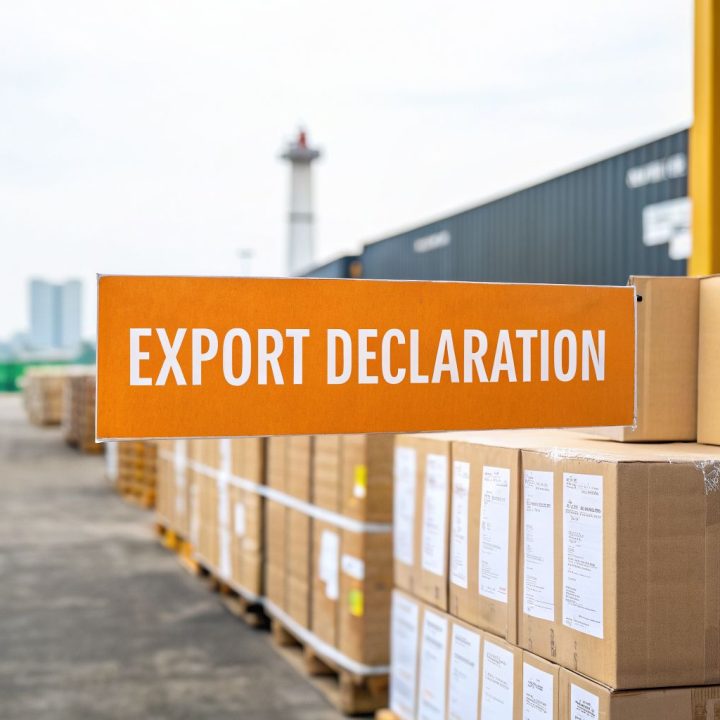
When we talk about an efficient supply chain, we're not just talking about getting products from point A to B. We're talking about a finely tuned system that uses the right resources, tech, and hands-on expertise to cut costs and drive profit at every single step—from the moment inventory hits your dock to the final customer delivery.
The goal is to build a predictable, scalable operation that turns logistics from a chaotic, money-draining headache into your biggest competitive advantage. This guide is your blueprint for getting there.
The Blueprint for a Growth-Ready Supply Chain
For most scaling e-commerce brands, logistics feels more like a roadblock than a growth engine. I've seen it countless times. An efficient supply chain isn't just about shipping fast; it's about being dead-on accurate, staying compliant with every platform's rules, and building a system that can handle your next 10,000 orders just as smoothly as your first 100.
Too many businesses are stuck in a reactive loop, constantly putting out fires—unexpected stockouts, frustrating fulfillment errors, or surprise freight delays. This fire-fighting mode burns cash and, worse, erodes the trust you've built with your customers. The real win is moving from managing chaos to orchestrating a seamless flow of goods, information, and capital.
The Core Pillars of Supply Chain Efficiency
To transform your logistics from a costly problem into a true asset, you need to master three interconnected areas:
- Inbound and Inventory Operations: This is your foundation. It covers everything from how you receive freight from suppliers to how accurately you track and forecast stock levels. If your inbound processes are a mess, you can't trust your inventory data, and that leads to terrible purchasing decisions.
- Fulfillment and Outbound Logistics: This is the part your customers actually see and feel. It’s the entire pick, pack, and ship process, your 3PL integration, and nailing compliance for marketplaces like Amazon FBA. Get this right, and customer satisfaction soars. Get it wrong, and your brand's reputation takes a direct hit.
- Data and Performance Measurement: This is the brains of the operation. Tracking key performance indicators (KPIs) lets you measure what’s working, spot bottlenecks before they become disasters, and make decisions based on hard data, not guesswork. You simply can't improve what you don't measure.
An efficient supply chain is a cohesive ecosystem. Each part has to support the others. A weakness in one area, like sloppy inventory counts, will absolutely cause problems downstream—think fulfillment delays and angry customers wondering why their order is out of stock.
This flow chart gives you a bird's-eye view of how these stages connect, from the moment goods arrive to the moment they leave.
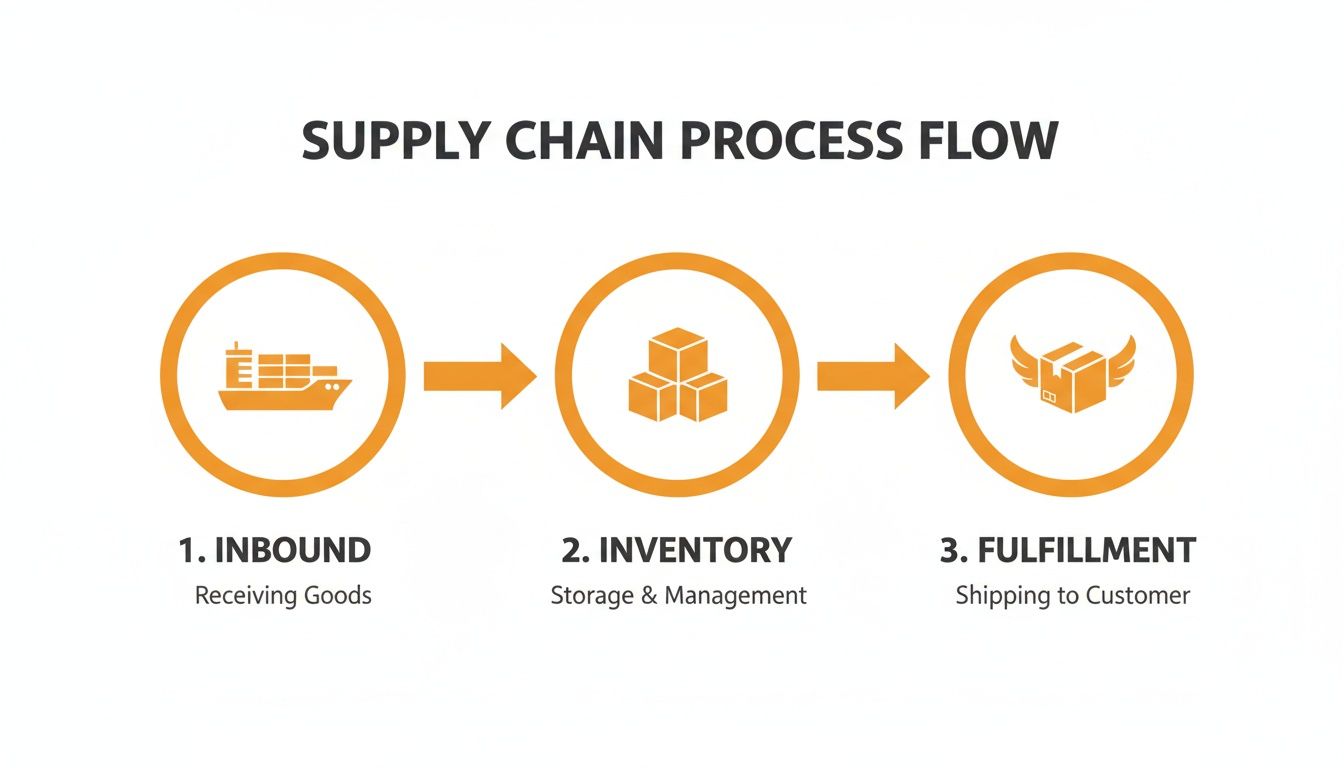
As you can see, efficiency isn't about perfecting one step in isolation. It’s all about the smooth handoff between each operational stage. Let's break down how to build and optimize each one.
Mastering Inbound Logistics and Supplier Relations
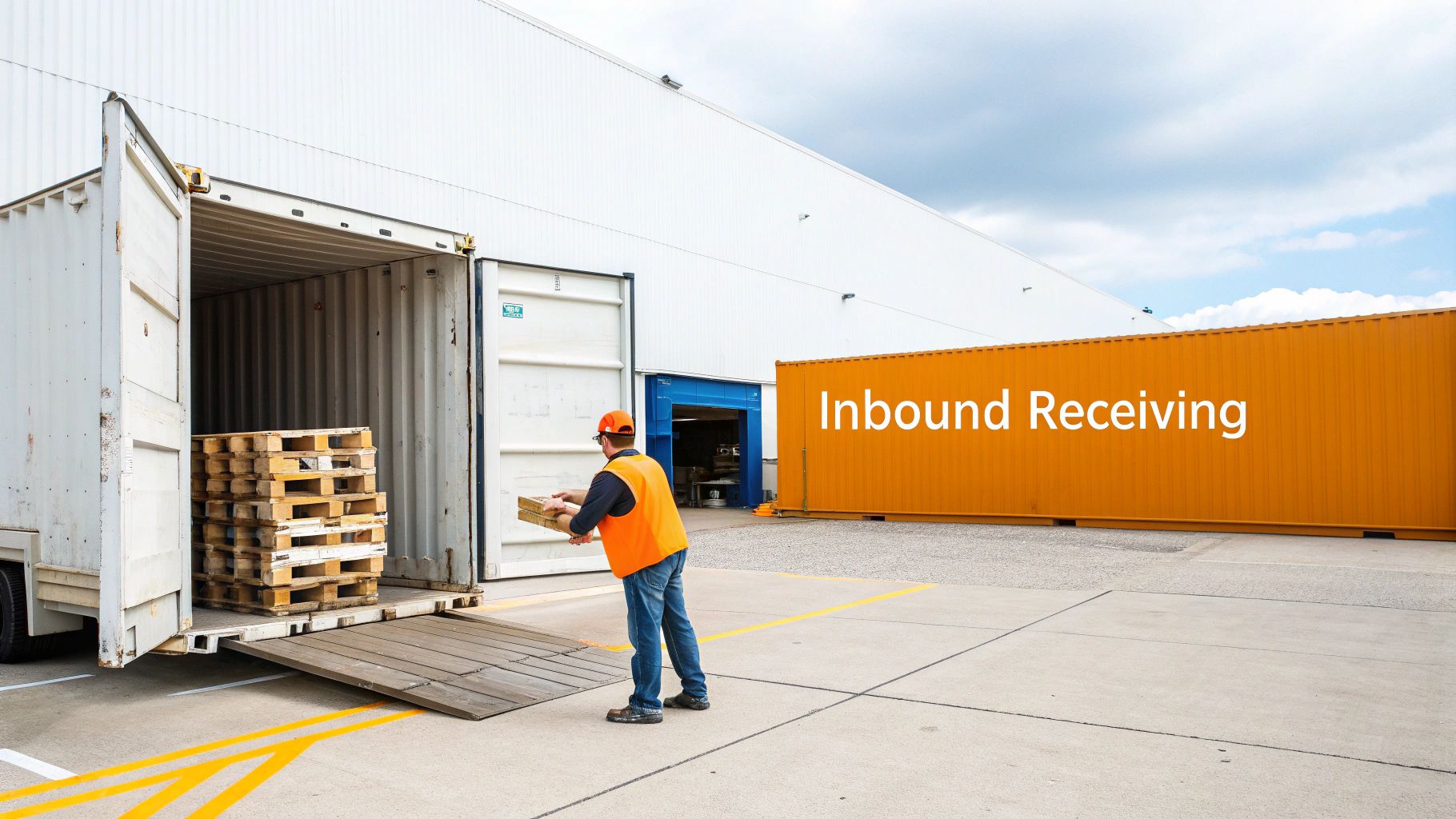
Your e-commerce operation is only as strong as its starting point. A truly efficient supply chain doesn't start when a customer clicks "buy"—it begins the moment your goods leave the supplier. Mastering inbound logistics is the bedrock of your entire fulfillment strategy. It's the whole process of receiving, inspecting, and storing your inventory.
Get this part wrong, and you're just injecting chaos into your system. Inaccurate receiving leads to phantom stock, which means you sell things you don't have. Disorganized docks create bottlenecks that can keep thousands of dollars of inventory off your digital shelves. It’s a recipe for angry customers and lost sales.
Taming the Chaos of Inbound Freight
Let's be real: no two shipments are the same. You need a documented, repeatable process for every type of inbound freight you handle, because a one-size-fits-all approach just doesn't work.
Your receiving strategy has to adapt to the shipment type:
- Full Containers or LTL (Less-Than-Truckload): If you're importing, this is your world. You absolutely need a clear plan for unloading, sorting, and palletizing. Without one, your warehouse floor turns into a mess of boxes, making an accurate count almost impossible.
- Small Parcel Shipments: For those getting goods from domestic suppliers via carriers like UPS or FedEx, the challenge is sheer volume. You need a dedicated spot and a lightning-fast process to open, inspect, and log dozens—or even hundreds—of boxes without falling behind.
The goal of any inbound process is simple: get every single unit accounted for, inspected, and put away correctly in the shortest amount of time possible. Speed without accuracy is useless, but accuracy without speed creates costly delays.
A Real-World Inbound Scenario
Imagine you sell home goods. A 40-foot container just pulled up with 500 cartons holding 10 different SKUs. You've got fragile ceramic vases, sturdy wooden picture frames, and some pre-packaged gift sets that must stay together.
The chaotic approach? Just unload everything onto the floor and tell the team you'll "figure it out later." This is a guaranteed path to disaster.
An efficient supply chain approach looks completely different. It's all about having a plan before the truck door opens:
- Designated Unloading Zone: Pallets are staged in a specific area, keeping walkways clear so people and forklifts can move safely.
- Immediate Sortation: As cartons come off the truck, they are immediately sorted by SKU onto separate pallets. No more mixed-SKU pallets that cause headaches down the line.
- QC Checkpoint: A team member spot-checks a percentage of cartons from each SKU, comparing them against the packing list and looking for damage. This is where you catch the broken vases or mislabeled frames.
- System Check-In: Each correctly received carton is scanned or manually entered into your inventory system. Just like that, the stock is live and available for sale online.
- Directed Putaway: Your system tells the team exactly where to store each pallet, ensuring items are put away logically (e.g., fragile items on lower, more accessible racks).
This kind of structured workflow prevents those downstream nightmares, like selling a product you don't actually have in stock or, even worse, shipping a damaged item to a customer.
Building Stronger Supplier Relationships
As you scale, your supplier list grows. Today's supply chains are more complex than ever, with companies adding suppliers to reduce risk. The average number of unique suppliers per company shot up from 80 in 2020 to 116 in 2024—a massive 45% increase. For anyone running operations, that means juggling more relationships, more packing lists, and way more potential points of failure. S&P Global has some great insights on this trend.
Your most powerful tool here is clear communication. Set expectations with your suppliers on how goods should be packed, labeled, and documented before they ever leave their facility.
Giving them a Supplier Routing Guide is a total game-changer. This document should spell out everything: carton labeling standards, how pallets should be built, and mandatory advance shipping notifications (ASNs).
This proactive step makes your receiving team's job infinitely easier and slashes the chance of errors. A good supplier relationship isn't just transactional; it turns them into a true partner who's invested in making your shared supply chain run smoothly. To really get everyone on the same page, you also need to understand the technical side of supply chain integration. A seamless data flow between your suppliers, your inventory system, and your fulfillment center is what truly unlocks operational excellence.
Optimizing Inventory with Smarter Forecasting
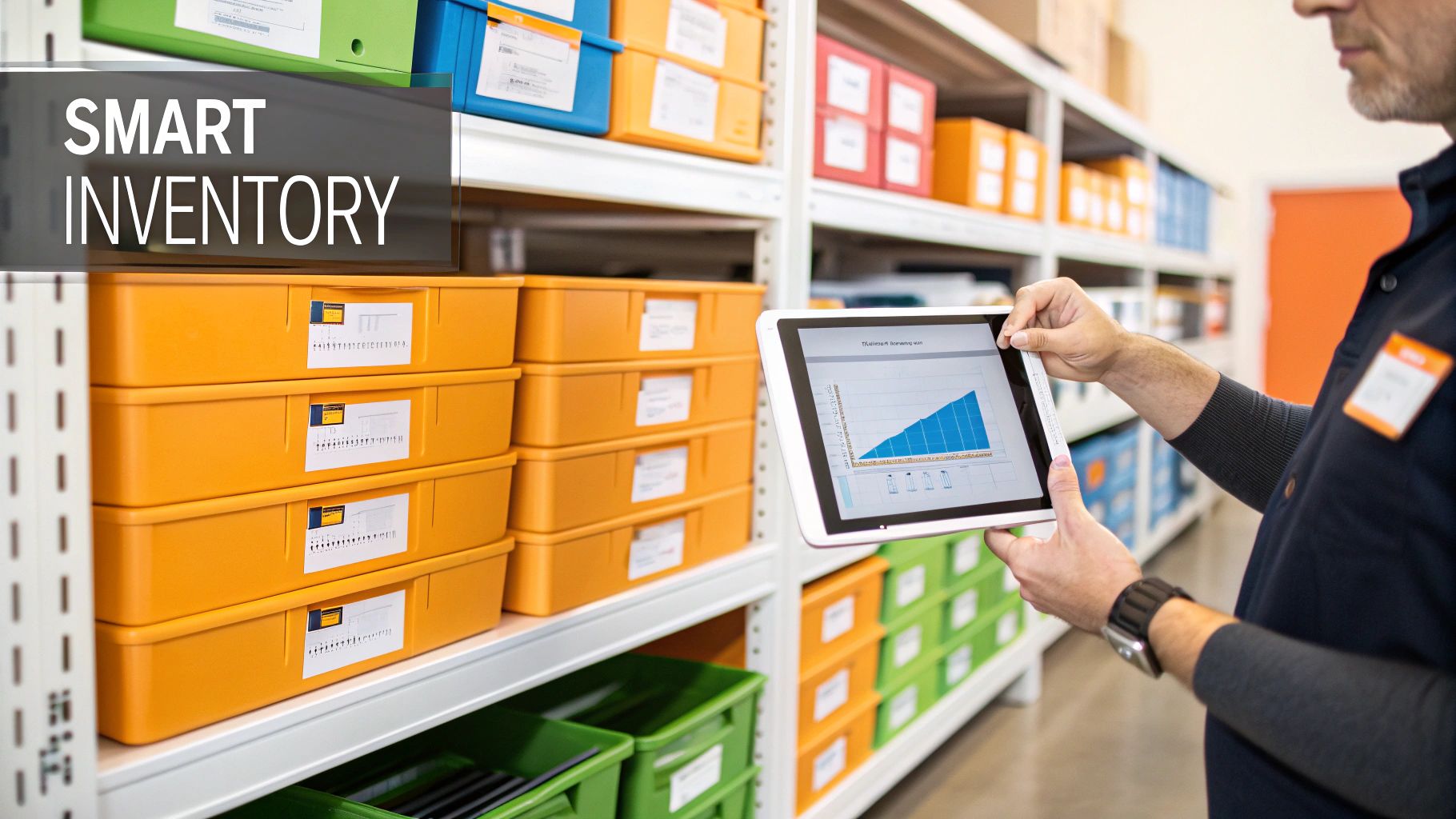
Once your goods are safely on the shelves, the real work begins. Smart inventory management is the battlefield where growing e-commerce brands either win or lose. Holding too much stock ties up your cash in products that aren't selling, while holding too little means stockouts, lost sales, and frustrated customers.
This isn't just about having product—it's about having the right product, in the right quantity, at the right time. Think of every unit on your shelf as cash. Managing it poorly is like leaving money on the table, and that directly stifles your ability to invest in growth.
Moving Beyond Guesswork in Demand Planning
A lot of sellers start out forecasting demand based on gut feelings or a quick look at last month's sales. That’s fine for a little while, but it’s a recipe for disaster as you scale. Once you’re juggling multiple SKUs across channels like Shopify and Amazon, you absolutely need a data-driven approach to predict what your customers will buy.
A solid forecast is the bedrock of an efficient supply chain. It dictates every purchase order you create and helps you dodge the cash-flow killers: overstocking and understocking. The goal here is to get proactive, not stay stuck in a reactive cycle of putting out fires.
To build a reliable forecast, you need to dig into your historical sales data and account for the variables that actually matter:
- Seasonality: Are you selling more swimwear in June or more jackets in November? Pinpointing these predictable peaks and valleys is the first step.
- Promotional Lifts: How much did sales jump during your last Black Friday event? You have to quantify that lift to plan for the next one accurately.
- Market Trends: What’s happening outside your business? A viral TikTok video or a shout-out from an influencer can create demand surges out of nowhere.
A spreadsheet can tell you what sold last year, but it can’t tell you that your biggest competitor is about to launch a massive sale that will absolutely impact your numbers. The best forecasts blend historical data with real-world context.
Setting Intelligent Reorder Points
A brilliant forecast is useless if you don't act on it. This is where reorder points (ROPs) come in. A reorder point is simply the stock level that triggers a new purchase order for a SKU. It’s your automated alarm bell to replenish inventory before you hit zero.
To calculate your ROP, you need to know your supplier’s lead time (how long it takes for new stock to show up) and your daily sales velocity. You also need a buffer, called safety stock, to shield you from unexpected shipping delays or a sudden spike in sales.
The rise of AI is making this process even smarter. In fact, AI adoption in supply chain operations is expected to explode, jumping from 28% to 82% by 2025. On top of that, 86% of supply chain executives are already planning to invest in AI and analytics to cut costs. These tools can analyze complex patterns to set dynamic reorder points that adjust on the fly.
Here’s a quick look at how old-school forecasting stacks up against modern, AI-powered methods.
Traditional vs. AI-Powered Inventory Forecasting
| Feature | Traditional Forecasting | AI-Powered Forecasting |
|---|---|---|
| Data Sources | Relies mainly on historical sales data. | Analyzes historical sales, market trends, weather, promotions, and more. |
| Methodology | Manual calculations using simple formulas (e.g., moving averages). | Uses machine learning algorithms to identify complex patterns and correlations. |
| Accuracy | Prone to error, especially with volatile demand or promotions. | Significantly more accurate; adapts to changing conditions automatically. |
| Labor | Time-consuming and requires manual oversight. | Automated, freeing up your team to focus on strategy. |
| Scalability | Becomes unmanageable as SKU count and sales channels grow. | Easily scales to handle thousands of SKUs and complex supply chains. |
As you can see, leaning on modern tools isn't just a "nice-to-have"—it's becoming a competitive necessity for building an efficient supply chain.
Maintaining Rock-Solid Inventory Accuracy
Here’s the hard truth: your forecasts and reorder points are only as good as the data they’re built on. If your system says you have 100 units but your shelf only has 90, your entire strategy is compromised. That’s why maintaining inventory accuracy is completely non-negotiable.
While a full physical count once a year is okay, it’s disruptive and the data is stale almost immediately. A far better approach is cycle counting—counting small, specific sections of your inventory on a continuous, rotating schedule. For instance, you could count your top 20% best-sellers every month and your slower-moving items once a quarter. This method catches discrepancies early and keeps your data clean without having to shut down your whole operation.
To learn more about getting this level of precision, check out our guide on real-time inventory management. It’s a critical piece of the puzzle for any brand serious about scaling.
Putting Your Fulfillment and 3PL Integration on Autopilot
This is where the rubber meets the road. The pick, pack, and ship process is the moment of truth for your customers. A dialed-in fulfillment operation is the heartbeat of an efficient supply chain—it directly impacts how customers feel about your brand and, ultimately, your profitability.
Get this part right, and logistics stops being a cost center and starts becoming a powerful tool for building loyalty. The whole game boils down to speed and precision. Every single order needs to get picked, packed, and shipped out the door with zero mistakes and minimal delay. Any hiccup in this process creates a ripple effect, leading straight to late shipments and unhappy customers.
Building a Fulfillment Workflow That Actually Works
To hit peak efficiency, you have to think beyond just grabbing items off a shelf. Smart picking strategies are what separate the pros from the amateurs, drastically cutting down on the time your team spends walking the warehouse floor. Two of the most effective methods I’ve seen are batching and zoning.
- Batch Picking: Instead of picking one order at a time, you group a bunch of them together. A picker can grab all the units of a single SKU for ten different orders in one go. It’s a simple change that slashes travel time.
- Zone Picking: Think of this like an assembly line. You divide the warehouse into distinct zones, and pickers stick to their assigned area. Orders move from zone to zone, with each person adding the items they're responsible for before passing it along.
Warehouse automation has been slow on the uptake, but 2025 is a turning point. Right now, only about 25% of warehouses have any real automation in place, but that number is set to climb fast. For anyone selling on major platforms like Amazon, Shopify, or Walmart, automation means quicker turnaround times, fewer errors, and the ability to handle holiday rushes without hiring an army of temporary staff. For more on this trend, Liferay.com has some great insights.
The Make-or-Break Role of a 3PL Partner
For most e-commerce brands hitting a growth spurt, partnering with a Third-Party Logistics (3PL) provider is the only logical next step. A good 3PL takes storage, picking, packing, and shipping off your plate so you can focus on what you do best—marketing and building great products.
But here’s the thing: a successful 3PL relationship isn't just about handing over your inventory. It’s a true partnership built on clear communication and perfectly aligned processes. Before you even think about signing a contract, you need to hammer out a Standard Operating Procedure (SOP) document. This thing is your operational bible.
Your SOP needs to spell out every single detail, from how orders get sent to the 3PL's system to the specific type of packing tape they should use. If you leave anything open to interpretation, you're asking for trouble.
A great 3PL should feel like an extension of your own team. They need to get your brand, your products, and what your customers expect. If you want to dive deeper into finding the right partner, we have a whole guide on what a 3PL warehouse does.
Demystifying Amazon FBA Prep
If you’re selling on Amazon, sending products into their Fulfillment by Amazon (FBA) network adds a whole new layer of complexity. Amazon’s prep requirements are notoriously strict. One wrong move can lead to costly chargebacks, rejected shipments, or even getting your selling privileges suspended. An efficient supply chain has to nail these rules every single time.
This is where a knowledgeable 3PL becomes your best friend. They can manage the entire FBA prep process, ensuring you stay 100% compliant.
Here’s a quick rundown of the most common FBA prep tasks and why they matter:
| Prep Task | Why It's Important | Consequence of Failure |
|---|---|---|
| FNSKU Labeling | This is Amazon’s unique barcode that ties a product to you. It has to cover any old manufacturer barcodes. | Amazon could lose your inventory or send the wrong items to customers. It’s a mess. |
| Poly Bagging | Required for anything that could be damaged by dust or moisture, plus loose items or products in perforated boxes. | Your products get damaged in the warehouse, and Amazon will charge you a per-item fee to fix it. |
| Bundling/Kitting | If you sell multiple items as one unit, they must be packaged together with a clear "Sold as a Set" label. | The warehouse team might break up your bundles, leading to incomplete orders and angry customers. |
Getting FBA prep right from the start saves you a world of logistical headaches and protects your bottom line. It's not optional for serious Amazon sellers.
Turning Fulfillment into a Brand Experience
Finally, never forget that the package arriving at your customer's door is your last physical touchpoint with them. This is your final chance to make a great impression.
This is where value-added services, often handled by your 3PL, can really shine:
- Kitting: Pre-assembling multiple items into a ready-to-ship gift set or subscription box.
- Custom Packaging: Using branded boxes, custom tissue paper, or a thank-you insert to create a memorable unboxing moment.
By weaving these elements into your fulfillment workflow, you transform a simple logistical function into a powerful marketing tool. This is how you build an efficient supply chain that doesn't just support your growth—it actively drives it.
Closing the Loop with Returns and Key Metrics

An efficient supply chain doesn't stop once a package lands on a customer's doorstep. The real pros know the job isn't done. Two critical, often overlooked, pieces of the puzzle are handling returns and actually measuring what matters.
Ignoring these is like running a marathon without checking your pace or learning from a bad race. Reverse logistics—the whole messy process of getting products back—can feel like a huge headache. But with a smart system, it’s a chance to win back customers and salvage value. At the same time, tracking the right data is what separates guessing from growing.
Building a Returns Process That Protects Your Bottom Line
Let's be honest, a clunky returns process is more than just an annoyance for your customers. It's a direct hit to your bottom line, burning up staff time and losing perfectly good inventory. The goal is simple: make it painless for the customer but ruthlessly efficient for your team. This all comes down to a clear, repeatable workflow.
Every time a return shows up at your dock, your team needs to know exactly what to do:
- RMA Verification: First things first, find the Return Merchandise Authorization (RMA) number. This is the golden ticket that connects the physical item back to the original order, which is essential for issuing refunds and knowing why it came back.
- Product Inspection: This is the moment of truth. Is the item brand new and ready to be resold? Is it slightly damaged? Is it even the right product? A quick but thorough check here decides its fate.
- Disposition: Based on that inspection, the item gets routed. Pristine products go right back into sellable inventory. Items with minor cosmetic damage might get funneled to a "scratch and dent" sale. Anything unsalvageable gets disposed of properly.
Think of every return as a clue. Is the same shirt coming back over and over because "the color is wrong"? That's not a warehouse problem; it's a signal to fix your product photos. A solid returns process doesn't just handle boxes—it gives you the intel to fix bigger issues at the source.
Measuring What Moves the Needle
There’s an old saying in logistics that’s gospel: you can't manage what you don't measure. To build a truly efficient supply chain, you have to track the key performance indicators (KPIs) that give you an honest look at how things are really going.
Don't get lost in a sea of data. Focus on the numbers that tie directly to your costs, your speed, and your customer's happiness. These metrics aren't just for fancy reports; they're your operational dashboard. If your Order Accuracy Rate suddenly drops, that's a flashing red light telling you something is wrong on the picking line—and you need to fix it before it becomes a customer service nightmare.
Here are the non-negotiable KPIs every e-commerce brand should have front and center:
- Order Accuracy Rate: What percentage of your orders go out the door perfectly? No wrong items, no wrong quantities, no damage. You should be aiming for 99.5% or higher.
- Inventory Turnover: How quickly are you selling through your entire stock? This tells you how well you’re managing the cash you have tied up in inventory.
- On-Time Shipping Rate: The percentage of orders that shipped on or before the promised date. This is a direct measure of whether you're keeping your promise to the customer.
- Cost Per Order: Add up all your fulfillment costs—labor, boxes, tape, shipping—and divide it by the number of orders you sent. This is your core efficiency metric.
A simple dashboard can make these numbers come alive. Imagine seeing your Cost Per Order trending down week after week while your On-Time Shipping Rate stays rock solid. That's the tangible proof that you're building a truly efficient supply chain. This data is what empowers you to spot problems, fix bottlenecks, and make smart decisions that fuel real growth.
Creating Your Playbook for Scalable Operations
The real test of your supply chain isn't how it runs on a quiet Tuesday morning. It’s about how it performs under extreme pressure. How do you handle 1,000 orders in a day during a flash sale with the same accuracy as you handle 100? The secret is to stop putting out fires and start building a playbook.
Forget the idea of a dusty binder on a shelf. A modern operations playbook is a living, breathing set of documented procedures that tells your team exactly what to do in high-stakes situations. This isn't about micromanaging—it’s about building muscle memory so your team can execute flawlessly when things get chaotic.
Planning for Predictable Chaos
Some of the biggest operational nightmares are the ones you can actually see coming. Seasonal rushes, product launches, and big promotions are all forms of predictable chaos that can bring an unprepared business to its knees. Your playbook needs dedicated chapters for these events.
Take Black Friday, for example. A solid playbook would break down the entire game plan:
- Inventory Buffers: How much safety stock do you need for your best-sellers, and what’s the absolute latest it can be checked into the warehouse?
- Labor Planning: A clear staffing schedule for the warehouse team, with pre-approved overtime and temporary help already lined up.
- Carrier Communication: Giving your shipping carriers a heads-up on projected volume spikes so they can have trucks ready.
When you plan like this, a potentially frantic period just becomes a controlled, manageable process. You’re not guessing; you’re executing a plan you’ve already rehearsed.
Think of your playbook as an insurance policy against your own growth. It’s what ensures that success doesn't shatter the very systems you built to achieve it. Scaling smoothly means documenting the "how" before you're buried in a crisis.
Building Resilience for the Unexpected
Of course, you can't plan for everything. A key supplier might suddenly shut down production, or a major shipping lane could get hopelessly backed up. A truly efficient supply chain is resilient—it can pivot when things go sideways.
Your playbook for the unexpected needs to be all about rapid response and crystal-clear communication. What’s the plan if a container holding your hottest product gets delayed by two weeks?
The playbook should trigger a series of immediate, pre-defined actions:
- Communication Protocol: Who on the team is responsible for instantly looping in the marketing and customer service departments? No delays.
- Inventory Allocation: How do you prioritize the stock you have left? Maybe you pause all wholesale orders to save every last unit for your direct-to-consumer customers.
- Customer Messaging: Have pre-approved email templates and website banners ready to go, so you can proactively inform customers about potential delays.
By mapping out these responses ahead of time, you kill the panic and empower your team to take decisive action. This is the final piece of the puzzle, the step that ensures your supply chain can actually support your ambitions instead of holding you back.
Frequently Asked Questions About Supply Chain Efficiency
Digging into the nuts and bolts of logistics always brings up good questions, especially when you’re trying to build a truly efficient supply chain. Here are some of the most common things we hear from e-commerce sellers, along with our straight-to-the-point answers.
What Is the First Step to Improve My Supply Chain?
Before you do anything else, map out your current process from the moment a supplier shipment leaves their dock to when it lands on your customer’s doorstep. The first—and most impactful—place to start optimizing is almost always your inbound receiving.
Get this right, and everything else downstream just works better. If you have a rock-solid, standardized process for checking in, inspecting, and logging new inventory, you'll immediately prevent a cascade of problems like inaccurate stock counts and fulfillment errors.
How Do I Choose the Right 3PL for My Business?
Don't just look for a warehouse with space. You need a partner who gets your business. Look for a 3PL that has real experience with your specific product types and, just as importantly, your sales channels. If you’re selling on Shopify or a marketplace like Amazon FBA, a 3PL that's already deep in that world is non-negotiable.
Ask them for case studies from brands that look a lot like yours. Make sure their tech can keep up as you grow. A great partner should feel like an extension of your own team, not just another vendor on your expense report.
What Are the Most Critical KPIs to Track?
You could track dozens of metrics, but for most e-commerce brands, a handful of key performance indicators (KPIs) give you a powerful, at-a-glance snapshot of your operational health. Focusing on these is essential for building and maintaining an efficient supply chain.
- Order Accuracy Rate: Are you sending the right stuff to the right people? This is ground zero for customer satisfaction.
- On-Time Shipping Rate: Are orders actually leaving your warehouse when you promised they would? This is a direct measure of your reliability.
- Inventory Turnover: Is your cash tied up in slow-moving stock, or are you selling through inventory efficiently? This metric is a direct line to your profitability.
Keeping a close eye on these three will help you move from just guessing to making sharp, data-driven decisions that actually move the needle on performance.
Ready to build an efficient supply chain that can keep up with your brand's growth? The team at Snappycrate specializes in fulfillment and FBA prep, turning your logistics from a headache into a real competitive advantage. Learn how we can support your growth at https://www.snappycrate.com.