Your ecommerce warehouse is the beating heart of your entire operation. Think of it less as a storage room and more as a high-stakes command center. How well you manage it directly impacts shipping speeds, order accuracy, and ultimately, your brand’s reputation.
What Is Ecommerce Warehouse Management and Why It Matters

At its core, warehouse management for ecommerce is the hands-on process of organizing and running every daily task that gets a product from your shelf to your customer’s doorstep. It's about making sure every single movement is efficient, accurate, and adds value.
This isn’t just about stacking boxes higher. It’s a strategic game that can turn your biggest logistical headaches into your strongest competitive advantages.
The Unique Pressures of Ecommerce Fulfillment
Running a warehouse for online sales is a completely different ballgame than traditional retail. You’re not shipping predictable, bulk pallets to a few big-box stores. You’re dealing with a massive number of small, unique orders going to thousands of individual addresses.
This creates some serious operational pressure:
- Demand Volatility: A viral TikTok or a flash sale can cause orders to spike overnight, putting massive strain on your team and processes if you're not prepared.
- Customer Expectations: Today’s shoppers have zero patience for mistakes. They expect near-perfect accuracy and lightning-fast shipping. One wrong item or a day’s delay can sink a customer relationship for good.
- Complex Return Logistics: Handling returns (often called reverse logistics) is a huge challenge. You need a solid process to inspect, restock, and process returned items without creating a bottleneck that ties up inventory and cash.
- Multi-Channel Complexity: If you’re selling on Shopify, Amazon, and Walmart, your inventory levels must be perfectly synced in real-time. Fail here, and you’ll find yourself overselling products you don't actually have.
Core Components of Ecommerce Warehouse Management
Before we dive deep, let's get a bird's-eye view of the key functions that make a warehouse tick. Each component has a specific job, but they all need to work together seamlessly to keep your business running smoothly.
| Component | Primary Goal | Key Impact on Business |
|---|---|---|
| Warehouse Layout & Organization | Maximize space and minimize travel time for staff. | Reduces pick/pack times, increases order throughput, lowers labor costs. |
| Receiving & Putaway | Accurately check in new inventory and store it correctly. | Prevents lost inventory, ensures stock is available for sale faster. |
| Inventory Control & Management | Maintain 100% accurate stock counts in real time. | Prevents stockouts and overselling, improves cash flow, informs purchasing decisions. |
| Picking & Packing | Fulfill customer orders quickly and accurately. | Directly impacts customer satisfaction, shipping speed, and brand perception. |
| Shipping & Fulfillment | Get packages out the door efficiently and with correct labeling. | Controls shipping costs, ensures on-time delivery, and meets carrier requirements. |
| Returns Management (Reverse Logistics) | Process returned items efficiently to recover value. | Improves customer experience, gets resellable products back in stock faster. |
| Amazon FBA Prep & Forwarding | Prepare inventory to meet Amazon's strict requirements. | Avoids FBA non-compliance fees, delays, and rejected shipments. |
Each of these areas is a critical piece of the puzzle. A breakdown in one can cause a domino effect across your entire fulfillment operation.
The Rise of Technology and Expert Partnerships
Trying to manage all this complexity with a clipboard and a spreadsheet is a recipe for disaster. That’s why brands are turning to powerful technology and expert partners to keep up. The global market for warehouse management systems (WMS) hit USD 2.76 billion in 2024 and is expected to soar to USD 5.98 billion by 2030. That explosion shows just how critical these tools have become. You can dig into more on the industry’s growth projections for warehouse management systems.
A well-run warehouse doesn't just ship products; it delivers on the brand promise made at checkout. It's the physical manifestation of your commitment to a great customer experience.
This is where a third-party logistics (3PL) partner often becomes a game-changer for growing brands. A 3PL like Snappycrate has the infrastructure, technology, and battle-tested expertise to manage everything from Amazon FBA prep to custom kitting. This frees you up to focus on what you do best: marketing and growing your brand.
The Five Pillars of an Optimized Ecommerce Warehouse
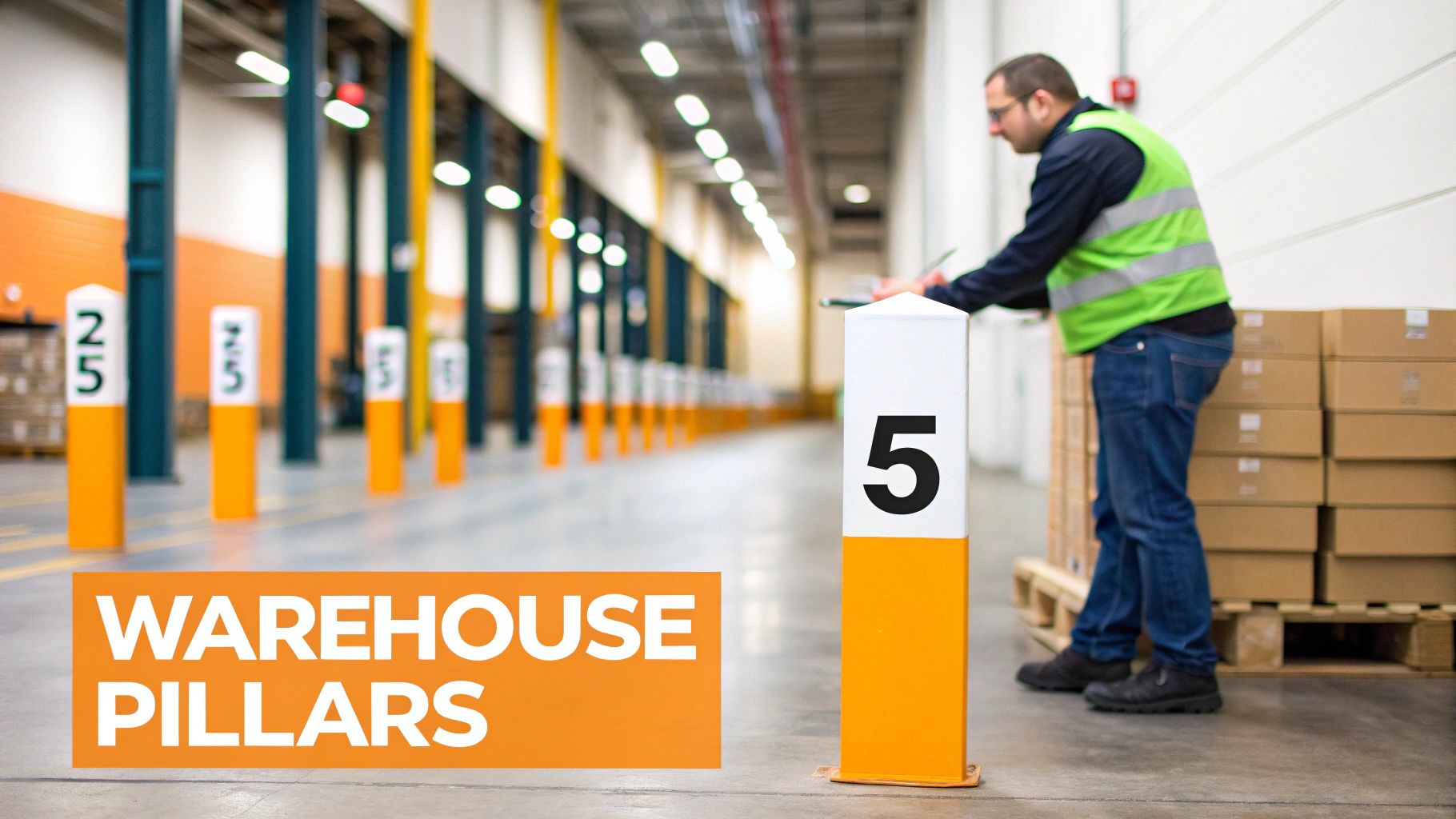
Effective warehouse management for ecommerce isn't one giant task. It's a system built on five interconnected pillars, and if one gets wobbly, the whole operation can come crashing down. Weakness in any single area leads to shipping delays, expensive mistakes, and—worst of all—unhappy customers.
Think of these pillars as the journey your product takes through the warehouse. From the moment it hits your loading dock to the second it’s handed off to a carrier, every step has to be dialed in. Let's break down these five core functions and see how they work together to keep your goods flowing smoothly.
1. Receiving and Putaway
This is where it all starts. The receiving process is your first, best chance to get your inventory count right. It’s way more than just unloading trucks; it’s a systematic check-in to make sure what you ordered is what you actually got.
Your team unloads shipments, inspects for damage, counts everything against the purchase order, and logs each item into your Warehouse Management System (WMS). A simple miscount here or a failure to spot damaged goods will create a domino effect of problems down the line.
Once everything is checked in, putaway is the process of moving that inventory from the dock to its designated home on the shelf. A smart putaway process makes sure items are stored logically so they’re a breeze to find later. Get this first step right, and you've set the foundation for success.
2. Inventory Management
With products neatly shelved, the game shifts to managing them. This pillar is all about knowing exactly what you have, where it is, and how fast it’s moving. It’s the difference between being in control and constantly putting out fires.
Bad inventory management leads to the two biggest nightmares in ecommerce: stockouts and overstocking. Stockouts mean lost sales and frustrated customers. Overstocking ties up your cash and eats up precious warehouse space with products that just sit there.
Effective inventory management isn't just about counting; it's about making your stock work for you. It turns a static asset into a dynamic engine for growth, ensuring capital is invested in products that sell.
To keep things under control, smart warehouses rely on a few proven strategies:
- ABC Analysis: This method sorts your inventory into three groups. 'A' items are your rockstars—high-value, fast-sellers that need constant attention. 'B' items are your steady performers, and 'C' items are the slow-movers. This helps you focus your energy where it counts.
- Cycle Counting: Instead of shutting down for a massive annual inventory count, cycle counting involves checking small sections of your inventory continuously. This keeps your accuracy high all year long without disrupting your operations.
3. Order Picking and Packing
As soon as a customer clicks "buy," the picking and packing pillar kicks into gear. This is the most labor-intensive part of the whole process, and every wasted second directly inflates your cost per order and slows down shipping. The goal is simple: grab the right items as fast as humanly possible.
Different picking strategies can make a world of difference:
- Batch Picking: A picker grabs items for a bunch of different orders all at once. If ten separate orders all need the same popular widget, the picker gets all ten in one trip instead of ten separate trips.
- Zone Picking: The warehouse is divided into zones, and each picker stays in their assigned area. Orders move from zone to zone on a conveyor or cart until they’re complete.
Once picked, items head to a packing station. Efficiency here is all about ergonomics. Packers need boxes, mailers, tape, and void fill all within arm's reach to minimize movement and get packages sealed, labeled, and ready to go without any delay.
4. Shipping and Fulfillment
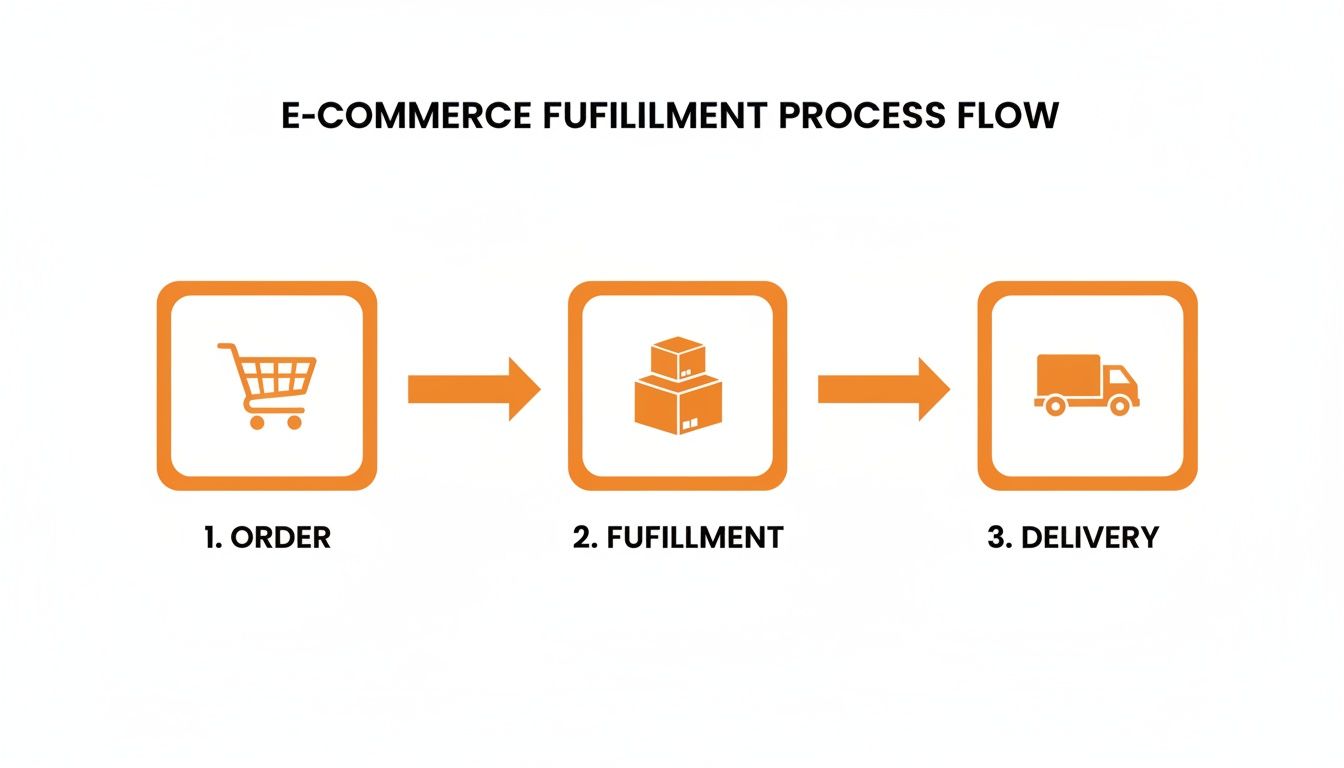
After an order is packed and sealed, the fourth pillar takes over: getting it out the door. This means generating the right shipping labels, manifesting packages with carriers, and having a smooth handoff when the trucks arrive for pickup. In a modern warehouse management ecommerce operation, a lot of this is automated.
Integrating your WMS directly with carriers like UPS, FedEx, and USPS is a must. This allows for automatic rate shopping to find the best price for the delivery speed you need. Automation also kills manual data entry, which is a huge source of errors like typos in addresses. For a deeper look, check out our guide on the details of ecommerce order fulfillment services.
5. Returns Management
The final pillar—and one that’s too often an afterthought—is returns management, also known as reverse logistics. Returns are just a fact of life in ecommerce. A slow, painful returns process can kill a customer relationship for good, but a fast, easy one can actually build loyalty.
The process involves receiving returned items, inspecting them, and deciding what happens next. Can it be restocked and sold as new? Does it need a little TLC? Or is it destined for liquidation? A solid system gets sellable products back into active inventory fast, recovering their value instead of letting them collect dust in a corner.
Getting Fast and Accurate: The Core Processes That Matter
In ecommerce warehouse management, everything boils down to two things: getting the right product to the right person (accuracy) and doing it faster than anyone else (speed). A lot of people think these two are at odds, but they're not. In fact, a process built for accuracy naturally becomes faster because you're not wasting time fixing mistakes.
Think of your warehouse like a high-performance engine. For it to run at its best, every single part has to work perfectly. Accuracy is the clean fuel, and speed is the horsepower you get from it. Let's look at the core processes that get your engine running on premium fuel at full throttle.
Lock Down Your Accuracy with Technology
Let's be honest: human error is the biggest threat to your order accuracy. Even your best team members can grab the wrong SKU or miscount inventory on a busy day. The goal isn't to replace people, but to give them tools that make it almost impossible to mess up.
The single best tool for this job is barcode scanning. When you put scanning at every key step, you create a digital paper trail for every single item that moves through your warehouse.
- At Receiving: Scan items as they come off the truck. This confirms you got what you ordered and instantly updates your inventory counts. No more guesswork.
- During Putaway: Scan the item, then scan its shelf location. This guarantees it's stored in the right spot so it can be found easily later.
- For Picking: Pickers scan the shelf location and then the product itself. This double-check confirms they've grabbed the correct item before they even move on to the next one.
- At Packing: One final scan before the box is taped shut acts as a last line of defense, verifying the order's contents one more time.
This disciplined approach can push your order accuracy rates above 99%. That means far fewer costly returns and a lot less time spent on customer service headaches.
Warehouse accuracy isn't about hoping for perfection; it's about building a solid process. By building simple checks and balances into every step, you systematically design errors out of your workflow and create a reliable experience your customers can count on.
Another game-changer is cycle counting. Instead of doing one massive, painful physical inventory count once a year (and shutting down operations to do it), cycle counting involves checking small sections of your warehouse continuously. It's a proactive way to keep your inventory numbers tight all year long, ensuring the stock levels on your website are actually what you have on the shelf.
Engineer Speed into Your Operations
Once you have accuracy dialed in, you can start focusing on speed. Speed in the warehouse isn't about rushing; it's about eliminating wasted movement. The number one time-waster for pickers is travel—all that time spent walking back and forth between aisles.
The first fix is optimizing your warehouse layout. Put your fastest-moving products (your "A" items) closest to the packing stations. It's a simple change, but it can dramatically cut down on travel time for the bulk of your orders and boost how many orders a single picker can handle per hour.
Next, you need smart picking strategies like batching. Instead of sending a picker out to grab items for one order at a time, you can have them gather all the items needed for a group of 10 or 20 orders in a single trip. This is where a good Warehouse Management System (WMS) is essential—it can analyze your orders and automatically create the most efficient batches and pick paths for your team.
How Speed and Accuracy Impact FBA Prep
These principles are absolutely critical when you're preparing shipments for Amazon FBA. Amazon’s receiving process is known for being incredibly strict. Any little mistake can lead to delays, extra fees, or even entire shipments being rejected. With the market for e-commerce warehousing projected to hit $64.32 billion by 2030, you can bet that competition for space and attention is only getting tougher.
This is where speed and accuracy in your own FBA prep process become your best defense.
- Compliant Labeling: Every single unit needs a perfect, scannable FNSKU label. There's no room for error here.
- Correct Kitting: If you're bundling multiple products into a single package, it has to be done with precision. Our team put together a guide that explains why this is so important and breaks down what kitting in logistics is and how to nail it.
Getting this stuff right the first time means your inventory won't get stuck in an Amazon receiving logjam. It turns a potential nightmare into a smooth, seamless handoff.
Choosing the Right Warehouse Technology and Tools
Your technology stack is the engine that powers your entire fulfillment operation. Without the right tools, even the best processes will sputter and stall. Smart tech investments are what separate the brands that scale smoothly from those that get tangled up in logistical knots.
The absolute center of that tech stack is your Warehouse Management System (WMS). Think of it as the brain of your warehouse—a central command hub that directs every single activity, from the moment new inventory arrives to the second you print a customer’s shipping label. A solid WMS gives you real-time visibility and control over every unit you own.
Selecting Your Warehouse Management System
Choosing a WMS is a huge decision, whether you're bringing one into your own building or evaluating the system used by a potential 3PL partner. The right platform should feel like a natural extension of your business, not some clunky piece of software that just creates more work.
When you're looking at a WMS, focus on these must-haves:
- Seamless Integrations: Your WMS has to connect effortlessly with the sales channels you depend on, especially giants like Shopify and Amazon. This is non-negotiable. It ensures order and inventory data flow automatically, preventing the kind of overselling that destroys customer trust.
- Scalability: Can the software handle 100 orders a day just as easily as it handles 1,000? A truly scalable WMS grows with you. It saves you from a costly and chaotic migration down the road when your order volume explodes.
- Actionable Reporting: The system should give you clean, easy-to-read reports on key metrics like inventory turnover, order accuracy, and picking efficiency. This isn't just about having data; it's about getting the insights you need to make smart, proactive decisions for your operations.
Beyond the WMS: Practical Automation Tools
If the WMS is the brain, other tools act as the hands and feet, executing tasks with speed and precision. You don’t need a warehouse full of robots to get a great return on your investment. In fact, a few practical pieces of automation can deliver immediate improvements.
This is where you start building momentum. As this infographic shows, everything starts with accuracy, which then unlocks speed and efficiency.
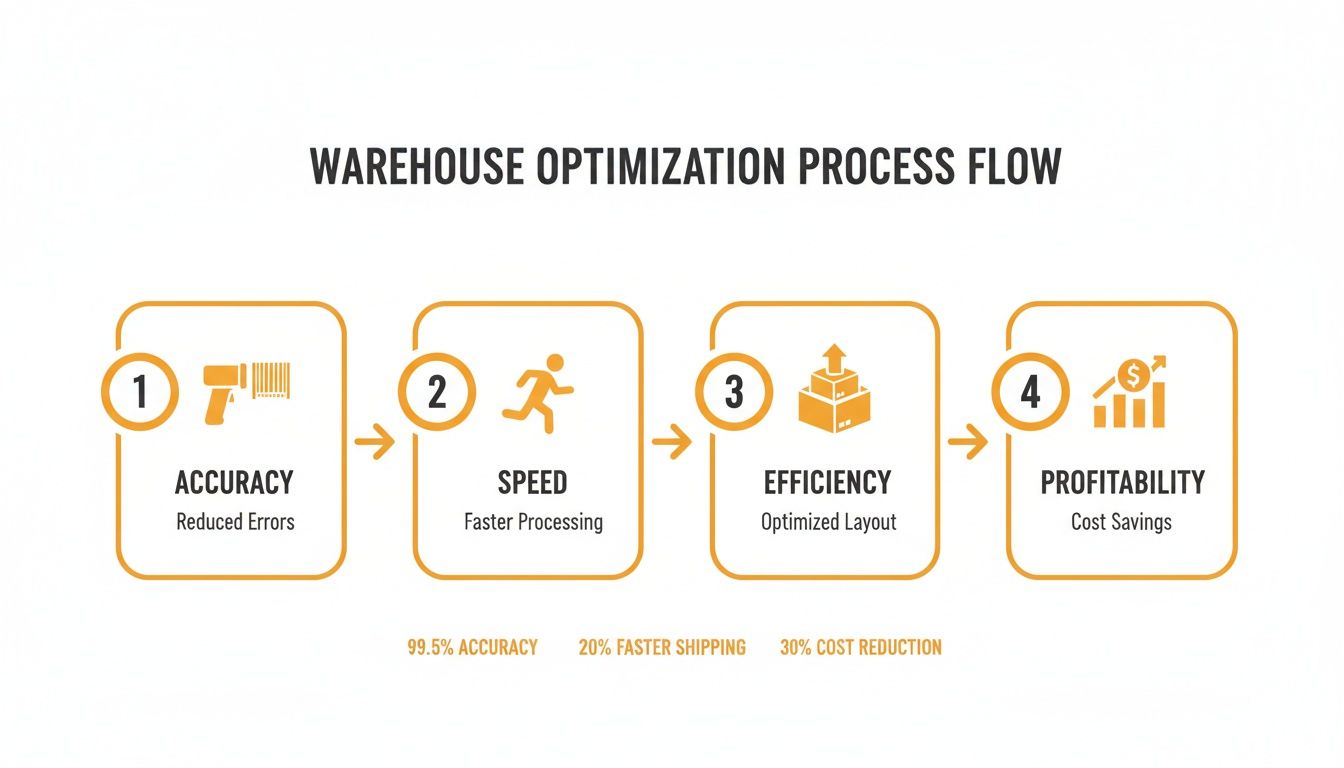
It all builds on itself. Foundational tools like barcode scanners are the first step toward locking down accuracy. Once you have that, you can introduce tools that enable faster, more efficient workflows.
Consider these high-impact tools:
- Barcode Scanners: As we've mentioned, these are non-negotiable for hitting near-perfect accuracy. They kill manual data entry, confirm every pick is correct, and give you a digital trail for every single item.
- Conveyor Systems: For operations with higher volume, simple conveyor belts can dramatically cut down the time your staff spends just walking around. They move picked items from the aisles to the packing stations, keeping your team focused on the tasks that actually add value.
- Pick Path Optimization Software: Many modern WMS platforms include this feature. It uses algorithms to map out the most efficient route for pickers to travel through the warehouse, minimizing their steps and maximizing the number of orders they can fulfill per hour.
Technology should be a growth enabler, not a limitation. The right tools empower your team to work smarter, not just harder, turning your warehouse into a true competitive advantage that supports your ecommerce brand’s expansion.
When it comes down to it, you're either investing in your own technology or you're "renting" the technology of your fulfillment partner. The table below breaks down what you should think about in either scenario.
WMS Selection Criteria vs. 3PL Partnership Benefits
| Consideration | In-House WMS | Partnering with a Tech-Forward 3PL (like Snappycrate) |
|---|---|---|
| Initial Cost & Setup | High upfront investment in software licenses, hardware, and implementation services. Can take months to deploy. | Zero upfront tech cost. You get immediate access to a mature, fully integrated WMS that’s already running. |
| Integrations | You are responsible for building and maintaining connections to Shopify, Amazon, etc. This requires technical expertise. | Pre-built, professionally managed integrations are already in place. It's a plug-and-play experience. |
| Scalability & Maintenance | You bear the cost and complexity of software updates, server maintenance, and scaling the system as you grow. | The 3PL handles all updates, security, and performance tuning. Their system is built to handle massive scale from day one. |
| Expertise | Your team needs to become experts in using and troubleshooting the WMS, which can distract from core business goals. | You benefit from a team that lives and breathes their WMS daily. They are true experts who can optimize its use for you. |
| Reporting & Visibility | You configure and run your own reports. Data might be limited to what your specific WMS tier provides. | Gain access to sophisticated, enterprise-level reporting and analytics that would be too expensive to buy on your own. |
Ultimately, your technology choices—or the technology of your fulfillment partner—will define your operational ceiling. By asking the right questions and focusing on integration, scalability, and practical automation, you ensure your tech stack can support your brand's ambitions for years to come.
When to Partner with a 3PL for Ecommerce Fulfillment
Every successful ecommerce brand eventually hits a wall. It’s that moment when managing fulfillment in-house stops being a smart, scrappy move and starts actively holding your business back.
Recognizing this tipping point is one of the most important things you can do to scale. You might be there right now if your day is more about packing boxes than making sales, or if your garage is so full of inventory you can barely walk through it. For many, the final straw is the headache of Amazon FBA prep, where one tiny mistake can get your shipment rejected.
Identifying the Tipping Point
So, how do you know it’s really time to hand things over? The signs are usually obvious long before total chaos hits. They're the daily frustrations that slow you down and burn you out.
It’s probably time to look for a partner when:
- You're Losing Focus: You're spending more energy troubleshooting shipping problems, ordering tape, and managing staff than you are on marketing, product development, or customer service—the things that actually grow your brand.
- Space Is Disappearing: Your current storage is completely maxed out. Renting a bigger warehouse is a massive commitment, locking you into long-term leases, insurance costs, and the expense of hiring staff.
- Order Volume Is Overwhelming: Your team simply can’t keep up. Orders are piling up, shipping is delayed, and customers are starting to notice. This goes from a small problem to a full-blown crisis during peak season.
The holiday rush magnifies every tiny inefficiency. Deloitte's 2025 holiday retail forecast predicts U.S. sales will hit between $1.61 trillion and $1.62 trillion. That kind of demand will turn a simple space crunch or a spreadsheet-based inventory system into a serious threat to your brand’s reputation.
The Strategic Advantages of a 3PL Partnership
Working with a third-party logistics (3PL) provider is about so much more than just getting boxes out the door. It’s a strategic decision to plug your business into an expert infrastructure that would cost you a fortune and years to build yourself.
A great 3PL doesn't just work for you; they become an extension of your team. Their expertise in logistics and fulfillment becomes your competitive advantage, allowing you to deliver a world-class customer experience without the operational burden.
A specialized 3PL gives you instant access to:
- Discounted Shipping Rates: 3PLs ship millions of packages a year, which gives them access to heavily discounted rates from carriers like UPS, FedEx, and USPS. They pass those savings directly to you.
- Scalable Space and Labor: A 3PL’s resources expand as you grow. You only pay for the space and labor you actually use, whether you're shipping 100 orders a month or 10,000.
- Expertise and Technology: You get a professional team and an enterprise-level Warehouse Management System (WMS) without the six-figure price tag. They are experts in complex tasks like kitting, returns management, and FBA prep.
Choosing the right partner is critical. You aren’t just giving them your inventory; you're trusting them with your customer experience. You can learn more about what a 3PL warehouse does in our detailed guide. This partnership can transform your fulfillment from a costly headache into a powerful, scalable asset.
Measuring Success with Warehouse Performance Metrics
You can't fix what you can't measure. In ecommerce warehouse management, data is your best friend—it’s the compass that points you toward efficiency and away from costly mistakes. Key Performance Indicators (KPIs) are the vital signs of your fulfillment operation, telling you exactly where you’re excelling and where you’re bleeding money.
Moving past a vague feeling of being "busy," these metrics give you a crystal-clear, objective look at your performance. They let you have real, data-driven conversations with your team or 3PL partner about what’s actually working, turning “continuous improvement” from a buzzword into a daily reality.
Essential KPIs for Ecommerce Warehouses
To get a true snapshot of your operational health, you don’t need a dozen different reports. Start by focusing on a few high-impact metrics that give you a balanced view of customer satisfaction, inventory health, speed, and cost.
Order Accuracy Rate: This is the ultimate measure of getting it right for the customer. It calculates the percentage of orders you ship without a single error—no wrong items, no incorrect quantities, no mistakes. A high rate means happy customers who trust you, and that’s the foundation of any successful brand.
- Calculation:
(Total Orders - Orders with Errors) / Total Orders * 100 - Industry Benchmark: The best warehouses hit 99.8% or higher, consistently.
- Calculation:
Inventory Accuracy Rate: This KPI tells you if the number of units in your software matches what’s actually sitting on your shelves. A low score is a huge red flag. It’s the reason you get surprise stockouts, oversell products you don’t have, and tie up cash in inventory you forgot existed.
- Calculation:
(Counted Inventory / WMS Inventory) * 100 - Industry Benchmark: Aim for 99% or better to keep your operations running smoothly.
- Calculation:
Think of your KPIs as the voice of your operation. A dropping Order Accuracy Rate is a customer shouting about a mistake. A low Inventory Accuracy Rate is a quiet warning that your finances are at risk.
Measuring Speed and Financial Health
Beyond getting orders right, you need to know how fast and how cheaply you can get them out the door. These metrics shine a light on bottlenecks and show you exactly where you can cut costs without sacrificing quality.
Dock-to-Stock Time: This is how long it takes for a new shipment to arrive at your warehouse, get processed, and be put away, ready for sale. The faster you can do this, the faster you can start making money on new products. A long dock-to-stock time points to a clunky receiving process.
Cost Per Order: This is your bottom-line metric. It calculates the total warehouse cost—labor, boxes, tape, overhead—to get a single order into a customer's hands. Tracking this number tells you if you're actually profitable on each sale and shows the real financial impact of any improvements you make.
By keeping a close eye on these core metrics, you stop guessing and start making strategic decisions. This data-first approach is non-negotiable for any brand that wants to scale up and turn its fulfillment from a cost center into a true competitive advantage.
Ecommerce Warehousing FAQs
As you scale your brand, you’ll inevitably run into new fulfillment questions. Making the leap from your garage to a professional operation is a big deal, so it's only natural to have a few things on your mind. Here are the straight-up answers to the questions we hear most often from growing ecommerce businesses.
What Is the Biggest Warehouse Mistake Growing Brands Make?
The single biggest mistake is waiting too long to adopt a real system for warehouse management. So many brands stick with manual processes and messy spreadsheets way past their expiration date. They think they're saving money, but the cost of mis-picks, lost inventory, and painfully slow shipping adds up fast.
This "we'll deal with it later" approach creates a chaotic fulfillment ceiling that literally stops you from growing. By the time brands realize they’re in deep, they're already drowning in orders and facing a rushed, stressful transition. The secret is to get a structured system in place before the chaos takes over.
How Does 3PL Pricing Actually Work?
At first glance, it can seem complicated, but 3PL pricing usually boils down to a handful of fees for the specific services you use. It's a pay-as-you-go model that's often far more affordable than the fixed costs of leasing your own warehouse (rent, labor, insurance, etc.).
You'll typically see fees for:
- Receiving: A charge for taking in your inventory, inspecting it, and logging it into the system.
- Storage: A monthly fee based on how much space your products take up, usually measured by the pallet or cubic foot.
- Pick & Pack: A fee for every order we fulfill. This can vary depending on how many items are in the order.
- Shipping: The actual postage cost from the carrier. The good news is, you get access to our deeply discounted rates.
A 3PL’s real power comes from economies of scale. They combine the shipping volume of hundreds of brands to negotiate incredible rates with carriers—an efficiency that’s nearly impossible for a single brand to achieve on its own.
What Is the Difference Between a Warehouse and a Fulfillment Center?
This is a really important distinction. Think of it this way: every fulfillment center is a warehouse, but not every warehouse is a fulfillment center. A traditional warehouse is built for long-term storage of bulk goods, usually on pallets. Its main job is just to hold stuff.
An ecommerce fulfillment center, on the other hand, is a high-energy hub built for speed and accuracy. It's specifically designed to process thousands of small, individual customer orders every day. The technology, the layout, and the team are all optimized for one thing: picking, packing, and shipping directly to your customers, fast.
How Can I Guarantee a Smooth Amazon FBA Inbound Process?
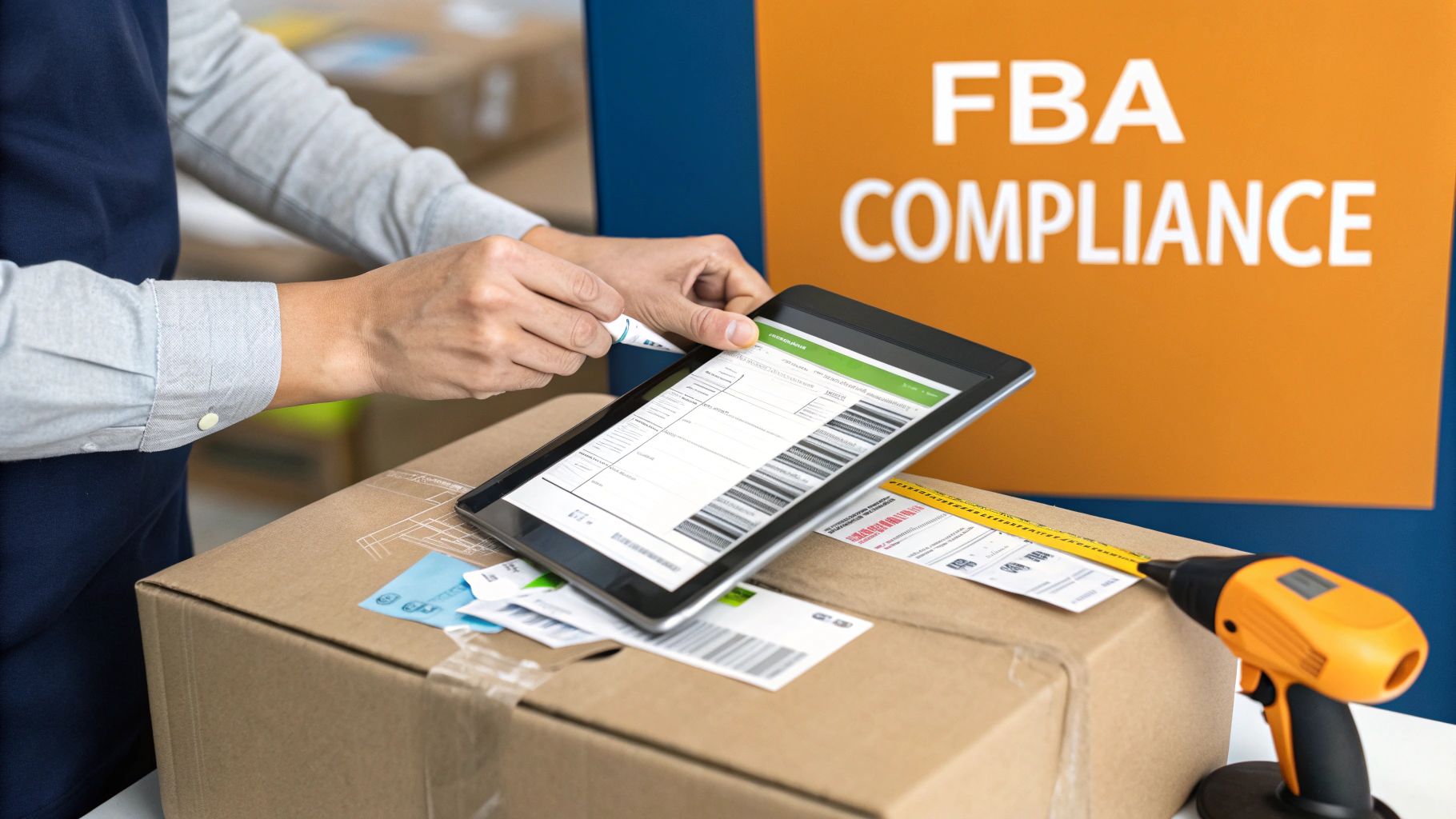
Success with FBA comes down to one word: compliance. Amazon has incredibly strict rules for how your inventory needs to be prepped, labeled, and packaged before it even thinks about hitting their docks. One tiny mistake can lead to hefty fees, rejected shipments, or your products sitting in a trailer for weeks.
The absolute best way to guarantee a smooth inbound process is to work with a partner who lives and breathes FBA prep. They know every little detail of Amazon's rulebook—from applying the right FNSKU labels and using the correct poly bags to building compliant case packs. That expertise eliminates the risk of errors, ensuring your inventory gets checked in fast and is ready to sell without a hitch.
Ready to stop worrying about fulfillment and get back to growing your brand? Snappycrate offers expert 3PL services, from fast and accurate order fulfillment to flawless Amazon FBA prep. Let us become an extension of your team. Get started with Snappycrate today!