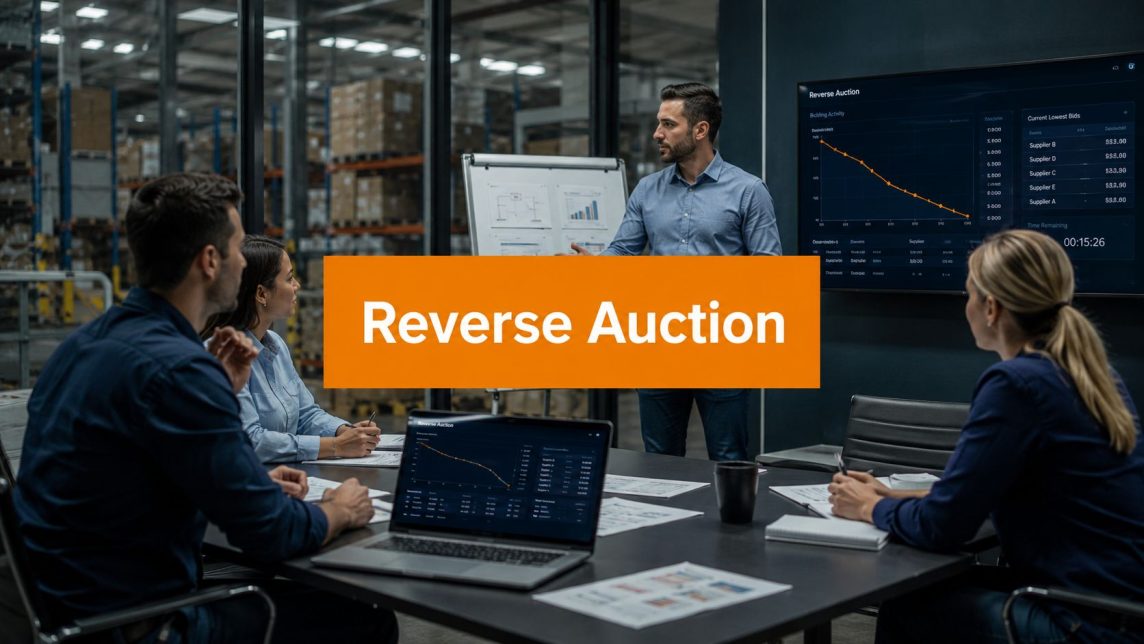
A reverse auction is a procurement event where suppliers bid prices downward to win a buyer's business, and the lowest acceptable bid typically wins. Used in the right categories, reverse auctions have delivered about 12% savings on more than $800 million in purchases in one GAO-cited government review, and other research found companies could save 15% while cutting procurement cycle times by 90%.
If you're managing fulfillment, packaging, or transportation spend, you've probably run into the same pressure point: cut cost without creating a service problem three weeks later. Finance wants lower unit costs. Operations wants fewer surprises. The warehouse team wants vendors that ship on time and follow specs.
That tension is where reverse auctions get misunderstood. Some teams treat them like a blunt instrument for forcing down price. Good procurement teams use them more like a controlled sourcing tool. They work well when the scope is fixed, suppliers are comparable, and service requirements are already locked down. They work badly when you're buying judgment, flexibility, or operational reliability that can't be captured in a spreadsheet.
Your Guide to Strategic Cost Reduction
An operations leader usually doesn't start by asking, "What is reverse auction?" The actual question is more practical. "How do I get packaging or freight costs under control without spending two months in back-and-forth negotiations?"
Say you're buying corrugated boxes for a growing DTC brand. Volumes are rising, your current supplier just pushed through a price increase, and your team needs a clean way to test the market. A reverse auction can help because every supplier is bidding on the same box specs, the same dimensions, the same board grade, the same delivery expectations. That's a fair fight.
Now switch the category. You're sourcing a 3PL partner for FBA prep, relabeling, bundling, inspection, and rush turnaround. That's not the same kind of purchase. Lowest price can look good in the event and turn expensive after go-live if the provider misses compliance details or creates rework. That's why reverse auctions should sit inside a broader sourcing strategy, not replace it.
Where operations teams usually get value
Reverse auctions make the most sense when you're buying categories with stable specifications and enough supplier competition to create real price tension.
- Packaging inputs: Corrugated cartons, stretch film, tape, labels, and similar repeat buys.
- Indirect spend: Routine supplies that don't depend on deep customization.
- Selected freight buys: Repeatable lanes or clearly scoped transportation requirements, if service terms are already defined.
For logistics leaders trying to connect sourcing decisions to warehouse performance, this broader view of procurement in logistics matters. Cost reduction only helps if the operation still runs cleanly after the award.
Reverse auctions aren't magic. They're a disciplined way to compress negotiation into a live competitive event.
How a Reverse Auction Actually Works
Think of a traditional auction first. People keep raising the price to buy one item. A reverse auction flips that logic. One buyer presents a contract, and multiple suppliers keep lowering their prices to win it.
A reverse auction is a real-time digital sourcing event in which suppliers compete by repeatedly lowering prices to win a buyer's business; it is most effective when the item or service has fixed, comparable specifications, according to Zycus' reverse auction definition.

The flow from the buyer's side
The auction itself is only the visible part. The actual work starts before anyone submits a bid.
Define the requirement clearly
The buyer sets the scope. That includes the item or service specification, quantities, delivery terms, service levels, quality requirements, and commercial terms. If the scope is vague, the auction result won't mean much.Pre-qualify suppliers
This step screens out vendors that can't perform. In practice, that means checking capacity, quality fit, compliance, and commercial viability before inviting anyone into the event.Launch the live event
Approved suppliers join a digital bidding session. Depending on the platform and rules, they may see bid rankings, the leading price, or only limited position feedback.Suppliers bid downward in real time
Competitive pressure builds during this process. Each supplier decides whether it can lower price further while still protecting margin and service commitments.Close and evaluate
When the event ends, the buyer reviews the result against all pre-set criteria. In a simple commodity buy, the lowest acceptable bid may win. In more controlled events, price is only one part of the award decision.
What buyers often miss
A reverse auction doesn't fix bad procurement hygiene. It exposes it.
If your carton spec isn't final, if your delivery cadence isn't defined, or if one supplier included freight and another didn't, the event may produce a low number that can't be compared cleanly. That's why experienced teams lock the commercial ground rules first.
Field rule: If suppliers aren't bidding on the same scope, you don't have competition. You have noise.
Reverse Auctions vs Traditional Auctions
People understand auctions from art, antiques, or liquidation sales. That familiar model can make reverse auctions sound more exotic than they are. The mechanics are simple. The power dynamics are just reversed.

The core difference
In a traditional auction, one seller offers something to the market and multiple buyers compete by increasing price. The seller wants the highest possible return.
In a reverse auction, one buyer offers a sourcing opportunity and multiple suppliers compete by decreasing price. The buyer wants the best qualified offer at the lowest acceptable cost.
| Factor | Reverse auction | Traditional auction |
|---|---|---|
| Who competes | Suppliers | Buyers |
| Price direction | Downward | Upward |
| Primary beneficiary | Buyer | Seller |
| Typical use | Procurement and sourcing | Asset sale or collectible sale |
| Winning logic | Lowest acceptable bid, or best evaluated offer | Highest bid |
Why this matters in operations
This isn't just a bidding format difference. It changes how you prepare the event and how you judge success.
In a traditional auction, the seller can tolerate some ambiguity if the item itself is visible and obvious. In reverse procurement, ambiguity is dangerous because suppliers need a precise scope to price. A box supplier can bid aggressively when dimensions, print requirements, board grade, and delivery schedule are fixed. A fulfillment provider can't do that fairly if the workload changes every week and error risk sits outside the written scope.
Another important difference is the outcome. Traditional auctions usually end at price. Reverse auctions should end at evaluated value. Even when the event is price-led, buyers still need to confirm service fit, contract terms, and execution capability before awarding business.
A simple way to explain it internally
Use this line with non-procurement stakeholders:
- Traditional auction: Many buyers chase one item.
- Reverse auction: Many suppliers chase one contract.
That usually clears up the confusion fast.
The Benefits and Risks for Your Operation
The appeal of reverse auctions is obvious. They create live competition, shorten negotiation cycles, and give buyers clearer market pricing. But the upside only holds if the category fits the tool.
A GAO-cited review found that four U.S. agencies reported about 12% savings on purchases totaling more than $800 million using reverse auctions, and separate research found companies could save 15% on goods and services while procurement cycle times could drop by 90%, as summarized in this public procurement reverse auction review. Those numbers explain why sourcing teams keep using the method.

The upside when the fit is right
For straightforward categories, reverse auctions can produce three practical benefits.
Lower prices through live competition
Instead of negotiating one supplier at a time, you let the market respond in real time. That usually creates cleaner pricing tension than email rounds and offline calls.Shorter sourcing cycles
A lot of traditional sourcing time gets burned in sequencing. Supplier A submits. You review. Supplier B counters. Legal marks up terms. Then someone asks for another commercial round. Reverse auctions compress the pricing portion into one managed event.Better pricing visibility
You learn quickly whether the incumbent is still competitive. You also see whether the market has real depth or whether only one or two suppliers can stay in the game.
For operations leaders, this ties directly to cost of serving. A lower bid on tape, cartons, or other repetitive inputs can improve unit economics without changing how the floor runs.
The risks generic guides skip
The danger starts when buyers assume the lowest bid equals the lowest total cost.
A supplier can win on price and lose on execution. Late deliveries, poor fill rates, incorrect specs, weak account management, and post-award disputes all create friction that doesn't show up in the final auction screen. In fulfillment and logistics, those hidden costs tend to hit fast because the warehouse depends on reliable inbound timing and consistent product standards.
Here are the common failure modes:
- Quality drift: Suppliers may stretch quality or service to protect margin after bidding too low.
- Relationship damage: Long-term partners may disengage if every discussion turns into a public price fight.
- False comparability: If the scope wasn't locked down, you may be comparing bids that look similar but include different assumptions.
- Operational rework: The team saves on paper, then spends time fixing misses, expediting shipments, or replacing stock.
Lowest bid is a result. It isn't a strategy.
A practical decision rule
Use a reverse auction when the requirement is stable and the post-award supplier management burden is predictable. Avoid it when success depends on collaboration, speed of problem-solving, or quality judgment that can't be captured cleanly in the event rules.
Real-World Use Cases in Logistics and Fulfillment
In logistics and fulfillment, the best reverse auction opportunities usually sit in categories where you can write a clean scope and hold suppliers to it. If the inputs are standardized, the event can work well. If the service depends on judgment, exception handling, and day-to-day communication, the tool starts to break down.

Reverse auctions are best for clearly defined, standardized goods or services. Standardized inputs such as corrugated boxes or tape are good candidates, while bespoke services like 3PL fulfillment or compliance-intensive kitting aren't a clean fit because poor service levels can create hidden costs, as outlined in JAGGAER's reverse auction procurement guidance.
Good fits for reverse auctions
These categories usually respond well because the market can quote against a fixed requirement.
Packaging materials
Corrugated boxes, tape, stretch film, labels, and poly mailers are classic candidates. The dimensions, material requirements, and delivery patterns can be specified in advance.Repeatable indirect supplies
Warehouse consumables and standard operating materials often fit the same pattern. If you know exactly what you're buying, suppliers can compete cleanly.Selected transportation buys
Some freight events work when the lane structure, fuel treatment, service expectations, and shipment profile are stable. This takes discipline. If the lane data is messy or service requirements shift constantly, the event gets less reliable.
For teams buying across borders, broader operating context matters too. A useful companion read is this guide for mastering global logistics, especially if your sourcing decision affects inbound timing, customs coordination, or regional handoffs.
Bad fits that cause expensive mistakes
Such scenarios often lead many operations teams to learn the hard way.
A reverse auction is usually the wrong tool for 3PL fulfillment, FBA prep, custom kitting, inspection-heavy workflows, or repackaging tied to marketplace compliance. Those services aren't just labor lines. They depend on accuracy, communication, problem solving, throughput management, and exception handling.
If a provider underbids to win the event, you may not see the damage until inventory starts missing labels, bundles fail compliance checks, or outbound orders stack up because the floor can't absorb a spike.
If the work depends on trust, speed, and judgment, treat price as one input, not the whole decision.
The same logic applies to vendor governance after award. Strong vendor management best practices matter more than the event itself, especially when the category touches customer experience.
A short explainer can help if your team needs to visualize the concept before using it in procurement planning:
The practical takeaway
Use reverse auctions for the parts of your operation that behave like commodities. Don't use them for the parts that behave like partnerships.
Implementing a Reverse Auction Strategy
A solid reverse auction isn't a website event with a countdown clock. It's a sourcing process with an auction in the middle. Teams that get strong results do most of the work before the bidding opens.
Modern execution now includes supplier shortlisting, mock auctions, and lotting, which groups similar items into a single auction lot to preserve service quality while still creating strong price competition, according to GEP's packaging procurement guidance.
Start with category selection
Pick categories that are spec-driven and commercially comparable. Packaging is often easier than services because the requirement can be written tightly. Freight can work in selected cases. Complex operational services usually shouldn't be your first experiment.
A simple filter helps:
| Question | If yes | If no |
|---|---|---|
| Can you define the requirement clearly? | Good candidate | Stop and tighten scope |
| Can suppliers quote the same scope? | Continue | Fix comparability first |
| Will service differences create hidden cost later? | Add non-price controls | Consider another sourcing method |
| Is there enough supplier competition? | Event may be effective | Auction may underperform |
Do the pre-work properly
This is the part buyers rush, and it's usually where problems start.
Lock the scope
Build a clear statement of work or product specification. Include quantities, tolerances, lead times, service levels, packaging requirements, delivery windows, and commercial assumptions.Shortlist the right suppliers
Don't invite anyone who can't perform. Shortlisting should happen before the event, not after a low bidder creates concern.Run a mock auction
This sounds minor, but it helps. Suppliers learn the platform, understand the rules, and avoid confusion during the live event.
Use structure to protect quality
Mature teams don't rely on a single lowest-number wins model. They use structure to keep the event commercially sharp without damaging execution.
For example, lotting lets buyers group similar SKUs or packaging items together instead of running disconnected one-line events. That can simplify award decisions and make service expectations easier to manage. Parallel auctions can also help when several comparable items need to be sourced at once.
The auction should test market price, not outsource your judgment.
Set rules before the event
Suppliers should know the rules in advance. That includes:
- What they're bidding on
- How long the event will run
- What bid visibility they'll have
- Whether price alone determines the winner
- What happens after the event closes
Clear rules protect both sides. Buyers get a cleaner result. Suppliers are more likely to participate seriously when they believe the process is fair.
Award carefully
When the event ends, don't rush the award memo. Confirm the supplier still meets technical and commercial requirements. Review assumptions, implementation timing, and transition risk. If the category touches production, warehousing, or customer service, involve the operators who will live with the decision.
That's the core discipline in reverse auctions. The bidding is fast. The judgment can't be.
Final Takeaways for Success
Reverse auctions can be highly effective when used with discipline. In successful applications, they can deliver a 13% reduction in price across all proposals and 31% savings on the selected provider, according to the IBM Center reverse auction report. But those outcomes depend on fit, preparation, and award control.
Keep the checklist simple:
- Use them for standard categories: Packaging and other clearly specified inputs are strong candidates.
- Avoid them for complex services: 3PL work, compliance-heavy prep, and custom kitting usually need a value-based sourcing approach.
- Pre-qualify before bidding: Don't let the auction screen substitute for supplier due diligence.
- Evaluate total operating impact: A low bid that creates delays, rework, or service failures isn't a win.
- Treat the event as one step: The sourcing strategy matters more than the countdown timer.
The best way to think about what is reverse auction is this: it's not a universal procurement method. It's a sharp tool for the right job.
If your business needs a fulfillment partner that can handle storage, order fulfillment, FBA prep, labeling, bundling, repackaging, and freight coordination without turning service quality into a pricing gamble, Snappycrate is built for that kind of operational complexity.