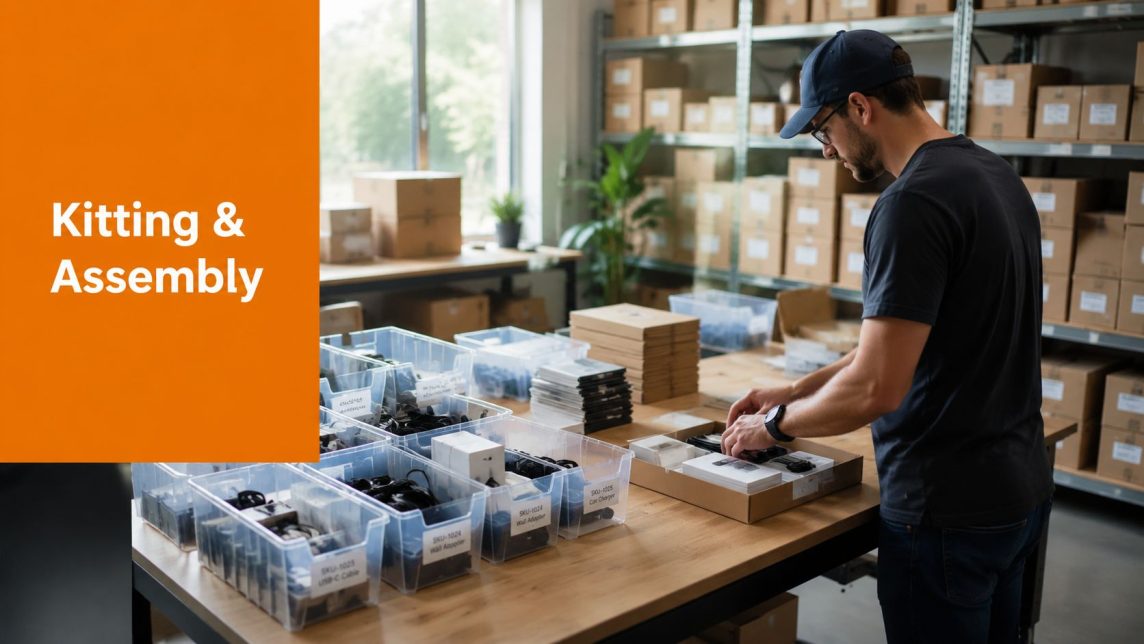
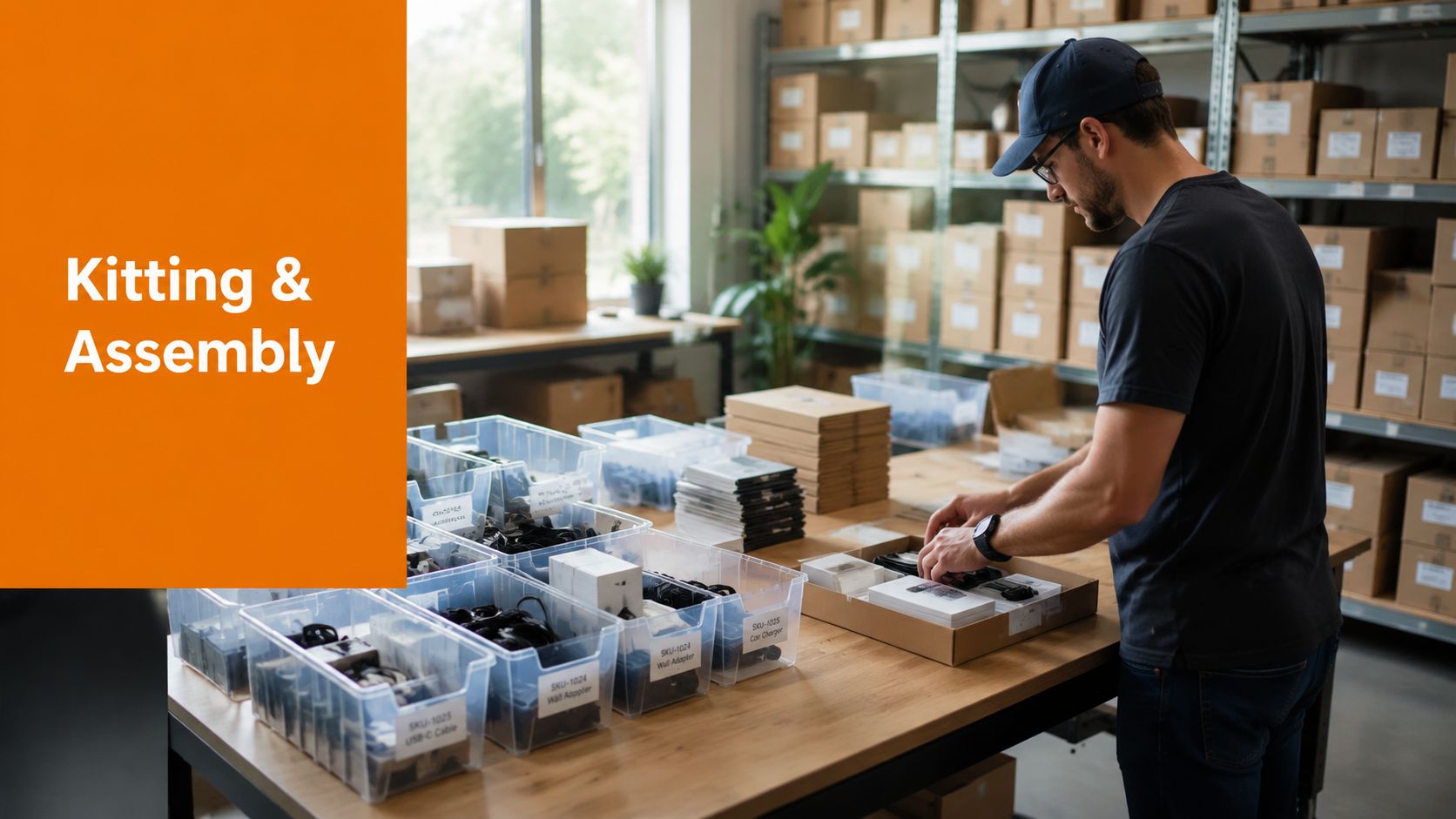
A lot of ecommerce brands hit the same wall at the same time. Orders are growing, bundles are selling, and what looked smart on the product page starts creating friction in the warehouse.
A customer buys a skincare starter set. Your team has to grab the cleanser from one shelf, the toner from another, the moisturizer from a third, then find the insert card, then pick the right box size, then hope nothing gets missed. That single order now takes more labor than it should, creates more chances for error, and usually produces a less polished unboxing experience than the brand promised.
That's where people start asking what is kitting and assembly, and whether either one will help the business make more money.
The short answer is yes, sometimes. But not every bundle should be kitted. Not every product should be assembled. And not every brand should do the work in-house. The key decision isn't about warehouse terminology. It's about whether pre-grouping or pre-building products lowers your total cost to serve while improving shipping speed, order accuracy, and customer experience.
The Hidden Cost of Shipping Separate Items
The cost problem usually shows up after a bundle starts selling well.
A brand adds a starter set, gift box, or buy-more-save-more offer. Revenue per order goes up, which looks great in Shopify. Then fulfillment starts eating the gain. The team walks farther, touches more SKUs, checks more line items, and spends more time making the shipment look like a planned bundle instead of a last-minute mix of products.
That gap matters because your P&L does not care whether margin disappeared in paid acquisition or on the warehouse floor.
Where margin starts leaking
Shipping separate items sounds simple until the same combination keeps showing up in order after order. If the products sit in different pick faces, each order requires multiple grabs, multiple scans, and another round of verification at packing. Add an insert card, tissue, or branded sleeve, and labor climbs again.
The extra cost usually shows up in four places:
- Higher labor per order because each SKU is picked and checked separately
- More preventable errors when one item is missed, swapped, or packed in the wrong quantity
- Less consistent presentation when bundles are built manually at the pack station
- Lower throughput during peak periods because multi-line orders take longer to clear
One order will not hurt much. A few hundred per week will.
A bundle can raise average order value and still lower contribution margin if fulfillment work grows faster than revenue.
This is the decision point many growing brands miss. They look at sales lift first and warehouse cost later. In practice, those numbers need to be reviewed together. If the bundle wins on the storefront but loses after pick, pack, packaging, and error-related reships, it is not a strong offer.
Brands that want a baseline for comparison should look at how standard pick and pack fulfillment services are priced and timed before deciding whether a repeated bundle should stay as separate picks.
Why kitting and assembly deserve management attention
For this reason, kitting and assembly should not be treated as minor warehouse chores. They are operating model decisions that change labor cost, order speed, storage setup, and error rates.
Kitting reduces repeated picking by turning a common combination into one ready-to-ship unit. Assembly makes sense when parts need to be combined into a finished or partially finished product before the order goes out. The important question is not which term sounds right. The important question is whether pre-work done once is cheaper than repeating the same work on every order.
That is the profitability lens. If your team keeps shipping the same combinations, picking them separately often becomes the expensive option.
Kitting and Assembly The Core Difference
Most confusion comes from the fact that people use the two terms loosely. In practice, they solve different problems.
Think of kitting like meal prep. You put the pasta, sauce packet, seasoning, and recipe card into one box so everything is ready when needed. Think of assembly like cooking the meal. You take those prepared components and turn them into the finished dish.

What kitting means in ecommerce
In ecommerce, kitting means taking separate sellable items and grouping them into a new bundled SKU. The original products still exist as individual units, but the warehouse now treats the grouped set as one pickable item.
Examples include:
- Gift sets with a candle, matches, and gift note
- Starter bundles with a device, charger, and case
- Subscription box builds with products from several brands
- Amazon multipacks prepared as one compliant unit
A kitted set is about preparation and speed. The products are grouped, packaged, labeled, and stored so fulfillment doesn't have to build the order from scratch every time. If you're comparing this with standard parcel operations, this pick and pack fulfillment services guide is useful because it shows where a normal order flow ends and value-added work like kitting begins.
What assembly means
Assembly means components are physically combined into a finished item or sub-assembly. That could be simple or more involved.
One manufacturing definition states that kitting prepares complete work-order inputs before production starts, while sub-assembly is the output. That sequencing reduces line-side searching and waiting, as explained in this manufacturing kitting overview.
A quick comparison makes the split clearer:
| Process | What happens | Result |
|---|---|---|
| Kitting | Separate items are grouped together | A ready-to-ship or ready-to-use set |
| Assembly | Components are joined or configured | A new finished item or sub-assembly |
Practical rule: If the parts stay separate inside one package, you're usually talking about kitting. If the parts become one working unit, you're in assembly.
A Look Inside a Kitting and Assembly Workflow
Inside a professional operation, this work is much more controlled than most brands expect. Good kitting isn't a folding table in the corner with tape guns and guesswork. It's a managed workflow with inventory control, work orders, QC, and clear SKU logic.
A useful way to think about it is this. The moment you decide to sell a bundle repeatedly, you're not just selling products together. You're creating a new operational object that has to be received, built, tracked, stored, and shipped correctly.

How the workflow usually runs
A repeatable workflow tends to follow these stages:
Create the kit SKU
The warehouse management system needs a defined kit or assembly SKU plus a bill of materials. If that record is sloppy, inventory accuracy gets messy fast.Receive the components
Each input item gets scanned into inventory by its own SKU, as the warehouse must still track component stock even after some units are consumed into kits.Stage a work order
The team pulls the required quantities into a dedicated kitting station. Clear instructions matter here, especially for insert cards, tape placement, polybagging, labels, or retail-facing presentation.Build the kit or perform assembly
For kitting, items are grouped and packed together. For assembly, parts are joined, configured, or attached before final packaging.Apply compliance labels
This step is critical for Amazon and retail workflows. “Sold as set” markings, barcode placement, suffocation warnings, lot control, and case labeling need to be right before inventory moves out.
Quality control is where good margins are protected
A lot of failures happen after the physical work is done. Wrong insert. Missing accessory. Barcode covered by tape. Quantity mismatch inside a sealed bundle.
Here's the operational reality. At industrial scale, kitting can run as a high-throughput process. GEODIS says its U.S. network processes over 50 million kits annually using automation and quality-control systems, with each kit treated as a newly defined SKU. That tells you how mature this process has become.
Later in the flow, finished kits are either stored as ready inventory or moved directly into outbound fulfillment if the build is tied to a launch or promotion.
The warehouse should never “remember” how to build a kit. The system should tell the team exactly how to build it every time.
For brands shipping premium printed materials, collector boxes, or presentation-heavy products, packaging often becomes part of the kit itself. That's where resources on Integrated packaging solutions for books can help because they show how finishing, packaging, and kitting intersect when presentation matters as much as protection.
A short visual walkthrough helps if you want to see how this kind of process fits inside a fulfillment environment:
How Kitting Improves Your Bottom Line
The biggest reason brands adopt kitting isn't that it sounds organized. It's that the economics can get better fast when the same item combinations ship again and again.
If a warehouse picks one kit instead of four separate SKUs, labor drops. If the packer doesn't need to rebuild the same bundle every time, throughput gets steadier. If the customer receives the full set correctly, support tickets and reships tend to fall.

The most direct P&L effects
The first gains usually show up in a few places:
- Fulfillment labor gets compressed because one pick replaces several
- Order accuracy improves because the build happens under controlled conditions instead of under order rush pressure
- Packaging decisions become more standardized, which helps speed and presentation
- Marketing flexibility improves because ops can support bundles, gift sets, promos, and launch packs without reinventing the wheel each time
Those benefits aren't theoretical. Peer-reviewed research on inventory reorganization found 36% to 49% reductions in kitting times and 30% to 36% improvements in warehouse space utilization. Those are warehouse metrics, but they roll straight into cost and capacity decisions.
Why speed matters more than people think
When brands look at fulfillment cost, they often focus only on the per-order fee. That misses the bigger issue. Slow, inconsistent handling creates hidden expense across the entire operation.
A cleaner bundle workflow helps you:
| Area | What improves |
|---|---|
| Labor planning | Less scrambling during promos and seasonal spikes |
| Inventory clarity | Easier tracking of bundle-ready stock |
| Customer experience | More consistent presentation and fewer incomplete shipments |
Faster fulfillment isn't only a warehouse win. It protects margin by reducing the amount of labor spent on preventable work.
If you're looking at broader process discipline beyond fulfillment, this guide for industrial efficiency improvements is a useful companion read because the same principles apply. Remove wasted motion, standardize repetitive work, and tighten control points before errors spread.
Practical Kitting Use Cases for Ecommerce Brands
Most brands don't need a textbook definition. They need to know whether this applies to their catalog.
It usually does when products are bought together often enough that the warehouse keeps rebuilding the same combination.
Subscription boxes and curated monthly sends
Subscription businesses are the obvious fit. Every month, the warehouse has to gather multiple products, inserts, and packaging components into one branded shipment.
If you build those boxes only after orders drop, labor gets unstable fast. If you pre-kit with controlled versioning, the operation gets much easier to run. This is especially true when each month's configuration has fixed contents.
Amazon FBA bundles and compliant multipacks
Amazon sellers use kitting for bundled offers, multipacks, and prep-heavy sets. The challenge isn't only putting items together. It's making sure the finished unit meets inbound requirements before it reaches the fulfillment center.
That means the kit needs the right outer packaging, barcode treatment, set labeling, and pack consistency. A warehouse team that treats FBA bundling as an afterthought usually learns the hard way through receiving delays and inventory exceptions.
Gift sets and seasonal promos
Holiday sets, launch bundles, and “buy this, get that” promotions are where many brands first test kitting. These programs work well because they turn existing inventory into a more compelling offer without changing the product itself.
A few common examples:
- Beauty sets with a hero product, travel size, and applicator
- Wellness bundles with a supplement, shaker bottle, and guide card
- Holiday packs with themed packaging and a gift-ready presentation
This kind of kitting also helps when you need to move slower inventory by pairing it with a stronger seller.
Starter kits and onboarding bundles
Some products are easier to sell when the customer doesn't have to figure out what else they need. That's where starter kits do real work.
A hobby brand might combine a main item, refill pack, setup tool, and instruction insert. A tech accessory brand might bundle a device stand, cable, and cleaning cloth. The point isn't just convenience. It's removing hesitation at checkout while making fulfillment more repeatable.
If customer success depends on receiving several items together, that's a strong signal to consider kitting instead of separate picking.
Light assembly before shipment
Some brands need more than bundling. They need minor configuration before the order leaves the warehouse.
That can include attaching components, combining parts into a finished retail unit, or preparing a semi-built product for final sale. In those cases, assembly can improve consistency and reduce customer frustration, especially if the end user shouldn't be doing first-step setup work themselves.
Calculating the Costs and ROI of Kitting
Evaluating kitting involves a critical decision. Kitting can improve fulfillment economics, but it can also add cost if the bundle doesn't move predictably.
That trade-off is often missed in surface-level content. One source notes that while kitting can reduce picking time, it can also create higher per-unit costs because inventory management becomes more complex, especially when demand for the finished kit is volatile. The decision comes down to balancing labor savings against SKU overhead, as discussed in this cost-of-serving perspective on kitting and assembly trade-offs and in broader cost to serve analysis.
The cost side of the equation
Before you decide to kit, list the added costs fully:
- Build labor for the initial kitting or assembly work
- Extra storage complexity if you now hold both components and finished kits
- SKU administration because bundles need their own setup, tracking, and replenishment logic
- Obsolescence risk if demand shifts and prebuilt kits sit too long
- Rework when marketing changes bundle contents midstream
These costs don't always kill the idea. But they need to be included.
A simple break-even framework
You don't need a complicated model to make a smart call. Start with four questions.
How often does this exact combination sell?
High repeatability supports kitting. One-off combinations usually don't.How much pick-pack effort does the kit replace?
If a kit replaces several picks, checks, and packaging actions, the savings can be meaningful.How likely is demand to change?
If bundle demand is volatile, prebuilding inventory becomes riskier.What happens when a kit is wrong or incomplete?
High-error consequences make controlled kitting more attractive.
A practical worksheet might compare:
| Decision factor | In-house separate picking | Pre-kitted SKU |
|---|---|---|
| Labor per order | Higher for repeat bundles | Lower once built |
| Inventory flexibility | Higher | Lower if demand changes |
| Error exposure | Higher during live order picking | Lower if QC is strong |
Margin check: Don't ask whether kitting is cheaper in theory. Ask whether it lowers your total cost per shipped order after labor, storage, SKU management, and rework are all counted.
If the answer is yes, kit it. If not, keep picking the components separately or use an on-demand workflow instead of prebuilding inventory.
When to Outsource Kitting to a 3PL Partner
A common break point looks like this. Your team starts the day shipping orders, then gets pulled into relabeling retail bundles, building influencer kits, and fixing last-minute Amazon prep requirements. By the end of the week, labor is up, outbound speed is down, and no one can tell whether the bundle program is making money.
That is usually when kitting stops being a warehouse task and becomes a profitability decision.

Signs it's time to hand it off
Outsourcing makes sense when the cost of doing it yourself is no longer limited to hourly labor. It starts showing up in slower shipping, crowded storage, stock mistakes, and management time pulled away from growth.
Watch for these signals:
- Order volume swings hard and you keep staffing up and down for prep work
- Warehouse space is tight and prebuilt kits are taking slots from faster-moving inventory
- Bundle count keeps growing and kit-level inventory control is getting messy
- FBA prep rules are creating friction around labeling, bundling, and packaging
- Your team is spending too much time on operations instead of merchandising, sourcing, or marketing
- Rework is becoming normal because bundle contents or packaging rules keep changing
The practical test is simple. If kitting is interrupting your core fulfillment flow, it belongs in a more controlled operation.
What a good 3PL should handle
A good partner should run kitting like a repeatable production process, not a side task at the end of the packing line. That means receiving components cleanly, tracking inventory at both the item and kit level, issuing work orders, checking accuracy, and moving finished kits into standard fulfillment without creating a second bottleneck.
They should also be honest about trade-offs. Prebuilding kits can cut pick time and improve order accuracy, but it can also tie up inventory if demand shifts. On-demand assembly preserves flexibility, but labor per order stays higher. A capable 3PL will help you choose the right model by SKU, not force every bundle into the same workflow.
If you need a baseline for that evaluation, this guide on what a 3PL warehouse does is a useful starting point.
One option in this category is Snappycrate, which handles storage, fulfillment, Amazon FBA prep, repackaging, and kitting workflows for ecommerce sellers that need extra operational capacity. The right partner does not replace your strategy. They protect margin by executing it with fewer errors, less internal distraction, and more consistent throughput.
If your team is repeatedly building the same bundles by hand, paying overtime to keep up, or missing ship windows because assembly work keeps jumping the line, outsourcing is worth serious review. The question is not whether your team can keep doing it. The question is whether they should.