Improving your e-commerce operations really boils down to a handful of core strategies: getting visibility across all your channels, automating the right processes, nailing inventory management, and building rock-solid supplier relationships. These aren’t just line items on a P&L; they’re the pillars that shift your supply chain from a reactive cost center to a proactive, strategic weapon that actually drives growth.
Why Supply Chain Efficiency Is Your Greatest Competitive Edge
It’s time to stop thinking of your supply chain as just a series of costs to be managed—it's your most powerful competitive tool. For way too many e-commerce brands, frustrating stockouts, expensive fulfillment mistakes, and sky-high shipping costs just feel like the price of doing business. This guide is your playbook to change that narrative.
We're going to dive into the real-world strategies that take chaotic operations and turn them into a hyper-efficient growth engine. The goal here is to move beyond just shipping boxes and start building a tough, responsive system that keeps customers happy and protects your bottom line. An efficient supply chain isn't about cutting every possible corner; it's about making smart, data-driven moves that save you money while making your service better.
The Four Pillars of an Efficient Supply Chain
To really get a handle on your logistics, you need to focus on four connected areas. What’s great is that improving one almost always creates a positive ripple effect on the others, creating a powerful flywheel of efficiency.
- Visibility: You can't fix what you can't see. The first, most critical step is getting a clear, real-time view of your inventory, orders, and shipments across every single warehouse and sales channel.
- Process: This is all about refining the physical and digital workflows in your warehouse—everything from the moment a shipment arrives at your dock to the way you pick, pack, and get it out the door.
- Technology: Putting the right software in place, like a Warehouse Management System (WMS), automates those repetitive tasks, cuts down on human error, and gives you the hard data you need to make sharp decisions.
- Partnerships: Your suppliers, freight carriers, and any 3PLs are extensions of your team. Strong, collaborative relationships are absolutely essential for navigating disruptions and finding ways to win together. You can learn more about how a strong supply chain and warehouse management go hand-in-hand in our detailed article.
This diagram shows how these four pillars—Visibility, Process, Technology, and Partnerships—build on each other to create a more efficient operation.
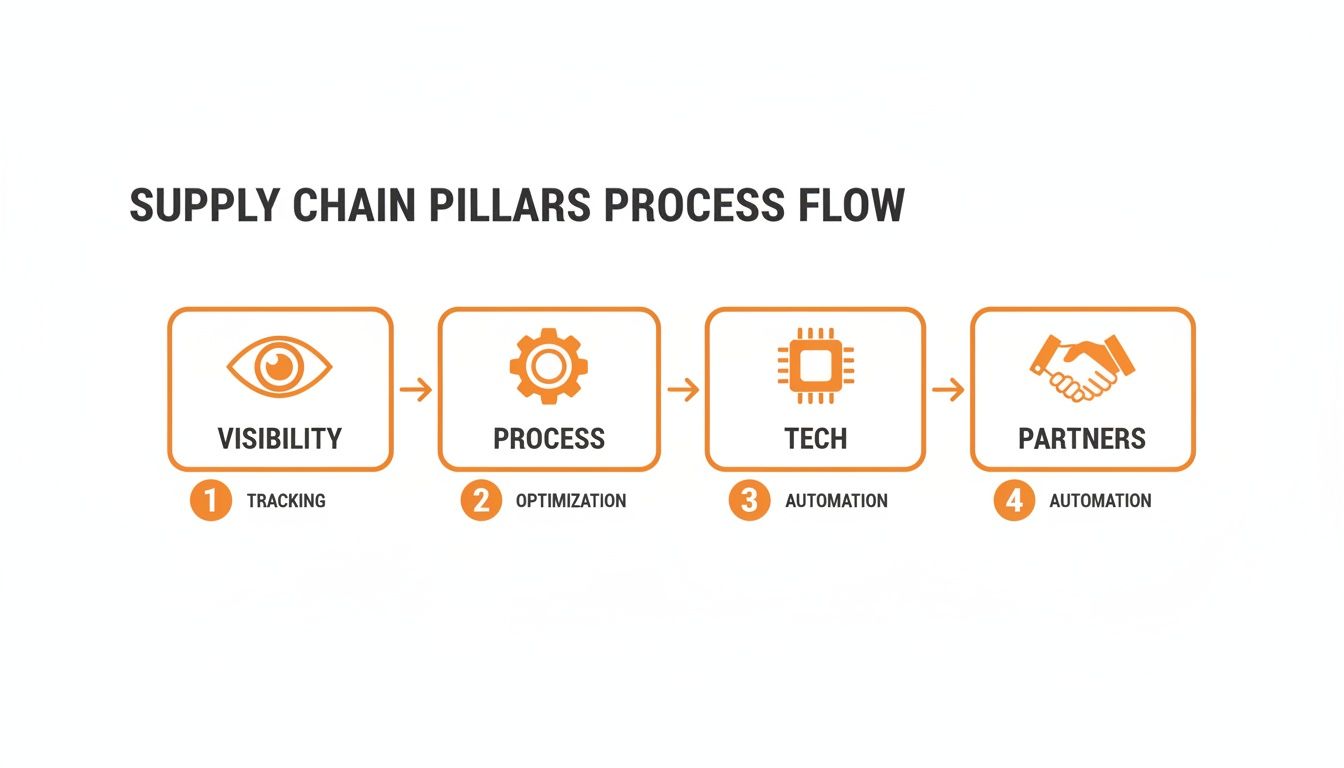
As you can see, operational excellence isn’t a one-and-done fix. It's a sequence of building blocks, with each one supporting the next. By tackling each pillar systematically, you can build a robust and scalable operation that’s ready for whatever comes its way.
Diagnosing Your Warehouse and Process Bottlenecks
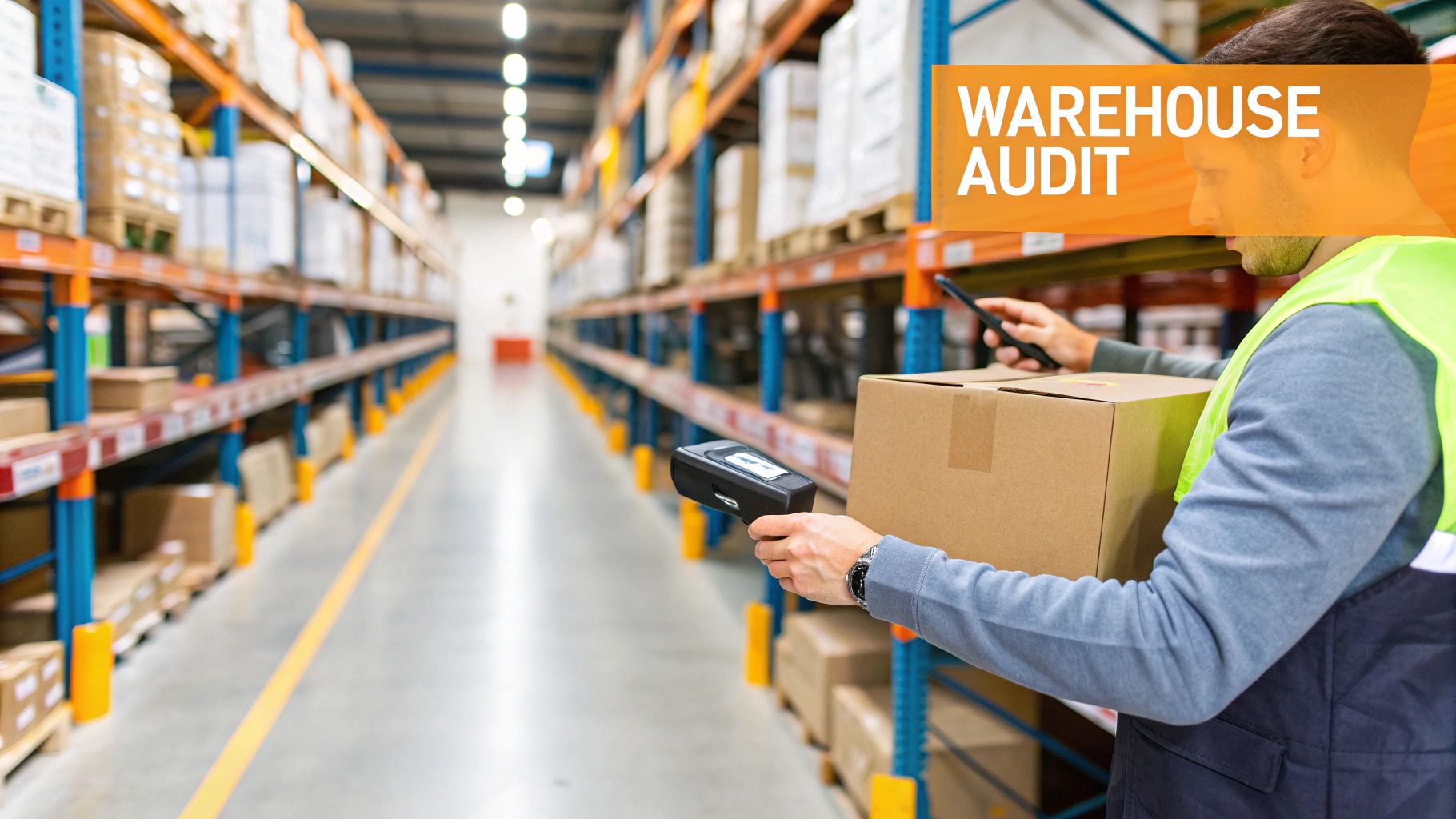
You can't fix what you can't see. Before you start overhauling your supply chain, you have to get an honest, boots-on-the-ground picture of what’s actually happening in your warehouse. This is the diagnostic phase—moving beyond gut feelings to find the real friction points that are quietly draining your time and money.
The best way to start? Walk the path of an order. Literally. Follow its entire journey from the moment it’s received to the second it leaves your dock. How many steps does a picker take to grab a single item? How many different people touch a single order before it’s sealed in a box? These simple observations often reveal shocking inefficiencies that never show up on a spreadsheet.
Where to Look for Hidden Inefficiencies
Pinpointing the exact source of a delay means zooming in on specific stages of your fulfillment process. Every step is an opportunity for improvement, but some areas are notorious for hiding the biggest bottlenecks. You're not just looking for obvious train wrecks; you're hunting for the small, repetitive actions that compound into massive wasted effort over thousands of orders.
A classic culprit is your warehouse layout. Is it actually designed around how you sell, or is it just organized by SKU number or whenever the inventory showed up? I see this all the time: a brand’s fastest-selling products are tucked away in the back of the warehouse, forcing the team to walk past slow-moving junk on every single pick.
I worked with a Shopify seller selling custom phone cases who was stuck with a two-day processing time. A quick audit revealed their top 20 SKUs made up 80% of their sales but were scattered randomly across the shelves. We moved those items into a dedicated "fast-mover" zone right next to the packing station, and just like that, they cut their average order processing time in half.
Key Metrics to Guide Your Audit
To take the guesswork out of your diagnosis, you need to track the right data. Numbers don’t have opinions—they point you directly to your biggest operational headaches. Focusing on a few key performance indicators (KPIs) gives you a clear baseline to measure your improvements against.
Get started with these critical metrics:
- Order Cycle Time: This is the total time from when a customer clicks "buy" to when the package lands on their doorstep. A long cycle time can signal anything from picking delays to slow carrier handoffs.
- Pick Accuracy: What percentage of your orders are picked perfectly the first time? Anything below 99% is a red flag. It points to issues with slotting, labeling, or your picking process, and it always leads to costly returns and angry customers.
- Receiving Dock-to-Stock Time: How long does it take for new inventory to get checked in, put away, and become available for picking? If this process takes days instead of hours, you're risking stockouts even when the product is sitting in your building.
Analyzing these numbers gives you a data-backed roadmap for what to fix first. This methodical approach is a cornerstone of effective warehouse management for e-commerce, ensuring your efforts are focused where they’ll make the biggest difference.
Finally, pull your findings together into a simple self-audit. It doesn't need to be fancy; a basic checklist is all you need to organize your thoughts and prioritize what to tackle.
Key Areas for Your Supply Chain Self-Audit
Use this table as a starting point to turn your observations into a concrete action plan. Ask yourself these questions for each key area of your operation to identify where the biggest opportunities for improvement lie.
| Operational Area | Key Question to Ask | Metric to Measure |
|---|---|---|
| Warehouse Layout | Are my fastest-selling items easily accessible? | Average pick time per order |
| Picking Workflow | How many steps does my team take to fulfill an order? | Steps per pick; orders per hour |
| Packing Station | Are all necessary supplies within arm's reach? | Units packed per hour |
| Inbound Receiving | How quickly is new inventory available for sale? | Dock-to-stock time (in hours) |
This simple framework transforms that vague feeling that "things could be faster" into a clear list of problems to solve. By methodically diagnosing these bottlenecks, you’re laying the essential groundwork to build a truly efficient supply chain.
Turning Inventory Into Your Smartest Asset
Inventory is the lifeblood of any e-commerce brand, but let's be honest—it’s also a massive headache. Carry too much, and your cash is tied up in boxes gathering dust. Carry too little, and you're dealing with stockouts, lost sales, and frustrated customers.
The secret to improving your supply chain isn't just counting what you have. It's about turning your inventory into a dynamic, intelligent asset that actively works for you. This means getting strategic about how you manage, prioritize, and forecast every single product.
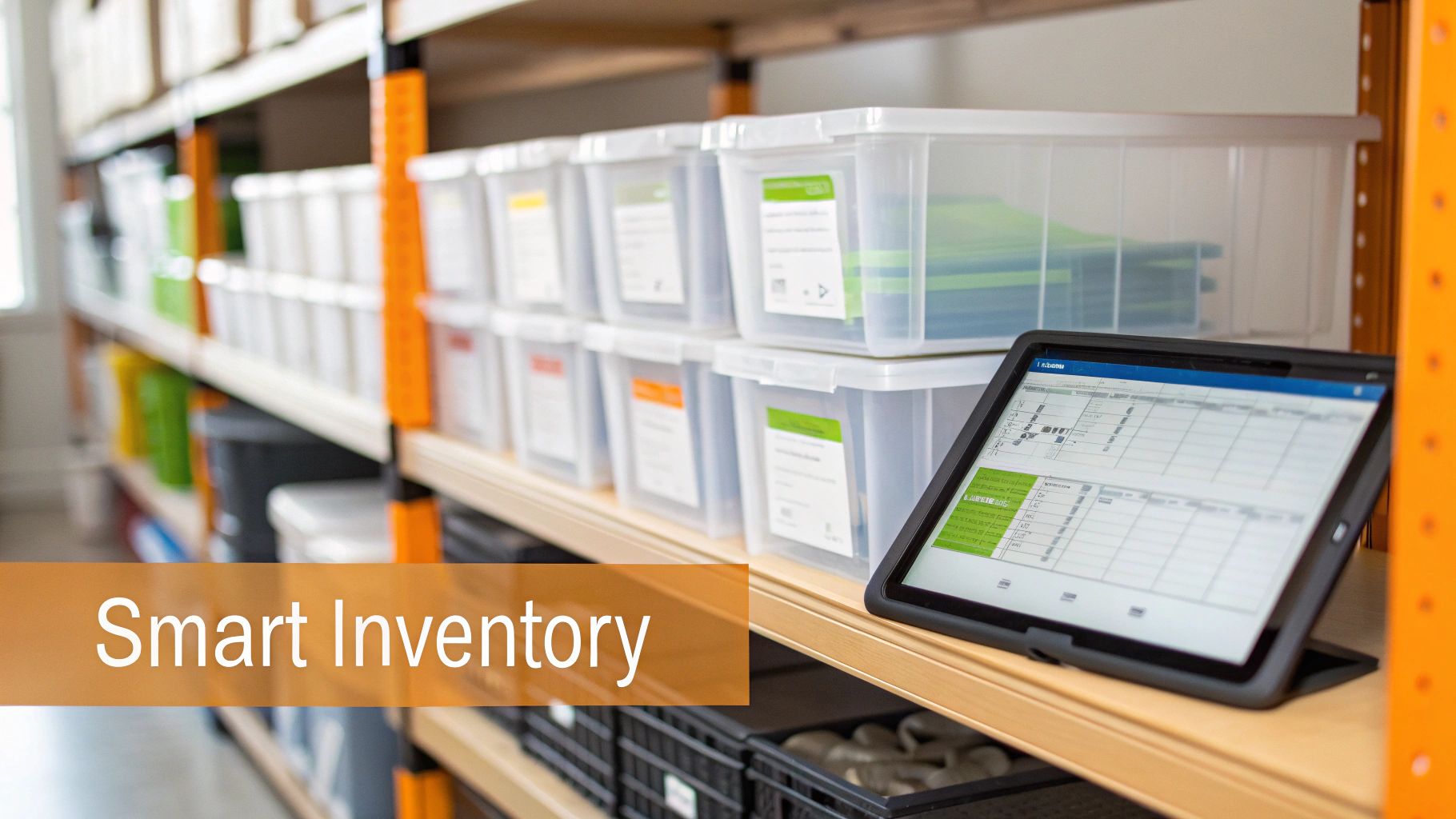
A fantastic place to start is with ABC analysis. It’s a simple but incredibly powerful method for categorizing your inventory based on its real value to your business, ensuring your most important products always get the VIP treatment they deserve.
Prioritizing Your Products With ABC Analysis
Ever heard of the 80/20 rule? ABC analysis is basically that principle applied directly to your warehouse shelves. You break down your entire product catalog into three tiers:
- A-Items: These are your superstars. They represent the top 10-20% of your SKUs but generate a whopping 80% of your revenue. These products demand the tightest inventory control, the most frequent cycle counts, and the best real estate in your warehouse.
- B-Items: This is your solid middle group. They typically make up 30% of your SKUs and contribute about 15% of your revenue. They need moderate attention but don't require the constant babysitting your A-Items do.
- C-Items: These are the slow-movers, the long-tail products. They might make up 50% of your total SKUs but only bring in around 5% of revenue. You can manage this inventory with a much looser grip, maybe using a periodic review system instead of constant monitoring.
Once you categorize your products this way, you can stop treating every SKU the same. It lets you focus your limited time and money where it will make the biggest impact.
Setting Smart Reorder Points and Buffer Stock
Now that you know which products are your breadwinners, the next job is to prevent stockouts without over-ordering. This is where setting automatic reorder points is a game-changer. A reorder point is simply the lowest stock level a product should hit before you place a new order with your supplier.
To calculate it properly, you'll need your lead time demand (that's your average daily sales multiplied by the supplier's lead time in days). Then, you add a layer of buffer stock, also called safety stock.
Buffer stock is your insurance policy against the chaos of e-commerce. It’s the extra inventory you keep on hand to guard against a sudden spike in demand or an unexpected delay from your supplier. A common mistake is applying a generic buffer—like two weeks of stock—to everything. Your A-Items need a much healthier buffer than your slow-moving C-Items.
For example, say you sell 10 units of a popular A-Item per day, and your supplier takes 14 days to deliver. Your lead time demand is 140 units. If you add a 7-day buffer (70 units), your reorder point should be set at 210 units. This simple calculation ensures you have enough stock to keep selling while the new shipment is on its way, plus a cushion for when things go sideways.
The Amazon Seller Challenge: IPI Score and FBA
For Amazon sellers, this whole inventory game gets an extra layer of difficulty: the Inventory Performance Index (IPI) score. This metric, from 0 to 1,000, is how Amazon grades your FBA inventory management. A low score can slam you with storage limits and higher fees, directly hitting your bottom line.
To keep your IPI score healthy, you have to juggle a few key factors:
- Excess Inventory: Don't clog up FBA with slow-moving products.
- Sell-Through Rate: Keep your products turning over by aligning stock levels with sales velocity.
- Stranded Inventory: Fix any listing problems immediately so your products are actually buyable.
- In-Stock Inventory: Make sure your most popular and profitable items are always available.
Many smart sellers use a hybrid strategy. They keep a small, fast-moving supply at FBA to protect their IPI score, while holding the rest of their inventory with a 3PL partner. This lets them replenish FBA in a flash without getting hit with long-term storage fees on slower products. To really nail this down, you can learn more about these inventory management best practices.
When you make your inventory work for you, not against you, you’re building the foundation for a truly efficient supply chain.
Using Automation and Tech to Scale Your Operations
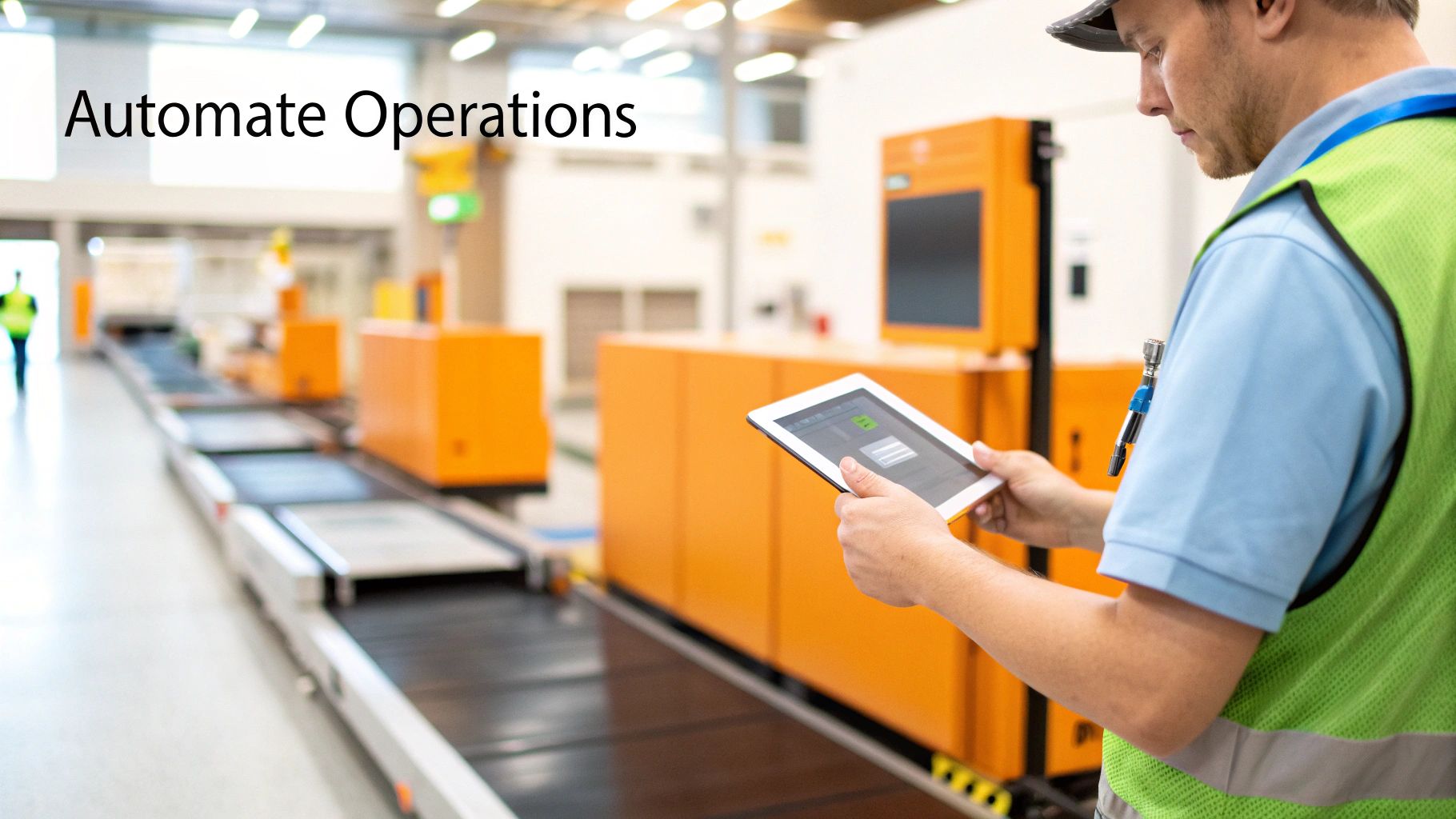
If you're still running your warehouse on spreadsheets and gut feelings, you're going to hit a wall. Sooner or later, manual processes become the bottleneck that chokes your growth. This is the point where technology isn't just a nice-to-have; it's the only way to scale without everything falling apart.
Embracing automation isn't about filling your warehouse with robots (though that can be part of it). It’s about being smart with software to kill repetitive tasks, slash human error, and get the data you need to make quick, informed decisions. Your tech stack is the central nervous system of your entire supply chain.
Implementing a Warehouse Management System
One of the biggest levers you can pull for efficiency is adopting a Warehouse Management System (WMS). A WMS is basically the mission control for your warehouse, giving you a live look at everything from the moment a product hits your dock to the second it’s on a truck to a customer.
It digitizes your entire workflow, and the improvements are almost immediate.
- Real-Time Inventory Visibility: A WMS tracks every single item, so you know exactly where it is. No more hunting for "lost" products, and your website's stock levels are always spot on.
- Optimized Picking Paths: The system tells your team the most efficient route to pick an order, which dramatically cuts down on wasted steps and boosts how many orders one person can pick in an hour.
- Fewer Picking Errors: With barcode scanners and system checks, a WMS can get your picking accuracy close to 100%. That means fewer returns, happier customers, and less money wasted on fixing mistakes.
A WMS turns organized chaos into a finely tuned, data-driven operation. It's the foundation that lets you scale from hundreds of orders a month to thousands without your team breaking a sweat.
A lot of smaller brands think a WMS is just for giants like Amazon. That's not true anymore. There are plenty of cloud-based WMS platforms built specifically for growing e-commerce businesses, and they're more affordable than you think.
The Rise of AI in Supply Chain Management
Beyond a WMS, Artificial Intelligence (AI) is quickly becoming the go-to tool for getting ahead of problems. AI isn't just about automating simple tasks; it’s about predictive analytics that help you make decisions before you're in crisis mode.
AI can sound intimidating, but its real-world uses are incredibly practical. For instance, an AI-powered system can chew through your sales history, current market trends, and even social media chatter to give you a demand forecast that's way more accurate than any human could create.
Imagine getting an alert that a key product is at risk of stocking out in three weeks because an influencer just mentioned it. That's the power of AI. It gives you a heads-up so you can place a PO and avoid a stockout entirely. It can also flag a delayed inbound shipment and suggest reallocating inventory from another channel to cover your immediate needs.
The results speak for themselves. Companies using these tools are seeing huge efficiency gains. In markets like the US and Europe, brands report up to 20-30% faster order fulfillment when AI flags issues and suggests solutions. For a deep dive into what's coming, check out these supply chain AI trends on dataiku.com.
Choosing the Right Tech for Your Business
With so many options out there, it’s easy to get overwhelmed. The secret is to start by tackling your biggest headache first.
| If your problem is… | Look for technology that offers… |
|---|---|
| Frequent stockouts or overstocking | Advanced inventory forecasting and automated reorder points. |
| High rate of picking/shipping errors | A WMS with barcode scanning and order verification features. |
| Slow order fulfillment times | Software with smart picking strategies and batch processing. |
| Lack of operational visibility | A centralized dashboard with real-time analytics and reporting. |
You don't need to buy a massive, do-it-all system on day one. Start small, focus on the tools that solve your most expensive problems, and build from there. By adding technology strategically, you build a resilient operation that's ready for whatever growth comes your way.
Building Stronger Supplier and Inbound Logistics
A slick supply chain doesn't just happen after a customer clicks "buy." It starts way, way back with the partners who actually make your products. If your inbound game is a mess—unpredictable, slow, and disorganized—you'll spend all your time putting out fires instead of growing your brand.
This is all about building a foundation of resilience and predictability. You need to trust that your suppliers can deliver on time, every time. And you need a rock-solid process for getting that inventory off the truck and onto your shelves without creating a massive traffic jam at the receiving dock.
Diversify Suppliers and Rethink Your Geography
Relying on a single factory for your best-selling product is just asking for trouble. One hiccup on their end—a production delay, a shipping nightmare, a port shutdown—and your entire business grinds to a halt. It's a massive single point of failure.
That's why smart brands always have a backup plan. Having a primary and a secondary supplier for your A-Items is non-negotiable. It gives you a safety net, strengthens your negotiating power, and helps keep quality high.
But it’s not just about having more names on a list. It’s also about where they are.
The move toward nearshoring—sourcing from countries closer to home—is exploding for a reason. With global supply chains still feeling shaky, brands are strategically shifting production to more stable regions. We're seeing businesses cut their lead times and risk exposure by 15-25% just by making this change. It's not about ditching your global partners, but about creating a more balanced, bulletproof network. You can dig deeper into these evolving supply chain trends on rfgen.com.
Establish Crystal-Clear Inbound Guidelines
Want to speed up receiving? Make it painfully easy for your suppliers to send you inventory exactly how you want it. Stop assuming they know your process. Create a formal Supplier Inbound Guide and bake it into every purchase order you send.
This document needs to be brutally specific, with pictures and diagrams—leave zero room for error.
- Carton Labeling: Show the exact size, format, and placement for all carton labels. Mandate barcodes, SKUs, quantities, PO numbers, and country of origin.
- Pallet Configuration: Lay out the rules for how cartons are stacked. Define the max height and weight. Specify if pallets can contain mixed SKUs or must be single-SKU only.
- Documentation: Make an electronic Advanced Shipping Notice (ASN) mandatory. It should be sent the second the freight leaves their facility, giving your team a critical heads-up to plan labor and space.
A well-defined inbound guide is a massive efficiency lever. When your team can scan a pallet and know exactly what's on it without opening a single box, your dock-to-stock time can shrink from days to just a few hours.
Master Your Receiving and Quality Control Process
Finally, your own inbound process needs to run like clockwork. When a container shows up, your team should have a clear, repeatable workflow ready to go.
This starts with scheduling delivery appointments. The last thing you want is three trucks showing up at once, completely overwhelming your dock crew and creating chaos.
As pallets come off the truck, step one is verification. Does the physical shipment match the ASN and the PO? Any issues get flagged on the spot. From there, your QC team can jump in to perform spot checks based on your quality standards. This ensures you catch any defects before a product ever hits a pickable shelf location.
Nailing your supplier relationships and inbound logistics creates a powerful ripple effect. Predictable lead times make your forecasting more accurate. Clear labeling makes putaway faster. And tight quality control stops bad products from ever reaching your customers.
When to Partner With a 3PL for Strategic Growth
At some point, every successful e-commerce founder has the same realization: they're spending more time wrestling with packing tape and shipping labels than they are actually growing their business.
Handling fulfillment in-house feels like the ultimate form of control when you're starting out. But as you scale, that control quickly becomes a bottleneck. Your time is your most valuable asset, and if it's being spent in the warehouse instead of on marketing, product development, or building your brand, you're holding yourself back.
This is the inflection point where partnering with a Third-Party Logistics (3PL) provider stops being a "nice to have" and becomes one of the smartest strategic moves you can make. It’s not about admitting defeat; it’s about recognizing that your genius lies in creating and selling great products, not in the highly specialized, capital-intensive world of logistics.
Telltale Signs You've Outgrown In-House Fulfillment
So, how do you know when it's time? The signs are usually pretty clear. If you find yourself nodding along to any of these scenarios, it’s time to start looking for a logistics partner. These aren't just minor growing pains—they're signals that your current operations are capping your growth.
- You’re the Chief Packing Officer: If you, the founder, are still packing boxes, you're the most expensive person on your own pick-and-pack line. Your focus should be on strategy, not on fulfilling individual orders.
- You Can't Keep Up With Orders: Are you constantly underwater during peak season? Or maybe even just a busy Tuesday? A good 3PL is built for this. They scale their labor and resources up or down in real-time, so you never become a victim of your own success.
- Your "Warehouse" Is Your Garage: When inventory starts taking over your office, your garage, and every spare closet, you’re not just creating a mess—you're running an inefficient operation. A 3PL gives you instant access to professional warehouse space without the headache of a long-term commercial lease.
- Your Shipping Rates Are Too High: 3PLs ship millions of packages a year. They have access to deeply discounted rates from carriers like UPS, FedEx, and USPS that a small or mid-sized business could never get on its own.
Partnering with a 3PL shifts fulfillment from a fixed cost to a variable one. You pay for what you use, which means your logistics expenses scale perfectly with your revenue.
The Power of Centralization and Scale
One of the biggest wins you get with a 3PL is centralization. Instead of juggling a dozen different tasks and systems, a 3PL becomes your single operational hub. This approach is designed to unify all the repetitive work under one roof, using scale to drive down costs and improve efficiency. In fact, industry reports show this model can cut operational costs by 10-20% while making your business far more agile. You can find more insights on this in Supply Chain Dive's recent analysis.
You get the benefits of enterprise-level technology and infrastructure without having to build or pay for it yourself.
A great 3PL isn't just a vendor; they are a true extension of your team. They bring the operational expertise, the tech stack, and the physical space that allows you to compete with much larger brands.
Specialized Services a 3PL Handles Seamlessly
Beyond just picking, packing, and shipping, a modern 3PL offers a whole menu of value-added services that are a massive headache to manage in-house. These services are often what unlock new sales channels and create a better customer experience.
Think about common e-commerce needs:
- Amazon FBA Prep: Selling on Amazon means playing by their rules, and those rules are complex. A good 3PL can handle everything—from applying FNSKU labels and poly bagging to creating case packs—to ensure your inbound shipments are 100% compliant. This saves you from costly penalties and receiving delays.
- Custom Kitting and Bundling: Want to sell a "starter kit" or bundle three of your products for a holiday promotion? A 3PL can build these kits on demand, turning your individual SKUs into new, high-value offerings without you having to pre-assemble a single one.
- Freight Management: Getting your inventory from your supplier to the warehouse is a job in itself. Whether it’s a full container from overseas or a smaller LTL shipment, a 3PL with freight capabilities can coordinate the entire process—receiving, unloading, pallet breakdowns, and quality checks—so your inventory gets from the dock to a stockable shelf fast.
When you hand off these complex operational tasks, you free up an incredible amount of mental and physical energy. You can finally stop worrying about the tactical details and pour that energy back into what really moves the needle: building an amazing brand.
Ready to stop packing boxes and start scaling your brand? Snappycrate is the trusted 3PL partner for growth-minded e-commerce sellers. We handle everything from secure storage and inventory management to fast, accurate order fulfillment and compliant Amazon FBA prep, so you can focus on what you do best. Get a quote and see how we can streamline your operations.