So, you’ve built a great product and your online store is finally getting traction. The orders are rolling in. Now what? Suddenly, you're not just a brand owner—you're a warehouse manager, a box packer, and a shipping coordinator. This is where most growing businesses hit a wall.
That's where an ecommerce order fulfillment service comes in. Think of them as your expert backstage crew. While you’re on stage focusing on marketing, product design, and connecting with customers, they're handling all the logistics behind the curtain to make sure every order ends with a happy customer.
What Are Ecommerce Order Fulfillment Services?
An ecommerce order fulfillment service, often called a 3PL (third-party logistics), is a partner company that manages the entire physical journey of your products after a customer clicks "buy." They handle everything from receiving your inventory from manufacturers to picking, packing, and shipping orders directly to your customers.
Basically, they take over the most time-consuming, physical parts of running an ecommerce business. This frees you from getting buried in packing tape and shipping labels so you can focus on what you do best: growing your brand.
The Core Functions of a Fulfillment Partner
A good fulfillment partner does way more than just stick a label on a box. They become an extension of your operations, managing the critical steps that define your customer's experience.
Here’s a breakdown of what they handle:
- Receiving Inventory: Your products arrive at their warehouse, where their team inspects everything, counts it, and adds it to your inventory so it’s ready to sell.
- Secure Storage: They store your products safely in an organized, professional warehouse, using software to keep track of every single unit. No more storing boxes in your garage.
- Picking and Packing: As soon as an order comes through your store, their team gets an alert. They find the right items, pack them securely, and get them ready for shipment.
- Shipping Logistics: They have relationships with major carriers like USPS, FedEx, and UPS. This means they can find the best shipping rates and speeds for each order, saving you time and money.
- Returns Management: Handling returns is a headache. A 3PL manages this "reverse logistics" process for you, inspecting returned items and putting them back into your inventory if they’re in good condition.
This model is exploding in popularity for a reason. The global market for these services was valued at $141.35 billion in 2025 and is on track to hit a staggering $468.44 billion by 2034. Why the massive growth? Because brands are realizing they can't compete on customer experience without expert logistics. You can explore more data on this market trend to see just how big this shift is.
Outsourcing your fulfillment isn't just about offloading work—it's a strategic move. It allows a small but ambitious brand on Shopify, Amazon, or Walmart to offer the same fast, reliable shipping as a major corporation, without needing to invest millions in their own warehouse and staff.
To give you a clearer picture, let's summarize these core responsibilities.
Key Functions of an Order Fulfillment Service
Here’s a quick overview of what a 3PL partner takes off your plate.
| Function | Description | Benefit for Your Business |
|---|---|---|
| Inventory Receiving | Inspecting, counting, and stocking incoming shipments from your suppliers. | Ensures inventory is accurate and ready for sale immediately upon arrival. |
| Warehousing & Storage | Securely storing your products in an organized and professional facility. | Frees up your space and provides a scalable solution as your inventory grows. |
| Pick & Pack | Accurately selecting the correct items for an order and packing them safely. | Guarantees orders are correct and protected during shipping, reducing errors and damages. |
| Shipping & Carrier Mgmt | Managing carrier relationships to access discounted rates and multiple shipping options. | Saves you money on shipping and lets you offer customers faster delivery choices. |
| Returns Processing | Handling inbound customer returns, inspecting products, and restocking them. | Streamlines the returns process, improving customer satisfaction and recovering inventory value. |
Ultimately, a fulfillment partner handles the operational complexity so you can stay focused on growth. They provide the infrastructure, technology, and expertise needed to create a seamless experience for your customers from checkout to delivery.
The Five Stages of the Fulfillment Workflow
To really get why ecommerce order fulfillment services are such a game-changer, you have to picture the journey your product takes. It's less of a straight line and more of a well-oiled machine, where every single step is fine-tuned for speed and accuracy. This entire process, managed by a 3PL partner, breaks down into five key stages that make or break your customer's experience.
This simple flowchart nails the basic journey, from the customer's "buy now" click to the package landing on their doorstep.
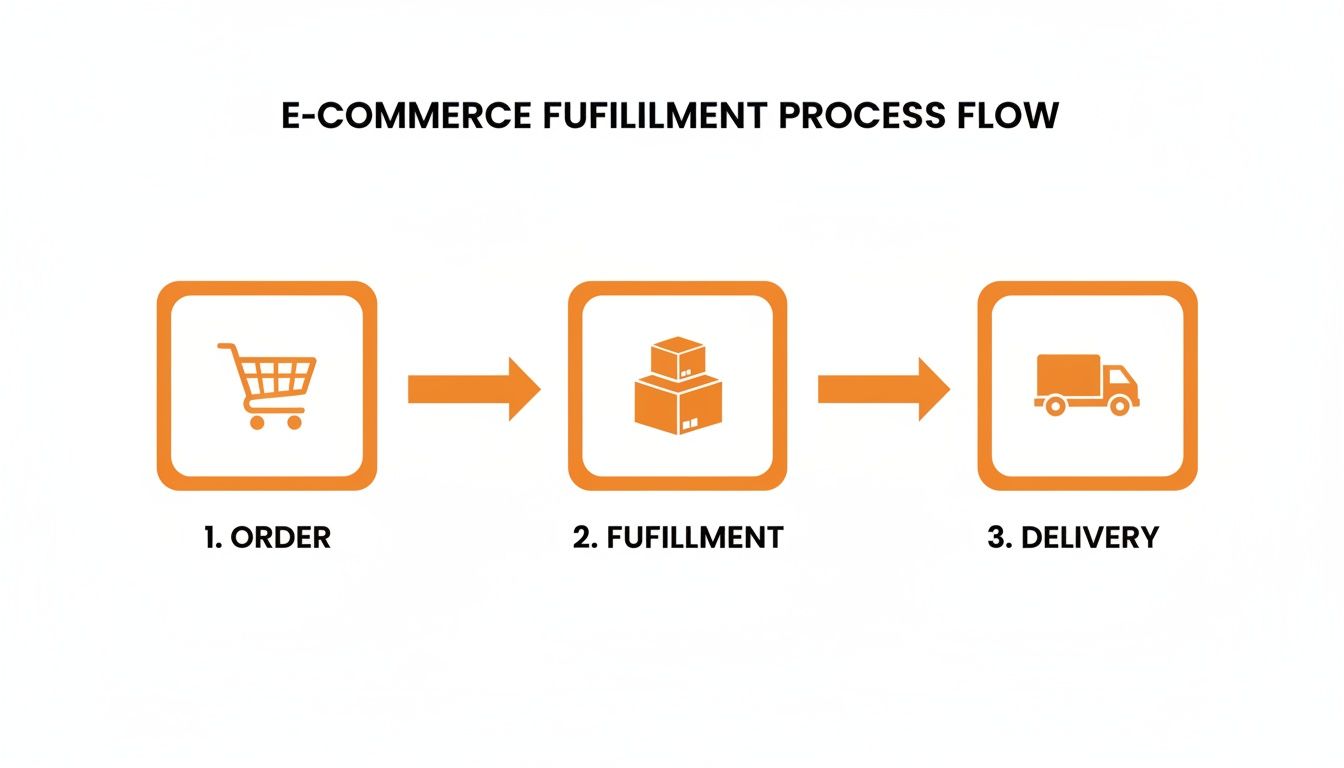
This shows the handoff from your digital storefront to the real-world logistics that get things done. Let's pull back the curtain on the five stages happening behind the scenes.
Stage 1: Receiving Inventory
It all starts the second your products hit the fulfillment center's loading dock. This isn't just a simple drop-off; it’s a critical checkpoint known as receiving or inbound logistics.
The warehouse crew unloads your shipment, whether it’s a few parcels or a full 40-foot container. Every box is opened, and the contents are inspected for damage and counted to make sure they match the packing slip or purchase order you sent over. This is your first line of defense against sending out damaged goods.
Once everything checks out, each item is scanned into the Warehouse Management System (WMS). Instantly, it appears in your inventory dashboard. This is the official moment your fulfillment partner takes custody of your stock.
Stage 2: Storage and Inventory Management
With your products received, they need a home. In a professional 3PL, this is all about strategic storage, not just stuffing things on a random shelf. Items get assigned specific spots—bins, shelves, or pallets—based on their size, weight, and how often they sell.
This is where a powerful WMS really shines. It’s the brain of the whole operation, tracking the exact location and quantity of every single SKU. This system makes several key things possible:
- Real-Time Visibility: You can log in anytime and see precisely what you have in stock. No guesswork.
- Low-Stock Alerts: The system can ping you automatically when a product's inventory dips below a certain level, helping you avoid painful stockouts.
- Smart Placement: Your fastest-selling products are often stored in the most accessible spots to slash the time it takes to pick an order.
A well-run warehouse is like a library with a flawless digital catalog. The picker knows exactly where to find any product in seconds, cutting out wasted time and making sure the right item gets pulled every single time.
This organized approach is the foundation for hitting high accuracy rates and getting orders out the door fast.
Stage 3: Picking and Packing
The moment a customer places an order on your Shopify, Amazon, or Walmart store, the WMS springs into action and generates a picking list. This kicks off the picking and packing stage—the most hands-on part of the whole workflow.
A warehouse team member, or "picker," gets the order on a mobile scanner that maps out the most efficient route to grab the items. Once everything for the order is collected, it goes to a packing station. Here, a "packer" double-checks the items against the order, chooses the right-sized box or mailer, and adds protective material like bubble wrap to prevent damage. This is also where any custom touches, like marketing inserts or branded tape, get added.
Stage 4: Shipping the Order
With the order all packed up, it's ready for shipping. The package is weighed and measured, and the fulfillment center’s software instantly shops for the best shipping rate across carriers like USPS, FedEx, or UPS. It automatically selects the right service based on the customer’s location and the delivery speed they chose at checkout.
This is way more efficient than doing it yourself. 3PLs ship in enormous volumes, giving them access to deeply discounted shipping rates they can pass on to you. A shipping label is printed, slapped on the box, and the package is moved to the pickup area. As soon as the carrier scans it, tracking info is pushed back to your e-commerce store, which triggers that "Your order has shipped!" email to your customer.
Stage 5: Managing Returns
The customer's journey doesn't always end at delivery. Returns management, often called reverse logistics, is the last—and frequently forgotten—stage. When a customer needs to send something back, a seamless process is crucial for keeping them happy.
Your fulfillment partner manages this whole process. They receive the returned package, inspect the item's condition, and handle it based on your rules. If the product is good as new, it's restocked and added back to your sellable inventory. If it's damaged, it's set aside for you to decide what to do. This closes the loop, helping you recover value from returns while giving your customers a hassle-free experience.
Mastering Amazon FBA Prep and Compliance
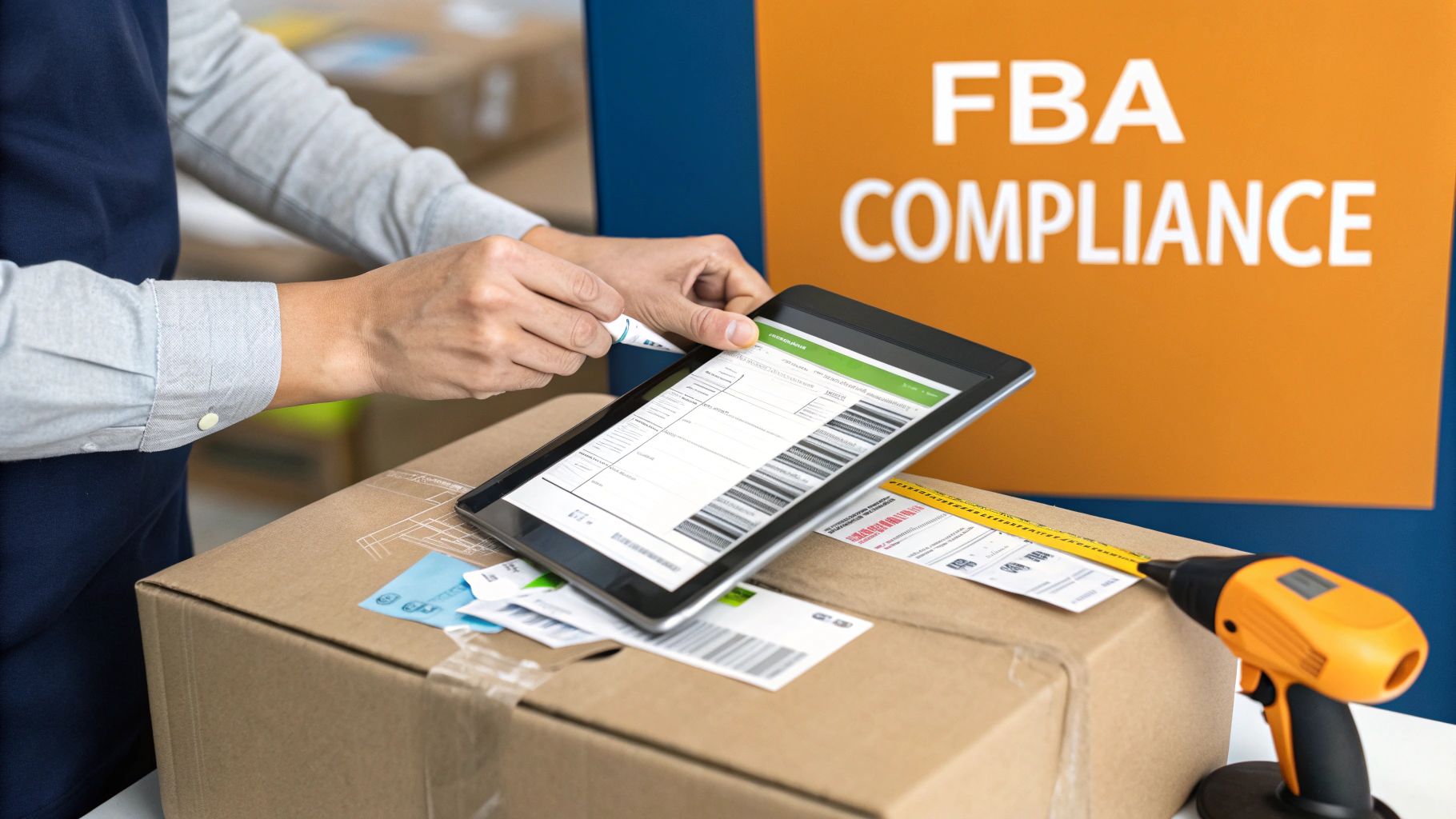
Selling on Amazon FBA is a game-changer. It gives you instant access to millions of customers and Amazon's world-class logistics. But there's a catch: you have to play by their rules. And trust me, Amazon's rulebook is thick, specific, and non-negotiable.
You can't just toss your products in a box and ship them off to a fulfillment center. Every single item has to meet a long checklist of prep requirements. If they don't, you're looking at costly penalties, rejected shipments, or even having Amazon dispose of your valuable inventory.
Think of an Amazon warehouse—it's a symphony of automation, with robots and scanners moving at lightning speed. For that system to work flawlessly, every product needs to be standardized. That's where FBA prep and compliance come in. A good fulfillment partner is your expert on the ground, making sure every shipment is perfect before it ever leaves their warehouse.
Why FBA Prep Is a Non-Negotiable Step
Getting FBA prep wrong isn't a small slip-up; it can bring your entire Amazon operation to a screeching halt. Amazon will absolutely refuse shipments that don't meet their guidelines, leaving you with stranded inventory racking up storage fees and zero sales.
Worse yet, repeated mistakes hurt your seller reputation and your Account Health score. That can lead to selling restrictions or worse. Proper prep is your insurance policy against these headaches. It’s what ensures your products get checked in quickly and go live for sale without a hitch.
Core FBA Prep Services Your Partner Handles
An experienced partner offering ecommerce order fulfillment services manages every last detail of the FBA prep process. It’s way more than just boxing things up; it's a meticulous, checklist-driven process to guarantee compliance.
Here are the must-have services they'll take off your plate:
- FNSKU Labeling: Every unit needs an Amazon-specific barcode (the FNSKU) that covers the original UPC. This is how Amazon tracks your inventory in their massive network, so it has to be perfect.
- Poly Bagging: Got t-shirts, plush toys, or products with small parts? They'll need to be sealed in a protective poly bag to stay clean and contained.
- Suffocation Warnings: This is a big one. Any poly bag with an opening 5 inches or wider must have a suffocation warning label. It’s a safety requirement Amazon takes very seriously.
- Bundling and Kitting: If you sell a shampoo and conditioner set, for example, it needs to be packaged together and slapped with a "Sold as Set" or "This is a Set, Do Not Separate" sticker. This prevents warehouse workers from splitting them up.
- Quality Control Inspections: Before anything heads to Amazon, your partner should be doing a final check for damage or defects. This simple step can save you from a flood of negative reviews.
A skilled FBA prep service acts as a final quality gatekeeper. They are your eyes and ears, catching potential issues before they reach Amazon's fulfillment centers, safeguarding your inventory and your brand's reputation with every shipment.
Handing this off to a specialist means you skip the painful learning curve and avoid the expensive mistakes. To see what a dedicated service looks like, check out this breakdown of Amazon FBA prep services and what to look for. It lets you tap into the power of FBA without getting lost in the weeds of its complex rules.
Integrating Your Sales Channels for Seamless Operations
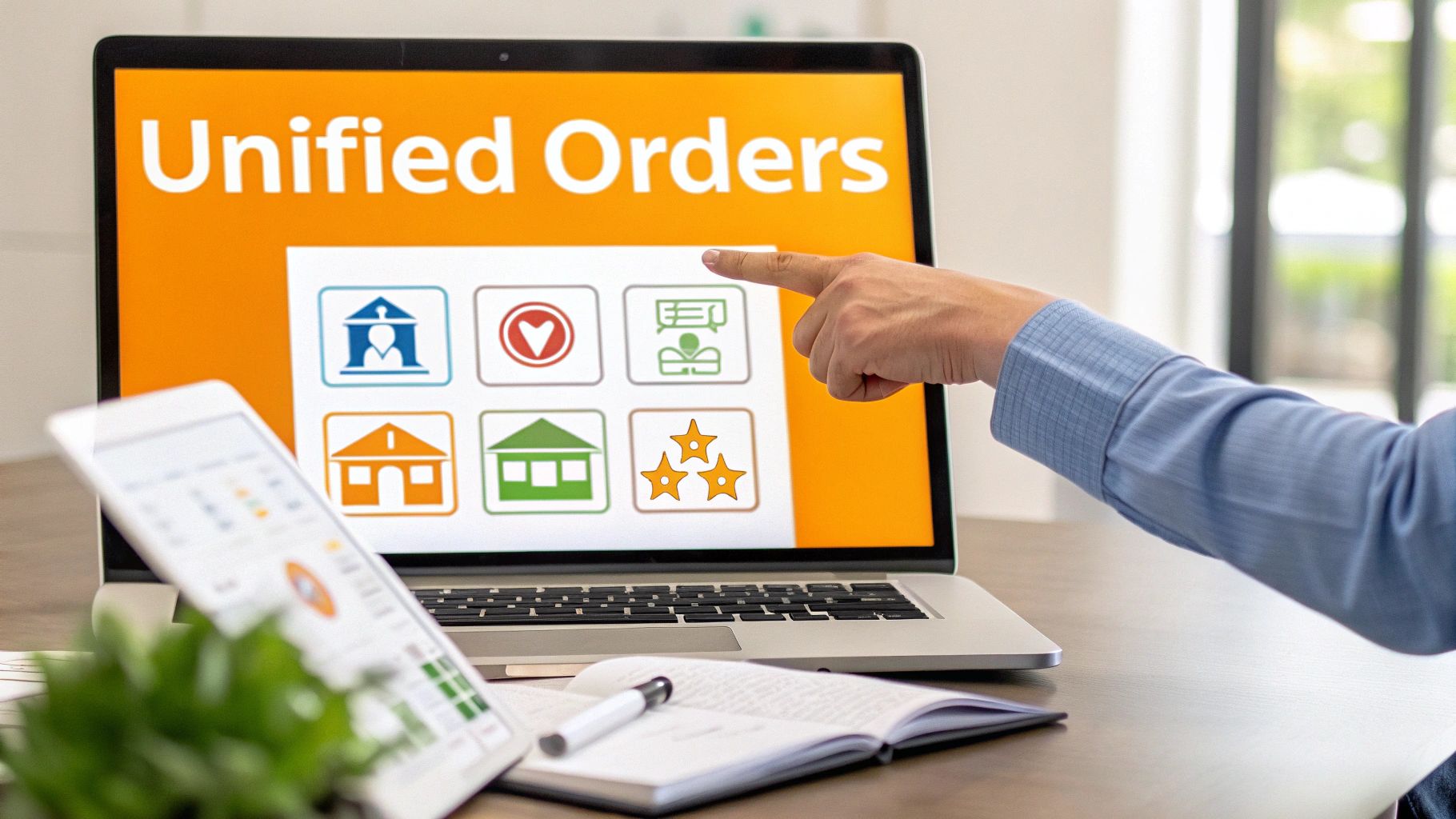
Today’s ecommerce brands don't live in just one place. You might have your main store on Shopify, a huge presence on Amazon, and a growing shop on Walmart Marketplace. Trying to manage orders from all those channels by hand is a recipe for disaster—it’s slow, full of errors, and simply won't scale with you.
This is where technology becomes the backbone of your partnership with an ecommerce order fulfillment services provider. The real magic is the seamless integration between your sales platforms and your partner’s Warehouse Management System (WMS).
Think of this digital link as the central nervous system for your entire operation. It works quietly in the background, making sure every part of your business talks to each other perfectly, without you having to lift a finger. This automation is what separates a chaotic, reactive process from a smooth, scalable one.
The Power of Automated Order Syncing
The second a customer hits "buy" on any of your channels, the integration instantly pulls that order data straight into the 3PL's system. This completely gets rid of the need for you to manually export order sheets and email them over. No more spreadsheets.
This direct connection is more than just a convenience; it's a must-have for modern commerce. The benefits are immediate and obvious.
- Drastically Reduces Human Error: Manually typing in orders always leads to mistakes—wrong addresses, incorrect products, you name it. Automation wipes out this risk, driving up your order accuracy.
- Saves a Ton of Time: All those hours you used to spend on order admin? You get them all back. Now you can focus on what really grows your business: marketing, product development, and customer service.
- Gets Orders Out Faster: Orders hit the warehouse floor in minutes, not hours. This seriously cuts down the time from click to ship, which is exactly what customers love to see.
This integration turns your fulfillment from a bunch of manual chores into a single, automated workflow. It’s the engine that lets you process hundreds or even thousands of orders across multiple channels just as easily as you’d handle one.
Real-Time Inventory Management Across Channels
Maybe the biggest win from a fully integrated system is unified inventory management. When your fulfillment partner ships an order from your Walmart store, the WMS automatically updates your stock levels. That change is then instantly pushed back to your Shopify and Amazon listings.
This real-time sync prevents one of the worst headaches for multi-channel sellers: overselling. You'll never have to cancel an order and tick off a customer because you sold something on one platform that was already gone from a sale on another.
It makes sure the inventory counts on all your storefronts are always spot-on. This builds trust with your customers and protects your seller ratings, which are vital for staying visible on competitive marketplaces. You can learn more about how these crucial ecommerce integrations connect your whole tech stack.
By plugging your sales channels directly into your fulfillment provider, you create a single, cohesive ecosystem. Every order, from any source, flows into one central hub for picking, packing, and shipping, while your inventory stays perfectly managed across your entire business.
Decoding Fulfillment Pricing and Performance Metrics
Choosing the right partner for your ecommerce order fulfillment services is about so much more than just finding someone to pack boxes. It’s about finding a partner whose costs make sense for your business and whose performance you can actually measure. Let's pull back the curtain on how fulfillment pricing really works and the critical numbers you need to watch.
Understanding a fulfillment quote can feel like you're trying to read a foreign language at first. But once you get the hang of the core components, it all starts to click. Most 3PL pricing is built around four key activities.
The Four Pillars of Fulfillment Costs
Think of fulfillment pricing less like a fixed-price meal and more like an à la carte menu. You only pay for the specific services you actually use, which keeps you from getting stuck with a bill for things your business doesn't need.
Here are the main fees you’ll run into:
- Receiving Fees: This is the cost to get your inventory checked in and ready for sale. It covers the labor for unloading trucks, inspecting your products, counting them, and putting them away in the warehouse. This is usually billed by the hour, per pallet, or sometimes per unit.
- Storage Fees: You’re essentially renting shelf space. This fee is charged monthly and is based on how much room your inventory takes up. It's often calculated in cubic feet, per pallet, or per bin.
- Pick and Pack Fees: This covers the labor involved in grabbing the items for an order and packing them up for shipment. It’s typically billed as a fee per order, plus a small extra fee for each item in that order.
- Shipping Fees: This is the actual postage cost to send a package through carriers like USPS, FedEx, or UPS. The good news? Because 3PLs ship in massive volumes, they get huge discounts and pass those savings on to you.
Once you understand these four fees, you can compare quotes from different providers and have a real conversation about what you need.
It's one thing to understand the bill, but it's another to know if you're getting your money's worth. Here's a quick look at the typical fees you'll see on a fulfillment quote.
Common Fulfillment Service Fees Explained
| Fee Type | What It Covers | Common Pricing Structure |
|---|---|---|
| Onboarding/Setup | The initial work to integrate your store, set up your products in the system, and train the team on your specific needs. | One-time flat fee |
| Receiving | Labor to unload, count, inspect, and put away your incoming inventory. | Per hour, per pallet, or per unit |
| Storage | Renting warehouse space for your products. | Per pallet, per bin, or per cubic foot (charged monthly) |
| Pick & Pack | Labor to retrieve items for an order, package them, and prepare the shipping label. | Per order + per item in the order |
| Shipping | The actual cost paid to the mail carrier (e.g., USPS, FedEx, UPS). | Based on package weight, dimensions, and destination |
| Packaging Materials | The cost of boxes, mailers, tape, and void fill used for your orders. | Per order or included in the pick & pack fee |
| Returns Processing | Handling returned items, including inspection, restocking, and updating your inventory. | Per item processed |
| Account Management | A dedicated point of contact and ongoing support from the 3PL's team. | Monthly flat fee or included in other charges |
Having this breakdown makes it much easier to see where your money is going and ensures there are no surprises when the invoice arrives.
Key Performance Indicators to Measure Success
So, your fulfillment is up and running. How can you tell if your 3PL is crushing it or dropping the ball? You have to track the right data. These Key Performance Indicators (KPIs) are the official report card for your fulfillment operation, showing you exactly what’s working and what needs a little help.
And make no mistake, performance is everything. Today's customers are demanding. A staggering 60% of online retailers outsource at least some of their fulfillment, largely because 52% of consumers get frustrated by shipping delays and 77% want their stuff delivered fast. Tracking performance isn’t just a good idea—it’s how you stay in business. You can discover more ecommerce fulfillment statistics on Capital One Shopping to see just how high the stakes have gotten.
Measuring performance isn't about micromanaging your 3PL. It's about establishing a shared understanding of success. When you and your partner are aligned on these metrics, you can work together to consistently delight your customers.
Here are the non-negotiable KPIs you should be watching like a hawk:
Order Accuracy Rate: What percentage of your orders are shipped perfectly, with no mistakes? A great partner should hit 99.5% or better. Anything less means you're dealing with unhappy customers and expensive returns.
On-Time Shipping Rate: This tracks how many orders are picked, packed, and out the door within the agreed-upon window (usually 24 hours). Hitting this goal is the first step to meeting your customers' delivery expectations.
Dock-to-Stock Time: How fast does your new inventory go from the delivery truck to being available for sale? A quick turnaround of 24-48 hours is crucial. Any longer, and you risk selling out of a product you technically have in the building.
Inventory Accuracy: Does the number in the computer match the number of units on the shelf? Your 3PL’s inventory count should be above 99% accurate. If not, you could easily oversell products you don’t actually have.
How to Choose the Right Fulfillment Partner
Picking a partner to handle your ecommerce order fulfillment services is one of the biggest decisions you'll make for your brand. This isn't just about hiring another vendor; it’s about trusting someone with the final, crucial step of your customer experience.
Get it right, and your fulfillment partner acts as a launchpad for growth. Get it wrong, and they become a bottleneck, frustrating customers and grinding your progress to a halt.
The stakes are massive. By 2025, the world is projected to ship a mind-boggling 217 billion parcels. That breaks down to nearly 5,900 packages flying out the door every single second. With 52% of shoppers admitting they get frustrated by slow deliveries, the pressure has never been higher. For a closer look at these numbers, you can discover more insights about global shipping statistics on Swell.is.
To make a smart choice, you need to go beyond the sales pitches. It’s all about asking the right questions to figure out what truly matters for your business.
Assess Their Expertise and Specialization
Not all fulfillment centers are built the same. A 3PL that's fantastic at shipping t-shirts might be completely lost when it comes to fragile glassware or oversized furniture. Your first filter should always be finding a partner whose expertise actually matches what you sell.
Ask them point-blank: "What other clients do you have in my product category?" You need to know if they understand the unique requirements of your inventory. Do your products need temperature control? Batch tracking for consumables? Special handling for delicate items? A partner who already gets your niche won't be learning the ropes on your dime.
Evaluate Their Technology and Integrations
Modern fulfillment is driven by technology. A partner’s Warehouse Management System (WMS) has to connect seamlessly with your ecommerce platform, whether that’s Shopify, Amazon, Walmart, or a custom-built site. A clunky, manual integration is a deal-breaker.
Here’s what to dig into:
- How seamless is the integration process? Ask for a live demo. Watch how an order flows from your storefront into their system.
- What level of visibility will I have? You absolutely need a real-time dashboard to see inventory levels, check order statuses, and manage your stock.
- How are inventory levels synced across channels? This is critical for preventing overselling and keeping customers happy.
Analyze Their Location and Scalability
A warehouse’s physical location has a direct impact on your shipping costs and delivery times. A partner with a warehouse network strategically placed near your customers can help you offer faster, cheaper shipping. If most of your buyers are on the East Coast, a facility in New Jersey makes a lot more sense than one in California.
But it’s not just about today. You have to think about tomorrow. The right partner needs to be able to grow with you. Ask them how they handle seasonal rushes and whether their operations can support you as you scale from 100 orders a month to 10,000. Their ability to flex is what separates a good partner from a great one.
By methodically working through these key areas, you can move past a simple price comparison. This approach helps you find a true operational partner who understands your business and is ready to help you scale. For more foundational knowledge, check out our guide on what a 3PL warehouse is and how it functions.
Frequently Asked Questions
Jumping into the world of ecommerce order fulfillment services always brings up a few questions. We get it. To help you make a confident decision for your brand, here are the straight-up answers to the most common things business owners ask us.
When Is the Right Time to Outsource My Fulfillment?
Most founders start seriously looking for a 3PL partner when they find themselves consistently shipping 10-20 orders per day. This is usually the tipping point where the hours you spend taping up boxes start to feel like they're actively stealing time from growth tasks like marketing, product development, or customer service.
Other classic triggers? You’re tripping over inventory in your garage, or you realize you can't compete with the fast, affordable shipping your customers have come to expect. If logistics feel more like a bottleneck than a competitive advantage, it’s probably time to start the conversation.
What’s the Difference Between a 3PL and a Fulfillment Center?
Great question. The terms get thrown around a lot, but there’s a key difference. A fulfillment center is simply the physical building—the warehouse where your inventory is stored and orders get packed.
A 3PL (Third-Party Logistics) is the company that runs that center and provides the entire suite of services that go with it. They manage the inventory, handle the transportation, and integrate with your sales channels. A 3PL uses fulfillment centers to deliver a complete, end-to-end logistics solution.
Think of it like this: the fulfillment center is the kitchen, but the 3PL is the entire catering company. They don't just cook the food; they plan the menu, manage the chefs, and make sure everything gets delivered perfectly, every time.
Can a Fulfillment Service Handle My Custom Packaging and Branding?
Absolutely—and any good one should. We know how critical the unboxing experience is, especially for direct-to-consumer brands that live and die by their customer connection.
Most modern 3PLs are built to support your brand identity. This often includes:
- Using your custom-branded boxes, mailers, or poly bags.
- Inserting promotional flyers, samples, or thank-you cards.
- Applying branded tape or stickers to seal the package.
These little touches are what keep customers coming back, even when you're not the one packing the box yourself. Just be sure to ask any potential partner exactly what level of customization they can handle before you sign on the dotted line.
Ready to stop packing boxes and start scaling your business? Snappycrate offers specialized fulfillment and Amazon FBA prep services designed for ambitious ecommerce brands. Get a quote and see how we can streamline your operations.